
Dyckman Dealers has an investment in Thomas Corporation that Dyckman accounts for
as a trading security. Thomas Corporation shares are publicly traded on the New York
Stock Exchange, and the prevailing price on that exchange indicates that Dyckman’s
investment is worth $20,000. However, Dyckman management believes that the stock
market is generally overvalued, and their analysis of the Thomas investment suggests to
them that it is worth $18,000. Dyckman should carry the Thomas investment on its
balance sheet at: A. $20,000.
B. $18,000.
C. Either $18,000 or $20,000, as either are defensible valuations.
D. $19,000, the midpoint of Dyckman’s range of reasonably likely valuations of
Thomas.
Answer:
You are reviewing the December 31, 2013, financial statements of Ellie’s Antiques.
Ellie’s management is considering an initial public offering of their shares. The
following items come to your attention:
a) Included in long-term investments are 10-year U.S. Treasury bonds that mature
March 31, 2014. The bonds were purchased November 20,
b) The property, plant, and equipment account is stated at cost, except that it includes a
parcel of land purchased for investment purposes at a cost of $40,000. Because of rising
land prices, the value of the land has been written up to $60,000. The company has an
independent appraisal that attests to this amount.
c) The accounts receivable account includes $20,000 due in three years from officers
and employees and a two-year, 8% note for $25,000 due from a customer. The loan
enabled the customer to buy equipment needed to process materials purchased from
Ellie’s Antiques.
Required:
Determine the proper balance sheet presentation and amounts for the above items.
Answer:
Which of the following is not true about EPS? A. It must be reported by all corporations
whose stock is publicly traded.
B. It must be reported separately for discontinued operations.
C. It must be reported separately for extraordinary items.
D. It must be reported on operating income.
Answer:
Reliable Corp. had a pretax accounting income of $30 million this year. This included
the collection of $40 million of life insurance proceeds when several key executives
died in a plane crash. Temporary differences for the current year netted out to zero.
Reliable has had a 40% tax rate and taxable income of $120 million over the previous
two years and plans to elect an operating loss carryback for any NOL. In the current

year financial statements, Reliable would report: A. Net income of $34 million.
B. A tax benefit of $10 million.
C. Net income of $26 million.
D. A deferred tax asset of $4 million.
Answer:
On September 30, 2013, Bricker Enterprises purchased a machine for $200,000. The
estimated service life is 10 years with a $20,000 residual value. Bricker records
partial-year depreciation based on the number of months in service. Depreciation for
2013, using the straight-line method is: A. $13,500.
B. $15,000.
C. $4,500.
D. $5,000.
Answer:

Clinton Corp. had the following pretax income (loss) over its first three years of
operations:
For each year there were no deferred income taxes and the tax rate was 40%. For its
2012 tax return, Clinton did not elect a loss carryback. No valuation account was
deemed necessary for the deferred tax asset as of December 31, 2012. What was
Clinton’s income tax expense in 2013? A. 600,000.
B. 480,000.
C. 240,000.
D. 160,000.
Answer:
In computing capitalized interest, average accumulated expenditures: A. Is the
arithmetic mean of all construction expenditures.
B. Is determined by time-weighting individual expenditures made during the asset
construction period.
C. Is multiplied by the company’s most recent financing rates.
D. All of the above are correct.

Answer:
Oregon Co.’s employees are eligible for retirement with benefits at the end of the year
in which both age 60 is attained and they have completed 35 years of service. The
benefits provide 15 years reimbursement for health care services of $20,000 annually,
beginning one year from the date of retirement.
Ralph Young was hired at the beginning of 1977 by Oregon after turning age 22 and is
expected to retire at the end of 2015 (age 60). The discount rate is 4%. The plan is
unfunded.
The PV of an ordinary annuity of $1 where n = 15 and i = 4% is 11.11839.
The PV of $1 where n = 2 and i = 4% is 0.92456
Assume the actuary estimates the net cost of providing health care benefits to a
particular employee during his retirement years to have a present value of $60,000. If
the benefits relate to an estimated 25 years of service and five of those years have been
completed: A. The EPBO would be $12,000.
B. The EPBO would be $8,400.
C. The APBO would be $8,400.
D. The APBO would be $12,000.
Answer:

Current liabilities are normally recorded at the amount expected to be paid rather than
at their present value. This practice can be supported by GAAP according to the concept
of: A. Matching.
B. Consistency.
C. Materiality.
D. Conservatism.
Answer:
The annual pension expense for what type of pension plan(s) is recorded by a journal
entry that includes a debit to pension expense and a credit to a noncurrent liability? A. A
defined benefit plan only.
B. A defined contribution plan only.
C. Both a defined benefit and a defined contribution plan.
D. This is not the correct entry.
Answer:
Assuming that Auerbach issued the bonds for $255,369,000, what would the company

report for its net bond liability balance after its first interest payment on March 31,
2014, rounded up to the nearest thousand? A. $252,369,000.
B. $256,369,000.
C. $256,300,000.
D. $257,030,000.
Answer:
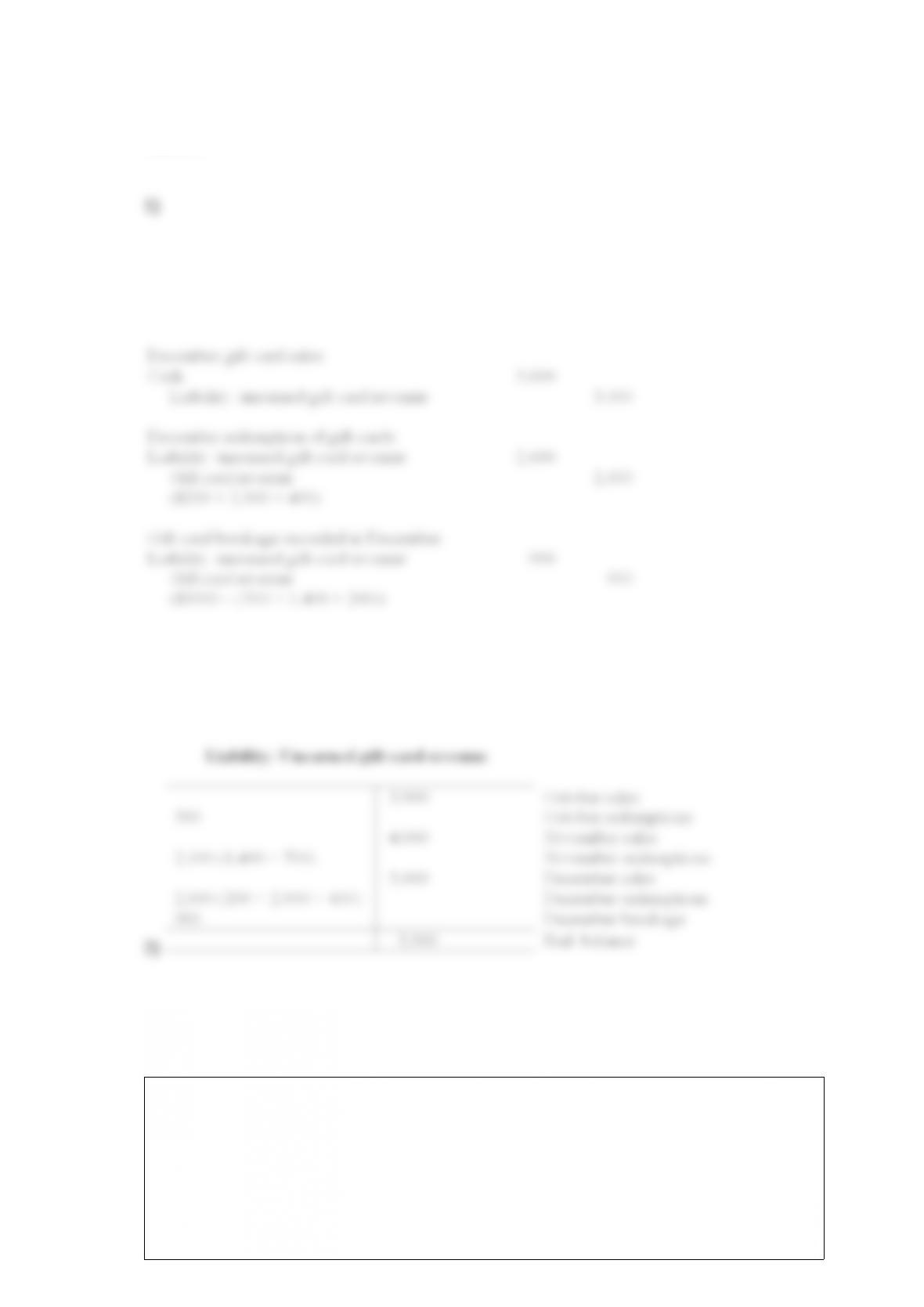
The following facts relate to gift cards sold by Sunbru Coffee Company during 2013.
Sunbru’s fiscal year ends on December 31.
(a.) In October 2013, sold $3,000 of gift cards, and redeemed $500 of those gift cards.
(b.) In November 2013, sold $4,000 of gift cards, and redeemed $1,400 of October gift
cards and $700 of November gift cards.
(c.) In December 2013, sold $3,000 of gift cards, and redeemed $200 of October gift
cards, $2,000 of November gift cards, and $400 of December gift cards.
(d.) Sunbru views a gift card to be “broken” (with a remote probability of redemption)
two months after the end of the month in which it is sold. Thus, an unredeemed gift
card sold at any time during July would be viewed as broken as of September
Required:
1) Prepare all journal entries appropriate to be recorded only during the month of
December 2013 relevant to gift card sales, gift card redemptions, and gift card
breakage.
2) Determine the balance of the unearned revenue liability to be reported in the
December 31, 2013, balance sheet. Show the relevant T-account information to support
your answer.
Answer:
A gain from changing an estimate regarding the obligation for pension plans will: A.
Increase assets.
B. Increase liabilities.
C. Decrease shareholders’ equity.

D. Increase shareholders’ equity.
Answer:
Listed below are five terms followed by a list of phrases that describe or characterize
each of the terms. Match each phrase with the correct term. 1)Normal spoilage
2)Cost-to-retail percentage
3)Requires retrospective treatment
4)Average cost retail method
5)Net markdown
A. Change from LIFO to FIFO
B. Always deducted after arriving at the calculation of the cost-to-retail percentage
C. Cost-to-retail percentage is determined for all goods available for sale
D. Deducted in arriving at ending inventory at retail
E. Divide cost of goods available for sale by goods available at retail
Answer:
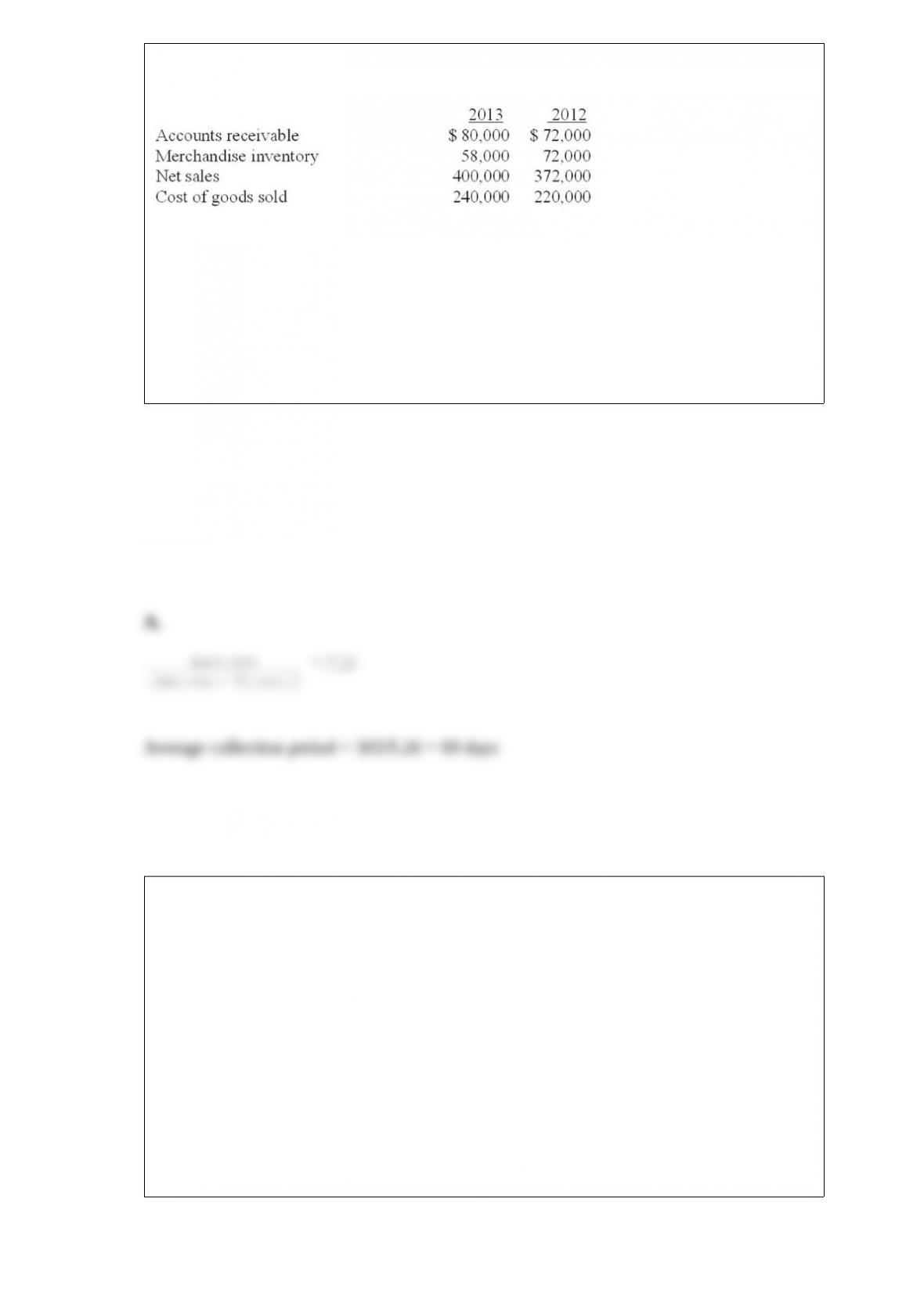
Excerpts from Huckabee Company’s December 31, 2013 and 2012, financial statements
are presented below:
Huckabee’s 2013 average collection period (rounded) is: A. 69 days.
B. 116 days.
C. 111 days.
D. 73 days.
Answer:
In May of 2013, Raymond Financial Services became involved in a penalty dispute
with the EPA. At December 31, 2013, the environmental attorney for Raymond
indicated that an unfavorable outcome to the dispute was probable. The additional
penalties were estimated to be $770,000 but could be as high as $1,170,000. After the
year-end, but before the 2013 financial statements were issued, Raymond accepted an
EPA settlement offer of $900,000. Raymond should have reported an accrued liability
on its December 31, 2013, balance sheet of: A. $770,000.
B. $900,000.
C. $970,000.
D. $1,170,000.

Answer:
Recording pension expense would usually: A. Increase the PBO.
B. Increase current assets.
C. Increase the prior service cost-AOCI.
D. Increase the net loss-AOCI.
Answer:
The primary objective of the statement of cash flows is to provide information about a
company’s: A. Cash receipts and disbursements.
B. Noncash financing and investing activities.
C. Financial position.
D. Profitability.
Answer:

On February 1, 2013, Pearson Corporation became the lessee of equipment under a
five-year, noncancelable lease. The estimated economic life of the equipment is eight
years. The fair value of the equipment was $600,000. The lease does not meet the
definition of a capital lease in terms of a bargain purchase option, transfer of title, or the
lease term. However, Pearson must classify this as a capital lease if the present value of
the minimum lease payments is at least A. $600,000.
B. $540,000.
C. $450,000.
D. $405,000.
Answer:
Rudyard Corporation had 100,000 shares of common stock and 10,000 shares of 8%,
$100 par convertible preferred stock outstanding during the year. Net income for the
year was $400,000 and dividends were paid to both common and preferred
shareholders. Rudyard’s effective tax rate is 40%. Each share of preferred stock is
convertible into five shares of common.
What is Rudyard’s diluted EPS (rounded)? A. $2.13.
B. $2.67.
C. $3.20.
D. $4.80.

Answer:
Information for Hobson Corp. for the current year ($ in millions):
How should Hobson report tax on the extraordinary item? A. A tax receivable of $12
million in the balance sheet.
B. A tax benefit of $12 million to net against the $30 million pretax loss.
C. A deferred tax asset of $12 million in the balance sheet.
D. None of the above.
Answer:
Contingently issuable shares may be included in: A. Basic EPS.
B. Diluted EPS.
C. Both A and B.

D. None of these is correct.
Answer:
Jing Statistical Services operates a website that links experienced statisticians with
businesses that need data analyzed. Statisticians post their rates, qualifications, and
references on the website, and Jing receives 25% of the fee paid to the statisticians in
exchange for identifying potential customers. VetMed Associates contact Jing and
arranges to pay a consultant $1,500 in exchange for analyzing some data. Jing’s income
statement would include the following with respect to this transaction: A. Revenue of
$1,500.
B. Revenue of $1,500, and cost of services of $1,125 (= 75% x $1,500).
C. Revenue of $375 (= 25% x $1,500).
D. None of the other answers is correct.
Answer:
Trading securities, by definition, are properly classified in the balance sheet as: A.
Shareholders’ equity.
B. Intangibles.

C. Current assets.
D. Other assets.
Answer:
The rate of interest printed on the face of a note payable is called the: A. Yield rate.
B. Effective rate.
C. Market rate.
D. Stated rate.
Answer:
Inventory records for Herb’s Chemicals revealed the following:
March 1, 2013, inventory: 1,000 gallons @ $7.20 = $7,200
Ending inventory assuming LIFO in a periodic inventory system would be: A. $5,040.
B. $5,055.
C. $5,075.
D. $5,135.
Answer:
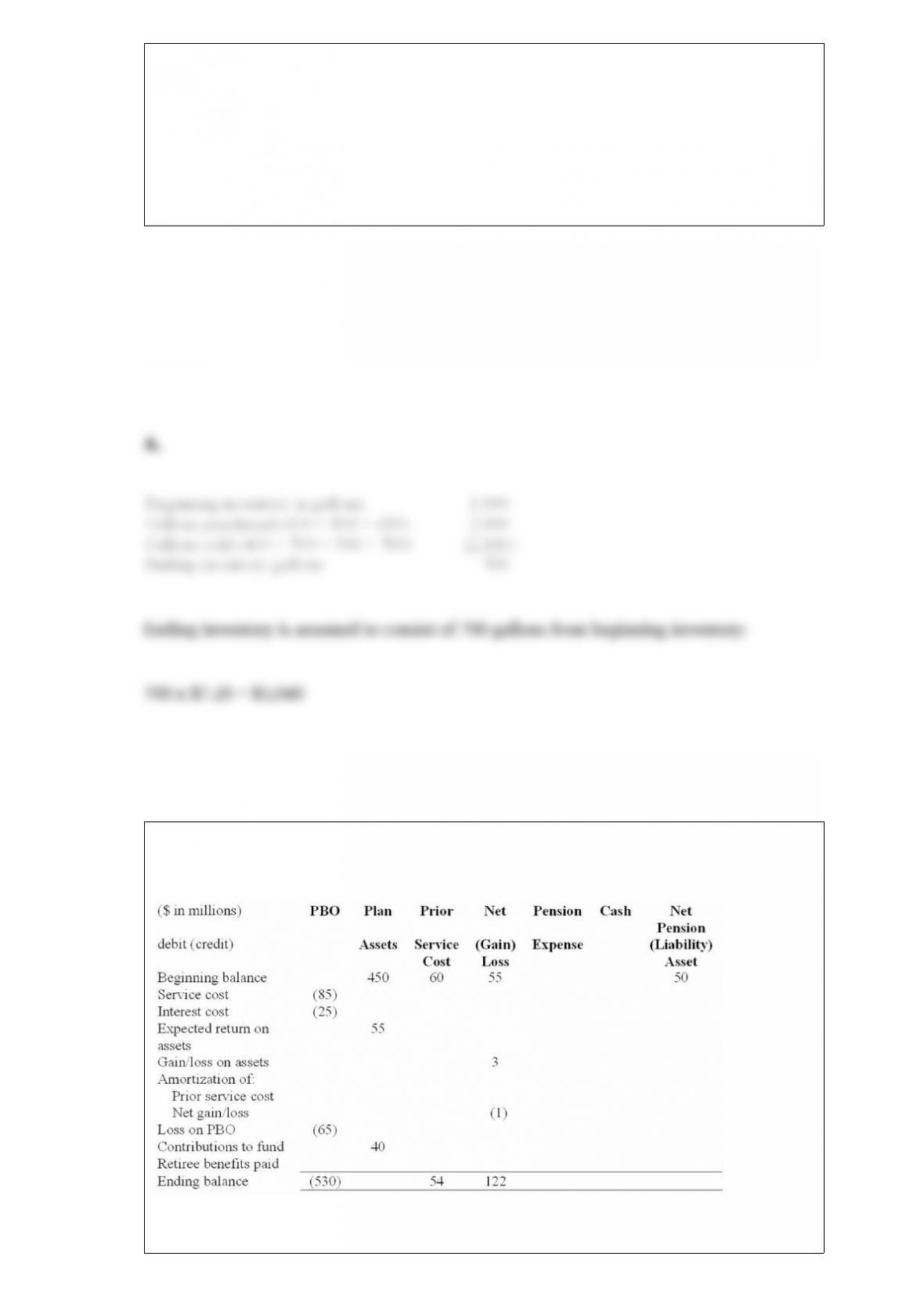
The following refers to the pension spreadsheet (columns have missing amounts) for
the current year for Pancho Villa Enterprises (PVE).
What were the retiree benefits paid? A. $45.

B. $50.
C. $55.
D. $60.
Answer:
Purple Cab Company had 50,000 shares of common stock outstanding on January 1,
2013. On April 1, 2013, the company issued 20,000 shares of common stock. The
company had outstanding fully vested incentive stock options for 5,000 shares
exercisable at $10 that had not been exercised by its executives. The average market
price of common stock was $12. The company reported net income in the amount of
$269,915 for 2013. What is the basic earnings per share (rounded)? A. $4.10.
B. $3.86.
C. $3.60.
D. $4.15.
Answer:

On January 1, 2013, Solo Inc. issued 1,000 of its 8%, $1,000 bonds at 98. Interest is
payable semiannually on January 1 and July 1. The bonds mature on January 1, 2023.
Solo paid $50,000 in bond issue costs. Solo uses straight-line amortization. The amount
of interest expense for the year is: A. $80,000.
B. $82,000.
C. $87,000.
D. $89,000.
Answer:
CPAs are licensed by: A.The AICPA.
B.The SEC.
C.The federal government.
D.State governments.
Answer:
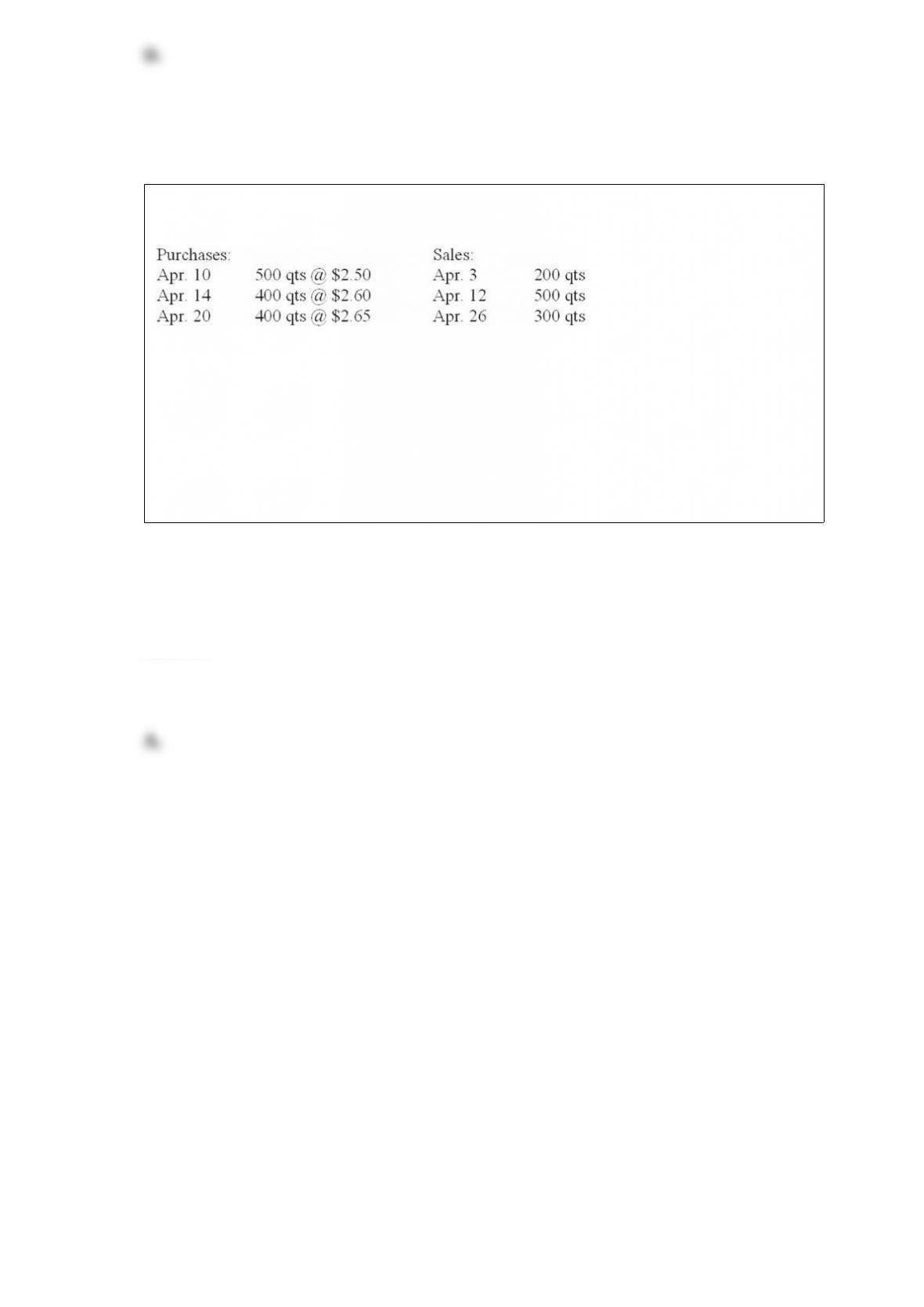
Texas Petrochemical reported the following April activity for its VC-30 lubricant,
which had a balance of 300 qts. @ $2.40 on April 1.
The ending inventory assuming LIFO and a perpetual inventory system is: A. $1,545.
B. $1,470.
C. $1,580.
D. $1,510.
Answer:
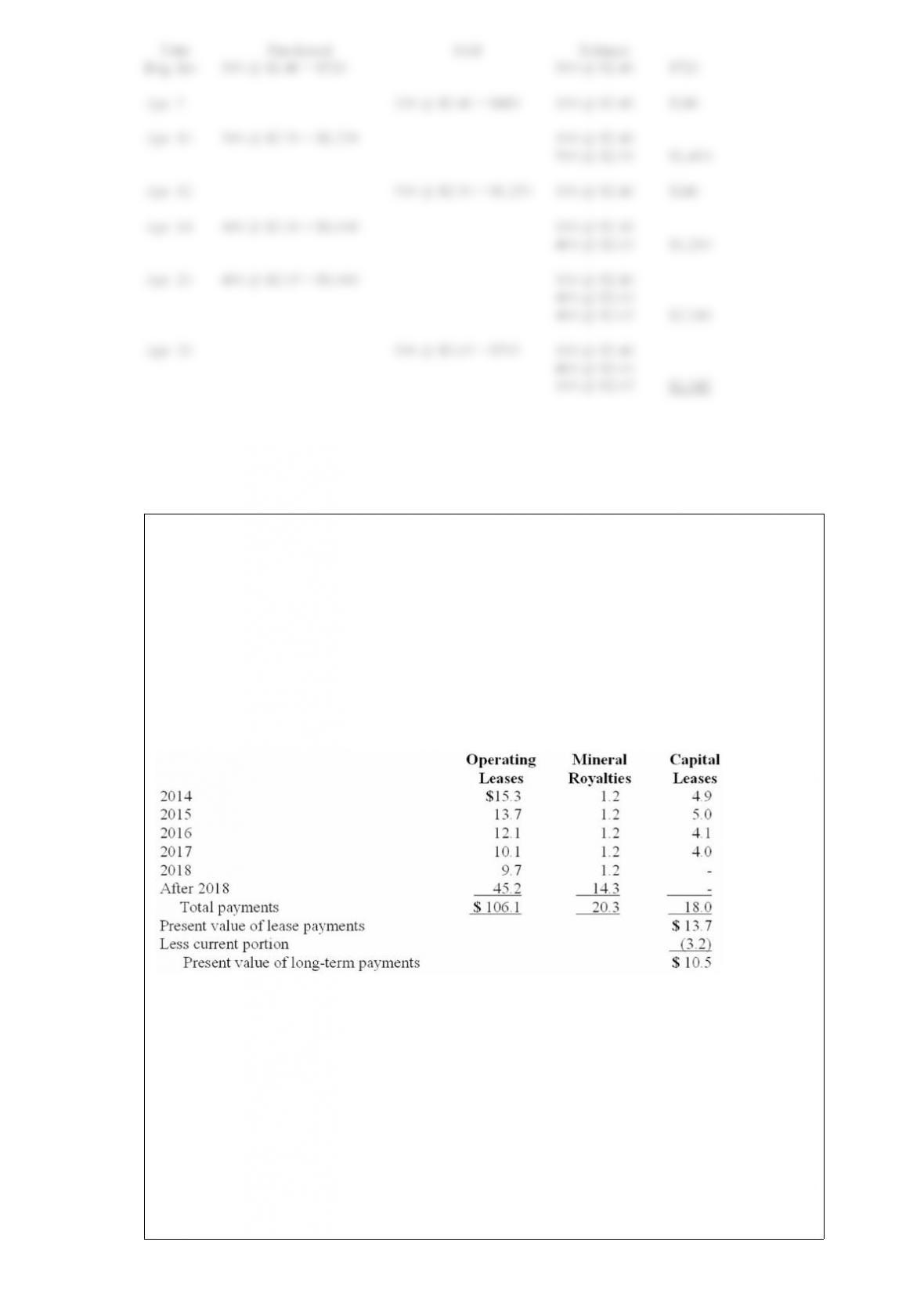
In its 2013 annual report to shareholders, Calipari Mining disclosed the following:
Calipari leases mineral interests and various other types of properties, including
shovels, offices, and miscellaneous equipment. Certain of the mineral leases require
minimum annual royalty payments, and others provide for royalties based on
production.
Summarized below at December 31, 2013, are future minimum rentals and royalties
under noncancelable leases (amounts in $ millions):
Required:
1) Assume that the operating lease payments disclosed are from a single contract that
lasts through 2021. How much rent expense on these leases will be charged in 2014 and
2015? Explain.
2) What amount would the Calipari December 31, 2013, balance sheet report as
long-term lease liabilities? Explain.
3) What amount of the 2014 capital lease payment by Calipari would represent interest
expense? Explain.
Answer:
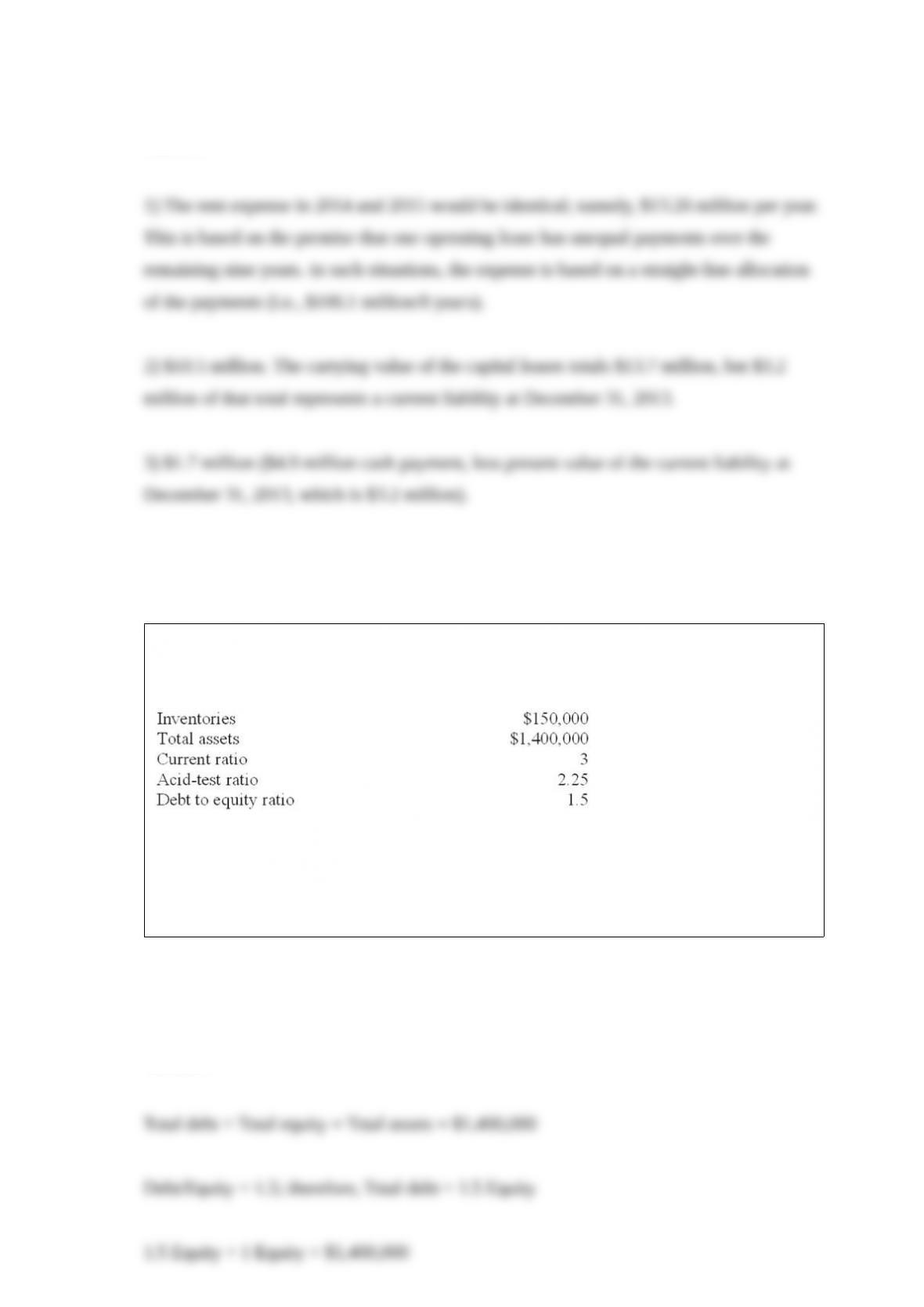
Bronco Electronics’ current assets consist of cash, marketable securities, accounts
receivable, and inventories. The following data were abstracted from a recent financial
statement:
Required:
Compute the following for Bronco:
Shareholders’ equity
Answer:
Ontario Resources, a natural energy supplier, borrowed $80 million cash on November
1, 2013, to fund a geological survey. The loan was made by Quebec Banque under a
short-term credit line. Ontario Resources issued a 9-month, 12% promissory note with
interest payable at maturity. Ontario Resources’ fiscal period is the calendar year.
Required:
1) Prepare the journal entry for the issuance of the note by Ontario Resources.
2) Prepare the appropriate adjusting entry for the note by Ontario Resources on
December 31, 2013. Show calculations.
3) Prepare the journal entry for the payment of the note at maturity. Show calculations.
Answer:
At the end of the preceding year, World Industries had a deferred tax asset of
$17,500,000, attributable to its only temporary difference of $50,000,000 for estimated
expenses. At the end of the current year, the temporary difference is $45,000,000. At the

beginning of the year there was no valuation account for the deferred tax asset. At
year-end, World Industries now estimates that it is more likely than not that one-third of
the deferred tax asset will never be realized. Taxable income is $12,000,000 for the
current year and the tax rate is 30% for all years.
Required:Prepare journal entries to record World Industries’ income tax expense for the
current year. Show well-labeled supporting computations for each component of the
journal entries.
Answer:
Comet Products prepares its financial statements according to International Financial
Reporting Standards (IFRS). On January 1, 2013, Comet Products issued $40 million of
6%, 10-year convertible bonds at a net price of $40.8 million. Comet recently issued
similar, but nonconvertible, bonds at 99 (that is, 99% of face amount). The bonds pay
interest on June 30 and December 31. Each $1,000 bond is convertible into 30 shares of
Comet’s no par common stock. Comet records interest by the straight-line method.
On June 1, 2015, Comet notified bondholders of its intent to call the bonds at face value
plus a 1% call premium on July 1, 2015. By June 30 all bondholders had chosen to
convert their bonds into shares as of the interest payment date. On June 30, Comet paid
the semiannual interest and issued the requisite number of shares for the bonds being
converted.
Required:
1) Prepare the journal entry for the issuance of the bonds by Comet.
2) Prepare the journal entry for the June 30, 2013, interest payment.
3) Prepare the journal entries for the June 30, 2015, interest payment by Comet and the
conversion of the bonds (book value method).
Answer:
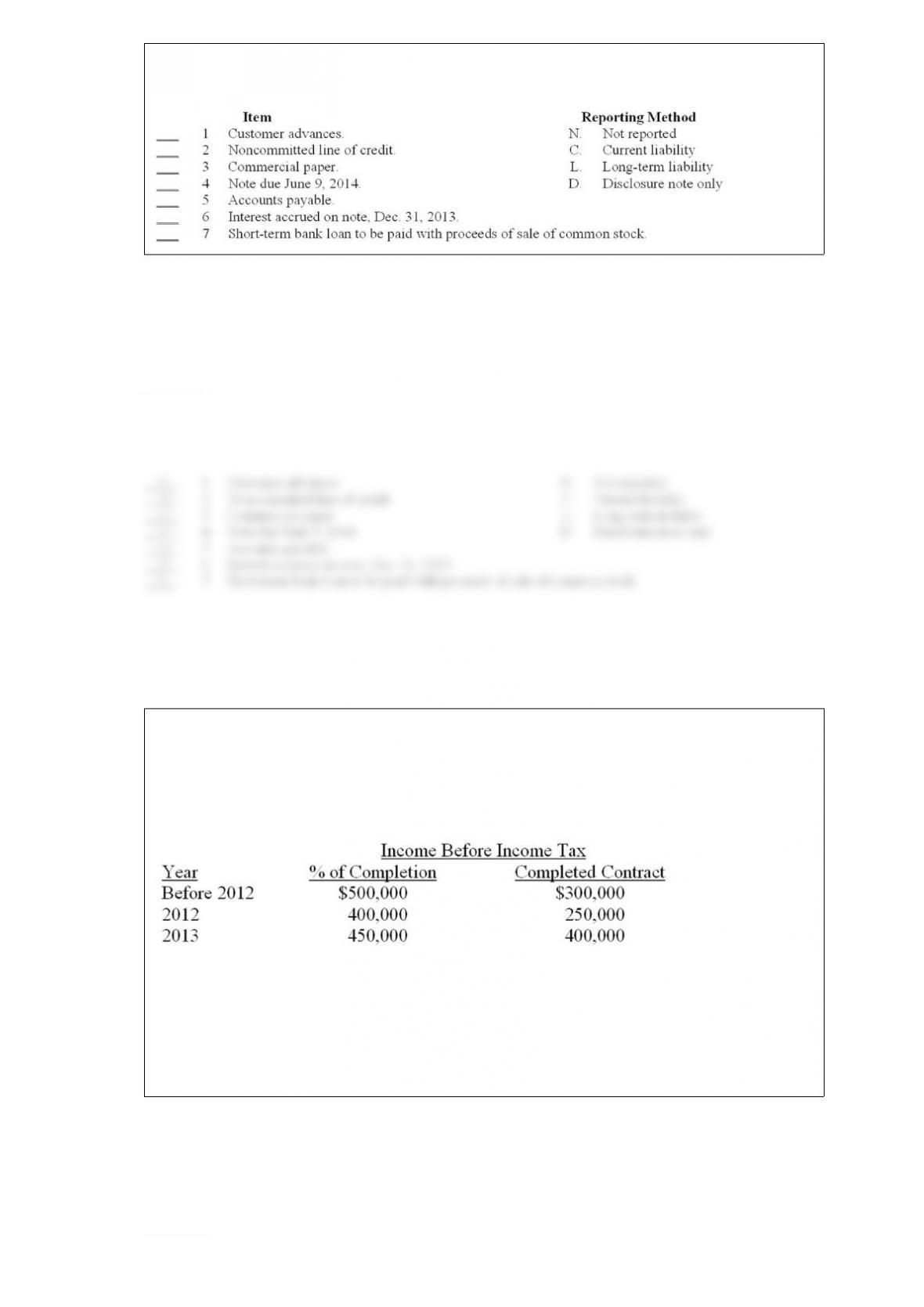
Indicate (by letter) the way each of the items listed below should be reported in a
balance sheet at December 31, 2013.
Answer:
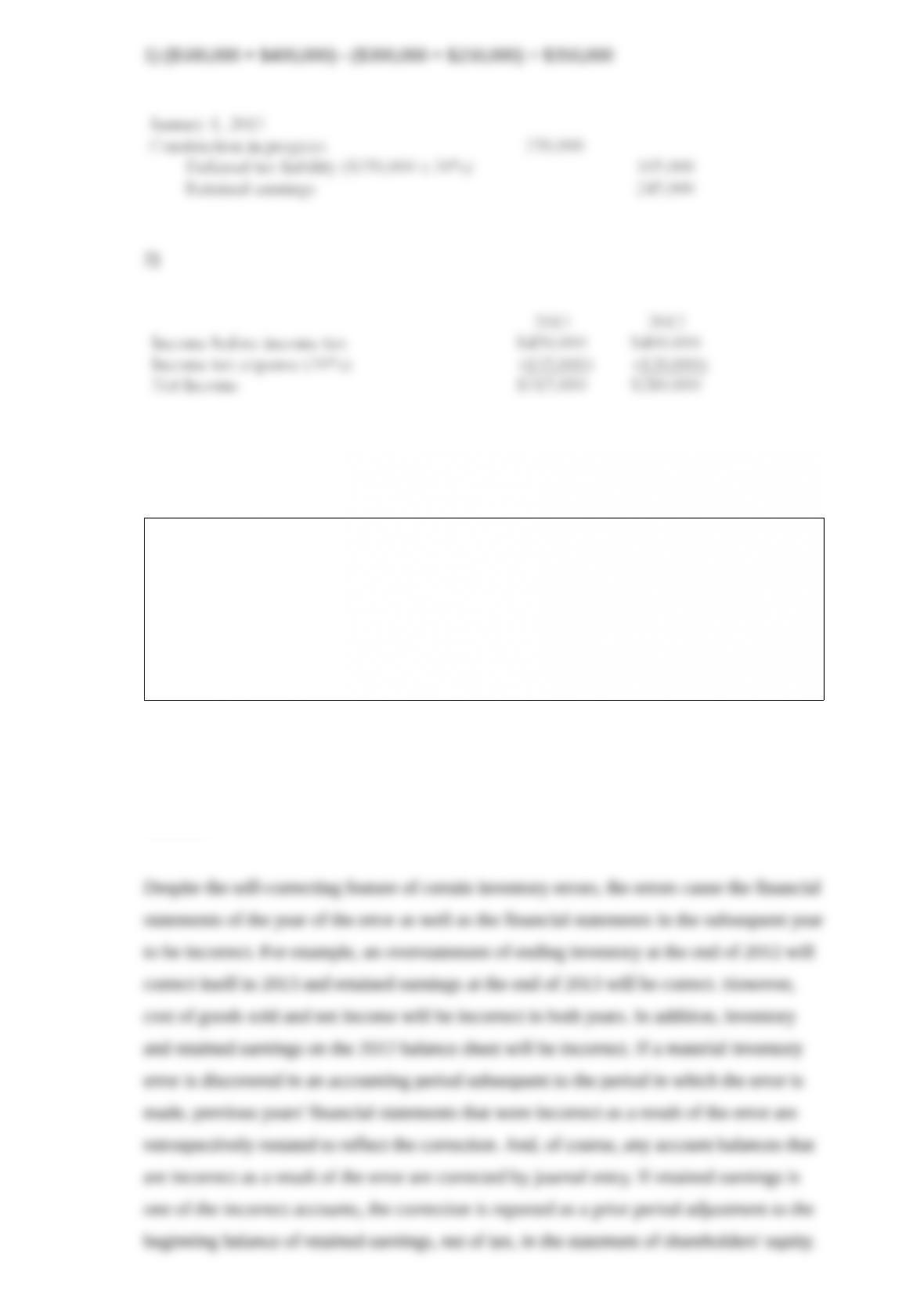
On January 1, 2013, Randall Construction decided to change from the completed
contract method of accounting for long-term construction contracts to the
percentage-of-completion method. The company will continue to use the completed
contract method for tax purposes. The tax rate is 30%. The following is all relevant data
concerning the change.
Required:
(1) Prepare the journal entry to record the accounting change.
(2) Determine the net income to be reported for each year in the 2013-2012
comparative income statements.
Answer:
Some inventory errors are described as ‘self-correcting” in that they have the opposite
financial statement effect in the period following the errors, thereby “correcting” the
original account balance errors.
Required:
Given this ‘self-correcting” feature, discuss why these errors should not be ignored and
describe the steps needed to correct these errors.
Answer:
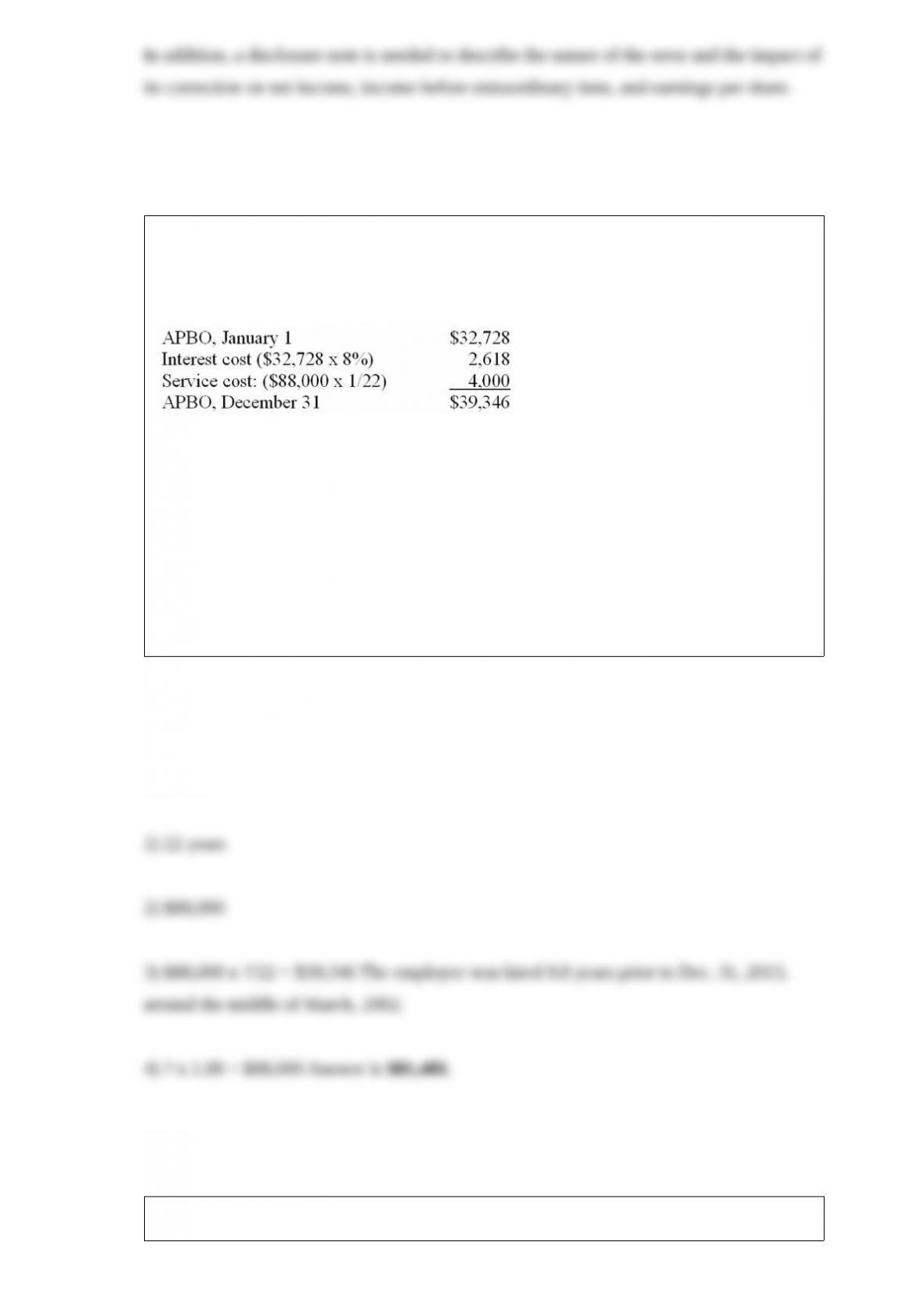
Careful Consulting Company has an unfunded postretirement benefit plan. On
December 31, 2013, the following data were available concerning changes in the plan’s
accumulated postretirement benefit obligation with respect to one of Careful’s
employees:
Required:
1) Over how many years is the expected postretirement benefit obligation being
expensed?
2) What is the expected postretirement benefit obligation at the end of 2013?
3) When was the employee hired?
4) What is the expected postretirement benefit obligation at the beginning of 2013?
Answer:
Briefly outline the steps in the gross profit method of estimating ending inventory and

indicate when the method might be used.
Answer:
On January 1, 2013, Boomer Universal issued 12% bonds dated January 1, 2013, with a
face amount of $200 million. The bonds mature in 2022 (10 years). For bonds of similar
risk and maturity, the market yield is 10%. Interest is paid semiannually on June 30 and
December
Required:
1) Determine the price of the bonds at January 1, 2013.
2) Prepare the journal entry to record the bond issuance by Boomer on January 1, 2013.
3) Prepare the journal entry to record interest on June 30, 2013, using the straight-line
method.
4) Prepare the journal entry to record interest on December 31, 2013, using the
straight-line method.
Answer:
In a recent press release, Estee Lauder Co. reported “a fiscal fourth-quarter loss due to a
restructuring charge but said it expects to see earnings growth in its fiscal second
through fourth quarters.” The New York skin care and cosmetics company reported a
net loss of $25.4 million, or 13 cents a share, for the quarter ended June 30, compared
with net income of $20.4 million, or six cents a share, a year earlier. Excluding the
restructuring charge of $76.9 million, or 32 cents a share, the company said profit
would have been $51.5 million, or 19 cents a share. Discuss how Estee Lauder’s press
release relates to its earnings quality.
Answer:
What is an antidilutive security?
Answer:

Several years ago, Western Electric Corp. purchased equipment for $20,000,000.
Western uses straight-line depreciation for financial reporting and MACRS for tax
purposes. At December 31, 2012, the carrying value of the equipment was $18,000,000
and its tax basis was $15,000,000. At December 31, 2013, the carrying value of the
equipment was $16,000,000 and the tax basis was $11,000,000. There were no other
temporary differences and no permanent differences. Pretax accounting income for the
current year was $25,000,000. A tax rate of 35% applies to all years.
Required:Prepare one journal entry to record Western’s income tax expense for the
current year. Show well-labeled computations for the income tax payable and the
change in the deferred tax account.
Answer:
Briefly explain when and why intraperiod tax allocation is necessary.
Answer:
Why are “cash equivalents” included as part of cash in the statement of cash flows?
Answer:
Accounting standard setting has been characterized as a political process. Discuss this
proposition giving an example.?
Answer:
In 2013, Southwestern Corporation completed the treasury stock transactions listed

below.
February 2: Reacquired 70,000 shares at $12.
March 17: Sold 20,000 shares at $14.
May 17: Sold 25,000 shares at $8.
Southwestern had issued 100,000 shares of its $1 par common stock for $10 several
months ago.
Required:
Prepare the journal entries to record the above transactions using the cost method.
Answer:
Diablo Company leased a machine from Juniper Corporation on January 1, 2013. The
machine has a fair value of $20,000,000. The lease agreement calls for four equal
payments at the end of each year. The useful life of the machine was expected to be four
years with no residual value. The appropriate interest rate for this lease is 10%.
Other information:
PV of an ordinary annuity @10% for 4 periods: 3.16987
PV of an annuity due @ 10% for 4 periods: 3.48685
Required:
1) Determine the amount of each lease payment.
2) Prepare the journal entry for Diablo Company at the inception of the lease.
3) Prepare the journal entry for the first lease payment.
4) Prepare the journal entry for the second lease payment.
Answer:
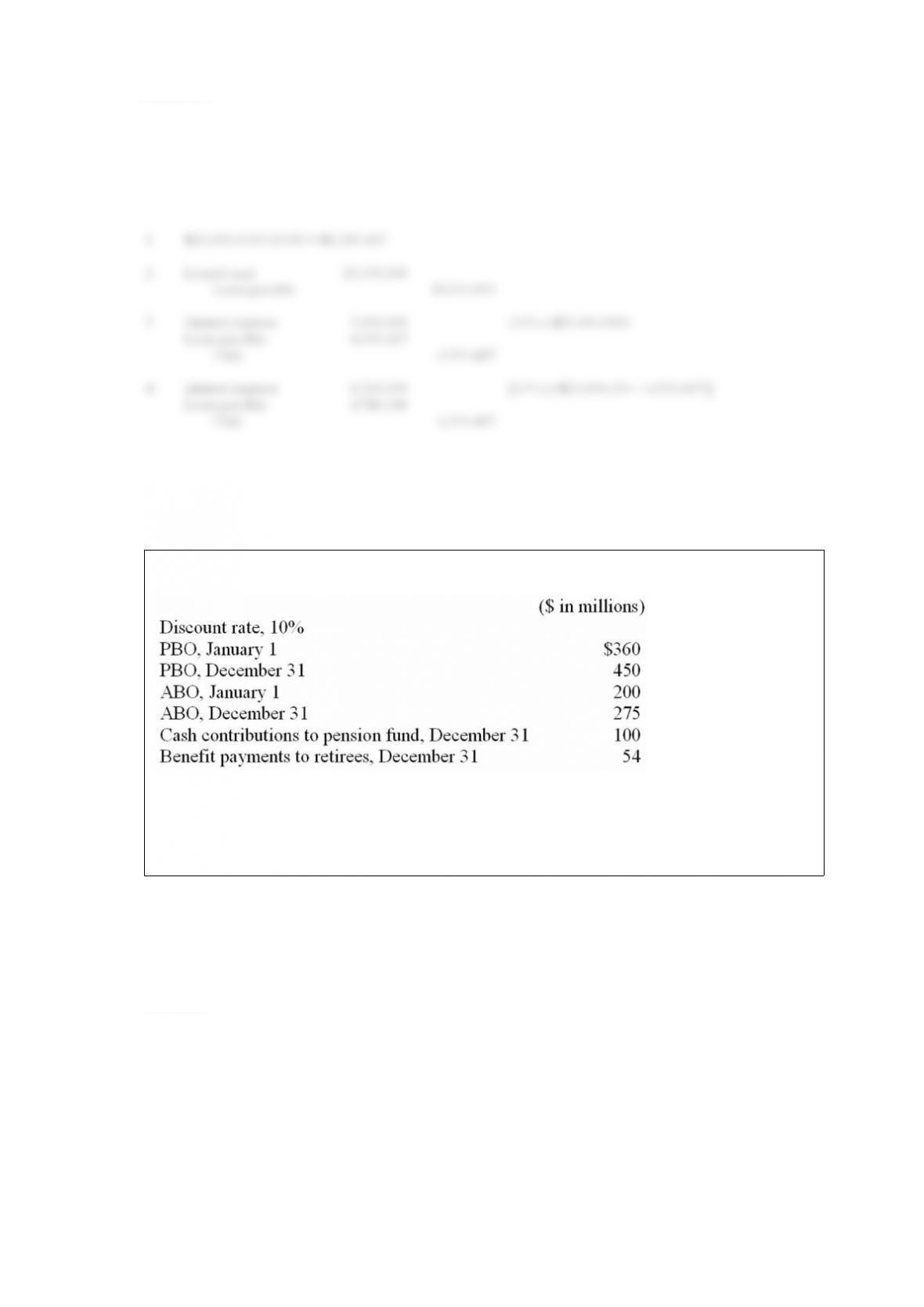
Pension data for Matta Corporation include the following for the current calendar year:
Required:
Assuming no change in actuarial assumptions and estimates, determine the service cost
component of pension expense for the current year.
Answer: