Which of the following is an expense of this period?
A. Costs of items used up this period but paid for next period.
B. Costs of items paid for in this period but used up next period.
C. Cost of land purchased and paid for this period.
D. Repayment of debt from a loan in a prior period.
Answer:
A company that has a current ratio less than one cannot cover:
A. current liabilities with its current cash flow.
B. current expenses with its current sales revenue.
C. expenses with its current revenues.
D. current liabilities with its current assets.
Answer:
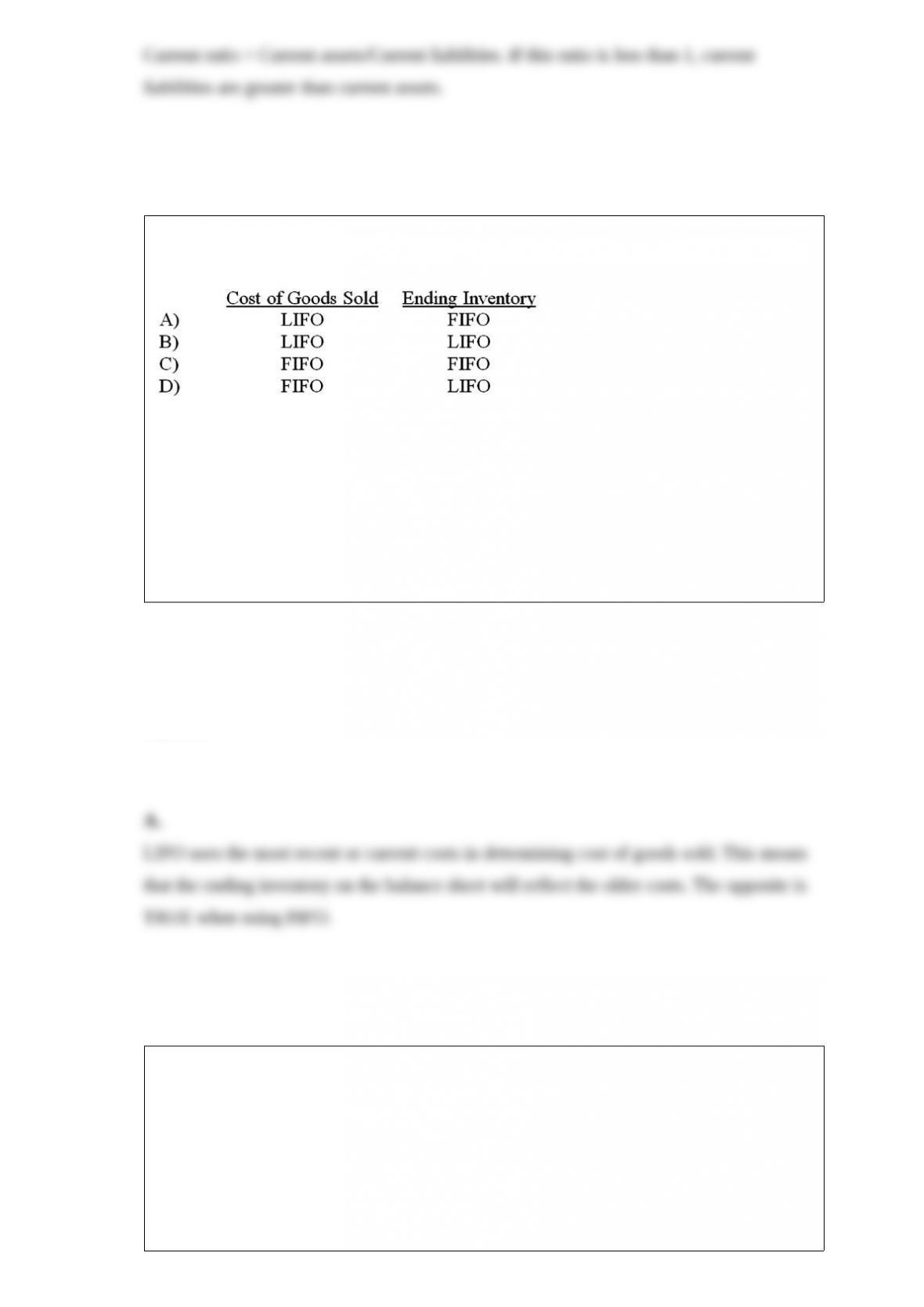
Generally, which inventory costing method approximates most closely the current cost
for each of the following?
A. Option A
B. Option B
C. Option C
D. Option D
Answer:
Which of the following is not an internal control for cash payments?
A. A voucher system.
B. An imprest system.
C. A bank reconciliation.
D. A cash count sheet.
Answer:
A retailer using a periodic inventory system returned $3,000 of defective merchandise
which was purchased on account from one of its wholesale suppliers. The entry to
record this transaction on the retailer’s books would include a debit to
A. Accounts receivable.
B. Cost of goods sold.
C. Accounts payable.
D. Inventory.
Answer:
A company buys a piece of equipment for $48,000. The equipment has a useful life of
ten years. Using the double-declining-balance method, the company’s depreciation
expense in the first year would be:
A. $9,600.
B. $12,000.
C. $4,800.
D. $24,000.
Answer:
One major difference between deferral and accrual adjustments is:
A. deferral adjustments involve previously recorded transactions and accruals involve
previously unrecorded events.
B. deferral adjustments are made after taxes and accrual adjustments are made before
taxes.
C. deferral adjustments are made annually and accrual adjustments are made monthly.
D. deferral adjustments are influenced by estimates of future events and accrual
adjustments are not.
Answer:
When the direct write-off method is used to account for uncollectible accounts, which
of the following accounts would not be used?
A. Bad Debt Expense
B. Accounts Receivable
C. Allowance for Doubtful Accounts
D. Notes Receivable
Answer:
Which of the following would not be reported on the Balance Sheet for a company?
A. Accounts receivable
B. Accounts payable
C. Advertising expense
D. Cash
Answer:
Segregation of duties means that a company assigns responsibilities so that:
A. sufficient workers are available to cover all necessary jobs.
B. responsibilities for related activities are assigned to two or more people.
C. employees are restricted to jobs for which they have adequate training.
D. workers are divided into those who do the same tasks but on different days.
Answer:
Which of the following is not an example of a benchmark?
A. SEC filings.
B. Time Series Analyses.
C. Cross Sectional Analysis.
D. Comparative Financial Statements.
Answer:
Operating activities:
A. include interest paid on a bank loan.
B. include the buying or selling of land, buildings, equipment, and other long-term
investments.
C. include the repayment of loan proceeds to the bank.
D. include a bank loan to cover the payment of wages, rent and other operating costs.
Answer:
Par value of a stock refers to the
A. issue price of the stock.
B. value assigned to a share of stock in the corporate charter.
C. market value of the stock.
D. maximum selling price of the stock.
Answer:
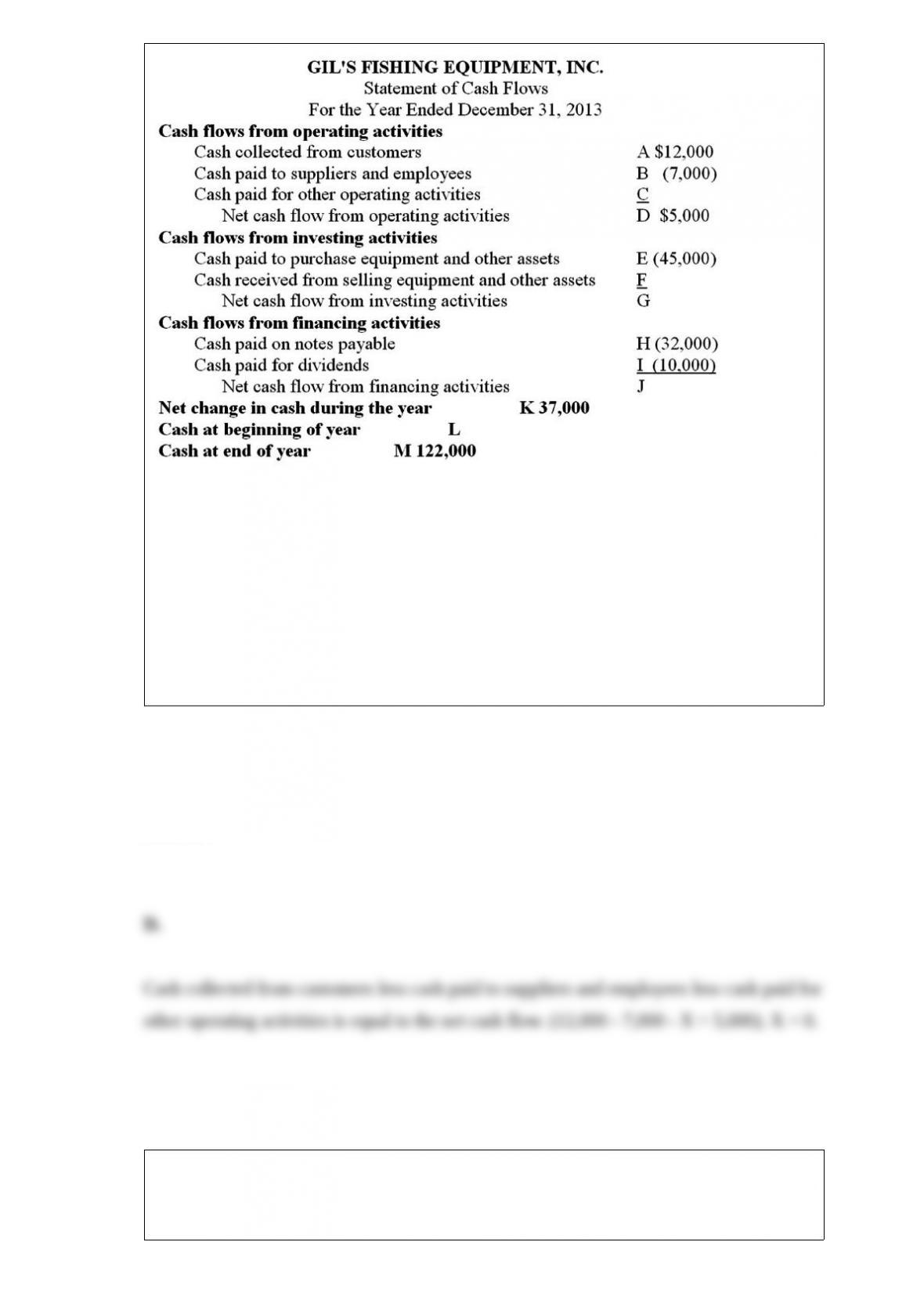
In the above statement of cash flows, what amount is represented by letter C?
A. $14,000
B. $10,000
C. (14,000)
D. 0
Answer:
Which of the following statements is false?
A. When choosing between a company that pays steady dividends and one that retains
its earnings to support future growth, investors will always choose the company that
pays steady dividends.
B. Companies can develop reputations for honest financial reporting even when
conveying bad news.
C. Trends in a company’s net income from year to year can provide clues about its
future earnings, which can help investors to decide whether to buy stock in the
company.
D. Information in the notes to the financial statements can influence a user’s
interpretation of balance sheet and income statement information.
Answer:
In a period of rising prices, the inventory costing method that assigns a value to
inventory that approximates current cost is
A. LIFO.
B. FIFO.
C. Weighted average.
D. Specific identification.
Answer:
Which of the following sources of information is most likely to contain unreliable
information?
A. An investor’s web site.
B. A company’s annual report.
C. A company’s press release.
D. A report filed with the SEC.
Answer:
Use the information above to answer the following question. What is the amount of
inventory purchases?
A. $78,000
B. $80,000
C. $82,000
D. $79,000
Answer:
Which of the following is the usual last step in the accounting cycle?
A. Preparing the adjusted trial balance.
B. Preparing the financial statements.
C. Preparing a post-closing trial balance.
D. Preparing an unadjusted trial balance.
Answer:

Choose the appropriate letter to match the term and the definition. There are more
definitions than terms.
Term
_____ 1/ outstanding check
_____ 2/ sales returns and allowances
_____ 3/ discount period
_____ 4/ net sales
_____ 5/ net income
_____ 6/ NSF check
_____ 7/ maximum credit period
_____ 8/ gross profit percentage
Definition
A. When a company accepts goods back from customers.
B. When companies reduce price for a sale and then raise it back again.
C. Net income divided by gross profit.
D. Gross profit divided by total assets.
E. Sales revenue minus all expenses.
F. The longest amount of time a company has to pay a supplier the gross amount owed.
G. When a check has been written but has not yet been recorded by the check writer’s
bank.
H. Sales revenue minus all sales discounts, credit card discounts, and sales returns and
allowances.
I. The length of time a company has to pay a supplier and still receive an early payment
discount.
J. Gross profit divided by net sales.
K. When a check has been written on an account that does not have enough money to
cover it.
Answer:
The Gulp convenience store chain buys new soda machines for $450,000 and pays
$50,000 for installation. One-half of the total cost is paid in cash; the other half is
financed. How should the company record this transaction?
A. Debit cash for $250,000, debit notes payable for $250,000 and credit equipment for
$500,000.
B. Debit equipment for $500,000, credit cash for $250,000 and credit notes payable for
$250,000.
C. Debit cash for $250,000, debit notes payable for $250,000 credit equipment for
$450,000, and credit expenses for $50,000.
D. Debit equipment for $450,000, debit expenses for $50,000, credit cash for $250,000
and credit notes payable for $250,000.
Answer:
Net sales divided by average total assets is the calculation for which of the following
ratios?
A. Net profit margin
B. Asset turnover
C. Current ratio
D. Return on assets
Answer:
Nonrecurring items such as a loss from discontinued operations is reported on the
income statement:
A. net of income tax.
B. before income tax expense.
C. below the net income line.
D. Nonrecurring items are not subject to income taxes; therefore, they are not reported
on the income statement.
Answer:
Accounting information serves a contracting function when it is used by:
A. creditors to manage financial agreements.
B. government officials to regulate the business and its financial records.
C. analysts to assess business risks.
D. investors to vote on company policies.
Answer:
A company increases sales revenue. Total assets and net income are unchanged. The
company’s
A. net profit margin and asset turnover both rise.
B. net profit margin rises and its asset turnover falls.
C. net profit margin and asset turnover ratio both fall.
D. net profit margin falls and its asset turnover ratio rises.
Answer:
The income statement
A. reports the assets, liabilities, and stockholders’ equity of a company.
B. reports cumulative earnings that have not been distributed to stockholders.
C. reports the amount of profit distributed to owners during the period.
D. reports the amount of revenues earned and expenses incurred during the period.
Answer:
The book value or carrying value of an asset is equal to:
A. its acquisition cost less the accumulated depreciation from the acquisition date to the
balance sheet date.
B. its acquisition cost plus accumulated depreciation from the acquisition date to the
balance sheet date.
C. the amount that could be obtained for the asset on the balance sheet date if it were
sold.
D. the annual cost of carrying the asset in inventory.
Answer:
If cost of goods sold remains unchanged, an increase in the inventory turnover rate is
indicative of:
A. a reduction in the cost of goods sold.
B. a decrease in inventory.
C. an increase in inventory.
D. an increase in sales revenue.
Answer:
The receipt of cash is one of the operating activities of:
A. companies that sell goods but not companies that sell services.
B. companies that sell to consumers but do not sell to other companies.
C. merchandising, manufacturing, and service companies.
D. companies that sell goods they bought from others but not of companies that make
the goods they sell.
Answer:
Permanent accounts:
A. are not permitted under GAAP.
B. have their balances zeroed-out at the end of each accounting year.
C. do not have their year-end balance carried into the next year.
D. are Balance Sheet accounts.
Answer:
Further information about financial data, accounting methods, and financial statements
is included in what part of the annual report?
A. The balance sheet.
B. The unaudited condensed quarterly data.
C. The notes to the financial statements.
D. The summarized financial data.
Answer: