
Gross profit is not a ledger account name.
Answer:
Which of the following statements regarding cash and accrual accounting isTRUE?
A. If payment is received at the same time a service is produced and sold, there is no
difference between how cash and accrual accounting record the transaction.
B. The cash basis of accounting works best when a lengthy delay exists between the
timing of cash flows and the underlying business activities to which they relate.
C. If a company receives a bill for rent for the period and decides to delay payment, the
rent will not be recorded as an expense according to the accrual model of accounting.
D. The cash basis of accounting would record unearned revenue if a company received
a deposit in advance of services to be rendered by the company.
Answer:
Which of the following is notTRUE concerning the basic business model?
A. Contains the activities of obtaining financing in order to invest in assets.
B. Contains the activities of investing in assets to be used to generate revenues.
C. Contains the activities of generating revenues which lead to net income.
D. Includes the financial measures of total liabilities, total stockholders’ equity and
other measures used as benchmarks.
Answer:
Which of the following statements regarding the interpretation of the receivables
turnover ratio is notTRUE?
A. Analysts often interpret a sudden increase in the receivables turnover ratio as a signal
of a developing problem.
B. The smaller the receivables turnover ratio the larger the days to collect will be.
C. A change in the receivables turnover ratio may indicate a change in the company’s
credit granting policies.
D. A change in the receivables turnover ratio may indicate a change in economic
conditions.
Answer:
The quick ratio is similar to the current ratio in that it is also a measure used to evaluate
whether a company can pay its current liabilities.
Answer:
Which of the following statements regarding the recording of merchandising journal
entries in a perpetual inventory system isTRUE?
A. When a customer pays within the discount period, accounts receivable is credited for
the full amount.
B. If a customer pays within the discount period, sales discounts is credited.
C. A sales return is recorded with entries that include a credit to sales returns and
allowances.
D. Sales of merchandise are recorded by entries that include a credit to cost of goods
sold.
Answer:
On September 1, a corporation with 50,000 shares of $5 par value common stock and
$1,000,000 of retained earnings issues a 2-for-1 stock split. The market price of the
stock on that date is $12 per share. Which of the following statements isTRUE
concerning this stock split?
A. Contributed capital will increase by $250,000.
B. Retained earnings will decrease by $600,000.
C. Dividends payable will increase by 250,000.
D. No entry will be made for this transaction.
Answer:
The asset turnover ratio is a profitability ratio.
Answer:
An error in the ending inventory in one year will cause a misstatement of retained
earnings in the following year.
Answer:
Which of the following isTRUE about interest receivable?
A. It is an asset reported on the balance sheet.
B. It is a temporary account reported on the income statement.
C. It is a permanent account reported on the income statement.
D. It represents the amount of interest the company has received on promissory notes.
Answer:
Which of the following statements regarding the allowance for doubtful accounts
isTRUE?
A. Under the aging of accounts receivable method, bad debt expense is calculated and
then added to the beginning balance in the allowance for doubtful accounts.
B. The allowance for doubtful accounts is a contra-revenue account.
C. The allowance for doubtful accounts is credited when a specific write-off is
recorded.
D. The allowance for doubtful accounts has a normal credit balance.
Answer:
When using the spreadsheet approach for preparing a Statement of Cash Flows using
the indirect method, one half of the spreadsheet reflects changes in balance sheet
accounts and the other half is used to demonstrate their effect on cash flows.
Answer:
The patent on a major drug produced by a pharmaceutical company will soon expire.
Sales of the drug contribute 10% to the company’s net income. Which of the following
statements is most likely to beTRUE in these circumstances?
A. The P/E ratio will probably fall because the stock price will fall and earnings will
rise.
B. The P/E ratio will probably rise because the stock price will rise and the earnings
will fall.
C. The P/E ratio will probably fall as investors factor in the future drop in net income.
D. The P/E ratio will probably rise because the stock price will fall and the earnings
fall.
Answer:
Which of the following statements regarding adjusting entries is notTRUE?
A. Adjustments are needed to ensure that the accounting system includes all of the
revenues and expenses of the period.
B. Adjustments help to ensure the related accounts on the balance sheet and income
statement are up to date and complete.
C. Adjusting entries often affect the cash account.
D. Adjusting entries generally include one balance sheet and one income statement
account.
Answer:
The carrying value of an asset is an approximation of the asset’s market value.
Answer:
The book value of a long-lived asset declines over time, assuming no additions,
replacements, or extraordinary repairs.
Answer:
A company with a high inventory turnover requires a larger investment in inventory
than another company of similar sales with a lower inventory turnover.
Answer:
The asset turnover ratio and the net profit margin ratio can both be used to evaluate the
solvency of a company.
Answer:
When LIFO is used with the periodic inventory system, costs are assigned to cost of
goods sold using the most recent purchase at the point of each sale, rather than from the
most recent purchase as of the end of the period.
Answer:
Costs that benefit future periods are reported as assets.
Answer:
Using the T-account approach to preparing the statement of cash flows, an increase in
accounts payable would appear on the debit side of the cash account.
Answer:
The days to collect receivables increases from 32 to 48. Which of the following
statements isTRUE?
A. The company is likely to see its bad debt expense decrease.
B. The receivables turnover rate increases by 50%.
C. The company is becoming more efficient at collecting payment.
D. The receivables turnover rate falls from approximately 11.4 to 7.6.
Answer:
On December 31, 2013, a company paid $10,000 to rent a storage facility from July 1,
2014 to July 1, 2015. Choose theTRUE statement.
A. The Balance Sheet at December 31, 2013 should report prepaid rent of $10,000 as a
non-current asset.
B. The income statement at December 31, 2013 should report rent expense of $10,000.
C. The Income Statement for the year ended December 31, 2013 is unaffected by this
transaction.
D. The Balance Sheet at December 31, 2014 will not report any of this rent as an asset.
Answer:
Which of the following statements is notTRUE about the par value of common stock?
A. The par value is not the same as the market value of the stock.
B. The par value is a nominal amount identified in the corporate charter.
C. The par value is the amount credited to the common stock account when the stock is
issued.
D. The par value is the amount credited to common stock when treasury stock is
reissued.
Answer:
Most companies report their sales revenue and contra-revenue accounts, as well as net
sales, on their externally reported income statements.
Answer:
If a company that uses a perpetual inventory system sold merchandise which cost
$1,000 for a selling price of $3,000, the accounting equation would show a:
A. net increase in assets and net increase in stockholders’ equity.
B. net increase in assets and net decrease in liabilities.
C. net decrease in assets and net increase in liabilities.
D. net decrease in assets and net decrease in stockholders’ equity.
Answer:
Which one of the following is not likely to be a consequence of fraudulent financial
reporting?
A. The company’s stock price drops once the fraud is discovered.
B. Innocent accountants who work for the company’s CPA firm lose their jobs.
C. Creditors recover 100% of amounts owed to them.
D. Employees lose their retirement savings.
Answer:
When a company sells a long-lived asset, stockholders’ equity will change by the:
A. amount of the sale.
B. amount of the asset’s book value.
C. amount of the asset’s accumulated depreciation.
D. difference between the sales price and the asset’s book value.
Answer:
A company has a loan that accrues interest at a rate of $20 a day. The company pays the
interest once a quarter. Which of these would be an accurate adjustment for a month in
which no payments are made?
A. Debit Interest Payable and credit Interest Expense.
B. Debit Notes Payable and credit Cash.
C. Debit Interest Expense and credit Interest Payable.
D. Debit Cash and credit Notes Payable.
Answer:
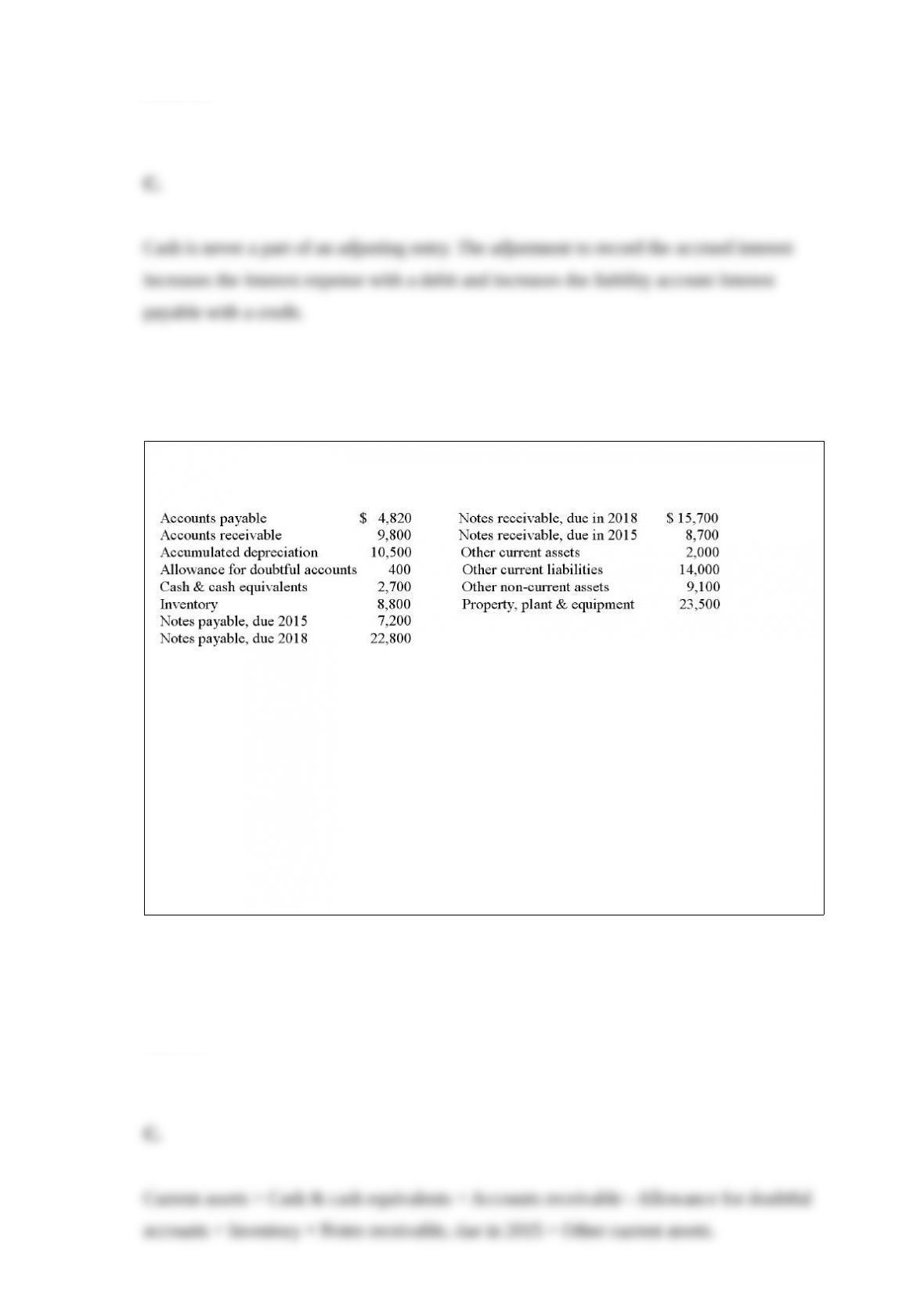
A company reported the following accounts and amounts in its December 31, 2014,
year-end financial statements:
Use the information above to answer the following question. What is the amount of
current assets on the balance sheet at December 31, 2014?
A. $32,000
B. $34,700
C. $31,600
D. $32,400
Answer:
A company lends its supplier $150,000 for 3 years at a 6% annual interest rate. Interest
payments are to be made twice a year. The company initially records the transaction by:
A. debiting Notes Receivable for $150,000 and crediting Cash for $150,000.
B. debiting Cash for $150,000 and crediting Notes Payable for $150,000.
C. debiting Cash for $9,000 and crediting Interest Revenue for $9,000.
D. debiting Interest Receivable for $4,500 and crediting Interest Revenue for $4,500.
Answer:
AMD buys back 300,000 shares of its stock from investors at $6.50 a share. Two years
later, it reissues this stock for $6.00 a share. The stock reissue would be recorded as:
A. a debit to Cash of $1.8 million, a debit to Additional Paid-in Capital of $150,000,
and a credit to Treasury Stock of $1.95 million.
B. a debit to Cash of $1.95 million, a credit to Treasury Stock of $1.8 million, and a
credit to Additional Paid-in Capital of $150,000.
C. a debit to Cash of $1.95 million and a credit to Treasury Stock of $1.95 million.
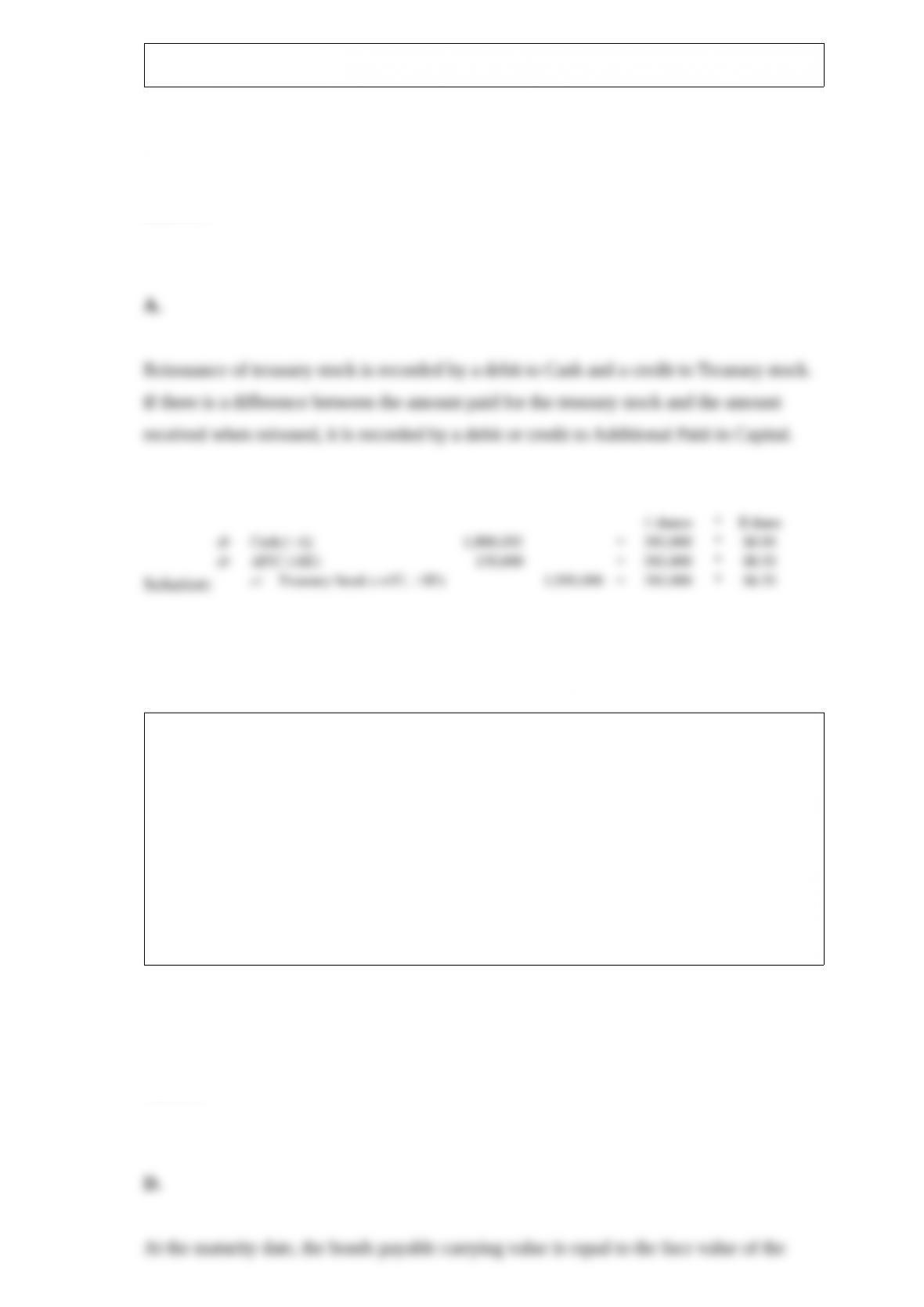
D. a debit to Cash of $1.8 million and a credit to Treasury Stock of $1.8 million.
Answer:
When bonds are retired at their maturity date, the balance in the Bonds Payable account
is equal to the bond’s:
A. face value minus any premium amortized.
B. face value plus interest to be paid.
C. face value plus any discount amortized.
D. face value.
Answer:
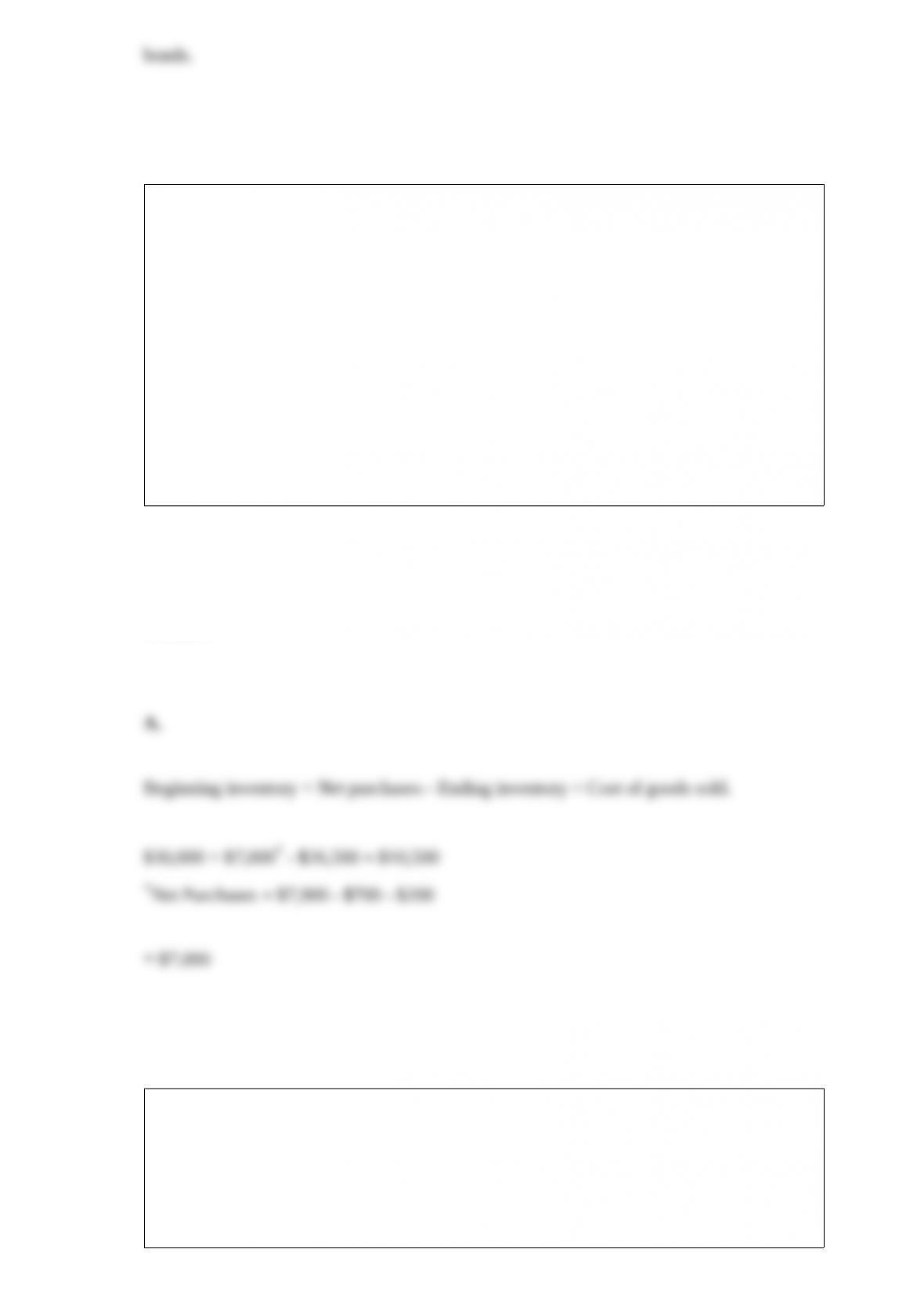
Purrfect Pets uses the perpetual inventory system. At the beginning of the quarter
Purrfect Pets has $30,000 in inventory. During the quarter the company purchases
$7,900 of new inventory from a vendor, returned $700 of inventory to the vendor, and
took advantage of discounts from the vendor of $200. At the end of the quarter the
balance in inventory is $26,500. What is the cost of goods sold?
A. $10,500
B. $11,400
C. $3,500
D. $11,900
Answer:
Match the letter and the blank in each transaction description to complete the analysis.
All letters will not be used and some letters may be used more than once.
A. debit
B. cash

C. revenue
D. supplies
E. credit
F. expense
G. accrued liabilities
H. unearned revenue
I. accounts receivable
J. notes payable
1. A company pays wages. This is posted as a(n) ____ to cash and a(n) ____ to wages
expense.
2. A company is paid for a job completed last month. This is posted as a debit to ____
and a credit to ____.
3. A restaurant buys and immediately uses ingredients. This is posted as a(n) ____ to an
expense and a(n) ____ to cash.
4. A company pays the original amount owed on a promissory note. This is posted as a
debit to ____ and a credit to ____.
5. A company receives money for a job to be done next month. This is posted as a debit
to ____ and a credit to ____.
Answer:
If total liabilities decreased by $25,000 and stockholders’ equity increased by $5,000
during a period of time, then total assets must change by what amount and direction
during the same time period?
A. $20,000 increase.
B. $20,000 decrease.
C. $30,000 increase.
D. $30,000 decrease.
Answer:
Which of the following is an accurate description of the economic events involving
Accounts Receivable as documented in the T-account above?
A. Customers added more to their account balances than they paid off.
B. Customers paid off more than they added to their account balances.
C. The company paid off its debt more than it incurred new debt.
D. The company incurred more debt than it paid off.
Answer:
Which of the following would be reported on the income statement for 2013?
A. Supplies that were purchased and used in 2012 but paid for in 2013.
B. Dividends that were paid in 2013.
C. Supplies that were purchased in 2012, but used in 2013.
D. Accounts receivable as of December 31, 2013.
Answer:
Consider the formula used to calculate each of the following financial performance
ratios. From the list of financial statement items below, match its letter with the ratio it
is used to calculate. Some financial statement items will be used more than once. Some
ratios will use one letter from the list and some ratios will use two letters from the list.
_____ 1/ Net Profit Margin
_____ 2/ Debt to Assets Ratio
_____ 3/ EPS
_____ 4/ ROE

_____ 5/ Days to collect
_____ 6/ Days to sell
_____ 7/ Price earnings ratio
_____ 8/ Current ratio
_____ 9/ Asset turnover
_____ 10/ Fixed asset turnover
_____ 11/ Gross profit percentage
_____ 12/ Quick ratio
A) Net income
B) Interest paid
C) Cost of goods sold
D) Net sales revenue
E) Total liabilities
F) Total assets at year end
G) Average stockholders’ equity
H) Current liabilities
Answer:
Choose the appropriate letter to match the term and the definition. Not all definitions
will be used.
Term:
_____ 1/ Accrued liability

_____ 2/ Loan covenant
_____ 3/ Issue price
_____ 4/ Face value
_____ 5/ Line of credit
_____ 6/ Public debt offering
_____ 7/ Security
_____ 8/ Contingent liability
Definition:
A. Bond features that allow the issuer to repay the loan early.
B. A prearranged agreement that allows a company to borrow at will up to a limit.
C. This item is reported as a contra asset account.
D. The amount that the lender actually pays for a bond.
E. The cost of issuing a bond.
F. Debt features that, if violated, allow the lender to revise loan terms.
G. The total amount of money that a company owes in debt.
H. The amount a company must repay creditors when a bond matures.
I. These are liabilities that have been incurred during the period but not yet paid.
J. When a company borrows money by issuing bonds in the financial markets.
K. A bond feature that allows a creditor to seize assets if debt is not properly repaid.
L. This type of liability is uncertain; it exists only if some other condition occurs.
Answer:
Company X has net sales revenue of $1,250,000, cost of goods sold of $760,000, and
all other expenses of $290,000. The beginning balance of stockholders’ equity is
$400,000 and the beginning balance of fixed assets is $361,000. The ending balance of
stockholders’ equity is $600,000 and the ending balance of fixed assets is $389,000. The
fixed asset turnover ratio is closest to:
A. 0.53.
B. 2.50.
C. 3.33.
D. 0.80.
Answer:
A company files a Form 10-K with the SEC to submit its:
A. quarterly report.
B. annual report.
C. press releases.
D. report of current events of financial importance.
Answer:
Which of the following is an example of an error that would cause the trial balance to
be out of balance?
A. A journal entry was posted as a debit to Cash for $525 and a credit to Accounts
Receivable for $552.
B. A journal entry was posted as a debit to Cash and a credit to Sales Revenue when the
company received a $400 payment from a customer on account.
C. A purchase of supplies on account for $100 was posted as a debit to supplies for $10
and a credit to accounts payable for $10.
D. A $350 transaction was not recorded at all.
Answer:
Which number is potentially the largest?
A. The number of shares authorized.
B. The number of shares issued.
C. The number of shares outstanding.
D. The number of shares certified.
Answer:
Which of the following is not a purpose of the annual report?
A. To inform external users about the company’s operations during the year.
B. To promote the company to investors in order to attract additional capital.
C. To assemble the numbers to be used by the external auditor to prepare the company’s
income tax return.
D. To provide the basis for reporting to the SEC on Form 10-K.
Answer:
Which of the following is not a condition for reporting revenue?
A. The goods or services have been delivered.
B. The customer has already paid for the good or service.
C. The price is fixed or determinable.
D. Collection is reasonably assured.
Answer:
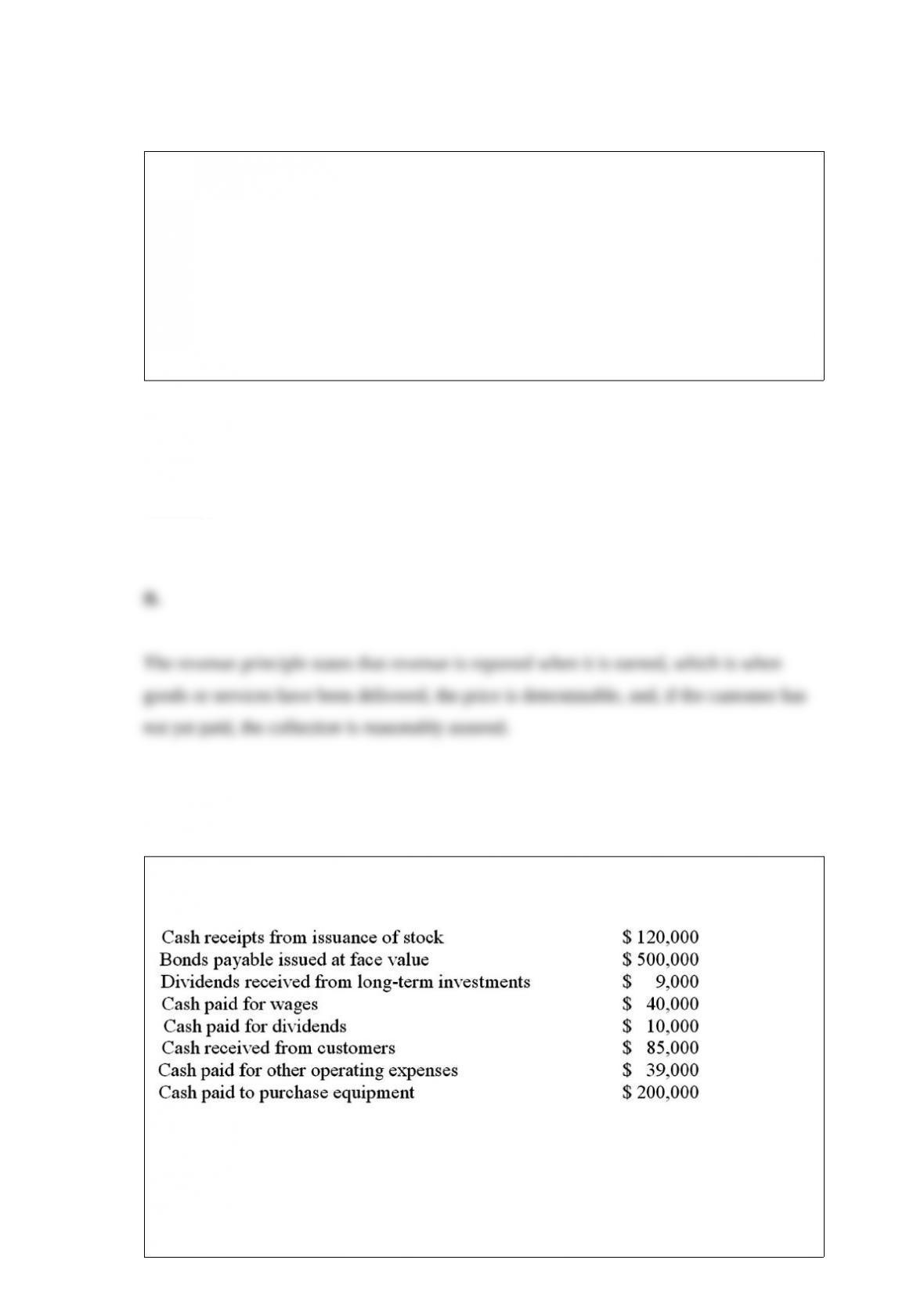
Flynn Corporation had the following cash flows for the current year. The company uses
the direct method in preparing the statement of cash flows.
Use the information above to answer the following question. If the cash balance at the
beginning of the current year was $0, what is the amount of cash at the end of the year?
A. $112,500
B. $425,000
C. $737,500
D. $311,500
Answer:
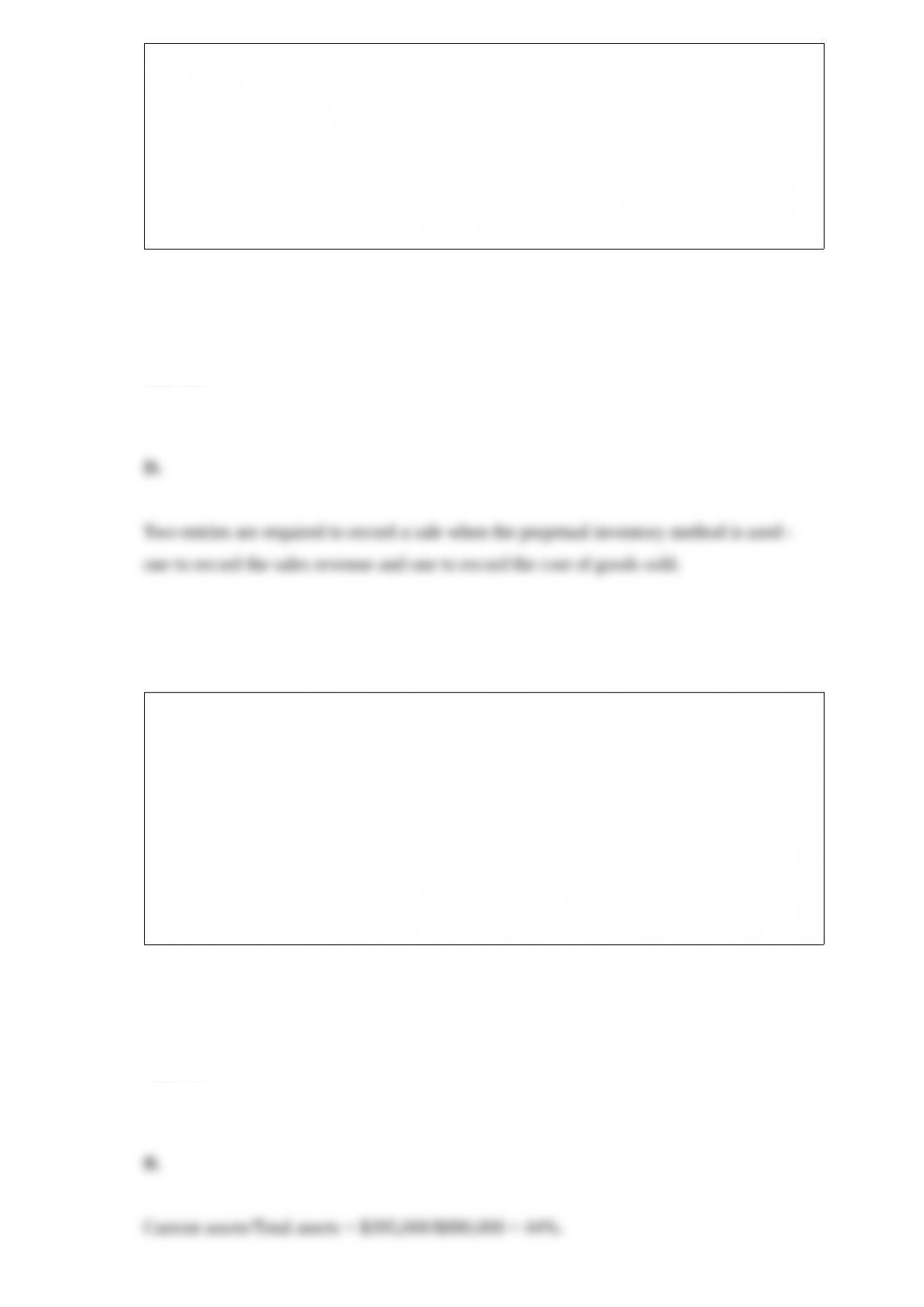
On October 1, B. Darin Company sold merchandise in the amount of $6,500 to S. Dee
Company, terms 2/10, n/30. The items cost B. Darin $4,200 and the company uses the
perpetual inventory method. On October 4, S. Dee returns some of the merchandise.
This merchandise had a selling price of $500 and a cost of $200. On October 8, S. Dee
Company paid B. Darin Company the correct amount due.
Use the information above to answer the following question. What is the journal entry
that B. Darin makes on October 1 to record this sale?
A. Option A
B. Option B
C. Option C
D. Option D
Answer:
On a common size balance sheet, the percentage that should be shown for current assets
is closest to
A. 100%
B. 44%
C. 30%
D. 33%
Answer:
A company sells 1 million shares of stock with no par value for $15 a share. In
recording the transaction, it would:
A. debit Cash for $15 million and credit Additional Paid-in Capital for $15 million.
B. debit Cash for $15 million and credit Common Stock for $15 million.
C. debit Common Stock for $15 million, credit Cash for $15 million.
D. debit Common Stock for $15 million and credit Additional Paid-in Capital for $15
million.
Answer:
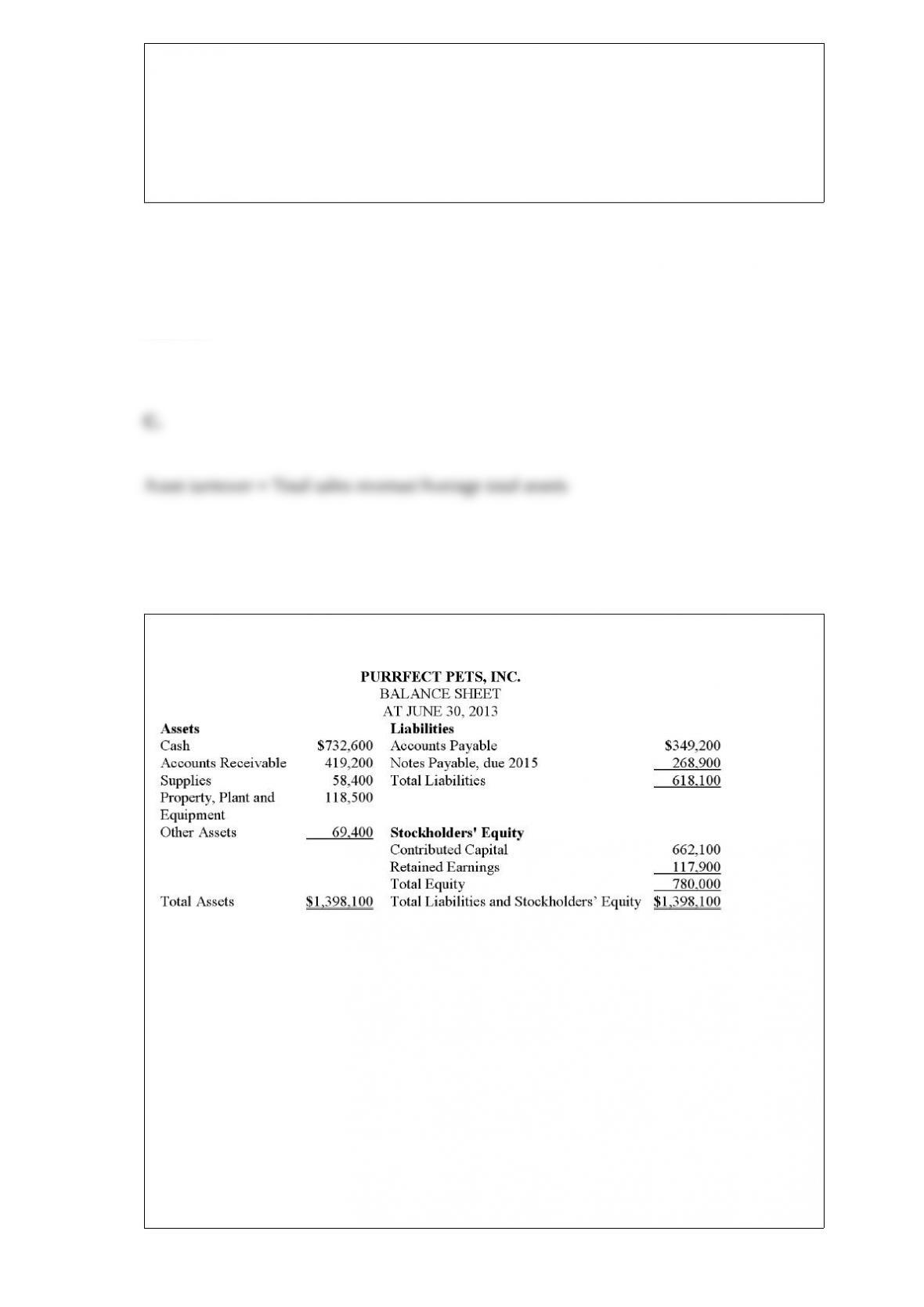
A retail clothing company began operations in 2014 with assets of $42,000. The
following additional data have been taken from the records as of December 31, 2014:
All accounts have normal balances.
The asset turnover ratio for 2014 is closest to:
A. 3.80
B. 4.67
C. 4.19
D. 3.23
Answer:
In 1999, the Denim Company bought land that cost $15,000. In 2013, a similar piece of
land was bought for $28,000 and the company’s existing land was estimated to be worth
$18,000. On the balance sheet at the end of 2013, the land that was purchased in 1999
would be reported at:
A. $15,000.
B. $28,000.
C. $18,000.
D. the average of the three prices.
Answer:
In September, a customer signed a contract to have his house painted and paid for the
job in October. The painting company bought the paint in August on account and paid
for it in September. The painting company painted the house in November. According
to the Revenue and Expense Recognition (Matching) Principles, the painting company
should record:
A. the revenues in November and the expenses in September.
B. the revenues and the expenses in September.
C. the revenues and the expenses in November.
D. the revenues in September and the expenses in August.
Answer:
If a company negotiates a deal with creditors to exchange debt for stock, its:
A. net profit margin ratio will increase.
B. asset turnover ratio will increase.
C. debt-to-assets ratio will decrease.
D. debt-to-assets ratio will remain unchanged.
Answer:
A company paid $17,000 for a vehicle that had an estimated useful life of 4 years, total
capacity of 100,000 miles, and a residual value of $1,000. After 2 full years of using the
vehicle (20,000 miles in year 1 and 27,000 miles in year 2), the company sold the
vehicle for $6,000 and reported a loss on disposal of $3,480. What method of
depreciation did the company use?
A. Units-of-production method.
B. Double-declining-balance method.
C. Straight-line method.
D. Units-of-production method in year 1 and straight-line in year 2.
Answer:
Which of the following is not an expense?
A. Wages of employees.
B. Interest incurred on a loan the company had taken out.
C. Dividends.
D. Corporate income tax.
Answer:
After the early years of an asset’s life, accelerated depreciation methods:
A. cause an asset to be carried at a higher book value than the straight-line method.
B. cause an asset to be carried at a lower book value than the straight-line method.
C. cause an asset to be carried at the same book value as the straight-line method.
D. cannot be used if the resulting book value will be significantly different from that
which would result from using the straight-line method.
Answer:
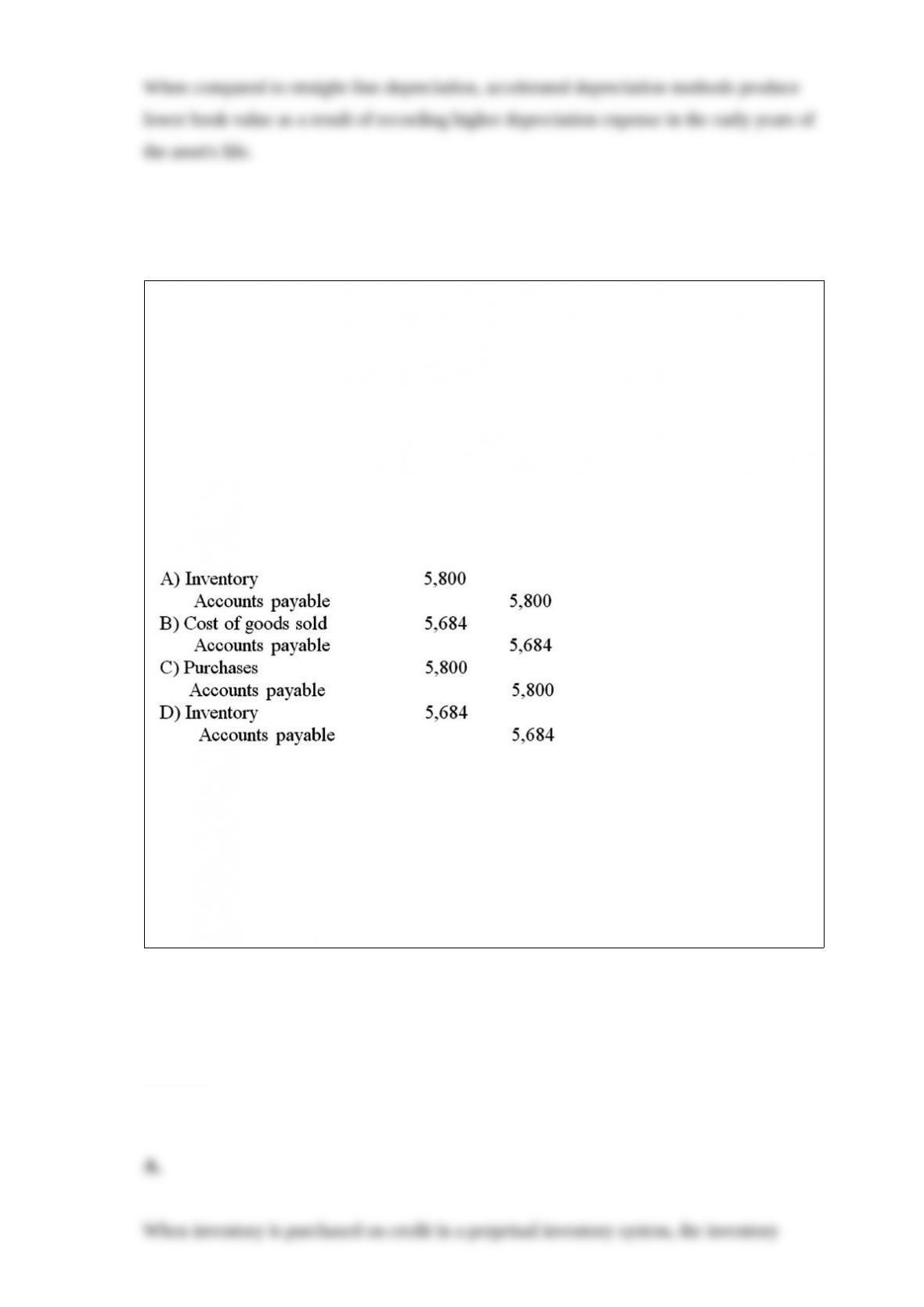
E. Flynn Company uses a perpetual inventory system and had the following
transactions during November:
November 6: Purchased $5,800 of inventory on account, terms 2/10, n/30.
November 8: Returned $800 of defective units and received full credit.
November 15: Paid the amount due.
Use the information above to answer the following question. What is the journal entry
to be recorded by E. Flynn Company on November 6?
A. Option A
B. Option B
C. Option C
D. Option D
Answer:
Which of the following accounts would be classified as a current liability?
A. Service revenue.
B. Wages expense.
C. Accumulated depreciation.
D. Dividends payable.
Answer: