In a sell-or-process-further decision, the additional costs incurred after the split-off
point are irrelevant.
Answer:
The basic difference between a first-stage cost allocation and a second-stage cost
allocation is that cost pools are not used in first-stage cost allocations.
Answer:
Financial statements prepared in accordance with generally accepted accounting
principles (GAAP) provide differential cost information.
Answer:
Joint products are outputs from common inputs and a common production process.
Answer:
One advantage of the engineering method is that it does not require data from prior
periods to estimate cost behavior.
Answer:
An organization that has significant foreign operations must disclose how its transfer
prices are established between domestic and foreign divisions.
Answer:
Process costing systems do not separate and record direct material and direct labor
costs for each individual unit of product.
Answer:
The theory of constraints focuses on determining the optimal product mix when one or
more resources restrict the attainment of a goal or objective.
Answer:
Labor variances are more important than material variances in service organizations.
Answer:
Direct labor cost (DLC) and direct labor hours (DLH) are examples of volume-related
cost drivers in the cost hierarchy.
Answer:
Delegated decision authority is the specification of what decisions a subordinate can
make in the organization.
Answer:
In multi-product cost-volume-profit (CVP) analysis, the fixed product mix method and
the weighted average contribution margin method give different break-even points.
Answer:
If variances are not prorated at the end of the accounting period, they are closed to the
Cost of Goods Sold.
Answer:
The concept of a balanced scorecard is to measure how well the organization is doing
from the view of employees, suppliers, customers, business partners, and the
community, as well as the shareholders.
Answer:
The selection of an allocation base in the direct method is easier than the selection of
an allocation base in the step method.
Answer:
In general, there is a direct relationship between the quality of the information provided
to managers and the quality of decisions made using that information.
Answer:
Job shops have three types of inventory accounts: Finished Goods, Work-in-Process,
and Direct Materials.
Answer:
The direct method makes no cost allocations between or among service departments.
Answer:
The standard cost for a unit of output is the standard price per unit of input times the
standard number of inputs per one unit of output.
Answer:
The cash budget is normally prepared before the budgeted income statement.
Answer:
Most organizations use residual income instead of return on investment (ROI) as a
performance measure.
Answer:
In general, all managers in a given organization are responsible for the same things and
should be evaluated using the same financial and nonfinancial measures.
Answer:
It is important that cost management systems are designed using the cost-benefit
principle so that the costs of gathering additional information are balanced against the
benefits of that information.
Answer:
Transfer prices are not used to record the exchange between two cost centers within the
same organization.
Answer:
The periodic allocation of manufacturing overhead costs to job cost sheets is based on
an event, not a transaction.
Answer:
The estimated net realizable value at the split-off point is calculated by taking the sales
value after further processing and deducting the additional processing costs.
Answer:
In general, the account analysis method focuses on the underlying relationship between
cost and activities from the previous period.
Answer:
Cost of goods sold plus the ending finished goods inventory minus the beginning
finished goods inventory equals the cost of goods manufactured.
Answer:
One disadvantage of using nonfinancial measures to evaluate performance is that they
are only available on a monthly, quarterly, or annual basis.
Answer:
A decision must involve at least two alternative courses of action.
Answer:
Process costing assumes all units are homogeneous and follow the same path through
the production process.
Answer:
An increase in the selling price per unit will decrease an organization’s operating
leverage, assuming sales unit volume doesn’t change and there are no other changes in
its cost structure.
Answer:
If the fixed costs are $2,400, targeted before-tax operating profit is $1,200, tax rate is
25%, selling price per unit is $2, and contribution margin ratio is 40%, then the sales
volume is 9,000 units.
Answer:
If there is only one alternative course of action and the status quo is unacceptable, then
there really is no decision to make.
Answer:
If the beginning Work-in-Process inventory is zero, first-in, first-out (FIFO) and
weighted-average process costing will assign the same amount to the units transferred
out.
Answer:
Managers are responsible for the costs incurred to achieve the targets set during the
budgeting process, but not the resources consumed to achieve those targets.
Answer:
The three categories of product costs are direct materials, direct labor, and
manufacturing overhead.
Answer:
Cost-volume-profit (CVP) analysis is more complicated for organizations with multiple
products because typically each product has a different contribution margin ratio.
Answer:
One advantage that regression techniques have over other cost estimation methods is it
generates information that can be used to determine how well the estimated cost
equation will predict future costs.
Answer:
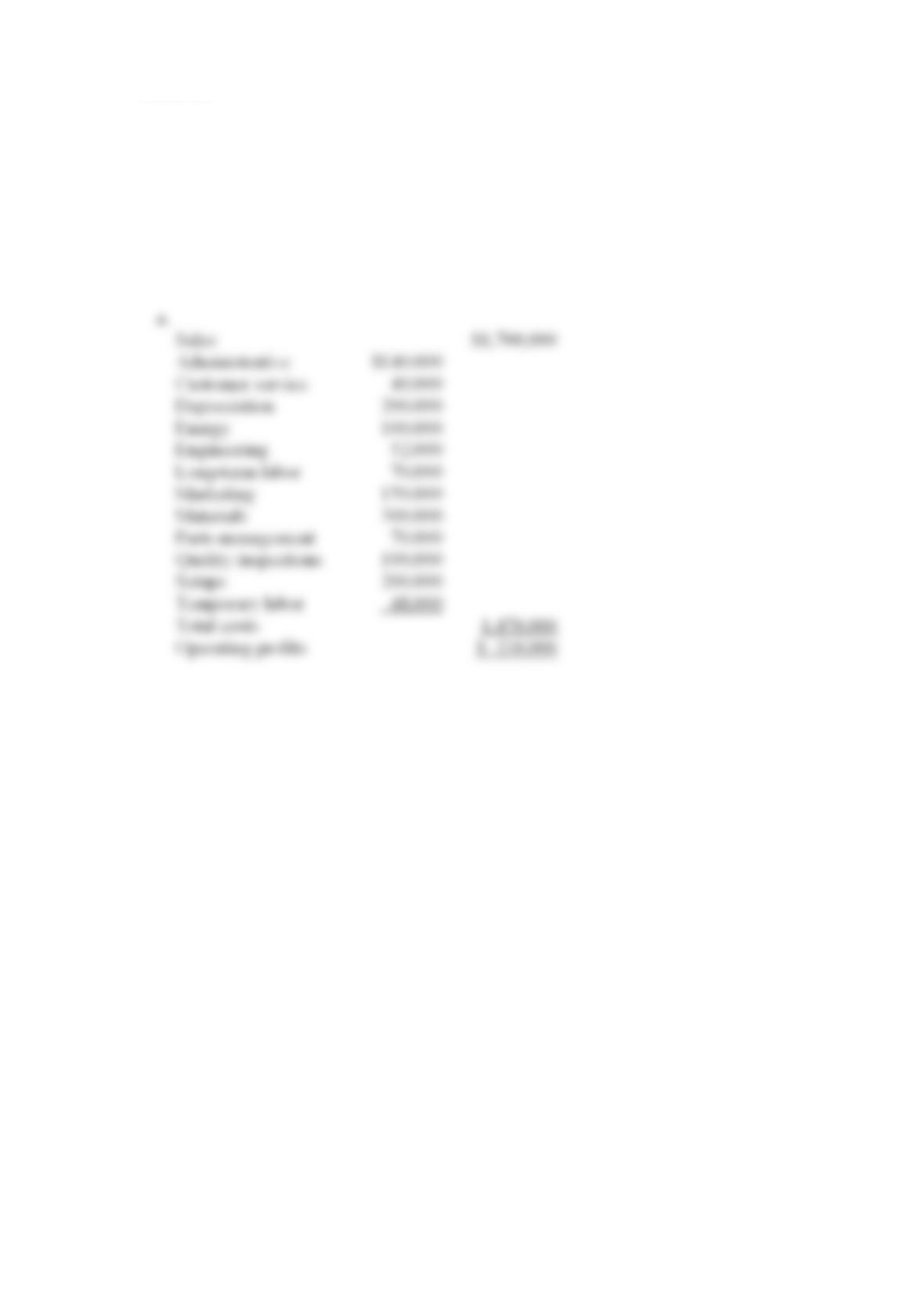
Larsmont Corporation manufactures electric trolling motors. Sales for the month
totaled $1,700,000. Information regarding resources for the month follows:
Required
a) Prepare a traditional income statement.
b) Prepare an activity-based income statement.
Answer:
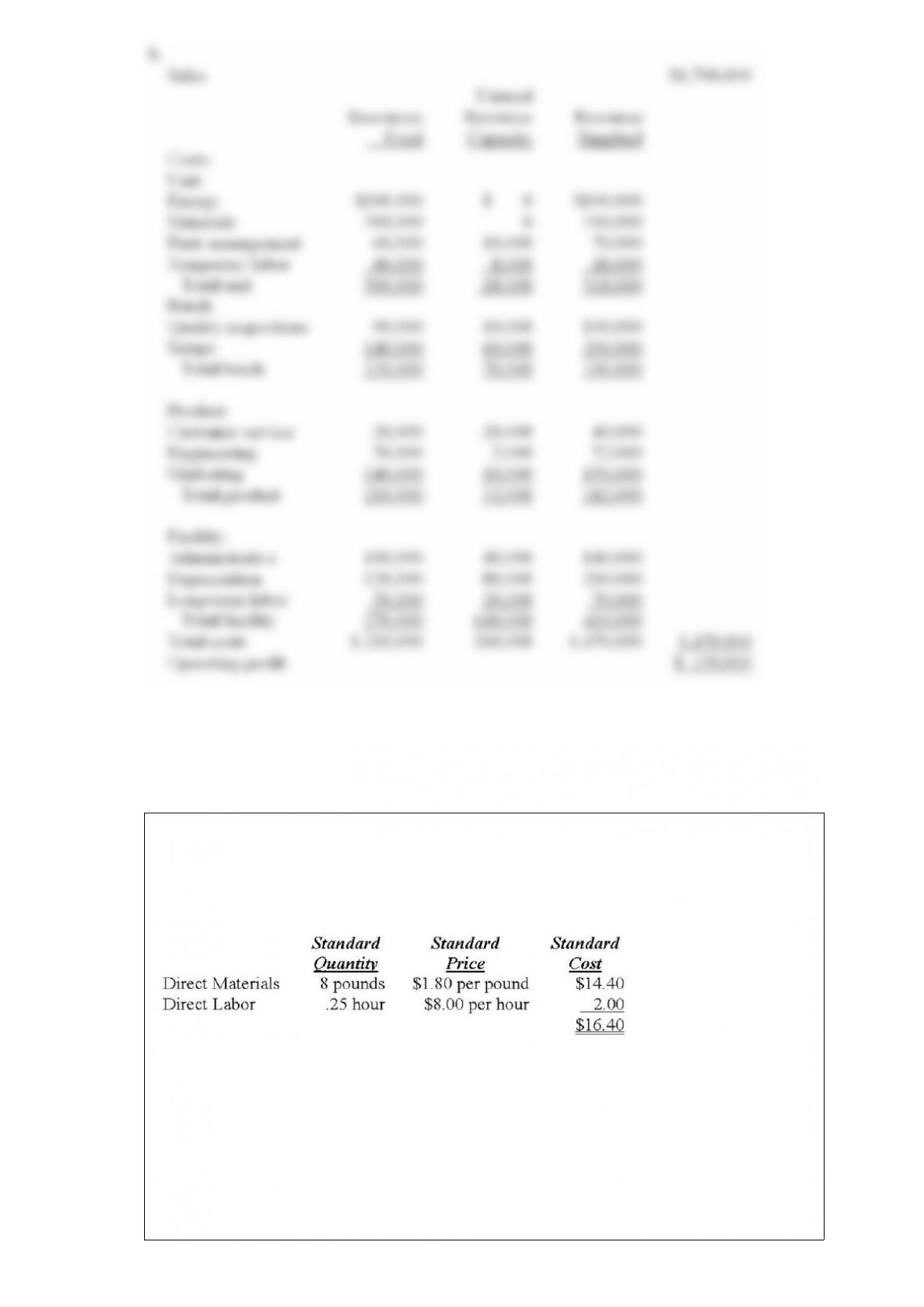
Arrow Industries employs a standard cost system in which direct materials inventory is
carried at standard cost. Arrow has established the following standards for the prime
costs of one unit of product.
During November, Arrow purchased 160,000 pounds of direct materials at a total cost
of $304,000. The total factory wages for November were $42,000, 90% of which were
for direct labor. Arrow manufactured 19,000 units of product during November using
142,500 pounds of direct materials and 5,000 direct labor hours.
What is the direct materials price variance for November?

A. $14,250
B. $14,400
C. $16,000
D. $17,100
Answer:
Before prorating the manufacturing overhead costs at the end of 2008, the Cost of
Goods Sold and Finished Goods Inventory had applied overhead costs of $57,500 and
$20,000 in them, respectively. There was no Work-in-Process at the beginning or end of
2008. During the year, manufacturing overhead costs of $74,000 were actually incurred.
The balance in the Applied Manufacturing Overhead was $77,500 at the end of 2008. If
the under or overapplied overhead is prorated between Cost of Goods Sold and the
inventory accounts, how much will be allocated to the Finished Goods Inventory?
A. $903
B. $1,217
C. $1,283
D. $2,597
Answer:
Which of the following statements about the theory of constraints is (are) true?
(A) The theory of constraints focuses on determining the optimal product mix when two
or more resources restrict the attainment of a goal or objective.
(B) The theory of constraints focuses on maximizing the rate of throughput contribution
while maximizing investment and other operating costs.
A. Only A.
B. Only B.
C. Neither A nor B is true.
D. Both A and B are true.
Answer:
A decrease in the margin of safety would be caused by a(n):
A. increase in the total fixed costs.
B. increase in total revenue (sales).
C. decrease in the break-even point.
D. decrease in the variable cost per unit.
Answer:
Which of the following statements does not reflect a XOAXOA in preparing the
marketing and administrative budget?
A. Managers have discretion about how much money is spent.
B. Managers have discretion about the timing of when money is spent.
C. Marketing and administrative expenses are made up of fixed and variable items.
D. Marketing and administrative expenses normally have a one year time horizon.
Answer:
Different cost estimations methods may produce different cost equations, even when

using the same set of data.
Answer:
T. Jackson Retail seeks your assistance to develop cash and other budget information
for May, June, and July. At April 30, the company had cash of $5,500, accounts
receivable of $437,000, inventories of $309,400, and accounts payable of $133,055.
The budget is to be based on the following assumptions:
SALES:
Each month’s sales are billed on the last day of the month. Customers are allowed a 3%
discount if payment is made within 10 days after the billing date. Receivables are
recorded in the accounts at their gross amounts (not net of discounts). 55% of the
billings are collected within the discount period; 30% are collected by the end of the
month; 9% are collected by the end of the second month; and 6% turn out to be
uncollectible.
PURCHASES:
60% of all purchases of merchandise and the selling, general, and administrative
expenses are paid in the month purchased and the remainder in the following month.
The number of units in each month’s ending inventory is equal to 125% of the next
month’s units of sales. The cost of each unit of inventory is $30. Selling, general, and
administrative expenses, of which $3,000 is depreciation, are equal to 15% of the
current month’s sales.
Actual and projected sales are as shown below:
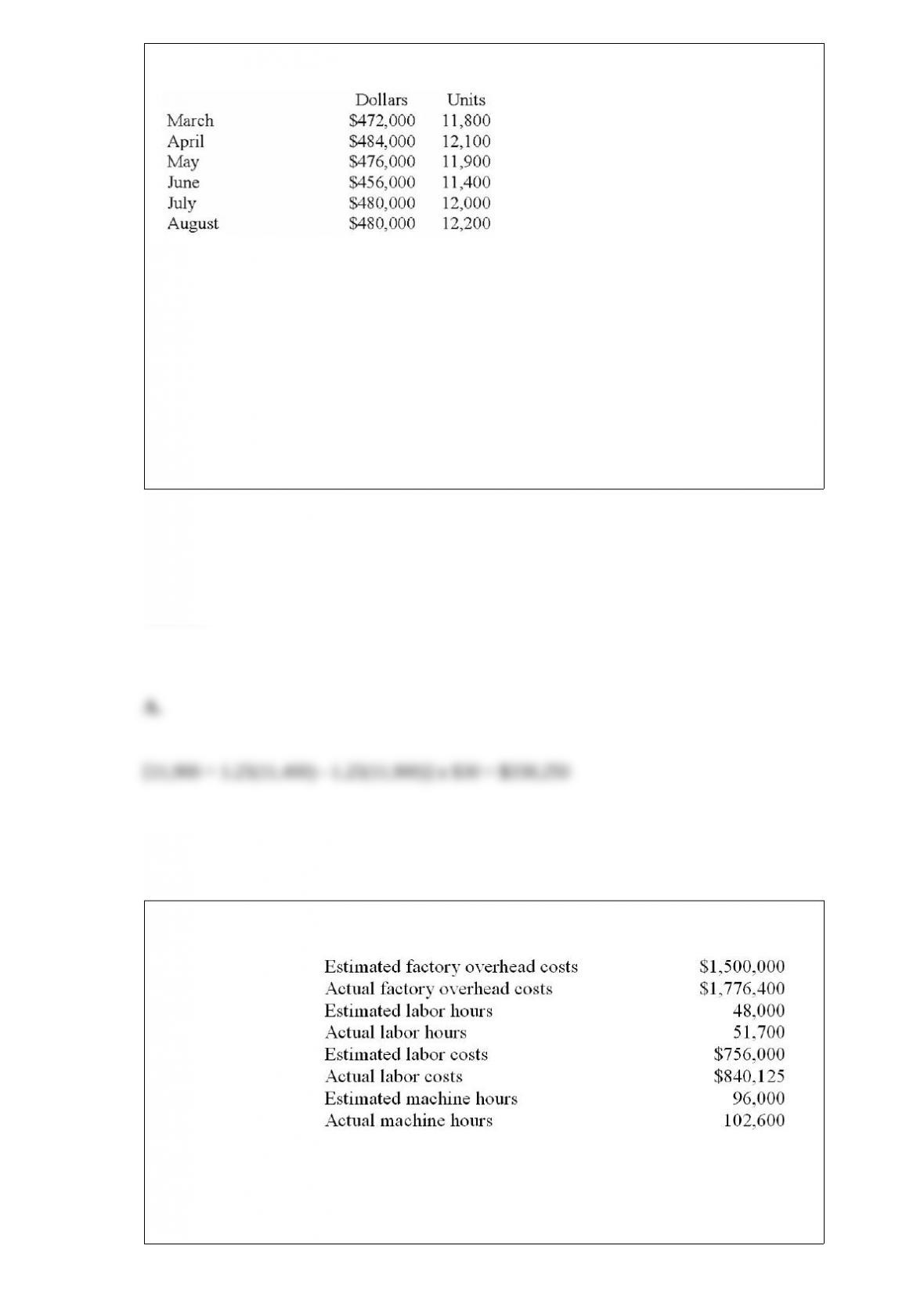
What are the budgeted merchandise purchases (in dollars) for May?
A. $338,250
B. $355,500
C. $357,000
D. $375,750
Answer:
The following information has been gathered for Roswell Machining for its fiscal year
ending December 31:
What is the predetermined factory overhead rate per labor dollar?
A. 178.54%

B. 211.44%
C. 118.43%
D. 198.41%
Answer:
Which of the following statements is (are) true?
(A) If a transfer has no effect on divisional profit, managers will be indifferent between
making the transfer or not.
(B) If an intermediate market exists but divisions are prohibited from buying or selling
from the outside, the intermediate market can be ignored in determining the optimal
transfer price.
A. Only A is true.
B. Only B is true.
C. Both A and B are true.
D. Neither A nor B is true.
Answer:
The slope of the flexible budget-line is the
A. selling price per unit.
B. variable cost per unit.
C. fixed cost per unit.
D. contribution margin per unit.
E. operating profit per unit.
Answer:
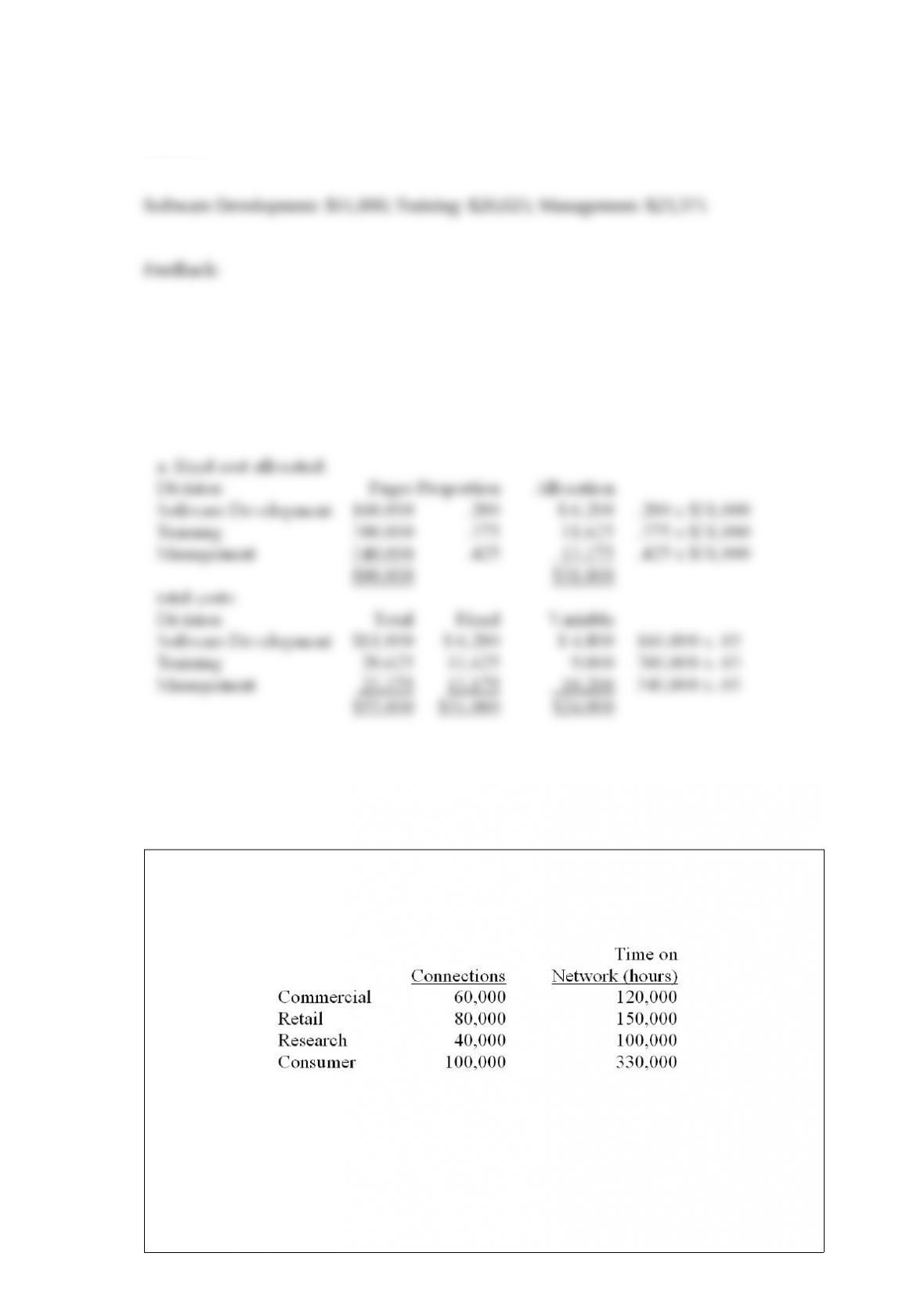
The Document Creation Center (DCC) for Aelerion Corp. provides document services
for three departments in the Denver office. The following budget has been prepared for
the month.
Required (use three decimal places in your calculations):
a) If DCC uses a dual rate for allocating its costs based on usage, how much cost will be
allocated to the three user departments?
Answer:
Comiskey has four divisions, commercial, retail, research and consumer, that share the
common costs of the company’s computer server network. The annual common costs
are $2,400,000. You have been provided with the following information for the
upcoming year:
Required (use three decimal places in your calculations):
a.)What is the allocation rate for the upcoming year assuming Comiskey uses the
single-rate method and allocates common costs based on the number of connections?
Calculate the allocated amount for each division.
b) What is the allocation rate for the upcoming year assuming Comiskey uses the
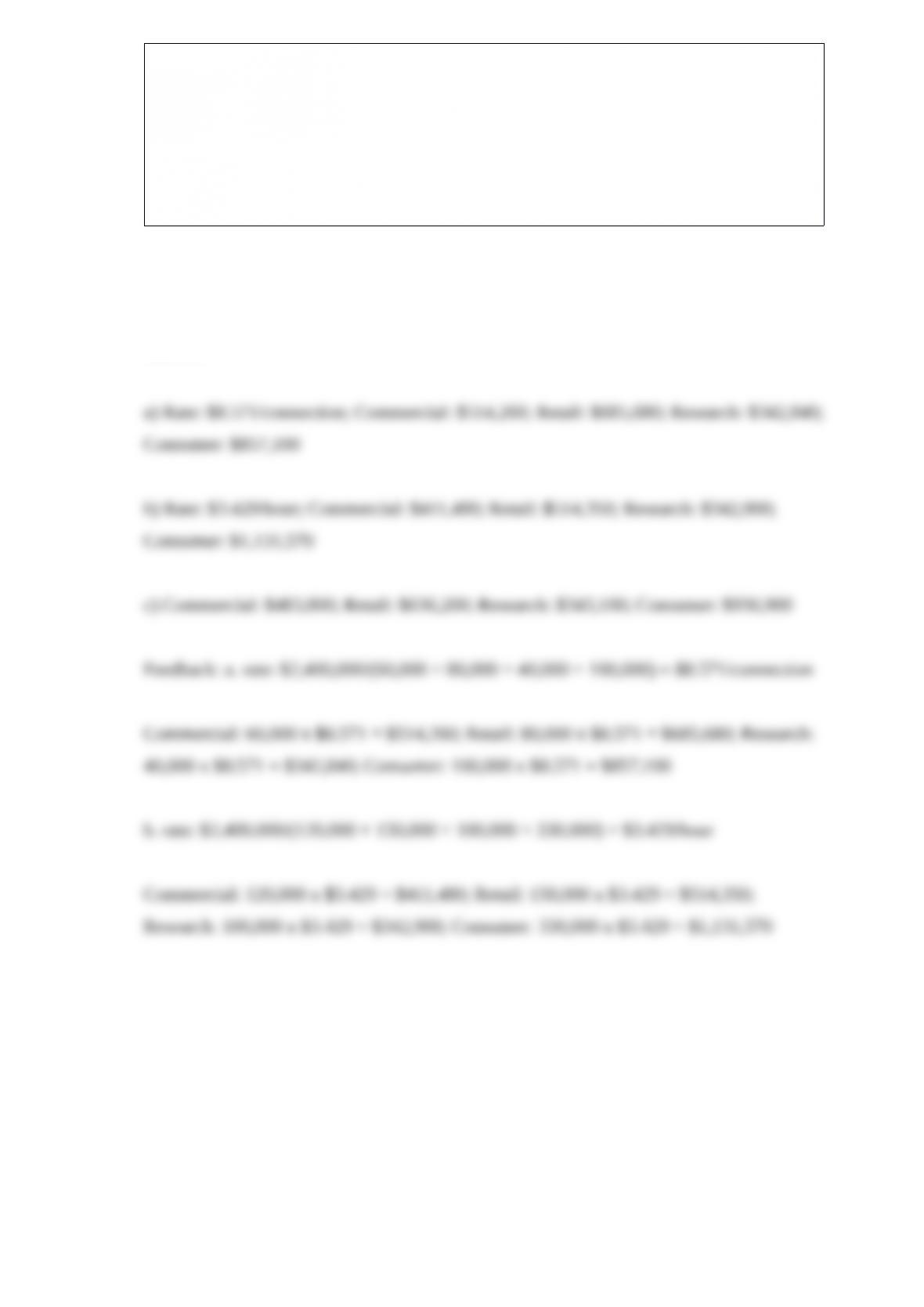
single-rate method and allocates common costs based on the time on network?
Calculate the allocated amount for each division.
c) The cost accountant determined $1,700,000 of the server network’s costs were fixed
and should be allocated based on the number of connections. The remaining costs
should be allocated based on the time on the network. What is the total server network
costs allocated to each division?
Answer:
Division A has variable manufacturing costs of $25 per unit and fixed costs of $5 per
unit. Division A is operating at capacity, what is the opportunity cost of an internal
transfer when the market price is $35?
A. $5
B. $10
C. $25
D. $30
E. $35
Answer:
Chipper Division of Acme Corp. sells 80,000 units of part Z-25 to the outside market.
Part Z-25 sells for $40, has a variable cost of $22, and a fixed cost per unit of $10.
Chipper has a capacity to produce 100,000 units per period. Jones Division currently
purchases 10,000 units of part Z-25 from Chipper for $40. Jones has been approached
by an outside supplier willing to supply the parts for $36. What is the effect on Acme’s
overall profit if Chipper REFUSES the outside price and Jones decides to buy outside?
A. no change
B. $140,000 decrease in Acme profits
C. $80,000 decrease in Acme profits
D. $40,000 increase in Acme profits
Answer:
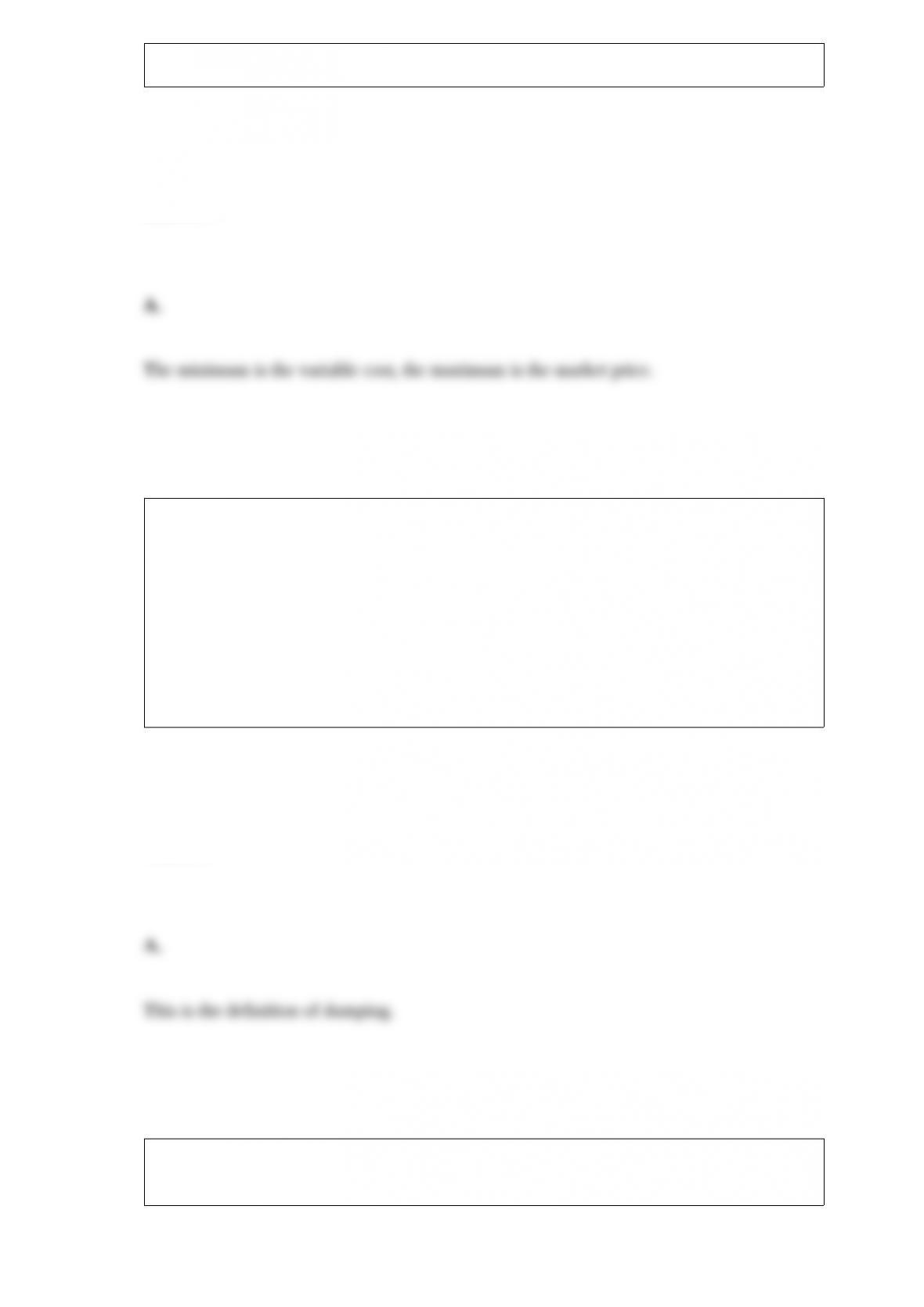
An appropriate transfer price between two divisions of The Stark Company can be
determined from the following data: (CIA adapted)
What is the natural bargaining range for the two divisions?
A. Between $20 and $50
B. Between $50 and $70
C. Any amount less than $50
D. $50 is the only acceptable transfer price
Answer:
Exporting a product to another country at a price below domestic cost:
A. dumping
B. target pricing
C. peak-load pricing
D. price fixing
Answer:
Homer Co. has provided the following information for last year:
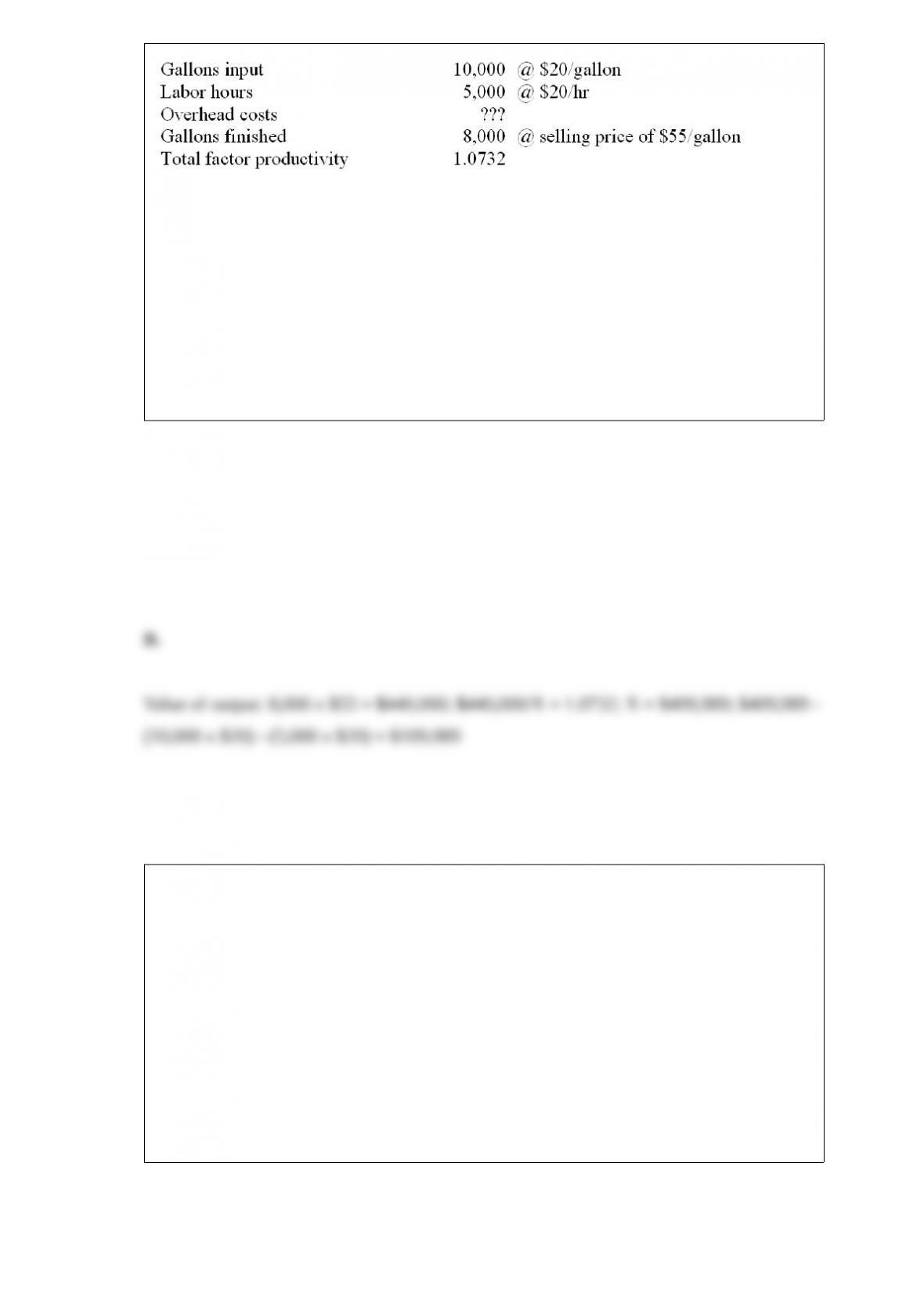
The total overhead cost (rounded) is:
A. $172,200
B. $109,989
C. $140,000
D. $200,000
Answer:
Beal Company uses direct labor cost as a basis for computing its predetermined
overhead rate. In computing the predetermined overhead rate for 2010, the company
misclassified a portion of direct labor cost as indirect labor. The effect of this
misclassification will be to
A. understate the predetermined overhead rate.
B. overstate the predetermined overhead rate.
C. there will be no effect on the predetermined overhead rate.
D. Can’t tell from the information provided.
Answer:
Which of the following budgets does not require the production budget?
A. Direct materials.
B. Direct labor.
C. Manufacturing overhead.
D. Marketing and administrative expenses.
Answer:
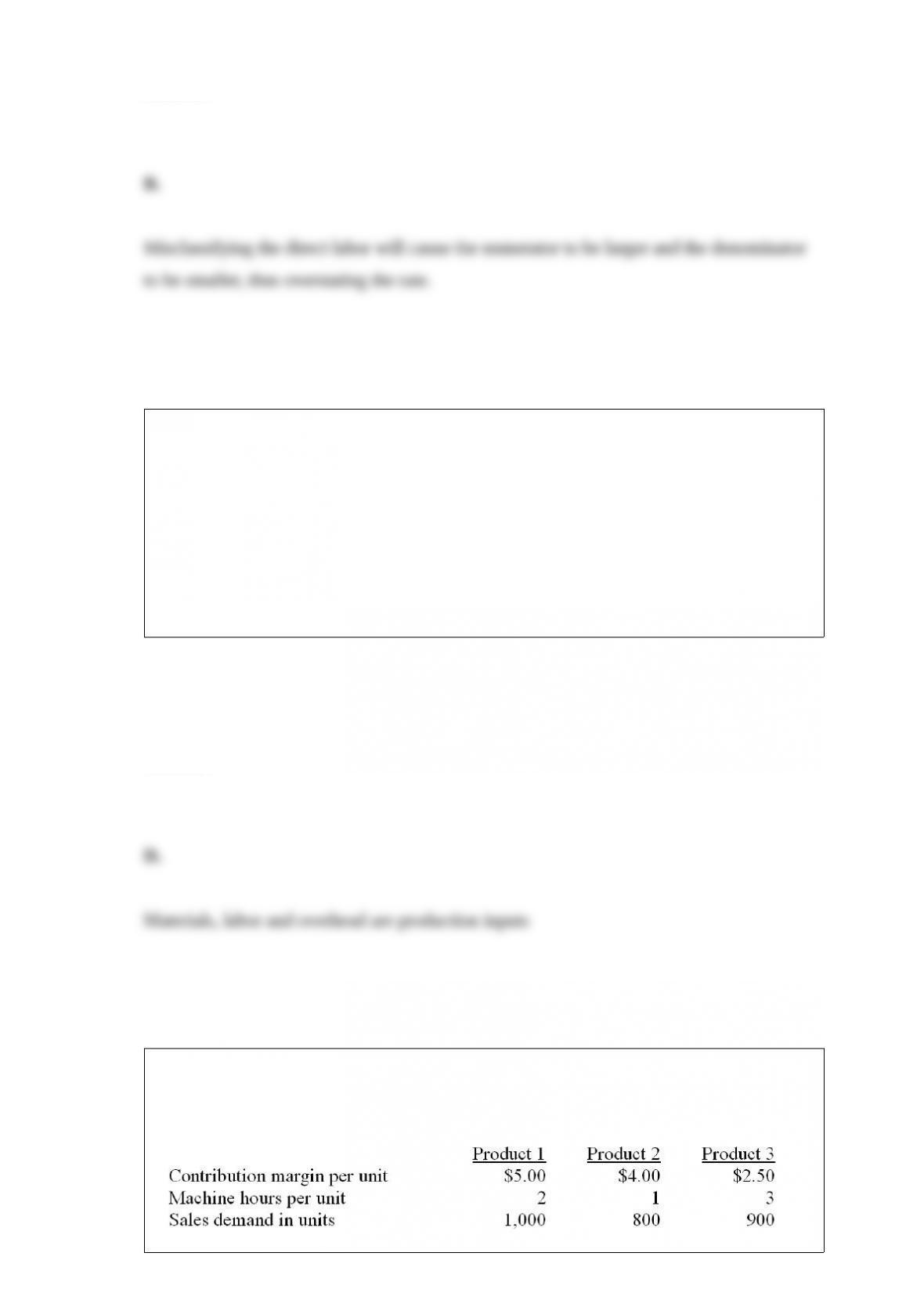
Gigure Inc has 3,600 machine hours available each month. The following information
on the company’s three products is available:
a)What production schedule will maximize the company’s profits?
b) What will be the maximum possible contribution margin?
Answer:
One of the results in using balanced scorecards is a shift from a focus on financial
results to a focus on
A. maximizing market share.
B. minimizing budgetary slack.
C. eliminating fraudulent behavior.
D. increasing customer satisfaction.
Answer:
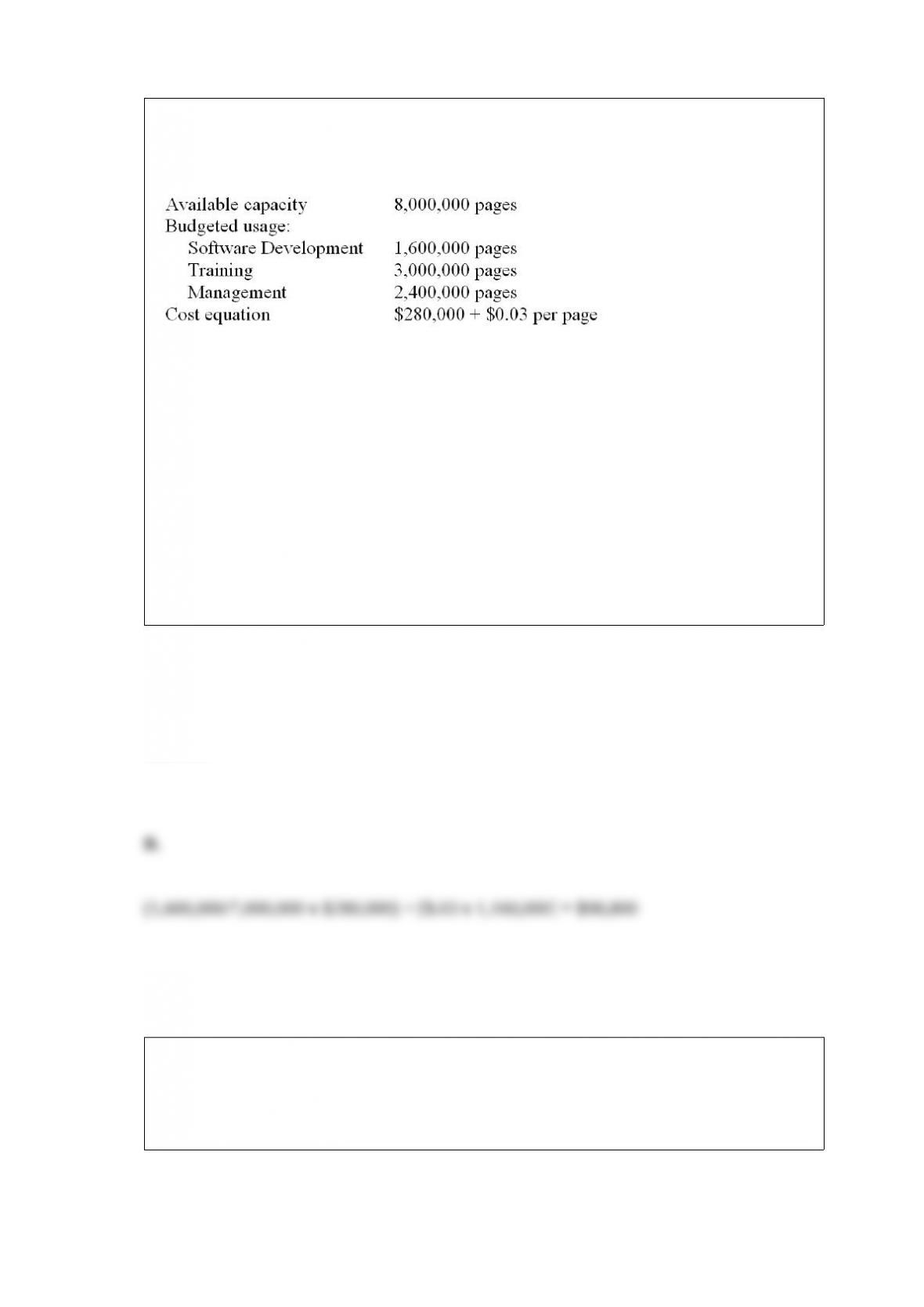
The Document Creation Center (DCC) for Alegis Corp. provides photocopying and
document services for three departments in the St. Paul office. The following budget
has been prepared for the year.
If DCC uses a dual-rate for allocating its costs, how much cost will be allocated to the
Software Development Department, assuming the Software Development Department
actually made 1,160,000 copies during the year?
A. $75,400
B. $98,800
C. $81,200
D. $84,312
Answer:
Carson Corporation produces and sells three products. The three products, Alpha, Beta,
and Gamma, are sold in a local market and in a regional market. At the end of the first
quarter of the current year, the following income statement (in thousands of dollars) has
been prepared:
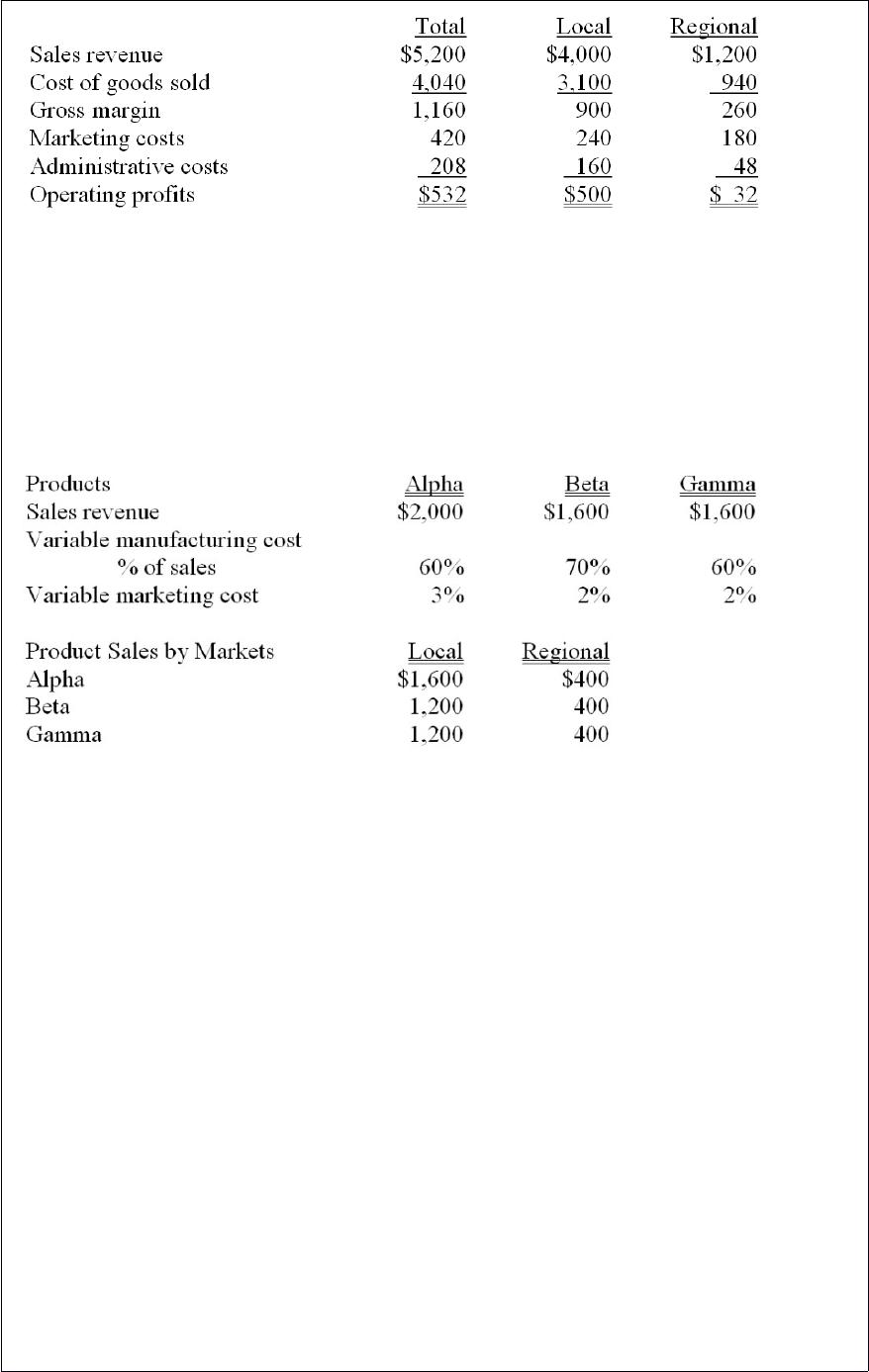
Management has expressed special concern with the regional market because of the
extremely poor return on sales. This market was entered a year ago because of excess
capacity. It was originally believed that the return on sales would improve with time,
but after a year, no noticeable improvement can be seen from the results as reported in
the above quarterly statement. In attempting to decide whether to eliminate the regional
market, the following information has been gathered:
All administrative costs and fixed manufacturing costs are common to the three
products and the two markets and are fixed for the period. Remaining marketing costs
are fixed for the period and separable by market. All fixed costs have been arbitrarily
allocated to markets.
Required:
(a) Assuming there are no alternative uses for the Carson Corporation’s present capacity,
would you recommend dropping the regional market? Why or why not?
(b) Prepare the quarterly income statement showing contribution margins by products.
Do not allocate fixed costs to products.
(c) It is believed that a new product can be ready for sale next year if the Carson
Corporation decides to go ahead with continued research. The new product can be
produced by simply converting equipment presently used in producing product Gamma.
This conversion will
increase fixed costs by $40,000 per quarter. What must be the minimum contribution
margin per quarter for the new product to make the changeover financially feasible?
Answer:
If materials are carried in the direct materials inventory account at standard cost, then it
is reasonable to assume that the
A. raw materials inventory account is understated.
B. price variance is recognized when materials are purchased.
C. company does not follow generally accepted accounting principles.
D. price variance is recognized when materials are placed into production.
Answer:
Department D has recently purchased and installed new computerized equipment for
Product X. This equipment will increase the overhead costs by $2,700 and decrease
labor costs (due to time savings) in Department D by $3.00 per case. Machine hours
will not change. If Smelly uses departmental rates, what are the product costs per case
for Product J assuming Departments C and D use direct labor hours and machine hours
as their respective allocation bases?
A. $161.50
B. $169.30
C. $171.45
D. $183.36
Answer:
The production volume variance must be computed when a company uses
A. activity-based costing.
B. process costing.
C. job-order costing.
D. full-absorption costing.
E. variable costing.
Answer:
The cost accountant determined $2,700,000 of the communication network’s costs were
fixed and should be allocated based on the number of calls. The remaining costs should
be allocated based on the time on the network. What is total communication network
costs allocated to the Small Box Division assuming the company uses dual-rates to
allocate common costs?
A. $2,520,000
B. $1,800,000
C. $1,320,000
D. $1,200,000
Answer:
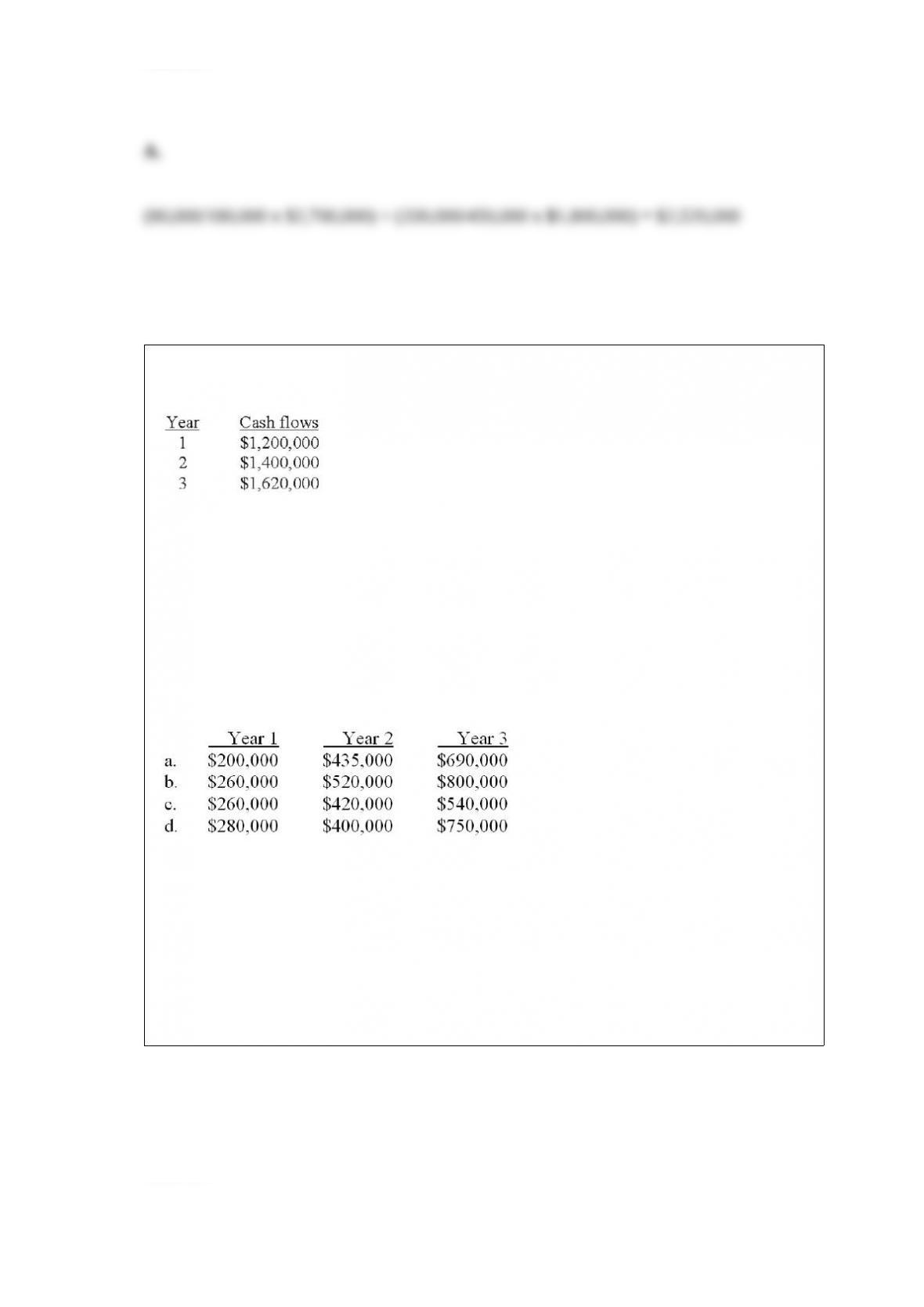
One division of the RST Enterprise Company has depreciable assets costing
$4,000,000. The cash flows from these assets for the past three years have been:
The current (i.e., replacement) costs of these assets were expected to increase 25% each
year. RST used the straight-line depreciation method; the estimated useful life is
10-years with no salvage value. For return on investment (ROI) calculations, RST uses
end-of-year balances.
What is the residual income for each year, assuming the cost of capital is 15% and RST
uses historical costs and net book values to compute residual income?
A. a
B. b
C. c
D. d
Answer:
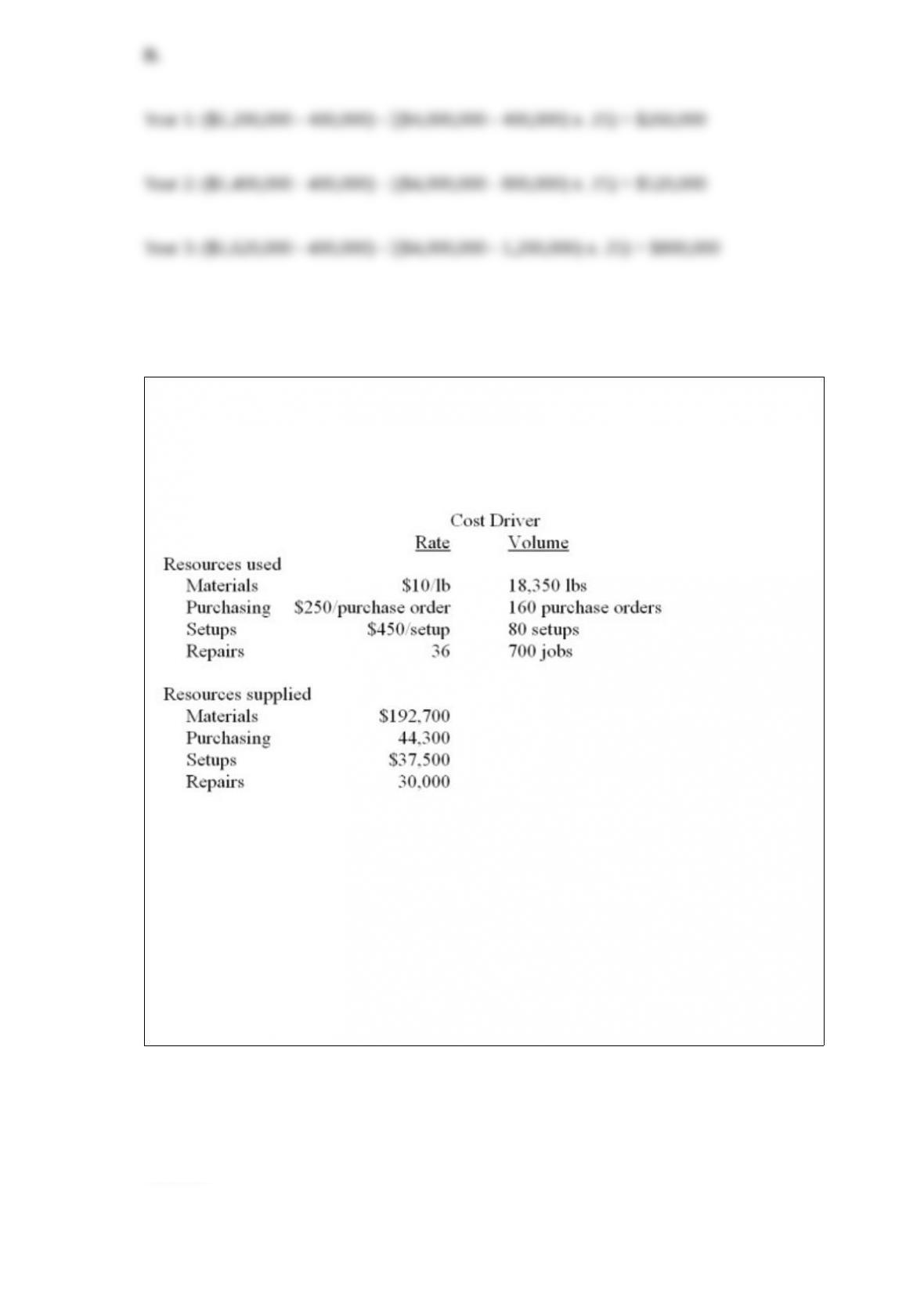
Sullivan Inc. reports the following information about resources. At the beginning of
the year, Sullivan estimated it would spend $180,000 for materials, $42,000 for
purchasing, $35,000 for setups and $36,000 for repairs.
Compute unused resource capacity for setups for Sullivan.
A. $2,500
B. $1,080
C. $1,500
D. $1,000
Answer:
In general, the direct labor efficiency variance is the responsibility of the
A. purchasing agent.
B. company president.
C. production manager.
D. industrial engineering.
E. marketing department.
Answer: