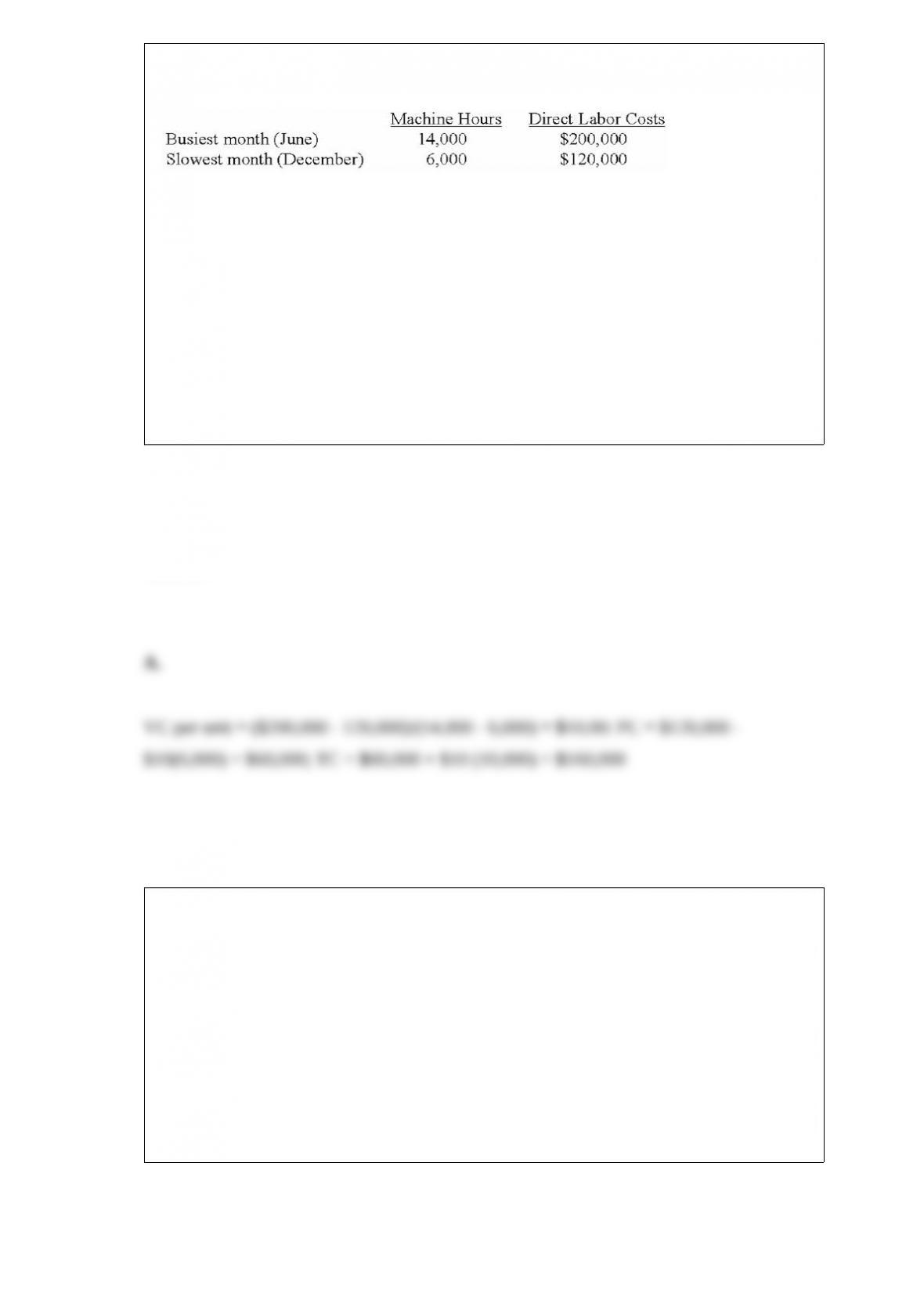
The Shapely Company uses the high-low method to determine its cost equation. The
following information was gathered for the past year:
If Shapely expects to use 10,000 machine hours next month, what are the estimated
direct labor costs?
A. $160,000
B. $180,000
C. $175,000
D. $150,000
Answer:
Which of the following costs is both a prime cost and a conversion cost?
A. direct materials
B. direct labor
C. manufacturing overhead
D. administrative costs
E. marketing costs
Answer:
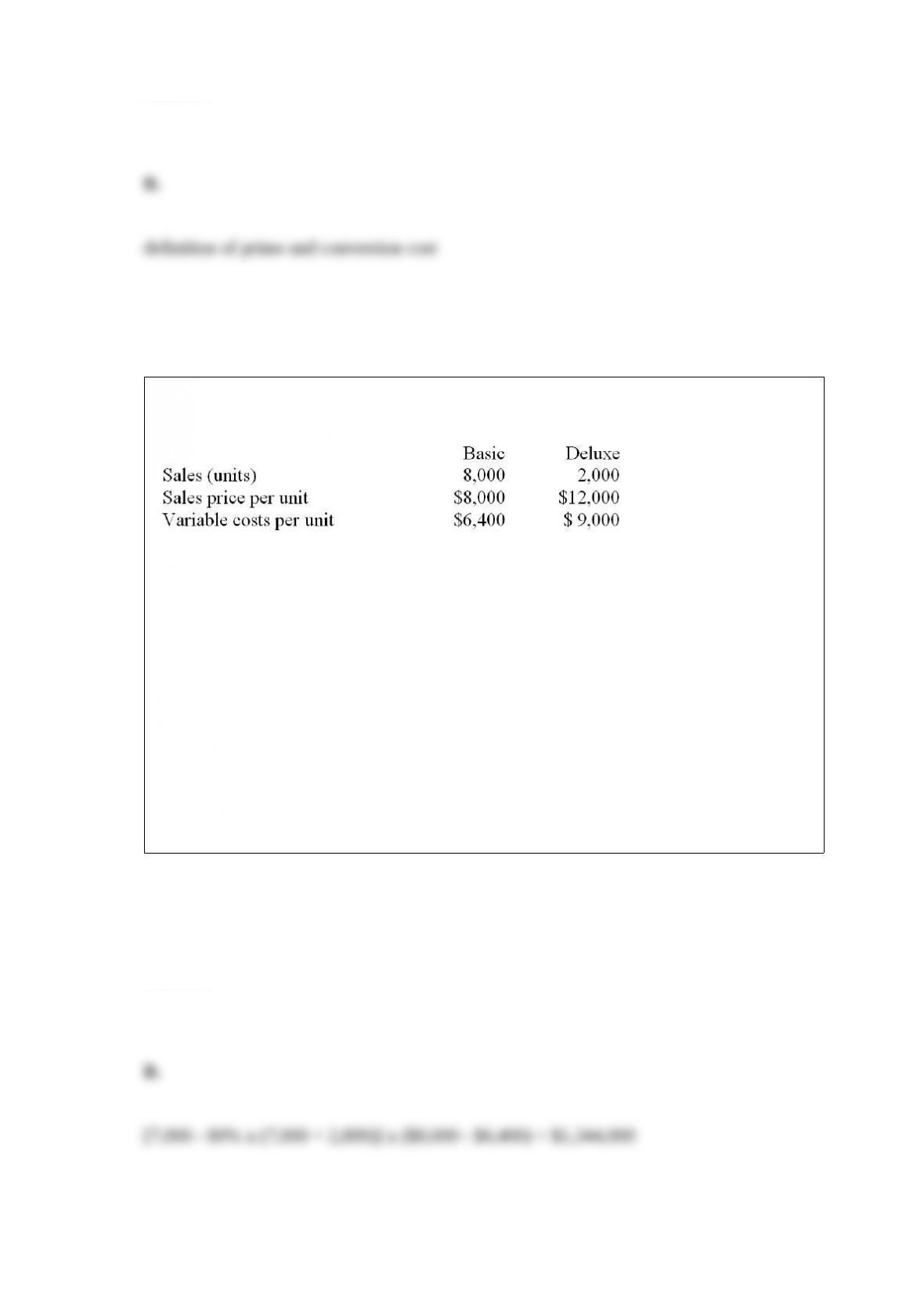
A machine distributor sells two models, basic and deluxe. The following information
relates to its master budget.
Actual sales were 7,000 basic models and 2,800 deluxe models. The actual sales prices
were the same as the budgeted sales prices for both models.
What is the sales mix variance for the basic model?
A. $256,000
B. $1,344,000
C. $1,600,000
D. $2,520,000
Answer:
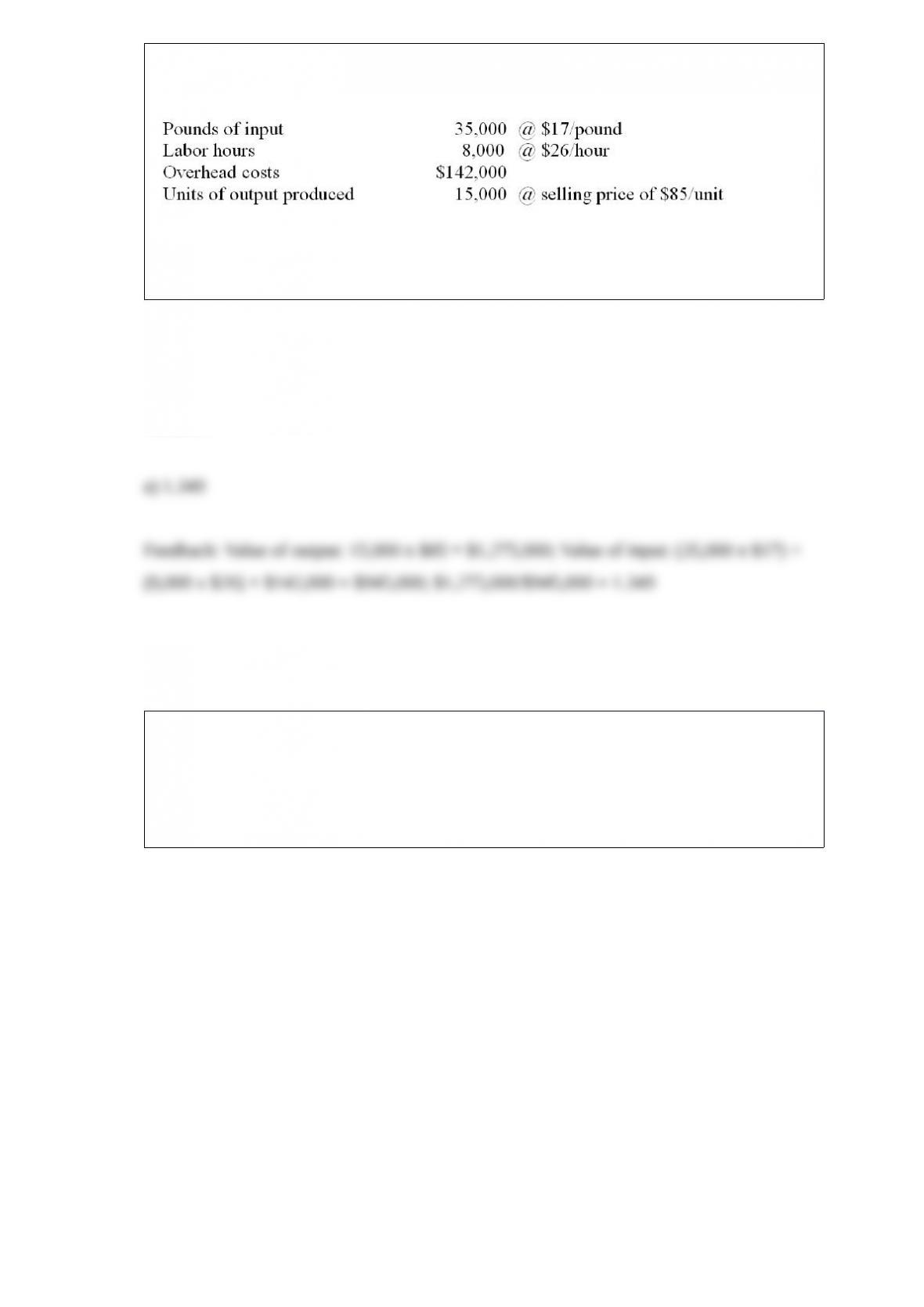
Colville Co. has provided the following information for last year:
Required:
a) Calculate the total factor productivity measure.
Answer:
Donnelly Corporation manufactures and sells T-shirts imprinted with college names
and slogans. Last year, the shirts sold for $7.50 each, and the variable cost to
manufacture them was $2.25 per unit. The company needed to sell 20,000 shirts to
break even. The after tax net income last year was $5,040. Donnelly’s expectations for
the coming year include the following: (CMA adapted)
• The sales price of the T-shirts will be $9
•Variable cost to manufacture will increase by one-third
•Fixed costs will increase by 10%
•The income tax rate of 40% will be unchanged.
If Donnelly Corporation wishes to earn $22,500 in after tax net income for the coming
year, the company’s sales volume in dollars must be
A. $213,750.
B. $257,625.
C. $207,000.
D. $229,500.
Answer:
A favorable materials price variance coupled with an unfavorable materials usage
variance would most likely result from (CMA adapted)
A. Machine efficiency problems.
B. Product mix production changes.
C. Labor efficiency problems.
D. The purchase of lower-than-standard-quality materials.
Answer:
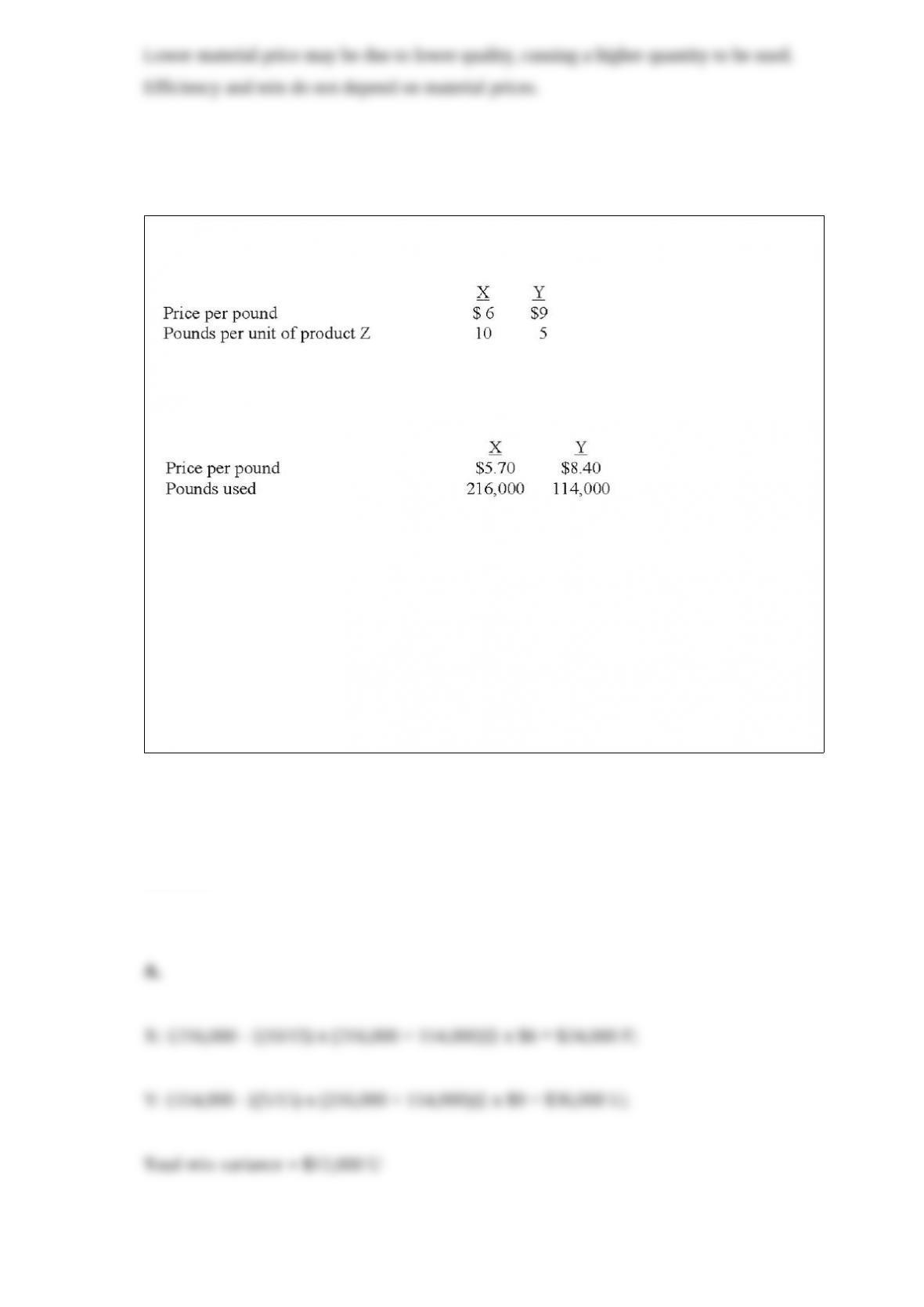
The Genes Company makes a product, Z, from two materials: X and Y. The standard
prices and quantities are as follows:
In May, 21,000 units of Z were produced by Genes Company, with the following actual
prices and quantities of materials used:
What is the total direct materials mix variance for May?
A. $12,000
B. $24,000
C. $36,000
D. $60,000
Answer:
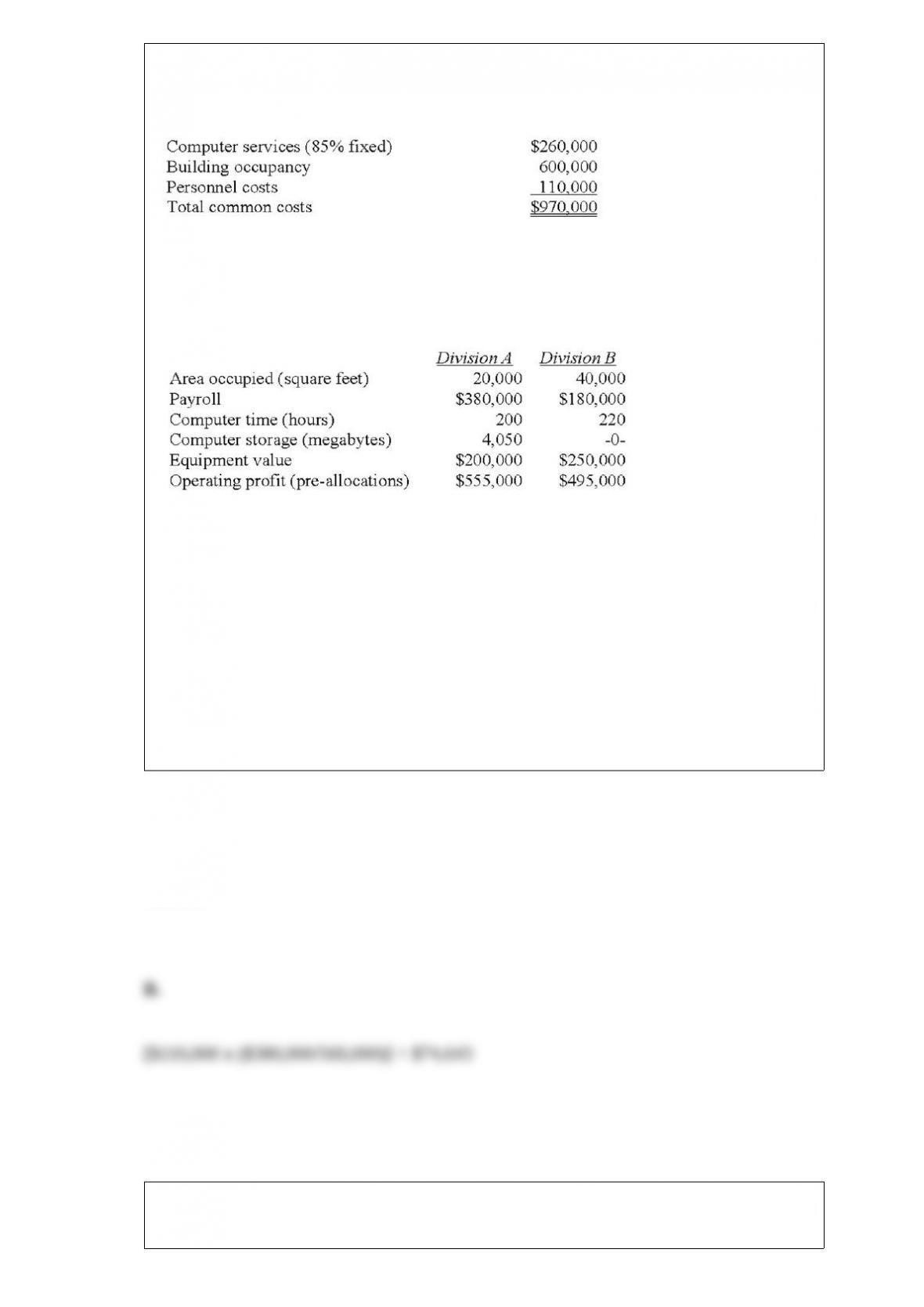
Cincinnati Million, Inc. operates two user divisions as separate cost objects. To
determine the costs of each division, the company allocates common costs to the
divisions. During the past month, the following common costs were incurred:
The following information is available concerning various activity measures and
service usages by each of the divisions:
Using the most appropriate allocation basis, what is the personnel cost allocated to
Division A?
A. $58,143
B. $74,643
C. $76,463
D. $110,000
Answer:
Which of the following is not an example of an external failure cost?
A. Accepting company liability resulting from product failure
B. Experiencing decreasing sales as a result of poor-quality products
C. Repairing or replacing defective products after they’ve been sold
D. Testing products in use at the customer’s site
Answer:
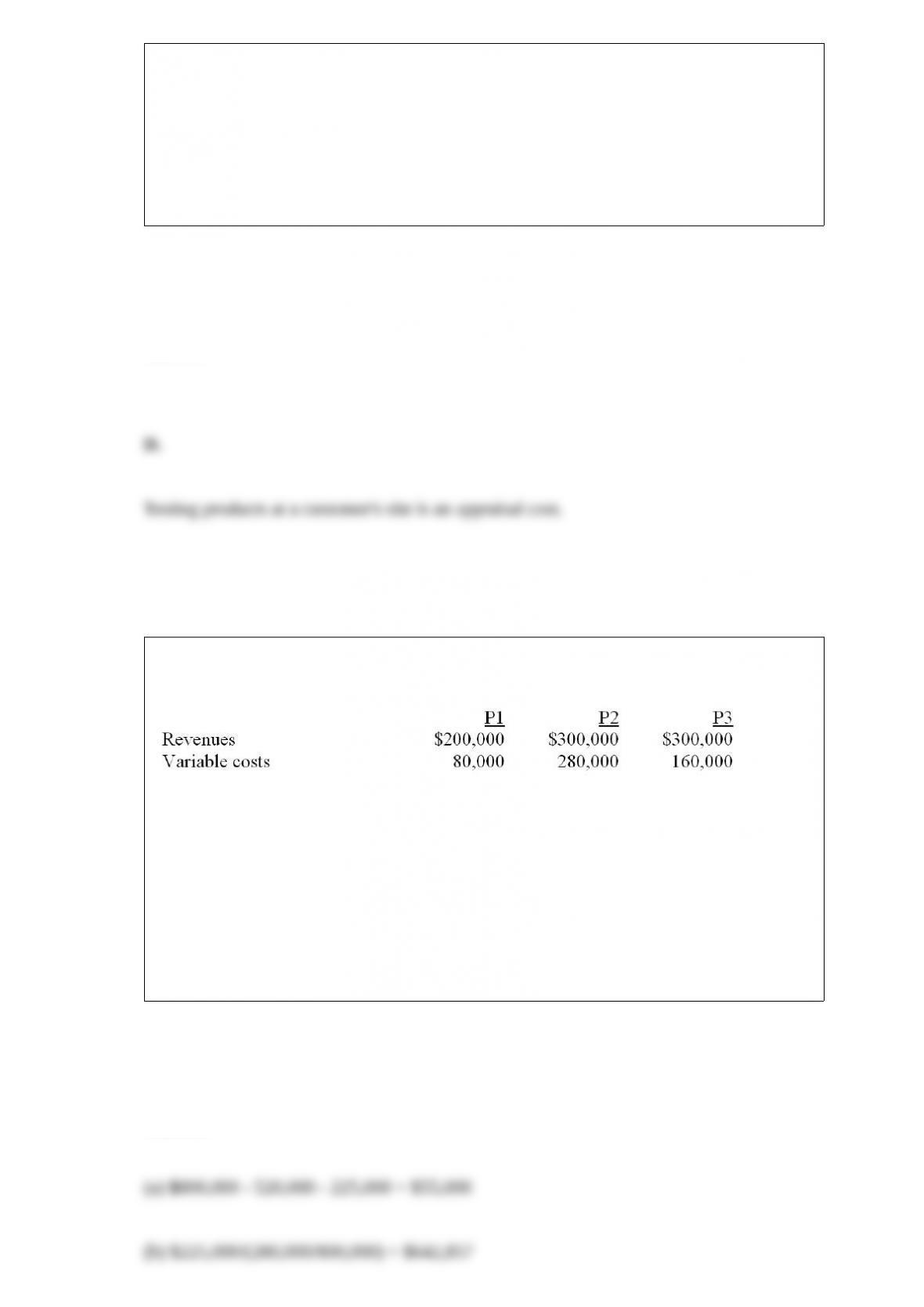
Craddock sells three products. Last month’s results are as follows:
Total fixed costs are $100,000 marketing and $125,000 administrative.
Required:
(a) What was the operating profit last month?
(b) What is Craddock’s break-even sales volume (at the given mix)?
(c) What is Craddock’s margin of safety?
Answer:
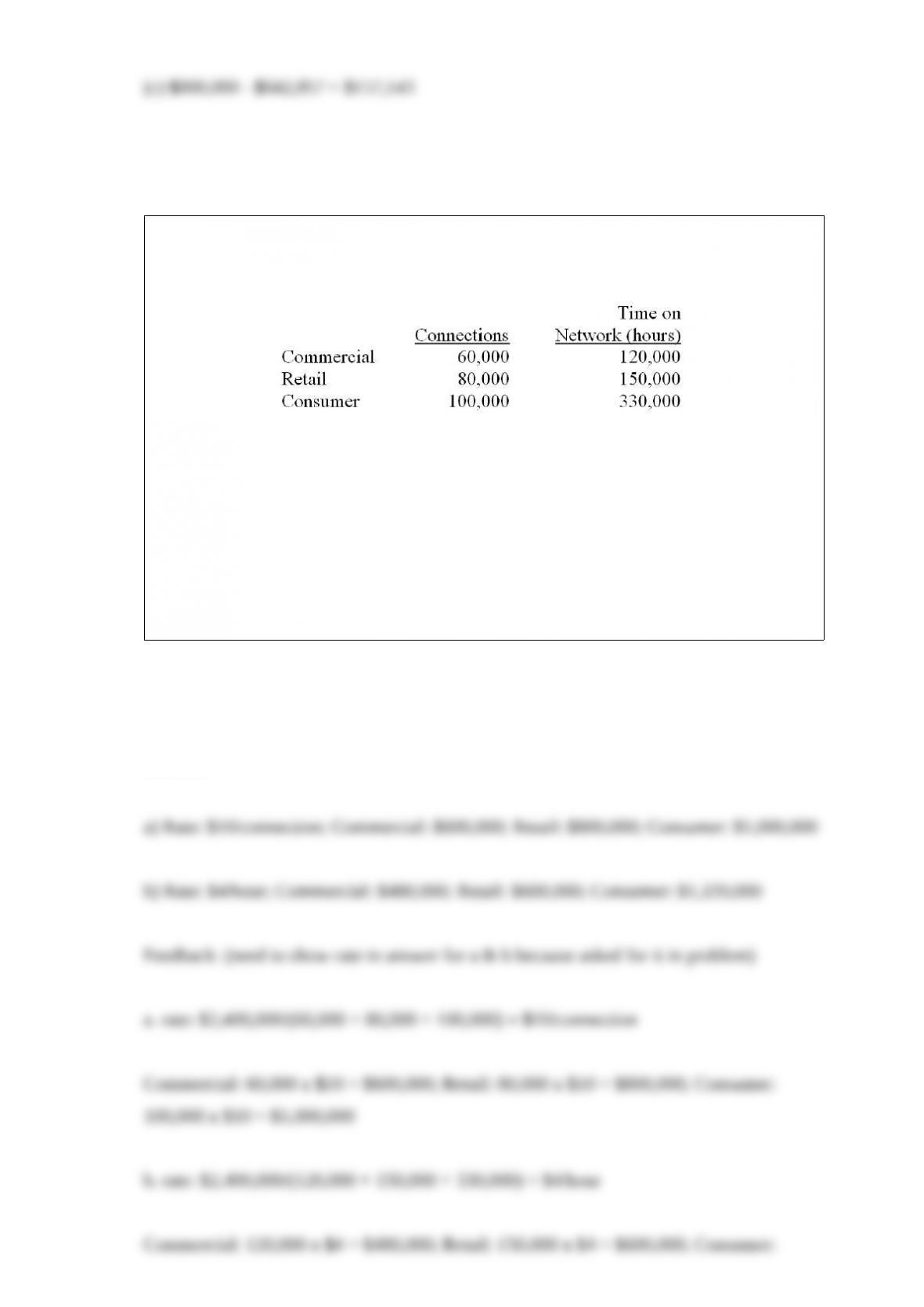
Jacobs Corp. has three divisions, commercial, retail and consumer, that share the
common costs of the company’s computer server network. The annual common costs
are $2,400,000. You have been provided with the following information for the
upcoming year:
Required (use three decimal places in your calculations):
a) What is the allocation rate for the upcoming year assuming Jacobs uses the
single-rate method and allocates common costs based on the number of connections?
Calculate the allocated amount for each division.
b) What is the allocation rate for the upcoming year assuming Jacobs uses the
single-rate method and allocates common costs based on the time on network?
Calculate the allocated amount for each division.
Answer:
Which of the following accounts would be a period cost rather than a product cost?
A. Depreciation on manufacturing machinery.
B. Maintenance on factory machines.
C. Production manager’s salary.
D. Direct Labor.
E. Freight out.
Answer:
How would miscellaneous supplies used in assembling a product be classified for a
manufacturing company?
A. Fixed, period cost.
B. Fixed, product cost.
C. Variable, period cost.
D. Variable, product cost.
Answer:
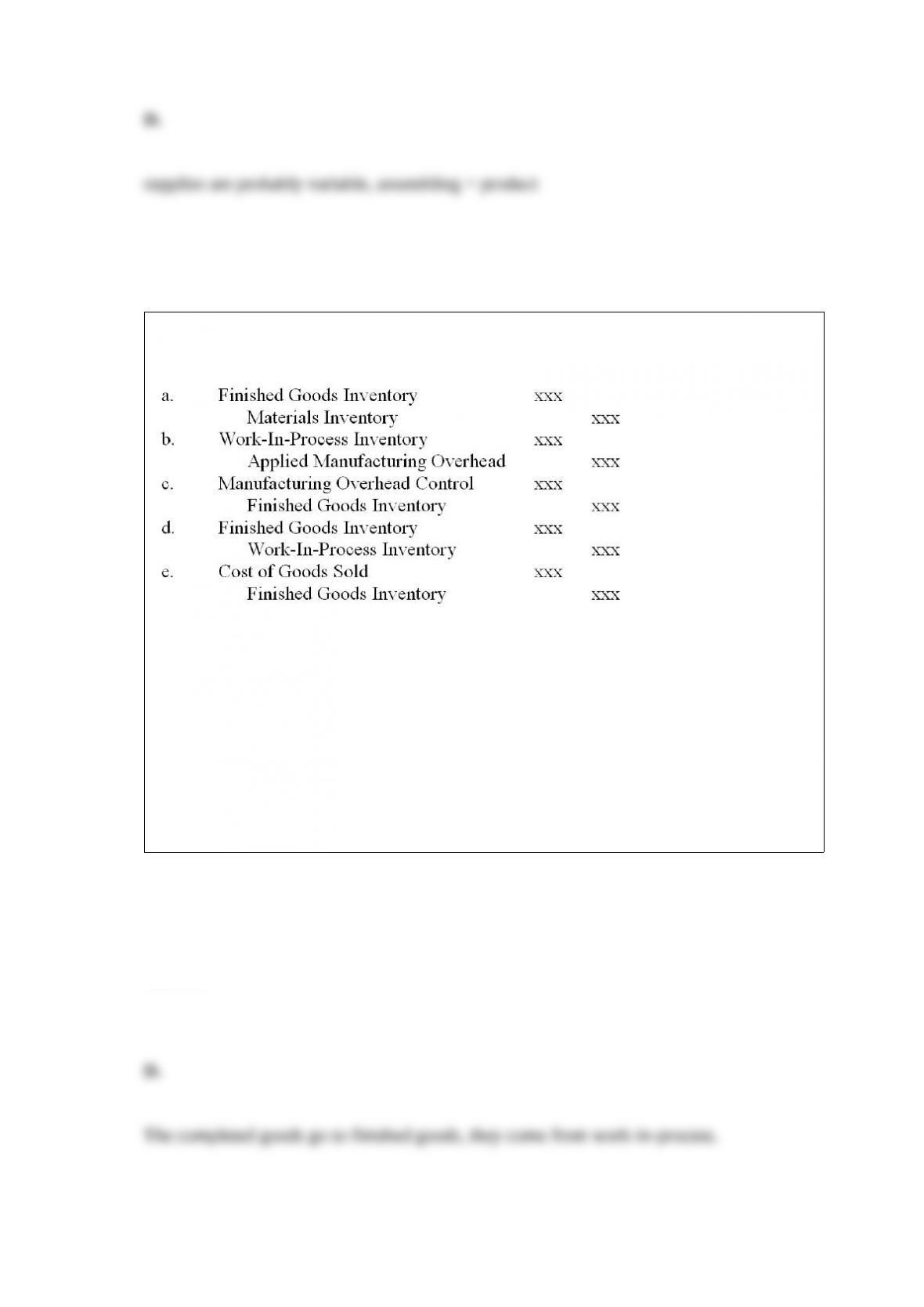
The journal entry to record the completion of a job in a job costing system is
A. a
B. b
C. c
D. d
E. e
Answer:
Rayburn Corporation purchased a new machine for $120,000. The machine has an
estimated useful life of 10-years with no salvage value and a return on investment
(ROI) of 15%. ROI is computed using annual cash flows and straight-line depreciation.
What is the annual cash flow using the gross book value method?
A. $12,200
B. $18,000
C. $28,200
D. $30,000
Answer:
Almo Company manufactures and sells adjustable canopies that attach to motor homes
and trailers. The market covers both new unit purchasers as well as replacement
canopies. Almo developed its 2011 business plan based on the assumption that canopies
would sell at a price of $400 each. The variable costs for each canopy were projected to
be $200, and the annual fixed costs were budgeted at $100,000. The goal for Almo’s
after-tax operating profits was $240,000; the company’s effective tax rate is 40%
While Almo’s sales usually rise during the second quarter, the May financial statements
reported that sales were not meeting expectations. For the first five months of 2011,
only 350 units had been sold at the established price, with variable costs as planned. It
was clear that the 2011 after-tax operating profit goal would not be reached unless some
corrective actions were taken. Almo’s president assigned a management committee to
analyze the situation and develop several alternative courses of action. The following
mutually exclusive alternatives were presented to the president:
(1) Reduce the sales price by $40. The sales department predicts that with the
significantly reduced price, 2,700 units can be sold during the remainder of 2011. Total
fixed and variable unit costs will stay as budgeted.
(2) Lower variable costs per unit by $25 through the use of less expensive materials and
lightly modified manufacturing techniques. The sales price will also be reduced by $30.
These changes will yield sales of 2,200 for the remainder of 2011.
(3) Cut fixed costs by $10,000 and lower the sales price by 5%. Variable costs per unit
will be unchanged. Sales of 2,000 units can be expected for the remainder of 2011.
Required:
(a) If no changes are made to the selling price or cost structure, determine the number
of units that Almo must sell in order to break-even.
(b) If no changes are made to the selling price or cost structure, determine the number
of units that Almo must sell in order to achieve its after-tax operating profit objective.
(c) Determine which one of the alternatives Almo should select to achieve its after-tax
operating profit objective. Be sure to support your selection with appropriate
computations.
Answer:
A company has identified the following overhead costs and cost drivers for the coming
year: (CIA adapted)
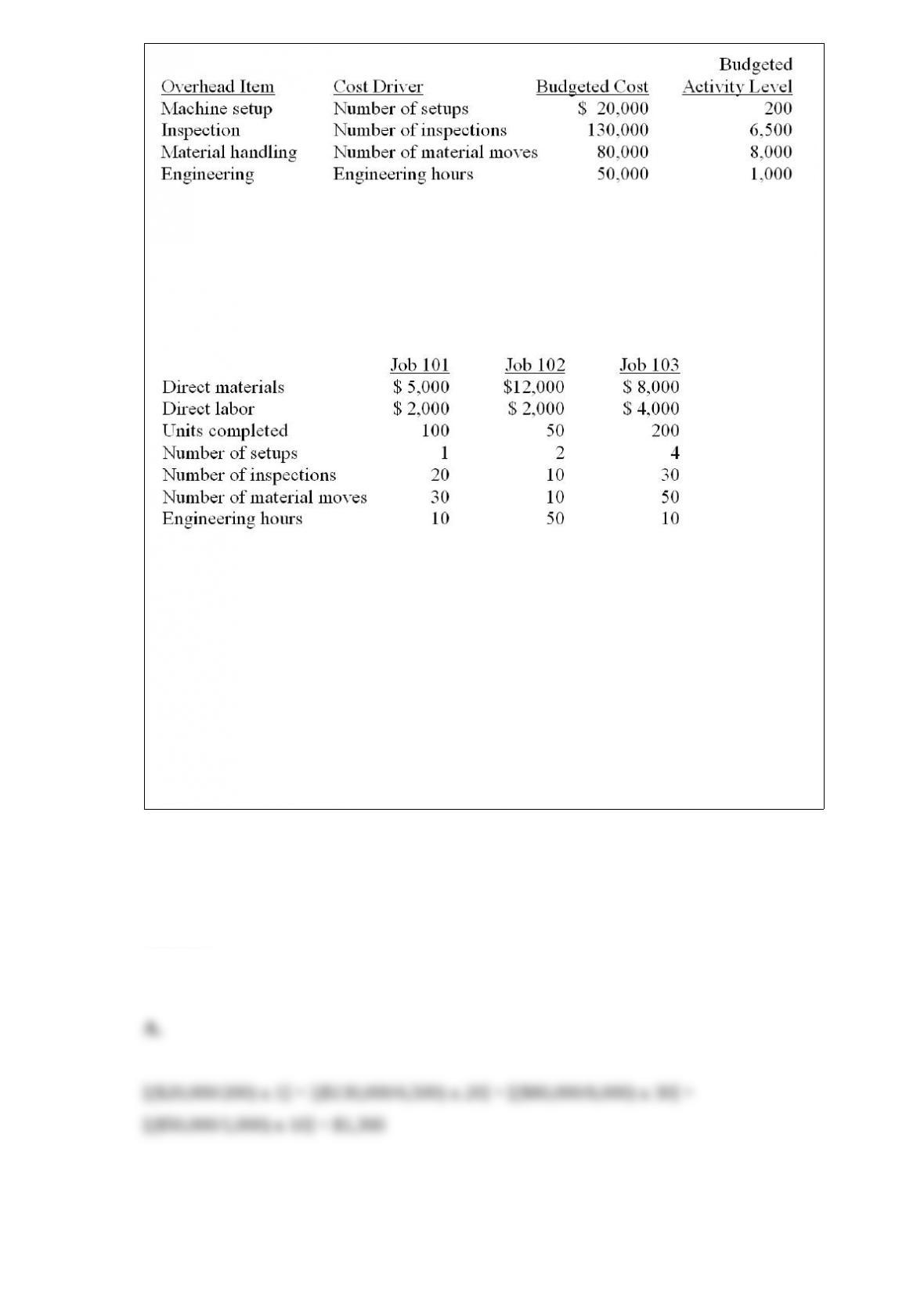
Budgeted direct labor cost was $100,000 and budgeted direct material cost was
$280,000. The following information was collected on three jobs that were completed
during the year:
If the company uses activity-based costing (ABC), how much overhead cost should be
assigned to Job 101?
A. $1,300
B. $2,000
C. $5,000
D. $5,600
Answer:
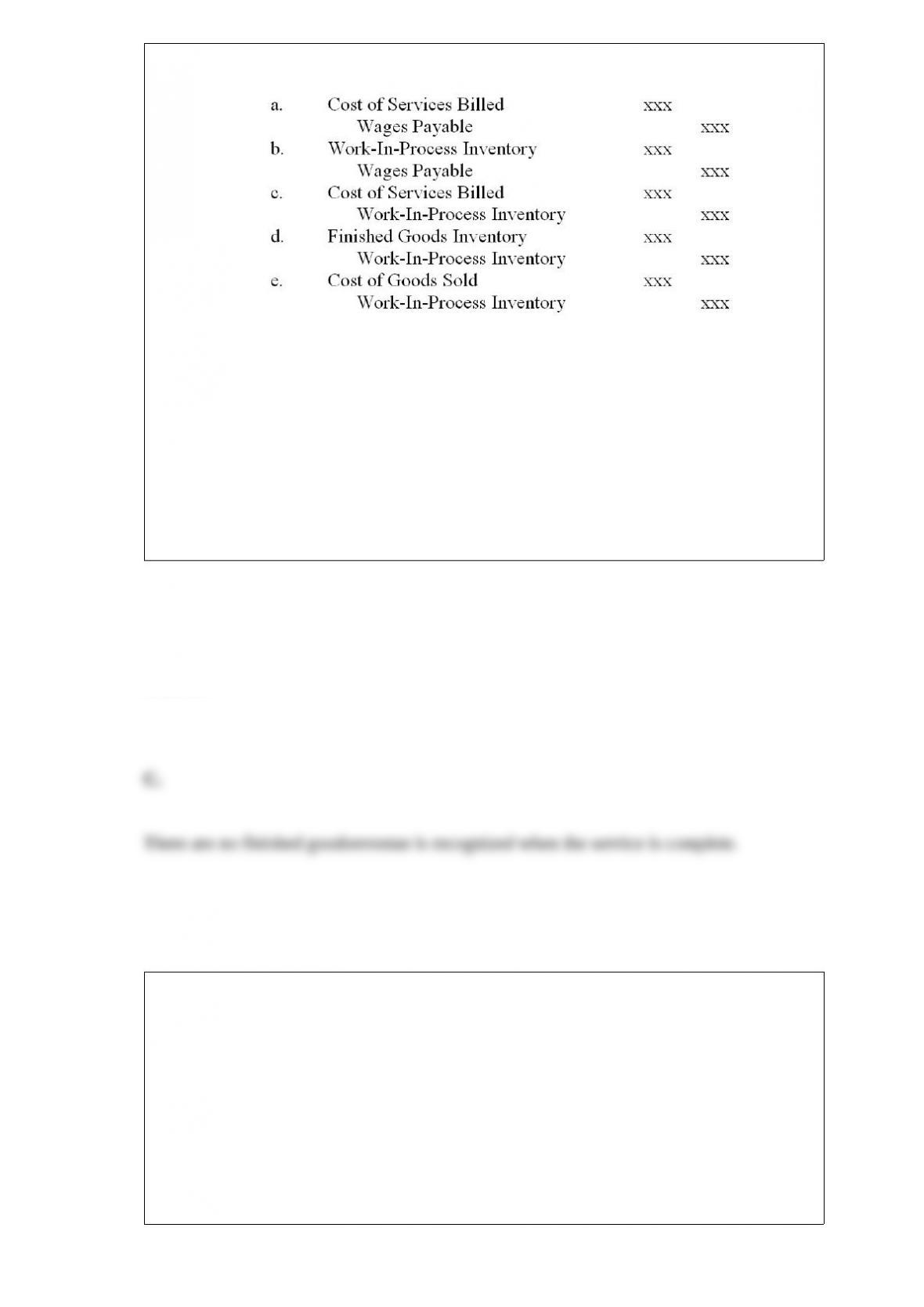
The journal entry to record the completion of a contract in a job costing system for a
service firm is
A. a
B. b
C. c
D. d
E. e
Answer:
The time from initial research and development to the time that support to the customer
ends is the
A. product life cycle
B. short run
C. target time
D. predatory price
Answer:
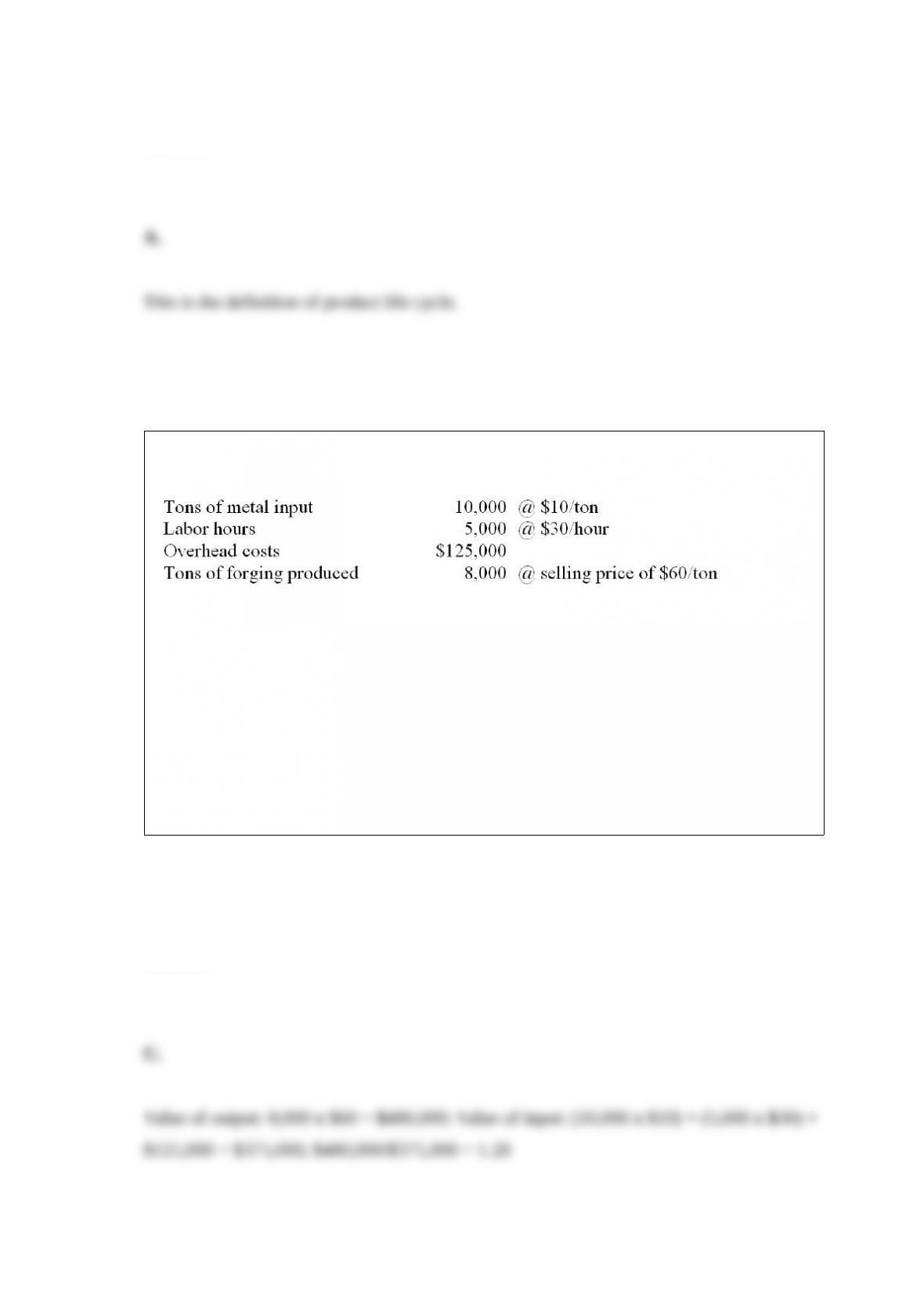
Brimson Forging Co. has provided the following information for last year:
The total factor productivity measure is:
A. $480,000
B. $375,000
C. 1.28
D. 0.78
Answer:
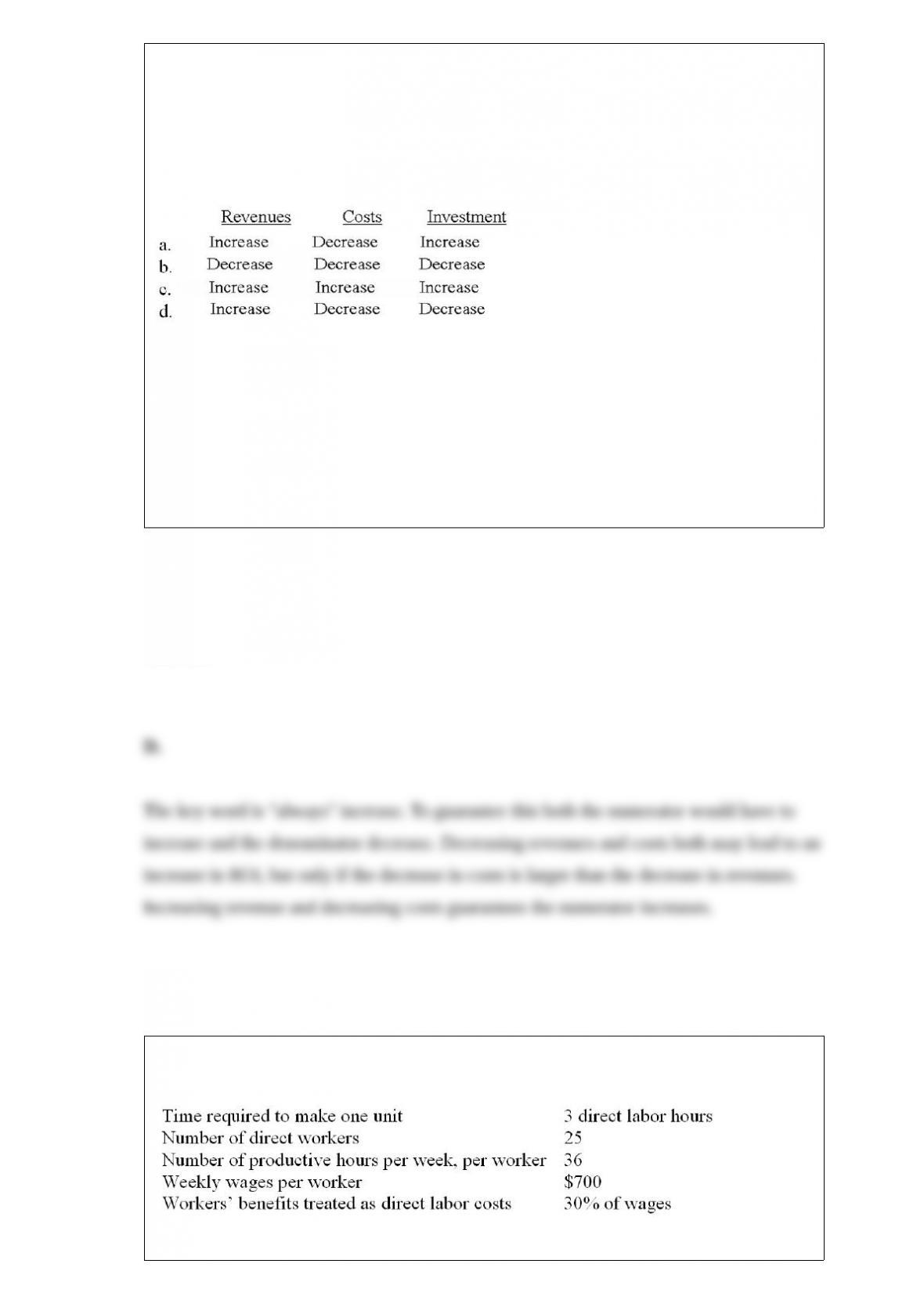
Return on investment (ROI) is a very popular measure employed to evaluate the
performance of corporate segments because it incorporates all of the major ingredients
of profitability (revenue, cost, investment) into a single measure. Under which one of
the following combinations of actions regarding a segment’s revenues, costs, and
investment would a segment’s ROI always increase? (CIA adapted)
A. a
B. b
C. c
D. d
Answer:
The following direct labor information pertains to the manufacture of product Frez:
What is the standard direct labor cost per unit of product Frez? (CPA adapted)
A. $19.44
B. $25.28
C. $58.33
D. $75.83
Answer:
The cost accounting system that minimizes wasteful or unnecessary transaction
processes is
A. performance measure
B. benchmarking
C. budgeting
D. responsibility center
E. lean accounting
Answer:
In a standard cost system, overhead is applied to production on a basis of
A. the denominator hours chosen for the period.
B. the budgeted hours for the normal production level of activity.
C. the actual hours required to complete the output of the period.
D. the standard hours allowed to complete the output of the period.
Answer:
Bayfield Division of Ashland Inc. has a capacity of 200,000 units and expects the
following results.
Washburn Division of Ashland Inc. currently purchases 50,000 units of a part for one of
its products from an outside supplier for $4 per unit. Washburn’s manager believes he
could use a minor variation of Bayfield’s product instead, and offers to buy the units
from Bayfield at $3.50. Making the variation desired by Washburn would cost Bayfield
an additional $0.50 per unit and would increase Bayfield’s annual cash fixed costs by
$20,000. Bayfield’s manager agrees to the deal offered by Washburn’s manager.
a) What is the effect of the deal on Washburn’s income?
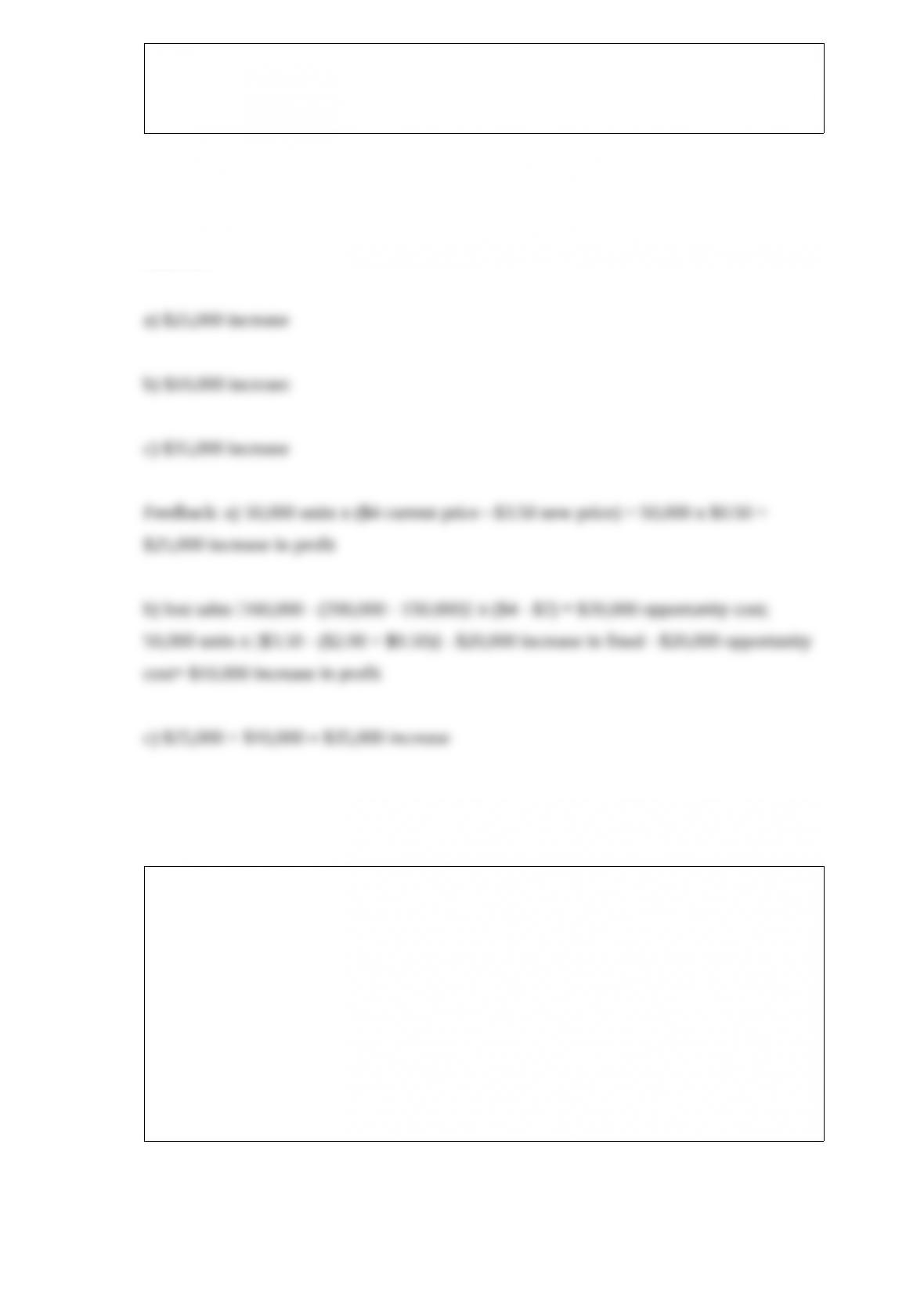
b) What is the effect of the deal on Bayfield’s income?
c) What is the effect of the deal on the income of Ashland Inc. as a whole?
Answer:
Which of the following would not cause the break-even point to change?
A. Sales price increases.
B. Sales volume increases.
C. Fixed cost increases.
D. Variable costs per unit decreases.
E. Product mix shifts towards the cheaper products.
Answer:
Trans-X processes credit card receipts for local banks. Trans-X processed 1,400,000
receipts in October. All receipts are processed the same day they are received. October
costs were labor of $14,000 and overhead of $28,000. What is the cost to process 1,000
receipts?
A. $10.00
B. $30.00
C. $20.00
D. $42.00
Answer:
Which of the following balanced scorecard perspectives focuses on customer service
issues?
A. Financial
B. Customer
C. Internal Business Process
D. Learning and growth
Answer:
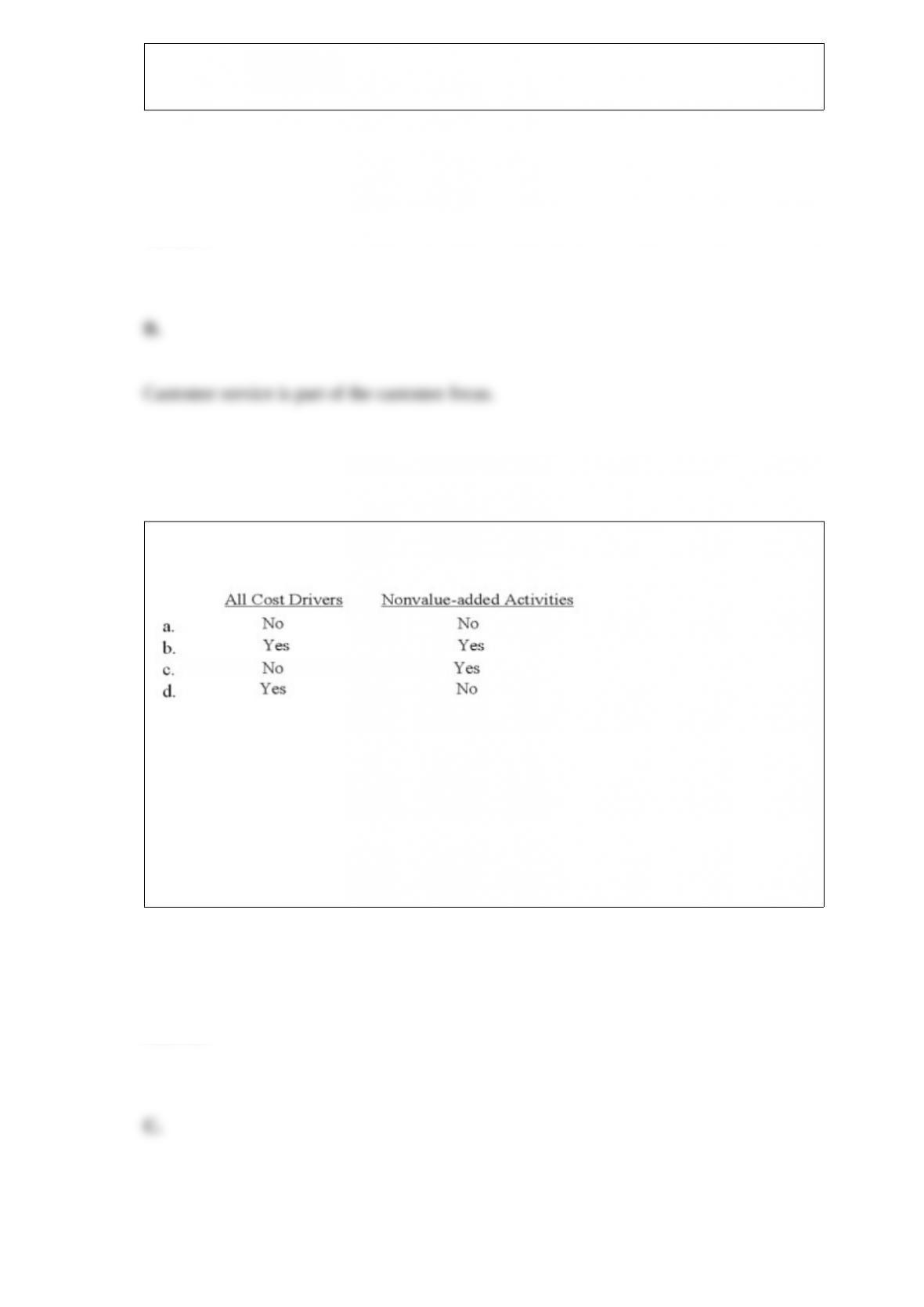
In an activity-based costing (ABC) system, cost reduction is accomplished by
identifying and eliminating (CPA adapted)
A. a
B. b
C. c
D. d
Answer:
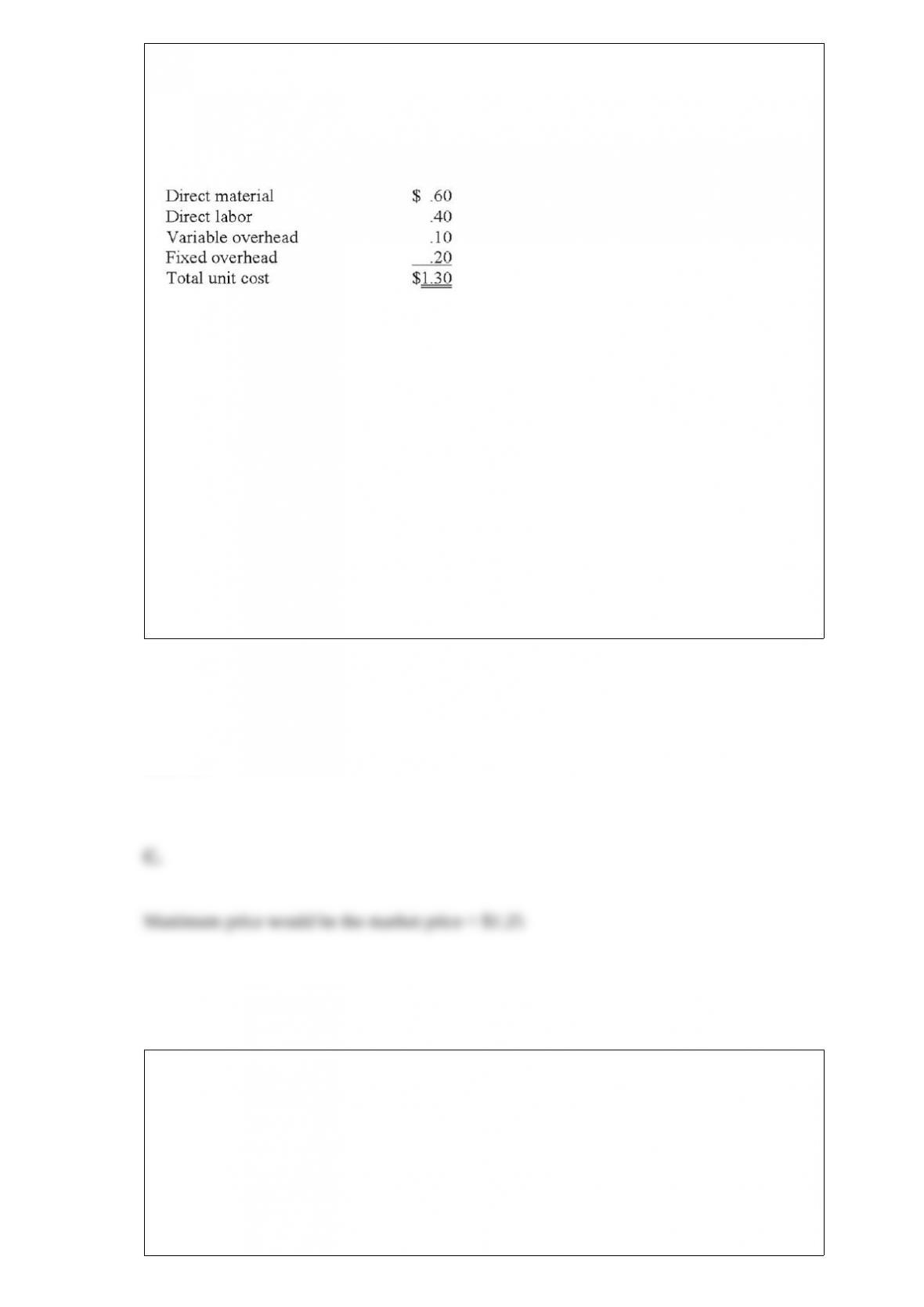
Cohasset Company currently manufactures all component parts used in the
manufacture of various hand tools. Hurley Division produces a steel handle used in
three different tools. The budget for these handles is 120,000 units with the following
unit cost.
Ironwood Division purchases 20,000 handles from Hurley Division and completes the
hand tools. An outside supplier, R & M Steel, has offered to supply 20,000 units of the
handle to Ironwood Division for $1.25 per unit. Hurley currently has idle capacity that
cannot be used.If Cohasset would like to develop a range of transfer prices, what would
be the maximum transfer price that Ironwood would be willing to pay?
A. $1.00
B. $1.10
C. $1.25
D. $1.30
Answer:
What is the company’s Cost of Goods Sold?
A. $164,190.00
B. $139,561.50
C. $252,600.00
D. $214,710.50
Answer:
Which of the following would be the least appropriate allocation base for allocating
overhead in a highly automated (i.e., capital-intensive) manufacturing company?
A. electricity used
B. machine hours
C. direct labor hours
D. material consumed
Answer:
Elk Creek Company produces precision components. Elk Creek has six customers, one
accounts for 40 percent of the sales, with the remaining five accounting for the rest of
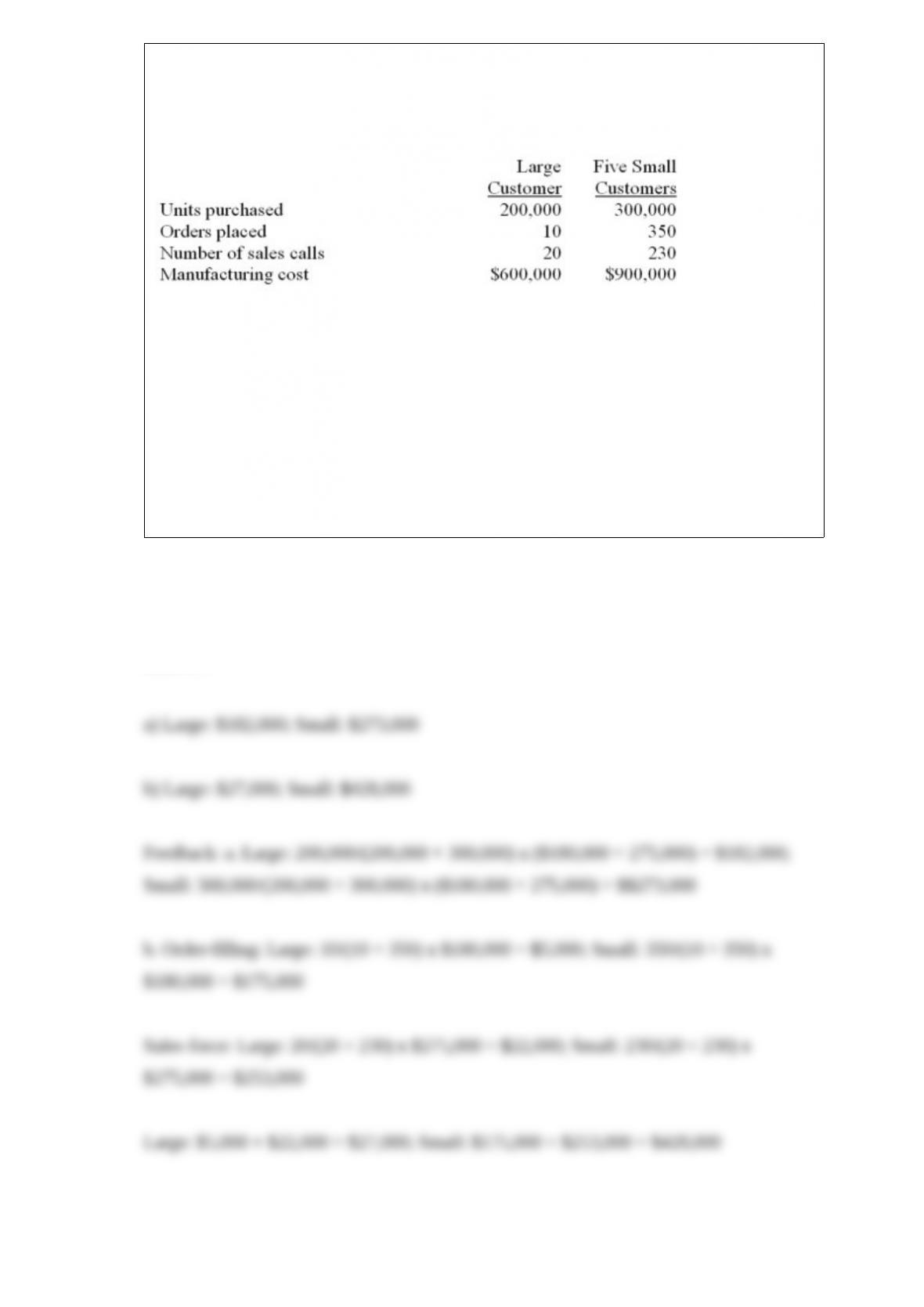
the sales. The five smaller customers purchase components in roughly equal quantities.
Orders placed by the smaller customers are about the same size. Data concerning Elk
Creek’s customer activity follow:
Order-filling costs for Elk Creek Company total $180,000, and sales-force costs are
$275,000.
Required:
a) Allocate the order-filling and sales force costs to the customers based on sales
volume?
b) Allocate the order-filling and sales force costs to the customers using an
activity-based costing approach?
Answer: