Assuming a present value factor of 1 for simplicity, what is the fair value of this
forward contract on December 31?
A) $160 asset
B) $160 liability
C) $140 asset
D) $140 liability
On December 31, 2014, Pinne Corporation sold equipment with a three-year remaining
useful life and a book value of $21,000 to its 70%-owned subsidiary, Sull Company, for
a price of $27,000. Pinne bought the equipment four years ago for $49,000. The salvage
value is zero. Straight-line depreciation is used by both companies.
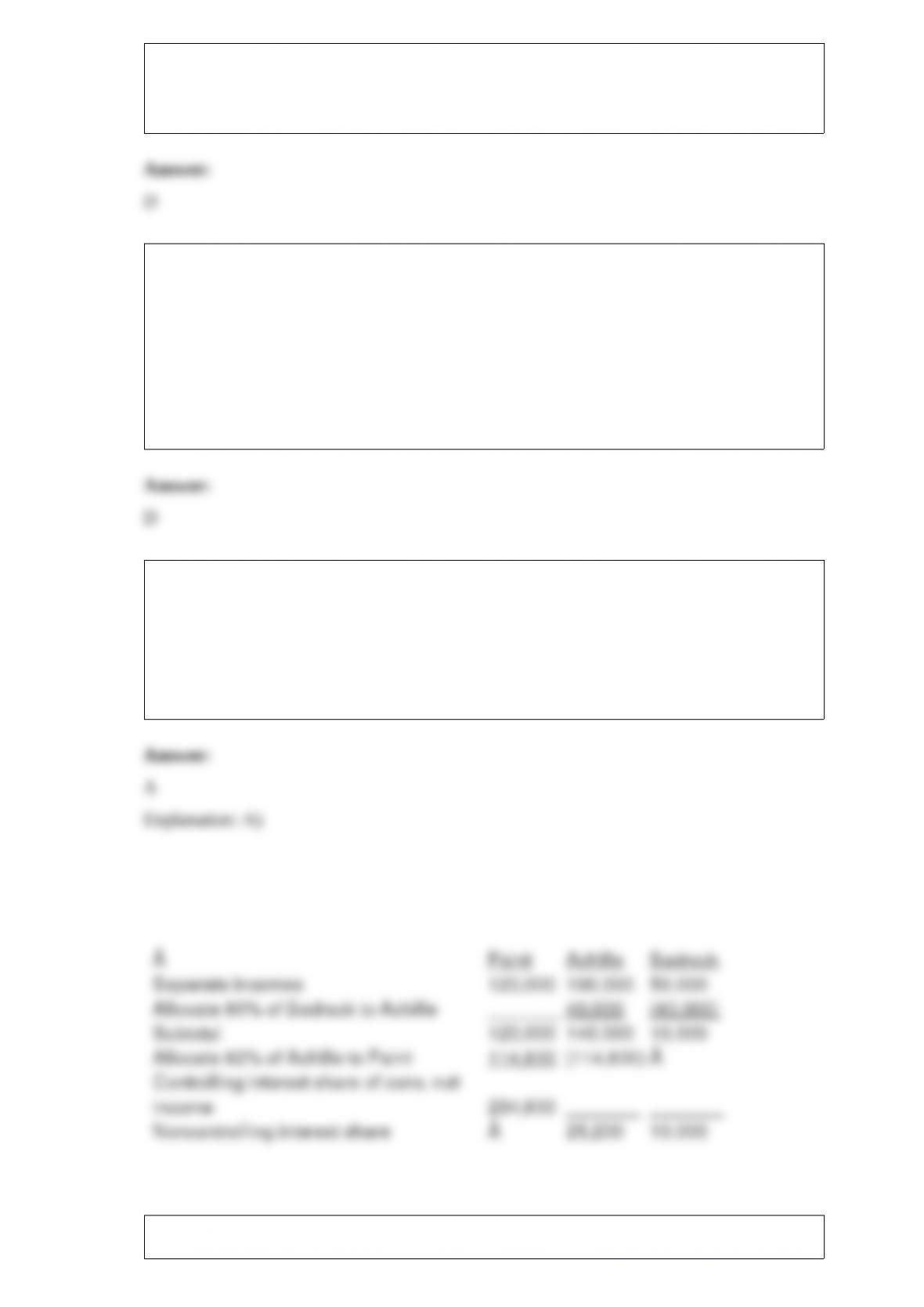
After eliminating/adjusting entries are prepared, what was the intercompany sale impact
on the consolidated financial statements for the year ended December 31, 2014?
Push-down accounting
A) requires a subsidiary to use the same accounting principles as its parent company.
B) is required when the parent company uses the equity method to account for its
investment in a subsidiary.
C) is required when the parent company uses the cost method to account for its
investment in a subsidiary.
D) is the process of recording the effects of the purchase price assignment directly on
the books of the subsidiary.
Following the accounting concept of a business combination, a business combination
occurs when a company acquires an equity interest in another entity and has
A) at least 20% ownership in the entity.
B) more than 50% ownership in the entity.
C) 100% ownership in the entity.
D) control over the entity, irrespective of the percentage owned.
The town of Mayberry receives a gift of $500,000 in bonds. The contributor instructs
that the principal should remain intact, but the annual interest income of $50,000 can be
used for the maintenance of the zoo animals.
The proper sequence of events is
A) purchase order, appropriation, encumbrance, expenditure.
B) purchase order, encumbrance, expenditure, appropriation.
C) appropriation, encumbrance, purchase order, expenditure.
D) appropriation, purchase order, encumbrance, expenditure.
Controlling interest share of consolidated net income for Paint Corporation and
Subsidiaries is:
A) $234,800.
B) $244,800.
C) $260,000.
D) $270,000.
Using the original information, the amount of consolidated Interest Expense for 2014
was
A) $ 135,000.
B) $ 180,000.
C) $ 270,000.
D) $ 360,000.
Durer Inc. acquired Sea Corporation in a business combination and Sea Corp went out
of existence. Sea Corp developed a patent listed as an asset on Sea Corp’s books at the
patent office filing cost. In recording the combination,
A) fair value is not assigned to the patent because the research and development costs
have been expensed by Sea Corp.
B) Sea Corp’s prior expenses to develop the patent are recorded as an asset by Durer at
purchase.
C) the patent is recorded as an asset at fair market value.
D) the patent’s market value increases goodwill.
Pitch Co. paid $50,000 in fees to its accountants and lawyers in acquiring Slope
Company. Pitch will treat the $50,000 as
A) an expense for the current year.
B) a prior period adjustment to retained earnings.
C) additional cost to investment of Slope on the consolidated balance sheet.
D) a reduction in additional paid-in capital.
Sadie Corporation’s stockholders’ equity at December 31, 2013 included the following:
Pilga Corporation purchased a 30% interest in Sadie’s common stock from other
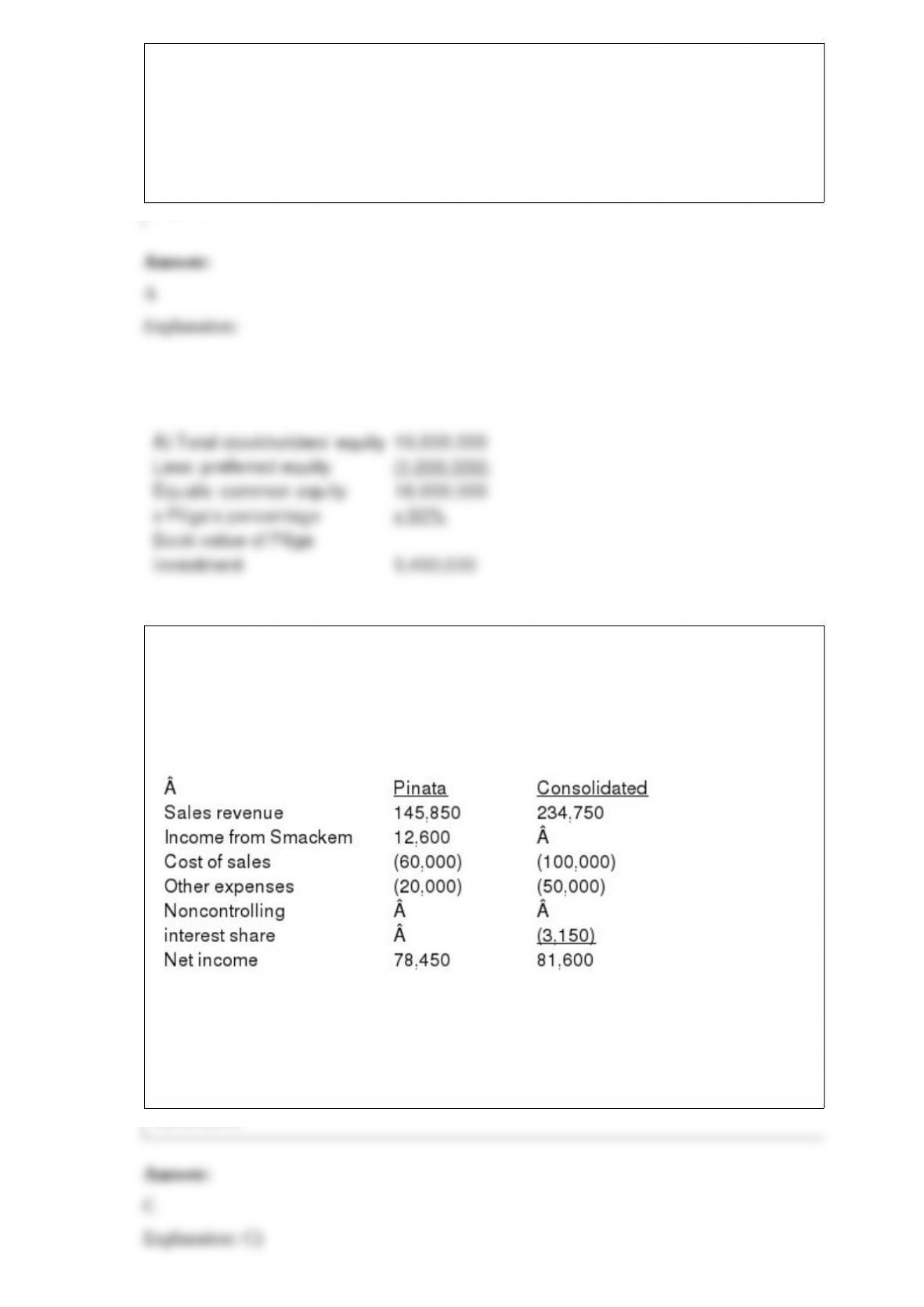
shareholders on January 1, 2014 for $5,800,000. What was the book value of Pilga’s
investment in Sadie on January 1, 2014?
A) $5,400,000
B) $5,700,000
C) $7,120,000
D) $7,440,000
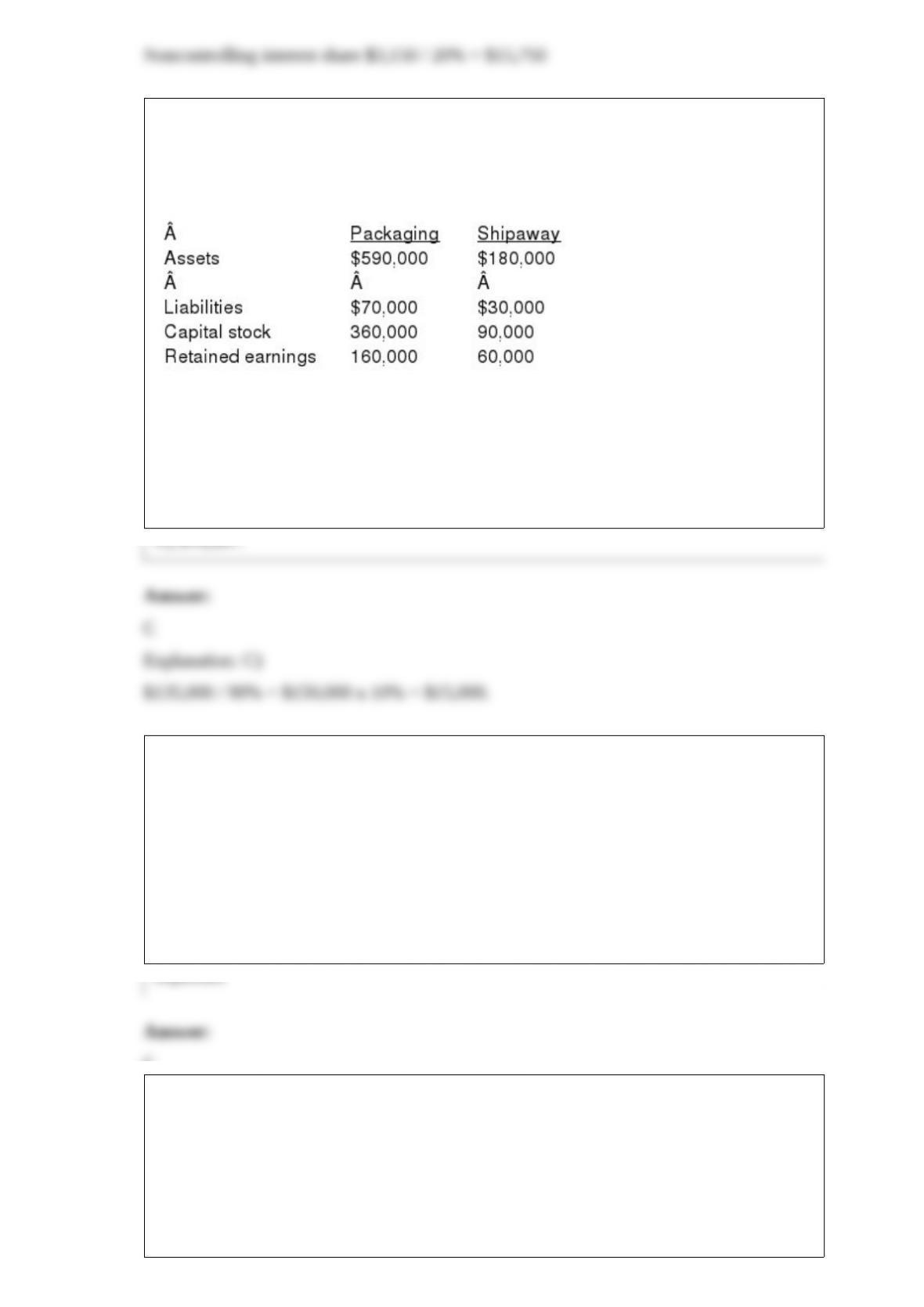
Pinata Corporation acquired an 80% interest in Smackem Inc. for $130,000 on January
1, 2014, when Smackem had Capital Stock of $125,000 and Retained Earnings of
$25,000. Assume the fair value and book value of Smackem’s net assets were equal on
January 1, 2014. Pinata’s separate income statement and a consolidated income
statement for Pinata and Subsidiary as of December 31, 2014, are shown below.
Smackem’s separate income statement must have reported net income of
A) $13,750.
B) $14,750.
C) $15,750.
D) $15,250.
On January 1, 2014, Packaging International purchased 90% of Shipaway Corporation’s
outstanding shares for $135,000 when the fair value of Shipaway’s net assets were equal
to the book values. The balance sheets of Packaging and Shipaway Corporations at
year-end 2013 are summarized as follows:
If a consolidated balance sheet was prepared immediately after the business
combination, the noncontrolling interest would be
A) $9,000.
B) $13,500.
C) $15,000.
D) $16,667.
In the business combination of Polka and Spot,
A) all of the items listed above are treated as expenses.
B) all of the items listed above except the cost of registering and issuing the securities
are included in the purchase price.
C) the costs of registering and issuing the securities are deducted from the fair market
value of the common stock used to acquire Spot.
D) only the costs of closing duplicate facilities, the salaries of Polka’s employees
assigned to the merger, and the costs of the shareholders’ meeting would be treated as
expenses.
In reference to international accounting for goodwill, U.S. companies have complained
that past U.S. accounting rules for goodwill placed them at a disadvantage in competing
against foreign companies for merger partners. Why?
A) Previous rules required immediate write off of goodwill which resulted in a one-time
expense that was not required under international rules.
B) Previous rules required amortization of goodwill which resulted in an ongoing
expense that was not required under international rules.
C) Previous rules did not permit the recording of goodwill, thus resulting in a lower
asset base than international counterparts would recognize.
D) All of the above are correct.
The net income reported for Pahm Corporation for the current year is
A) $504,800.
B) $516,800.
C) $545,200.
D) $557,200.
Assume Paris’s land account had a book value of $50,000 and a fair value of $70,000 on
January 1, 2014. Using the parent company and entity theories, what amounts would be
reported on the consolidated balance sheet at January 1, 2014 for the land account?
A)
B)
C)
D)
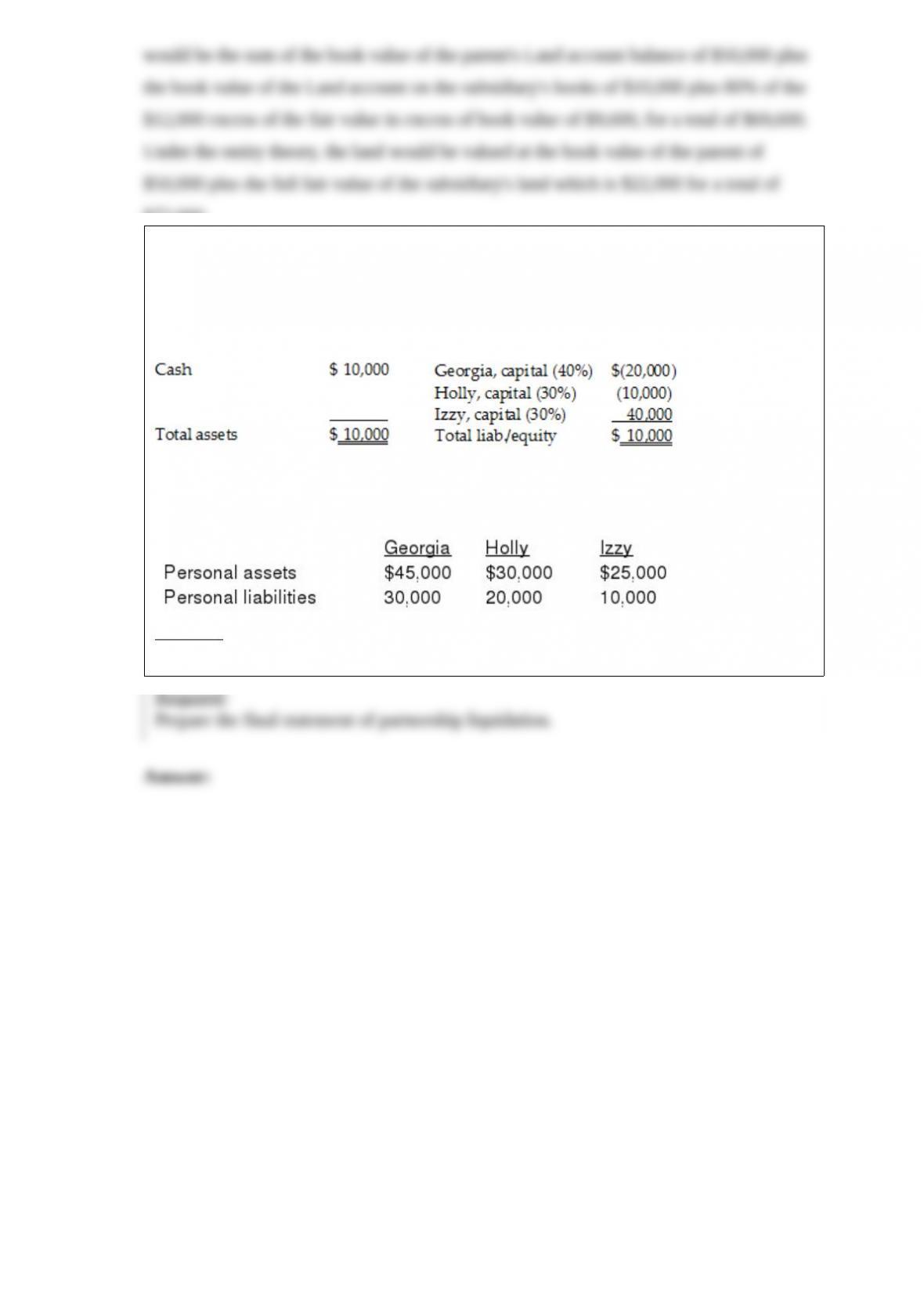
The partnership of Georgia, Holly, and Izzy was dissolved, and by July 1, 2014, all
assets had been converted into cash and all partnership liabilities were paid. The
partnership balance sheet on July 1, 2014 (with partner residual profit and loss sharing
percentages) was as follows:
The value of the partners’ personal assets and liabilities on July 1, 2014 were as follows:
Required:
Prepare the final statement of partnership liquidation.
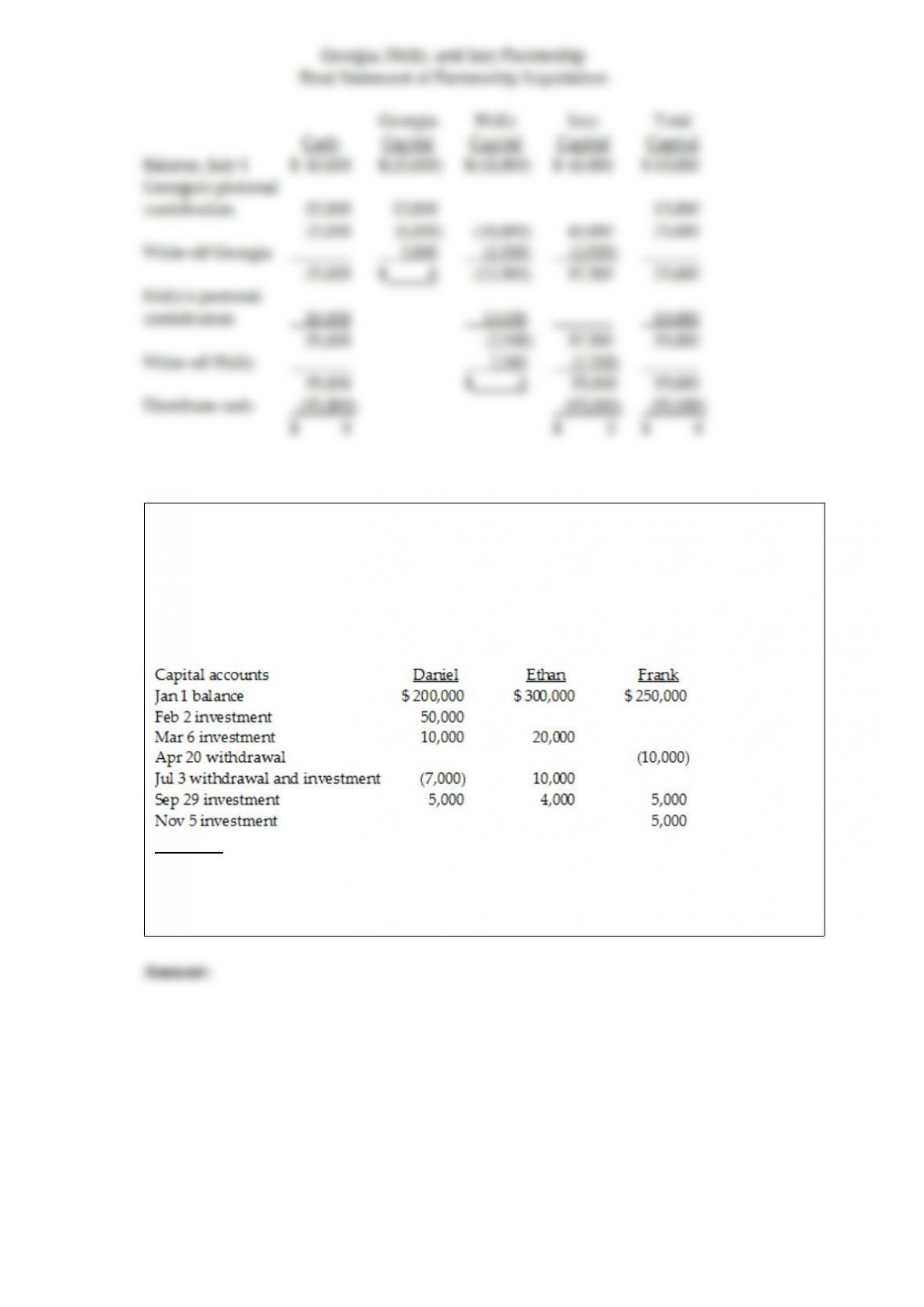
Daniel, Ethan, and Frank have a retail partnership business selling personal computers.
The partners are allowed an interest allocation of 8% on their average capital. Capital
account balances on the first day of each month are used in determining weighted
average capital, regardless of additional partner investment or withdrawal transactions
during any given month. Withdrawals of capital that are debited to the capital account
are used in the average calculation. Partner capital activity for the year was:
Required:
Calculate weighted average capital for each partner, and determine the amount of
interest that each partner will be allocated. Round all calculations to the nearest whole
dollar.
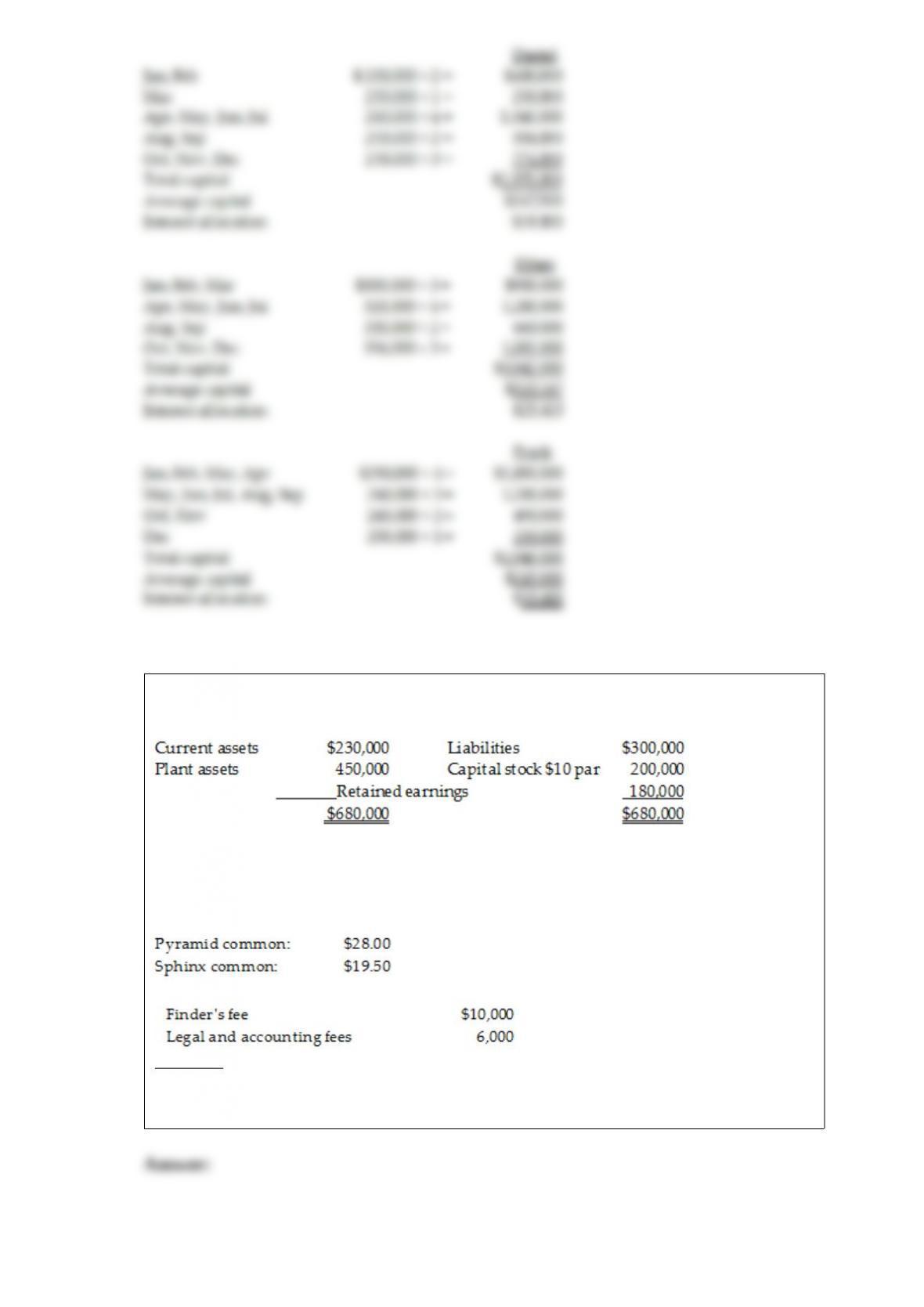
Balance sheet information for Sphinx Company at January 1, 2013, is summarized as
follows:
Sphinx’s assets and liabilities are fairly valued except for plant assets that are
undervalued by $50,000. On January 2, 2013, Pyramid Corporation issues 20,000
shares of its $10 par value common stock for all of Sphinx’s net assets and Sphinx is
dissolved. Market quotations for the two stocks on this date are:
Pyramid pays the following fees and costs in connection with the combination:
Required:
1.Calculate Pyramid’s investment cost of Sphinx Corporation.
2.Calculate any goodwill from the business combination.

Ending Company is in bankruptcy and is being liquidated under the provisions of
Chapter 7 of the bankruptcy code. The trustee has converted all assets into $80,000 cash
(which includes the amounts shown below for assets sold) and has prepared the
following list of approved claims:
Property taxes payable$10,000
Accounts payable, unsecured30,000
Mortgage payable, secured by property that was sold for $50,00030,000
Note payable to bank, secured by all accounts receivable of which $20,000
was able to be collected and the balance was written off30,000
Required:
How much will the bank receive on the note payable?
At January 1, 2013, the stockholders’ equity of Raven Corporation and its 60%-owned
subsidiary, Trunk Corporation, are as follows:
RavenTrunk
Common stock, $10 par value$700,000$400,000
Retained earnings800,00050,000
Totals$1,500,000$450,000
Trunk’s net income for 2013 was $40,000. No dividends were declared or paid in 2013.
Raven’s Investment in Trunk account balance on December 31, 2013 was equal to its
underlying equity on December 31, 2013. Trunk Corporation issued 10,000 additional
shares of common stock directly to Raven on January 1, 2014 at $22 per share.
Required:
1. Compute the balance in Raven’s Investment in Trunk account on January 1, 2014
after its purchase of the additional Trunk shares.
2. Determine the increase or decrease in goodwill stemming from Raven’s investment in
the 10,000 Trunk shares. Assume the fair value and book value of Trunk’s assets and
liabilities are equal.
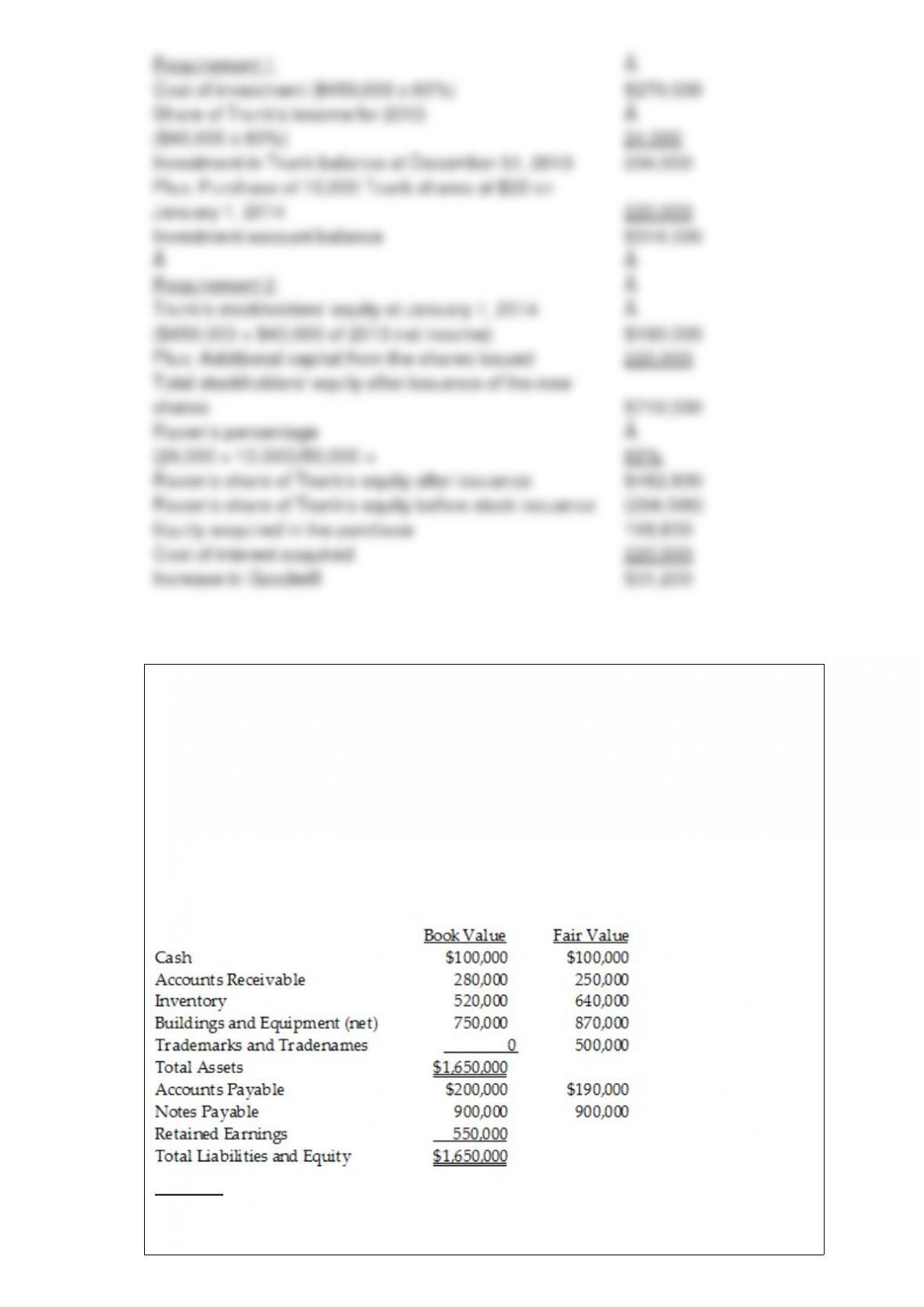
At December 31, 2013, Pandora Incorporated issued 40,000 shares of its $20 par
common stock for all the outstanding shares of the Sophocles Company. In addition,
Pandora agreed to pay the owners of Sophocles an additional $200,000 if a specific
contract achieved the profit levels that were targeted by the owners of Sophocles in
their sale agreement. The fair value of this amount, with an agreed likelihood of
occurrence and discounted to present value, is $160,000. In addition, Pandora paid
$10,000 in stock issue costs, $40,000 in legal fees, and $48,000 to employees who were
dedicated to this acquisition for the last three months of the year. Summarized balance
sheet and fair value information for Sophocles immediately prior to the acquisition
follows.
Required:
1.Prepare Pandora’s general journal entry for the acquisition of Sophocles assuming that
Pandora’s stock was trading at $35 at the date of acquisition and Sophocles dissolves as
a separate legal entity.
2.Prepare Pandora’s general journal entry for the acquisition of Sophocles assuming that
Pandora’s stock was trading at $35 at the date of acquisition and Sophocles continues as
a separate legal entity.
3.Prepare Pandora’s general journal entry for the acquisition of Sophocles assuming that
Pandora’s stock was trading at $25 at the date of acquisition and Sophocles dissolves as
a separate legal entity.
4.Prepare Pandora’s general journal entry for the acquisition of Sophocles assuming that
Pandora’s stock was trading at $25 at the date of acquisition and Sophocles survives as a
separate legal entity.
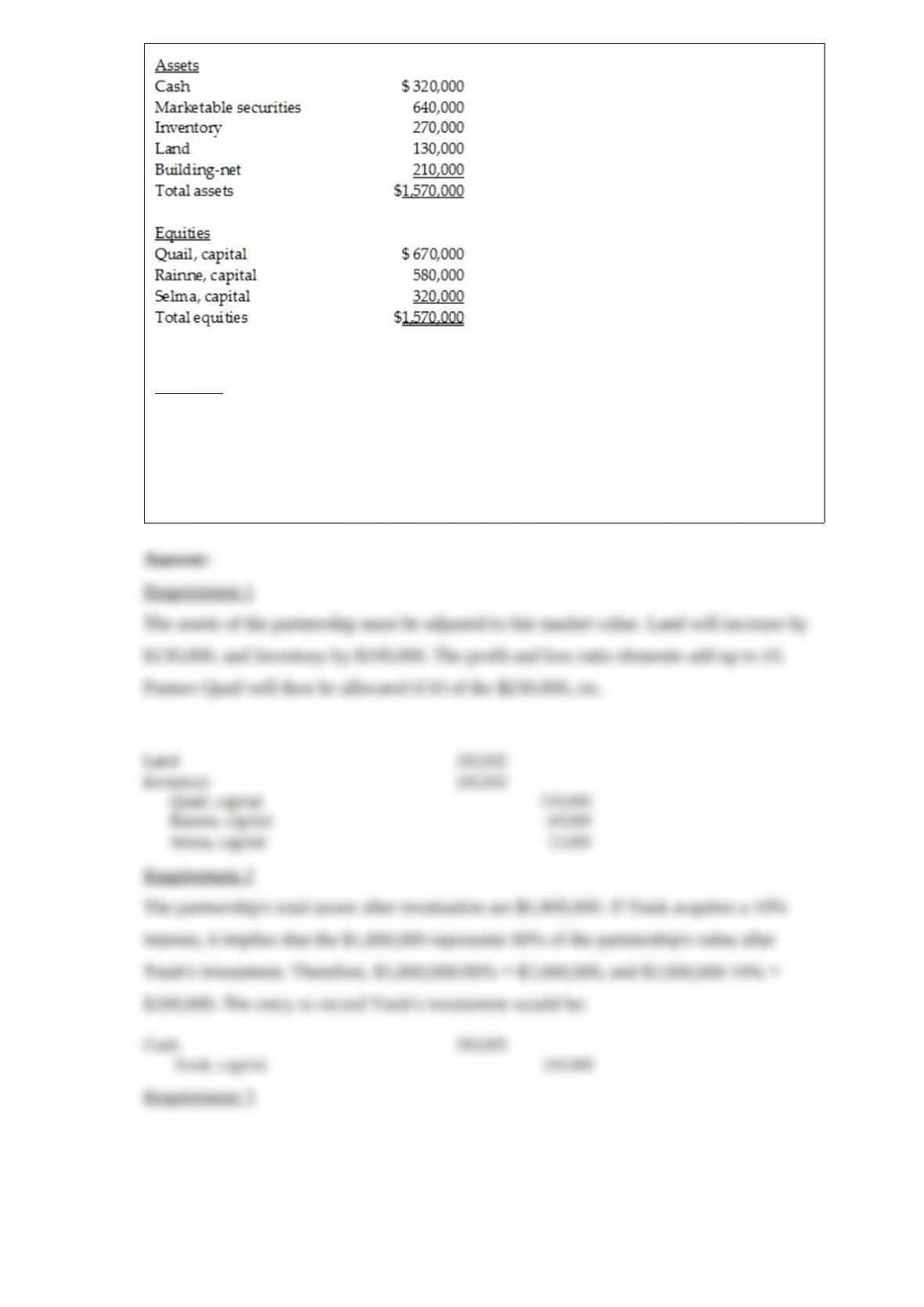
A summary balance sheet for the partnership of Quail, Rainne and Selma on December
31, 2014 is shown below. Partners Quail, Rainne and Selma allocate profit and loss in
their respective ratios of 6:3:1.
The partners agree to admit Trask for a one-tenth interest. The fair market value for
partnership land is $260,000, and the fair market value of the inventory is $370,000.
Required:
1.Record the entry to revalue the partnership assets prior to the admission of Trask.
2.Calculate how much Trask will have to invest to acquire a 10% interest.
3.Assume the partnership assets are not revalued. If Trask paid $300,000 to the
partnership in exchange for a 10% interest, what would be the bonus that is allocated to
each partner’s capital account?
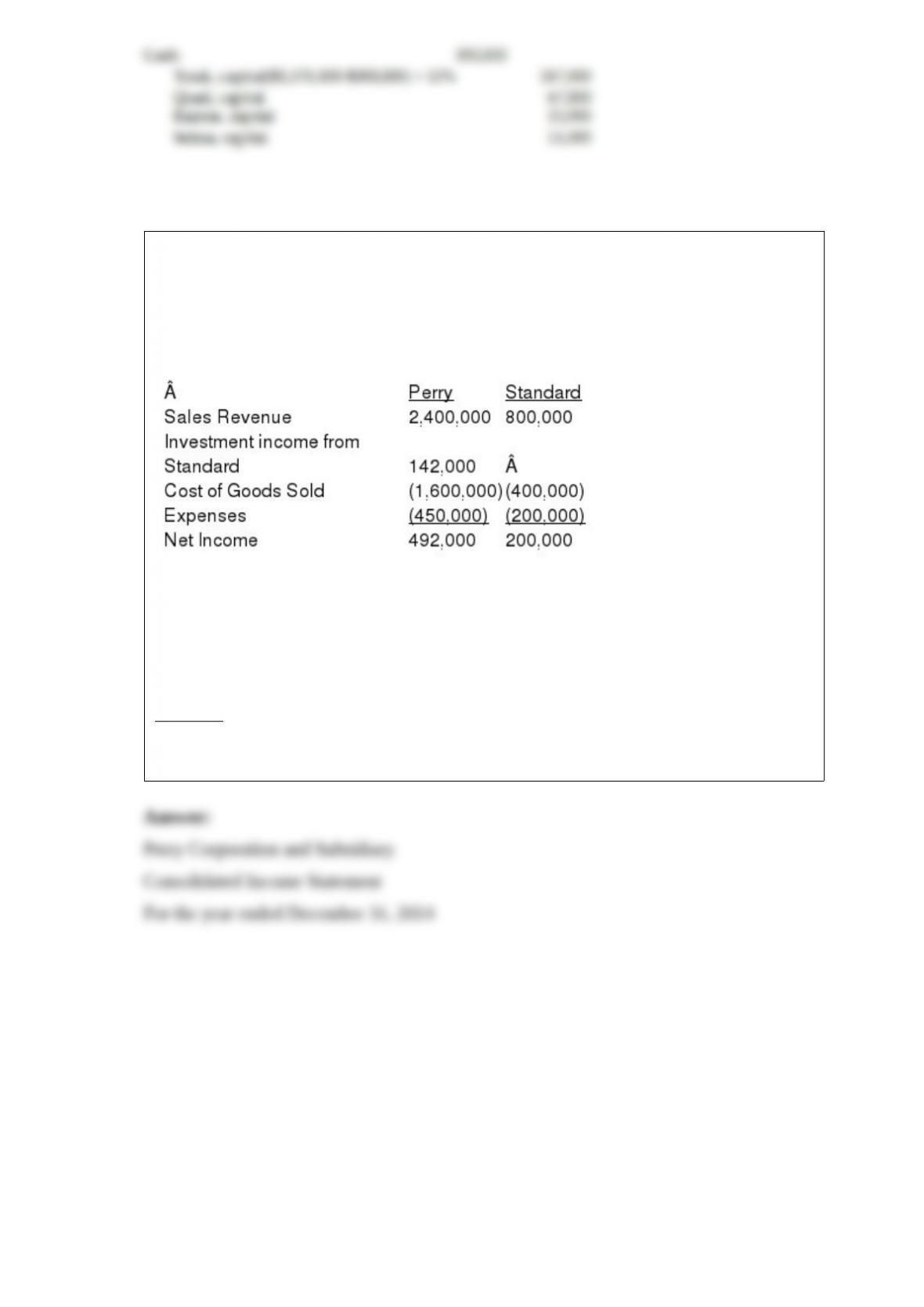
Perry Instruments International purchased 75% of the outstanding common stock of
Standard Systems in 1997 when the book values and fair values of Standard’s assets and
liabilities were equal. The cost of Perry’s investment was equal to 75% of the book
value of Standard’s net assets. Separate company income statements for Perry and
Standard for the year ended December 31, 2014 are summarized as follows:
During 2014, the companies began to manage their inventory differently, and worked
together to keep their inventories low at each location. In doing so, they agreed to sell
inventory to each other as needed at a markup of 10% of cost. Perry sold merchandise
that cost $100,000 to Standard for $110,000, and Standard sold inventory that cost
$80,000 to Perry for $88,000. Half of this merchandise remained in each company’s
inventory at December 31, 2014.
Required:
Prepare a consolidated income statement for Perry Corporation and Subsidiary for
2014.
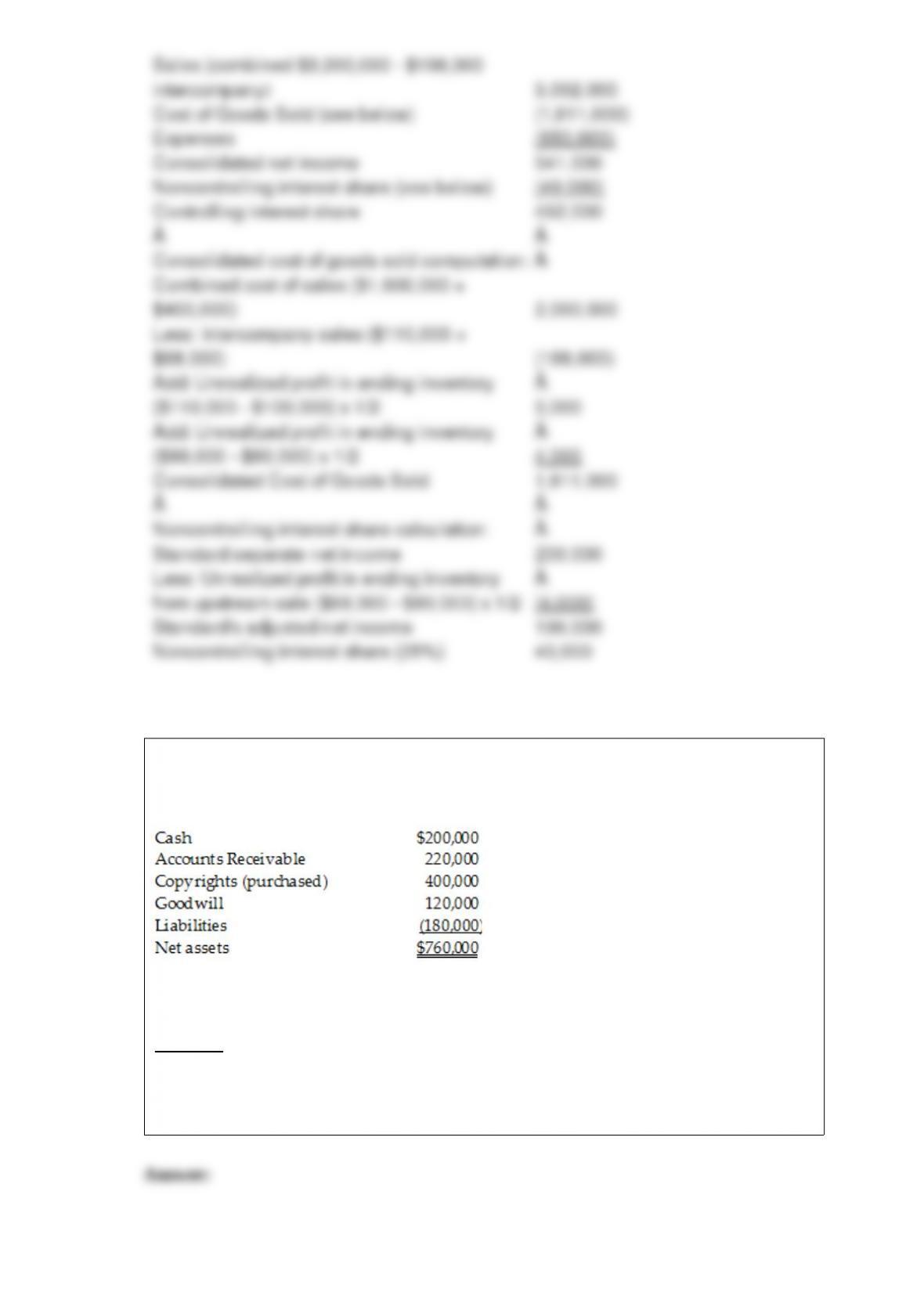
On January 2, 2013, Pilates Inc. paid $700,000 for all of the outstanding common stock
of Spinning Company, and dissolved Spinning Company. The carrying values for
Spinning Company’s assets and liabilities are recorded below.
On January 2, 2013, Spinning anticipated collecting $185,000 of the recorded Accounts
Receivable. Pilates entered into the acquisition because Spinning had Copyrights that
Pilates wished to own, and also unrecorded patents with a fair value of $100,000.
Required:
Calculate the amount of goodwill that will be recorded on Pilate’s balance sheet as of
the date of acquisition. Then record the journal entry Pilates would record on their
books to record the acquisition.