The withdrawals account of each partner is closed to retained earnings at the end of the
accounting period.
Partners can invest both assets and liabilities into a partnership.
Times interest earned can be calculated by multiplying income by the interest rate on a
company’s debt.
Activity-based budgeting is a budget system based on expected activities and their
activity levels, which helps management plan for the resources required.

Employers are required to pay local, state, and federal payroll taxes.
A voucher system establishes procedures for verifying, approving, and recording
obligations for eventual cash disbursement.
The accounting equation can be restated as: Assets – Equity = Liabilities.

The direct write-off method of accounting for bad debts records the loss from an
uncollectible account receivable when it is determined to be uncollectible.
Sparrow Company had net income of $63,000. At January 1, there were 8,000 shares of
common stock outstanding. On July 1, the company issued an additional 2,000 shares
of common stock. The earnings per share equals $7.00 per share.
Technologically advanced accounting systems do not need monitoring for errors
because computers always process transactions correctly.
Overapplied or underapplied overhead should be removed from the Factory Overhead
account at the end of each accounting period.
Coors reported net sales of $2,463 million and average total assets of $1,546 million. Its
total asset turnover equals 1.59.
Unearned revenues is another name for sales.
The materiality constraint permits the use of the direct write-off method of accounting
for uncollectible accounts when bad debts are very large in relation to a company’s
other financial statement items such as sales and net income.

Trend analysis is a form of horizontal analysis that can reveal patterns in data across
successive periods.
The number of equivalent units of production assigned to ending goods in process
inventory should usually be equal to or less than the number of physical units in ending
goods in process inventory.
The master budget consists of three major groups of budget components: the operating
budgets, the capital expenditures budgets, and the financial budgets.
Good internal control dictates that a person who controls an asset also maintains that
asset’s accounting records.
Working capital is computed as current liabilities minus current assets.
A bond listed at 103 on a stock exchange is selling at 103% of its par value.
Closing entries are designed to transfer the end-of-period balances in the revenue
accounts, the expense accounts, and the withdrawals account to owner’s capital.

Notes receivable are classified as current liabilities.
The days’ sales in inventory ratio is computed by dividing ending inventory by cost of
goods sold and multiplying the result by 365.
The business entity principle means that a business will continue operating for an
indefinite period of time.
Input devices include journal entries, keyboards, scanners, and modems.

Neither the payback period nor the accounting rate of return methods of evaluating
investments considers the time value of money.
In a job order cost accounting system, any immaterial underapplied overhead at the end
of the period can be charged entirely to Cost of Goods Sold.
The extent, or relative size, of fixed costs in the total cost structure is known as
operating leverage.

An asset’s cost includes all normal and reasonable expenditures necessary to get the
asset in place and ready for its intended use.
Payments of FUTA are made quarterly to a federal depository bank if the total amount
due exceeds $1,000.
Intangible assets are long-term resources that benefit business operations that usually
lack physical form and have uncertain benefits.
Managerial accounting information can be forwarded to the managers of a company

quickly since external auditors do not have to review it, and estimates and projections
are acceptable.
A company purchased a plant asset for $45,000. The asset has an estimated salvage
value of $6,000, and an estimated useful life of 10 years. The annual depreciation
expense using the straight-line method is $3,900 per year.
Activity cost pools are an important part of the allocation of overhead costs using
activity-based costing.
A schedule of accounts receivable is a listing of all creditor accounts and account
balances.
The full disclosure principle requires the reporting of contingent liabilities that are
reasonably possible.
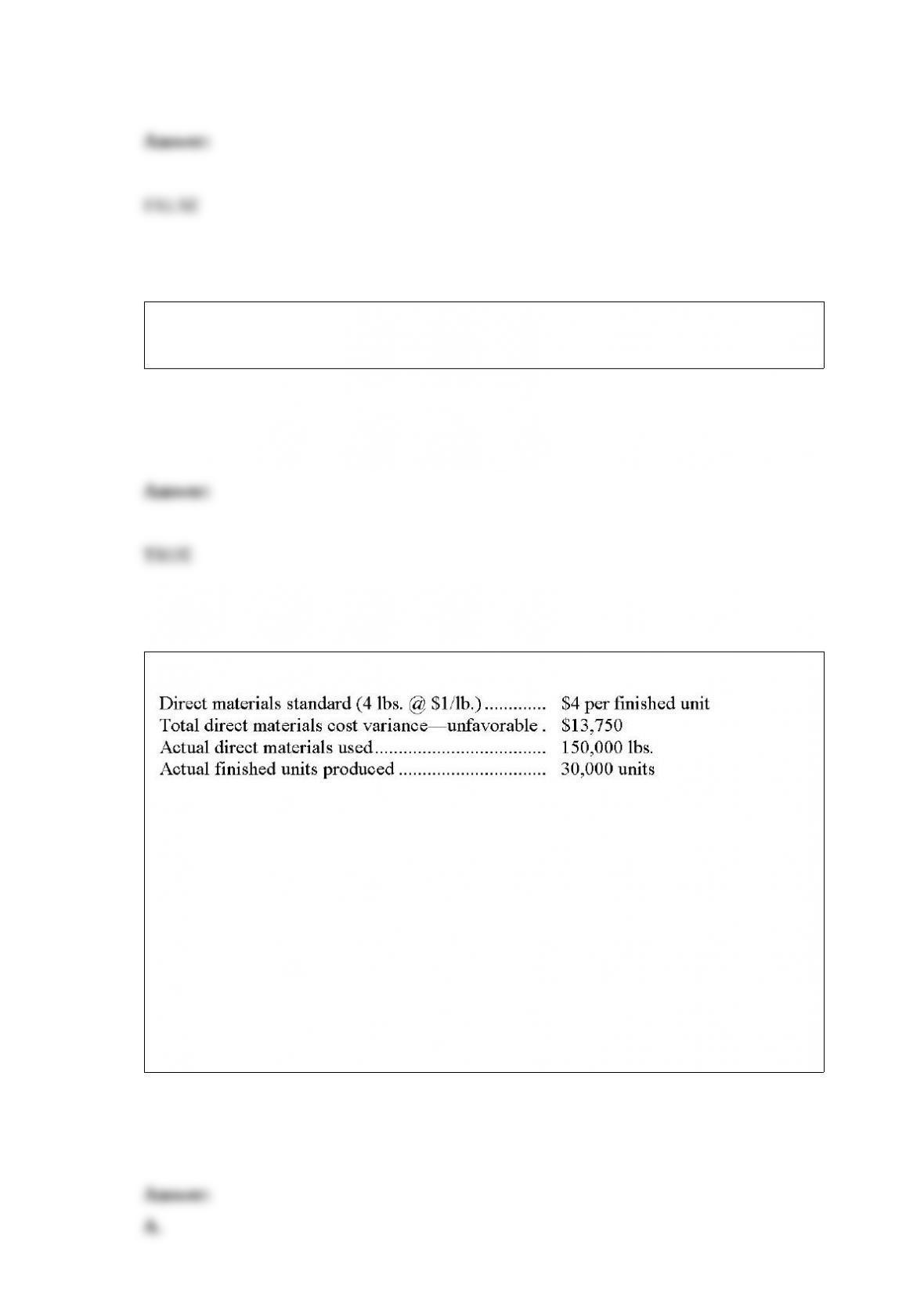
Kyle, Inc., has collected the following data on one of its products:
The actual cost of the direct materials used is:
A.$133,750.
B.$150,000.
C.$106,250.
D.$158,750.
E.$120,000.
An exchange of value between two entities is called:
A.The accounting equation.
B.Recordkeeping or bookkeeping.
C.A business transaction.
D.An asset.
E.Net Income.
A company had the following direct materials cost information:
What was the cost variance?
A.$2,500 Favorable.
B.$78,250 Favorable
C.$78,250 Unfavorable
D.$80,750 Favorable.
E.$80,750 Unfavorable.
The accounting principle that requires financial statements (including notes) to report
all relevant information about the operations and financial condition of a company is
called:
A.Relevance.
B.Full disclosure.
C.Evaluation.
D.Materiality.
E.Matching.
A type of production that yields customized products or services for each customer is
called:
A.Customer orientation production.
B.Job order production.
C.Just-in-time production.
D.Job lot production.
E.Process production.
A limited partnership:
A.Includes a general partner with unlimited liability.
B.Is subject to double taxation.
C.Has owners called stockholders.
D.Is the same as a corporation.
E.May only have two partners.
A corporation reported cash of $14,000 and total assets of $178,300. Its common-size
percent for cash equals:
A..0785%.
B.7.85%.
C.12.73%.
D.1273%.
E.7850%.
A company used the percent of sales method to determine its bad debts expense. At the
end of the current year, the company’s unadjusted trial balance reported the following
selected amounts:
All sales are made on credit. Based on past experience, the company estimates 0.6% of
credit sales to be uncollectible. What adjusting entry should the company make at the
end of the current year to record its estimated bad debts expense?
A.
B.
C.
D.
E.
A statement of cash flows should reconcile the differences between the beginning and
ending balances of:
A.Net income.
B.Equity.
C.Cash and cash equivalents.
D.Working capital.
E.Cash, cash equivalents, and short-term investments.
Creditors’ claims on the assets of a company are called:
A.Net losses.
B.Expenses.
C.Revenues.
D.Equity.
E.Liabilities.
The private group that currently has the authority to establish generally accepted
accounting principles is the:
A.APB.
B.FASB.
C.AAA.
D.AICPA.
E.SEC.
Prepaid expenses are:
A.Payments made for products and services that do not ever expire.
B.Classified as liabilities on the balance sheet.
C.Decreases in equity.
D.Assets that represent prepayments of future expenses.
E.Promises of payments by customers.
A company made an error in recording the 2009 purchase of machinery. This was
discovered in 2011. The item should be reported as a prior period adjustment:
A.on the 2009 statement of retained earnings.
B.on the 2009 income statement.
C.on the 2011 statement of retained earnings.
D.on the 2011 income statement.
E.accounted for with a cumulative “catch-up” adjustment.
Long-term liability data for the budgeted balance sheet is derived from:
A.The cash budget and capital expenditures budget.
B.The cash budget and sales budget.
C.The cash budget and budgeted income statement.
D.The sales budget and production budget.
E.The asset budget and debt budget.
An approach to managing inventories and production operations such that units of
materials and products are obtained and provided only as they are needed is called:
A.Continuous improvement.
B.Customer orientation.
C.Just-in-time manufacturing.
D.Theory of constraints.
E.Total quality management.
Unearned revenues are:
A.Also called deferred revenues.
B.Amounts received in advance from customers for future delivery of products or
services.
C.Also called collections in advance.
D.Also called prepayments.
E.All of these.
Preparation of the statement of cash flows involves:
A.Computing the net increase or decrease in cash.
B.Computing and reporting net cash provided or used by operations.
C.Computing and reporting net cash provided or used by investing activities.
D.Computing and reporting net cash provided or used by financing activities.
E.All of these.
A company issued 60 shares of $100 par value stock for $7,000 cash. The total amount
of paid-in capital in excess of par is:
A.$ 100.
B.$ 600.
C.$1,000.
D.$6,000.
E.$7,000.
Next year’s sales forecast shows that 20,000 units of Product A and 22,000 units of
Product B are going to be sold for prices of $10 and $12, respectively. The desired
ending inventory of Product A is 20% higher than its beginning inventory of 2,000
units. The beginning inventory of Product B is 2,500 units. The desired ending
inventory of B is 3,000 units.
Budgeted purchases of Product A for the year would be:
A.22,400 units.
B.20,400 units.
C.20,000 units.
D.19,500 units.
E.12,200 units.
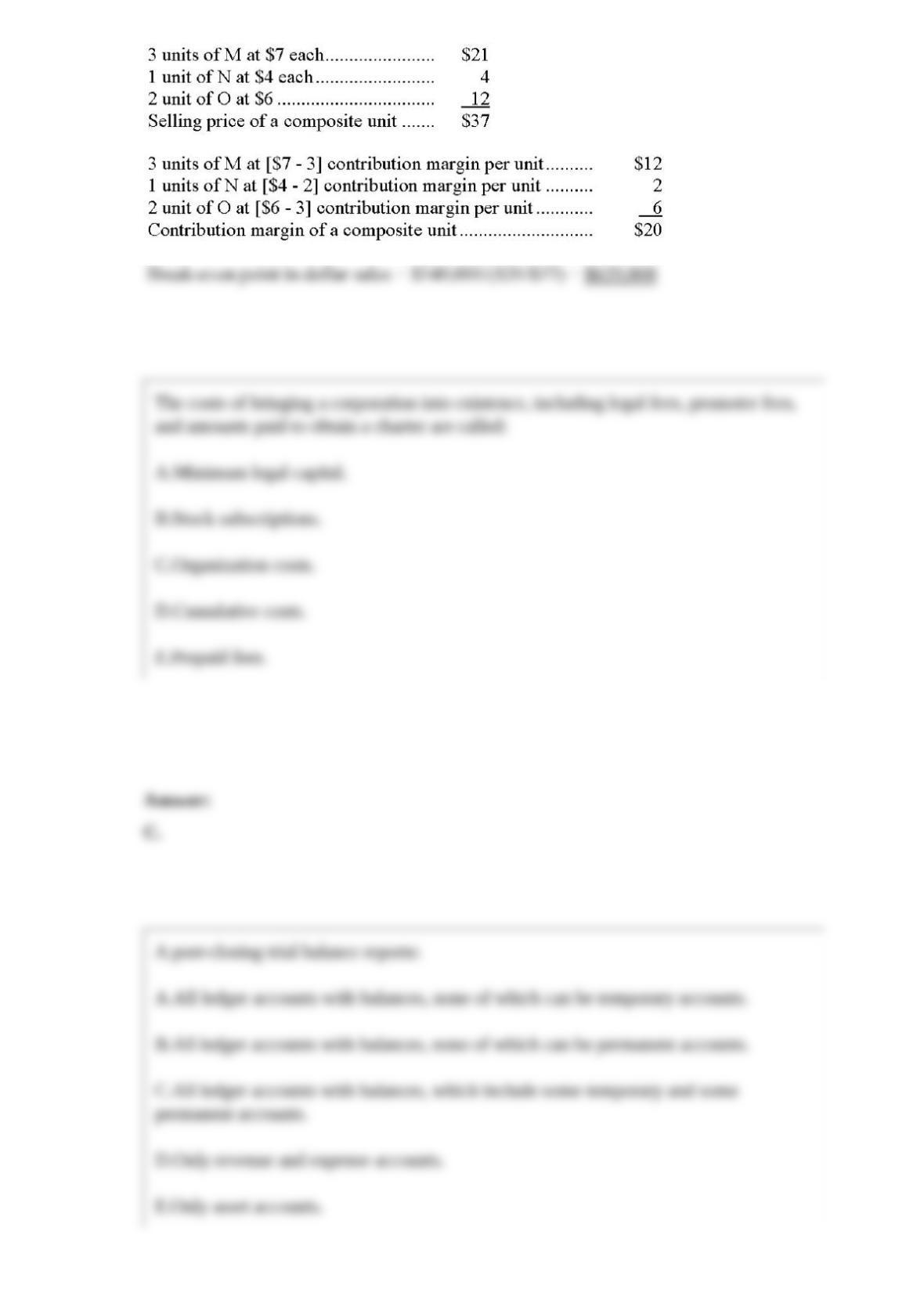
Camden Corporation sells three products (M, N, and O) in the following mix: 3:1:2.
Unit price and cost data are:
Total fixed costs are $340,000. The break-even point in sales dollars for the current
sales mix is:
A.$ 20,000.
B.$289,000.
C.$400,000.
D.$629,000.
E.$740,000.
The costs of bringing a corporation into existence, including legal fees, promoter fees,
and amounts paid to obtain a charter are called:
A.Minimum legal capital.
B.Stock subscriptions.
C.Organization costs.
D.Cumulative costs.
E.Prepaid fees.
A post-closing trial balance reports:
A.All ledger accounts with balances, none of which can be temporary accounts.
B.All ledger accounts with balances, none of which can be permanent accounts.
C.All ledger accounts with balances, which include some temporary and some
permanent accounts.
D.Only revenue and expense accounts.
E.Only asset accounts.
A firm sells two products, A and B. For every unit of A the firm sells, two units of B are
sold. The firm’s total fixed costs are $1,612,000. Selling prices and cost information for
both products follow:
What is the firm’s break-even point in units of A and B?
A.31,000 of A and 31,000 of B.
B.31,000 of A and 62,000 of B.
C.10,333 of A and 20,667 of B.
D.36,167 of A and 72,333 of B.
E.62,000 of A and 31,000 of B.
Montaigne Corp. has the following information about its standards and production
activity in November:
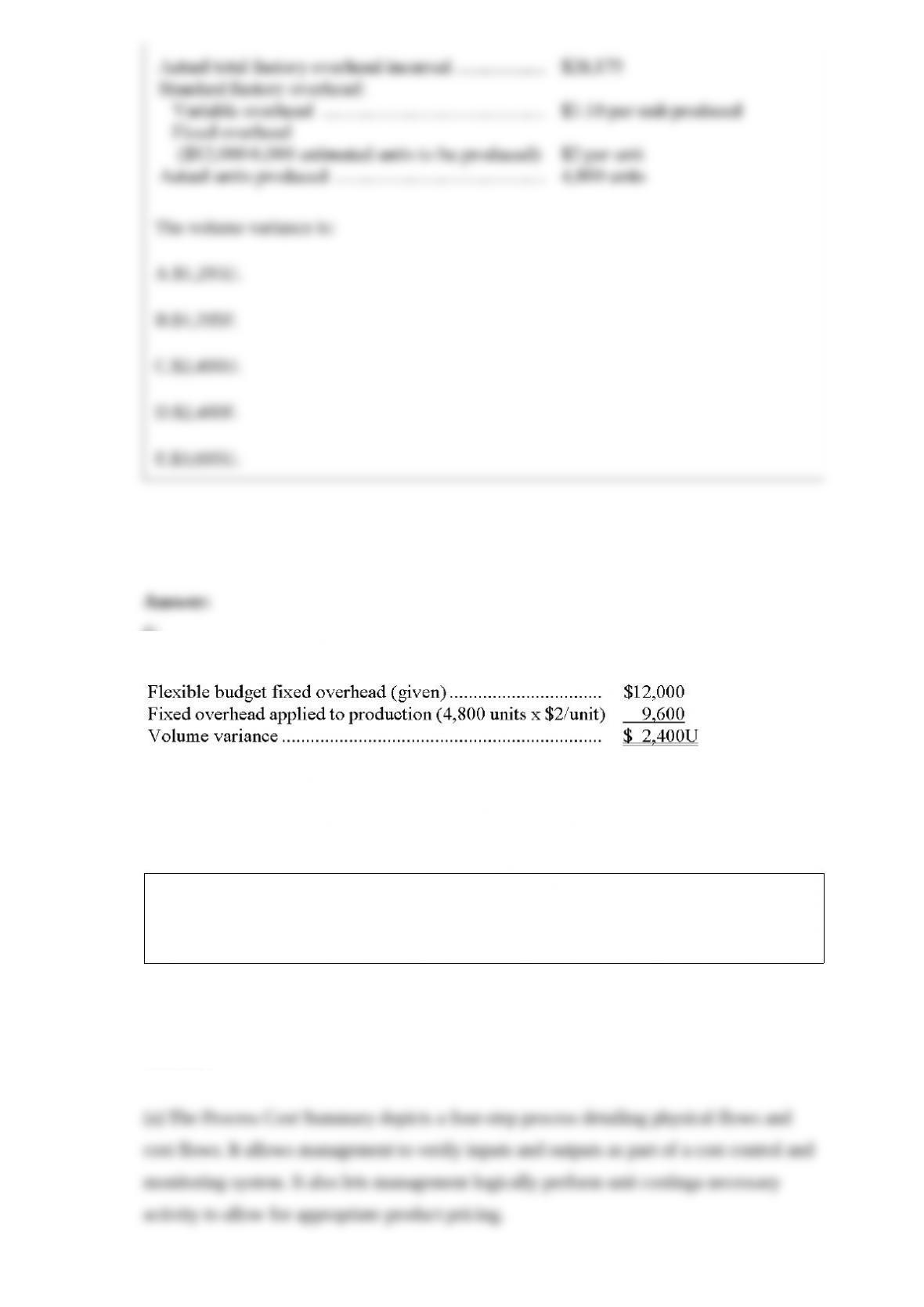
The volume variance is:
A.$1,295U.
B.$1,295F.
C.$2,400U.
D.$2,400F.
E.$3,695U.
On June 30 of the current year, the assets and liabilities of Phoenix Phildell are as
follows: Cash $20,500; Accounts Receivable, $7,250; Supplies, $650; Equipment,
$12,000; Accounts Payable, $9,300. What is the amount of owner’s equity as of July 1
of the current year?
A.$8,300
B.$13,050
C.$20,500
D.$31,100
E.$40,400
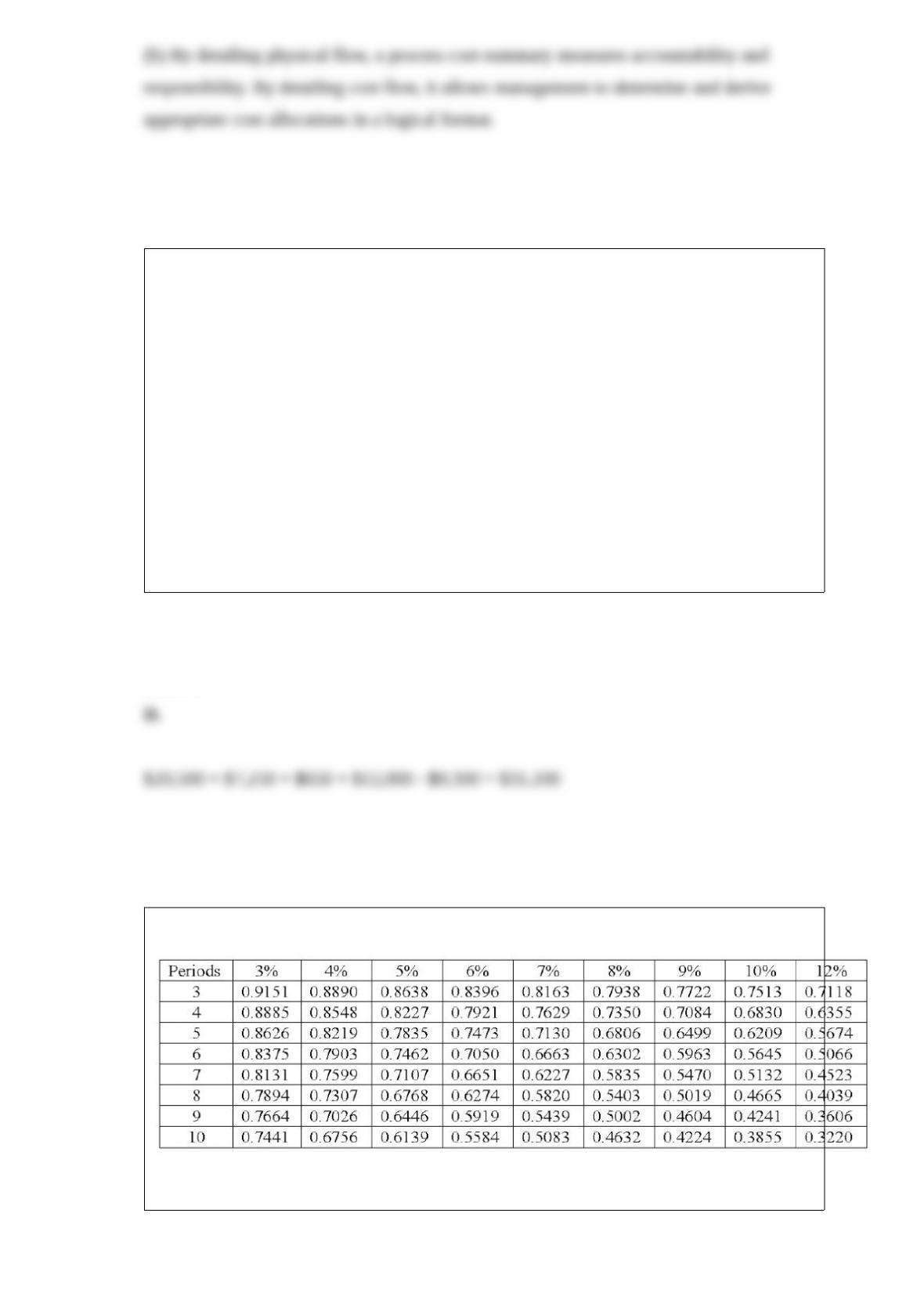
Present Value of 1
Future Value of 1
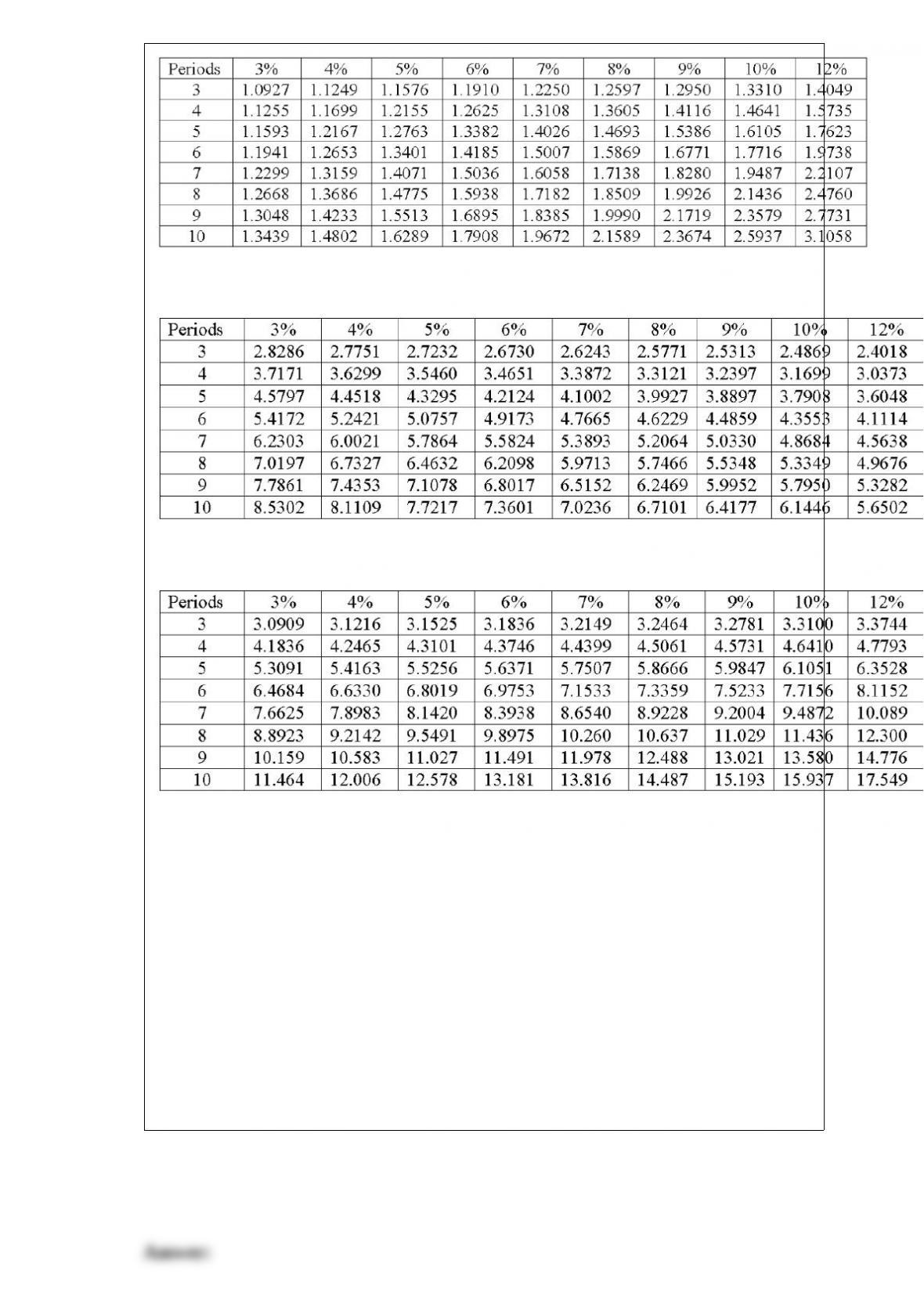
Present Value of an Annuity of 1
Future Value of an Annuity of 1
A company expects to invest $5,000 today at 12% annual interest and plans to receive
$15,529 at the end of the investment period. How many years will elapse before the
company accumulates the $15,529?
A.0.322 years.
B.3.1058 years.
C.5 years.
D.8 years.
E.10 years.
A company had net sales of $541,500 in 2008 and $475,300 in 2009. Its average assets
were $410,000 for 2008 and $400,000 for 2009. (1) Calculate the total asset turnover
for each year. (2) Interpret and comment on the company’s efficiency in the use of its
assets.
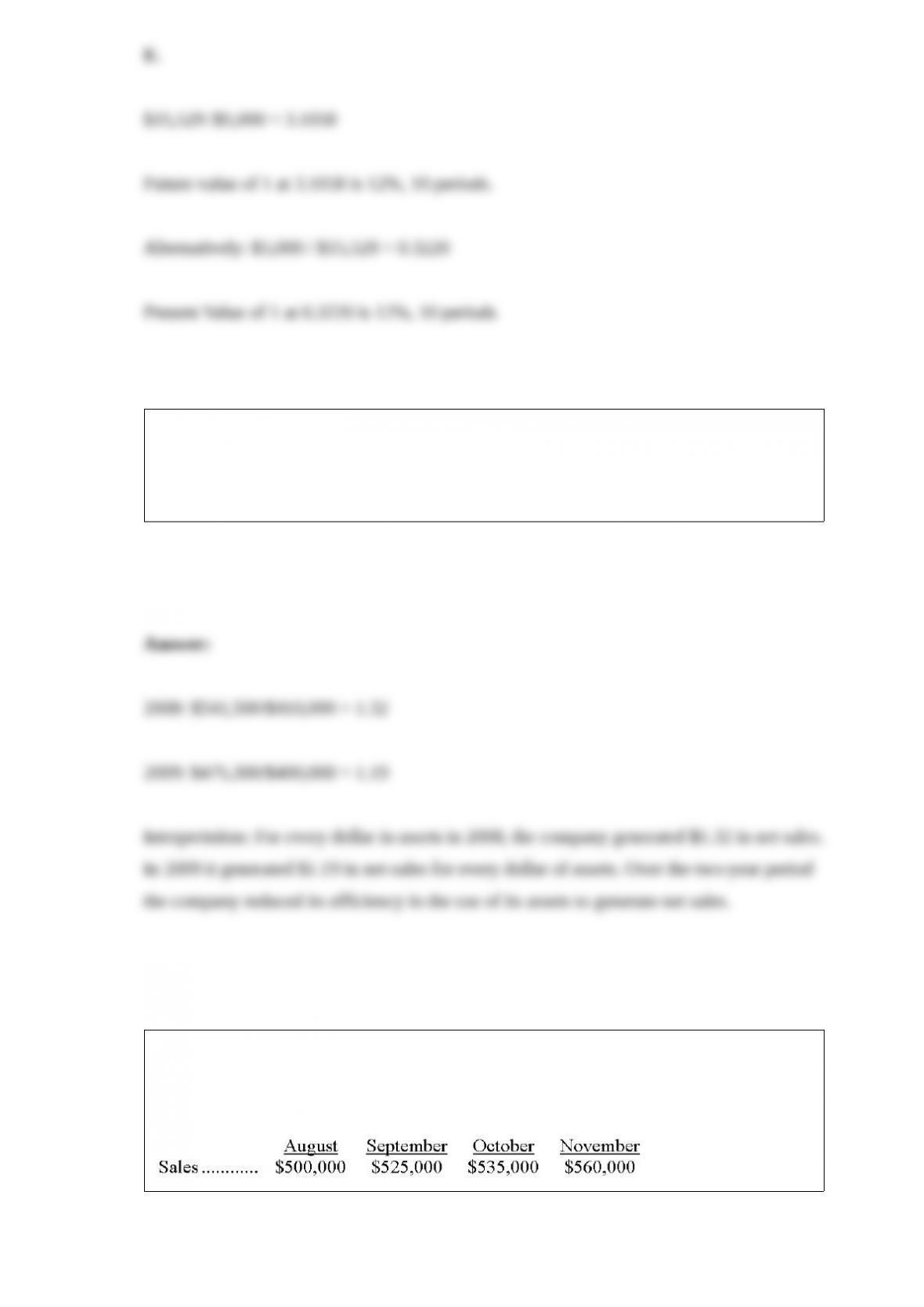
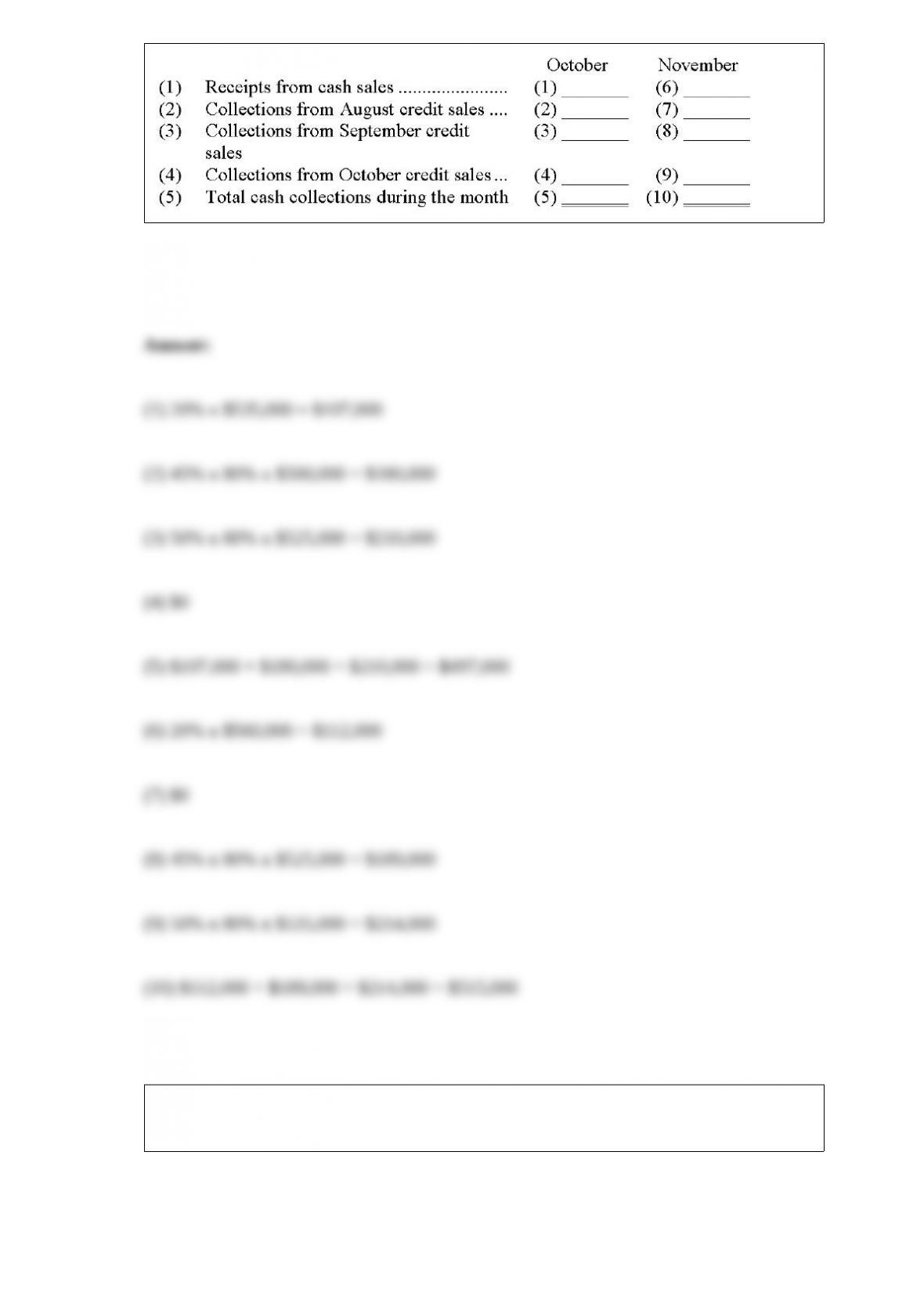
Rich Company’s experience shows that 20% of its sales are for cash and 80% are on
credit. An analysis of credit sales shows that 50% are collected in the month following
the sale, 45% are collected in the second month, and 5% prove to be uncollectible.
Calculate items (1) through (10) below:
How do companies decide what allocation bases to use to allocate indirect costs to
departments?
An investing company that owns more than ________ of another (investee) company’s
voting stock is presumed to have controlling influence over the investee.
The _____________________ ratio is used to assess the risk of a company’s financing
structure.
Describe the accounting for natural resources, including their acquisition, cost
allocation, and account titles.
Samm’s Department Store operates three departments (A, B and C). If total costs of
$4,500 are to be allocated on the basis of square feet of space (Dept. A = 1,500 Sq. Ft.;
Dept. B = 900 Sq. Ft.; Dept. C = 600 Sq. Ft.) then Dept A’s share (in percent) of the
$4,500 cost would be ________%; Dept. B would be ______%, and Dept C would be
__________%. The amount of cost allocated to Dept. C would be $__________.
Reversing entries are linked to ____________________ and _____________ that were
created by adjusting entries at the end of the prior accounting period.
The __________________________ shows expected cash inflows and outflows during
the budget period.
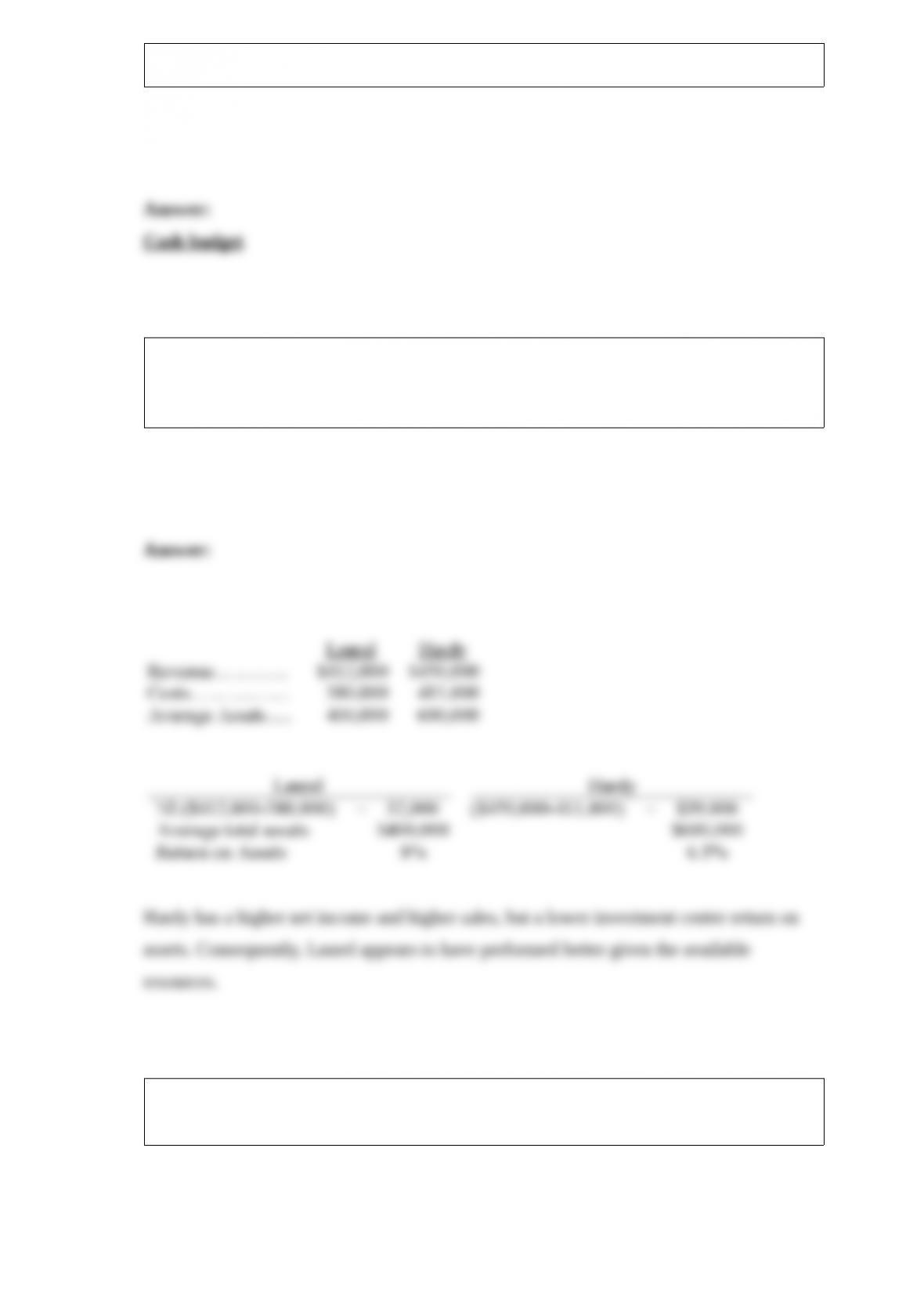
Laurel and Hardy are managers of two product lines for Keaton Company. One of them
is a candidate for promotion based on performance. Using the data below, determine
who had the better performance. Detail your calculations and support your answer.
A supplementary record created to maintain a separate account for each customer is
called the ________________________.