
If an asset costs $16,000, has an expected useful life of 8 years, is expected to have a
$2,000 salvage value and generates net annual cash inflows of $2,000 a year, the cash
payback period is
A. 8 years.
B. 7 years.
C. 6 years.
D. 5 years. $16,000/$2,000 = 8 years
Which of the following statements is true regarding the reporting of discontinued
operations?
A. The impact that the discontinued operations had on any previous year results is not
shown for comparative purposes.
B. The income or loss, net of taxes, of the discontinued operations is reported as a
separate component of income from continuing operations.
C. Earnings per share data are not reported separately for discontinued operations.
D. By reporting discontinued operations as a separate item, net of taxes, all of the
effects of the discontinued business segment are excluded from the revenues, expenses,
gains, and losses of continuing operations.
Computing a borrower’s effective interest rate is another application of which of the
following concepts?
A. Present value concept.
B. Current value concept.
C. Periodic interest concept.
D. None of the above.
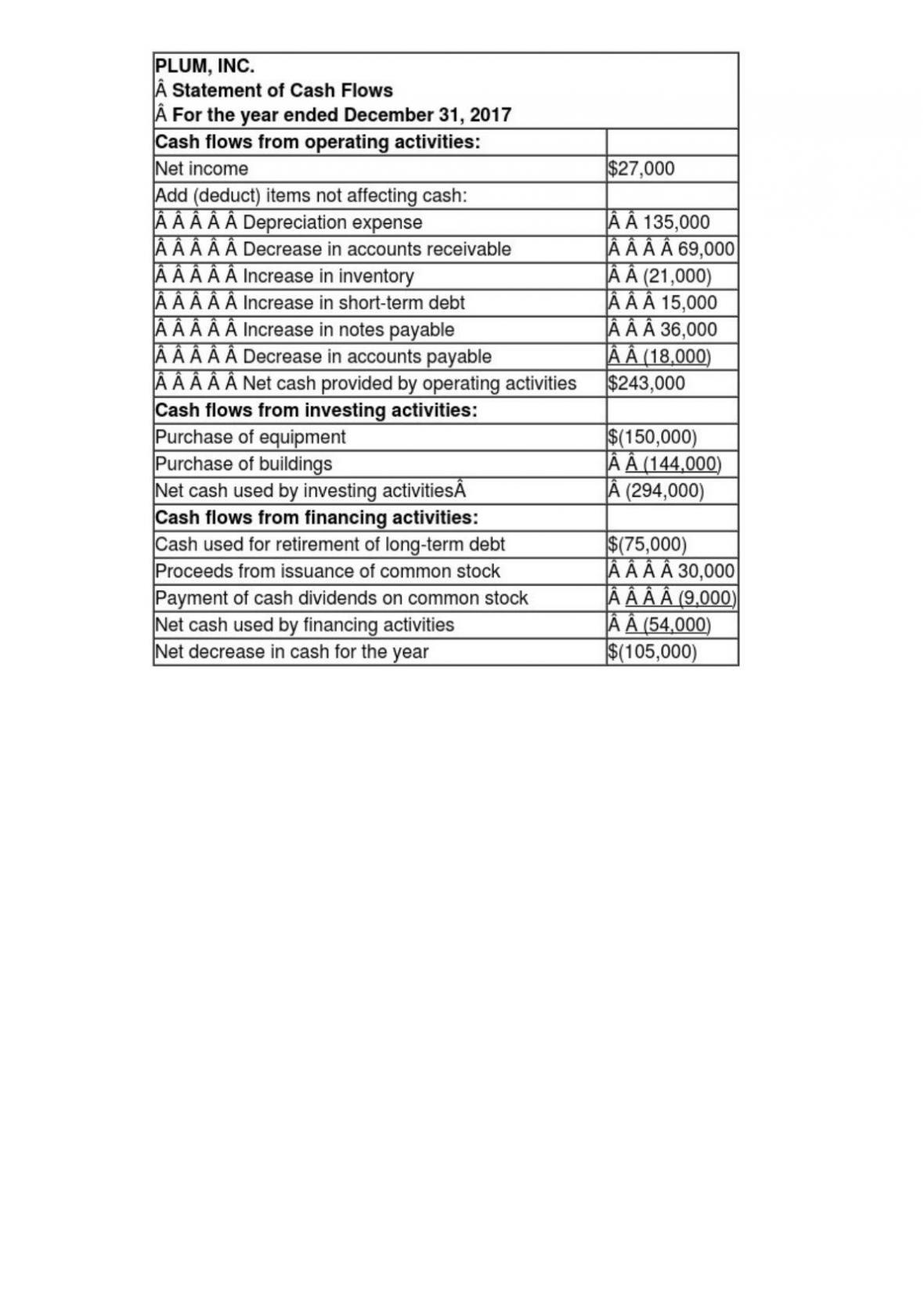
Required:
(a.) Complete the December 31, 2017 and 2016 balance sheets.
(b.) Prepare a Statement of Changes in Retained Earnings for the year ended December 31,
2017.
a. PLUM, INC.
Balance Sheets
The accounting concept or principle applied when the cost of short-term marketable
securities is adjusted to market value is:
A. objectivity.
B. matching revenue and expense.

C. original cost.
D. consistency.
A chart of accounts:
A. is where transactions are initially recorded.
B. is where transactions are posted to after they are initially recorded.
C. serves as an index to the ledger, with each account numbered to facilitate frequent
references that are made to it.
D. is the same as a T-account, with debits on the left and credits on the right.
The current liability for Wages Payable (or Accrued Payroll) represents the:
A. gross pay earned by employees for which they have not yet been paid.
B. net pay earned by employees for which they have not yet been paid.
C. employer’s federal and state payroll tax obligation.
D. employer’s liability for various withholdings that taken out of the gross pay earned
by employees.
What is the “key” to the entire operating budget?
A. the forecast of operating activity.
B. the budgeted income statement.
C. the budgeted balance sheet.
D. the production/purchases budget.
Which of the following is NOT an example of an inventory account a manufacturing
firm might use?
A. Work in process inventory.
B. Finished goods inventory.
C. Merchandise inventory.
D. Raw materials inventory.
The present value ratio of a proposed investment will be:
A. less than 1.0 if the net present value is positive.
B. negative if the proposed investment meets the cost of capital target.
C. less than 1.0 if the net present value is negative.
D. greater than 1.0 if the cost of capital exceeds the internal rate of return.
An example of a cost likely to have an indirect relationship with products being
manufactured is:
A. production labor costs.
B. raw material costs.
C. electricity costs for packaging equipment.
D. none of the above.
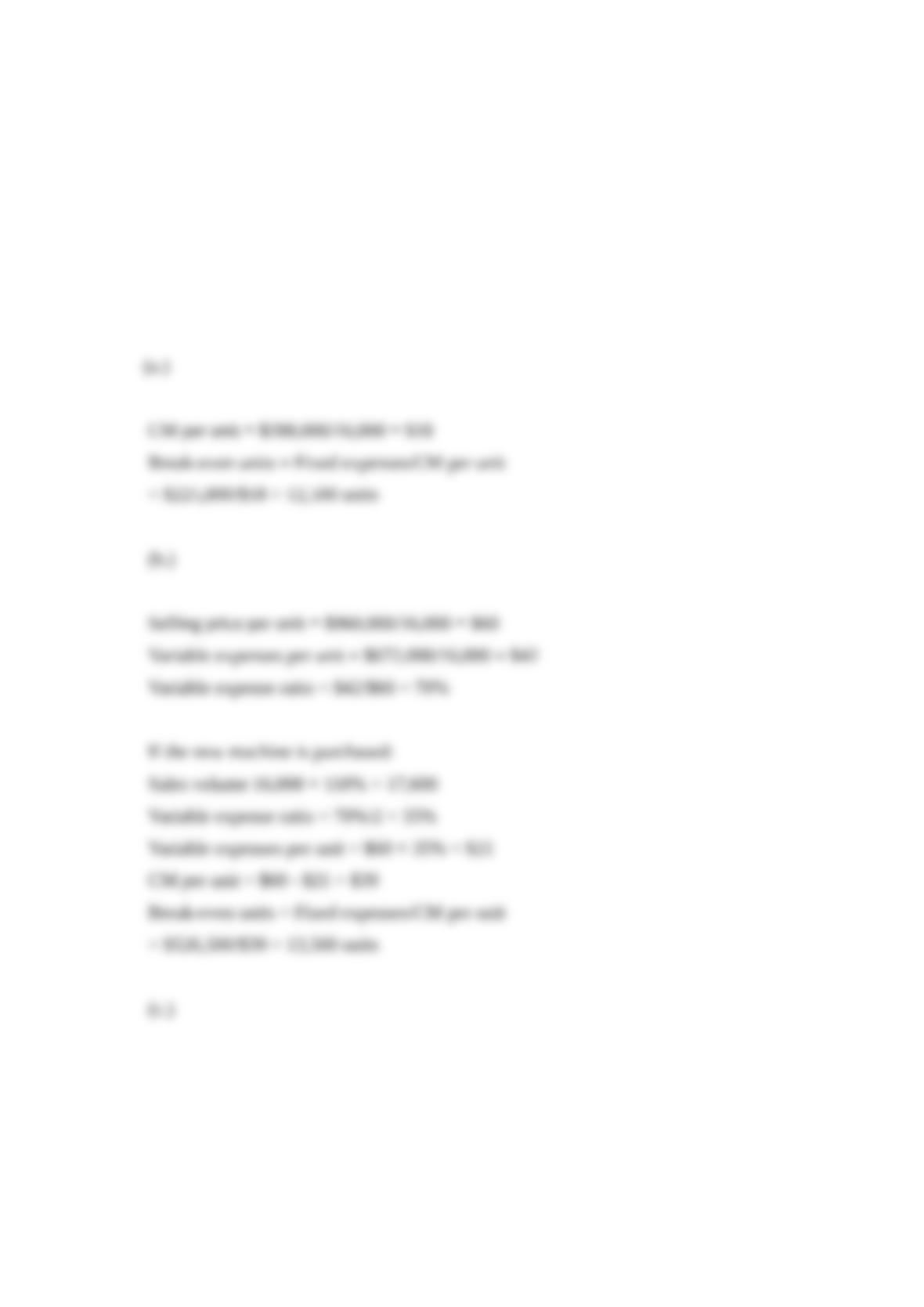
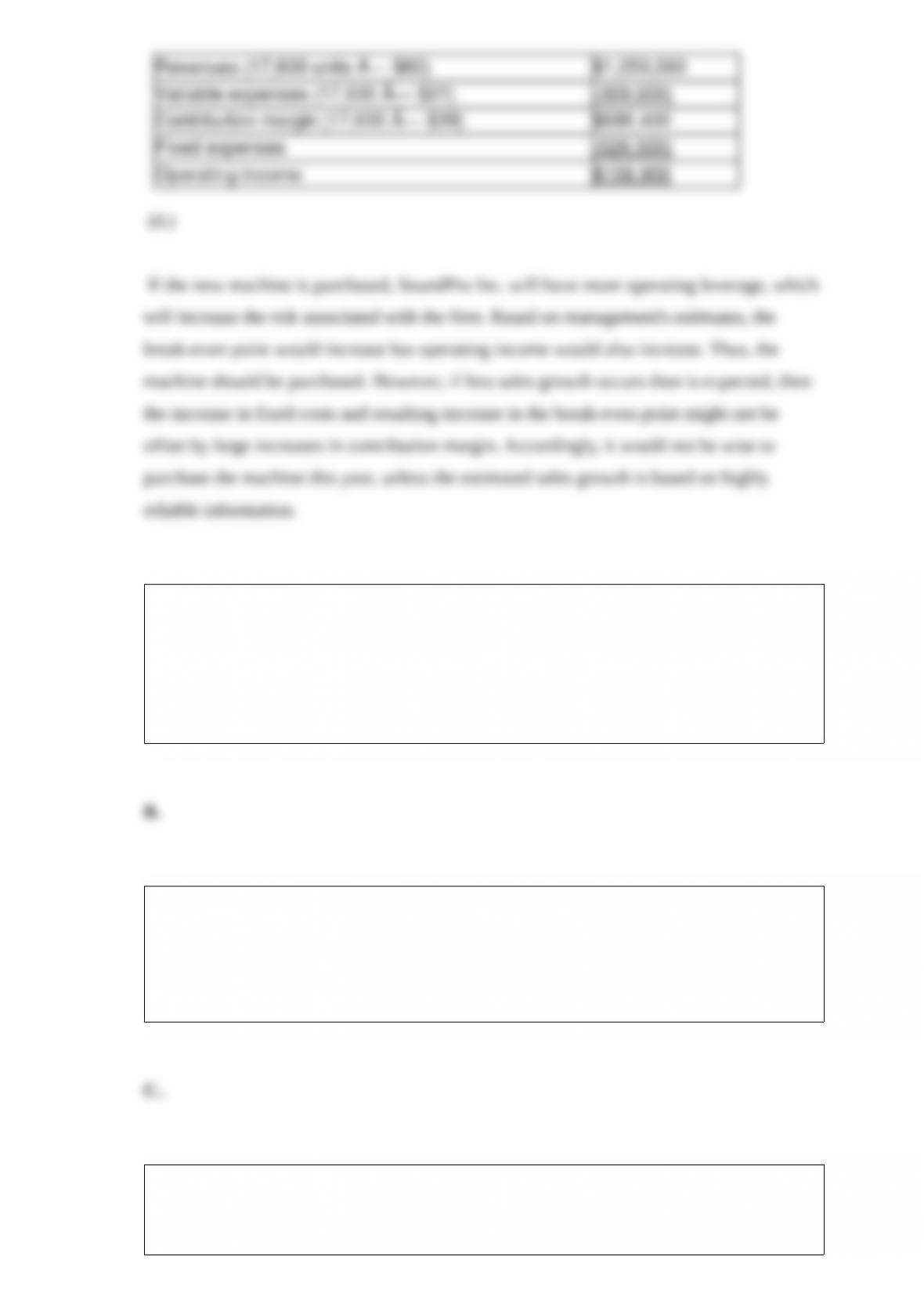
SoundPro, Inc. produces amplifiers for electric guitars. The firm’s income statement
showed the following:
An automated machine has been developed that can produce several components of the
amplifiers. If the machine is purchased, fixed expenses will increase to $526,500 per year.
The firm’s production capacity will increase, which is expected to result in a 10 percent
increase in sales volume. It is also estimated that the variable expense ratio will be reduced
to half of what it is now.
(a.) Calculate the firm’s current contribution margin per unit and break-even point in units.
(b.) Calculate the firm’s contribution margin per unit and break-even point in terms of
units if the new machine is purchased.
(c.) Calculate the firm’s operating income assuming that the new machine is purchased.
(d.) Do you believe that management of SoundPro, Inc. should purchase the new
machine? Explain your answer.
A firm’s net income for the year was $800,000. Average assets totaled $6 million, and
average liabilities totaled $1.2 million. Return on equity was:
A. 13.3%
B. 16.7%
C. 10%
D. 20%
The net book value of a depreciable asset is:
A. the fair value of the asset.
B. the amount for which the asset should be insured.
C. the difference between the asset’s cost and accumulated depreciation.
D. the difference between the asset’s cost and depreciation expense.
Which of the following is an accurate statement regarding a statement of cash flows?
A. Only cash items that affect the income statement are included.
B. Only material cash items that affect the income statement are included.
C. All material operating, investing, and financing activities are included.
D. Immaterial financing activities that affect cash do not need to be included.
Once standard costs for products or services have been developed:
A. they must be updated monthly to be useful.
B. they can be used for more than planning and control purposes.
C. they need not be revised unless the product or service is modified.
D. performance reports must be issued if the standards are to be useful.
A simple cost/benefit analysis is not appropriate for:
A. sell or process further decisions.
B. make or buy decisions.
C. capital expenditure decisions.
D. special pricing decisions.
Selling price per unit $100 Variable expenses per unit $40 Fixed expenses per month
$60,000
The break-even point in terms of total revenues per month is:
A. $30,000.
B. $60,000.
C. $75,000.
D. $100,000.
“Noncontrolling interest”:
A. is a component of the parent company’s net income and reported on the income
statement.
B. is a component of stockholders’ equity attributable to the parent company and
reported on the balance sheet.
C. is the portion of equity in a subsidiary not attributable, directly or indirectly, to the
parent company, and reported on the balance sheet within equity, but separate from the
parent company’s equity.
D. is not reported within the parent company’s consolidated financial statements, but
instead reported within the minority stockholders’ financial statements.
XYZ Company incurred the following costs for the month of August when it observed
an activity level of 10,000 units.
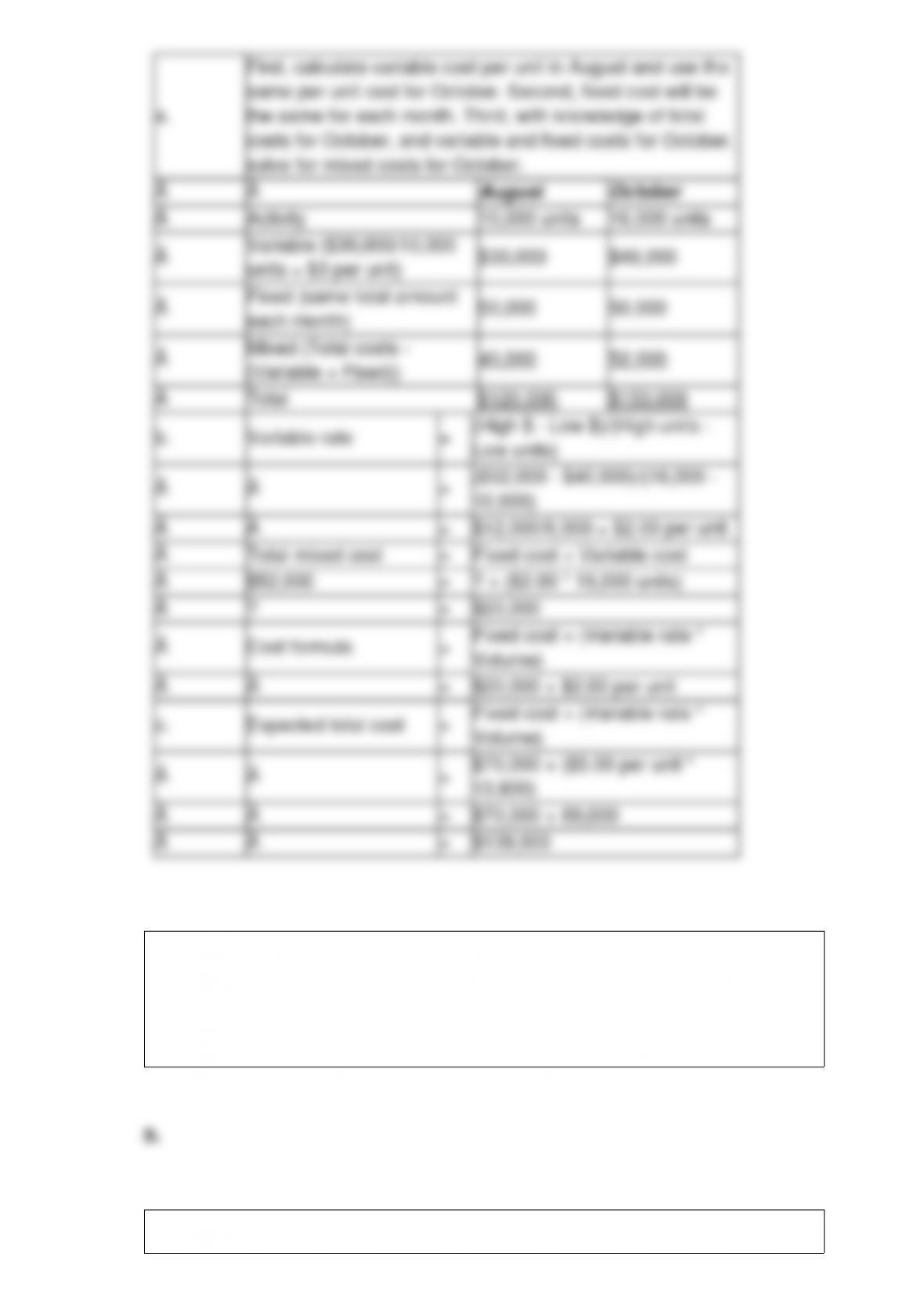
During October, the activity level was 16,000 units, and the total costs incurred were
$150,000.
a. Calculate the variable costs, fixed costs, and mixed costs incurred during October.
b. Use the high-low method to calculate the cost formula for mixed costs.
c. If the activity level were expected to be 13,800 units for the month of December, what
amount of total costs would be expected?
The first caption in most income statements in annual reports is:
A. gross sales.
B. net sales.
C. earned revenues.
D. sales, less sales returns and allowances.
A management that wanted to increase the financial leverage of its firm would:

A. raise additional capital by selling common stock.
B. use excess cash to purchase preferred stock for the treasury.
C. raise additional capital by selling fixed interest rate long-term bonds.
D. try to increase its ROI by increasing asset turnover.
In a capital budgeting decision, if a firm uses the net present value method and a 12%
discount rate, what does a negative net present value indicate?
A. the proposal’s rate of return exceeds 12%.
B. the proposal’s rate of return is less than the minimum rate required.
C. the proposal earns a rate of return between 10% and 12%.
D. none of the above.
A budget that has been prepared only once prior to the budget period is called a:
A. continuous budget.
B. zero-based budget.
C. discretionary budget.
D. single-period budget.
The amount of cash related to a particular bank checking account that is shown on the
balance sheet at December 31 is:
A. the cash balance shown on the bank’s records at the close of business on December
31, without further adjustments.
B. the cash balance shown in the company’s general ledger account for this checking
account at the close of business on December 31, without further adjustments.
C. the cash balance shown in the general ledger account for this checking account as of
the close of business on December 31, after recognizing any outstanding checks and/or
deposits in transit from the December 31 bank account reconciliation.
D. the cash balance shown in the general ledger account for this checking account as of
the close of business on December 31, after recognizing any bank service charges
and/or interest income from the December 31 bank account reconciliation.
When a company issues a bond at a discount:
A. the company will pay less than the face amount of the bond at its maturity.
B. the company will pay more than the face amount of the bond at its maturity.
C. the company’s interest expense will be less than the interest paid each year.
D. the company’s interest expense will be more than the interest paid each year.
If they are to be useful to managers, variances should be reported:
A. simultaneously to all managers within a week after the end of the month.
B. in dollar amounts as soon as all costs are known.
C. in physical terms or dollar amounts as promptly as feasible.
D. in physical terms and dollar amounts if the variance exceeds 10% of the budget.
Trading and Available-for-Sale securities are reported on the balance sheet at:
A. net realizable value.
B. historical cost.
C. weighted average cost.
D. market value.
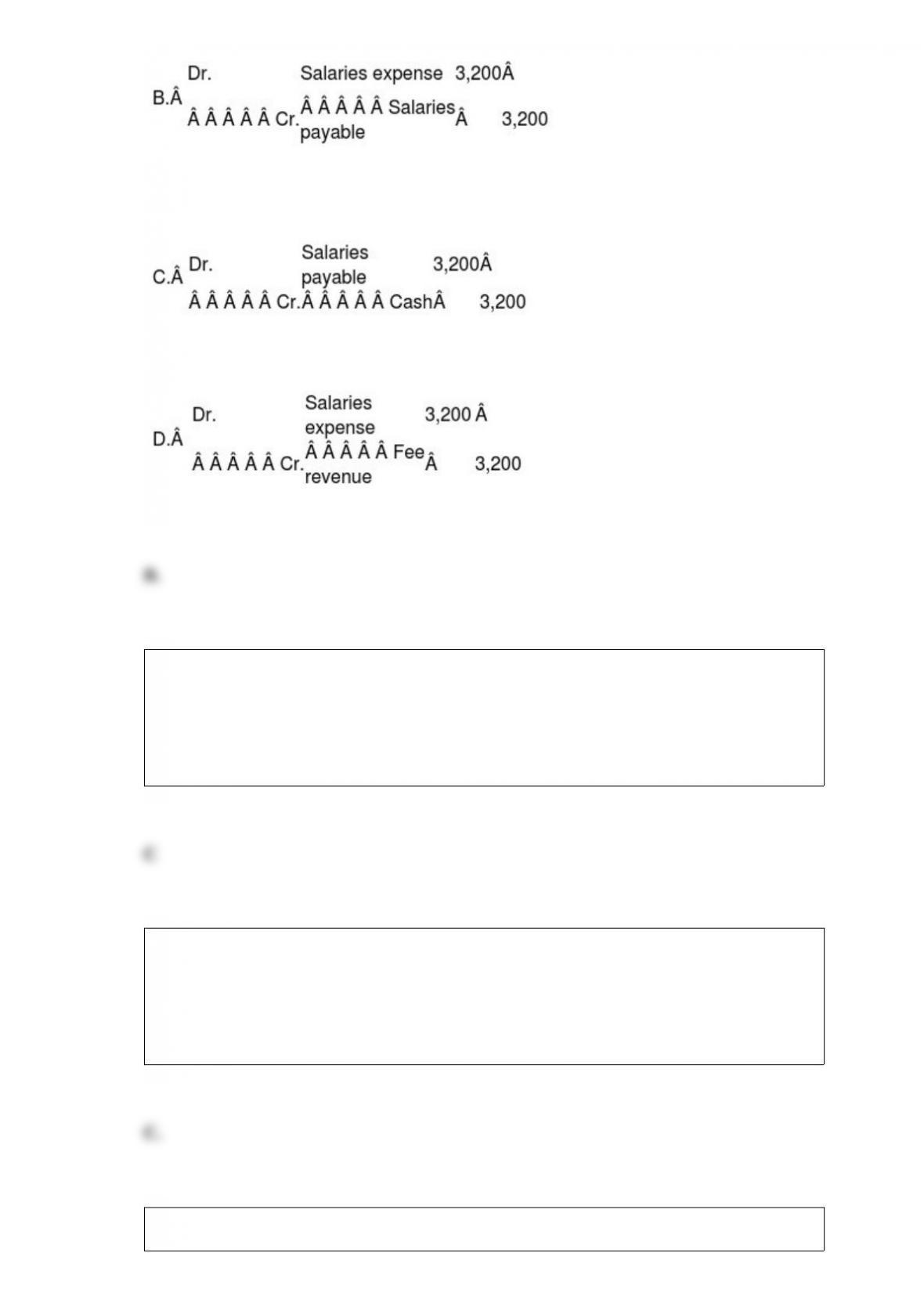
To accrue $3,200 of employee salaries for the last week of February, the employer’s
journal entry is:
An example of a cost likely to have a fixed behavior pattern is:
A. sales force commission.
B. production labor wages.
C. advertising cost.
D. electricity cost for packaging equipment.
An example of a committed cost is:
A. employee training.
B. manufacturing supplies.
C. real estate taxes.
D. charitable contributions.
For the fiscal year ended March 31, 2017, a company reported earnings per share of

$1.95 and cash dividends per share of $0.30. During fiscal 2018, the company had a
3-for-2 stock split. In the annual report for the fiscal year ended March 31, 2018,
earnings per share and cash dividends for fiscal 2017 would be reported, respectively,
as:
A. $1.95 and $0.30
B. $2.91 and $0.45
C. $1.30 and $0.20
D. $0.65 and $0.10