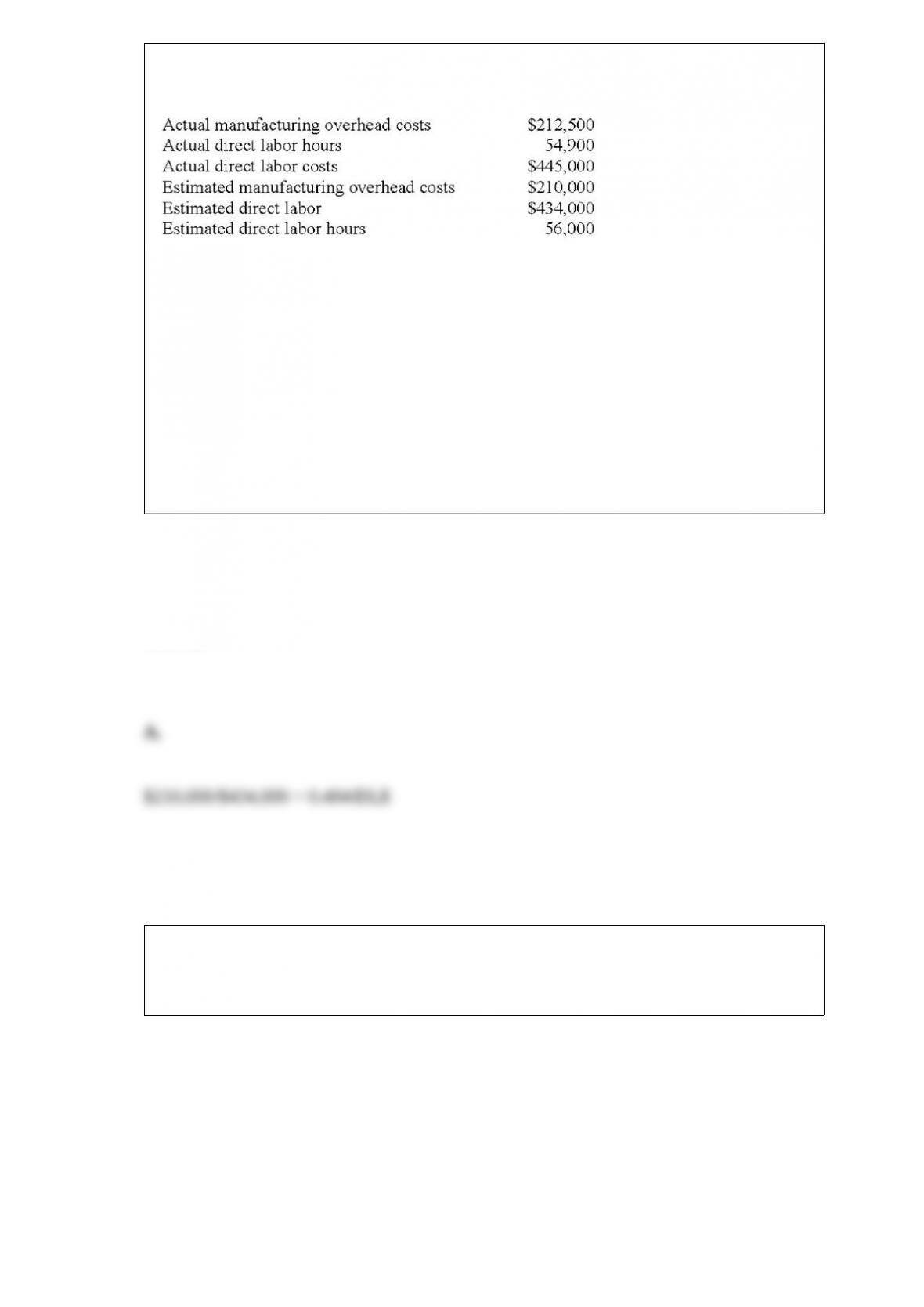
The following information has been gathered for the GHI Manufacturing Company for
its fiscal year ending December 31:
What is the predetermined manufacturing overhead rate assuming direct labor cost is
used as the activity base?
A. 4%
B. 47.2%
C. 49.0%
D. 47.8%
Answer:
Misa Corporation manufactures circuit boards and is in the process of preparing next
year’s budget. The pro forma income statement for the current year is presented below.
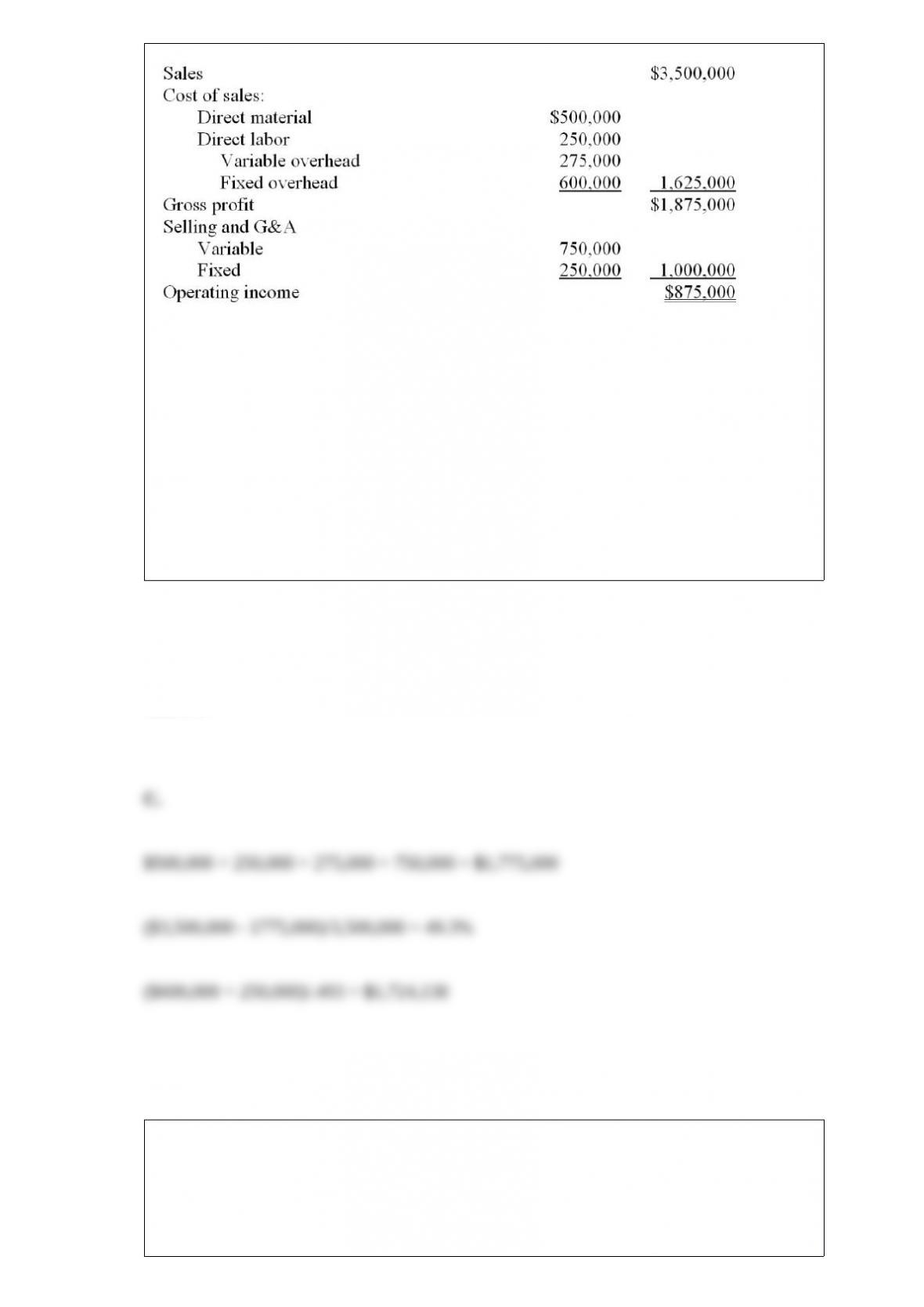
The break-even point (rounded to the nearest dollar) for Misa Corporation for the
current year is
A. $2,625,000.
B. $1,865,672.
C. $1,724,138.
D. $2,155,172.
Answer:
The term “gross margin” for a manufacturing firm refers to the excess of sales over:
A. cost of goods sold, excluding fixed indirect manufacturing costs.
B. all variable costs, including variable marketing and administrative costs.
C. cost of goods sold, including fixed indirect manufacturing costs.
D. variable costs, excluding variable marketing and administrative costs.
E. total manufacturing costs, including fixed indirect manufacturing costs.
Answer:
In the general model, a price variance is calculated as
A. (AP x AQ) – (AP x SQ)
B. (AP x SQ) – (SP x SQ)
C. (AP x AQ) – (SP x AQ)
D. (AP x AQ) – (SP x SQ)
Answer:
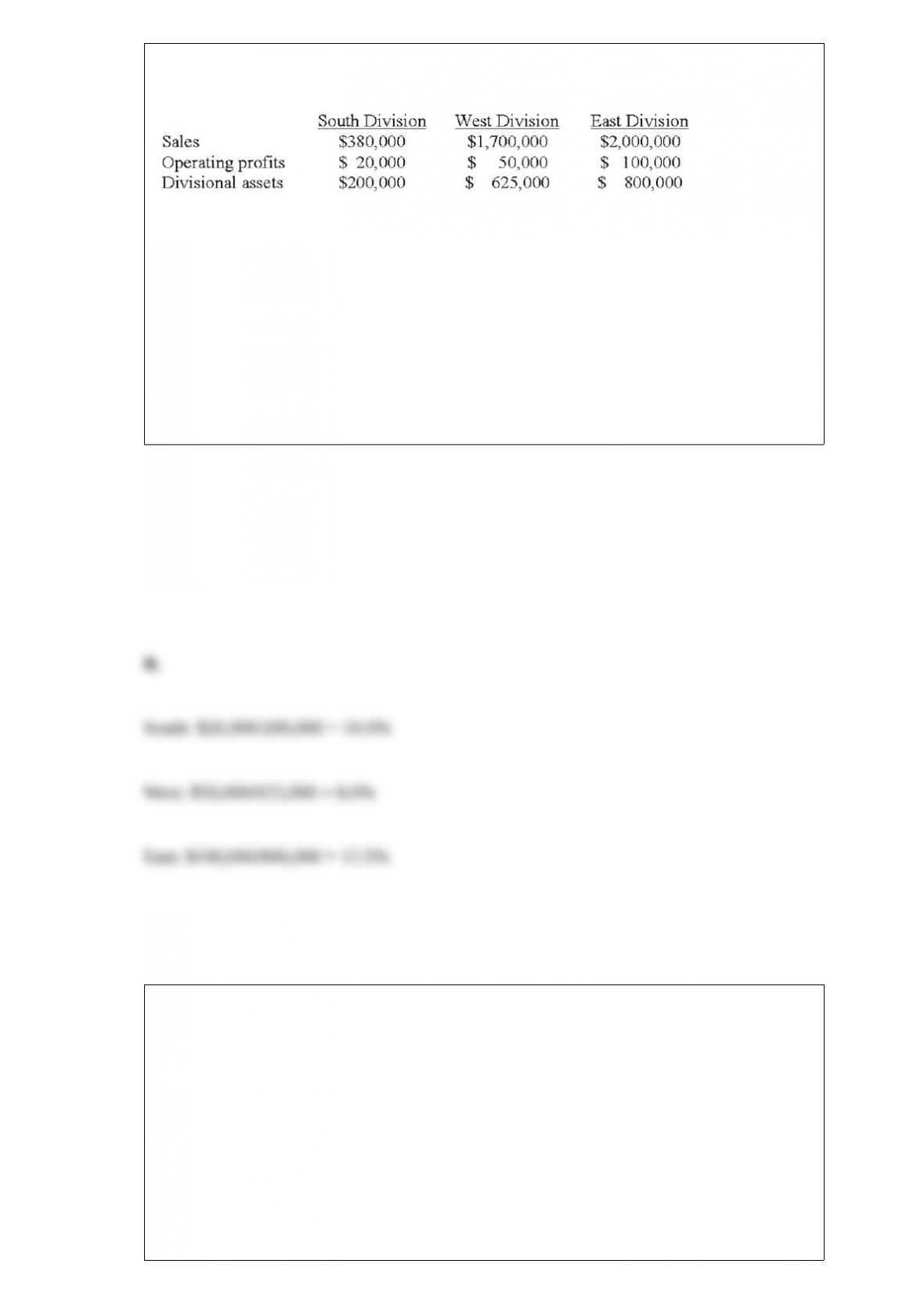
The Multidivision Corporation reported the following operating results for its three
divisions: South, West, and East.
Which division has the smallest return on investment (ROI)?
A. South
B. West
C. East
D. All three divisions are the same
Answer:
Managers do not make decisions about future events based on:
A. Perfect information.
B. Estimated information.
C. Actual information.
D. Financial information.
E. Cost information.
Answer:
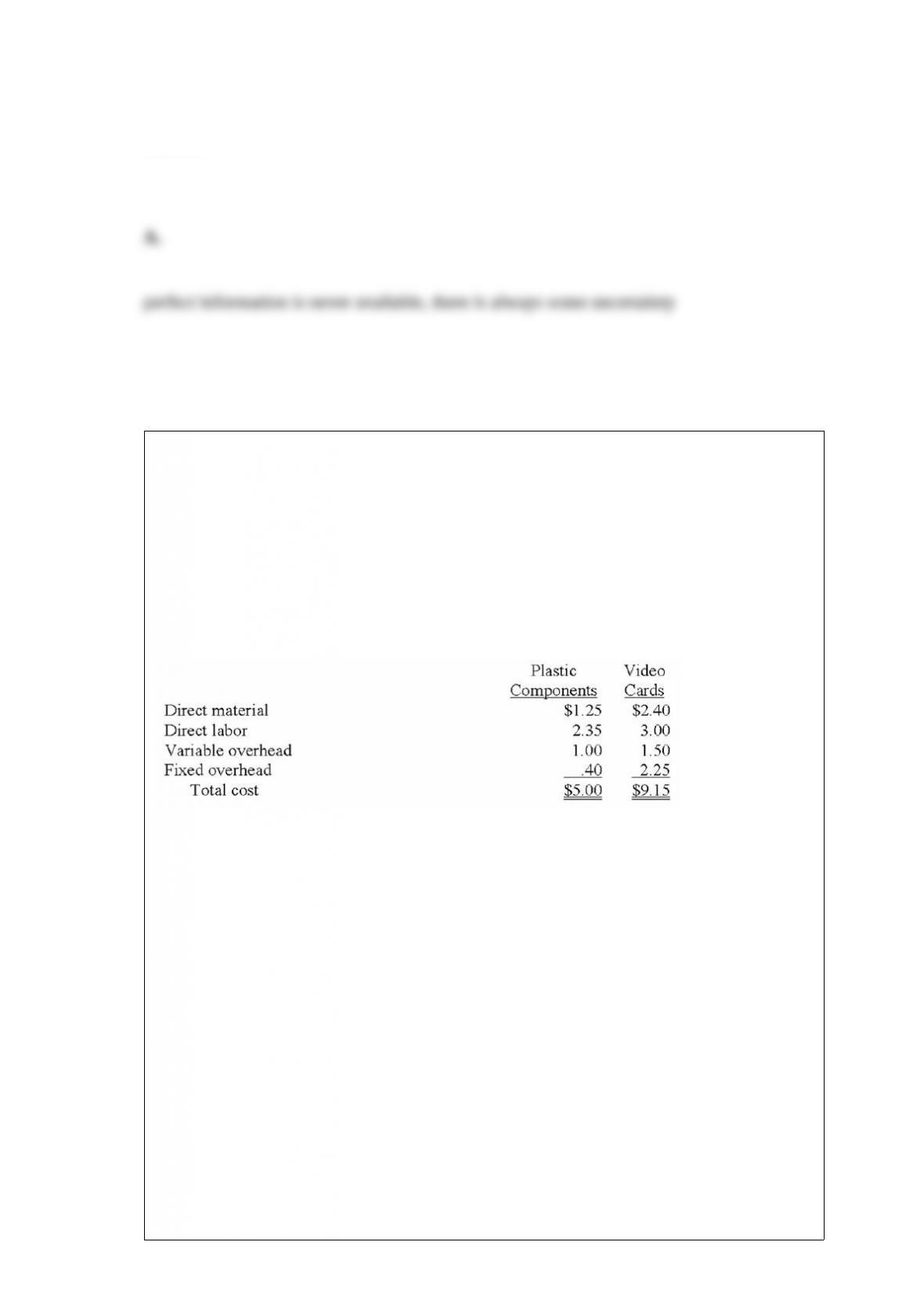
Parkside Inc. has several divisions that operate as decentralized profit centers.
Parkside’s Entertainment Division manufactures video arcade equipment using the
products of two of Parkside’s other divisions. The Plastics Division manufactures
plastic components, one type that is made exclusively for the Entertainment Division,
while other less complex components are sold to outside markets. The products of the
Video Cards Division are sold in a competitive market; however, one video card model
is also used by the Entertainment Division. The actual costs per unit used by the
Entertainment Division are presented in the next column. (CMA adapted)
The Plastics Division sells its commercial products at full cost plus a 25% markup and
believes the proprietary plastic component made for the Entertainment Division would
sell for $6.25 per unit on the open market. The market price of the video card used by
the Entertainment Division is $10.98 per unit.
Assume that the Plastics Division has excess capacity and it has negotiated a transfer
price of $5.60 per plastic component with the Entertainment Division. This price will
A. cause the Plastics Division to reduce the number of commercial plastic components
it manufactures.
B. motivate both divisions as estimated profits are shared.
C. encourage the Entertainment Division to seek an outside source for plastic
components.
D. demotivate the Plastics Division causing mediocre performance.
Answer:
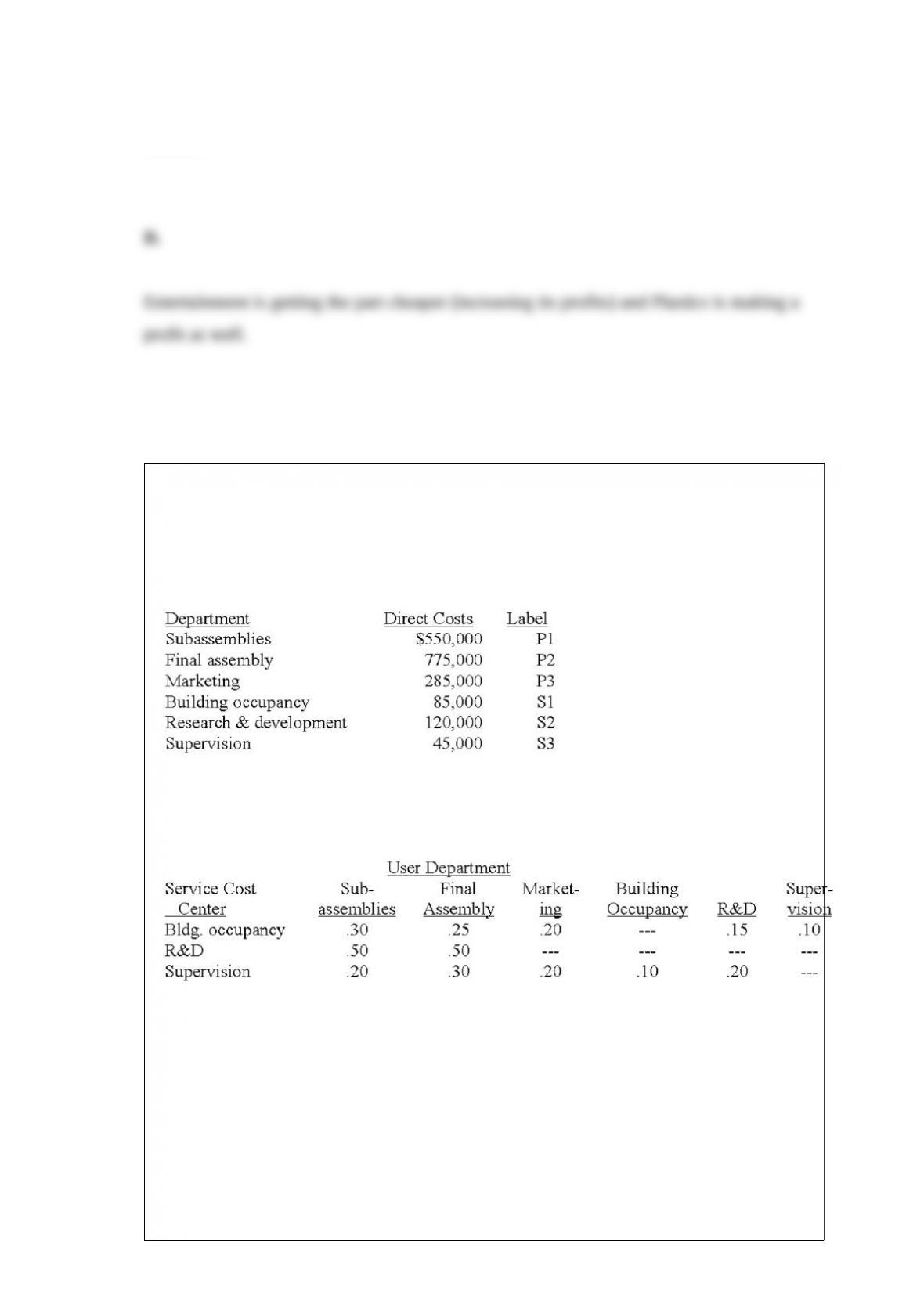
The following set up is a system of simultaneous linear equations to allocate costs
using reciprocal method. Matrix algebra is not required.
The following costs were incurred in three operating departments and three service
departments in Reality Company.
Use of services by other departments is as follows.
The equation for department P1 (subassemblies) is
A. P1 = $550,000 + .25P2 + .20P3 + .15S2 + 10S3.
B. P1 = $550,000 + .30S1 + .50S2 + .20S3.
C. P1 = .30S1 + .50S2 + 20S3.
D. P1 = .30S1 + .50S.
Answer:
The Wisco Company has a process cost system. All materials are placed in process
when the process is first begun. At the beginning of September, there were no units of
product in process. During September 50,000 units were started; 5,000 of these were
still in process at the end of September and were 3/5 finished. The equivalent units for
the conversion costs in September were
A. 40,000
B. 45,000
C. 48,000
D. 50,000
Answer:
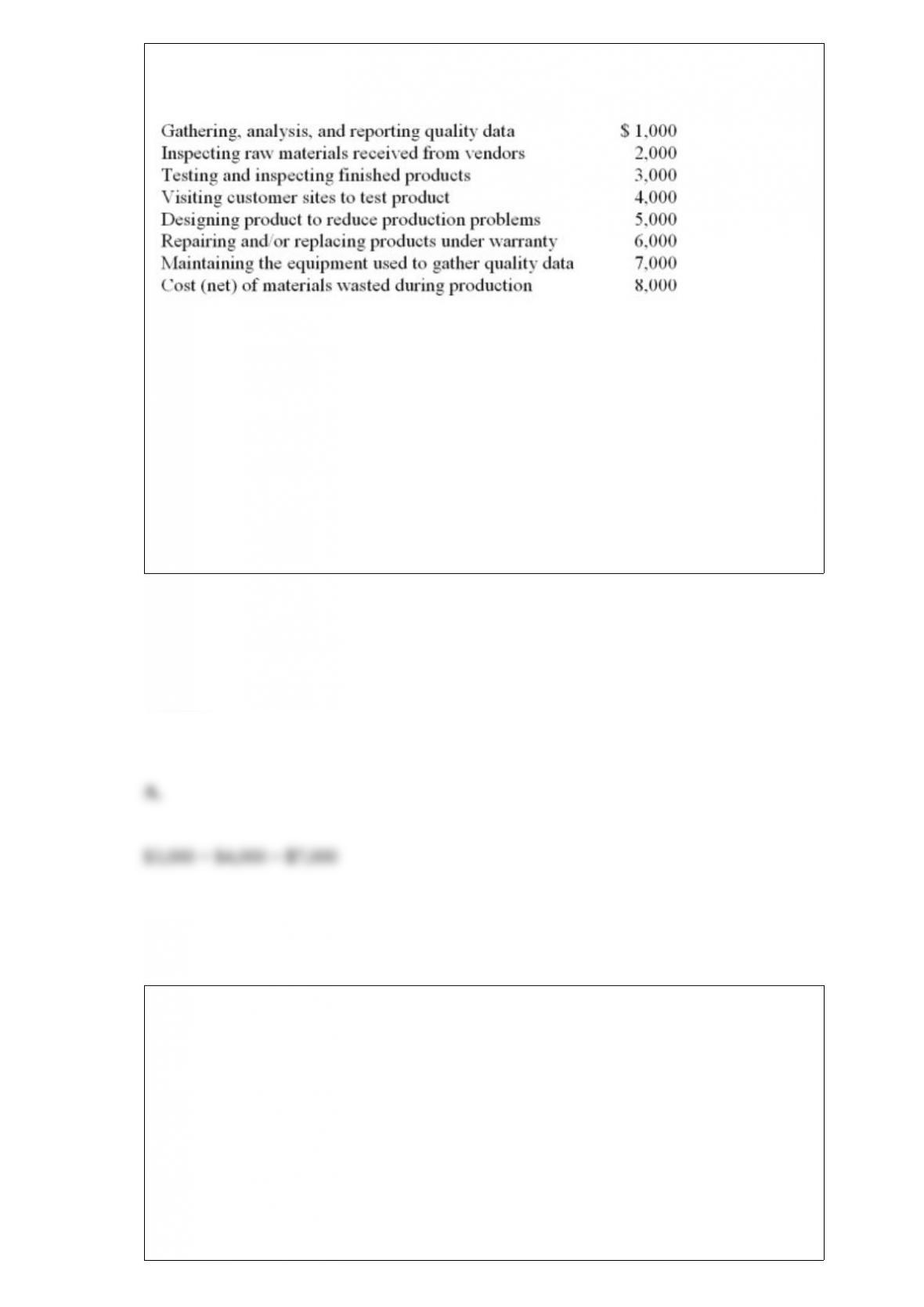
BC Enterprises’ quality control report for August contains the following items.
What would be the total of the appraisal costs on the August quality control report for
BC Enterprises?
A. $7,000
B. $11,000
C. $12,000
D. $15,000
Answer:
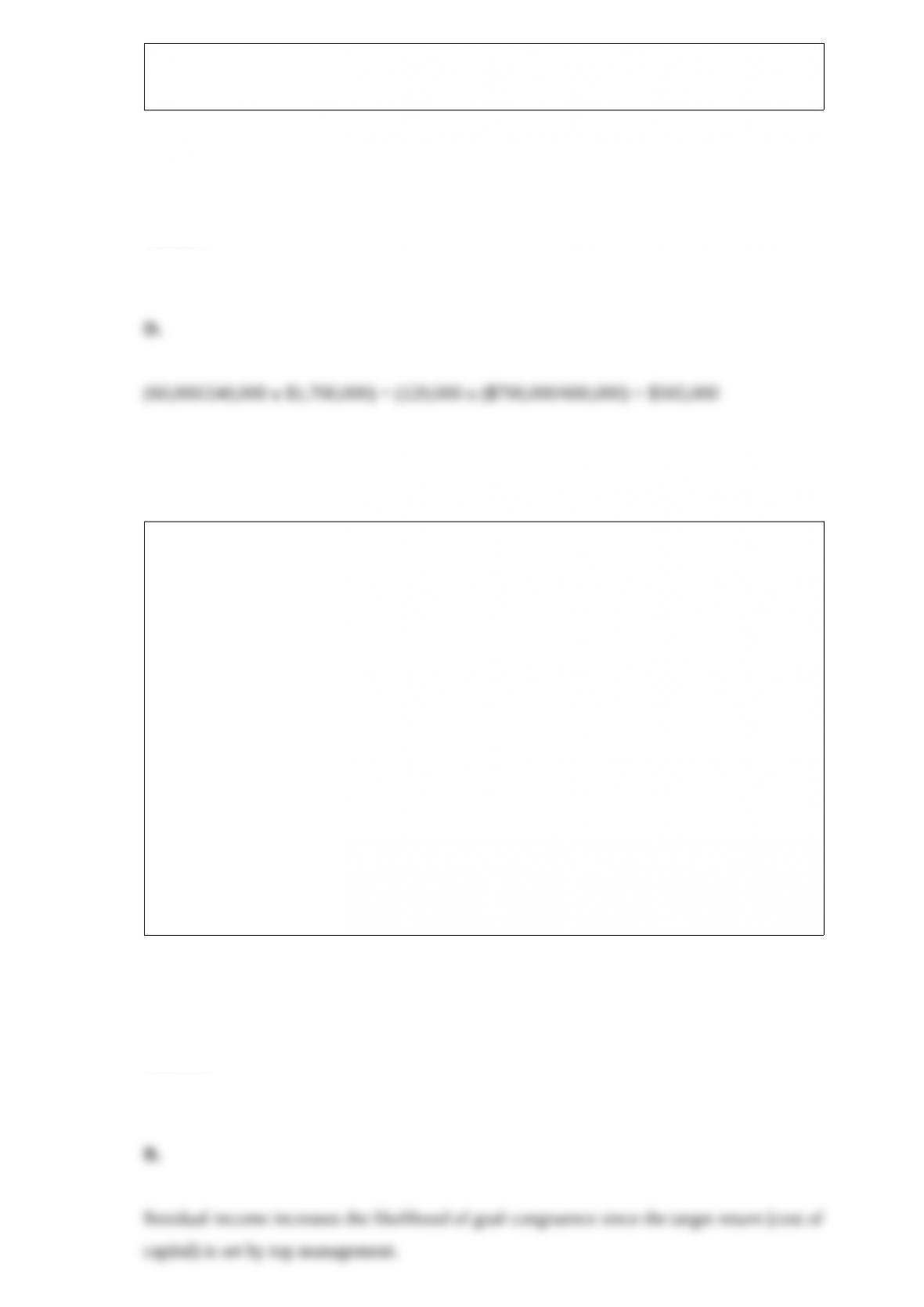
The cost accountant determined $1,700,000 of the server network’s costs were fixed
and should be allocated based on the number of connections. The remaining costs
should be allocated based on the time on the network. What is the total server network
costs allocated to the Commercial Division assuming the company uses dual-rates to
allocate common costs?
A. $514,286
B. $480,000
C. $600,000
D. $565,000
Answer:
Managerial performance can be measured in many different ways including return on
investment (ROI) and residual income. A good reason for using residual income instead
of ROI is that
A. Residual income can be computed without regard to identifying an investment base.
B. Appropriate goal congruence behavior is more likely to occur when using residual
income.
C. Residual income is well accepted in many organizations and often used in the
financial press.
D. ROI does not take into consideration both the investment turnover ratio and
return-on-sales percentage.
E. An imputed interest rate (cost of capital) does not have to be determined when using
residual income.
Answer:
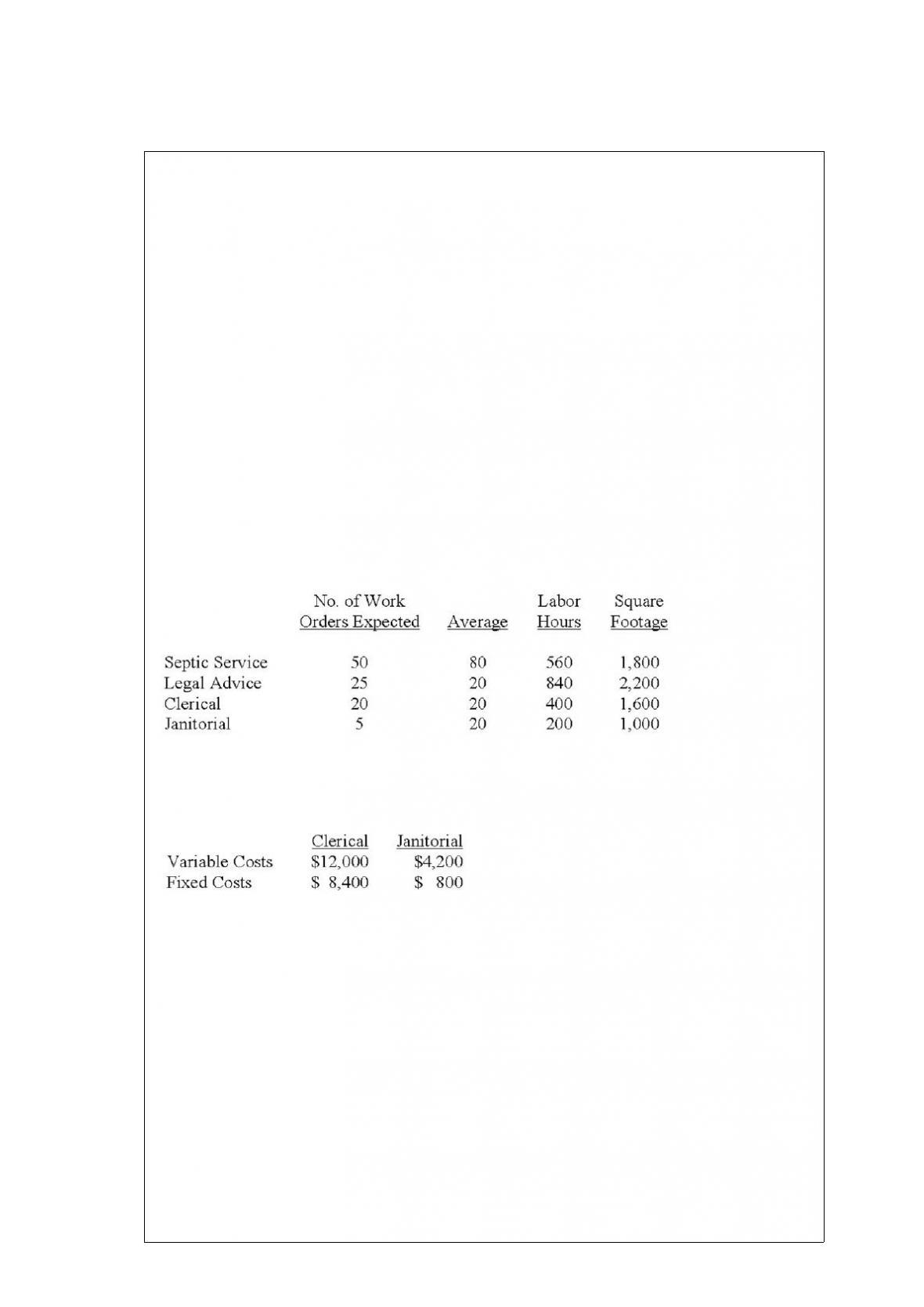
Harry Dishman owns and operates Harry’s Septic Service and Legal Advice. Harry’s
two revenue generating (production) operations are supported by two service
departments: Clerical and Janitorial. Costs in the service departments are allocated in
the following order using the designated allocation bases:
Clerical:
Variable cost: expected number of work orders processed
Fixed cost: long-run average number of work orders processed
Janitorial:
Variable cost: labor hours
Fixed cost: square footage of space occupied
Average and expected activity levels for next month (June) are as follows:
Expected costs in the service departments for June are as follows:
Under the step method of allocation, how much Clerical service cost should be
allocated to the Septic Service operation for June? (Assume Clerical costs are allocated
before Janitorial costs and round all calculations to the nearest whole dollar.)
A. $12,689
B. $13,100
C. $13,620
D. $15,596
E. $16,070
Answer:
Redmond Company produces precision components. Redmond has 11 customers, one
accounts for 60 percent of the sales, with the remaining ten accounting for the rest of
the sales. The ten smaller customers purchase components in roughly equal quantities.
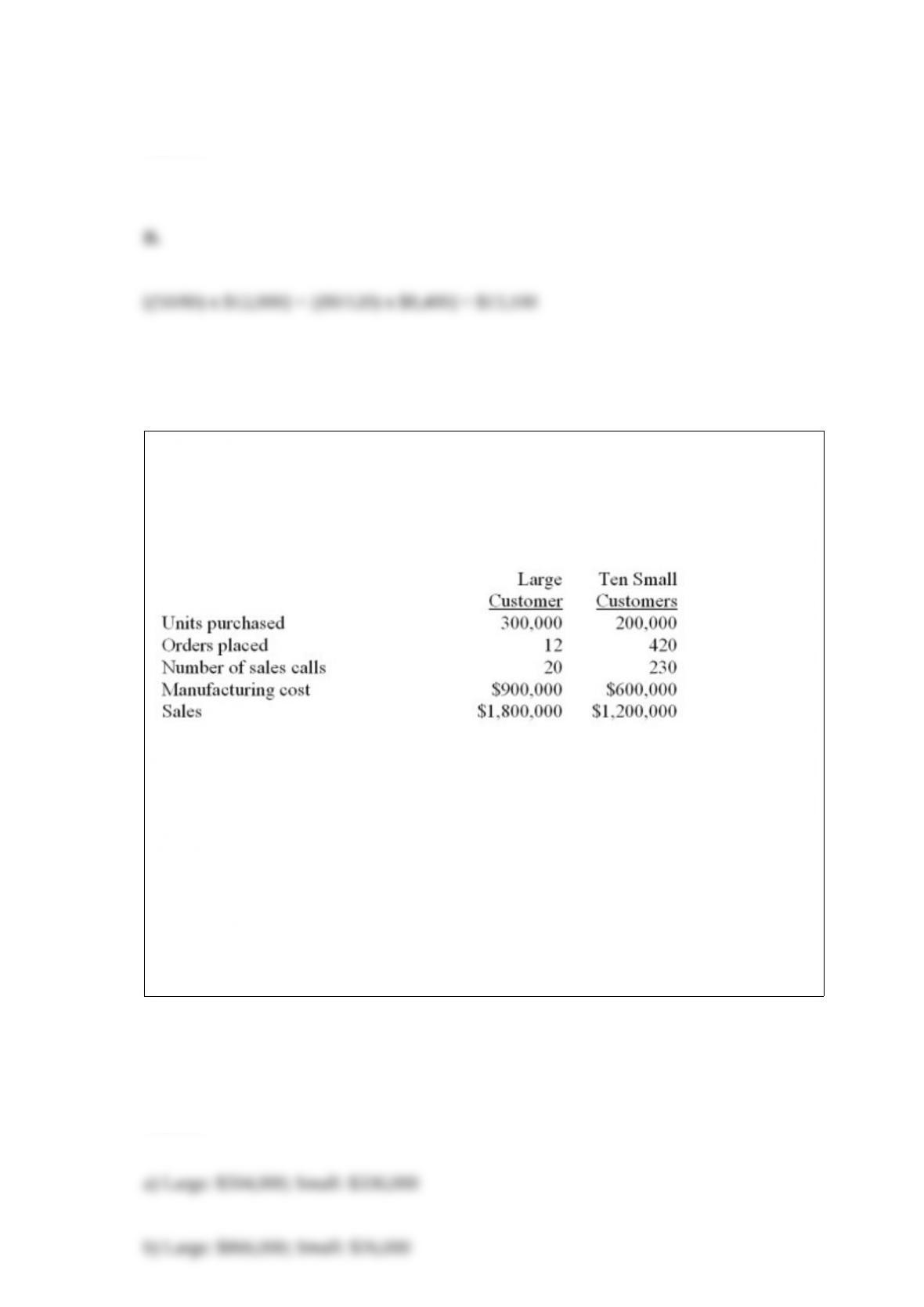
Orders placed by the smaller customers are about the same size. Data concerning
Redmond’s customer activity follow
Order-filling costs for Redmond Company total $360,000, and sales-force costs are
$300,000.
Required:
a) Determine the profitability of each of the two classes of customers (large and small).
Allocate the order-filling and sales force costs to the customers based on sales volume.
b) Determine the profitability of each of the two classes of customers (large and small).
Allocate the order-filling and sales force costs to the customers using an activity-based
costing approach?
Answer:
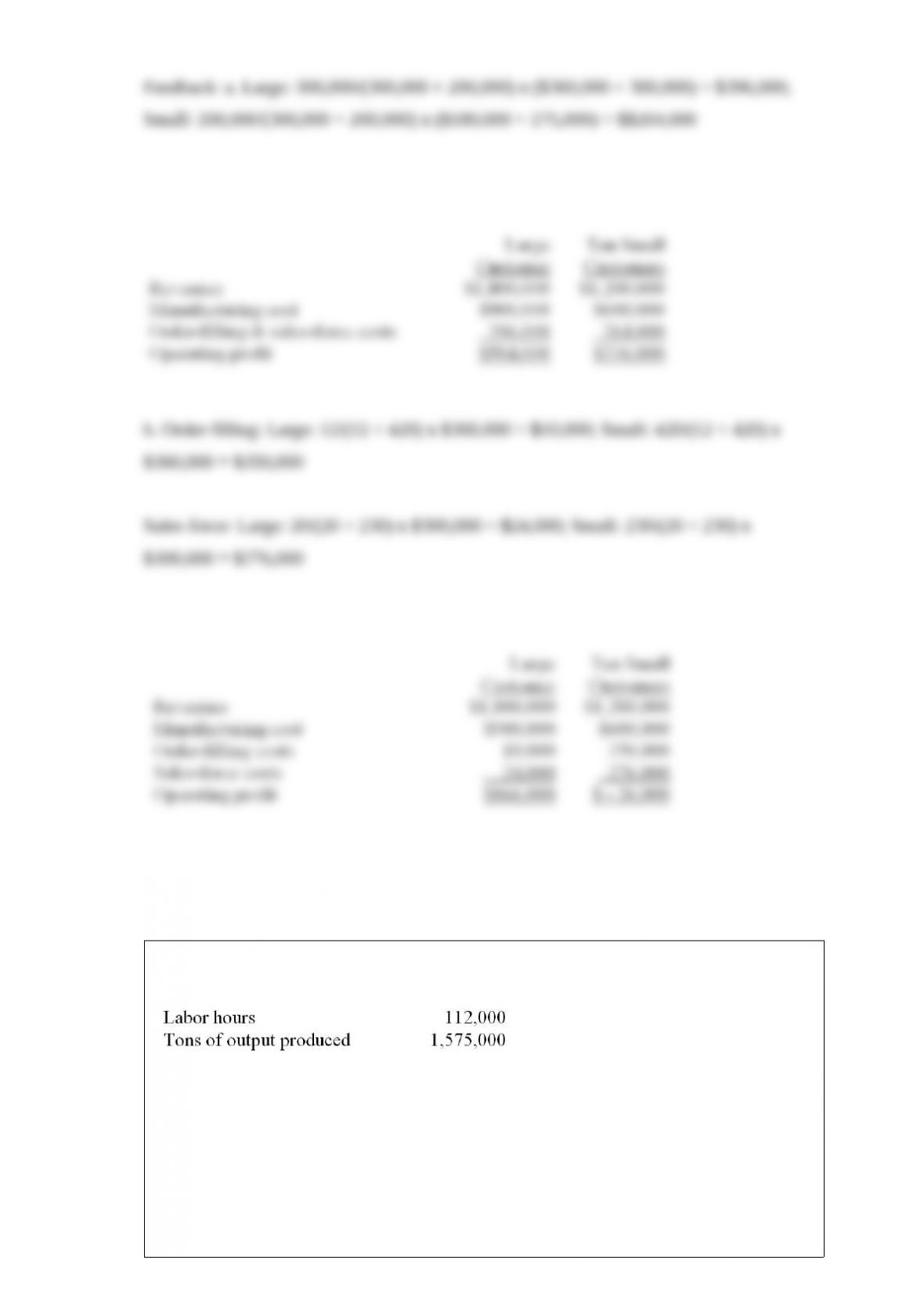
The Berdle Mining Co has the following information for last year
The partial productivity for labor is
A. 1.120
B. 0.071
C. 14.06
D. 112.00
Answer:
Lemaire Products reports the following information about resources. At the beginning
of the year, Lemaire estimated it would spend $8,000 for energy and $12,000 for
repairs.
Compute unused resource capacity for repairs for Lemaire Products.
A. $2,400
B. $12,000
C. $6,000
D. $3,600
Answer:
One problem with economic value added (EVA) adjustments is determining the
appropriate life for expenditures that benefit multiple periods.
Answer:
The Redrock Company uses flexible budgeting for cost control. Redrock produced
10,800 units of product during October, incurring indirect material costs of $13,000. Its
master budget for the reflected indirect material costs of $180,000 at a production
volume of 144,000 units. What was the flexible budget variance for the indirect
material costs in October?
A. $1,100 favorable
B. $1,100 unfavorable
C. $2,000 favorable
D. $2,000 unfavorable
E. $500 favorable
Answer:
A variance can best be described as
A. benchmarks common to other firms in the same industry.
B. differences between planned results and actual results.
C. useful for performance evaluations but not making decisions.
D. generally accepted accounting principles when standards are used.
Answer:
The transfer price that should be used by top management in evaluating whether a
division should buy within the company or from an outside supplier is
A. negotiated transfer price.
B. transfer price based on full cost.
C. transfer price based on variable cost.
D. transfer price based on an open market price.
Answer:
Which of the following items would be classified as a fixed compensation item?
A. Administrative salaries
B. Sales commissions
C. Stock options
D. Piece rates
Answer:
A company had beginning inventories as follows: Direct Materials, $300;
Work-in-Process, $500; Finished Goods, $700. It had ending inventories as follows:
Direct Materials, $400; Work-in-Process, $600; Finished Goods, $800. Material
Purchases (net including freight) were $1,400, Direct Labor $1,500, and Manufacturing
Overhead $1,600. What is the Cost of Goods Sold for the period?
A. $4,100.
B. $4,200.
C. $4,300.
D. $4,400.
Answer:
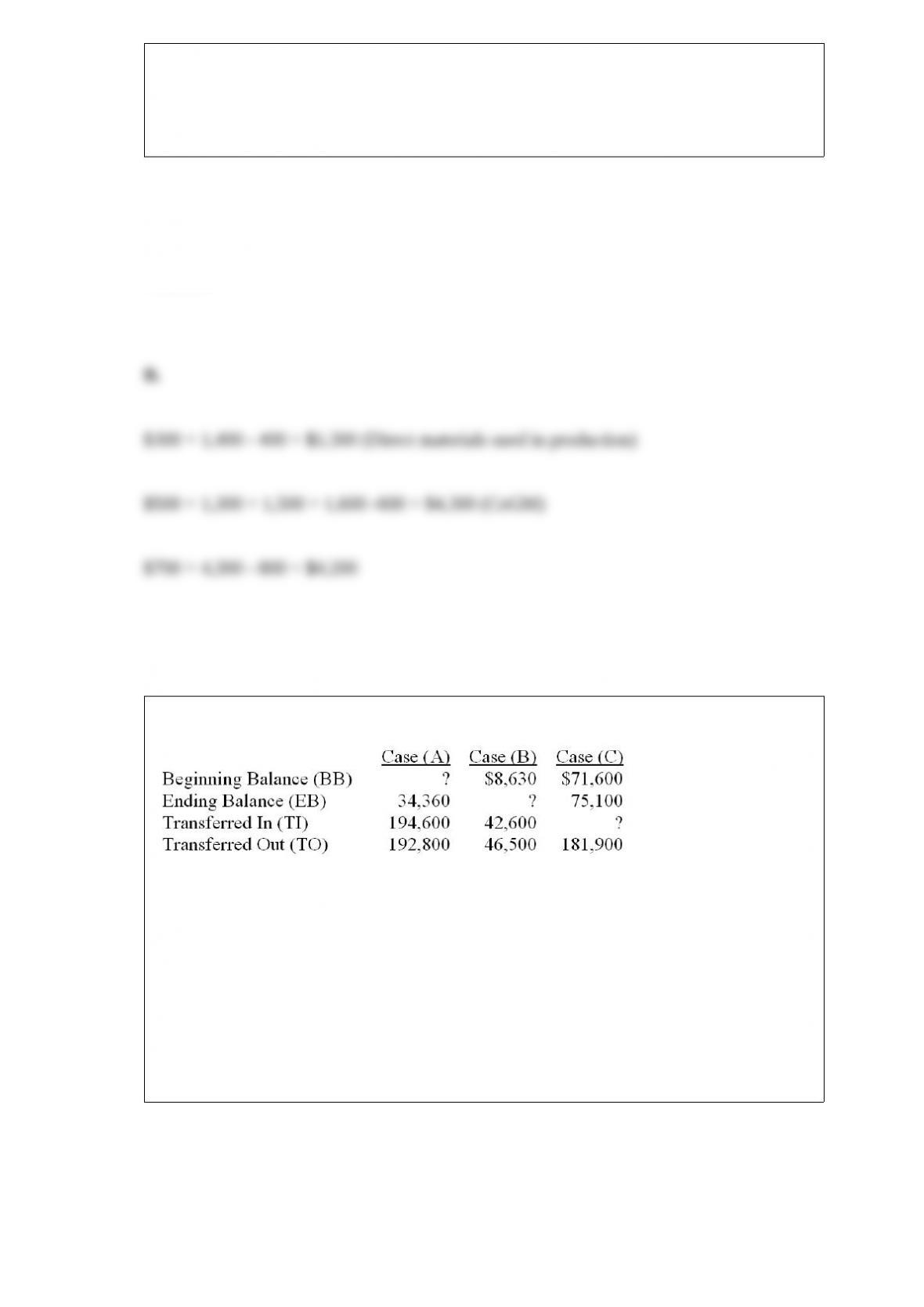
For Case (B) above, what is the Ending Balance (EB)?
A. $4,730
B. $12,530
C. $46,500
D. $8,630
Answer:
The Finishing Department had 5,000 incomplete units in its beginning Work-in-Process
Inventory which were 100% complete as to materials and 30% complete as to
conversion costs. 15,000 units were received from the previous department. The ending
Work-in-Process Inventory consisted of 2,000 units which were 50% complete as to
materials and 30% complete as to conversion costs. The Finishing Department uses
first-in, first-out (FIFO) process costing. How many units were transferred-out during
the period?
A. 12,000
B. 13,000
C. 18,000
D. 20,000
Answer:
The following set up is a system of simultaneous linear equations to allocate costs
using reciprocal method. Matrix algebra is not required.
The following costs were incurred in three operating departments and three service
departments in Reality Company.
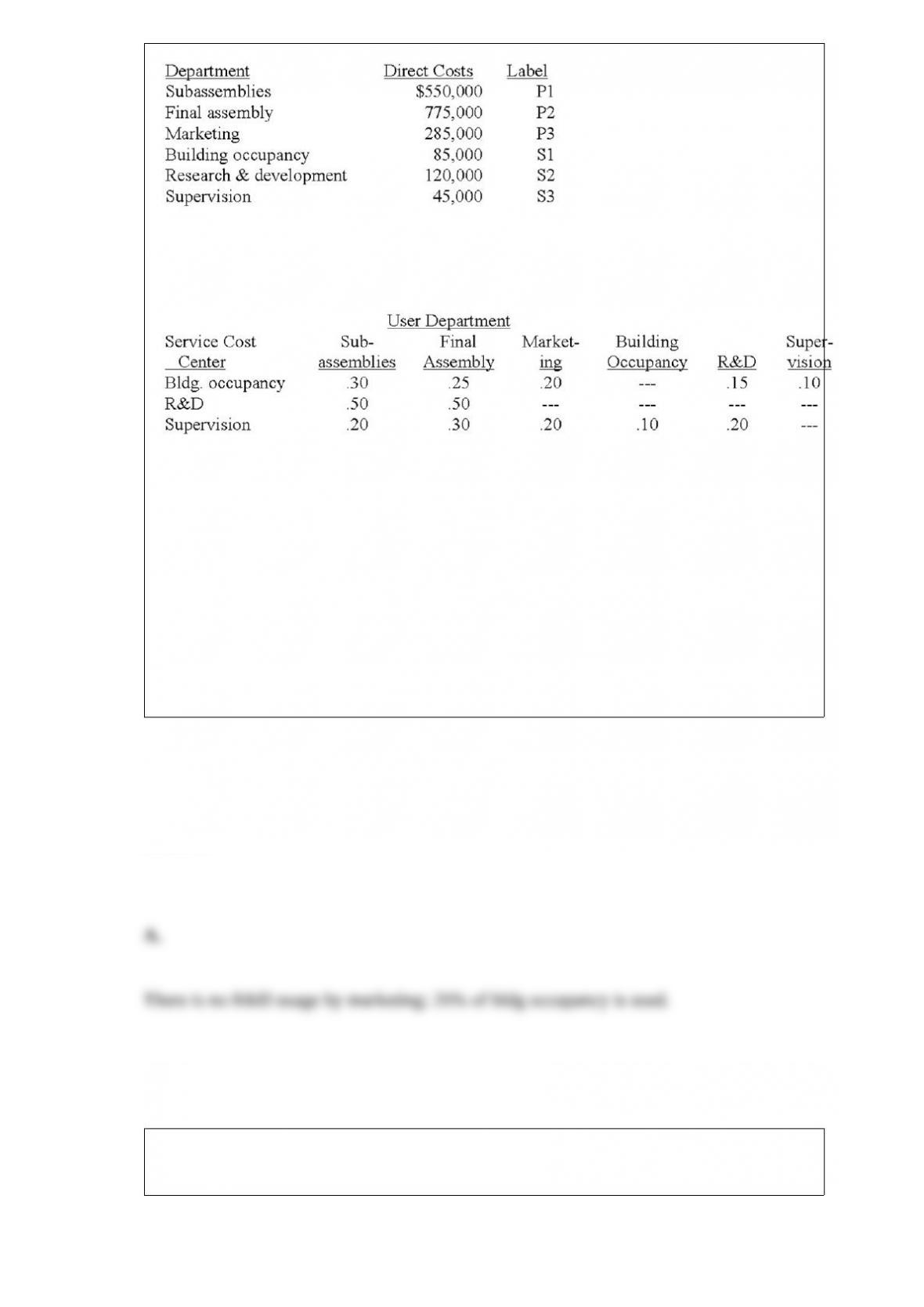
Use of services by other departments is as follows.
The equation for department P3 (marketing) is
A. P3 = $285,000 + .20S1 + .20S3.
B. P3 = $285,000 + .20S1 + .60S2 + .20S3.
C. P3 = $285,000 + .20S1 + .20S2 + .60S3.
D. P3 = $285,000 + .50S1 + .50S3.
Answer:
The Alma Company collected the following information (in days):
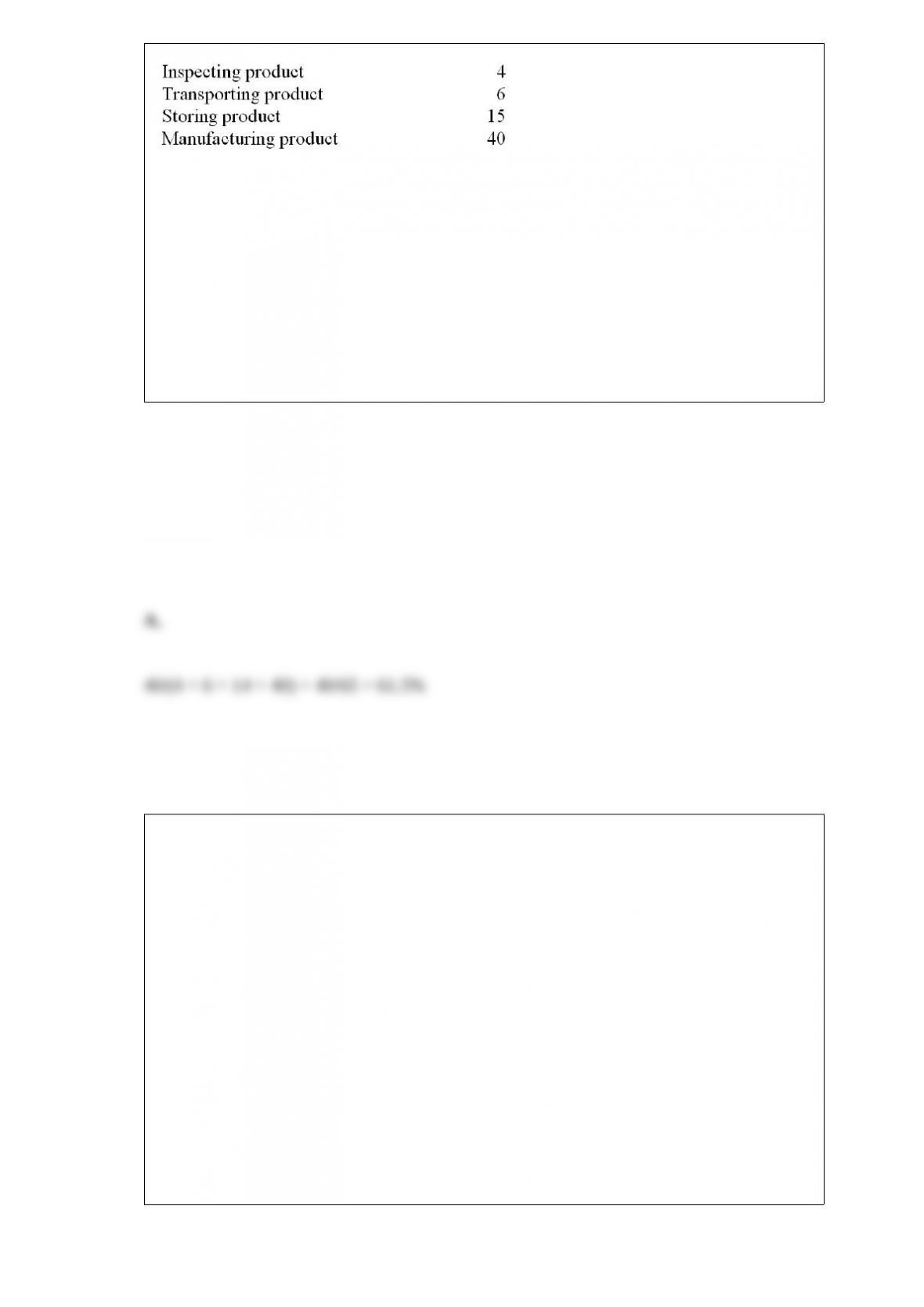
What is the manufacturing cycle efficiency?
A. 61.5%
B. 72.7%
C. 87.0%
D. 27.3%
Answer:
Which of the following statements is (are) false regarding first-stage and second-stage
cost allocation methods?
(A) The basic difference between a first-stage cost allocation and a second-stage cost
allocation is that cost pools are not used in first-stage cost allocations.
(B) Predetermined overhead rates are used in first-stage cost allocations but not in
second-stage cost allocations.
A. Only A is false.
B. Only B is false.
C. Neither A and B nor false.
D. Both A and B are false.
Answer:
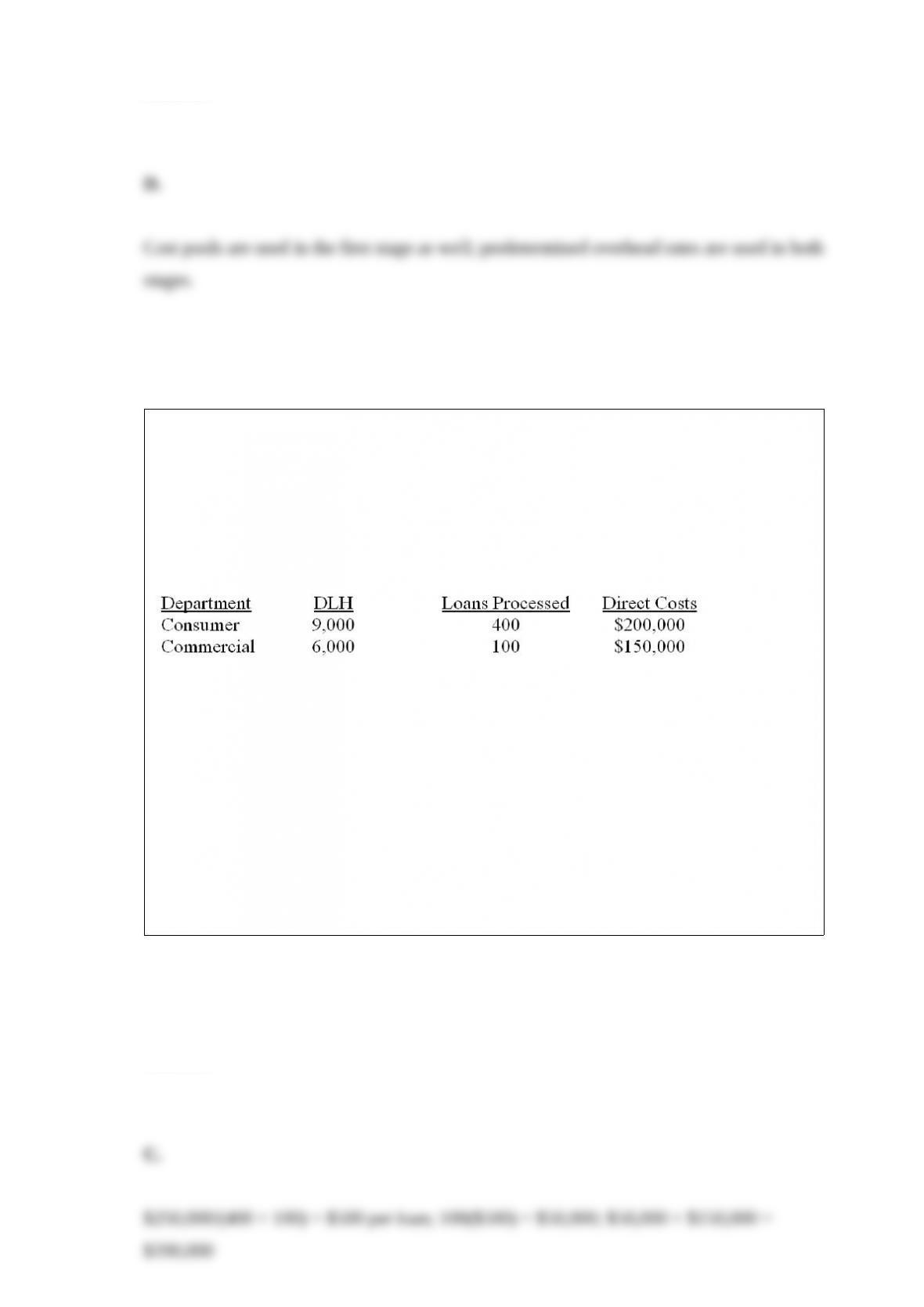
The Muskego National Bank is considering either a bankwide overhead rate or
department overhead rates to allocate $250,000 of indirect costs. The bankwide rate
could be based on either direct labor hours (DLH) or the number of loans processed.
The departmental rates would be based on direct labor hours for Consumer Loans and a
dual rate based on direct labor hours and the number of loans processed for Commercial
Loans. The following information was gathered for the upcoming period:
If Muskego uses a bankwide rate based on the number of loans processed, what would
be the total costs for the Commercial Department?
A. $50,000
B. $150,000
C. $200,000
D. $250,000
Answer:
The alternative courses of action in a make-or-buy decision are (a) manufacture needed
items internally or (b) purchase needed items externally.
Answer:
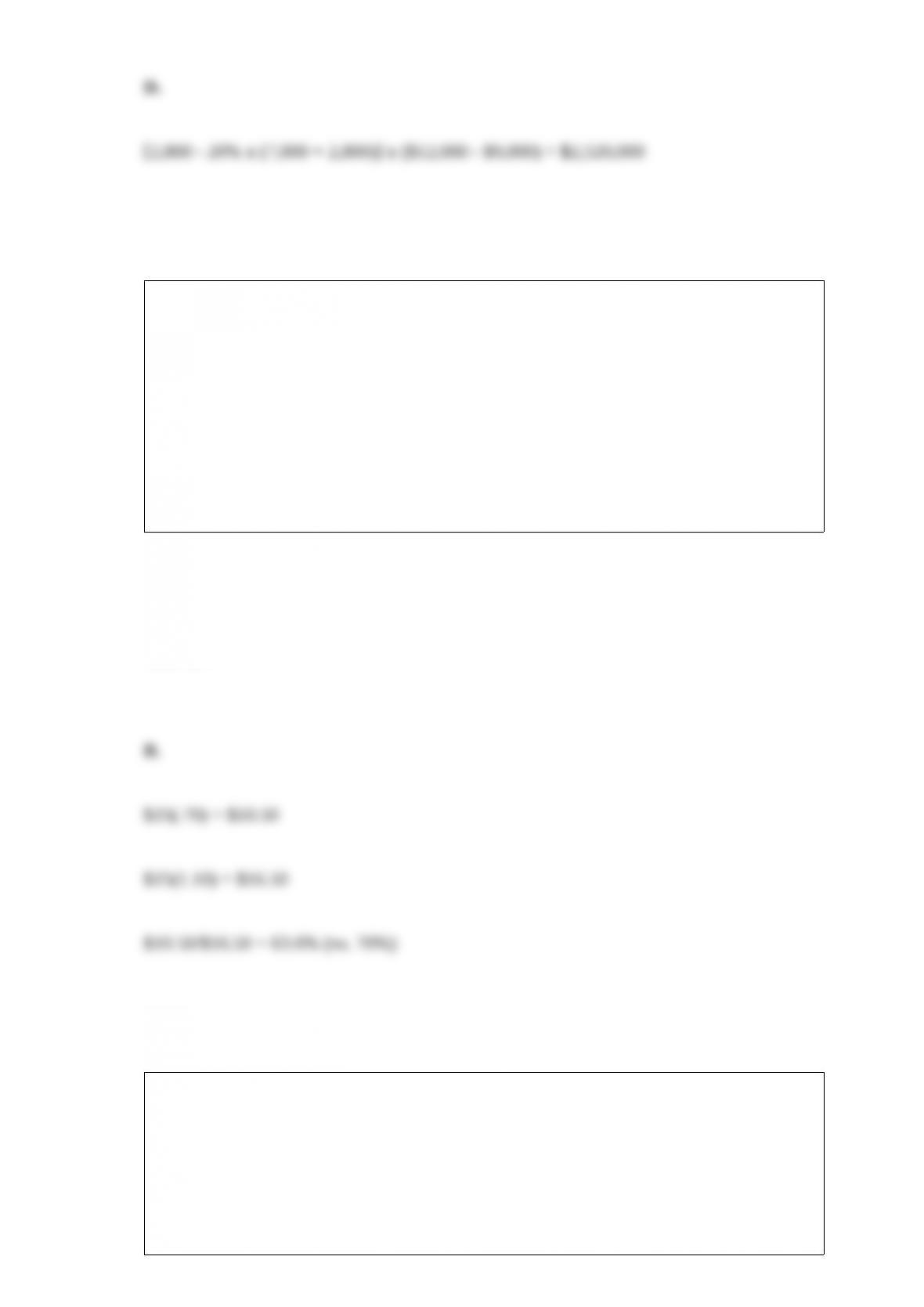
A machine distributor sells two models, basic and deluxe. The following information
relates to its master budget.
Actual sales were 7,000 basic models and 2,800 deluxe models. The actual sales prices
were the same as the budgeted sales prices for both models.
What is the sales mix variance for the deluxe model based?
A. $1,176,000
B. $1,344,000
C. $2,400,000
D. $2,520,000
Answer:
The Blue Company is currently selling its single product for $15. Variable costs are
estimated to remain at 70% of the current selling price and fixed costs are estimated to
be $4,800 per month. If Blue increases its selling price by 10%, its variable cost ratio
will
A. not change
B. decrease
C. increase
Answer:
Top management intervention in settling transfer pricing disputes between two
divisions should be avoided unless
A. there is no intermediate markets.
B. the intermediate market is imperfect.
C. there is an extraordinarily large order.
D. there is no opportunity costs.
Answer: