1) Closing entries are required at the end of each accounting period to close all ledger
accounts.
2) The payment of cash dividends never changes the balance of retained earnings.
3) Owner’s investments are increases in equity from a company’s earnings activities.
4) Callable bonds can be exchanged for a fixed number of shares of the issuing
corporation’s common stock.
5) Under the allowance method of accounting for uncollectible accounts receivable, no
attempt is made to estimate bad debts expense.
6) A useful measure used to evaluate the performance of an investment center is
investment center residual income.
7) If a company provides services to a customer on credit the selling company should
credit Accounts Receivable.
8) If at the time of partnership liquidation, a partner has a $5,000 capital deficiency and
pays the partnership $5,000 out of personal assets to cover the deficiency, then that
partner is entitled to share in the final distribution of cash.
9) Net realizable value for damaged or obsolete goods is sales price plus the cost of
making the sale.
10) If partners devote their time and services to their partnership, their salaries are
expenses on the income statement.
11) A Company had net sales of $23,000 million, and its average account receivables
were $5,860 million. Its accounts receivable turnover is 0.92.
12) A customer’s promise to pay is called an account payable to the seller.
13) A time ticket is a source document used by an employee to record the number of
hours worked on a particular job during the work day.
14) A company is planning to purchase a machine that will cost $24,000, have a
six-year life, and be depreciated over a three-year period with no salvage value. The
company expects to sell the machine’s output of 3,000 units evenly throughout each
year. A projected income statement for each year of the asset’s life appears below. What
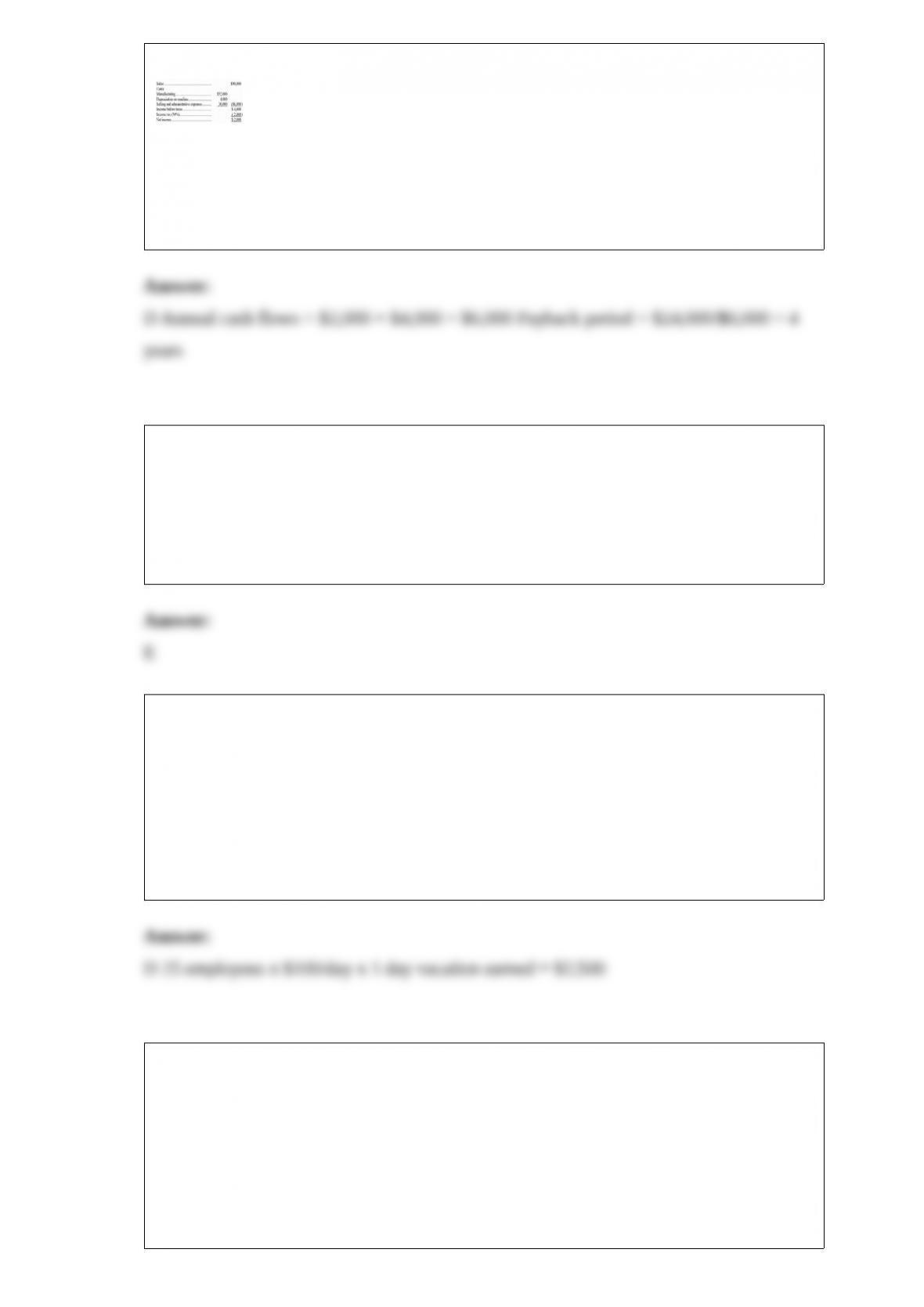
is the payback period for this machine?
A.24 years
B.12 years
C.6 years
D.4 years
E.1 year
15) Permanent accounts include all of the following except:
A.Accumulated Depreciation – Equipment
B.Prepaid Rent
C.Unearned Consulting Revenue
D.Accounts Payable
E.Depreciation Expense – Equipment
16) Employees earn vacation pay at the rate of one day per month. During July, 25
employees qualify for one vacation day each. Their average daily wage is $100 per day.
What is the amount of vacation benefit expense to be recorded for the month of July?
A.$25
B.$100
C.$250
D.$2,500
E.$25,000
17) Bard Manufacturing uses a job order cost accounting system. During one month
Bard purchased $198,000 of raw materials on credit; issued materials to production of
$195,000 of which $30,000 were indirect. Bard incurred a factory payroll of $150,000,
paid in cash, of which $40,000 is classified as indirect labor. Bard uses a predetermined
overhead application rate of 150% of direct labor cost. The journal entry to record the
issuance of materials to production is:
A.Debit Raw Materials Inventory $195,000; credit Accounts Payable $195,000
B.Debit Goods in Process Inventory $195,000; credit Raw Materials Inventory
$195,000
C.Debit Raw Materials Inventory $195,000; credit Goods in Process Inventory
$195,000
D.Debit Goods in Process Inventory $165,000; debit Factory Overhead $30,000; credit
Raw Materials Inventory $195,000
E.Debit Finished Goods Inventory $195,000; credit Raw Materials Inventory $195,000
18) If a company owns more than 20% of the stock of another company and the stock is
being held as a long-term investment, which method would the investor normally use to
account for this investment?
A.Equity method
B.Fair value method
C.Historical cost method
D.Cost with amortization method
E.Effective method
19) Trenton reports net income of $230,000 for the year ended December 31, Year 2. It
also reports $87,700 depreciation expense and a $5,000 gain on the sale of equipment.
Its comparative balance sheet reveals a $35,500 decrease in accounts receivable, a
$15,750 increase in accounts payable, and a $12,500 decrease in wages payable.
Calculate the new cash provided (used) in operating activities using the indirect
method.
A.$376,450
B.$351,450
C.$356,450
D.$319,950
E.$263,750
20) Use the following information to prepare a budgeted income statement for Arbor
Company for the month of June.
a. Beginning cash balance on June 1 is $52,000.
b. Cash receipts from sales: 40% is collected in the month of sale, 50% in the next
month, and 10% in the second month after sale (uncollectible accounts are negligible
and can be ignored). Sales amounts are: April (actual), $1,450,000, May (actual),
$1,600,000, and June (budgeted), $1,700,000.
c. Payments on merchandise purchases: 80% in the month of purchase and 20% in the
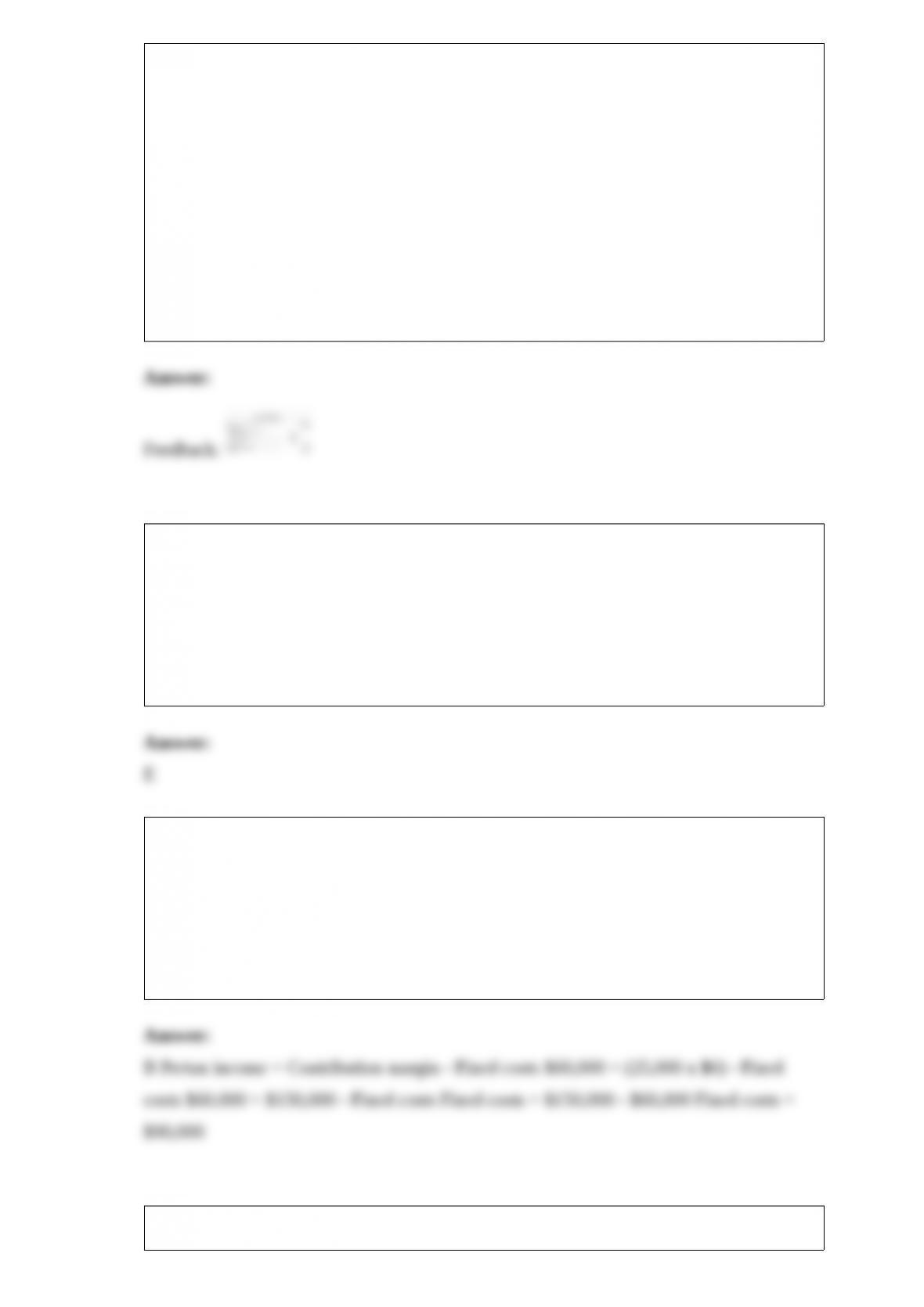
month following purchase. Purchases amounts are May (actual), $830,000; and June
(budgeted), $867,000.
d. Budgeted cash disbursements for salaries in June: $260,000. Salaries payable on May
31 are $60,000 and are expected to be $50,000 on June 30.
e. Budgeted depreciation expense for June: $24,000.
f. Other cash expenses budgeted for June: $282,000.
g. Accrued income taxes due in June: $48,000.
h. Bank loan interest due in June: $8,000 which represents the 1% monthly expense on
a bank loan of $800,000.
i. Loan payment of $50,000 if the preliminary cash balance is greater than $100,000.
j. Cost of goods sold is 53% of sales.
k. The income tax rate applicable to the company is 30%.
21) Which one of the following is representative of typical cash flows from operating
activities?
A.Proceeds from collecting the principal amounts of loans
B.Repayment of principals on loans
C.Proceeds from the issuance of bonds and notes payable
D.Payments by a merchandiser to acquire equity securities of other companies
E.Receipts of cash sales
22) A firm expects to sell 25,000 units of its product at $11 per unit. Pretax income is
predicted to be $60,000. If the variable costs per unit are $5, total fixed costs must be:
A.$65,000
B.$90,000
C.$125,000
D.$215,000
E.$275,000
23) The calculation of the payback period for an investment when net cash flow is even
(equal) is:
A.Cost of investment/Annual net cash flow
B.Cost of investment/Total net cash flow
C.Annual net cash flow/Cost of investment
D.Total net cash flow/Cost of investment
E.Total net cash flow/Annual net cash flow
24) The area of accounting aimed at serving the decision making needs of internal users
is:
A.Financial accounting
B.Managerial accounting
C.External auditing
D.SEC reporting
E.Bookkeeping
25) The margin of safety is the excess of:
A.Break-even sales over expected sales
B.Expected sales over variable costs
C.Expected sales over fixed costs
D.Fixed costs over expected sales
E.Expected sales over break-even sales
26) The most useful budget figures are developed:
A.From the “top-down”
B.From the “bottom-up” following a participatory process
C.Solely by the budget committee
D.By the CEO
E.After the accounting period has begun
27) A company had net sales of $600,000, total sales of $750,000, and an average
accounts receivable of $75,000. Its accounts receivable turnover equals:
A..13
B..80
C.7.75
D.8.00
E.10.00
28) A company paid $0.48 in cash dividends per share. Its earnings per share is $4.20
and its market price per share is $30.00. Its dividend yield equals:
A.1.60%
B.6.25%
C.8.75%
D.11.43%
E.14.00%
29) Investments in debt and equity securities that the company actively manages and
trades for profit are referred to as short-term investments in:
A.Available-for-sale securities
B.Held-to-maturity securities
C.Trading securities
D.Realizable securities
E.Liquid securities
30) The purpose of reversing entries is to:
A.simplify the recording of certain journal entries in the future
B.correct an error made in a previous journal entry
C.ensure that closing entries have been properly posted to the ledger accounts
D.make certain that only permanent accounts are carried forward into the next
accounting period
E.complete a required step in the accounting cycle
31) A corporation declared and issued a 15% stock dividend on November 1. The
following information was available immediately prior to the dividend:
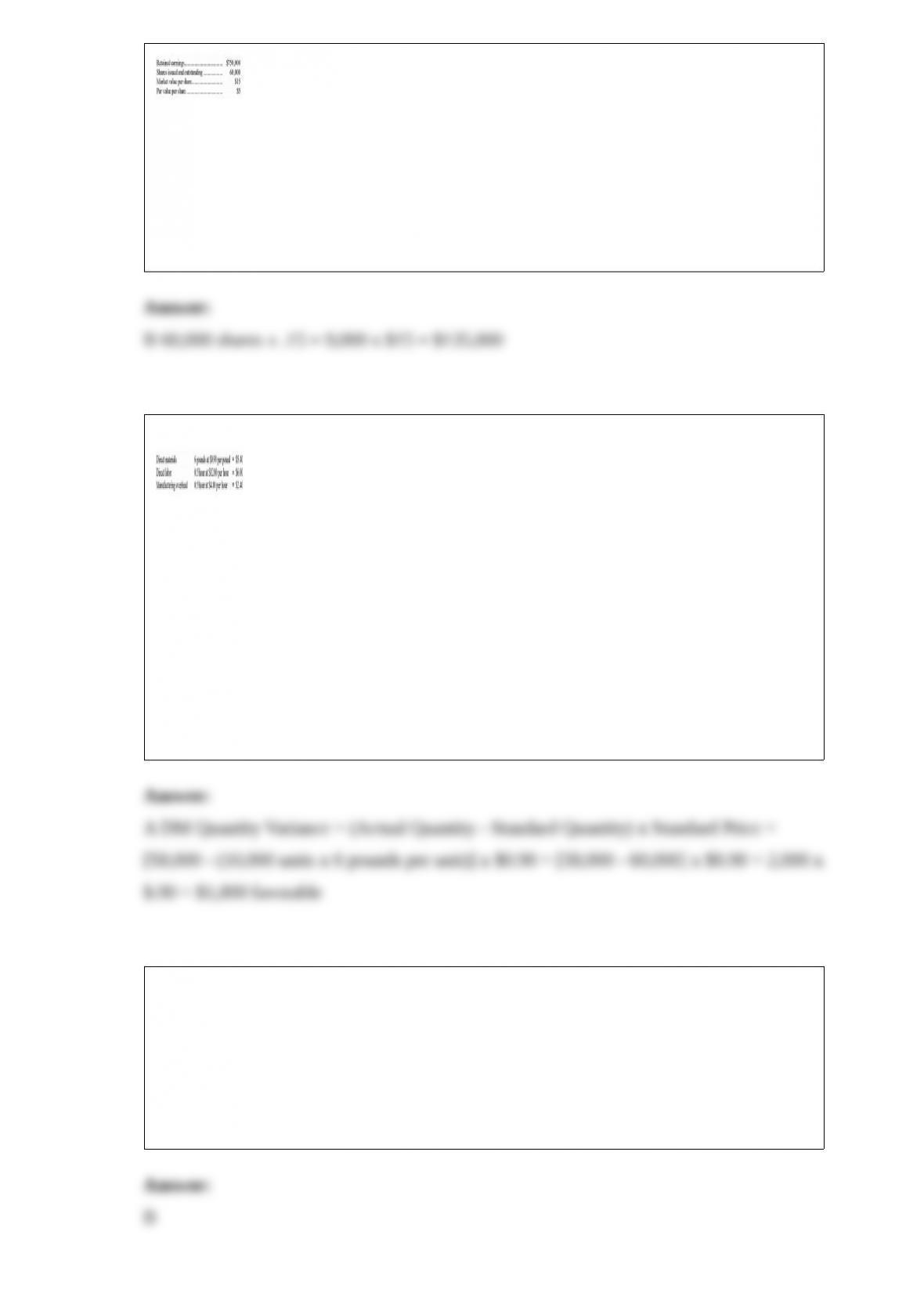
The amount that contributed capital will increase (decrease) as a result of recording this
stock dividend is:
A.$45,000
B.$135,000
C.$(45,000)
D.$(135,000)
E.$0
32) A company uses the following standard costs to produce a single unit of output.
During the latest month, the company purchased and used 58,000 pounds of direct
materials at a price of $1.00 per pound to produce 10,000 units of output. Direct labor
costs for the month totaled $56,350 based on 4,900 direct labor hours worked. Variable
manufacturing overhead costs incurred totaled $15,000 and fixed manufacturing
overhead incurred was $10,400. Based on this information, the direct materials quantity
variance for the month was:
A.$1,800 favorable
B.$5,800 unfavorable
C.$5,800 favorable
D.$1,800 unfavorable
E.$1,000 favorable
33) The amount of income earned per share of a company’s outstanding common stock
is known as:
A.Restricted retained earnings per share
B.Earnings per share
C.Continuing operations per share
D.Dividends per share
E.Book value per share
34) Prepaid expenses are:
A.Payments made for products and services that do not ever expire
B.Classified as liabilities on the balance sheet
C.Decreases in equity
D.Assets that represent prepayments of future expenses
E.Promises of payments by customers
35) Job order costing systems normally use:
A.Periodic inventory systems
B.Perpetual inventory systems
C.Real inventory systems
D.General inventory systems
E.All of these
36) Bard Manufacturing uses a job order cost accounting system. During one month
Bard purchased $198,000 of raw materials on credit; issued materials to production of
$195,000 of which $30,000 were indirect. Bard incurred a factory payroll of $150,000,
paid in cash, of which $40,000 is classified as indirect labor. Bard uses a predetermined
overhead application rate of 150% of direct labor cost. The journal entry to record the
allocation of the factory payroll to production is:
A.Debit Goods in Process Inventory $150,000; credit Factory Payroll $150,000
B.Debit Goods in Process Inventory $150,000; credit Cash $150,000
C.Debit Factory Payroll $150,000; credit Cash $150,000
D.Debit Goods in Process Inventory $110,000; debit Factory Overhead $40,000; credit
Factory Payroll $150,000
E.Debit Goods in Process Inventory $110,000; debit Factory Overhead $40,000; credit
Cash $150,000
37) Micron owns 35% of Martok. Martok pays a total of $47,000 in cash dividends for
the period. Micron’s entry to record the dividend transaction would include a:
A.Credit to Long-Term Investments for $16,450
B.Debit to Long-Term Investments for $16,450
C.Debit to Cash for $47,000
D.Credit to Cash for $16,450
E.Credit to Investment Revenue for $47,000
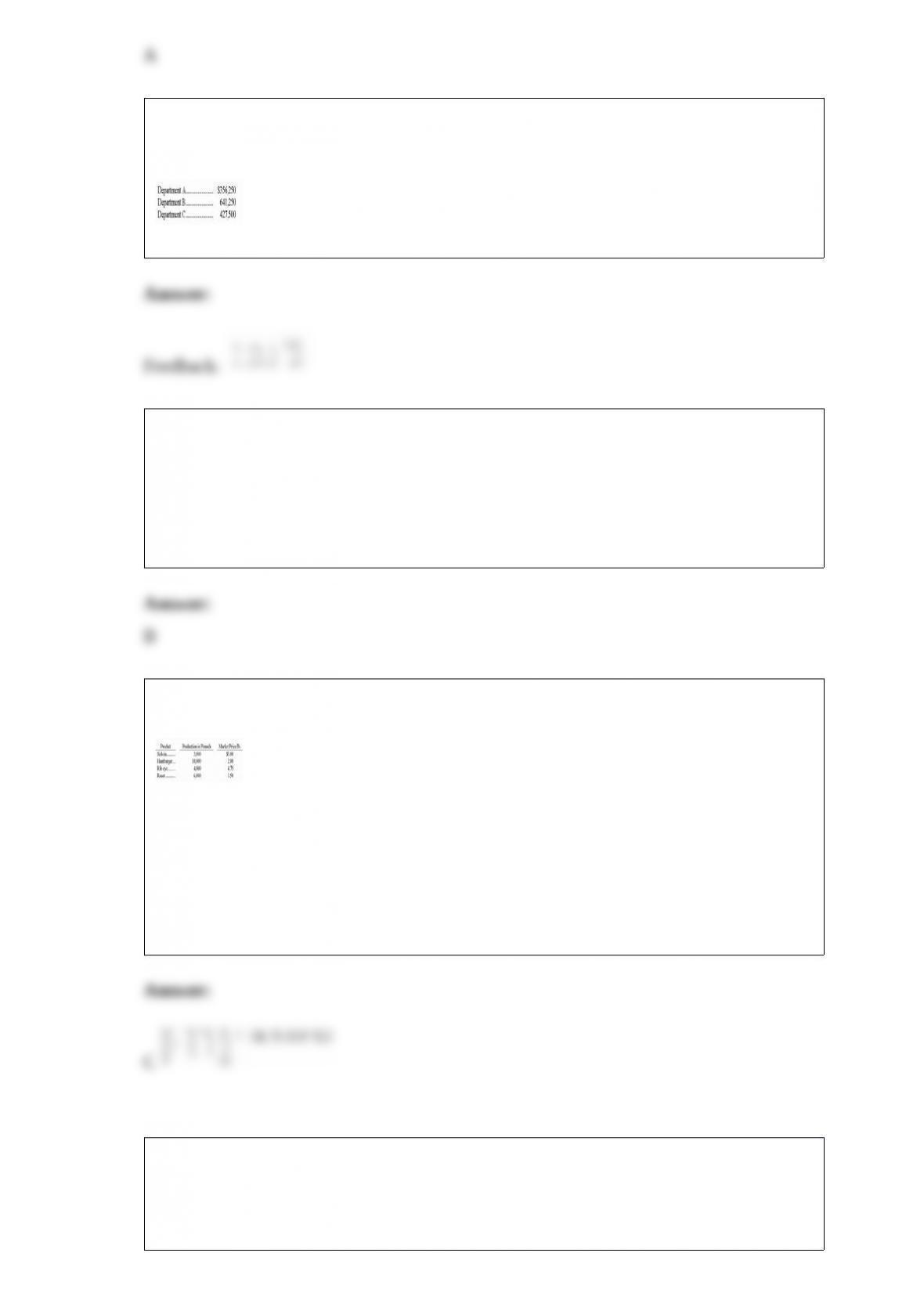
38) A retail store has three departments, A, B, and C, each of which has four full-time
employees. The store does general advertising that benefits all departments. Advertising
expense totaled $90,000 for the current year, and departmental sales were:
How much advertising expense should be allocated to each department?
39) The accounts receivable ledger:
A.Is for storing transaction data for customers
B.Is for storing transaction data for individual customers
C.Is for storing transaction data for individual creditors
D.Is for storing transaction date for creditors
E.Is also the controlling account
40) Breon Beef Company uses the relative market value method of allocating joint costs
in its production of beef products. Relevant information for the current period follows:
The total joint cost for the current period was $43,000. How much of this cost should
Breon Beef allocate to sirloin?
A.$0
B.$5,909
C.$8,600
D.$10,750
E.$43,000
41)
Identify the inventory valuation method that is being described for each situation below.
In all cases, assume a period of rising prices. Use the following to identify the inventory
valuation method:
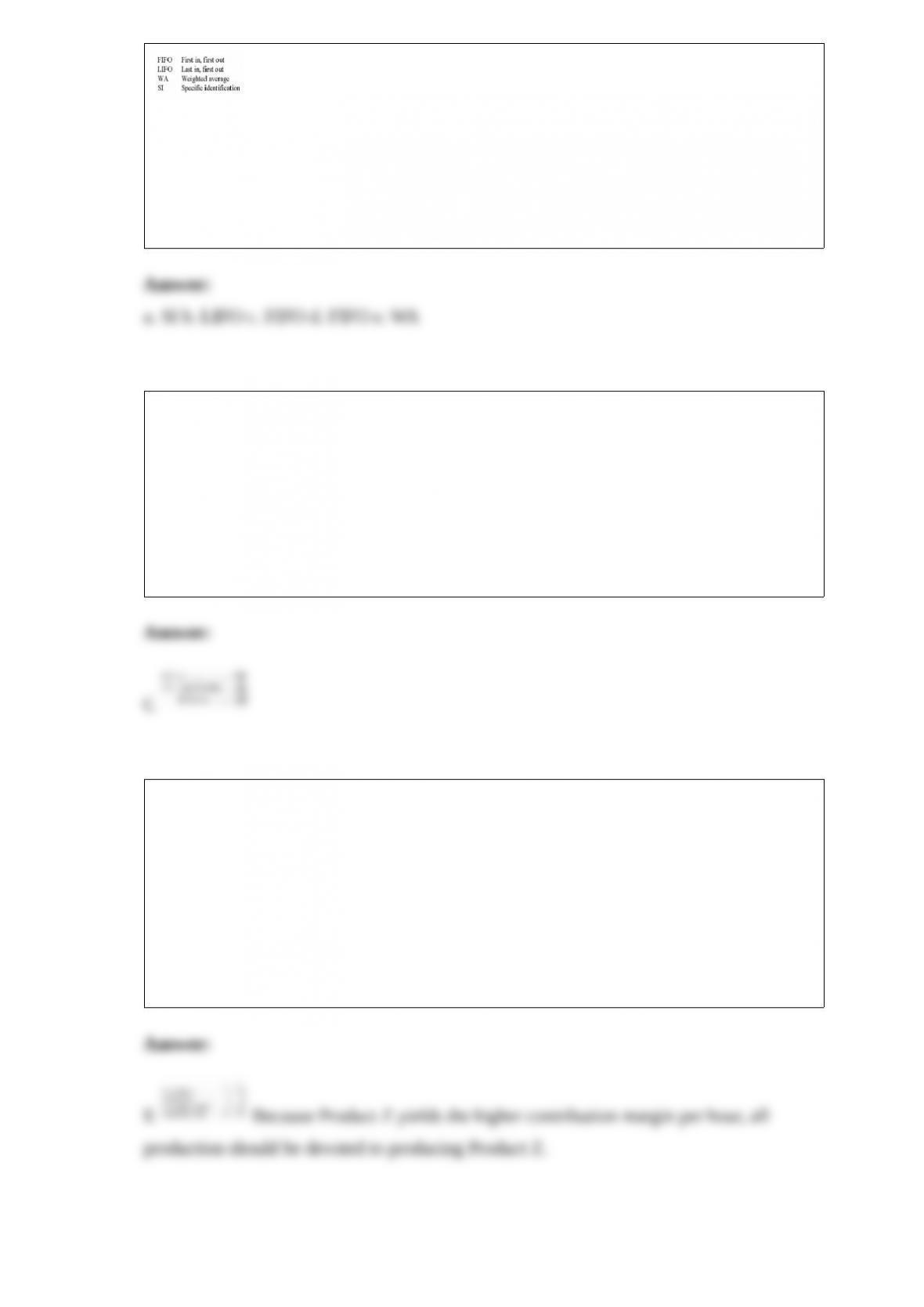
a. The method that can only be used if each inventory item can be matched with a
specific purchase and its invoice.
b. The method that will cause the company to have the lowest income taxes.
c. The method that will cause the company to have the lowest cost of goods sold.
d. The method that will assign a value to inventory that approximates its current cost.
e. The method that will tend to smooth out erratic changes in costs.
42) A job was budgeted to require 3 hours of labor per unit at $8.00 per hour. The job
consisted of 8,000 units and was completed in 22,000 hours at a total labor cost of
$198,000. What is the total labor cost variance?
A.$2,000 unfavorable
B.$3,000 unfavorable
C.$6,000 unfavorable
D.$8,000 unfavorable
E.$9,000 unfavorable
43) Sherman Company can sell all of its products A and Z that it can produce, but it has
limited production capacity. It can produce 6 units of A per hour or 10 units of Z per
hour, and it has 20,000 production hours available. Contribution margin per unit is $12
for A and $10 for Z. What is the most profitable sales mix for this company?
A.84,000 units of A and 60,000 units of Z
B.48,000 units of A and 80,000 units of Z
C.60,000 units of A and 100,000 units of Z
D.120,000 units of A and 0 units of Z
E.0 units of A and 200,000 units of Z

44) A company uses a process cost accounting system. Its Sewing Department
completed and transferred out 120,000 units during the current period. The ending
inventory in the Sewing Department consists of 40,000 units (20% complete with
respect to direct materials and 60% complete with respect to direct labor). Overhead is
applied on the basis of direct labor.
Determine the equivalent units of production for the Sewing Department for direct
materials, direct labor and overhead assuming the weighted average method.
A.120,000; 120,000; 120,000
B.120,000; 160,000; 120,000
C.128,000; 120,000; 120,000
D.128,000; 144,000; 144,000
E.128,000; 184,000; 160,000
45) Which of the following represents the correct formula for calculating cost of goods
manufactured?
A.Direct materials used + direct labor + factory overhead + beginning goods in process
+ ending goods in process
B.Direct materials used + direct labor + factory overhead + beginning goods in process
– ending goods in process
C.Direct materials used + direct labor + factory overhead – beginning goods in process
+ ending goods in process
D.Direct materials used + direct labor + factory overhead – beginning goods in process –
ending goods in process
E.Direct materials used + direct labor – factory overhead + beginning goods in process –
ending goods in process
46) Expenditures that flow directly to the current income statement and are not reported
as assets are ___________________ costs.
47) Aster Company’s 2011 income statement and changes in selected balance sheet
accounts are given below. Calculate the company’s net cash provided or used by
operating activities using the direct method.
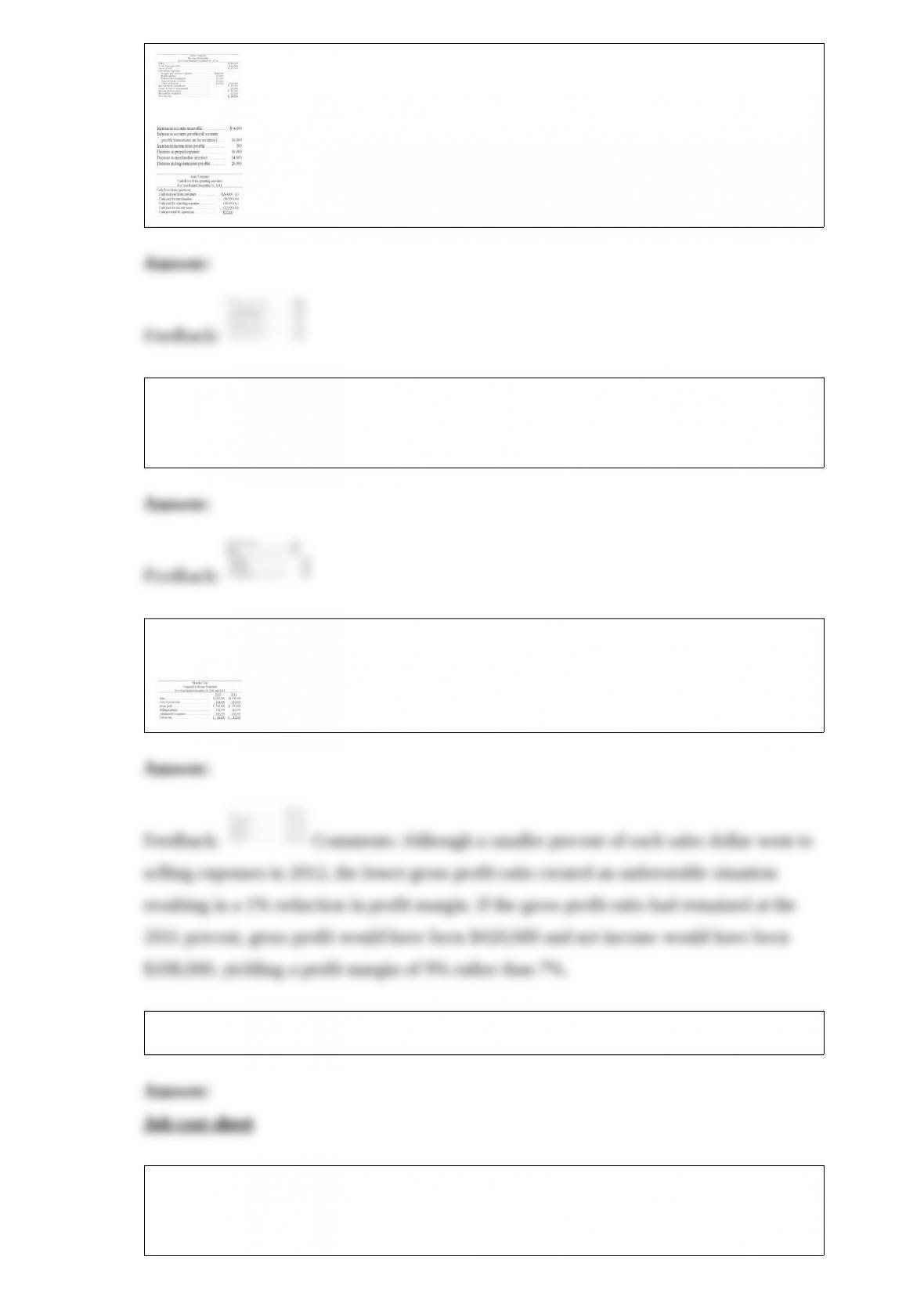
The company also experienced the following during 2011:
48) Arthur, Barnett, and Cummings form a partnership. Arthur contributes $250,000
cash and Barnett contributes $230,000 in cash. Cummings contributes equipment worth
$255,000. Prepare the single journal entry to record the formation of this partnership.
49) Express the following income statement information in common-size percents
(round to nearest whole percent). Comment on the results.
50) A ______________________ is a separate record maintained for each job.
51) Marble Corporation had the following balances in its stockholders’ equity accounts
at December 31, 2010:
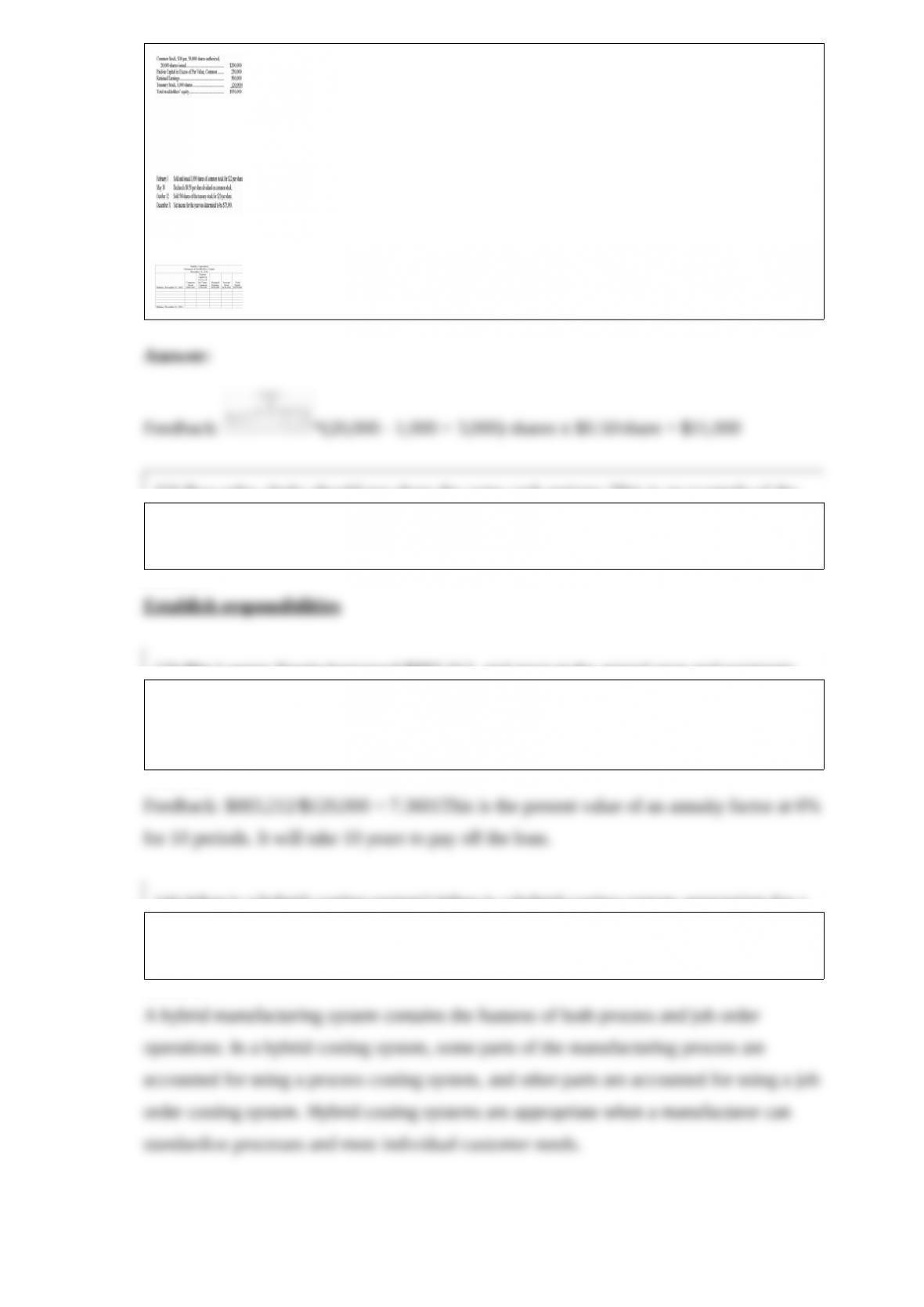
The following transactions occurred during 2011:
Based on the above information, prepare a statement of stockholders’ equity for 2011.
Use the form below.
52) Two sales clerks should not share the same cash register. This is an example of the
internal control principle of ______________________.
53) Big League Sports borrowed $883,212, and must make annual year-end payments
of $120,000 each. If Big League’s interest rate is 6%, how many years will it take Big
League Sports to pay off the loan?
54) What is a hybrid costing system? When is a hybrid costing system appropriate for a
manufacturer?