Which of the following statements isTRUE concerning the declaration and payment of
cash dividends?
A. Declaration and payment of cash dividends will reduce the amount of net income.
B. Declaration and payment of cash dividends will not reduce the retained earnings
balance.
C. Declaration and payment of cash dividends will reduce the amount of resources
available to invest in assets.
D. Declaration and payment of cash dividends is calculated on the amount of shares of
stock issued, not the amount of shares outstanding.
Answer:
Form 10-Q is a quarterly report electronically filed with the SEC.
Answer:
Which of the following isTRUE?
A. Equity financing is always better than debt financing.
B. Equity financing requires dividends to be paid.
C. Dividends are tax-deductible.
D. If a corporation has only one class of stock, it is common stock.
Answer:
The stockholders’ equity of a company is the difference between assets and liabilities.
Answer:
The amounts of all the accounts reported on the balance sheet can be taken from the
adjusted trial balance.

Answer:
Which one of the following statements regarding amortization of discounts and
premiums is notTRUE?
A. Under straight-line amortization, when a bond is sold at a premium, the annual
premium amortization is the total premium divided by the number of years until bond
maturity.
B. When a bond is sold at a discount, interest expense recorded using the
effective-interest method is less than the interest paid on the bond.
C. The effective-interest method of amortization is considered to be conceptually
superior to straight-line amortization.
D. When a bond discount is amortized using the effective-interest method, the promised
interest payment is less than the interest expense, so the bond liability will increase as a
result of the contra-liability account decreasing.
Answer:
Which of the following statements isTRUE concerning the allowance for doubtful
accounts?
A. The allowance for doubtful accounts is a contra-revenue account.
B. The allowance for doubtful accounts has a normal debit balance.
C. The allowance for doubtful accounts is not used in the direct write-off method.
D. The allowance for doubtful accounts is reported on the Income Statement.
Answer:
Which of the following statements regarding sales returns and allowances isTRUE?
A. Recording sales returns and allowances in a separate account is an important internal
control that allows management to evaluate the volume of returns and allowances as a
potential indicator of the quality of their products.
B. The Sales Returns and Allowances account balance should be added to the Sales
account balance when computing net sales.
C. Sales Returns and Allowances account is an example of a contra-asset account.
D. Recording a sales allowance requires two entries.
Answer:
Expenses are the same as expenditures.
Answer:
Purrfect Pets announces that its gross profit rose 5% and its net income fell. Which of
the following statements isTRUE?
A. This is not possible given that net income is determined by gross profit.
B. This must mean that selling, general, and administrative expenses rose more than
5%.
C. This must mean that sales revenue rose more than expenses.
D. This must mean that cost of goods sold fell.
Answer:
If debits equal credits on the trial balance, it means that the accounting records do not
contain any errors.
Answer:
LA Company has a gross profit percentage of 61%, while NY Company has a gross
profit percentage of 37%. Which of the following is alwaysTRUE?
A. LA Company will report a higher net income than NY Company.
B. NY Company must have a greater sales volume than LA Company.
C. LA Company is more efficient at controlling selling, general, and administrative
expenses than NY Company.
D. LA Company and NY Company both earn enough on each sale to make a
contribution to their operating costs.
Answer:
The Securities and Exchange Commission (SEC) is the government agency that has
primary authority for setting accounting standards in the U.S.
Answer:
Which of the following statements regarding financing activities is notTRUE?
A. Cash dividends paid to a company’s stockholders are reported as cash outflows from
financing activities.
B. When a company issues stock for cash, it reports a cash inflow from financing
activities.
C. When a company repurchases stock with cash, it reports a cash outflow for financing
activities.
D. When a company repays a loan, it reports a cash inflow from financing activities.
Answer:
A good voucher system includes procedures and approvals designed to control cash
payments.
Answer:
Which of the following statements regarding trend analysis isTRUE?
A. Time-series analysis is an example of trend analysis.
B. Trend data are always in dollars.
C. Trend analysis is also known as vertical analysis.
D. Common-size analysis is an example of trend analysis.
Answer:
The order in which assets are reported on the balance sheet under IFRS is the same as
the order under the U.S. GAAP rules.
Answer:
A contra account is added to the account it offsets.
Answer:
The Sarbanes-Oxley Act requires external auditors to test the company’s internal control
system.
Answer:
Which of the following statements regarding gross profit isTRUE?
A. Gross profit is net sales minus cost of goods sold.
B. A company sells $10,000 of goods. If the gross profit percentage is 32%, net income
would be $3,200.
C. Gross profit is recorded by a credit to the gross profit account.
D. If net sales are $100 and cost of goods sold is $50 then the gross profit percentage is
100%.
Answer:
An audit report expressing an unqualified opinion is generally desired by the company
presenting its financial statements.
Answer:
If EPS (earnings per share) decreases, it must mean that the company’s net income has
fallen.
Answer:
All asset accounts, all liability accounts, contributed capital, and retained earnings
accounts are called permanent accounts.
Answer:
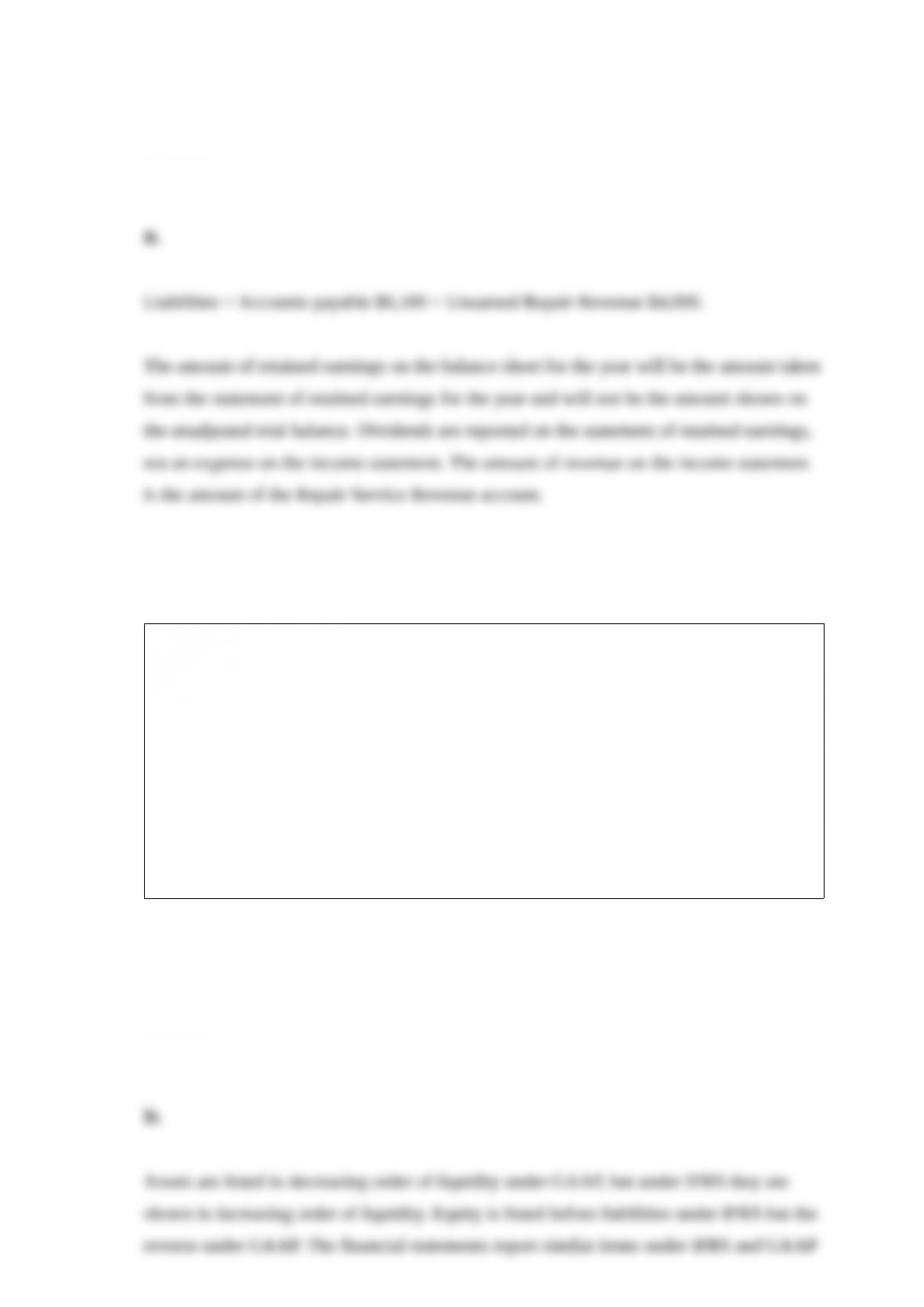
The balances for the accounts of Dudley Do-Right Repair Shop for the year ended
December 31, 2013, are shown below and each account has a normal balance:
Which of the following is notTRUE about the financial statements of Dudley Do-Right
Repair Shop?
A. The balance sheet at December 31, 2013 will show Total Liabilities of $10,500.
B. The balance sheet at December 31, 2013 will show Retained earnings of $68,700.
C. The Income Statement for the year will not include the dividends of $48,000.
D. The Income Statement for the year will show Total Revenue of $175,000.
Answer:
Which of the following would NOT beTRUE regarding financial statements prepared
using IFRS versus U.S.GAAP?
A. The order of current and noncurrent assets differs.
B. The order of total liabilities and total stockholders’ equity differs.
C. The financial statements have different titles.
D. Within the current classification, there is no difference between the order in the
presentation using IFRS versus U.S. GAAP.
Answer:
Which of the following statements is notTRUE about sales returns & allowances?
A. Sales returns and allowances can provide useful information about the quality of
merchandise and the possibility of unsatisfied customers.
B. Sales returns and allowances are recorded in a separate contra-revenue account.
C. Sales returns and allowances are always disclosed in external financial statements.
D. Sales returns and allowance are closed to retained earnings at the end of the year.
Answer:
The principal of a loan does not include any interest charges.
Answer:
Your company buys 500 pairs of socks at $3 each (including other purchasing costs
such as transportation) and sells them for $5 each.
Use the information above to answer the following question. Which of the following
statements isTRUE?
A. The sales revenue is $1,500.
B. The gross profit is $1,500.
C. The cost of goods sold is $1,500.
D. The net income is $1,500.
Answer:
The going-concern assumption is also known as the continuity assumption.
Answer:
As of 2012, the U.S. had not switched to IFRS.
Answer:
Which of the following statements isTRUE?
A. When unit costs are steadily rising or falling, the weighted average cost method
yields a cost of goods sold between that of FIFO and LIFO.
B. FIFO will lead to the highest net income if unit costs are falling.
C. LIFO will always yield a smaller net income than FIFO.
D. Specific identification is the most practical, but least accurate, measure of cost and
net income.
Answer:
At the end of the accounting period, but before closing entries are made, Harry, the
proprietor of Harry’s Bar and Grill, has a debit balance of $24,500 in his drawing
account and a credit balance of $72,300 in his capital account. Which of the following
statements isTRUE?
A. Harry’s net income was $47,800.
B. In closing, Harry will debit the drawing account for $24,500 and credit the capital
account for $24,500.
C. In closing, Harry will debit the capital account for $24,500 and credit the drawing
account for $24,500.
D. Harry’s retained earnings account was $47,800.
Answer:
Common size financial statements are not useful in analyzing companies of different
size.
Answer:
Company A uses an accelerated depreciation method while Company B uses the
straight-line method for an asset of the same cost and useful life. Other things being
equal, which of the following isTRUE?
A. Company A will have higher net income in the early years, but Company B will have
higher net income towards the end of the asset’s useful life.
B. Company A will consistently have the larger net income until residual value is
reached.
C. Company B will have higher net income in the early years, but Company A will have
higher net income towards the end of the asset’s useful life.
D. Company B will consistently have the larger net income until residual value is
reached.
Answer:
Which one of the following statements regarding the Revenue Recognition Principle
and Expense Recognition (Matching) Principle isTRUE?
A. According to the revenue principle, a company should not record the revenue from a
transaction until it is actually received in cash.
B. Expenses are recorded when the company uses goods or services.
C. The Expense Recognition (Matching) principle requires that expenses be determined
first and then revenues be “matched” to those expenses.
D. The revenue and expense accounts on the income statement continue to have an
impact beyond the current period, whereas balance sheet items report the financial
impact in just the current period.
Answer:
Allowance for doubtful accounts is a temporary account which is closed to retained
earnings at the end of the accounting period.
Answer:
When sales discounts in the current year exceed sales discounts in the prior year,
assuming all else remains unchanged, what is the effect on the gross profit percentage?
A. The percentage will not change.
B. The percentage will increase.
C. The percentage will decrease.
D. It may increase or decrease.
Answer:
Which of the following statements about organizational forms of a business is FALSE?
A. In a sole proprietorship form of business or in a partnership form, the owner(s) are
personally responsible for the debts of the business.
B. The partnership agreement states how profits are to be shared between partners and
what happens when a new partner is to be admitted or an existing partner is retiring.
C. A corporation is a separate entity from both a legal and accounting perspective.
D. The owners of a corporation are legally responsible for the corporation’s debts and
taxes.

Answer:
Which of the following would generally be considered an operating revenue or
expense?
A. Income from renting out extra warehouse space.
B. Interest on a note payable.
C. Dividends earned on an investment is another company’s stock.
D. Depreciation expense.
Answer:
What would be the effect on the current ratio if the company paid $10,000 on its
accounts payable?
A. The current ratio would increase since it is now greater than 1 to 1.
B. The current ratio would decrease since it is now greater than 1 to 1.
C. This transaction would have no effect on the current ratio.
D. The current ratio would change in the same direction whether the ratio were now
greater than or less than 1 to 1.
Answer:
Alphabet Company, which uses the periodic inventory method, buys different letters for
resale. It buys A thru G in January at $4 per letter. In February, it buys H thru L at $6
per letter. It buys M thru R in March at $7 per letter. It sells A, D, E, H, J and N in
April.
Use the information above to answer the following question. If the company uses the
specific identification method, what is the cost of its ending inventory?
A. $31
B. $69
C. $76
D. $100
Answer:
Assuming no errors have been made, when a company prepares its adjusted trial
balance:
A. assets will equal liabilities plus retained earnings.
B. stockholders’ equity will be adjusted to include the current period’s net income.
C. the debit column and the credit column will be equal.
D. income statement accounts will have been closed.
Answer:
Which of the following would be included in cash flows from financing activities?
A. Cash proceeds from sales.
B. Cash received from a sale of land.
C. Dividends paid to stockholders.
D. Cash used to purchases of equipment.
Answer:
On the statement of retained earnings:
A. dividends declared increase net income and are added to calculate the end-of-year
balance of retained earnings.
B. dividends declared are subtracted to calculate the end-of-year balance of retained
earnings.
C. dividends declared are not used to calculate the end-of-year balance of retained
earnings.
D. dividends declared are not reported on the retained earnings statement.
Answer:
On February 16, a company declares a 34¢ dividend to be paid on April 5. There are 2
million shares of common stock issued and 100,000 shares of treasury stock. What does
the company record on April 5?
A. A debit to Dividends Payable and a credit to Cash for $680,000.
B. A debit to Dividends Declared and a credit to Dividends Payable for $646,000.
C. A debit to Dividends Payable and a credit to Cash for $646,000.
D. A debit to Dividends Declared and a credit to Dividends Payable for $680,000.
Answer:
Companies with the same asset may report different amounts of depreciation in a given
year for all of the following reasons, except
A. They use different residual values.
B. They use different estimated useful lives.
C. They use different depreciation methods.
D. They are in different industries.
Answer:
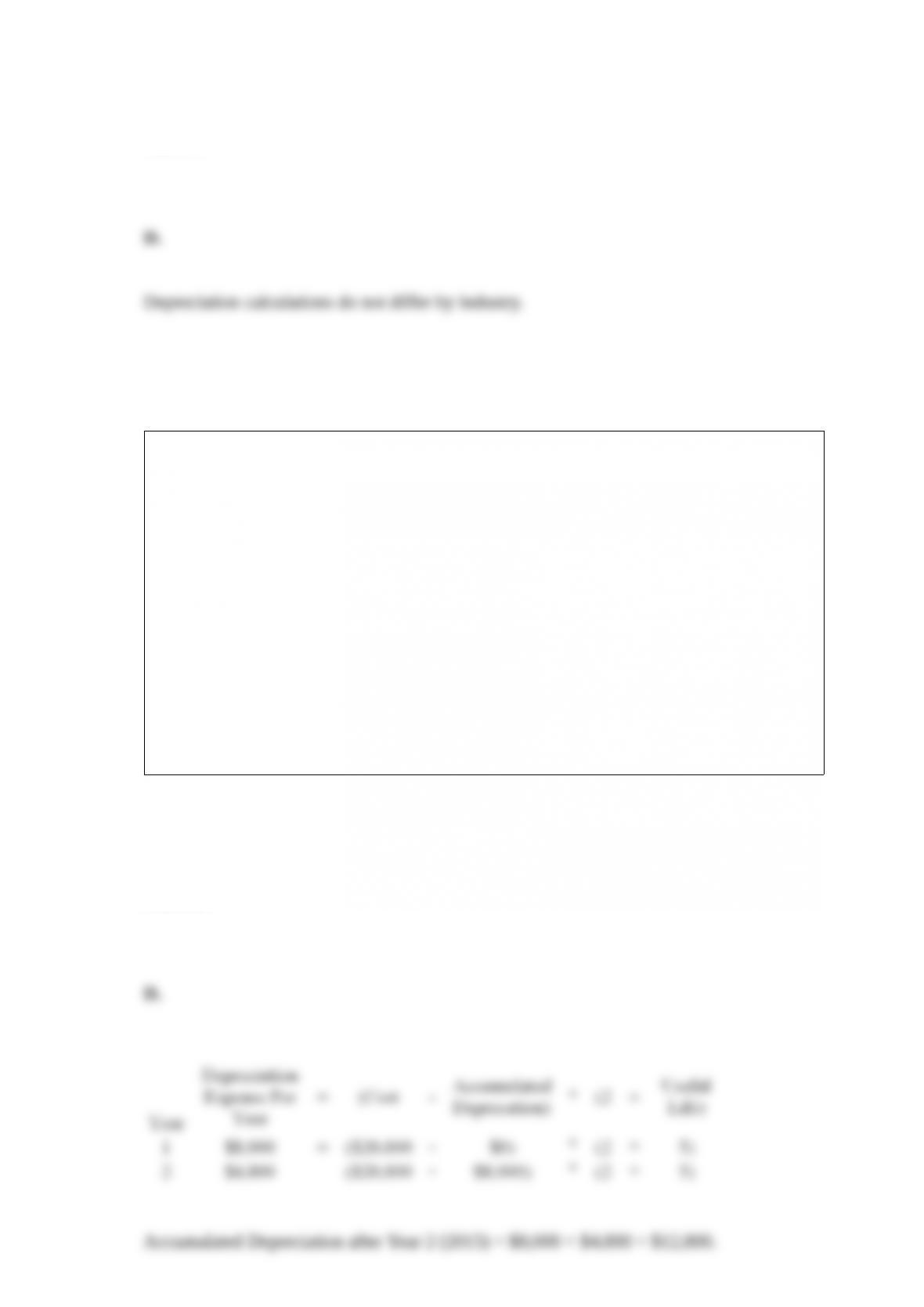
Shaggy Limited purchased a new van on January 1, 2014. The van cost $20,000. It has
an estimated life of five years and the estimated residual value is $5,000. Shaggy uses
the double-declining-balance method to compute depreciation.
Use the information above to answer the following question. What is the adjusted
balance in the Accumulated Depreciation account at the end of 2015?
A. $3,200.
B. $4,800.
C. $9,600.
D. $12,800.
Answer:
Accounting information serves a management function when it is used by:
A. executives to make a business decision.
B. government officials to regulate the business and its financial records.
C. labor unions to negotiate contracts with the business.
D. investors to vote on company policies.
Answer:
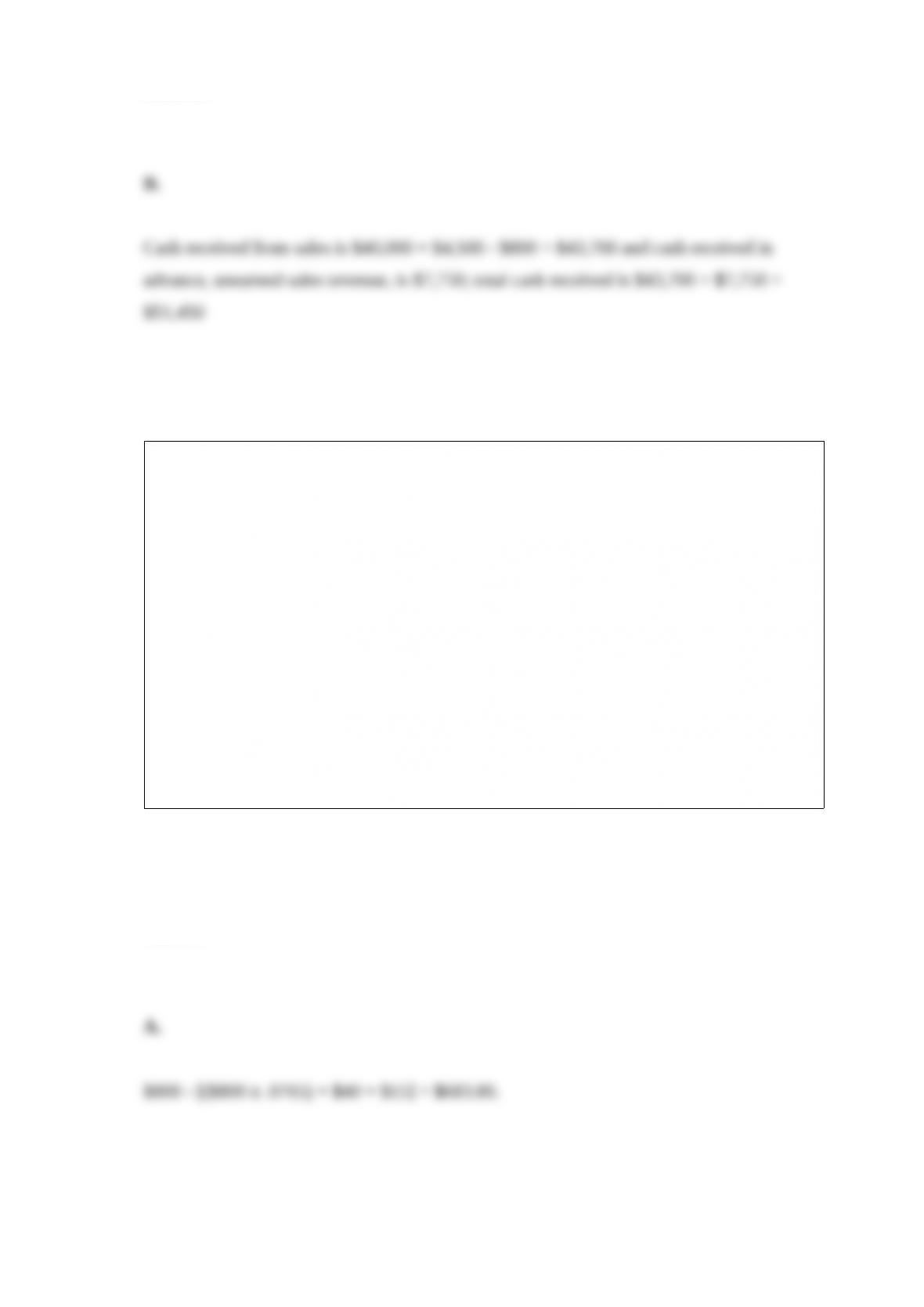
A company reported Sales revenue, all from credit sales, of $40,000 on the Income
Statement for the current year. The balance sheet includes the following:
What is the amount of cash that was collected during the year?
A. $11,450
B. $51,450
C. $43,700
D. $38,200
Answer:
Bobby Darin is the only employee of Atlantic Records, Inc. During the first week of
January, Darin earned $800 and had federal and state income tax withholdings of $40
and $15, respectively. FICA taxes are 7.65 percent on wages up to $100,000. State and
federal unemployment taxes for the period are $50 and $8, respectively.
Use the information above to answer the following question. What would be the amount
of Darin’s payroll check for the first week of January?
A. $683.80
B. $741.80
C. $628.80
D. $625.80
Answer:

Which of the following would be reported on the income statement for the year?
A. The amount of cash at the end of the year.
B. The amount of supplies used up during the current year.
C. The amount of dividends distributed to owners during the current year.
D. The amount of unpaid employee wages at the end of the year.
Answer:
Use the information to answer the following question. What is the amount of cash
collected for rent?
A. $21,000
B. $19,000
C. $23,000
D. $14,000
Answer:
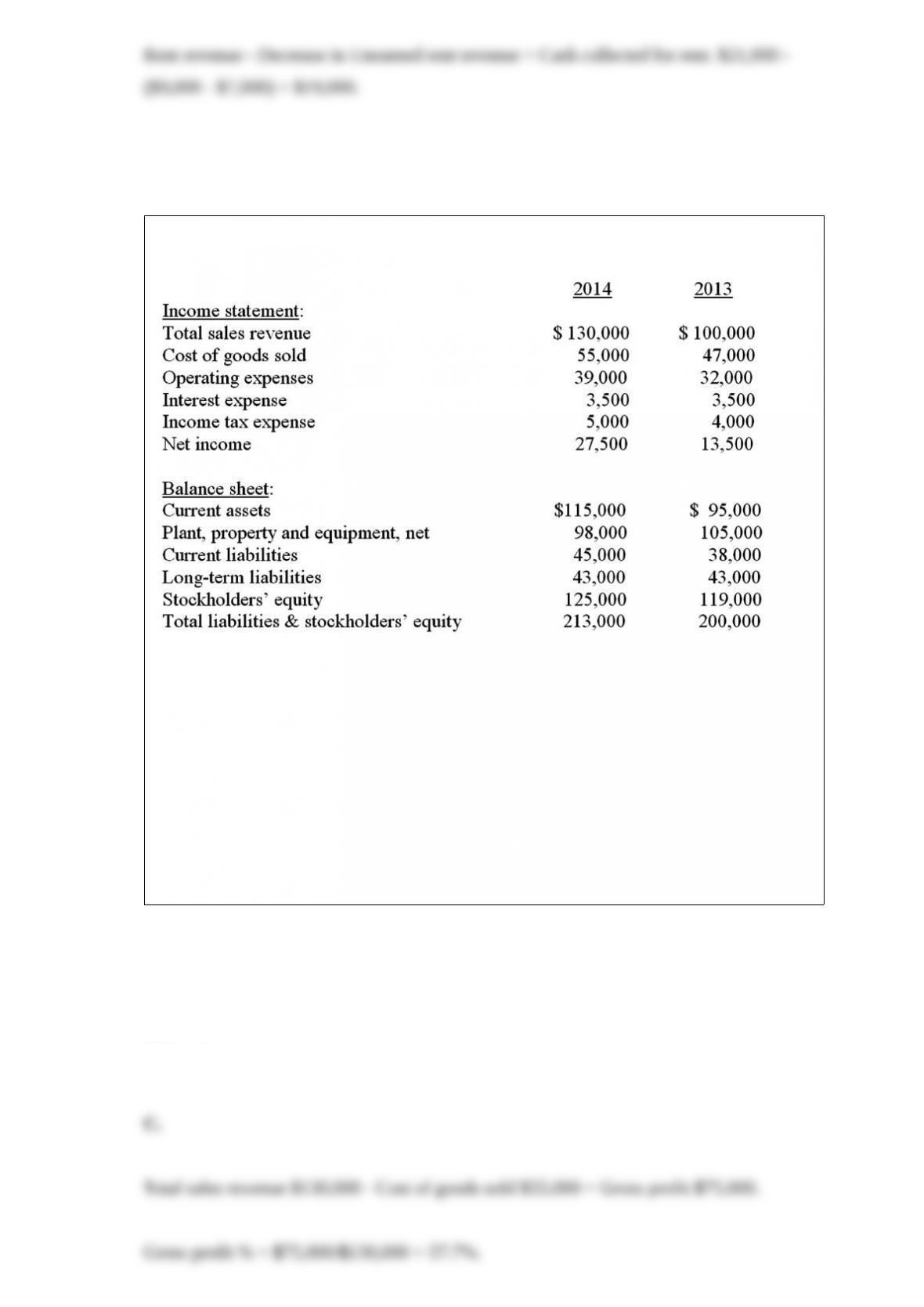
The comparative financial statements of B. Darin include the following data:
Use the information above to answer the following question. The gross profit
percentage for 2014 is closest to:
A. 42%.
B. 13.5%.
C. 57.7%.
D. 21.15%.
Answer:
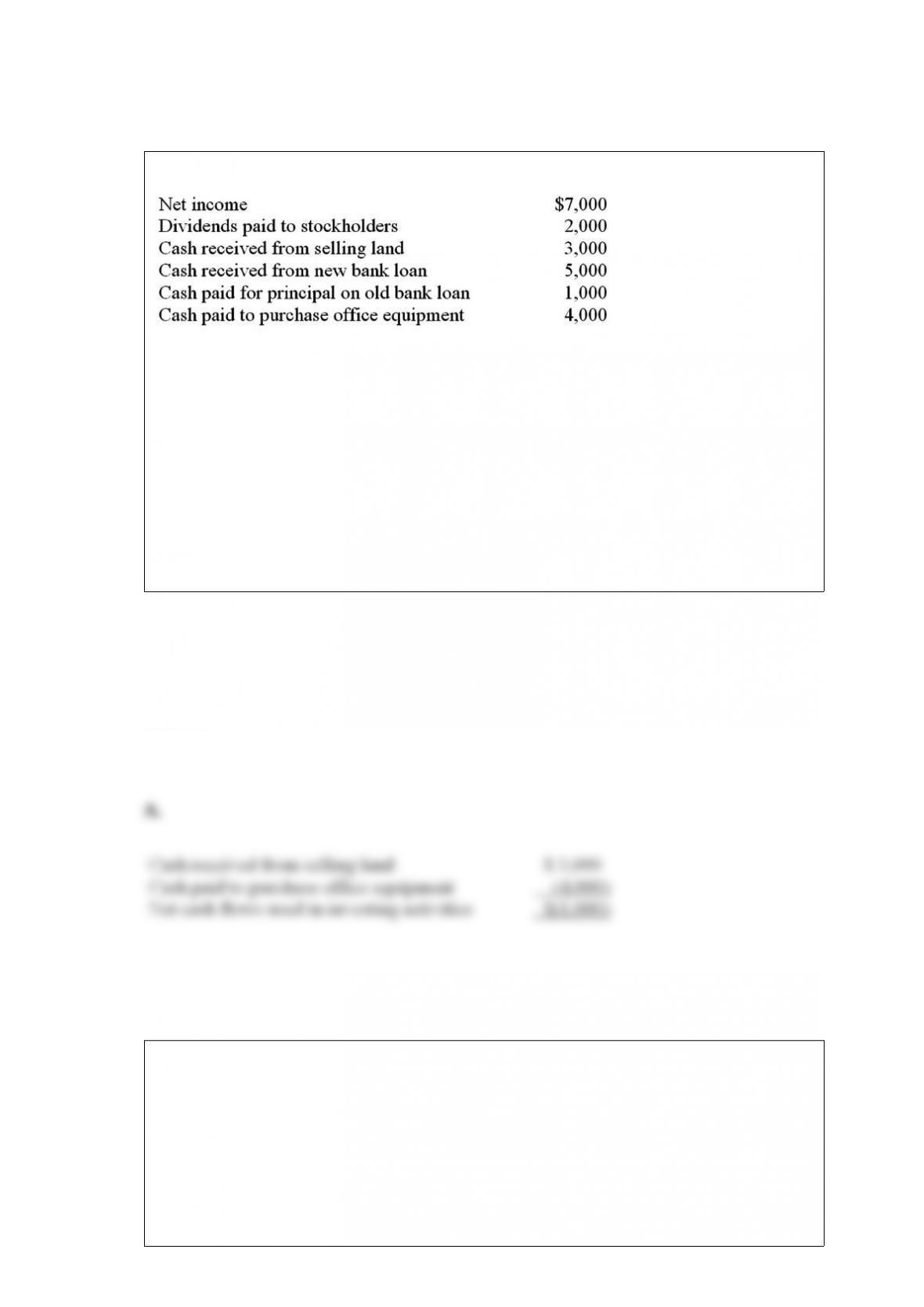
Use the information above to answer the following question. The company would
report net cash provided by (used in) investing activities of:
A. $(1,000)
B. $(2,000)
C. $5,000
D. $7,000
Answer:
What is the amount of the discount to be taken by a company that purchases inventory
for $10,000 with terms 2/10, n/30, returns $2,000 of the inventory purchased, receives
an allowance for defective merchandise of $100, and pays the amount due within the
discount period?
A. $200
B. $158
C. $160
D. $198
Answer:
An adjusting journal entry that includes an increase to an asset contra-account would
include an increase in a(n):
A. related asset account.
B. liability account.
C. revenue account.
D. expense account.
Answer:
Free cash flow is a positive cash flow:
A. beyond what is needed to replace current property, plant, and equipment and pay
dividends.
B. across all three activity components of the statement of cash flows.
C. beyond what has been allotted for future property, plant, and equipment replacement
and expansion.
D. across both financing and investing activities.
Answer:
Public accountants:
A. provide services to a variety of businesses.
B. may work for the SEC.
C. are government employees.
D. are generally involved in internal auditing, budgeting, and cost accounting.
Answer:
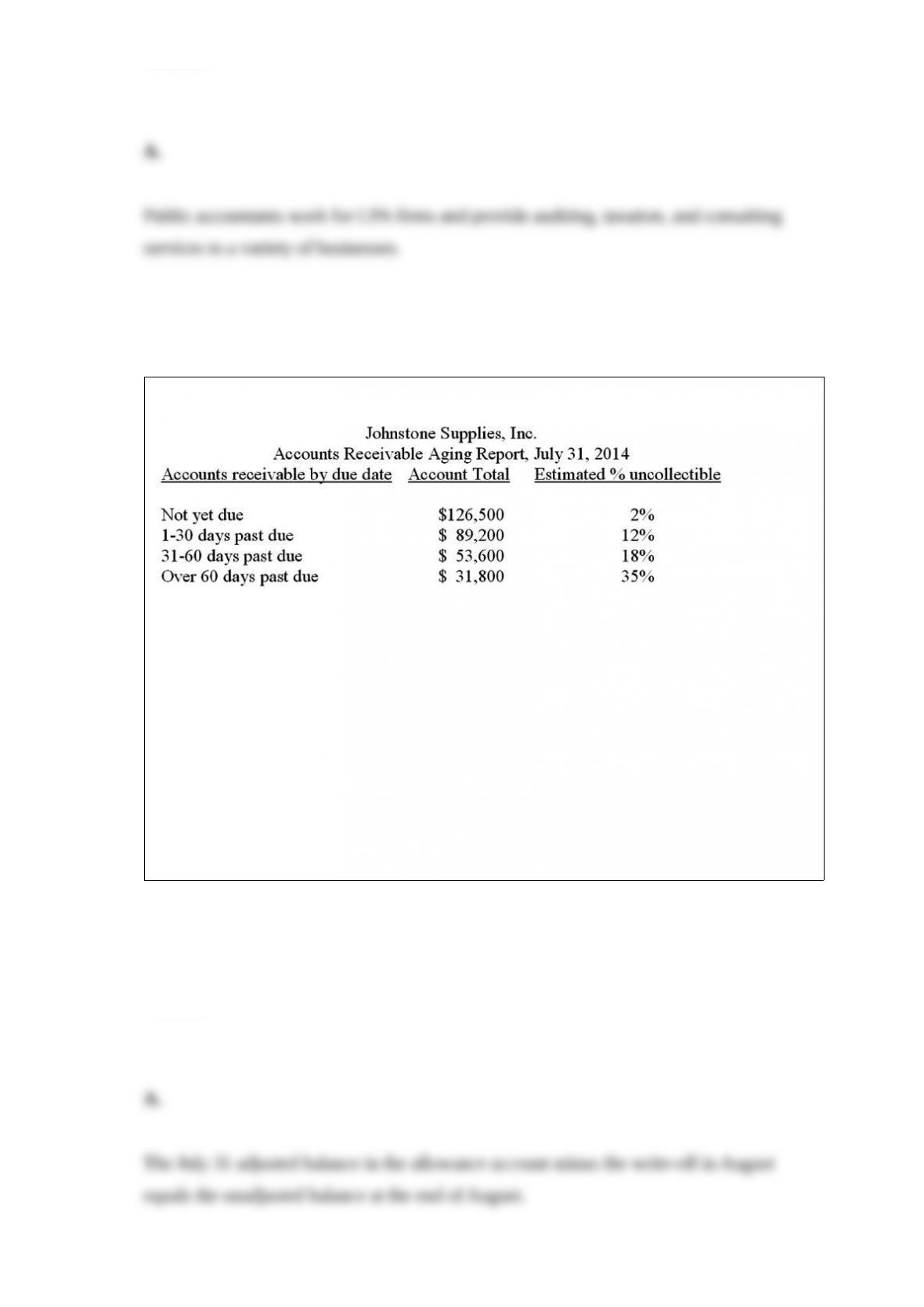
Use the information above to answer the following question. If Johnstone Supplies,
Inc., writes off $3,081 of uncollectible accounts during August, 2014, the unadjusted
account balance in the allowance for doubtful accounts on August 31, 2014 will be:
A. $30,931.
B. $5,065.
C. $34,012.
D. $1,984.
Answer:
What effect will transaction (b) have on the net profit margin ratio and the
debt-to-assets ratio?
A. Net profit margin ratio will be unaffected and the debt-to-assets ratio will increase.
B. Net profit margin ratio will increase and the debt-to-asset ratios will not be affected.
C. Net profit margin ratio will be unaffected and the debt-to assets ratio will decrease.
D. Net profit margin ratio will decrease and the debt-to-assets ratio will increase.
Answer:
Which of the following assets would be amortized?
A. Land improvements.
B. Trademarks.
C. Goodwill.
D. Franchise.
Answer:
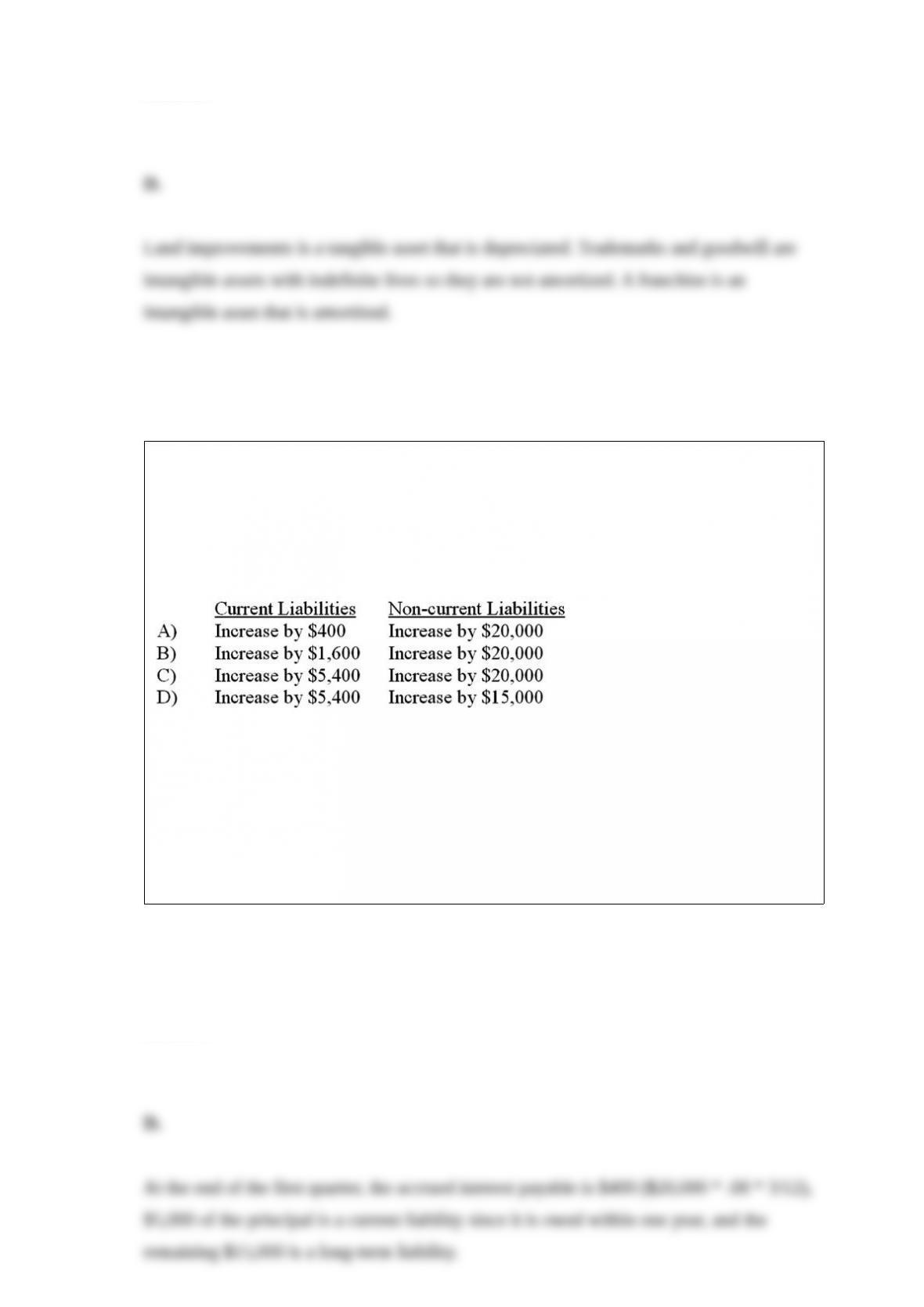
At the beginning of the quarter, your company borrows $20,000 by signing a four-year
promissory note that states an annual interest rate of 8% plus principal repayments of
$5,000 each year. Interest is paid at the end of the second and fourth quarters, whereas
principal payments are due at the end of each year. How does this new promissory note
affect the current and non-current liability amounts reported on the balance sheet at the
end of the first quarter?
A. Option A
B. Option B
C. Option C
D. Option D
Answer:
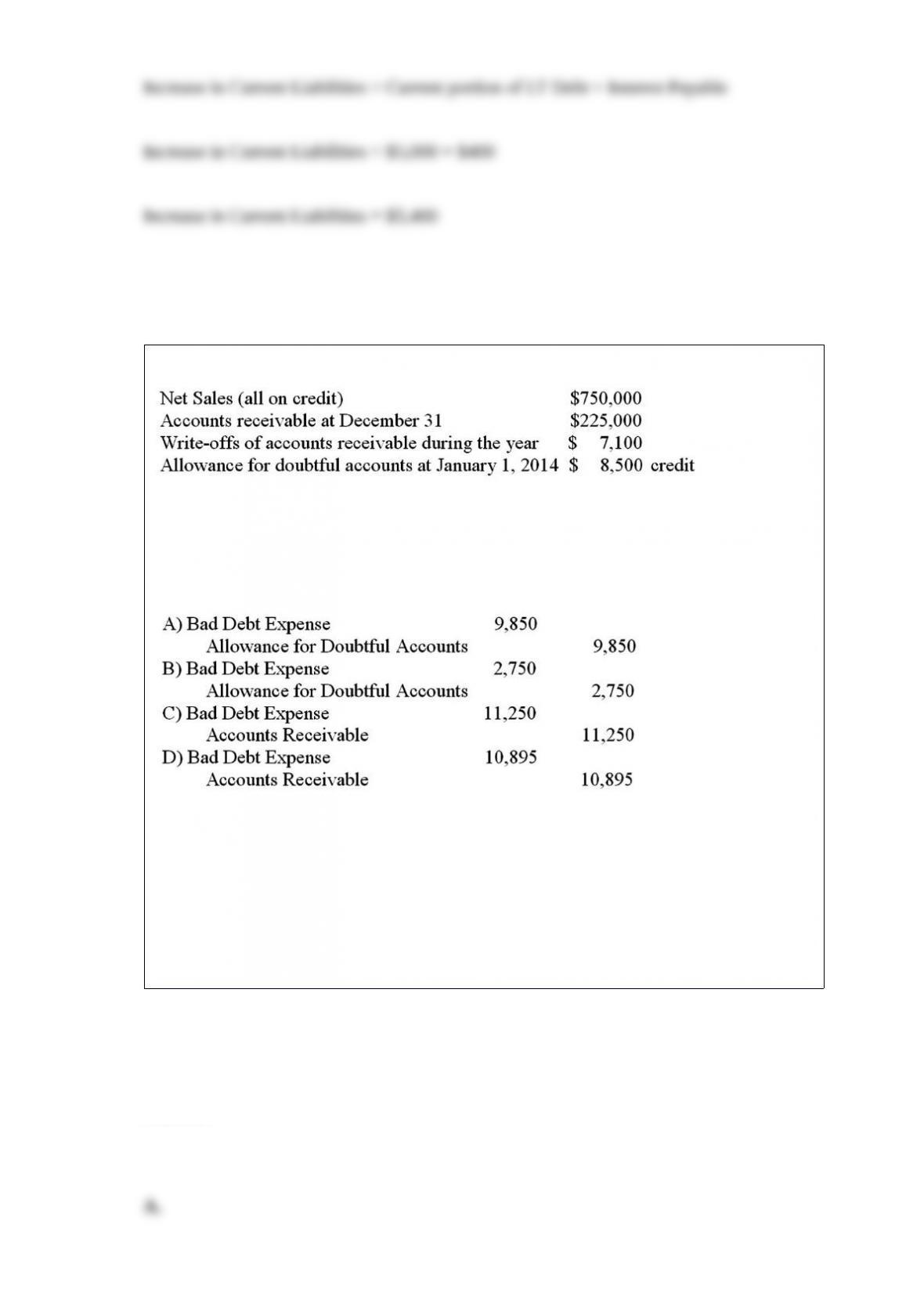
At December 31, 2014, a company’s records include the following:
Use the information above to answer the following question. Assuming the company
uses the aging of receivables method and estimates the uncollectible amount at 5% of
accounts receivable, what is the required adjusting entry to record bad debt expense for
the year?
A. Option A
B. Option B
C. Option C
D. Option D
Answer:
For which of the following types of equipment would the double-declining balance
depreciation method make the most sense?
A. Computer hardware.
B. Automobile and trucks.
C. Factory equipment.
D. A warehouse building.
Answer:

Choose the appropriate letter of the explanation to match the term. Not all explanations
will be used.
Term
_____ 1/ Long-lived assets
_____ 2/ Average net fixed assets
_____ 3/ Capitalization of cost
_____ 4/ Units-of-production method
_____ 5/ Carrying value
_____ 6/ Asset impairment loss
_____ 7/ Depreciation
_____ 8/ Net sales revenue
_____ 9/ Declining-balance method
Explanation
A. The average proportion of a company’s total assets that is long-lived.
B. A depreciation method that produces higher amounts of depreciation expense in the
early years of an asset’s life and lower amounts in the later years.
C. The cost of financing an asset.
D. Also known as book value.
E. Assets that have physical substance.
F. The denominator of the fixed asset turnover ratio.
G. How expenses are reported in the income statement.
H. A depreciation method that spreads asset cost by use rather than time.
I. Assets that will be used for more than a year.

J. The process of transferring the cost of long-lived tangible assets to expenses.
K. When a company writes down the value of an asset when estimated future cash
flows fall below the original level estimated.
L. The numerator of the fixed asset turnover ratio.
M. When costs are recorded as assets rather than expenses.
N. When a company writes down the value of an asset because estimated future cash
flows fall below the book value.
Answer:
According to the Sarbanes-Oxley Act (SOX), who are the external auditors hired by and
required to report to?
A. Audit committee.
B. Chief financial officer.
C. President of the company.
D. the Internal Revenue Service.
Answer:
One of the advantages of a partnership is:
A. limited liability.
B. the salaries of the partners can be written off as an expense.
C. ease of formation.
D. income tax is paid by the business.
Answer: