Which of the following is management’s challenge when setting transfer prices?
A.Ensuring the buyer has goal congruence with respect to the organization’s goals.
B.Ensuring the seller has goal congruence with respect to the organization’s goals.
C.Ensuring either the buyer or the seller, but not both, has goal congruence with respect
to the organization’s goals.
D.Ensuring both the buyer and seller have goal congruence with respect to the
organization’s goals.
The value chain begins with which of the following?
A.supplier.
B.research and development.
C.design.
D.production.
What recent management innovation views a business as a linked sequence of processes
that transforms inputs into saleable outputs and is used to improve operations?
A.Just-in-time production
B.Total quality management
C.Theory of constraints
D.Strategic cost analysis systems
A differential cost is a cost that changes (differs) as a result of changing which of the
following?
A.products or levels of products.
B.departments or levels of departments.
C.batches or levels of batches.
D.activities or levels of activities.
Which of the following is a systematic way for organizations to identify and eliminate
activities that add costs but not value to the product?
A.customer profitability analysis.
B.activity analysis.
C.systems analysis.
D.cost-based analysis.
CVP analysis with step costs. Sparkle Company has one product: printing t-shirts with
logos for various businesses. The sales price of $20 remains constant per unit regardless
of volume, as does the variable cost of $12 per unit. The company is considering
operating at one of the following three monthly levels of operations:
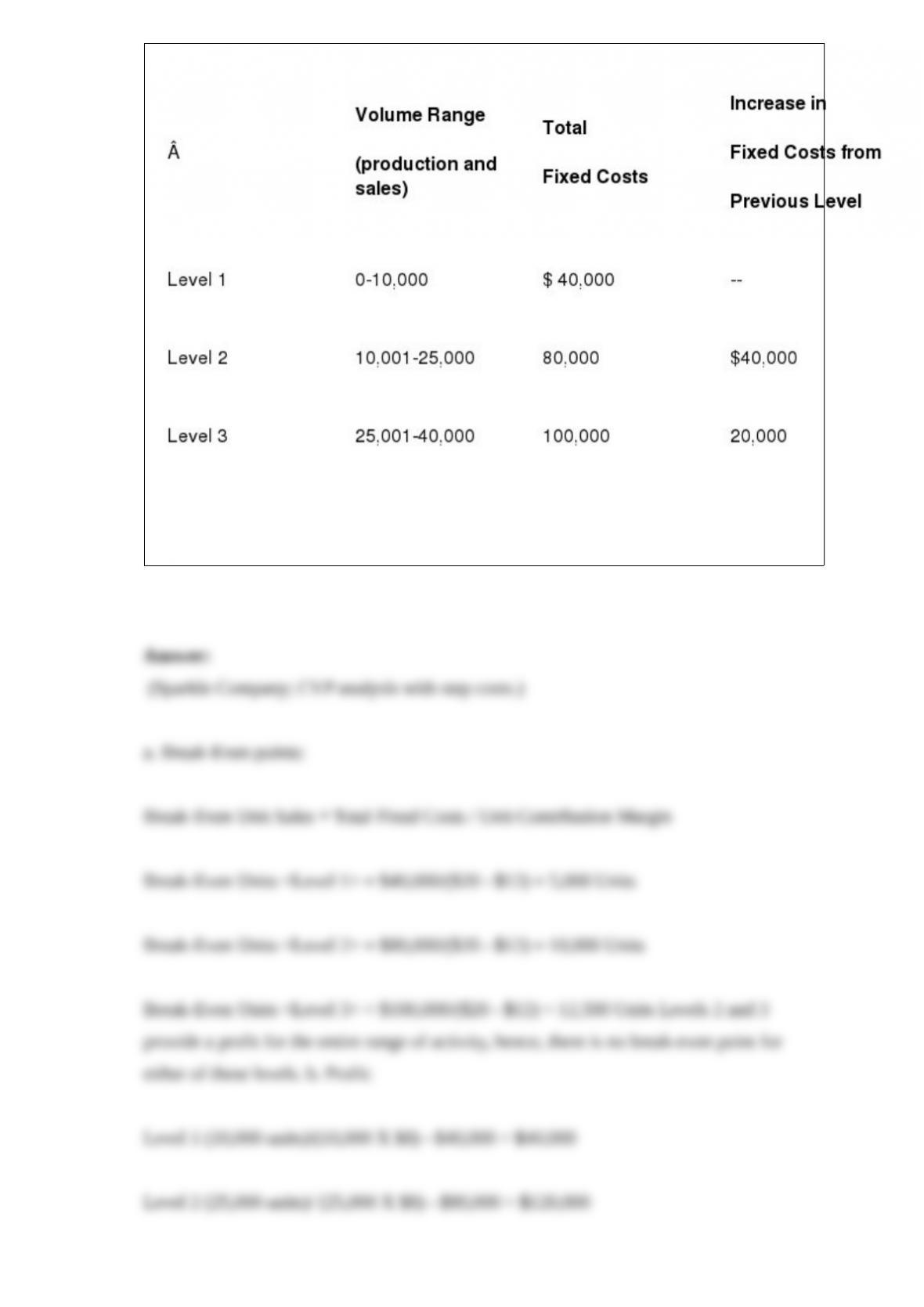
Required: a. Calculate the break-even point(s) in units.
b. If the company can sell everything it makes, should it operate at level 1, level 2, or
level 3? Support your answer.
Narrative 5-1
The following question(s) refer to the this equation analyzing the relationship of total
cost to changes in machine hours. The following relationship was determined:
TC = $2,200 + $3X
Refer to Narrative 5-1. The $3 in the above equation is an estimate of which of the
following?
A.total fixed costs.
B.variable costs per machine hour.
C.total variable costs.
D.fixed costs per machine hour.
Which of the following is a capital investment decision method that in evaluating
investments involving cash flows over time where there is a significant time difference
between cash payment and receipt?
A.zero-based budgeting
B.linear programming.
C.discounted cash flow.
D.program planning and review.
Shenandoah Company
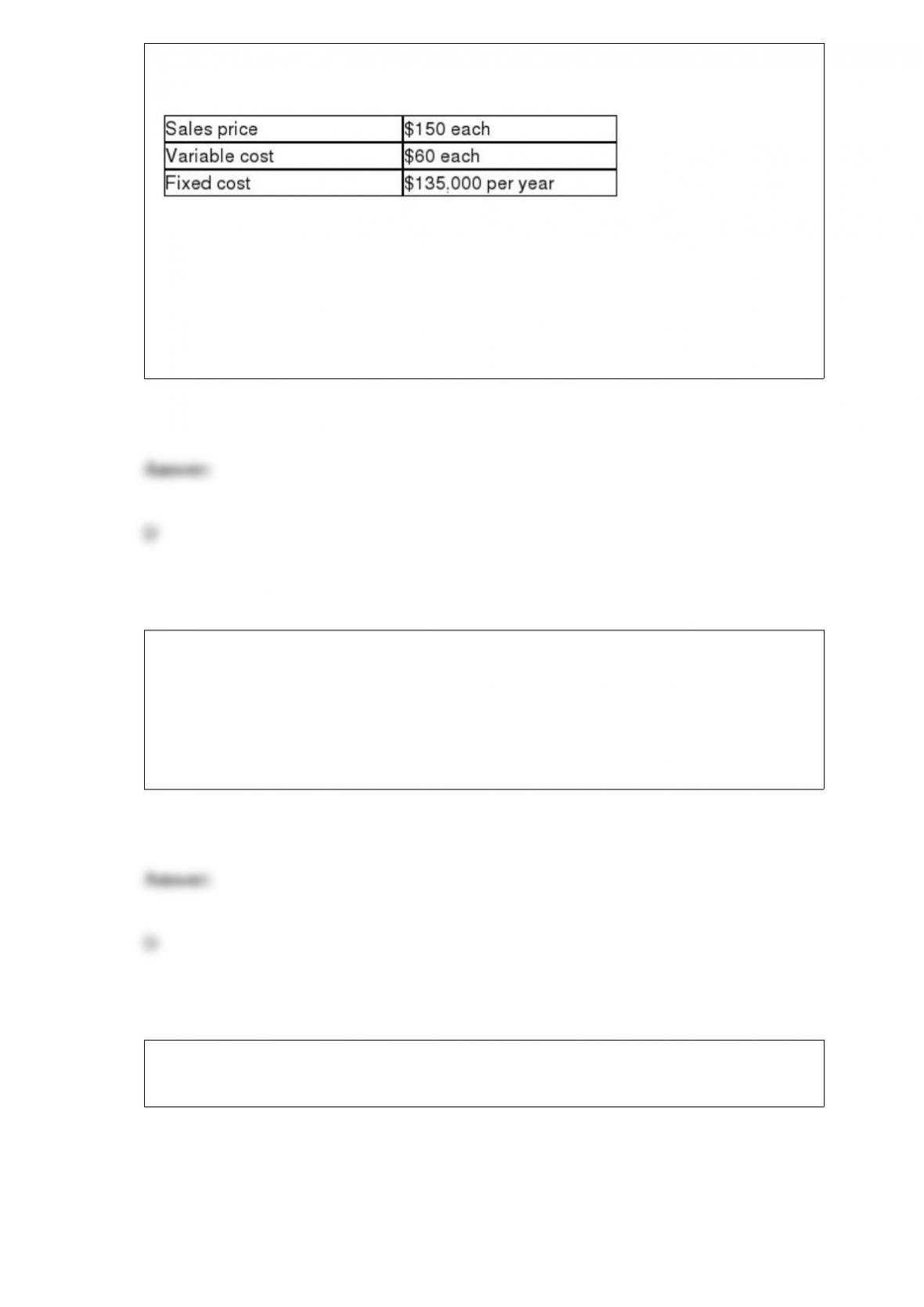
Shenandoah Company is considering the introduction of a new product with the
following price and cost characteristics
The company expects to sell 2,000 units for the year.
Refer to Shenandoah Company. If 2,000 units are sold, what operating profit is
expected?
A.$100,000
B.$ 75,000
C.$ 15,000
D.$ 45,000
Benefit(s) of the income statements for managerial use include(s)
A.demonstrating which costs are variable and which are fixed.
B.breaking down revenues and costs in a number of ways to meet managers’ needs.
C.breaking down revenues and expenses in a number of ways to meet managers’ needs.
D.demonstrating which costs are variable and which are fixed, and breaking down
revenues and costs in a number of ways to meet managers’ needs.
Framing Division
The Framing Division had the following data:
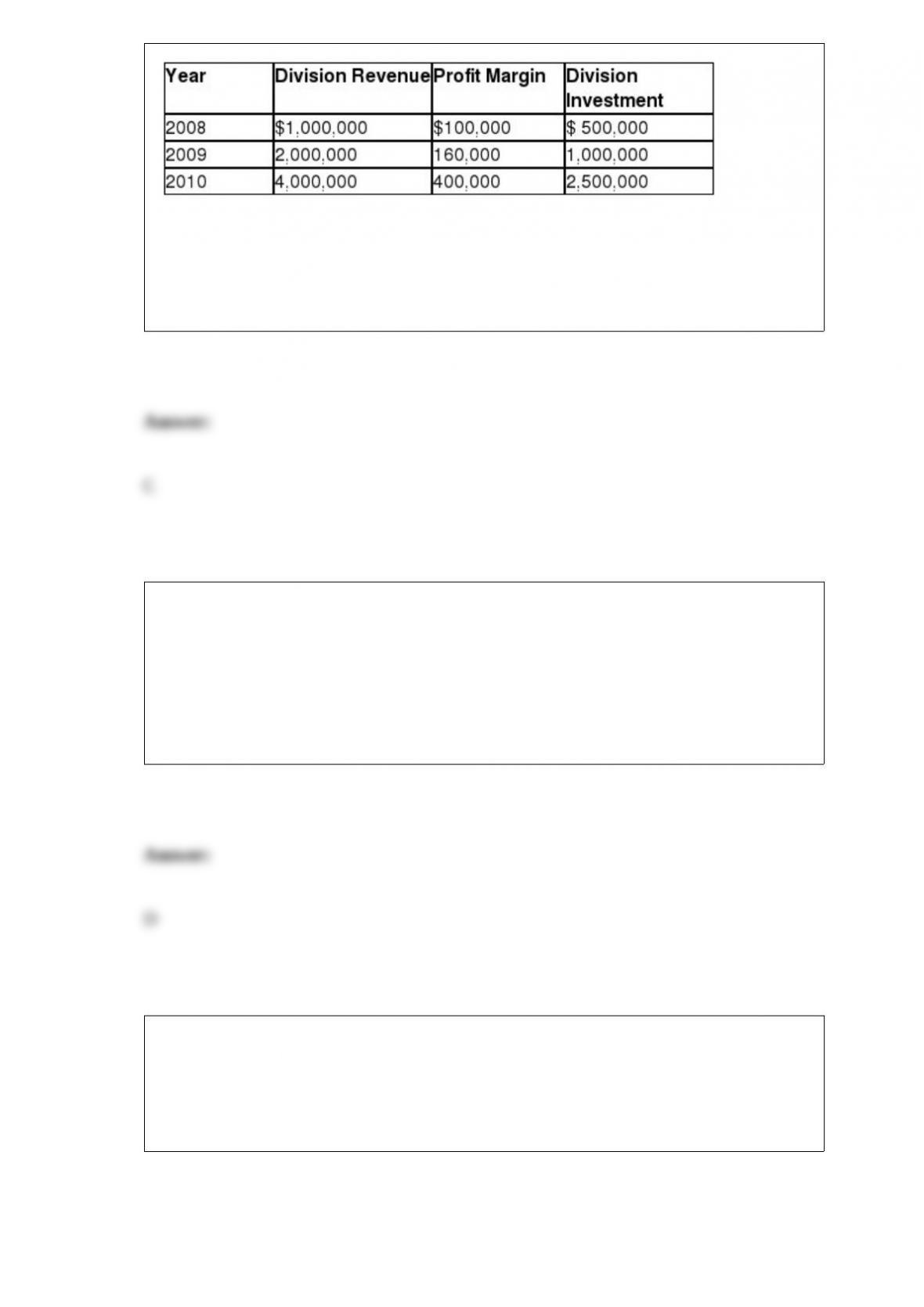
Refer to the Framing Division. What is the profit margin percentage for Year 2010?
A.6%
B.8%
C.10%
D.12%
What is the final step in the activity analysis process used to implement Activity Based
Management?
A.Chart, from start to finish, the activities used to complete the product or service.
B.Classify activities as value-added or non-value-added.
C.Eliminate non-value-added activities.
D.Continuously improve and reevaluate the efficiency of value-added activities or
replace them with more efficient activities.
The Chinese Teapot Company manufactures plastic and ceramic teapots. The
company’s western plant has changed from a labor-intensive operation to a robotics
environment. As a result, management is considering changing from a direct-labor
based overhead rate to an activity-based cost method. The controller has chosen the
following activity cost pools and cost drivers for the factory overhead:
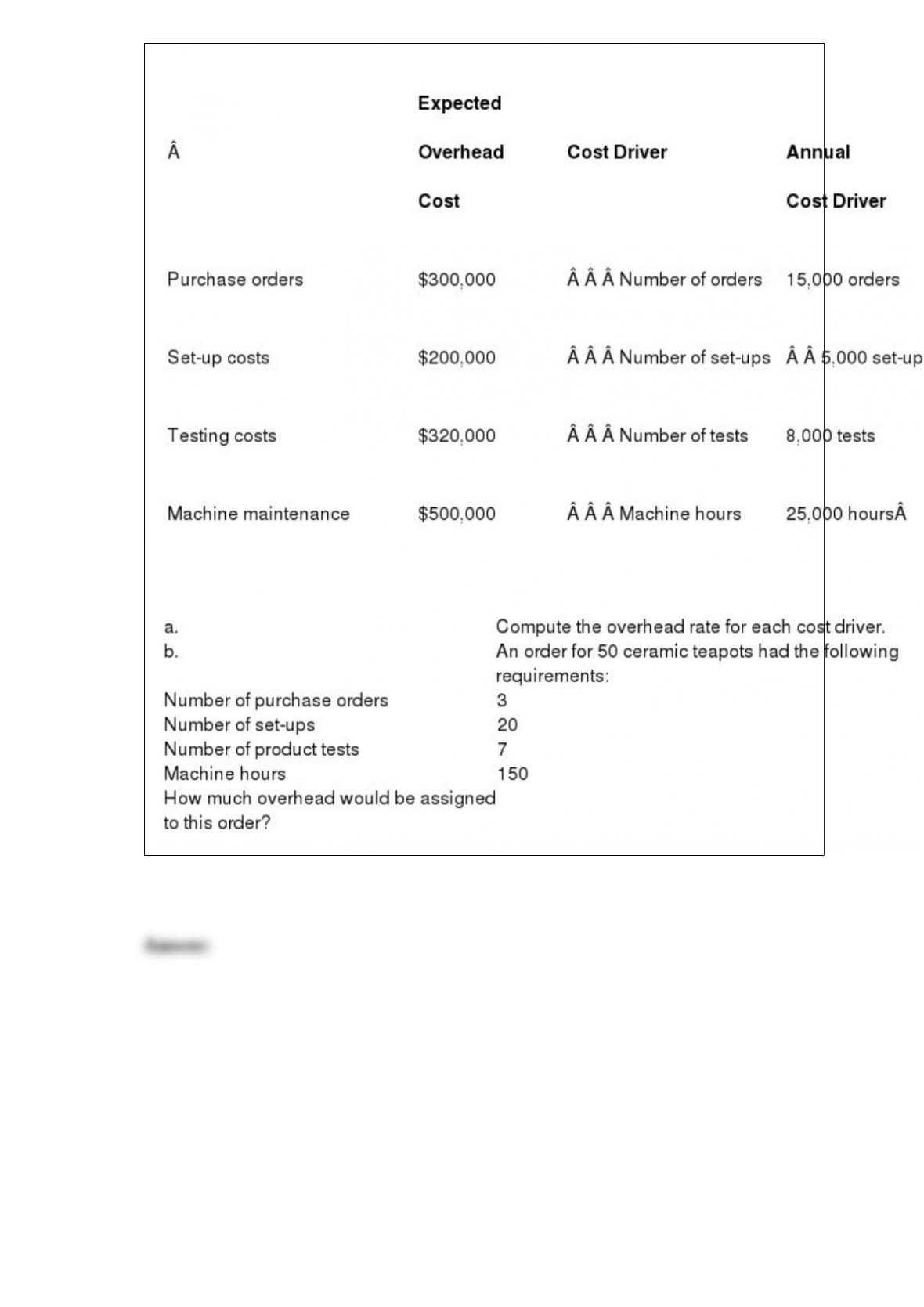
REQUIRED:
Narrative 5-1
The following question(s) refer to the this equation analyzing the relationship of total
cost to changes in machine hours. The following relationship was determined:
TC = $2,200 + $3X
Refer to Narrative 5-1. The dependent variable is which of the following?
A.TC
B.$2,200
C.$3
D.X
Activity-based costing in a nonmanufacturing environment. Green Thumb, Inc., is a
lawn care service. The company originally specialized in serving residential clients but
has recently started contracting for work with larger commercial clients. Mr. Green, the
owner, is considering reducing residential services and increasing commercial lawn
care. Five field employees worked a total of 10,000 hours last year-6,500 on residential
jobs and 3,500 on commercial jobs. Wages were $9 per hour for all work done. Direct
materials used were minimal and are included in overhead. All overhead is allocated on
the basis of labor hours worked, which is also the basis for customer charges. Because
of greater competition for commercial accounts, Mr. Green can charge $22 per hour for
residential work, but only $19 per hour for commercial work.
Required:
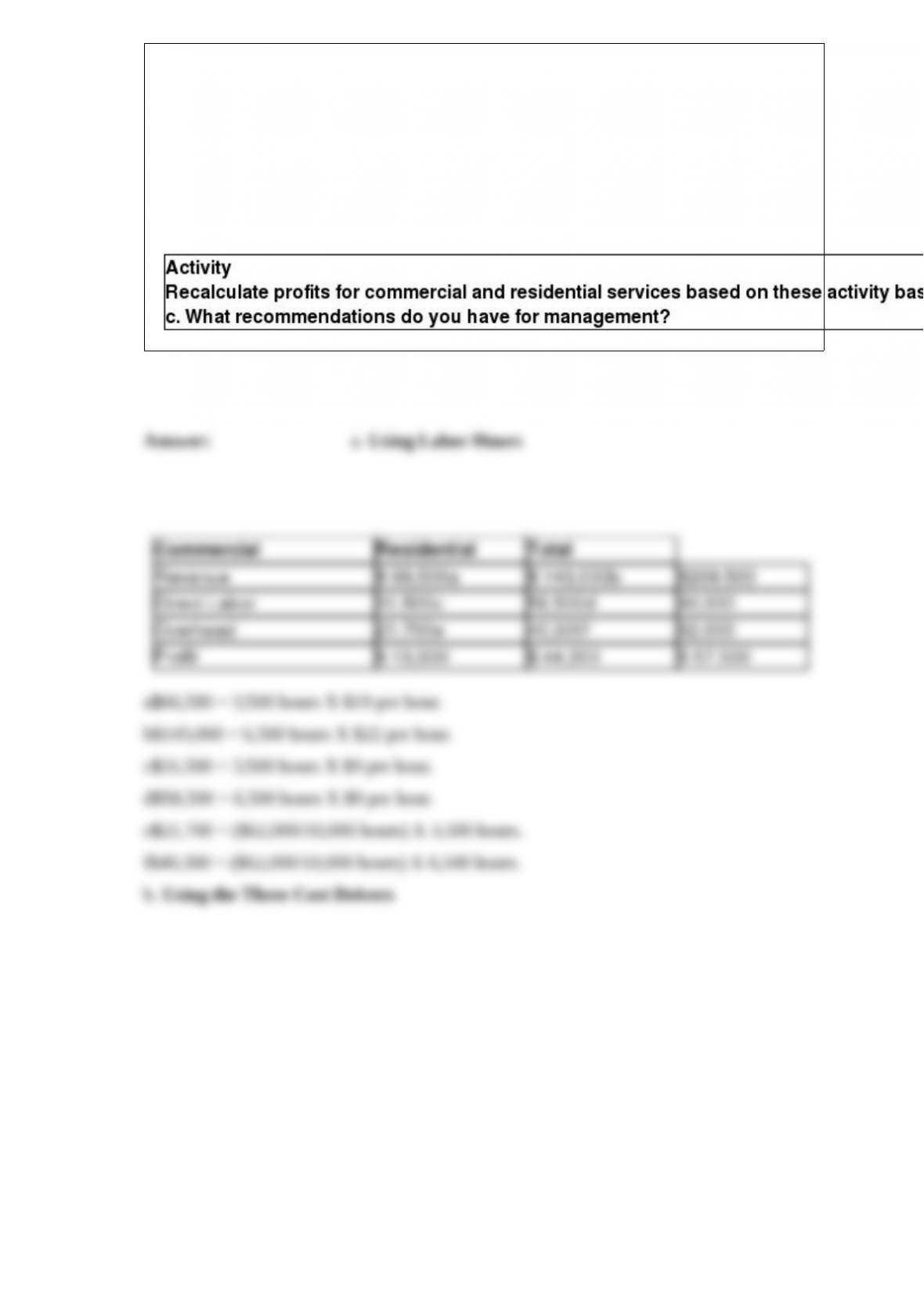
a. If overhead for the year was $62,000, what were the profits of commercial and
residential service using labor hours as the allocation base?
b. Overhead consists of office supplies, garden supplies, and depreciation and
maintenance on equipment. These costs can be traced to the following activities: