
When audit clients acquire new, more sophisticated IT systems,
(a) The audit strategy will not be impacted as long as the duties of accounting personnel
are primarily unchanged.
(b) Auditors with advanced IT knowledge may need to be added to the audit team.
(c) The design of internal controls will be considered ineffective until those new
controls have been tested.
(d) The timing of the auditor’s procedures for reviewing interim financial statements
will be accelerated.
If a predecessor auditor re-issues an audit report, the date of the predecessor auditor’s
report should be:
a. the end of field work for the current year.
b. the date the predecessor auditor was removed as auditor.
c. the original report date.
d. the same date as that of the successor auditor’s report.
GAAS refers to:
(a) ten auditing standards grouped into three sections.

(b) those auditing standards that apply only to audits of public companies.
(c) accounting principles generally accepted.
(d) None of the above.
Non public companies:
(a) do not have to be audited.
(b) are not required to have an audit of their ICFR.
(c) follow different standards than public companies.
(d) present little, if any, risk to auditors.
The forensic accountant’s mind-set is that all cases may involve:
a. materiality thresholds.
b. attitudes of employees.
c. management’s values.
d. reward systems.

e. illegal acts.
Which of the following is a personal characteristic associated with person who is
considered a professional?
A. Specific body of knowledge.
B. Possess technical expertise and behave with integrity.
C. Self-discipline and self-regulation.
D. Recognizable individual characteristics.
Manual control testing:
(a) occurs more frequently than automated control testing.
(b) must be performed prior to automated control testing.
(c) is more important than automated control testing.
(d) needs more testing than a similar automated control.

Generally, as acceptable risk is reduced, sample size:
a. decreases.
b. increases.
c. can either increase or decrease depending on the circumstances.
d. can increase or decrease depending on the risk.
Assessing the design effectiveness of the internal control system involves:
(a) reviewing the controls that are missing.
(b) reviewing the controls present.
(c) deciding if those controls are operating as intended.
(d) All of the above.

Inquiry can provide new information that conflicts with what the auditor has already:
a. corroborated.
b. documented.
c. learned.
d. provided.
e. responded to.
Following are procedures used by auditors to understand likely sources of
misstatements:
I. Identify controls that management has implemented to address potential
misstatements.
II. Identify points within the process at which misstatements could arise.
III. Understand the flow of transactions.
The proper sequence of these steps is:
(a) I, II, III.
(b) III, II, I.
(c) I, III, II.
(d) III, I, II.
The following are paired lists of terms that have specific meaning within the
AICPA Code of Conduct. For each, explain how the pair of terms interacts or contrasts
regarding their impact on auditor independence:
(a) Direct financial interest: immediate family
(b)Material: indirect financial interest
(c) Covered member: immediate family
(d)Covered member: close relative
(e) Covered member: key position

In addition to ethical guidance, the Yellow Book contains the following standards:
a. compliance standards.
b. recovery standards.
c. reinvestment standards.
d. retention standards.
e. field work standards.
An example of qualitative materiality is:
(a) an error involving an amount of great magnitude.
(b) an error involving management oversight of small amounts.
(c) a misstatement caused by management fraud.
(d) All of the above.

Which of the following internal control activities most likely would deter lapping of
collections from customers?
a. Independent internal verification of dates of entry in the cash receipts journal with
dates of daily cash summaries.
b. Separation of duties between receiving cash and posting the accounts receivable
ledger.
c. Authorization of write-offs of uncollectible accounts by a supervisor independent of
credit approval.
d. Supervisory comparison of the daily cash summary with the sum of the cash receipts
journal entries.
e. Segregation of duties between cash payments and recording checks.
Estimated misstatements are:
a. always recorded by the auditor.
b. always recorded by the client.
c. may be recorded by the auditor.
d. None of the above.

Which of the following would not be an appropriate benchmark to use in setting
financial statement-level materiality?
(a) a percentage of total revenue
(b) a percentage of total assets
(c) a percentage of current liabilities
(d) a percentage of profit from continuing operations
An expert system can be used to:
(a) assist in planning the audit.
(b) assist in selecting samples.
(c) assist in evaluating results from testing details of balances.
(d) All of the above.
[Adapted from Wiley CPA Review] Dana, an auditor for the audit firm C&C, recently
finished up testing controls relating to management’s assertion concerning the
completeness of sales transactions. In her audit work papers, Dana included
the following:
a) “I inspected the entity’s reports of prenumbered shipping documents that have
notbeen recorded in the sales journal”
b) “In the course of my testing, I have found 0 items that have been sold but have
notrecorded in the sales journal.”
c) “Since testing was performed without exception, I have determined that the
controlsto address the completeness of sales transactions are operating
effectively.”Which essential elements of AS 3’s documentation requirements did Dana
omit fromher documentation?
Dillon is auditing Byrne Corp., a public company. Byrne recently implemented a new
accounting system. As part of the ICFR audit, Dillon discovers that material controls

surrounding access to the new software were only partially installed. Dillon should:
a. withdraw from the audit.
b. issue a disclaimer opinion on the ICFR.
c. issue an adverse opinion on the ICFR.
d. depending on the circumstances, the auditor may choose any of the above.
When a company’s cost accounting system uses process costing, work-in-process is
accumulated based on:
a. batches.
b. specific inventory projects.
c. raw materials less shrinkage.
d. periodic labor charts.
Going concern affects:
a. the scope of the audit.
b. the audit opinion.

c. the decision whether or not to accept a client.
d. All of the above.
How would you test a computer application designed to re-order inventory
automatically when it falls below a predetermined point?
a. Examine purchase orders for proper management approval.
b. Determine of the supplier is on the approved list.
c. Perform tests of parameters to determine if purchase orders were generated when
inventory was above the re-order point.
d. All of the above.
Match the term with its correct definition.
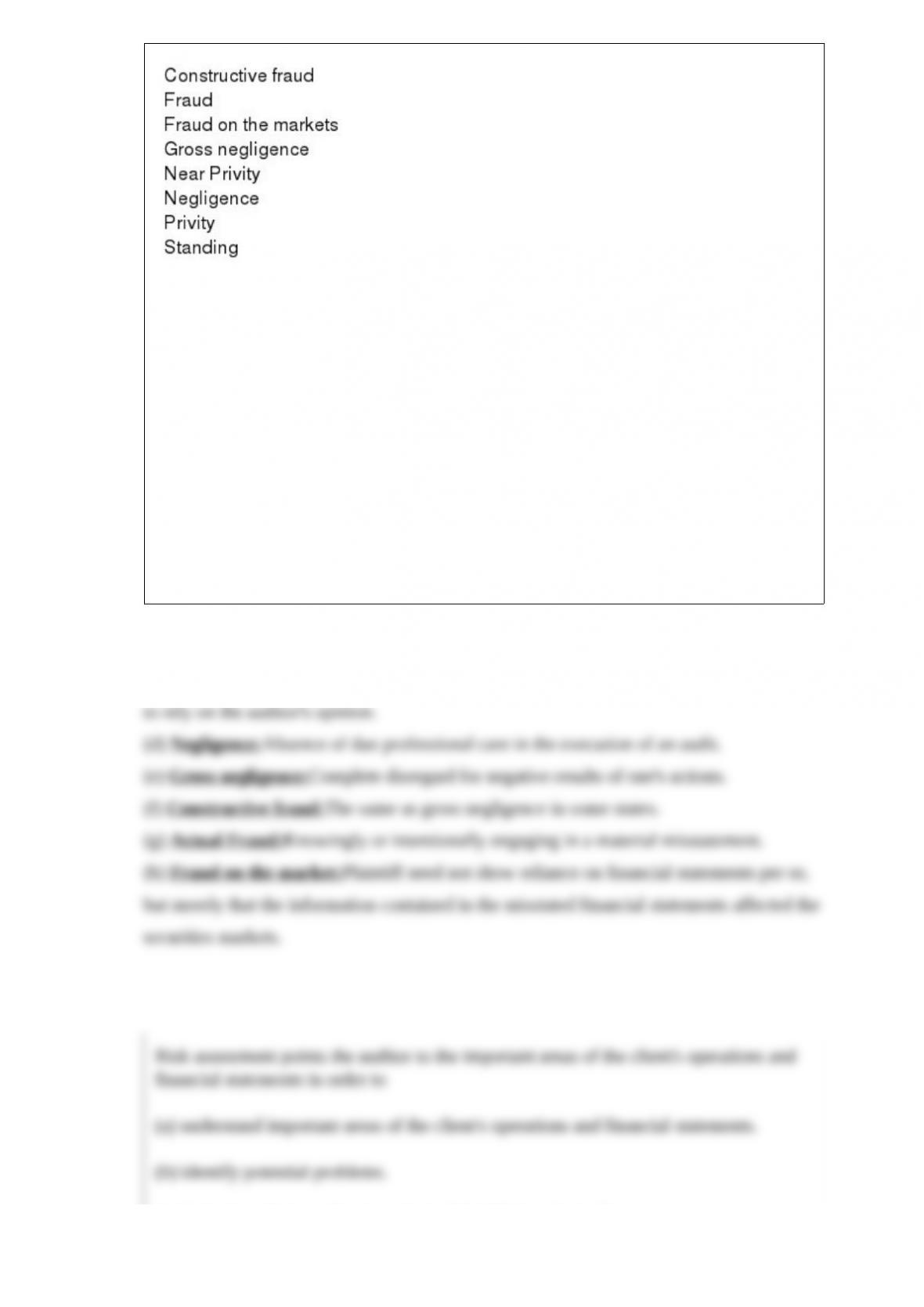
(a) A relationship between two parties sharing a common interest.
(b) The right to bring a legal action against a defendant in court.
(c) Three-part standard: 1). The auditor understood that the financial statements were
going to be used for a specific purpose (e.g. credit granting decisions). 2).The auditor
knew the plaintiff andknew the client relied on the work of the auditor. 3). Action on
the part of the auditor indicating that (s)he understood the third party was going to rely
on the auditor’s opinion.
(d) Absence of due professional care in the execution of an audit.
(e) Complete disregard for negative results of one’s actions.
(f) The same as gross negligence in some states.
(g) Knowingly or intentionally engaging in a material misstatement.
(h) Plaintiff need not show reliance on financial statements per se, but merely that the
information contained in the misstated financial statements affected the securities
markets.

Risk assessment points the auditor to the important areas of the client’s operations and
financial statements in order to
(a) understand important areas of the client’s operations and financial statements.
(b) identify potential problems.
(c) determine what needs to be accomplished during the audit.
(d) all of the above
Auditors normally test accounts payable balances by:
a. sending out negative confirmations.
b. sending out positive confirmations.
c. matching supplier invoices to receiving reports.
d. matching supplier invoices to cash disbursements.
Obstruction of justice involves:
a. Shredding audit evidence.
b. A criminal offense.
c. Destroying emails pertinent to the audit.
d. All of the above.
Tests of controls for sales address all of the following except:
a. credit approval.
b. billing evidence for all items shipped.
c. actual occurrence and validity of any transactions recorded as purchases.
d. completeness of recorded sales.
In a breach of contract claim, the auditor can:
a. Cite the professional standards.
b. Cite lack of privity on the part of the plaintiff.
c. Cite client refusal to provide records to the auditor on a timely basis.
d. All of the above.

Litigation differs from a claim in that:
a. litigation involves obligations that have already been assessed; claims are possible
obligations.
b. litigation involves amounts that have been set; claims involve possible obligations.
c. litigation involves legal actions; claims are possible obligations.
d. None of the above.
Which of the following best describes the role of an audit firm’s quality control
standards to provide guidance addressing client acceptance and continuance?
(a) A standard framework should provide important benchmarks to be used by client
companies to evaluate their own risk factors.
(b) Representative legal cases should be documented whenever client company
characteristics resemble fact patterns.
(c) Policies and procedures should be in place for determining whether to accept or
continue to perform an audit engagement.
(d) A well-structured timeline and written communication plan should be in place for all
proposal and decision processes.
The audit is concluded with:

(a) the audit opinion on the financial statements.
(b) the audit opinion on the ICFR.
(c) wrap-up procedures.
(d) All of the above.
Which of the following is an example of a specialist who might assist an audit
engagement team on a high-risk audit area?
(a) actuary
(b) banker
(c) internal auditor
(d) tax accountant
The Institute of Internal Auditors is not the most notable professional organization for
internal auditors.

The cutoff assertion refers to the distinction between the company and its subsidiaries
and related entities.
Compilations and reviews are two types of engagements commonly desired by
nonpublic companies.
The PCAOB oversees the securities markets.

Risk assessment is important only for companies who report to the SEC.
Explanatory language is always necessary if the auditor issuing the audit report relies
on the work of other auditors.
Materiality is a measure of magnitude; yet, it is affected by both quantitative and
qualitative factors.
Audit Standard (AS) number 5 addresses the impact of consistency issues on the audit
report.

A common title for the head of the internal audit function is the Chief Audit Executive.
Audit firms should always avoid a potential client company that conducts significant
related party transactions in the ordinary course of business.
GAAS allows auditors to use substantive analytical procedures to obtain audit evidence.
Discuss and compare the three levels of moral development.
Joint and severally applies to damages for negligence.
Auditors are not allowed to roll-forward tests of ITGC to year-end.
Materiality is first set at the account balance level and is then aggregated to the
financial statement level.
Explain what is meant by a prohibited service. Provide examples.
Joan Hacker, CPA, is the CFO of Smooth Ride, a publicly held boat
trailer manufacturer. At the close of the second quarter of 2010, Joan received the
physical count of raw materials inventory amounting to $2,695,872. At the same time,
Joan’s self-designed computer model for deriving inventory figures showed a
raw materials inventory calculation of $3,374,024, which was $678,152 higher than
the physical count calculation. Since Joan was rushed to prepare the financial
statements, she used the computer model figure, resulting in a $181,000 net income and
$0.03 per share earnings. She adjusted the inventory to equal the correct count for the
end of the third quarter when she had more time. The result for Quarter 3 was a net
loss of $253,000 and a loss of $0.04 per share.
What are the control ramifications of Joan’s actions?
Financial statement audits of state and local governments are normally performed by
internal auditors.

How do the capital markets and economy benefit as a result of all publicly-traded
companies having an independent audit?
Registration statements apply to new security issues.