The assignment of costs to cost of goods sold and to inventory using the weighted
average method usually yields different results depending on whether a perpetual or a
periodic system is used.
When costs per unit are increasing, the inventory costing method that results in the
higher income tax expense is the FIFO method.
An understatement of beginning inventory causes net income to be understated.
One reason why a company may choose a stock split over a stock dividend is that the
stock split does not reduce Retained Earnings.
Operating cycles are generally longer than a year.
The principal of a loan does not include any interest charges.
The percentage of credit sales method focuses on estimating the ending balance to be
reported in the Allowance for Doubtful Account, whereas the aging of accounts
receivable method focuses on estimating Bad Debt Expense for the period.
Preferred stock is generally classified as stockholders’ equity under both GAAP and
IFRS.
When a company reissues (or sells) shares of its treasury stock at an amount different
than its cost, it reports a gain or a loss on the sale.
The amounts of all the accounts reported on the balance sheet can be taken from the
adjusted trial balance.
When a company sells goods, it removes their cost from the Inventory account and
reports the cost on the income statement as Selling Expense
The payment of dividends is a financing activity on the statement of cash flows.
The Allowance for Doubtful Accounts account is a temporary account which is closed
to Retained Earnings at the end of the accounting period.
The temporary accounts will have zero balances in a post-closing trial balance.
The unadjusted trial balance:
A) is a preliminary financial statement for external and internal users.
B) generally lists account names in alphabetical order.
C) is created to determine that total debits equal total credits.
D) indicates whether or not errors were made in recording transactions.
A loss on disposal of an asset would be reported:
A) in the Operating Revenues section of the income statement.
B) in the Operating Expenses section of the income statement.
C) as a direct increase to the asset account on the balance sheet.
D) as a direct decrease to the asset account on the balance sheet.
Which one of the following statements about earnings per share (EPS) is correct?
A) The EPS ratio is important because it signals the ability of the company to pay future
dividends, which investors factor into the stock price.
B) Earnings per share (EPS) is generally reported in the balance sheet under
stockholders’ equity.
C) Earnings per share (EPS) is the best way to compare the performance of different
companies.
D) EPS, in its basic form, is calculated by dividing net income by the average number
of common shares issued.
Which of the following misstatements would cause the debt-to-assets ratio to be
overstated?
A) Capitalizing costs that should have been expensed as assets.
B) Failing to adjust for depreciation in the current period.
C) Failing to accrue income taxes of the current period.
D) Failing to accrue interest earned of the current period.
What would a user of financial statements learn from reading the auditors’ report?
A) Whether the financial statements present a fair picture of the company’s financial
results and are prepared in accordance with GAAP.
B) Whether or not it is a good time to purchase the stock.
C) How much the company plans to distribute as dividends.
D) Whether or not the company has plans for future expansion.
The table shows financial data for Purrfect Pets, Inc. as of June 30, Year 3.
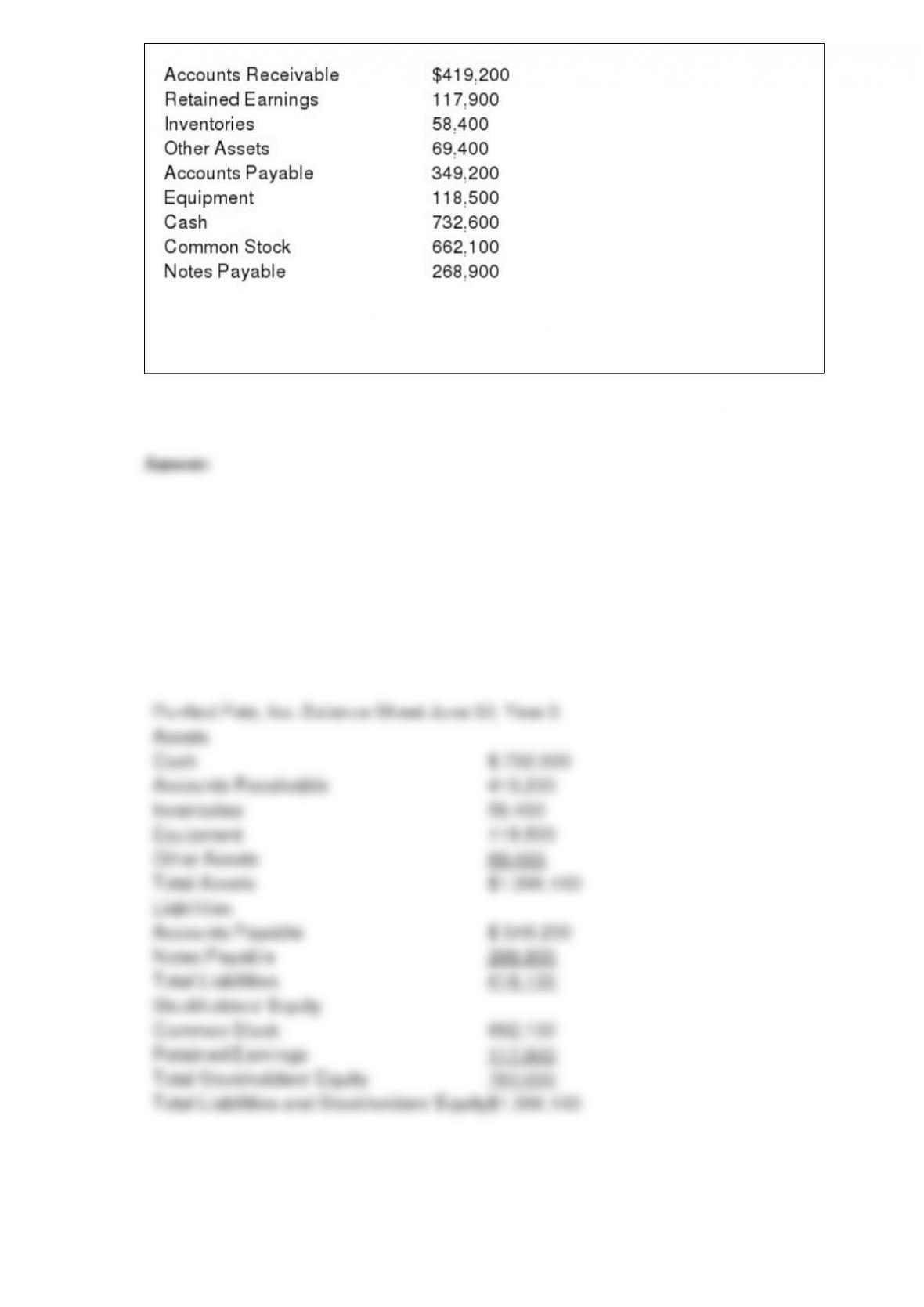
Required:
Prepare a balance sheet using these data.

Your company pays back $2 million on a loan it had obtained earlier from a bank.
A) Assets decrease by $2 million; liabilities and stockholders’ equity are both
unchanged.
B) Assets decrease by $2 million, liabilities decrease by $2 million, and stockholders’
equity is unchanged.
C) Assets decrease by $2 million and liabilities increase by $2 million.
D) Assets decrease by $2 million, liabilities are unchanged, and stockholders ‘ equity
decreases by $2 million.
When a company issues bonds that do not pay periodic interest, the bonds are called:
A) convertible bonds.
B) debenture bonds.
C) serial bonds.
D) zero-coupon bonds.

Nancy O’Rode, doing business as O’Rode Consulting, performs consulting services for
companies that create online learning games for children. On January 1, 2015, she
started a sole proprietorship by placing $15,000 cash in a bank account opened for the
business. Each month during the year, O’Rode withdrew $500 cash from the business
for personal use. At December 31, 2015, after the last withdrawal, the Drawings
account reflected a debit balance of $6,000. During the year, the usual journal entries
for the year, including adjusting and closing entries for the revenue and expense
accounts, resulted in total revenue of $60,000, total expenses of $12,000, and net
income of $48,000. (For purposes of the related journal entry, use the accounts
€Consulting Revenue€ and €Operating Expenses.€)
Part a. Prepare the journal entry to record the initial capital contribution.
Part b. Prepare the journal entry to record one of the monthly withdrawals.
Part c. Prepare the journal entry to close the net income to the N. O’Rode, Capital
account.
Part d. Prepare the journal entry to close the N. O’Rode, Drawings accounts at the end
of the year.
Part e. Prepare a Statement of Owner’s Equity for the year ending December 31, 2015.
During the first year of operations, a company sold $100,000 of goods to customers and
received $90,000 in cash from customers. The remainder is owed to the company at the
end of the year. The company incurred $70,000 in expenses for the year and paid
$65,000 in cash for these expenses. The remainder is owed by the company at the end
of the year. Based on this information, what is the amount of net income for the year?
A) $25,000
B) $35,000
C) $20,000
D) $30,000

Sparkling Pools received a bill for $1,200 for running newspaper ads during the last two
weeks of July; the bill will be paid on August 1. Advertising Expense should be:
A) credited for $1,200 in July.
B) credited for $1,200 in August.
C) debited for $1,200 in July.
D) debited for $1,200 in August.
Darin Company uses a perpetual inventory system. On October 1, Darin Company sold
inventory in the amount of $6,500 to Dee Company, terms 2/10, n/30. The items cost
Darin $4,200. On October 4, Dee returns some of the inventory. This inventory had a
selling price of $500 and a cost of $200. On October 8, Dee Company paid Darin
Company the amount due on that date.
Use the information above to answer the following question. What journal entry
(entries) will Darin Company make on October 4 to record the sales return?
A) Debit Sales Returns & Allowances and credit Accounts Receivable for $500; debit
Inventory and credit Cost of Goods Sold for $200
B) Debit Sales Returns & Allowances for $200 and credit Accounts Receivable for
$200
C) Debit Sales for $500 and credit Inventory for $500
D) Debit Accounts Receivable and credit Sales Returns & Allowances for $500; debit
Cost of Goods Sold and credit Inventory for $200