1) Hammond and Jarrett provide tax consulting for estates and trusts. Their job-costing
system has a single direct-cost category (professional labor) and a single indirect-cost
pool (research support). The indirect-cost pool contains all the costs except direct
personnel costs. All budgeted indirect costs are allocated to individual jobs using actual
professional labor-hours.
Required:
a.Discuss the reasons a consulting firm might use a normal costing system rather than
an actual costing system.
b.What might be some reasons for the firm to change from a one-pool to a
multiple-pool allocation concept?
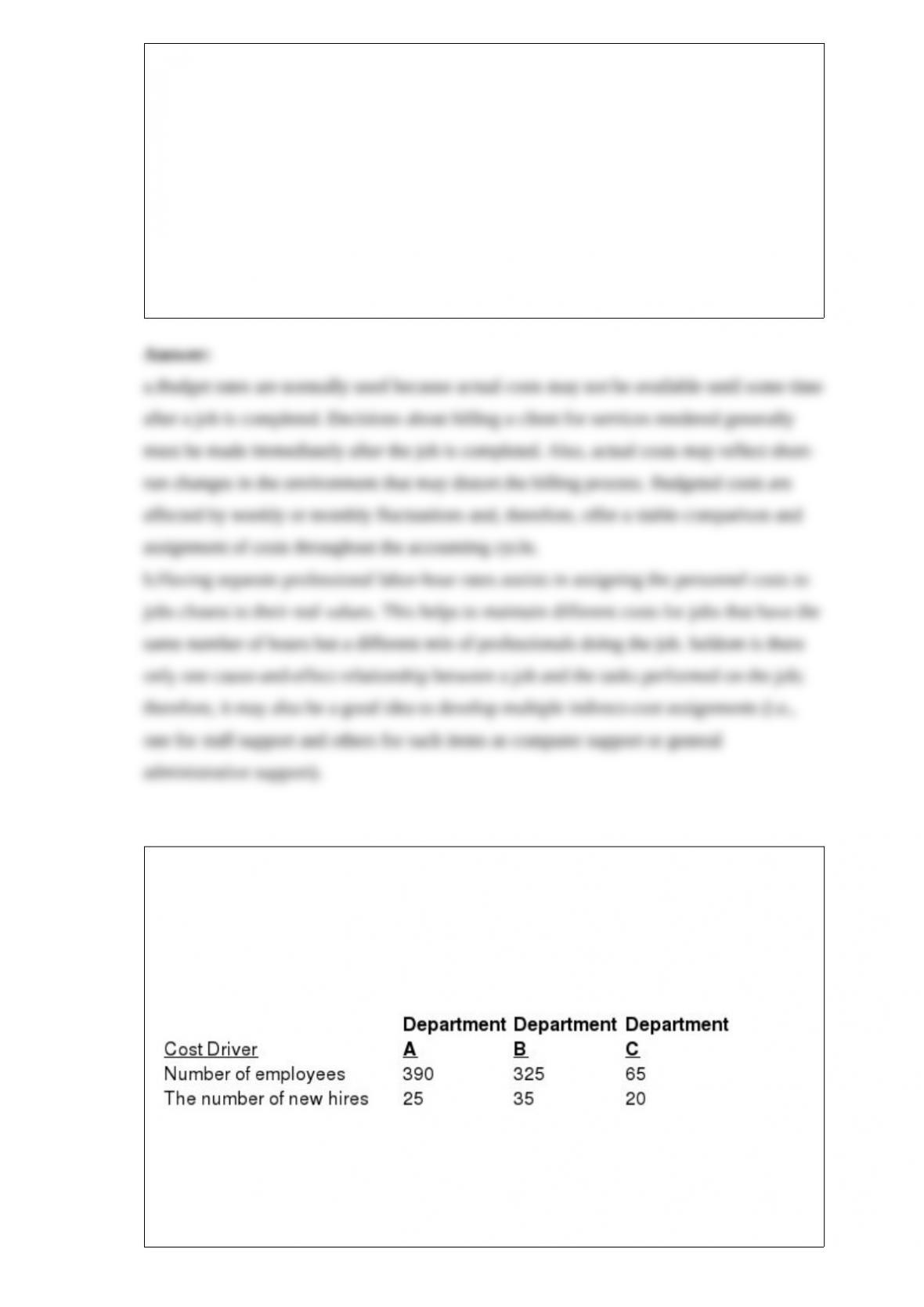
2) The cost of the personnel department at the Binix Company has always been charged
to the production departments based upon number of employees. Recently, opinions
gathered from the department managers indicated that the number of new hires might
also be a predictor of personnel costs to be assigned. Total personnel department costs
are $180,000.
Required:
Using the above data, prepare a report that contrasts the different amounts of personnel
department cost that would be allocated to each of the production departments if the
cost driver used is:
a.number of employees.
b.the number of new hires.
c.Which cost estimation method is being used by Binix Company?
3) Which of the following is a disadvantage of using target costing?
A) It may lead to an increase in all the non-value added cost of the product
B) It may lead to a product being in development stage for a long time as the team
repeatedly evaluates alternative designs.
C) It may lead to increased employee participation in the cost reduction process of the
organization thereby making it impossible to co-ordinate the process.
D) It eliminates creativity in the manufacturing process as the focus is always on cost
reduction and cost elimination.
4) Apple Valley Corporation uses a job cost system and has two production
departments, A and B. Budgeted manufacturing costs for the year are:
The actual material and labor costs charged to Job #432 were as follows:
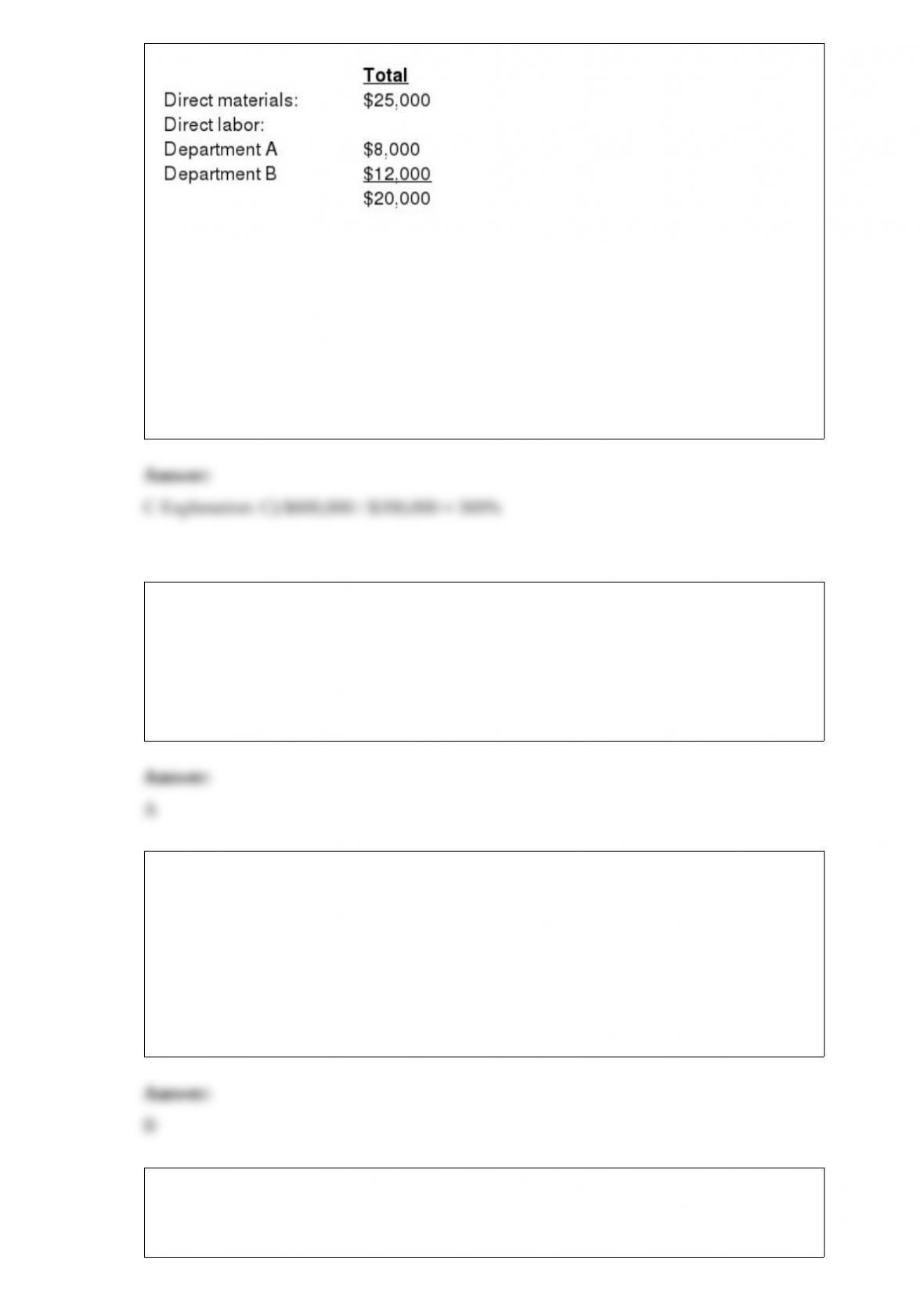
Apple Valley applies manufacturing overhead costs to jobs on the basis of direct
manufacturing labor cost using departmental rates determined at the beginning of the
year.
For Department A, the manufacturing overhead allocation rate is ________.
A) 33%
B) 66%
C) 300%
D) 100%
5) The direct allocation method ________.
A) does not allocate support department costs to other support departments
B) uses information about reciprocal services provided among support departments and
can therefore lead to inaccurate estimates of the cost of operating departments
C) allocates complete reciprocated costs
D) offers key input for outsourcing decisions
6) Depreciation is usually NOT considered an operating cash flow in capital budgeting
because ________.
A) depreciation is usually a constant amount each year over the life of the capital
investment
B) deducting depreciation from operating cash flows would be counting the lump-sum
amount twice
C) depreciation usually does not result in an increase in working capital
D) depreciation usually has no effect on the disposal price of the machine
7) The gross margin percentage is an example of the ________ measure of a
balanced-scorecard.
A) internal business process perspective
B) customer perspective
C) learning and growth perspective
D) financial perspective
8) An example of allocating joint costs using physical measures is allocating joint costs
based on ________.
A) sales value at splitoff point
B) volume of the products
C) constant gross-margin percentage
D) net realizable value
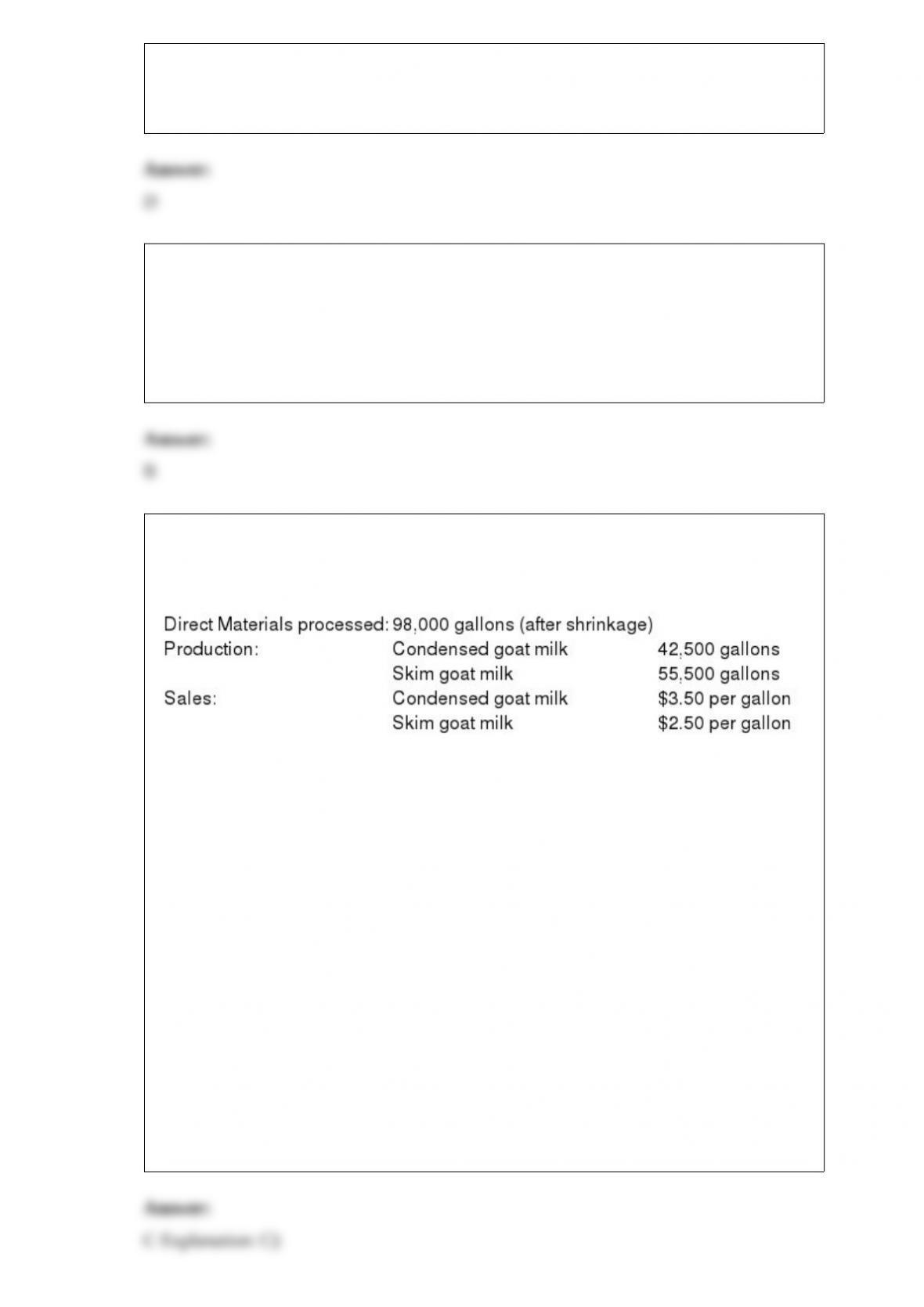
9) The Green Company processes unprocessed goat milk up to the splitoff point where
two products, condensed goat milk and skim goat milk result. The following
information was collected for the month of October:
The costs of purchasing the of unprocessed goat milk and processing it up to the splitoff
point to yield a total of 98,000 gallons of saleable product was $184,480. There were no
inventory balances of either product.
Condensed goat milk may be processed further to yield 42,000 gallons (the remainder is
shrinkage) of a medicinal milk product, Xyla, for an additional processing cost of $4
per usable gallon. Xyla can be sold for $20 per gallon.
Skim goat milk can be processed further to yield 54,200 gallons of skim goat ice cream,
for an additional processing cost per usable gallon of $4. The product can be sold for $9
per gallon.
There are no beginning and ending inventory balances.
How much (if any) extra income would Green earn if it produced and sold all of the
Xyla from the condensed goat milk? Allocate joint processing costs based upon relative
sales value on the splitoff. (Extra income means income in excess of what Green would
have earned from selling condensed goat milk.)
A) $576,552
B) $132,250
C) $523,250
D) $181,968
10) Which of the following issues is addressed by the Sarbanes-Oxley legislation?
A) safety aspects of products
B) environmental damages caused by industries
C) disclosure practices of public corporations
D) disclosure practices of private companies
11) Russo Corporation manufactured 16,000 air conditioners during November. The
overhead cost-allocation base is $31.50 per machine-hour. The following variable
overhead data pertain to November:
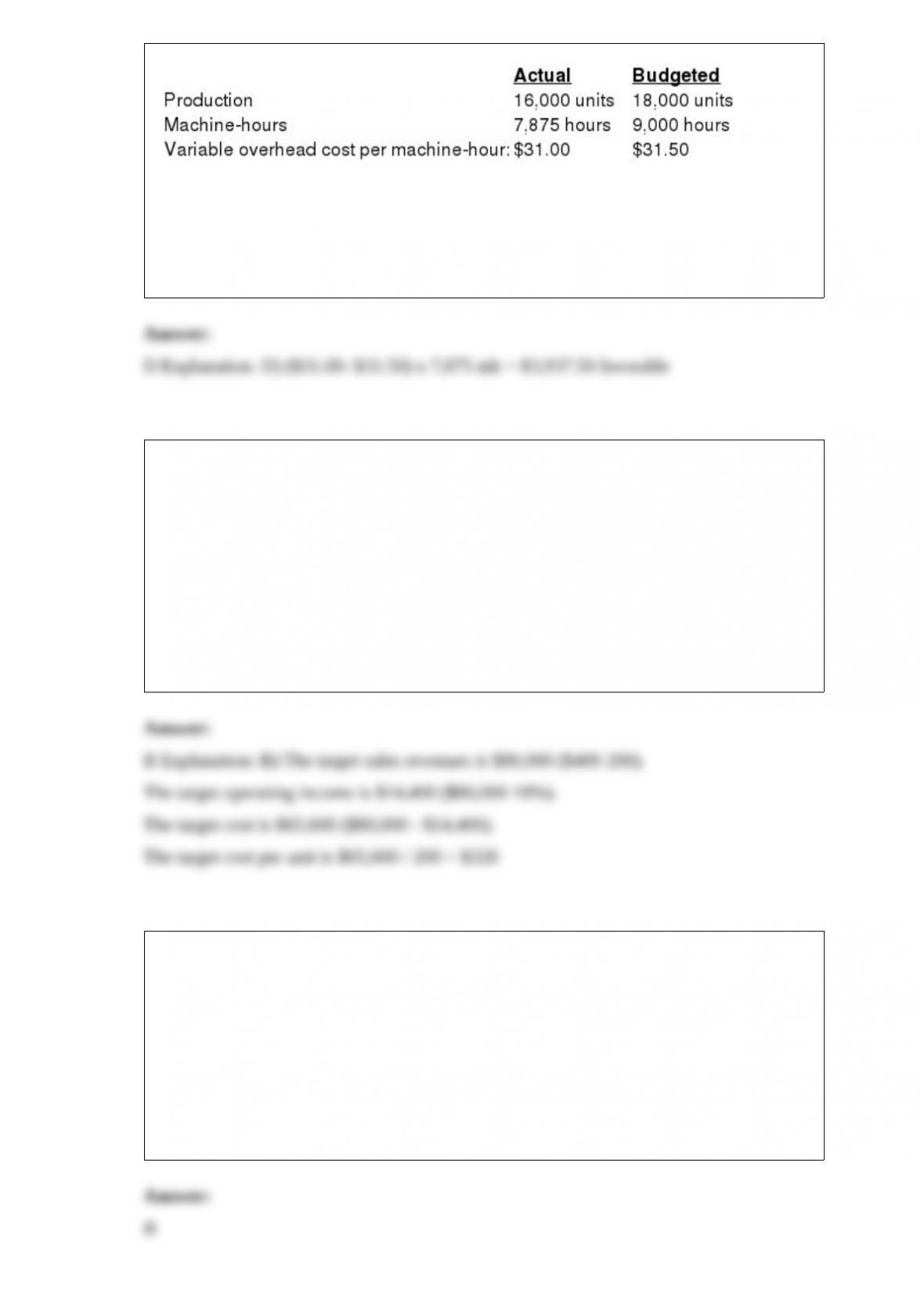
What is the variable overhead spending variance?
A) $4,500 unfavorable
B) $3,937.50 unfavorable
C) $4,500 favorable
D) $3,937.50 favorable
12) Sales of Blair Inc. have been on a steady decline for the last 12 months. A market
research study conducted revealed that the product of Blair Inc. can be sold only for
$400 as opposed to the current market price charged of $500 per unit. Blair Inc. has
decided to revise its sales price to $400. The annual sales target volume of the product
after price revision is 200 units. Blair Inc. wants to earn 18% on its sales amount.
What is the target cost per unit?
A) $387.04
B) $328.00
C) $268.96
D) $73.80
13) Place the following steps for the implementation of target costing in order:
A = Derive a target cost
B = Develop a target price
C = Perform value engineering
D = Determine target operating income
A) B D A C
B) B A D C
C) A D B C
D) A B C D
14) Which of the following is a fixed cost for an automobile manufacturing plant?
A) administrative salaries
B) electricity used by assembly-line machines
C) sales commissions
D) tires
15) Julian Pharma manufactures hospital beds. Its most popular model, Deluxe, sells for
$5,000. It has variable costs totaling $2,650 and fixed costs of $1,200 per unit, based on
an average production run of 5,000 units. It normally has four production runs a year,
with $400,000 in setup costs each time. Plant capacity can handle up to six runs a year
for a total of 30,000 beds.
A competitor is introducing a new hospital bed similar to Deluxe that will sell for
$3,800. Management believes it must lower the price to compete. The marketing
department believes that the new price will increase sales by 25% a year. The plant
manager thinks that production can increase by 25% with the same level of fixed costs.
The company currently sells all the Deluxe beds it can produce.
Required:
a.What is the annual operating income from Deluxe at the current price of $5,000?
b.What is the annual operating income from Deluxe if the price is reduced to $3,800
and sales in units increase by 25%?
c.What is the target cost per unit for the new price if target operating income is 30% of
sales?
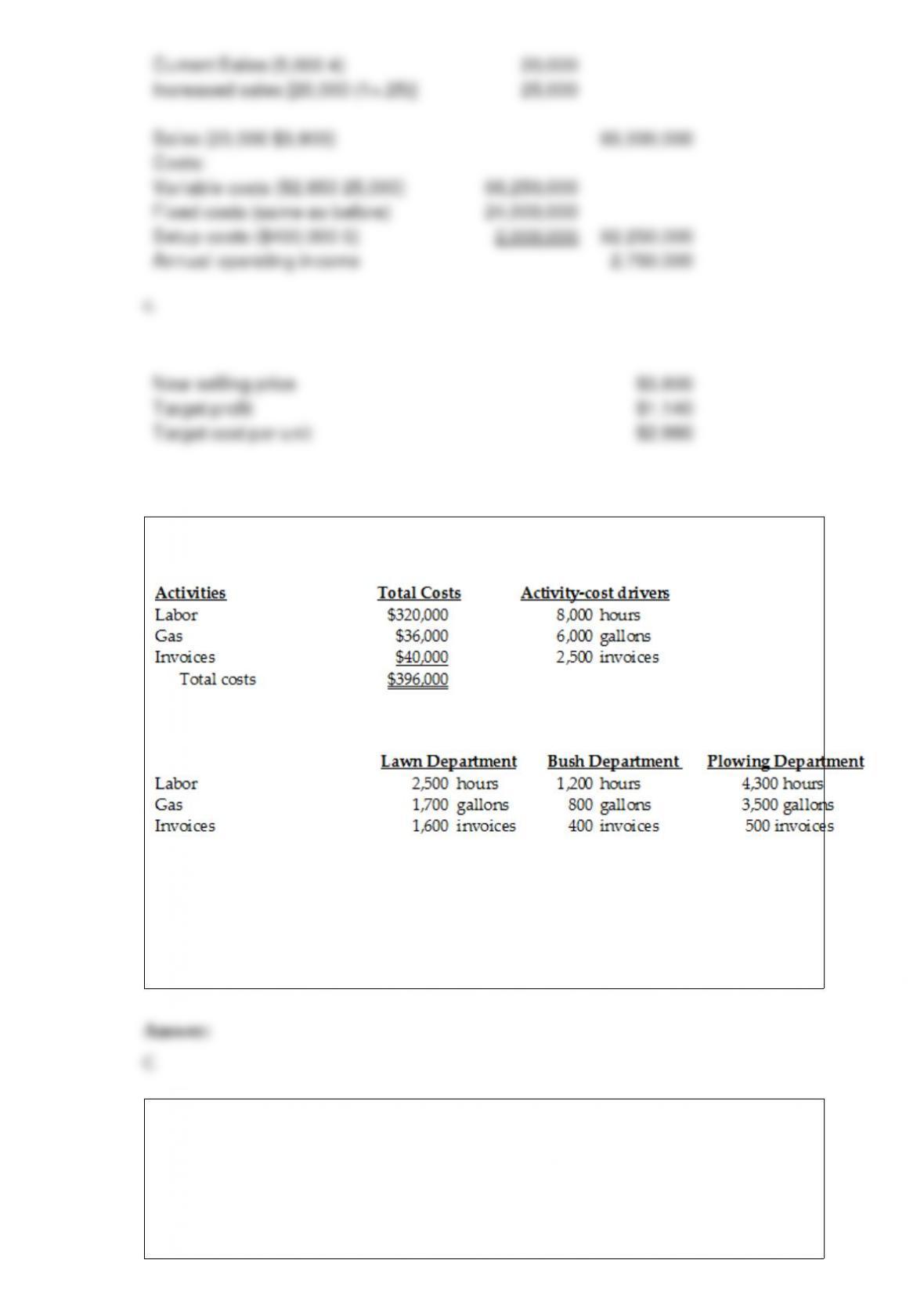
16) Teecorp Company provides the following ABC costing information:
The above activities used by their three departments are:
How much of the total costs will be assigned to the Lawn Department?
A) $134,500
B) $135,600
C) $135,800
D) $134,600
17) Which of the following is true of master-budget capacity utilization?
A) It hides the amount of unused capacity.
B) It represents the maximum units of production intended for current capacity.
C) It provides the best cost estimate for benchmarking purposes.
D) It is an average that provides no meaningful feedback to a firm’s marketing manager
for a particular year.
18) Design engineering is an example of ________.
A) prevention costs
B) appraisal costs
C) internal failure costs
D) external failure costs
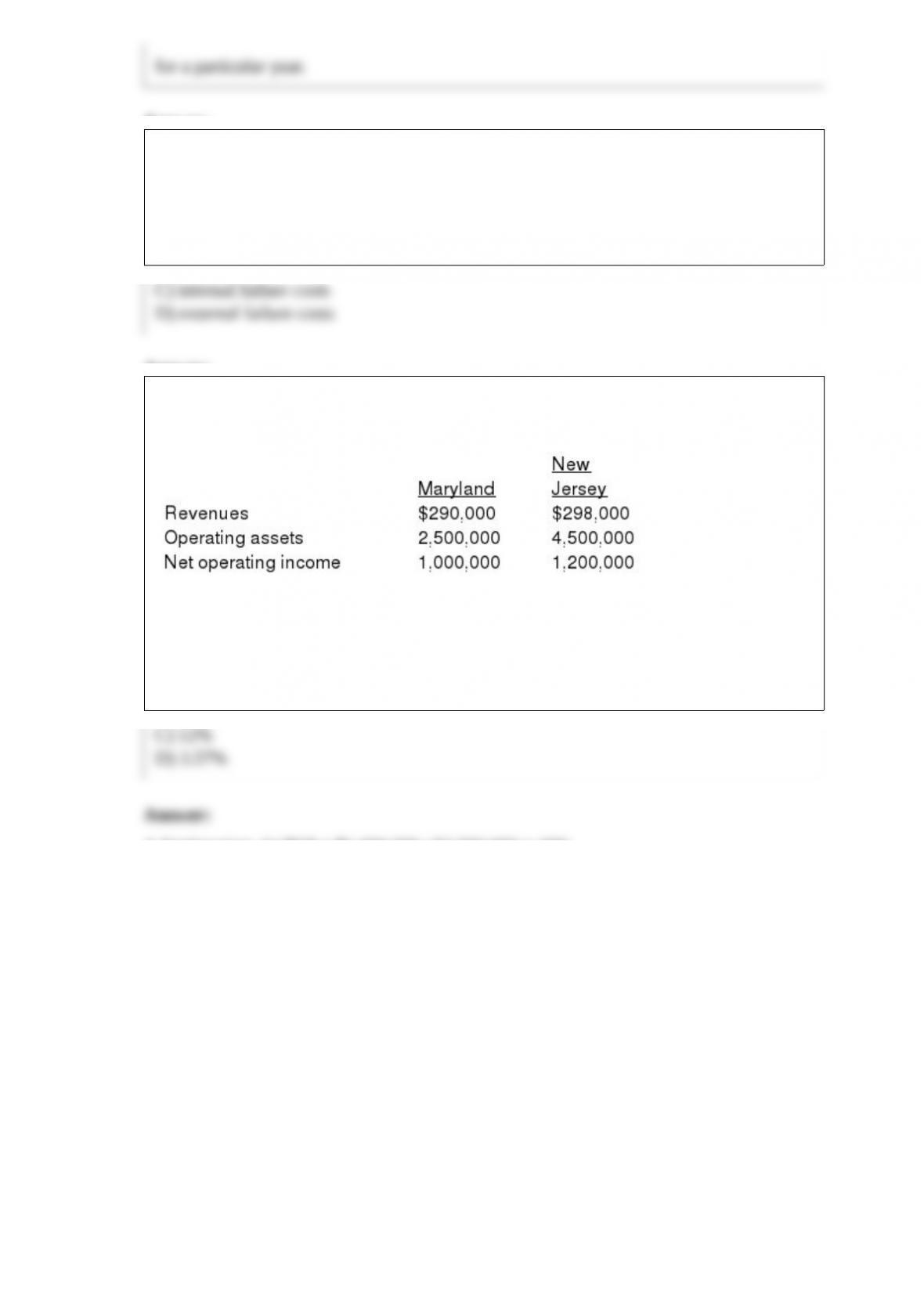
19) Aeralia Inc., has two regional offices. The data for each are as follows:
What is the Maryland Division’s return on investment?
A) 40%
B) 54%
C) 12%
D) 3.57%