1) When computing standard cost variances, the difference between actual and standard
price multiplied by actual quantity yields a(n):
A.combined price and quantity variance.
B.efficiency variance.
C.price or rate variance.
D.quantity variance.
2) Milano Corporation is working on its direct labor budget for the next two months.
Each unit of output requires 0.50 direct labor-hours. The direct labor rate is $9.80 per
direct labor-hour. The production budget calls for producing 6,400 units in October and
6,300 units in November. If the direct labor work force is fully adjusted to the total
direct labor-hours needed each month, what would be the total combined direct labor
cost for the two months?
A.$30,870
B.$31,360
C.$62,230
D.$31,115
3) If a company decreases the variable expense per unit while increasing the total fixed
expenses, the total expense line relative to its previous position will:
A.shift downward and have a steeper slope.
B.shift downward and have a flatter slope.
C.shift upward and have a flatter slope.
D.shift upward and have a steeper slope.
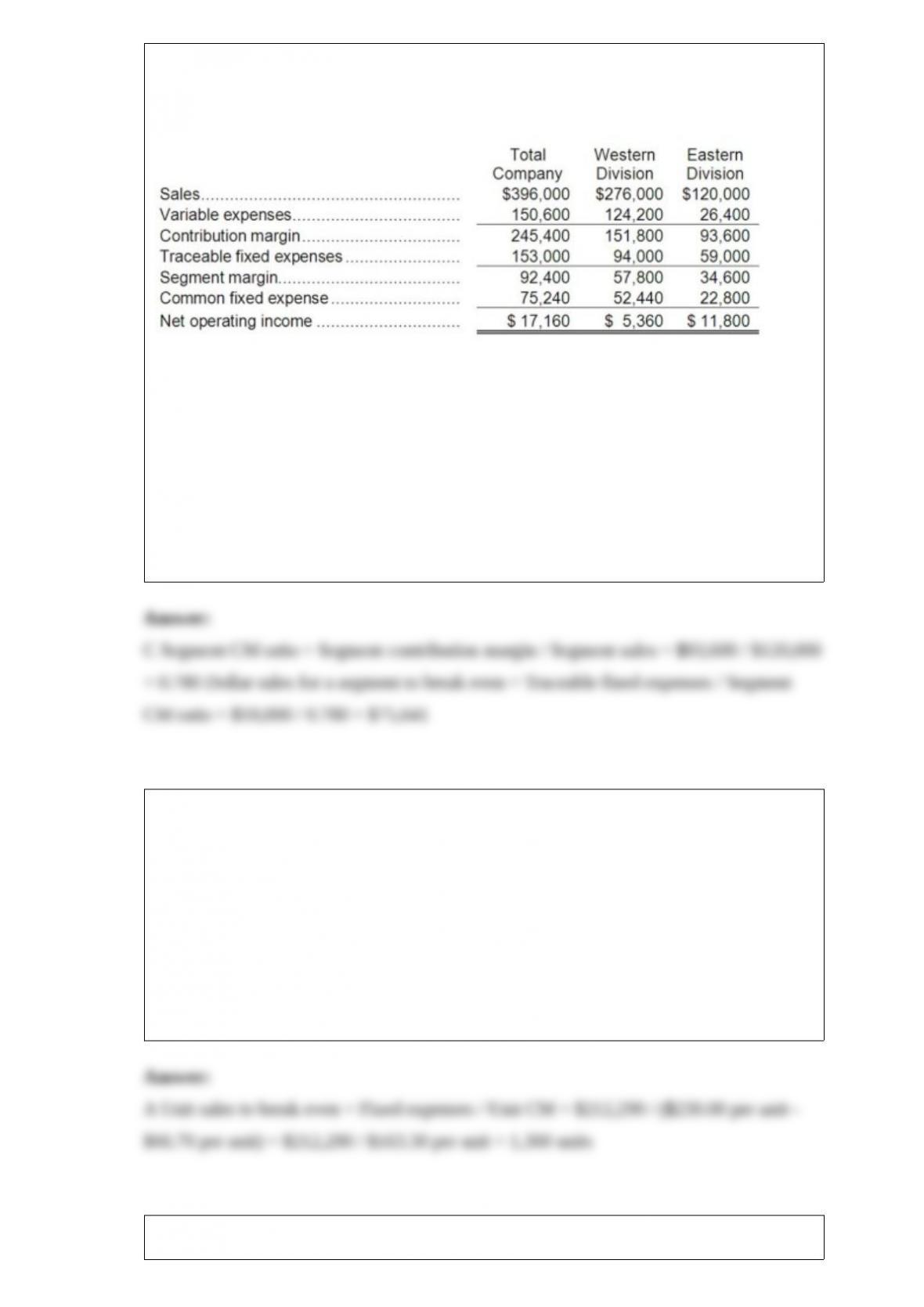
4) Keefe Corporation has two divisions: Western Division and Eastern Division. The
following report is for the most recent operating period:
The common fixed expenses have been allocated to the divisions on the basis of sales.
The Eastern Division’s break-even sales is closest to:
A.$104,872
B.$368,309
C.$75,641
D.$172,103
5) Holdt Inc. produces and sells a single product. The selling price of the product is
$230.00 per unit and its variable cost is $66.70 per unit. The fixed expense is $212,290
per month. The break-even in monthly unit sales is closest to:
A.1,300
B.3,183
C.1,802
D.923
6) Kuzuck Corporation uses the weighted-average method in its process costing system.
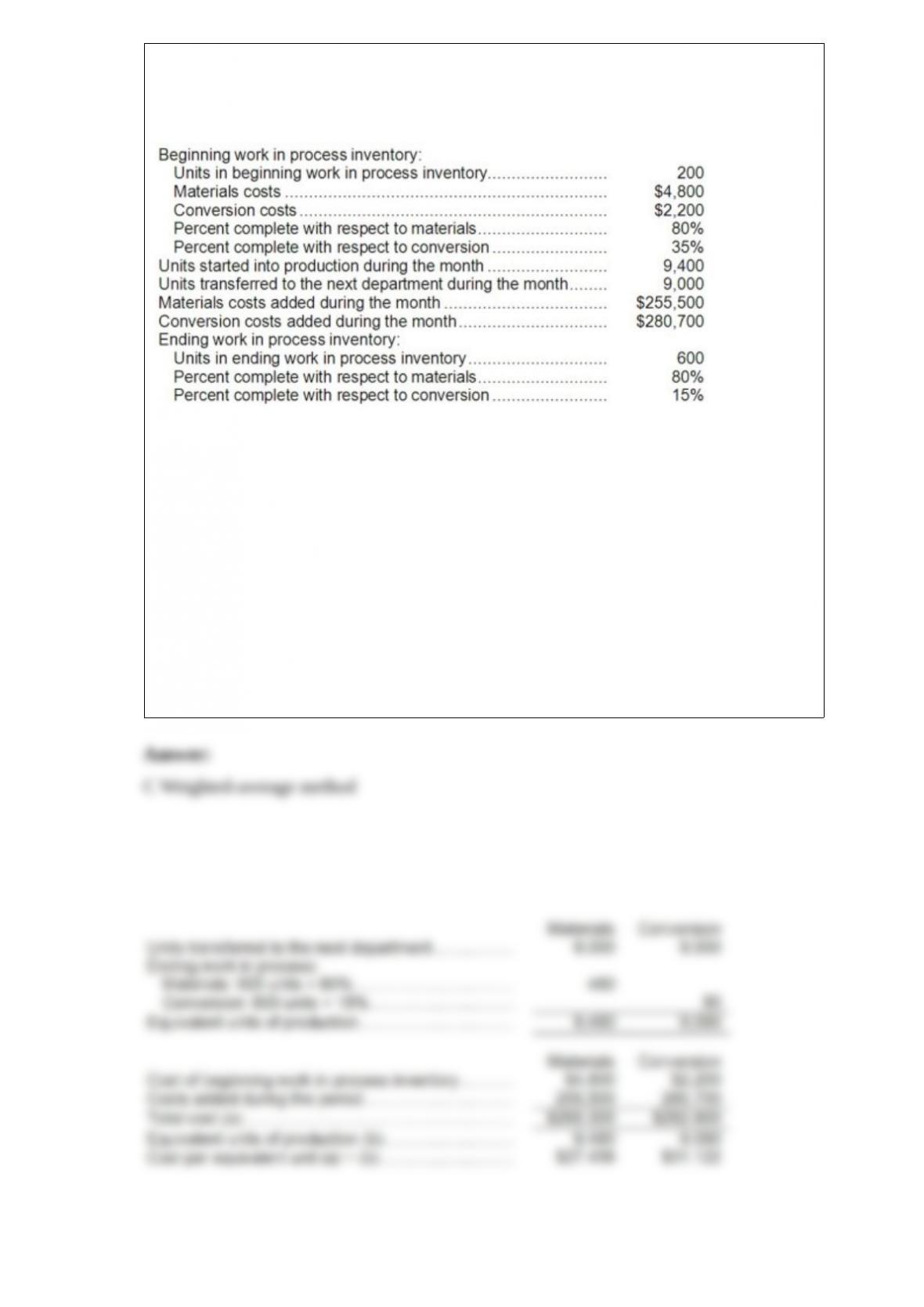
Data concerning the first processing department for the most recent month are listed
below:
Note: Your answers may differ from those offered below due to rounding error. In all
cases, select the answer that is the closest to the answer you computed. To reduce
rounding error, carry out all computations to at least three decimal places.
The total cost transferred from the first processing department to the next processing
department during the month is closest to:
A.$562,368
B.$543,200
C.$527,219
D.$536,200
7) The journal entry to record the allocation of any underapplied or overapplied
manufacturing overhead for November would include the following:
A.debit to Finished Goods of $48,830
B.debit to Finished Goods of $1,200
C.credit to Finished Goods of $48,830
D.credit to Finished Goods of $1,200
8) Compound B73G is used to make Vasconcellos Corporation’s major product. The
standard cost of B73G is $27.60 per ounce and the standard quantity is 8.6 ounces per
unit of output. In the most recent month, 3,200 ounces of the raw material were
purchased at a cost of $26.70 per ounce. When recording the purchase of materials,
Raw Materials would be:
A.debited for $88,320.
B.debited for $85,440.
C.credited for $85,440.
D.credited for $88,320.
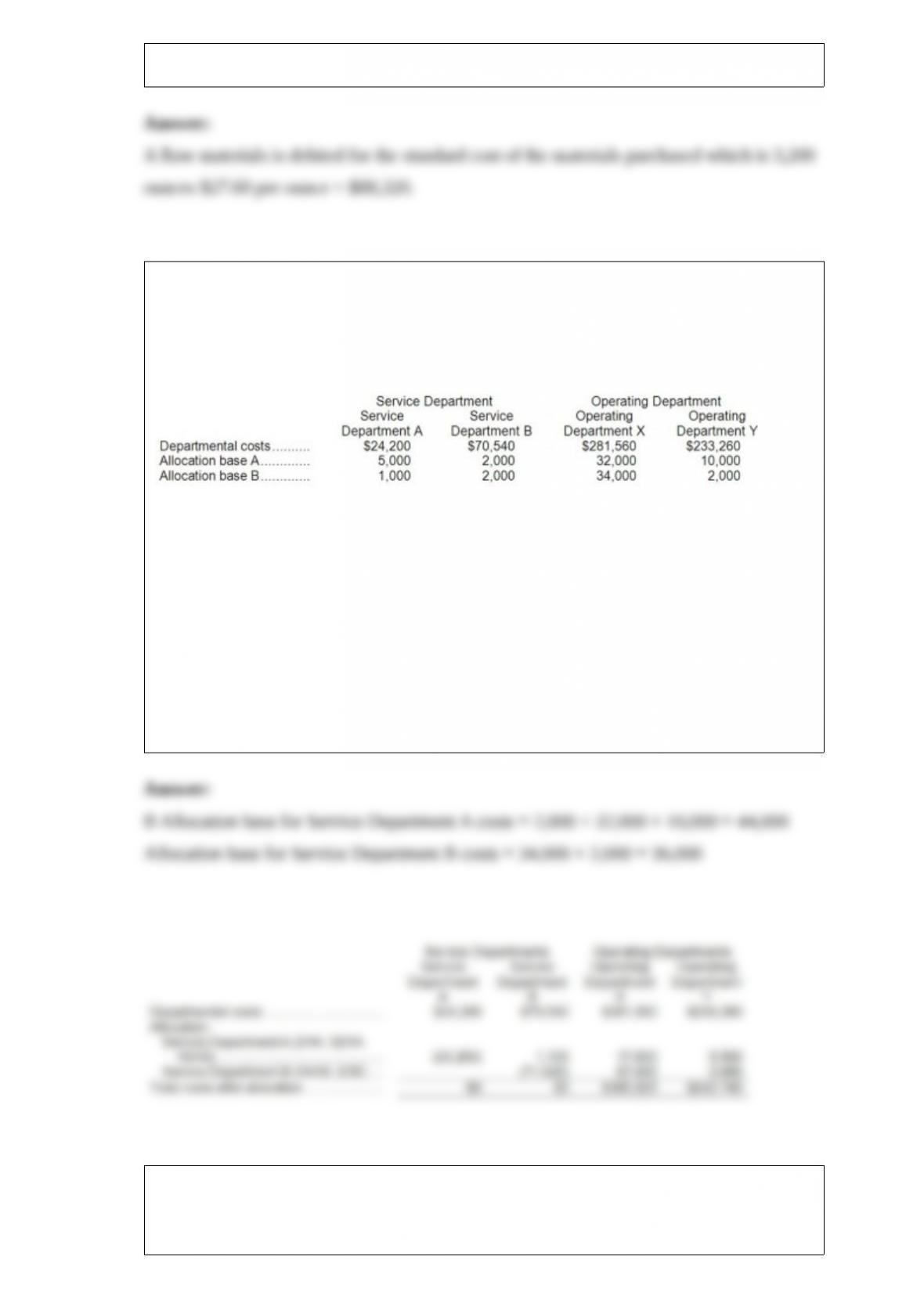
9) Mcbrien Corporation uses the step-down method to allocate service department costs
to operating departments. The company has two service departments, Service
Department A and Service Department B, and two operating departments, Operating
Department X and Operating Department Y. Data concerning those departments follow:
Service Department A costs are allocated first on the basis of allocation base A and
Service Department B costs are allocated second on the basis of allocation base B.
The total Operating Department Y cost after allocations is closest to:
A.$242,941
B.$242,740
C.$237,240
D.$241,816
10) Which of the following would be an argument for the use of net book value in the
computation of operating assets in return on investment calculations?
A.It allows the manager to replace old, worn-out equipment with a minimum adverse
impact on ROI.
B.It allows ROI to decrease over time as assets get older.
C.It is consistent with how plant and equipment items are reported on the balance sheet.
D.It eliminates both age of equipment and method of depreciation as factors in ROI
computations.
11) The West Division of Frede Corporation had average operating assets of $700,000
and net operating income of $120,800 in December. The minimum required rate of
return for performance evaluation purposes is 16%.
What was the West Division’s residual income in December?
A.$8,800
B.$(19,328)
C.$(8,800)
D.$19,328
12) How many units of product R94X should be produced each month?
A.490
B.275
C.0
D.951