
1) nominal (temporary) accounts are revenue, expense, and dividend accounts and are
periodically closed.
2) the conceptual framework underlying u.s. gaap is similar to that underlying ifrs.
3) if the difference between the construction in process and the billings on construction
in process account balances is a debit, the difference is reported as a current asset.
4) the accounting profession has adopted a current operating performance approach to
income reporting.
5) revenues are realized when a company exchanges goods and services for cash or
claims to cash.
6) companies must use the percentage-of-completion method when estimates of
progress toward completion are reasonably dependable.
7) some intangible assets are not required to be amortized every year.

8) ifrs does not intend to issue detailed guidance on the selection of a discount rate
when the time value of money is required to determine cash flows.
9) the receivables turnover ratio is computed by dividing net sales by the ending net
receivables.
10) financial flexibility is a companys ability to respond and adapt to financial adversity
and unexpected needs and opportunities.
11) ifrs uses a ceiling to determine market.
12) gaap is a product of careful logic or empirical findings and are not influenced by
political action.
13) all of the following are key differences between u.s. gaap and ifrs with respect to
accounting for inventories except the
a.definition of the lower-of-cost-or-market test for inventory valuation differs between
u.s. gaap and ifrs
b.inventory basis determination for writedowns differs between u.s. gaap and ifrs
c.guidelines are more principles based under ifrs than they are under u.s. gaap
d.average costing method is prohibited under ifrs
14) james, inc. incurred the following infrequent losses during 2012:

a $140,000 write-down of equipment leased to others.
a $80,000 adjustment of accruals on long-term contracts.
a $120,000 write-off of obsolete inventory.
in its 2012 income statement, what amount should james report as total infrequent
losses that are not considered extraordinary?
a.$340,000
b.$260,000
c.$220,000
d.$200,000
15) equity or debt securities held to finance future construction of additional plants
should be classified on a balance sheet as
a.current assets
b.property, plant, and equipment
c.intangible assets
d.long-term investments
16) calcount provides its employees two weeks of paid vacation per year. as of
december 31, 65 employees have earned two weeks of vacation time to be taken the
following year. if the average weekly salary for these employees is $1,140, what is the
required journal entry?
a.debit salaries and wages expense for $148,200 and credit salaries and wages payable
for $148,200
b.no journal entry required
c.debit salaries and wages payable for $147,600 and credit salaries and wages expense
for $147,600
d.debit salaries and wages expense for $74,100 and credit salaries and wages payable
for $74,100
17) stine inc. had 400,000 shares of common stock issued and outstanding at december
31, 2012. on july 1, 2013 an additional 400,000 shares were issued for cash. stine also
had stock options outstanding at the beginning and end of 2013 which allow the holders
to purchase 120,000 shares of common stock at $28 per share. the average market price
of stines common stock was $35 during 2013. the number of shares to be used in
computing diluted earnings per share for 2013 is
a.896,000
b.824,000
c.696,000
d.624,000
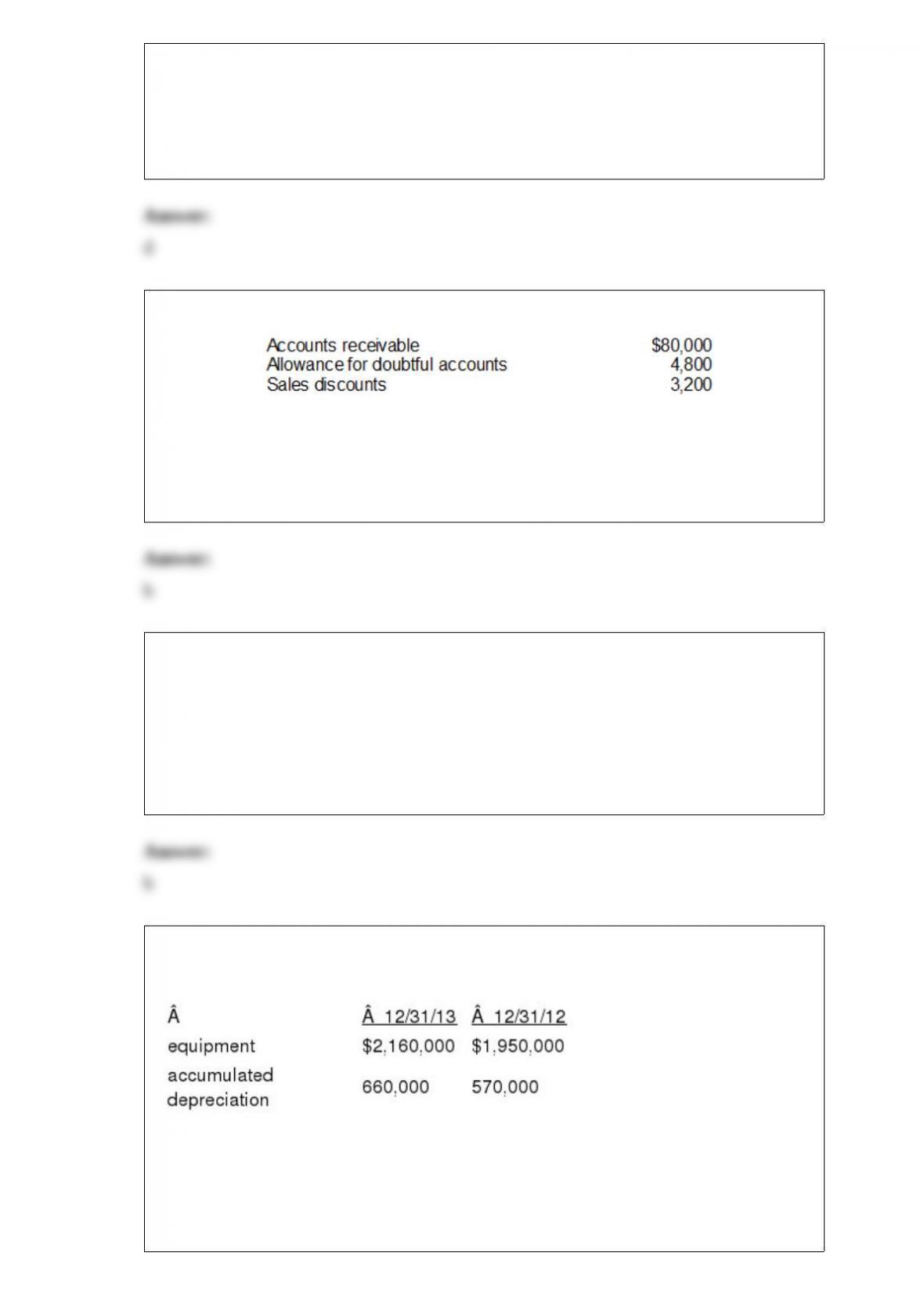
18) lankton company has the following account balances at year-end:
lankton should report accounts receivable at a net amount of
a.$72,000
b.$75,200
c.$76,800
d.$80,000
19) under the lower-of-cost-or-market method, the replacement cost of an inventory
item would be used as the designated market value
a.when it is below the net realizable value less the normal profit margin
b.when it is below the net realizable value and above the net realizable value less the
normal profit margin
c.when it is above the net realizable value
d.regardless of net realizable value
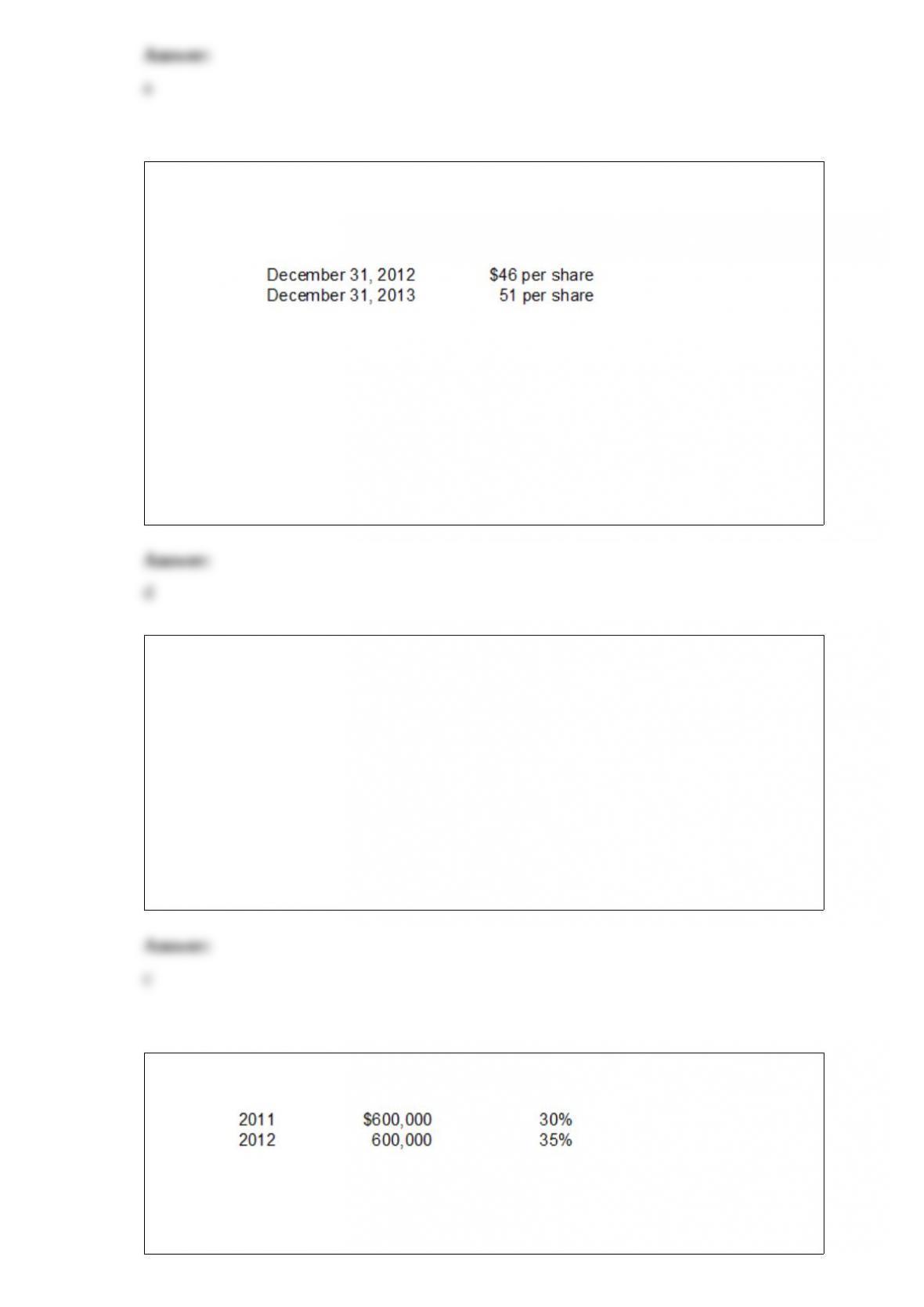
20) equipment that cost $350,000 and had a book value of $156,000 was sold for
$180,000. data from the comparative balance sheets are:
equipment purchased during 2013 was
a.$560,000
b.$350,000
c.$210,000
d.$366,000
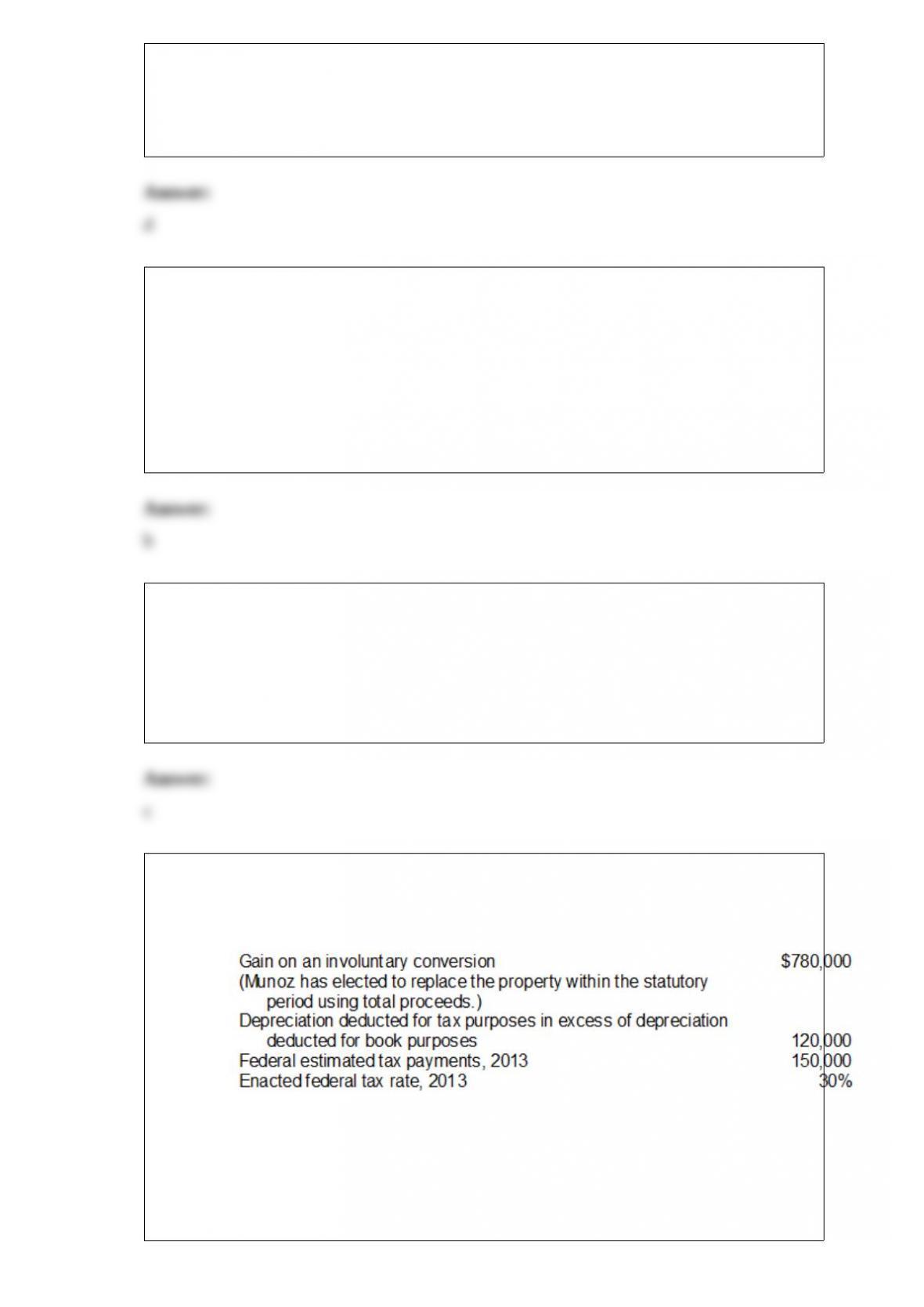
21) in order to retain certain key executives, smiley corporation granted them incentive
stock options on december 31, 2011. 100,000 options were granted at an option price of
$35
per share. market prices of the stock were as follows:
the options were granted as compensation for executives services to be rendered over a
two-year period beginning january 1, 2012. the black-scholes option pricing model
determines total compensation expense to be $1,000,000. what amount of compensation
expense should smiley recognize as a result of this plan for the year ended december
31, 2012 under the fair value method?
a.$1,750,000
b.$1,100,000
c.$1,000,000
d.$500,000
22) arlington company is constructing a building. construction began on january 1 and
was completed on december 31. expenditures were $4,000,000 on march 1, $3,300,000
on june 1, and $5,000,000 on december 31. arlington company borrowed $2,000,000 on
january 1 on a 5-year, 12% note to help finance construction of the building. in
addition, the company had outstanding all year a 10%, 3-year, $4,000,000 note payable
and an 11%, 4-year, $7,500,000 note payable.
what amount of interest should be charged to expense?
a.$637,987
b.$1,225
c.$877,987
d.$691,987
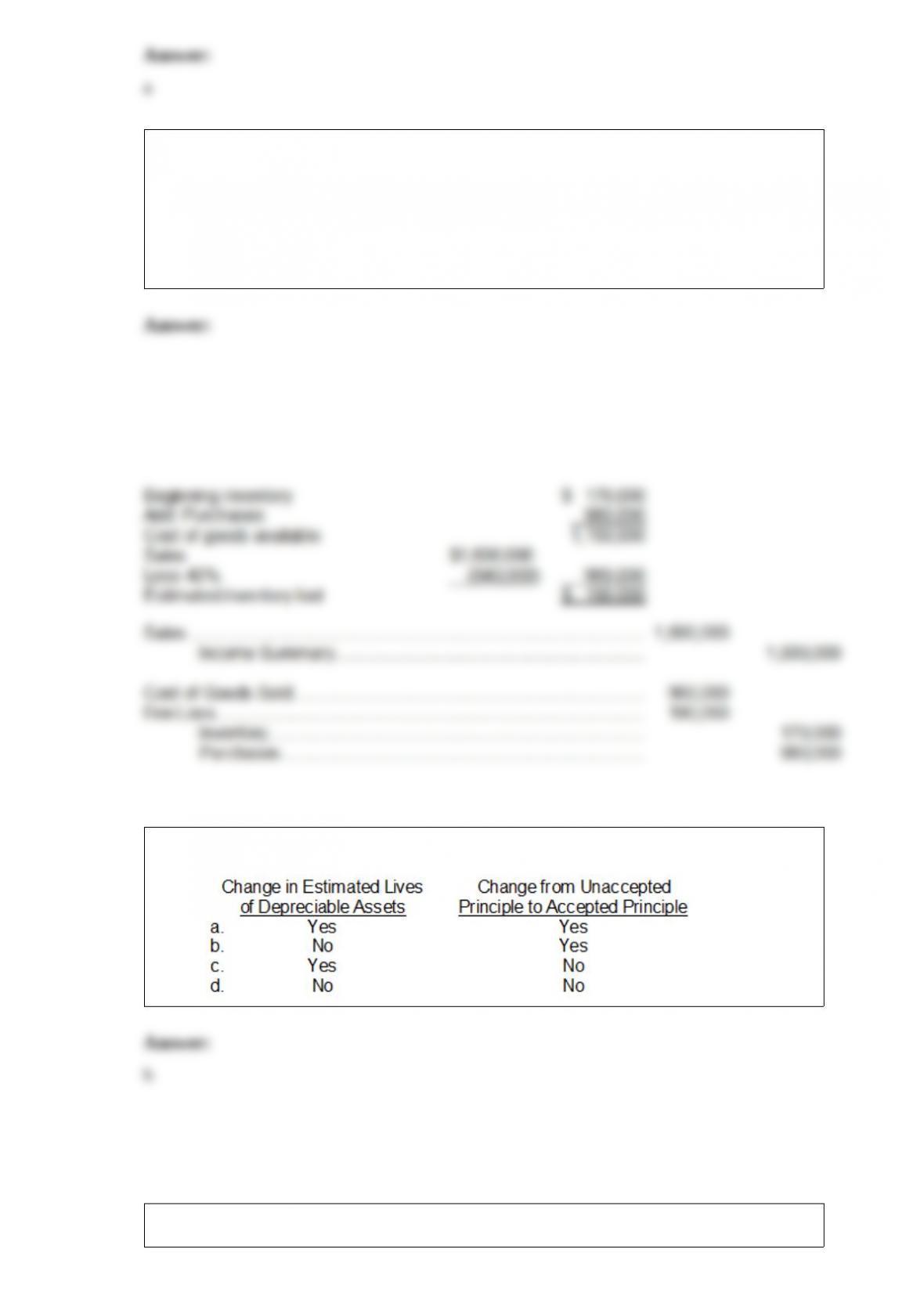
23) rodd co. reports a taxable and pretax financial loss of $600,000 for 2013. rodd’s
taxable and pretax financial income and tax rates for the last two years were:
the amount that rodd should report as an income tax refund receivable in 2013,
assuming that it uses the carryback provisions and that the tax rate is 40% in 2013, is
a.$180,000
b.$210,000

c.$240,000
d.$270,000
24) on november 1, 2012, horton co. purchased lopez, inc., 10-year, 9%, bonds with a
face value of $500,000, for $450,000. an additional $15,000 was paid for the accrued
interest. interest is payable semiannually on january 1 and july 1. the bonds mature on
july 1, 2019. horton uses the straight-line method of amortization. ignoring income
taxes, the amount reported in horton’s 2012 income statement as a result of horton’s
available-for-sale investment in lopez was
a.$8,750
b.$8,333
c.$7,500
d.$6,666
25) which of the following items should be included in a company’s inventory at the
balance sheet date?
a.goods in transit which were purchased f.o.b. destination
b.goods received from another company for sale on consignment
c.goods sold to a customer which are being held for the customer to call for at his or her
convenience
d.none of these
26) expensing the cost of copy paper when the paper is acquired is an example of which
constraint?
a.materiality
b.cost
c.conservatism
d.industry practices
27) which of the following is considered research and development costs?
a.planned search or critical investigation aimed at discovery of new knowledge
b.translation of research findings or other knowledge into a plan or design for a new
product or process
c.neither a nor b
d.both a and b
28) the original cost of an inventory item is above the replacement cost and the net
realizable value. the replacement cost is below the net realizable value less the normal
profit margin. as a result, under the lower-of-cost-or-market method, the inventory item
should be reported at the
a.net realizable value
b.net realizable value less the normal profit margin
c.replacement cost
d.original cost
29) what effect will the acquisition of treasury stock have on stockholders’ equity and
earnings per share, respectively?
a.decrease and no effect
b.increase and no effect
c.decrease and increase
d.increase and decrease
30) munoz corp.’s books showed pretax financial income of $1,800,000 for the year
ended december 31, 2013. in the computation of federal income taxes, the following
data were considered:
what amount should munoz report as its current federal income tax liability on its
december 31, 2013 balance sheet?
a.$120,000
b.$156,000
c.$270,000
d.$306,000
31) on december 31, 2012 felt company’s inventory burned. sales and purchases for the
year had been $1,600,000 and $980,000, respectively. the beginning inventory (jan. 1,
2012) was $170,000; in the past felt’s gross profit has averaged 40% of selling price.
instructions
compute the estimated cost of inventory burned, and give entries as of december 31,
2012 to close merchandise accounts.
32) which of the following should be reported as a prior period adjustment?
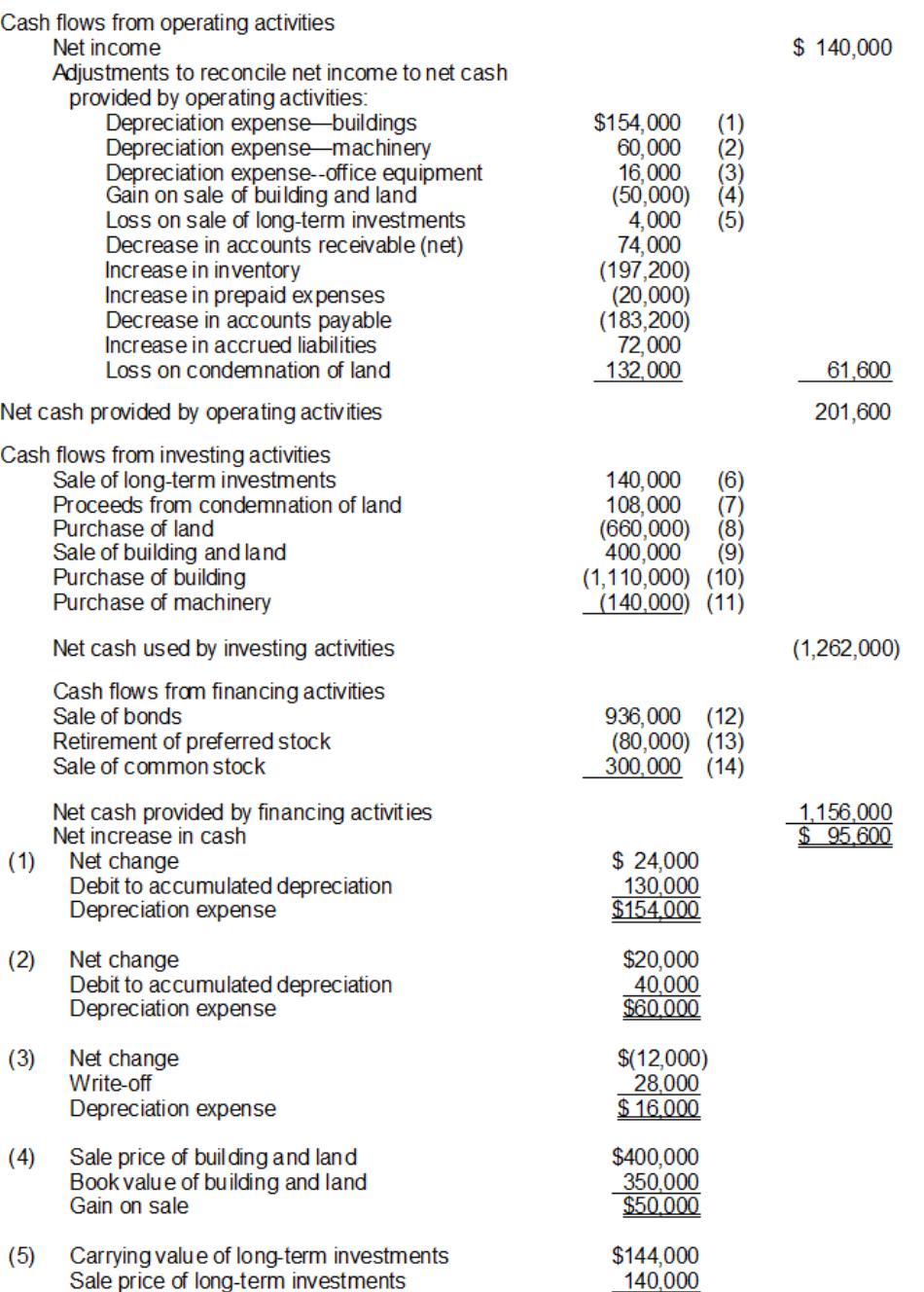
33) land that was condemned had a book value of $240,000.

instructions
prepare a statement of cash flows (indirect method). ignore tax effects.
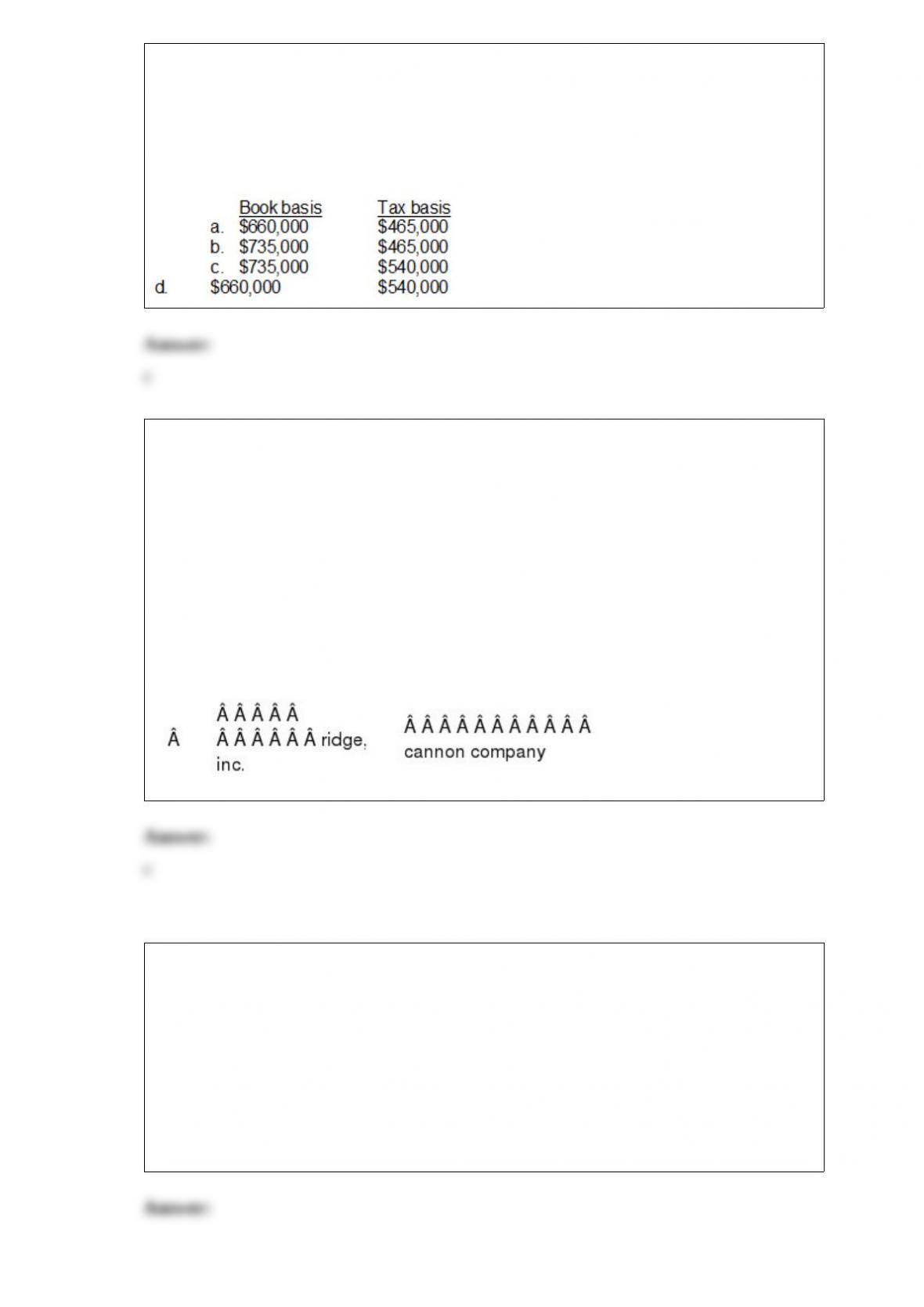
34) at the beginning of 2013, pitman co. purchased an asset for $900,000 with an
estimated useful life of 5 years and an estimated salvage value of $75,000. for financial
reporting purposes the asset is being depreciated using the straight-line method; for tax
purposes the double-declining-balance method is being used. pitman co.s tax rate is
40% for 2013 and all future years.
at the end of 2013, what is the book basis and the tax basis of the asset?
35) ridge, inc. follows ifrs for its external financial reporting, and cannon company
follows u.s. gaap for its external financial reporting. during 2013, both companies
changed depreciation methods, from double-declining balance to straight-line.
compared to double-declining balance, for ridge, inc. the change resulted in a decrease
in reported depreciation expense of $60,000, and for cannon company the change
resulted in a reported decrease in depreciation expense of $70,000. the remaining useful
lives of the assets impacted by the change in depreciation method is 10 years for both
companies. how would this change impact the net income reported by ridge, inc. and
cannon company for the year ended december 31, 2013?
a.decrease $60,000 decrease $70,000b.increase $6,000 increase $7,000c.increase
$60,000 increase $70,000d.increase $60,000 increase $7,000
36) on august 31, jenks co. partially refunded $450,000 of its outstanding 10% note
payable made one year ago to arma state bank by paying $450,000 plus $45,000
interest, having obtained the $495,000 by using $131,000 cash and signing a new
one-year $400,000 note discounted at 9% by the bank.
instructions
(1)make the entry to record the partial refunding. assume jenks co. makes reversing
entries when appropriate.
(2)prepare the adjusting entry at december 31, assuming straight-line amortization of
the discount.
37) below are three independent situations.
1>in august, 2012 a worker was injured in the factory in an accident partially the result
of his own negligence. the worker has sued wesley co. for $800,000. counsel believes it
is reasonably possible that the outcome of the suit will be unfavorable and that the
settlement would cost the company from $250,000 to $500,000.
2>a suit for breach of contract seeking damages of $2,400,000 was filed by an author
against greer co. on october 4, 2012. greer’s legal counsel believes that an unfavorable
outcome is probable. a reasonable estimate of the award to the plaintiff is between
$800,000 and $1,800,000. no amount within this range is a better estimate of potential
damages than any other amount.
3>quinn is involved in a pending court case. quinns lawyers believe it is probable that
quinn will be awarded damages of $1,000,000.
instructions
discuss the proper accounting treatment, including any required disclosures, for each
situation. give the rationale for your answers.
38) briefly describe some of the similarities and differences between u.s. gaap and ifrs
with respect to the accounting for stockholders equity.