Carson Corporation’s sales increase from $500,000 to $600,000 in the current year.
What is the percentage change in sales?
A. 20%
B. 25%
C. 22%
D. 16.7%
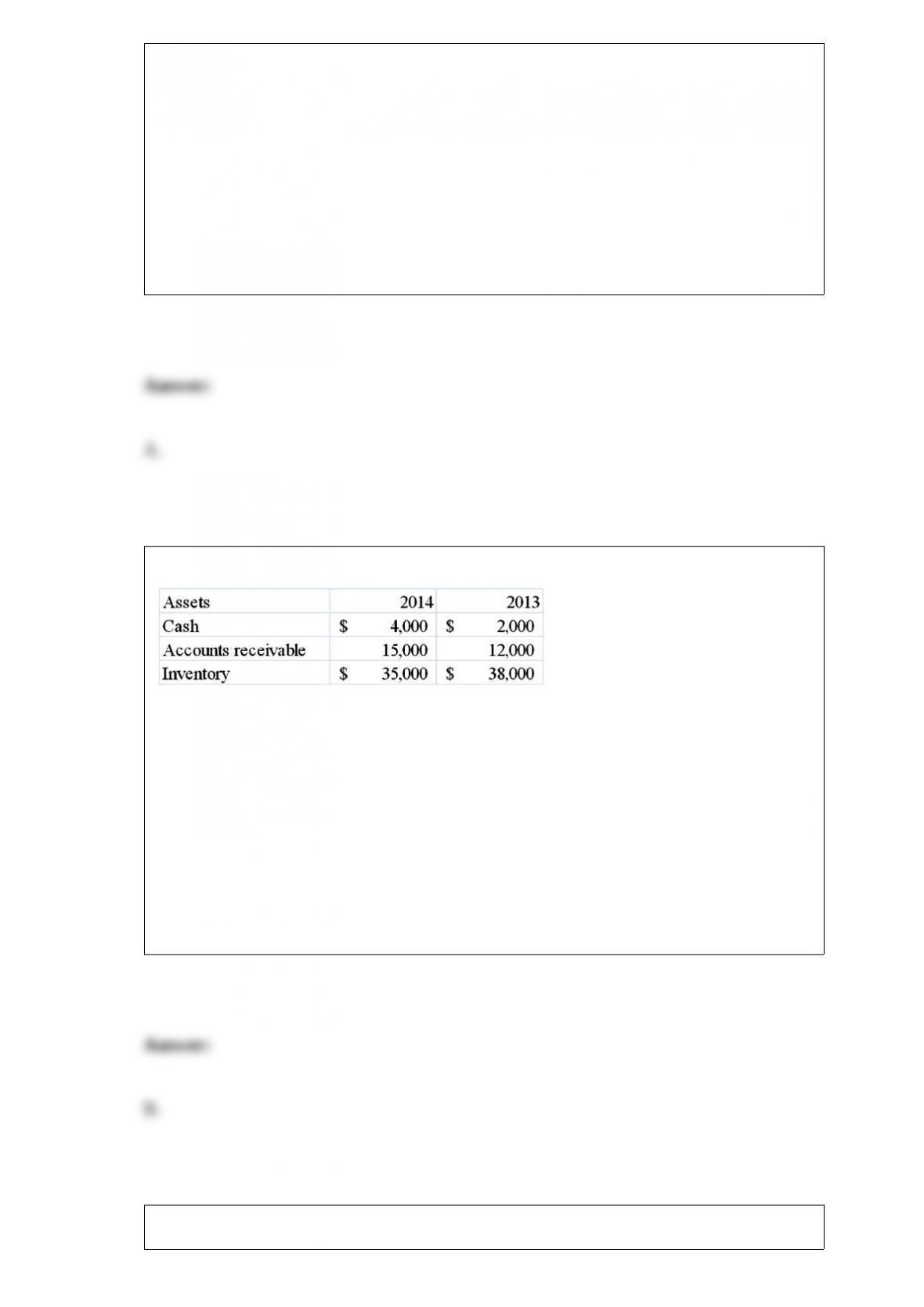
The following balance sheet information was provided by O’Connor Company:
Assuming that net credit sales for the year 2014 totaled $270,000, what is the
company’s most recent accounts receivable turnover?
A. 18 times
B. 20 times
C. 22.5 times
D. 7.7 times
Select the incorrect statement regarding postaudits of capital investment decisions.
A. A postaudit should be conducted at the end of the project.
B. The postaudit helps management determine whether a project that had been accepted
should have been rejected.
C. A postaudit is only necessary for a capital investment selected using a technique that
does not consider the time value of money.
D. The goal of a postaudit is to provide feedback that can be used to improve the
accuracy of future capital investment decisions.
When would a variance be labeled as unfavorable?
A. When standard costs are more than actual costs
B. When expected sales are less than actual sales
C. When actual sales are equal to expected sales
D. None of these answers is correct.
When using the indirect method to complete the cash flows from operating activities
section, what is the proper treatment for an increase in the inventory account?
A. Deduct the increase to cash payments to suppliers
B. Add the increase to net income
C. Add the increase to cash collections from customers
D. Deduct the increase from net income
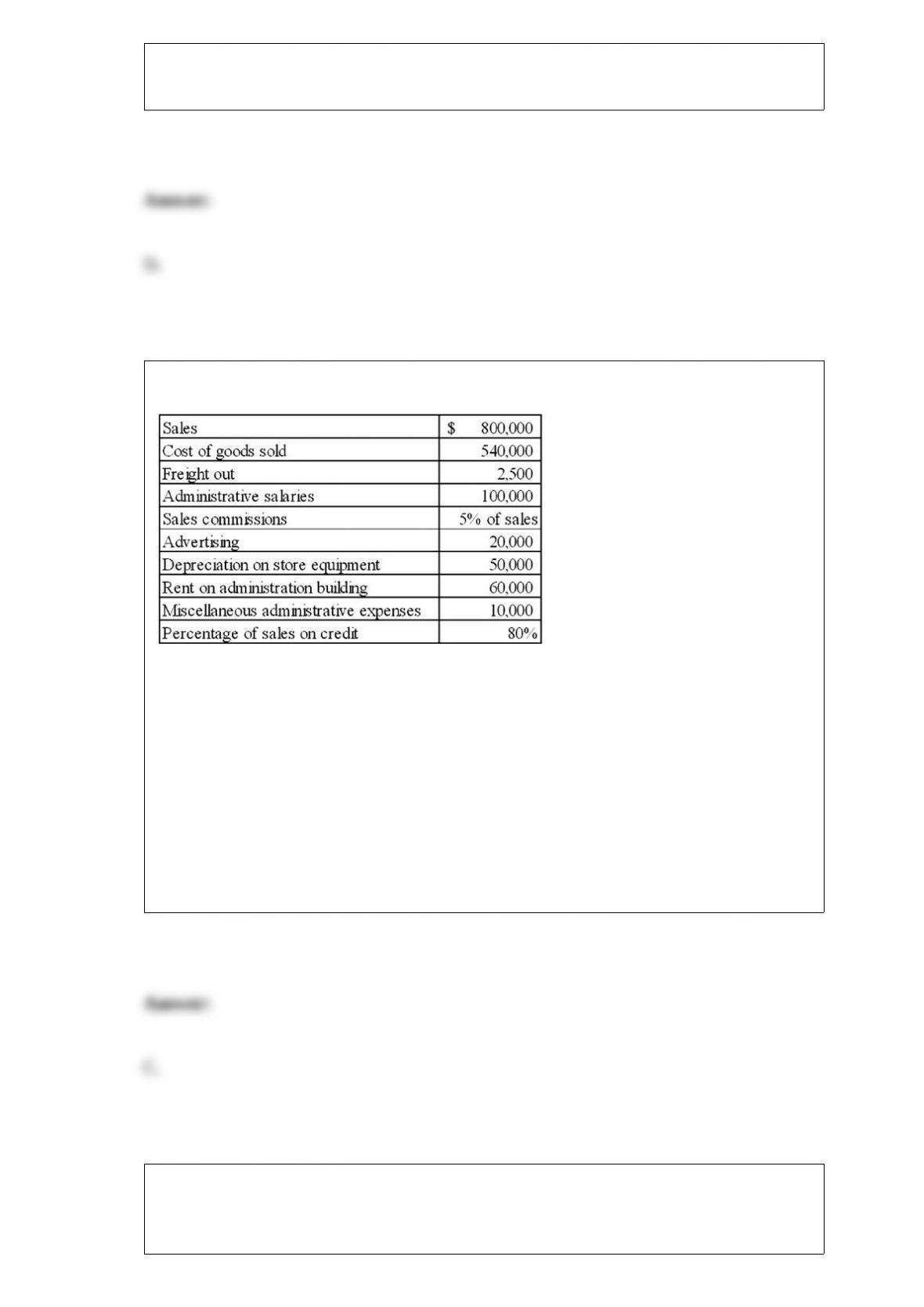
The following budget information is available for Crescent Company for January 2014:
All operating expenses are paid in cash in the month incurred. The amount of expected
cash outflow for selling and administrative expenses would be:
A. $262,500.
B. $247,50.
C. $232,500.
D. $312,500.
Rachel Robinson owns a small retail store in Cairo, Georgia. The following summary
information regarding expectations for the month of January is provided: As of
December 31 there is $1,000 in the bank and the balance in accounts receivable is
$5,000. Budgeted cash and credit sales for January are $6,000 and $4,000, respectively.
Ninety percent of credit sales are collected in the month of sale and the remainder is
collected in the following month. Rachel’s suppliers do not extend credit. Cash
payments for January are expected to be $24,000. Rachel has a line of credit that
enables the store to borrow funds on demand. However, funds must be borrowed on the
first day of the month and interest paid in cash on the last day of the month. Rachel’s
bank charges annual interest of 12% per year. Rachel desires a minimum $1,000 cash
balance at the end of each month.Required:
1) Compute the amount of funds that needs to be borrowed.
2) Compute the amount of interest expense that will appear on the January 31 pro forma
income statement.
When using the indirect method, a decrease in a current asset is:
A. subtracted from current liabilities in the cash flows from financing activities section.
B. subtracted from net income in the cash flows from operating activities section.
C. added to net income in the cash flows from operating activities section.
D. added in the cash flows from investing activities section.
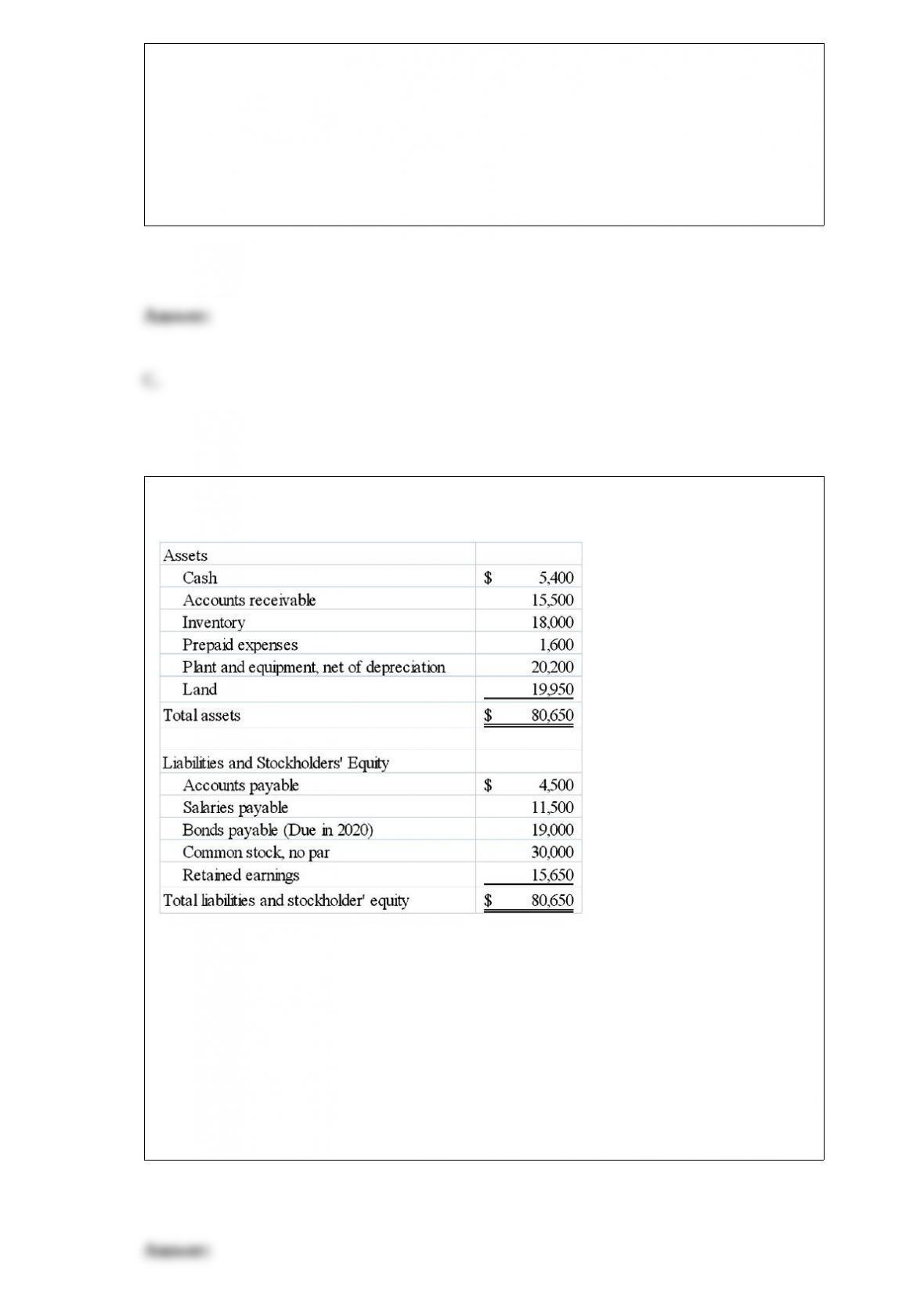
The following balance sheet information is provided for Greene Company for 2014:
What is the company’s quick (acid-test) ratio?
A. 0.7
B. 1.4
C. 1.3
D. 3.8
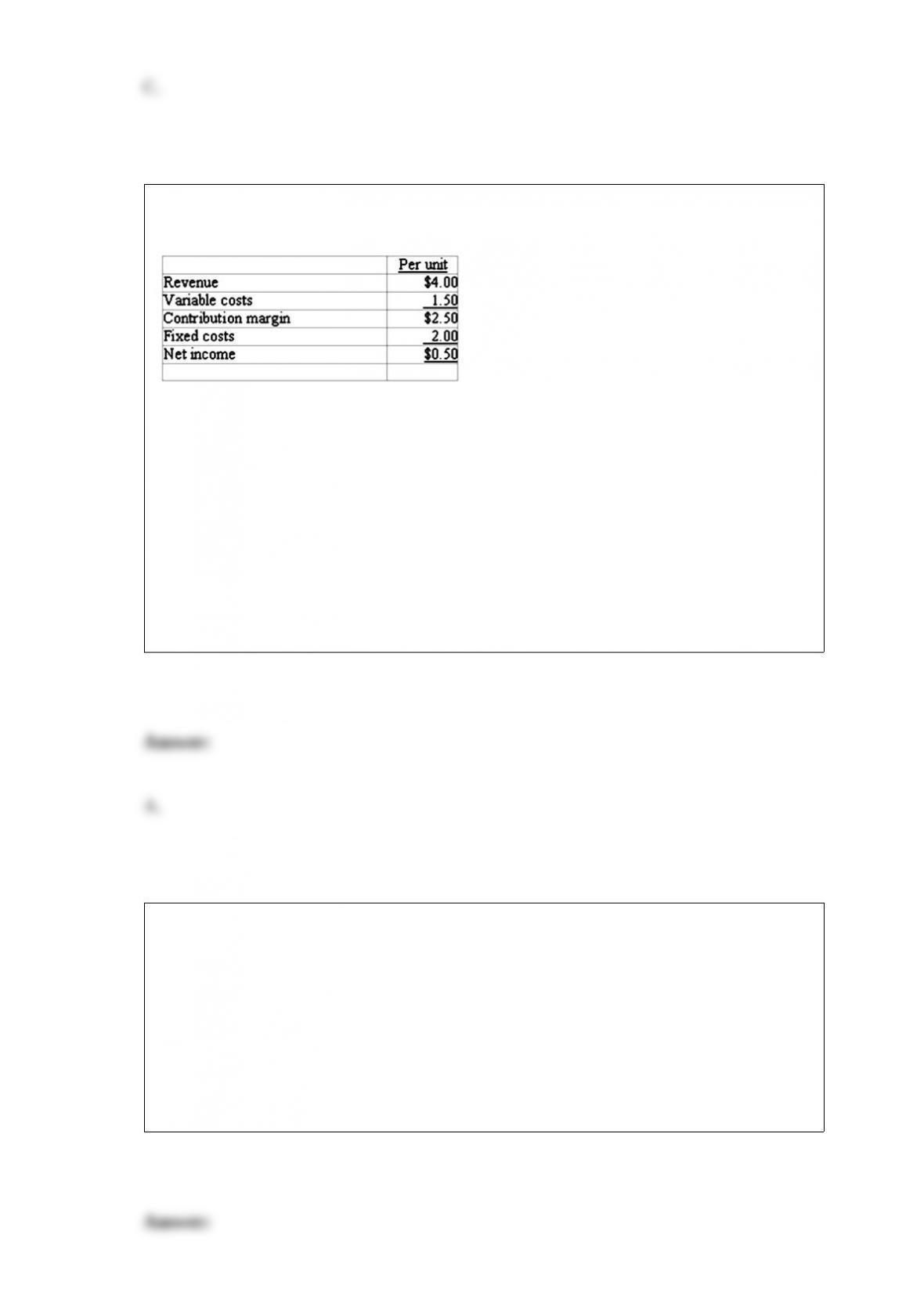
Burruss Company developed a static budget at the beginning of the company’s
accounting period based on an expected volume of 8,000 units:
If actual production totals 10,000 units which is within the relevant range, the flexible
budget would show fixed costs of:
A. $16,000.
B. $2 per unit.
C. $20,000.
D. None of these answers is correct.
Voluntary costs refer to:
A. prevention and appraisal costs.
B. prevention and internal failure costs.
C. appraisal and external failure costs.
D. internal failure costs and external failure costs.
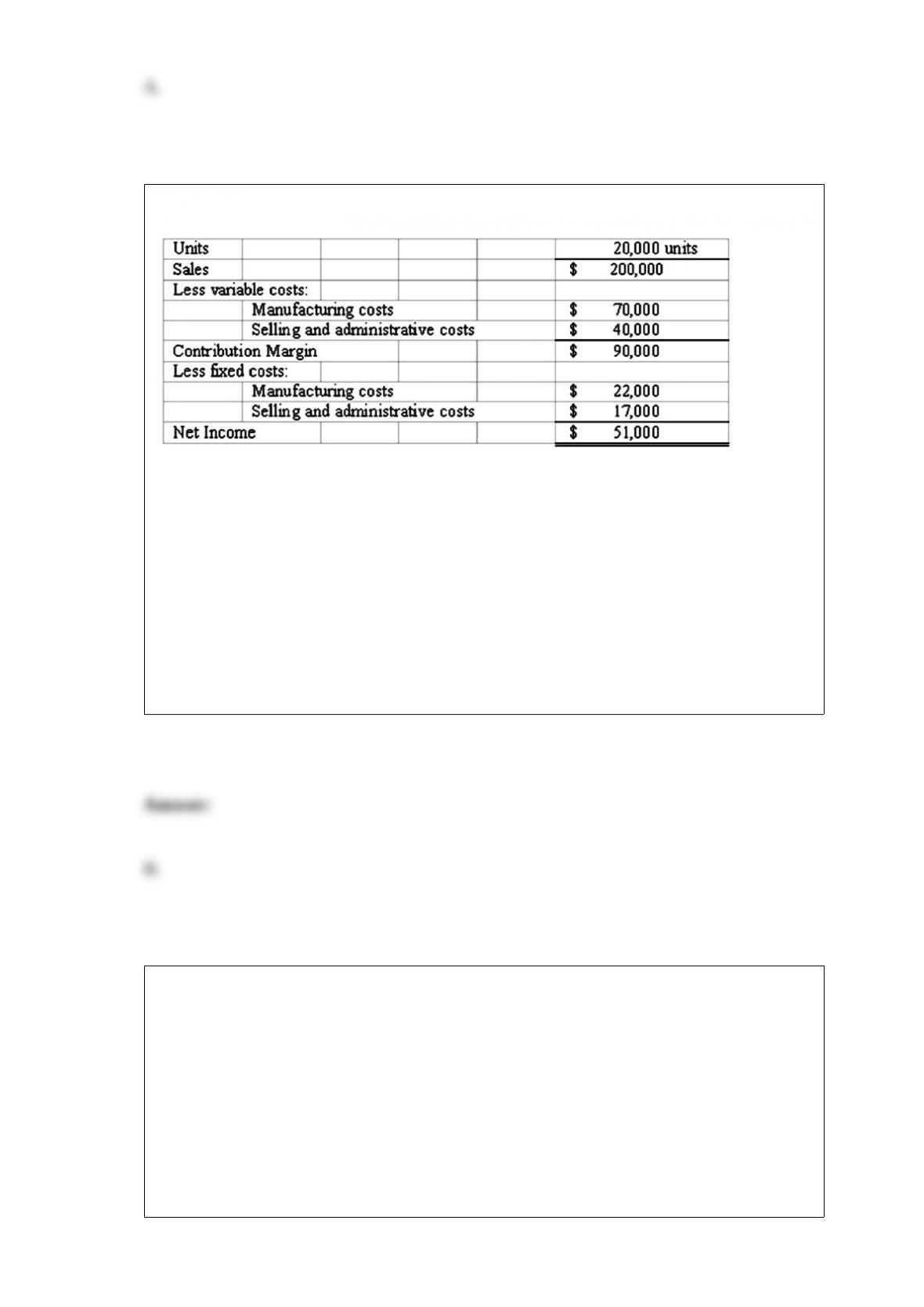
The following static budget is provided:
What will budgeted net income equal if 21,000 units are produced and sold? (Do not
round intermediate calculations.)
A. $53,550
B. $55,500
C. $94,500
D. $210,000
Company A has break-even sales of 90,000 units and budgeted sales of 99,000 units.
What is the margin of safety as expressed as a percentage?
A. 9.00%
B. 10.0%
C. 9.09%
D. None of these answers is correct.
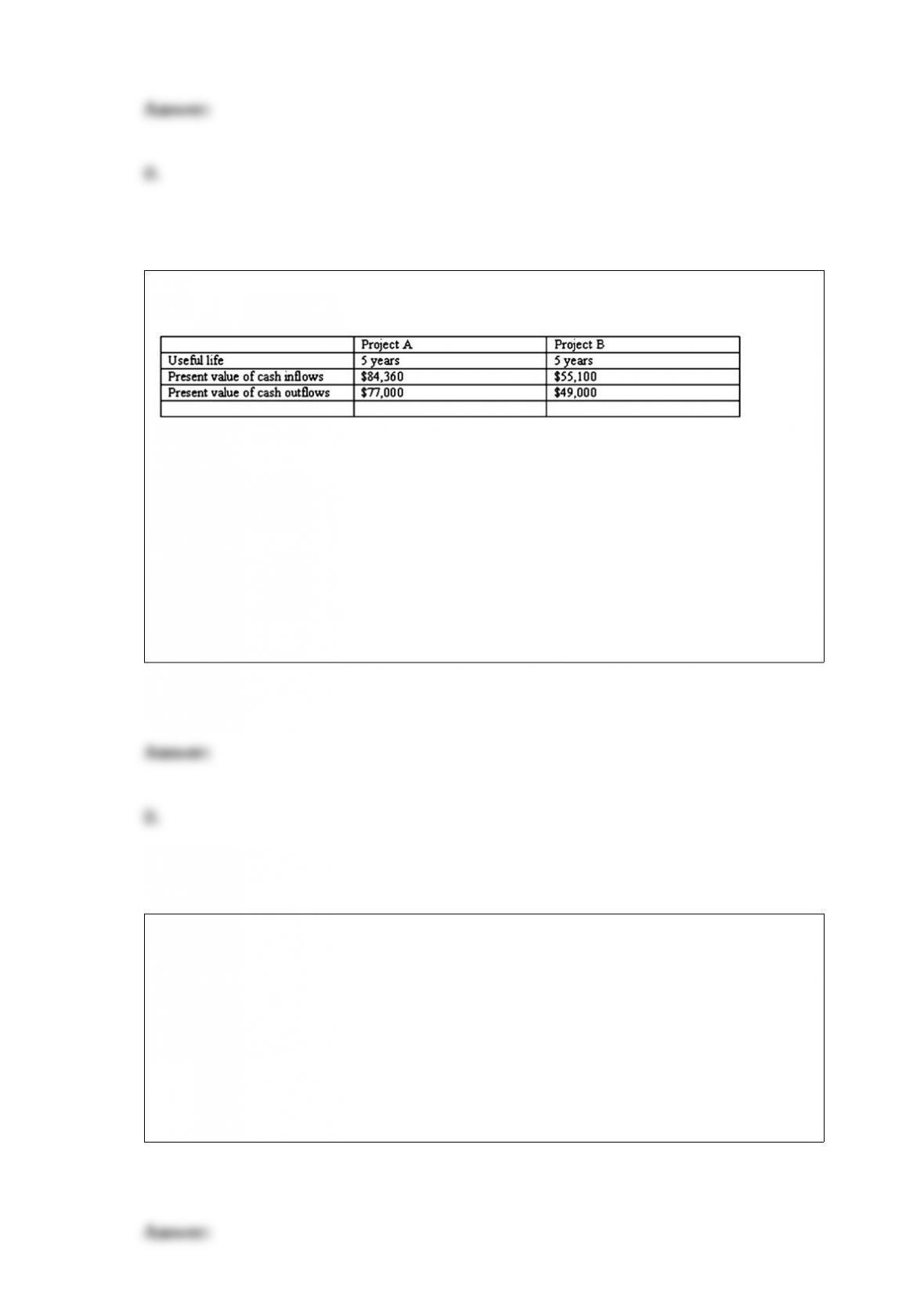
Findell Corporation is considering two projects, A and B, and it has gathered the
following estimates for the projects:
What is the net present value for project B?
A. $7,360
B. $6,100
C. $1,260
D. None of these answers is correct.
Solvency ratios are used to assess a company’s:
A. Long-term debt paying ability.
B. Profitability.
C. Short-term debt paying ability.
D. Efficiency in use of its assets.
Lexington Company’s predetermined overhead rate is $4.00 per direct labor hour.
Which of the following equations correctly computes the amount of overhead cost that
should be applied to work in process assuming a job required 100 hours but was
estimated to require 90 hours?
A. 100 hours × $4 = $400
B. 90 hours × $4 = $360
C. 1 job × $4 = $4
D. None of these.
Blair Company transferred the cost of units completed during the month to Finished
Goods. The total cost was $1,100. How does this event affect the financial statements?
A.
B.
C.
D.
Indicate whether each of the following statements is true or false.
A work ticket is used to keep track of an employee’s time for a given time period, as
well as the amount of time spent on individual jobs.
When a job is finished, the job cost sheet shows all the costs associated with the job.
Use of a predetermined overhead rate is needed for a company using a process cost
system but not for a company using a job-order cost system.
A company using a job-order cost system generally would maintain three inventory
accounts – raw materials inventory, work in process inventory, and manufacturing
overhead.
Applying overhead to products is an asset exchange transaction.
Discuss why qualitative characteristics must be considered when making decisions such
as special orders, outsourcing, elimination and replacement decisions and scarce
resource allocation decisions. Give examples.
Time Unlimited makes grandfather clock kits that it sells to hobbyists who then
assemble and finish the clocks. The company has the capacity to make 5,000 of the kits,
and its current volume is 3,000 kits. The costs of a clock kit are: $300 for unit-level
materials, $200 for unit-level labor, and $150 for an allocation of facility-level
overhead. The normal selling price is $950. The Clock Builder has received a special
order for 600 clock kits at a price of $600 each.Required:Should The Clock Builder
accept the special order? Support your answer with appropriate computations.
How is operating leverage related to cost structure?
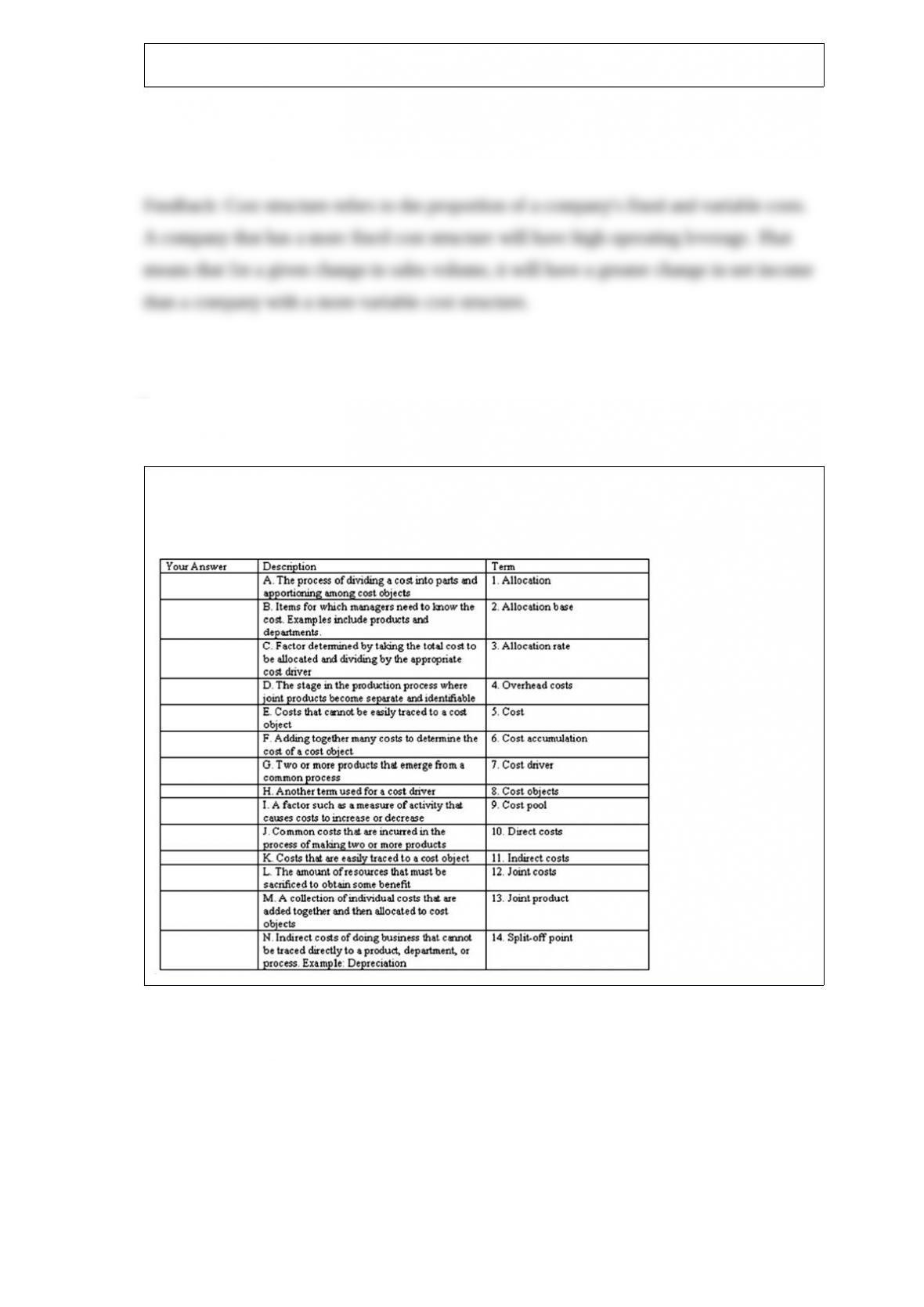
Select the term from the list provided that best describes each of the following
descriptions.