Which of the following is a true statement about inventory systems?
a. Periodic inventory systems require more detailed inventory records.
b. Perpetual inventory systems require more detailed inventory records.
c. A periodic system requires cost of goods sold be determined after each sale.
d. A perpetual system determines cost of goods sold only at the end of the accounting
period.
Answer:
When an interest-bearing note matures, the balance in the Notes Payable account is
a. less than the total amount repaid by the borrower.
b. the difference between the maturity value of the note and the face value of the note.
c. equal to the total amount repaid by the borrower.
d. greater than the total amount repaid by the borrower.
Answer:
A plant asset was purchased on January 1 for $60,000 with an estimated salvage value
of $12,000 at the end of its useful life. The current year’s Depreciation Expense is
$6,000 calculated on the straight-line basis and the balance of the Accumulated
Depreciation account at the end of the year is $30,000. The remaining useful life of the
plant asset is
a. 10 years.
b. 8 years.
c. 5 years.
d. 3 years.
Answer:
A Sales Returns and Allowances account is not debited if a customer
a. returns defective merchandise.
b. receives a credit for merchandise of inferior quality.
c. utilizes a prompt payment incentive.
d. returns goods that are not in accordance with specifications.
Answer:
The IFRS standard dealing specifically with revenue recognition is based on
a. whether the revenue is realized or realizable.
b. whether the revenue is earned.
c. whether the revenue is realized or realizable, and earned.
d. the probability that economic benefits will flow to the company, and reliability of
measurement.
Answer:
Which of the following statements concerning current liabilities is incorrect?
a. Current liabilities include unearned revenues.
b. A company that has more current liabilities than current assets is usually the subject
of some concern.

c. Current liabilities include prepaid expenses.
d. A current liability is a debt that can reasonably be expected to be paid out of existing
current assets or result in the creation of other current liabilities.
Answer:
Losses on an exchange of plant assets that has commercial substance are
a. not possible.
b. deferred.
c. recognized immediately.
d. deducted from the cost of the new asset acquired.
Answer:
Gross profit is calculated by subtracting
a. total expenses from total revenues.
b. cost of goods sold from net sales.
c. cost of goods sold from total revenues.
d. operating expenses from net sales.
Answer:
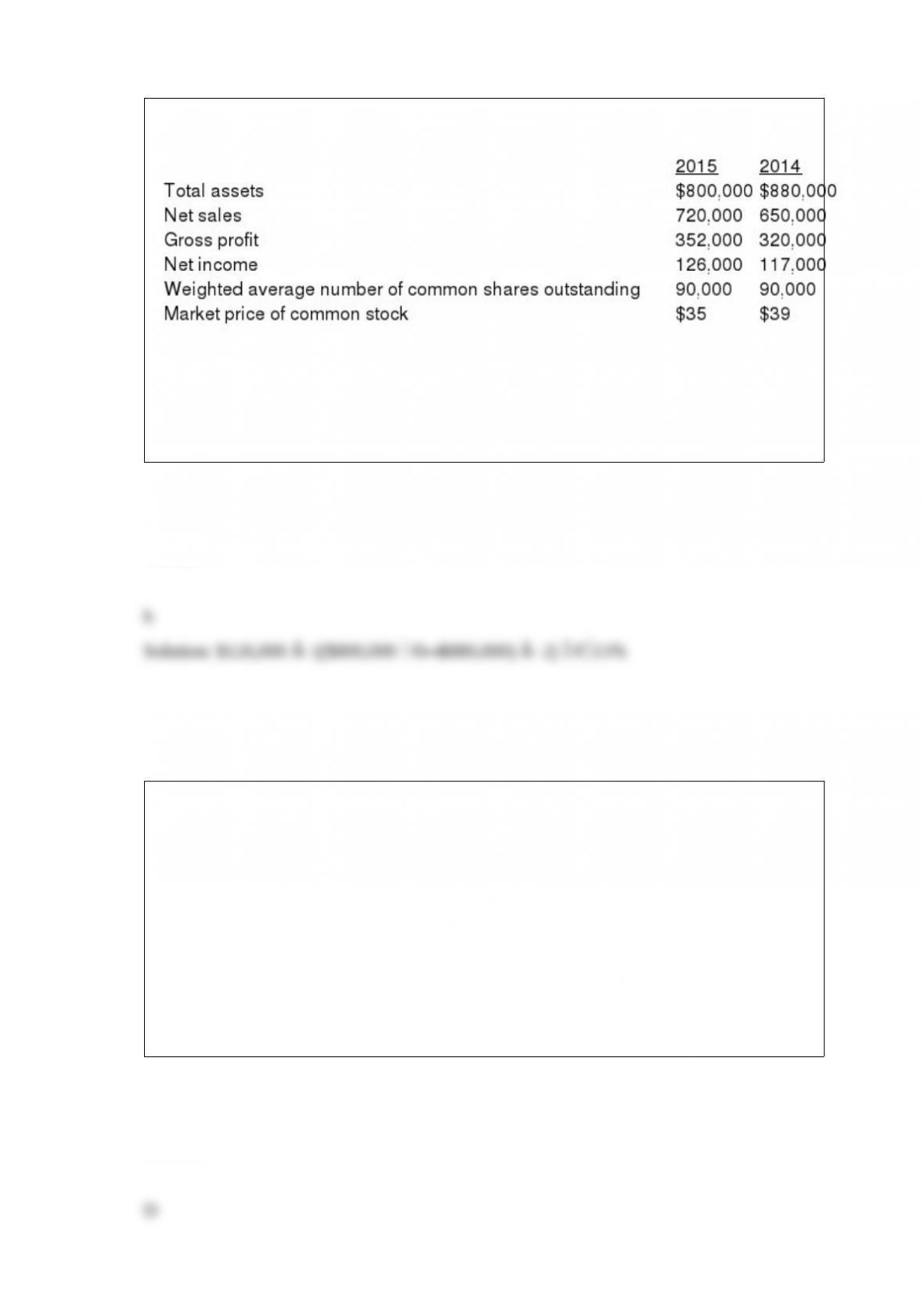
The following amounts were taken from the financial statements of Leaf Company:
The return on assets ratio for 2015 is
a. 15.8%.
b. 15%.
c. 14.3%.
d. 14.5%.
Answer:
If a petty cash fund is established in the amount of $250, and contains $153 in cash and
$94 in receipts for disbursements when it is replenished, the journal entry to record
replenishment should include credits to the following accounts
a. Petty Cash, $94.
b. Petty Cash, $97.
c. Cash, $94; Cash Over and Short, $3.
d. Cash, $97.
Answer:
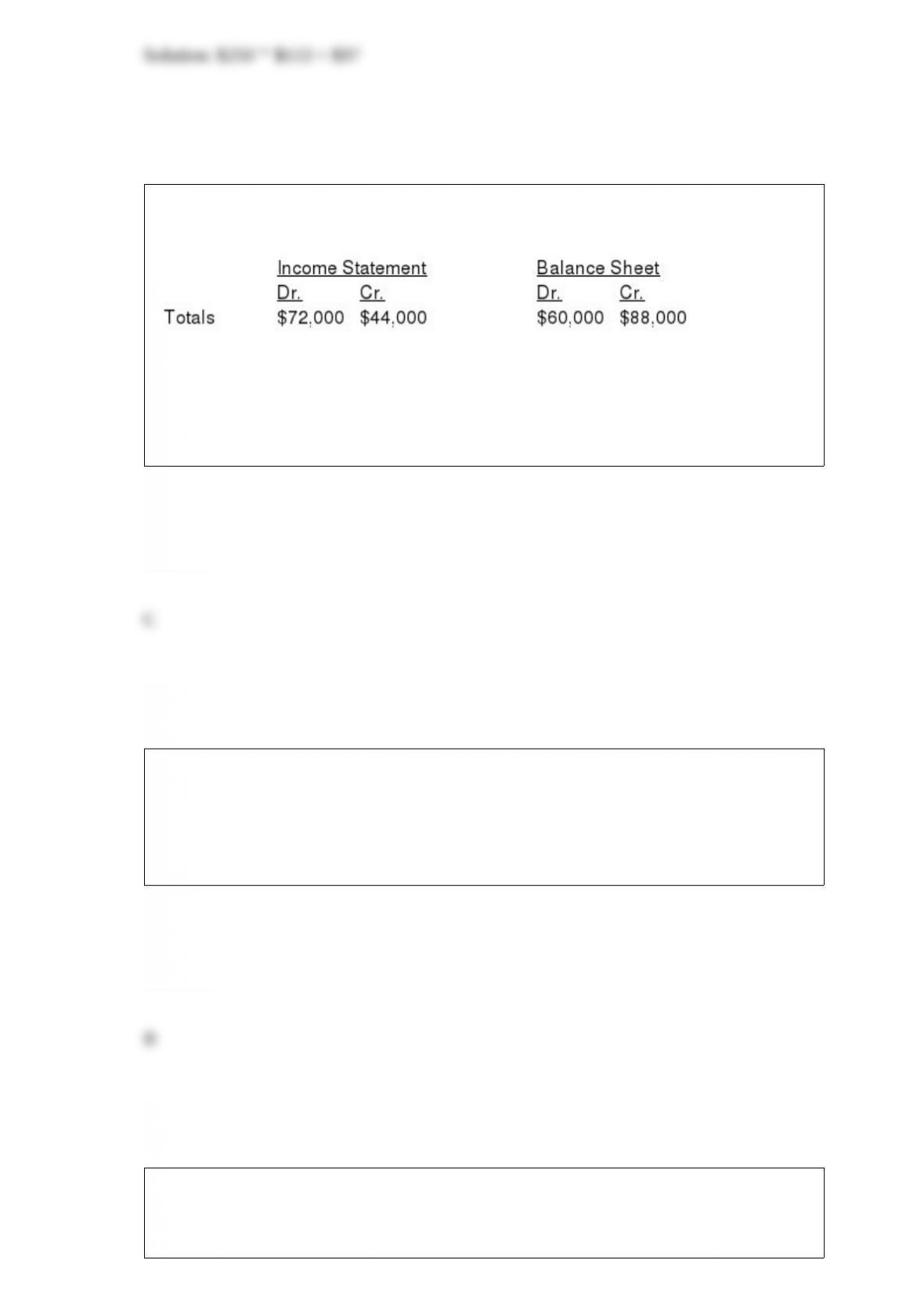
The income statement and balance sheet columns of Iron and Wine Company’s
worksheet reflect the following totals:
The net income (or loss) for the period is
a. $44,000 income.
b. $28,000 income.
c. $28,000 loss.
d. not determinable.
Answer:
The final closing entry to be journalized is typically the entry that closes the
a. revenue accounts.
b. dividends account.
c. retained earnings account.
d. expense accounts.
Answer:
Each of the following is an extraordinary item except the
a. effects of major casualties, if rare in the area.
b. effects of a newly enacted law or regulation.

c. expropriation of property by a foreign government.
d. losses attributable to labor strikes.
Answer:
A company may purchase a noncontrolling interest in another firm in a related industry
a. to house excess cash until needed.
b. to generate earnings.
c. for strategic reasons.
d. for speculative reasons.
Answer:
If unearned revenues are initially recorded in revenue accounts and not all the related
services been performed at the end of the accounting period, the failure to make an
adjusting entry will cause
a. liabilities to be overstated.
b. revenues to be understated.
c. revenues to be overstated.
d. accounts receivable to be overstated.
Answer:
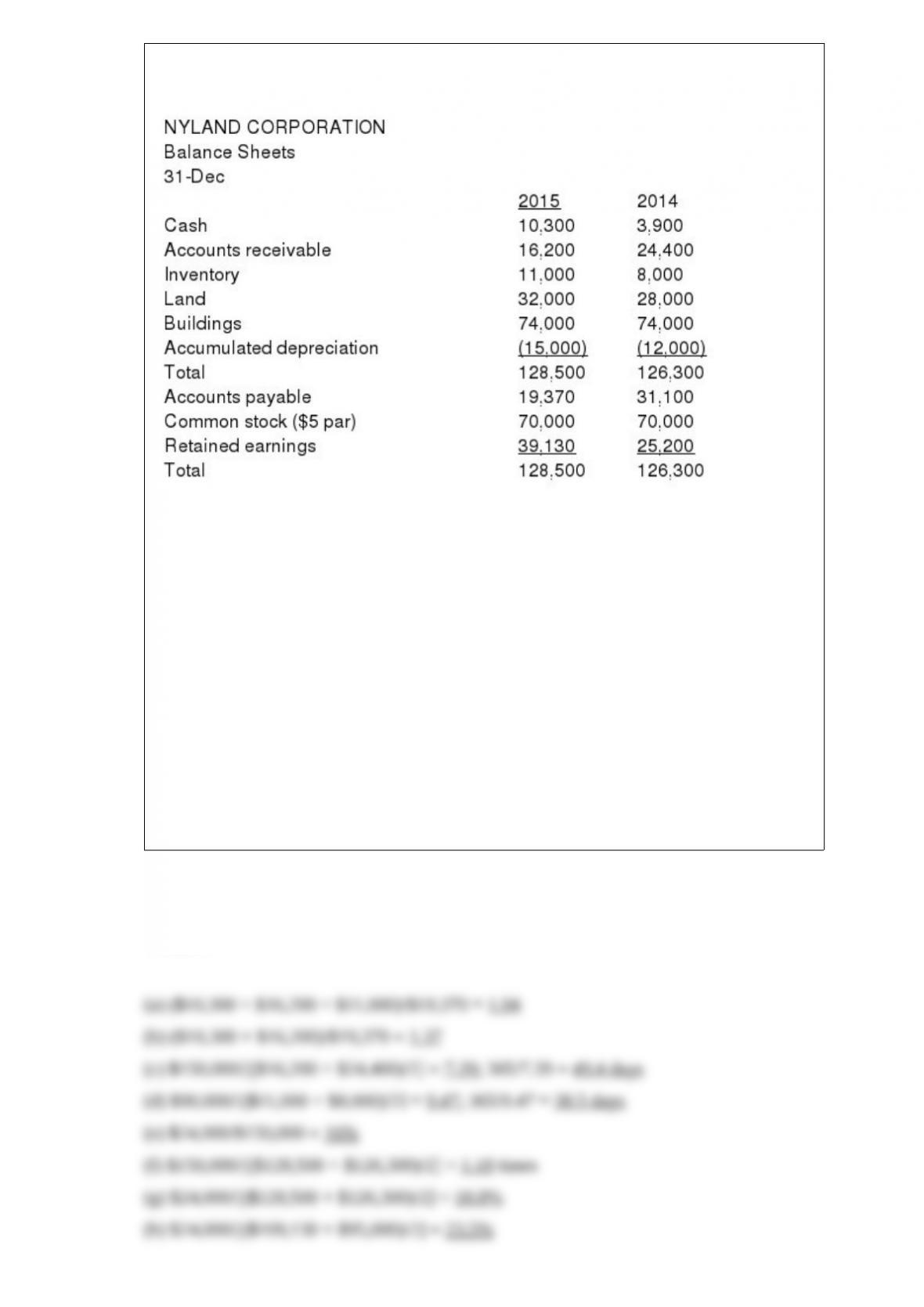
Nyland Corporation’s comparative balance sheets are presented below.
Mulder’s 2015 income statement included net sales of $150,000, cost of good sold of
$90,000, and net income of $24,000. Dividends of $10,070 were paid.
Instructions
Compute the following ratios for 2015.
(a) Current ratio.
(b) Acid-test ratio
(c) Accounts Receivable turnover and average collection period.
(d) Inventory turnover and days in inventory.
(e) Profit margin.
(f) Assets turnover.
(g) Return on assets.
(h) Return on common stockholders’ equity.
(i) Earnings per share.
(j) Payout ratio.
(k) Debt to assets.
Answer:

Which of the following changes in retained earnings during a period will be reported in
the financing activities section of the statement of cash flows?
1> Declaration and payment of a cash dividend during the period.
2> Net income for the period.
a. 1
b. 2
c. Neither 1 nor 2
d. Both 1 and 2
Answer:
The average time that is required to go from “cash to cash” in producing revenues is
referred to as the
a. business cycle.
b. operating cycle.
c. fiscal year cycle.
d. accounting cycle.
Answer:
Malone Co. recorded a payment of cash on account to a creditor by debiting Accounts
Receivable and crediting Cash. The correcting entry is
a. debit Accounts Payable and credit Cash.
b. debit Cash and credit Accounts Receivable.
c. debit Accounts Payable and credit Accounts Receivable.
d. Some other correcting entry is necessary.
Answer:
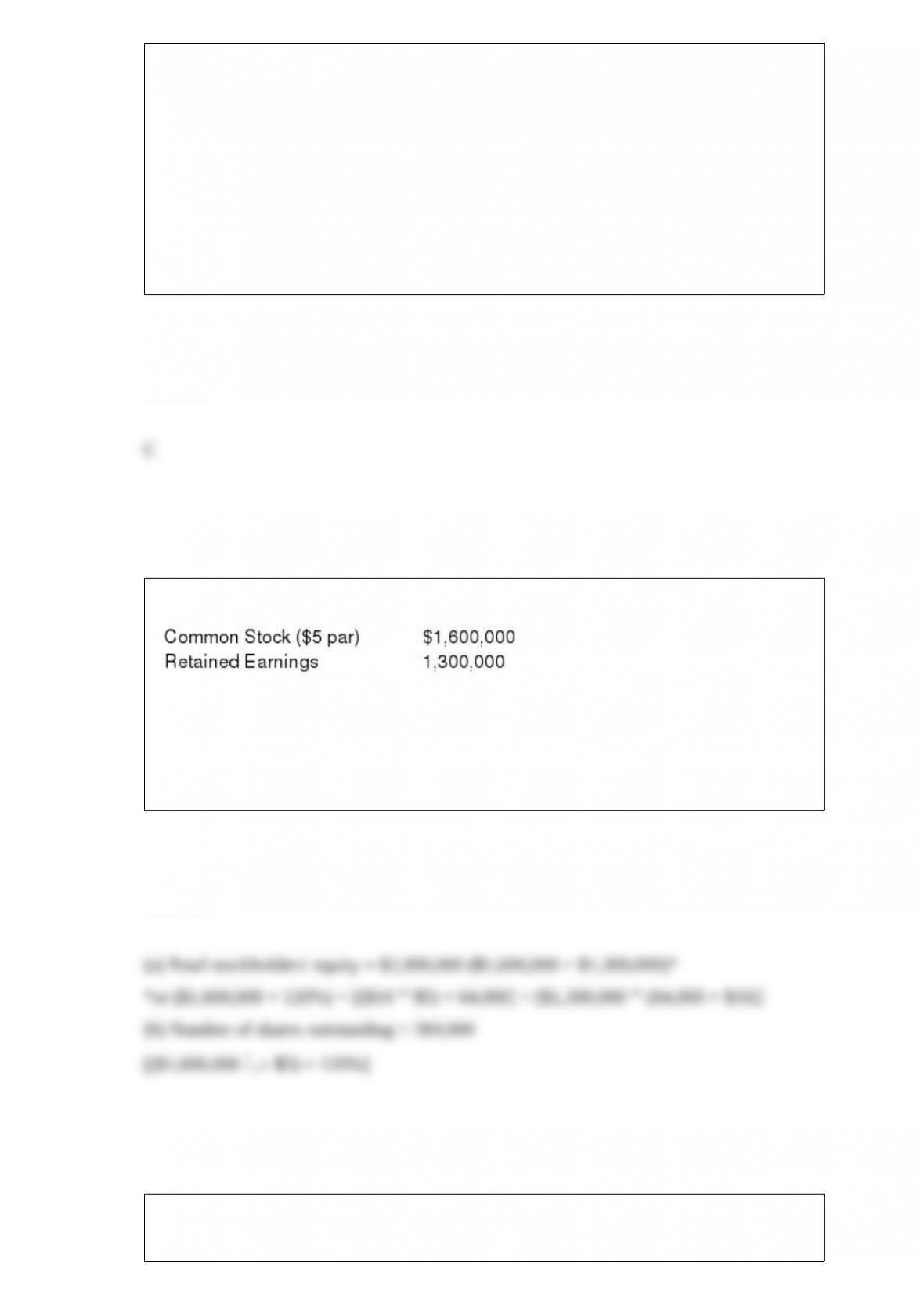
The following information is available for Pencil Corporation:
A 20% stock dividend is declared and paid when the market value was $16 per share.
Instructions
Compute each of the following after the stock dividend.
(a) Total stockholders’ equity.
(b) Number of shares outstanding.
Answer:
In the month of November, Kinsey Company Inc. wrote checks in the amount of
$18,500. In December, checks in the amount of $25,316 were written. In November,

$16,936 of these checks were presented to the bank for payment, and $21,766 were
presented in December. What is the amount of outstanding checks at the end of
November?
a. $1,564
b. $4,830
c. $5,114
d. $6,816
Answer:
A law firm received $3,000 cash for legal services to be rendered in the future. The full
amount was credited to the liability account Unearned Service Revenue. If the legal
services have been rendered at the end of the accounting period and no adjusting entry
is made, this would cause
a. expenses to be overstated.
b. net income to be overstated.
c. liabilities to be understated.
d. revenues to be understated.
Answer:
A loss on disposal of a plant asset as a result of a sale or a retirement is calculated in the
same way.
Answer:
The steps in the accounting cycle are different for a merchandising company than for a
service company.
Answer:
On July 6, Clayton Corporation issued 3,000 shares of its $50 par common stock. The
market price of the stock on that date was $18 per share. Journalize the issuance of the
stock.
Answer:
Long-term investments would appear in the property, plant, and equipment section of
the balance sheet.
Answer:
Banks that issue credit cards generally charge retailers a fee of 2 to 4% of the amount of
sale. List reasons why companies are willing to pay these fees.
Answer:
The account balances appearing in the adjusted trial balance columns are extended to
the ______________ columns and the ______________ columns.
Answer:
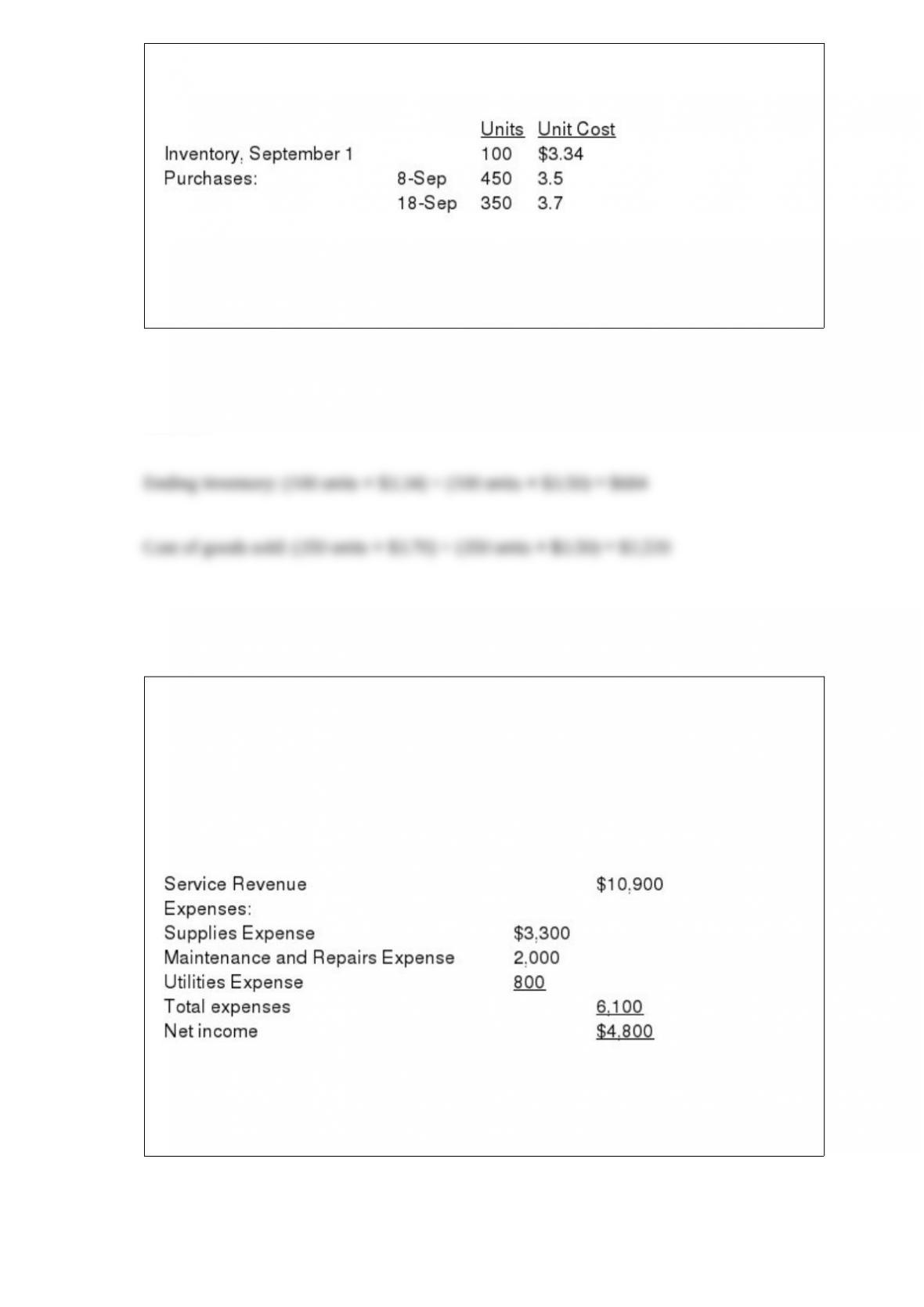
Shellhammer Company’s inventory records show the following data for the month of
September:
A physical inventory on September 30 shows 200 units on hand. Calculate the value of
ending inventory and cost of goods sold if the company uses LIFO inventory costing
and a periodic inventory system.
Answer:
Remington Company had the following income statement at December 31, 2015:
Remington Company
Income Statement
For the Year Ended Dec. 31, 2015
No dividends were paid during the year.
Prepare the closing entries at December 31, 2015.
Answer: