Stockholders’ equity is:
A. the amount the company received for all stock when issued plus the amount of
retained earnings minus treasury stock.
B. the amount the company received for all stock authorized plus the amount of
retained earnings and treasury stock.
C. the par value the company received for all stock issued plus the amount of retained
earnings minus treasury stock.
D. the amount the company received for all stock when issued minus the amount of
retained earnings and treasury stock.
Answer:
A company originally issues 180,000 shares of stock at a price of $22; one year later the
stock price is $40 per share, the number of outstanding shares is unchanged, and the
company’s net income for the year is $230,400. The P/E ratio at the end of the recent
year is:
A. 0.0002.
B. 24.22.
C. 31.25.
D. 0.0001.
Answer:

Choose the appropriate letter to match the term and the definition. Not all definitions
will be used.
Term
_______ 1/ Time-series analysis
_______ 2/ Common-size financial statements
_______ 3/ Management discussion and analysis
_______ 4/ P/E ratio
_______ 5/ Earnings per share
_______ 6/ Comprehensive income
_______ 7/ Discontinued operations
_______ 8/ Net income
Definition
A) The practice of reporting accounting data in the national monetary unit.
B) A nonrecurring item associated with abandoning or selling an operation.
C) The earnings of a company after taxes.
D) An increase in an asset or a decrease in a liability that results from peripheral
activities.
E) After-tax earnings adjusted for gains and losses that may disappear before they are
realized.
F) A section of the annual report that can be used in interpreting the results of financial

statement analysis.
G) The ratio calculated by dividing the net income by the number of common shares
outstanding.
H) The ratio calculated by dividing the price of a share of stock by the earnings per
share.
I) Also known as ratio analysis.
J) A nonrecurring item on the income statement that reflects gains and losses associated
with extraordinary events.
K) Another name for a trend analysis.
L) The practice of reporting information in percentages rather than monetary amounts.
Answer:
E. Flynn Company purchased a building for $400,000. The current book value of the
building is $200,000 and the fair value is $180,000. The sum of future cash flows from
the building is $160,000. According to GAAP, the amount of impairment loss that
should be recognized is
A. $0.
B. $20,000.
C. $40,000.
D. $120,000.
Answer:

A company started the current year with assets of $700,000, liabilities of $350,000 and
contributed capital of $200,000. During the current year, assets increased by $400,000,
liabilities decreased by $50,000 and contributed capital increased by $275,000. There
was no payment of dividends to owners during the year.
Based on this information, what was the amount of retained earnings at the beginning of
the year?
A. $150,000
B. $850,000
C. $550,000
D. $350,000
Answer:
Company A lends $100,000 to Company B. The interest on the loan is reported:
A. as an expense to Company A and a revenue to Company B.
B. as an asset to Company A and a revenue to Company B.
C. as a liability to Company A and an asset to Company B.
D. as a revenue to Company A and an expense to Company B.
Answer:
The Expense Recognition (Matching) principle indicates
A. where expenses should be presented on the income statement.
B. how expenses should be split between the income statement and the balance sheet
C. the ordering of current assets and current liabilities on the balance sheet.
D. when costs are recognized as expenses on the income statement.
Answer:
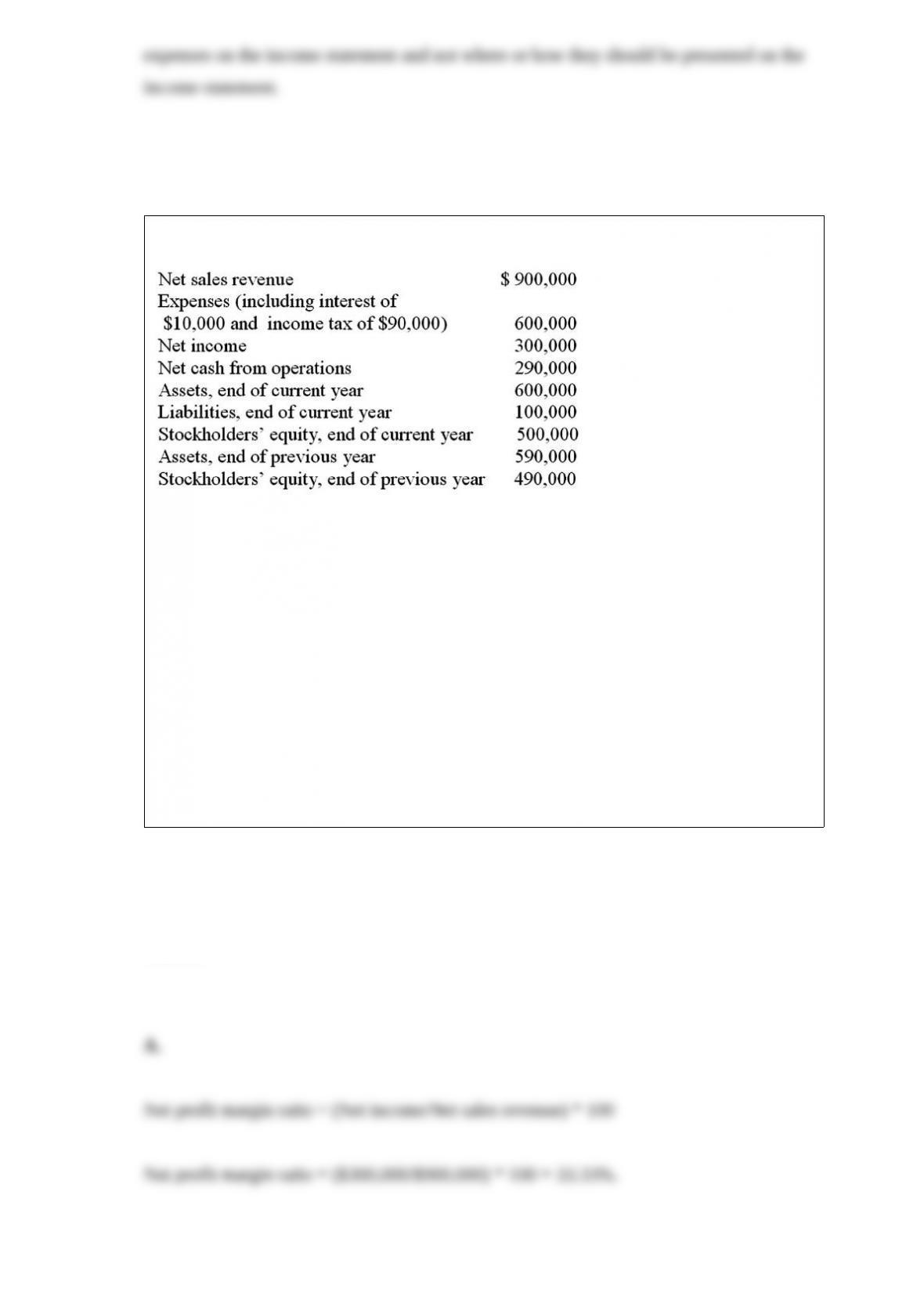
The following information is taken from the financial statements of B. Darin Company:
In addition, there was an average of 40,000 shares of common stock outstanding and
the current market price of the stock is $15 per share.
Use the information above to answer the following question. Which of the following is
closest to the company’s net profit margin for the current year?
A. 33.33%
B. 44.45%
C. 32.22%
D. 43.33%
Answer:

A trend analysis to determine a year-to-year dollar amount change is calculated by:
A. subtracting the previous period amount from the current amount.
B. subtracting the current period amount from the previous period amount.
C. subtracting the current period amount from the previous period amount and then
dividing the result by the previous period amount.
D. subtracting the previous period amount from the current period amount and then
dividing the result by the current period amount.
Answer:
A company reported a receivables turnover ratio of 8.0. Cost of goods sold was
$350,000 and net sales were $480,000. The average accounts receivable must have been
A. $45,000
B. $120,000
C. $60,000
D. $90,000
Answer:
Goodwill
A. is not amortized, but is tested annually for impairment.
B. is amortized using the straight-line method.
C. is amortized using the units-of-production method.
D. is not amortized and is not tested for impairment.
Answer:
The income statements for 2014 and 2013 for Purrfect Pets, Inc. are presented below:
Purrfect Pets, Inc.
Income Statements
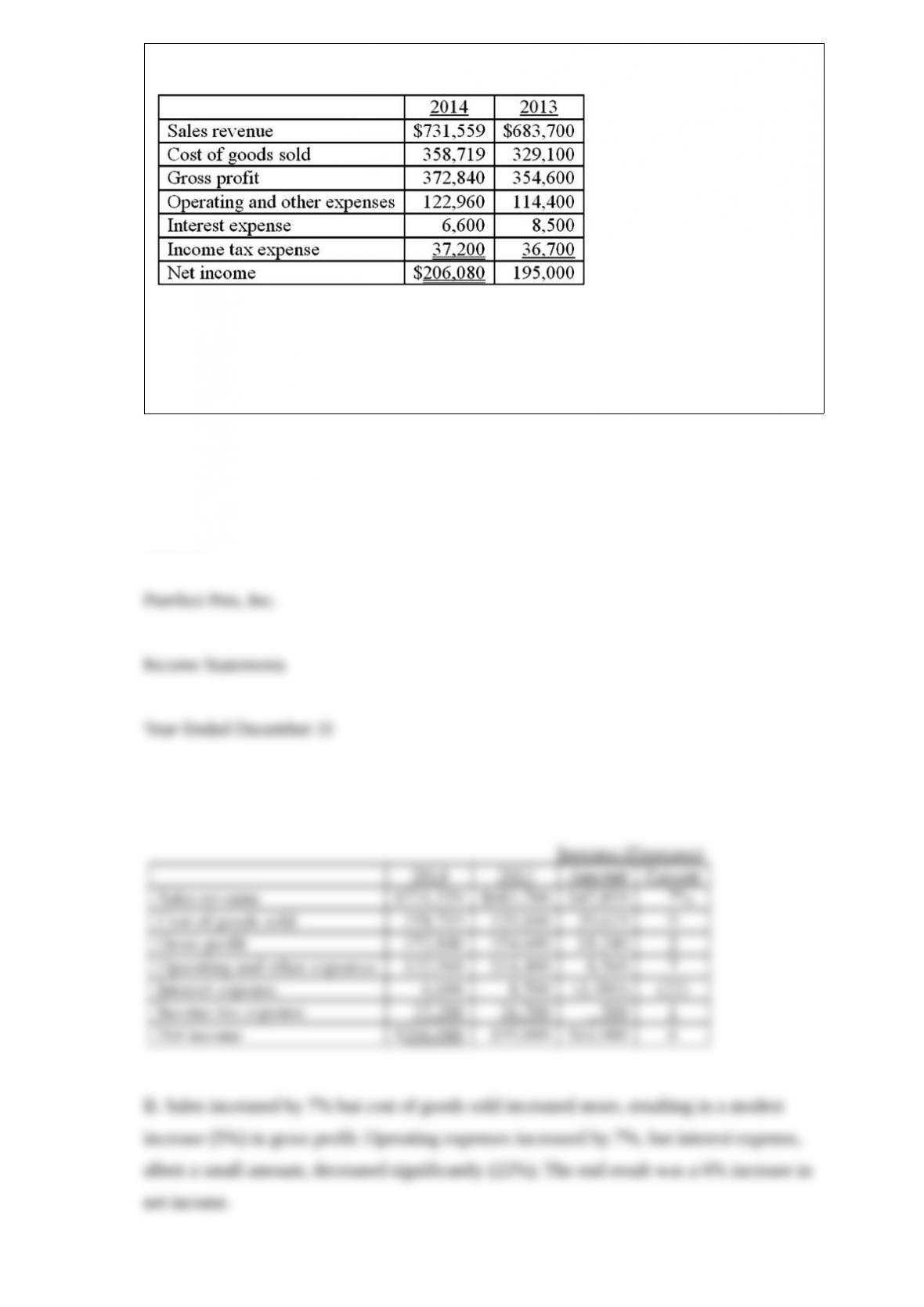
Year Ended December 31
A. Prepare a horizontal analysis of the income statement above. Round to the nearest
whole percent.
B. Interpret your analysis. Comment on significant changes.
Answer:
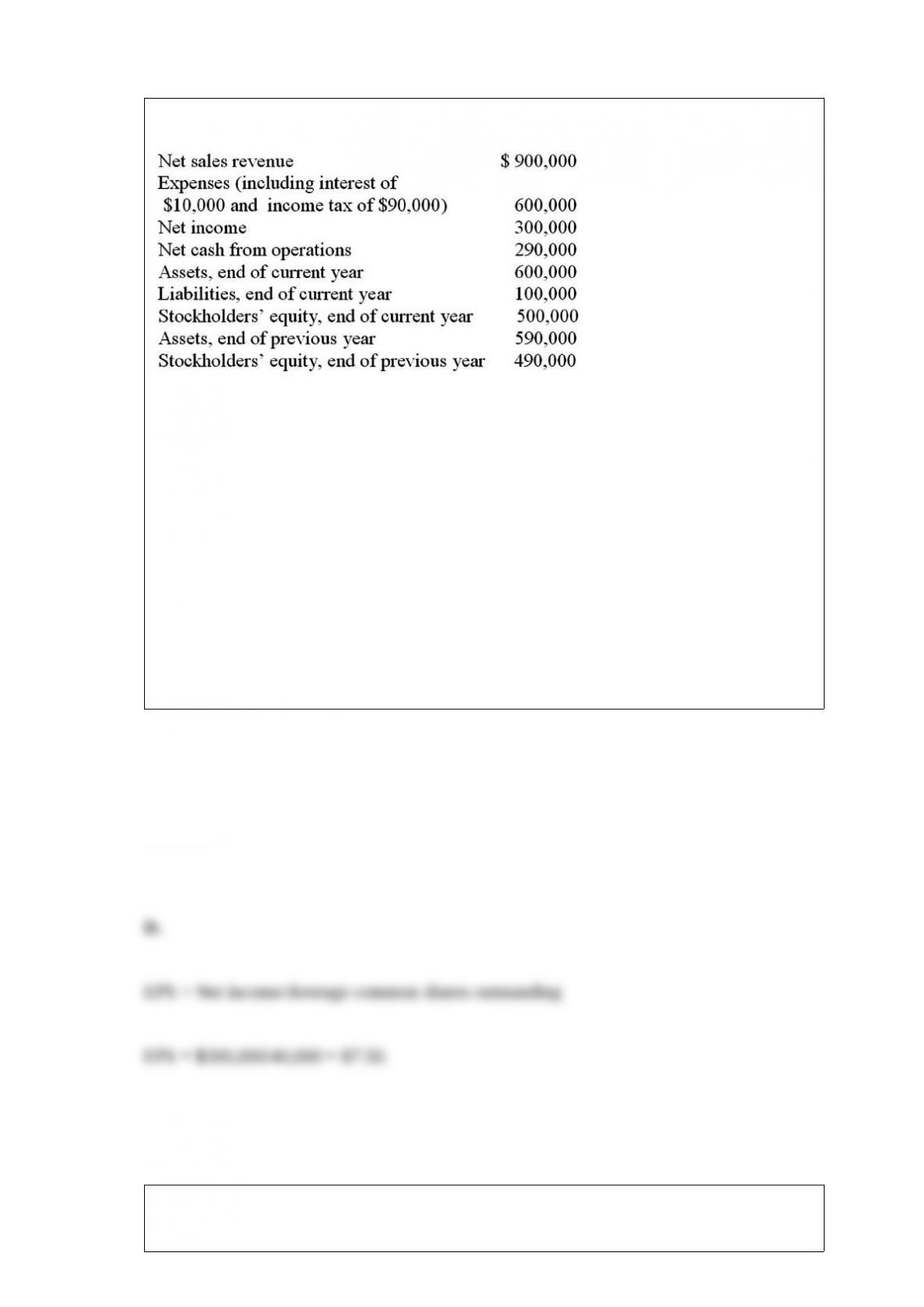
The following information is taken from the financial statements of B. Darin Company:
In addition, there was an average of 40,000 shares of common stock outstanding and
the current market price of the stock is $15 per share.
Use the information above to answer the following question. Which of the following is
closest to the company’s earnings per share for the current year?
A. $10.00
B. $20.00
C. $7.25
D. $7.50
Answer:
Coca-Cola reported net sales revenues of $19.8 billion and cost of goods sold of $6.0
billion. Its gross profit percentage was:

A. 30.3%.
B. 69.7%.
C. 3.3%.
D. 2.3 %.
Answer:
Which of the following items on a bank reconciliation would require an adjusting
journal entry on the company’s books?
A. An error by the bank.
B. Outstanding checks.
C. A bank service charge.
D. A deposit in transit.
Answer:

What would happen to asset turnover if additional assets were acquired at the end of
2015 for $2,000 on account?
A. Asset turnover would decrease.
B. Asset turnover would increase.
C. Asset turnover may increase or decrease depending on whether the company had net
income or a net loss.
D. Asset turnover would not change.
Answer:
Jackson and O’Neill open a partnership that produces gates. Jackson provides $30,000
of capital while O’Neill contributes $90,000 of capital; they agree to split net income by
the same proportion. The partnership’s net income is $80,000 for the first year. They did
not draw any income out of the business or add any additional capital during the first
year. At the end of the year, the partners’ equity is:
A. $70,000 for Jackson and $130,000 for O’Neill for a total of $200,000.
B. $200,000 minus income tax expense for the partnership.
C. $200,000 minus the income tax paid by each partner.
D. $50,000 for Jackson and $150,000 for O’Neill for a total of $200,000.
Answer:
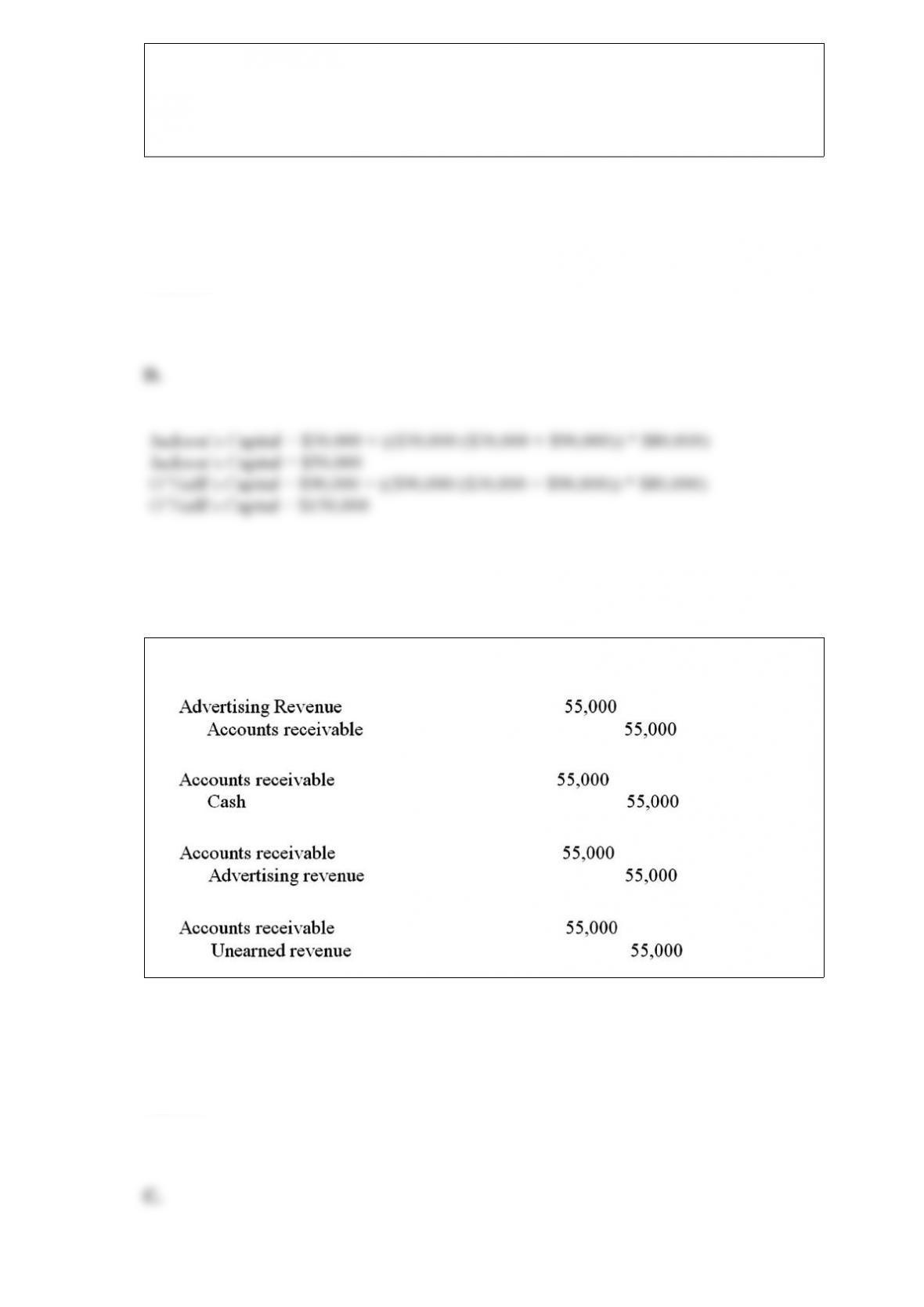
Which of the following is the journal entry to record activity #1?
A.
B.
C.
D.
Answer:
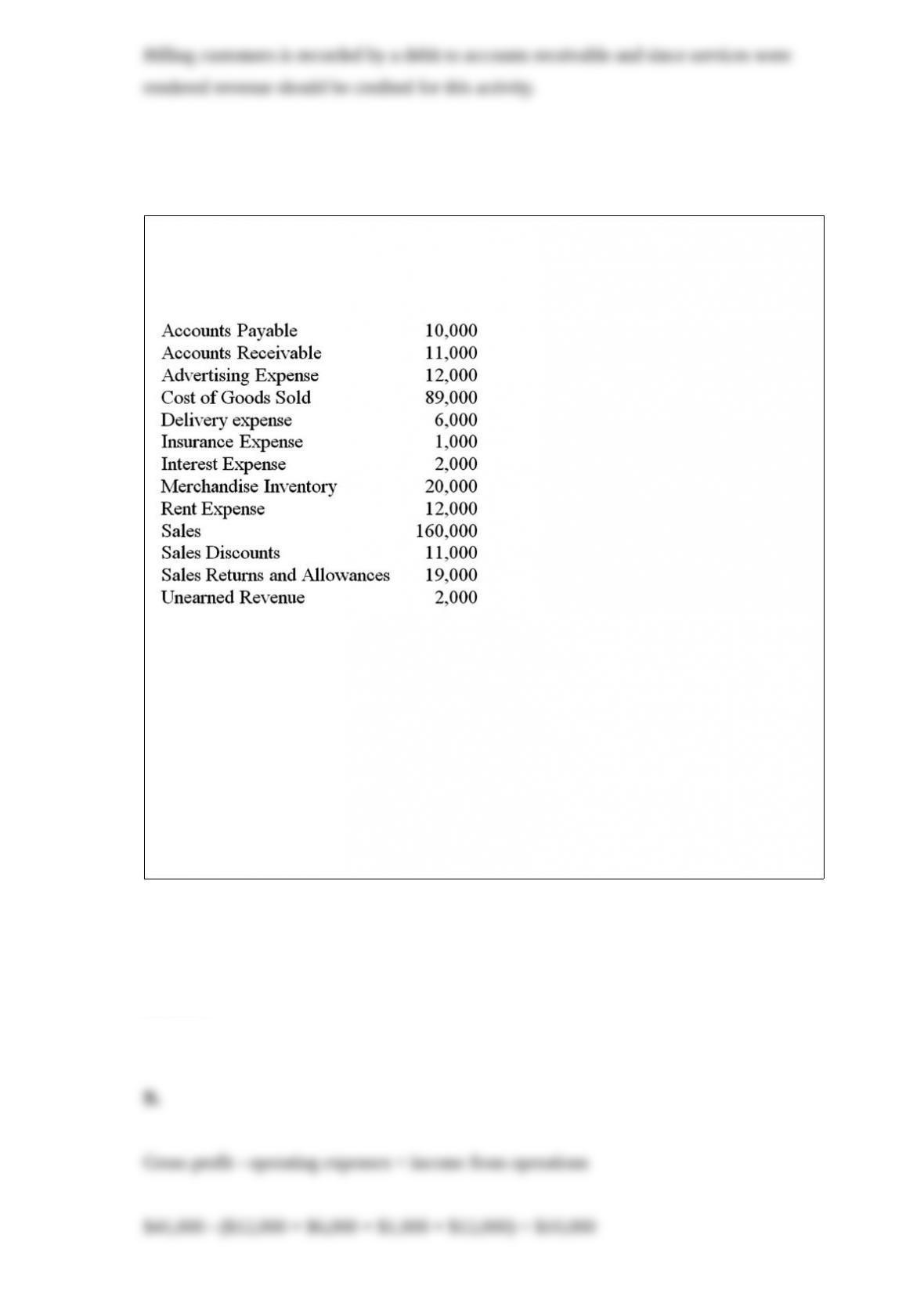
The following is a listing of some of the balance sheet accounts and all of the income
statement accounts for Mulberry Street Sportswear as they appear on the 12/31/14
adjusted trial balance.
Use the information above to answer the following question. Income from operations
for 2014 would be
A. $6,000.
B. $10,000.
C. $11,000.
D. $12,000.
Answer:
If net sales revenue and the average book value of fixed assets both rise 5%:
A. the fixed asset turnover ratio will rise.
B. the fixed asset turnover ratio will fall.
C. the fixed asset turnover ratio will stay the same.
D. the impact on the fixed asset turnover ratio cannot be determined since the beginning
values are unknown.
Answer:
The effect of a stock dividend is to:
A. decrease total assets and stockholders’ equity.
B. change the composition of stockholders’ equity.
C. decrease total assets and total liabilities.
D. increase the market value per share of common shares.
Answer:

Company A has liabilities of $6,773,000 and stockholders’ equity of $3,647,000 at the
end of the current year, and sales revenue of $9,800,000 and net income of $899,080 for
the year. Company B has assets of $1,680,000 and stockholders’ equity of $978,750 at
the end of the current year, and sales revenue of $1,950,000 and net income of $351,000
for the year.
A. Calculate the debt-to-assets and net profit margin ratios for each company.
B. Which company has greater financing risk?
C. Which company generates more profit per dollar of sales?
Answer:

A company bought $250,000 of equipment with an expected life of ten years and no
residual value. After six years the company sold the equipment for $94,000. If it uses
straight-line depreciation and the indirect method is used to determine cash flows from
operating activities, which of the following reflects how the sale of the equipment
would be reported in the statement of cash flows?
A. $94,000 is recorded as a cash inflow from investing activities and no other sections
of the statement are affected.
B. $94,000 is recorded as a cash inflow from investing activities and $6,000 is added to
convert net income to net cash flow from operating activities.
C. $94,000 is recorded as a cash inflow from investing activities and $6,000 is
subtracted to convert net income to net cash flow from operating activities.
D. $94,000 is recorded as a cash inflow from operating activities.
Answer:
The direct write-off method:
A. results in better matching of costs with revenues than the allowance method.
B. is an acceptable method under generally accepted accounting principles (GAAP).
C. requires that losses from bad debts be recorded in the period in which sales are
made.
D. does not report accounts receivable on the balance sheet at their net realizable value.
Answer:
If a company’s P/E ratio is 12.5 and the company’s stock price is $17.50 per share then
the company’s EPS is:
A. $0.71.
B. $1.40.
C. $5.00.
D. $0.40.
Answer:
Which of the following is not a term for the value at which an asset is reported on a
financial statement?
A. Carrying value.
B. Book value.
C. Equipment, net.
D. Accrual value.
Answer:
Accountants are able to most influence which component of the fraud triangle?
A. Incentive.
B. Ability to rationalize the fraud.
C. Ability to conceal the fraud.
D. Accountants cannot influence any component.
Answer:
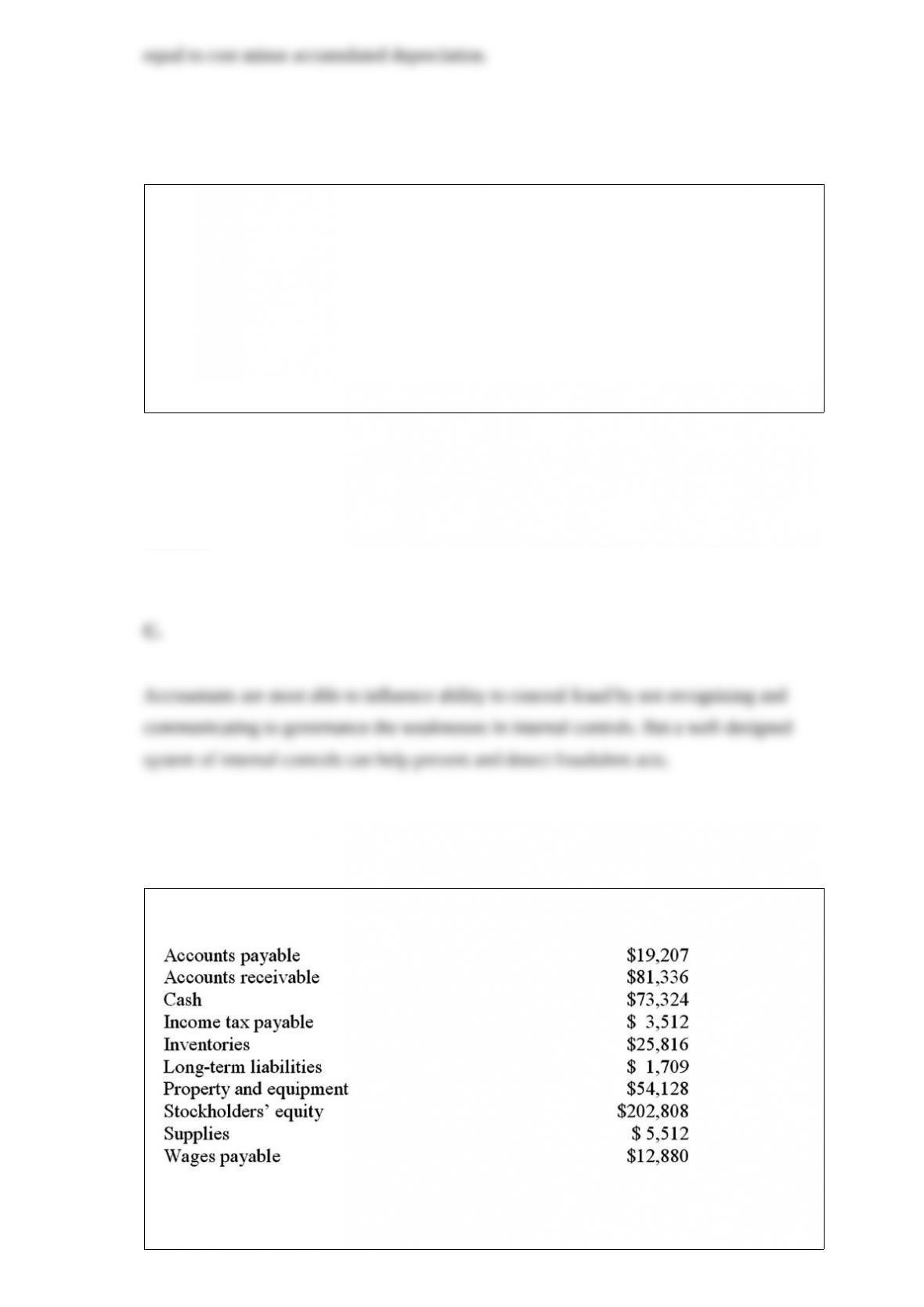
A company reported the following in its recent balance sheet:
What is the amount of Total Assets on the Balance Sheet?

A. $240,116
B. $214,300
C. $442,924
D. $480,232
Answer:
All of the following may be used to calculate total liquid assets, except:
A. inventory.
B. cash equivalents.
C. a 120-day Treasury bill.
D. allowance for doubtful accounts.
Answer:
Assume a company uses the direct method to prepare its statement of cash flows. If the
company’s inventory and accounts payable both increase during the accounting period,
how would these changes affect cash flow calculations?
A. The changes in each account are both added to net income.
B. The change in inventory is subtracted from cost of goods sold and the change in
accounts payable is added to cost of goods sold to find the cash paid to suppliers.
C. The changes in each account are both subtracted from net income.
D. The change in inventory is added to cost of goods sold and the change in accounts
payable is subtracted from cost of goods sold to find the cash paid to suppliers.
Answer:
A company purchased $6,000 of merchandise. Transportation costs were an additional
$100. The company returned $250 of the merchandise and then paid the invoice within
the 2% discount period. What is the total amount of cash paid?
A. $5,733
B. $6,100
C. $5,735
D. $5,730

Answer:
The Don’t Bite Me Pest Control Company has 10,000 gallons of insecticide supplies on
hand that cost $300,000; a bill from the vendor for $100,000 of these supplies has not
yet been paid. The company expects to earn $800,000 for its services when it uses the
insecticide supplies. The company would report a supplies asset in the amount of
A. $10,000.
B. $200,000.
C. $300,000.
D. $800,000.
Answer:
An allowance for doubtful accounts is a contra-account that offsets:
A. bad debt expense.
B. cash.
C. net income.
D. accounts receivable.
Answer:
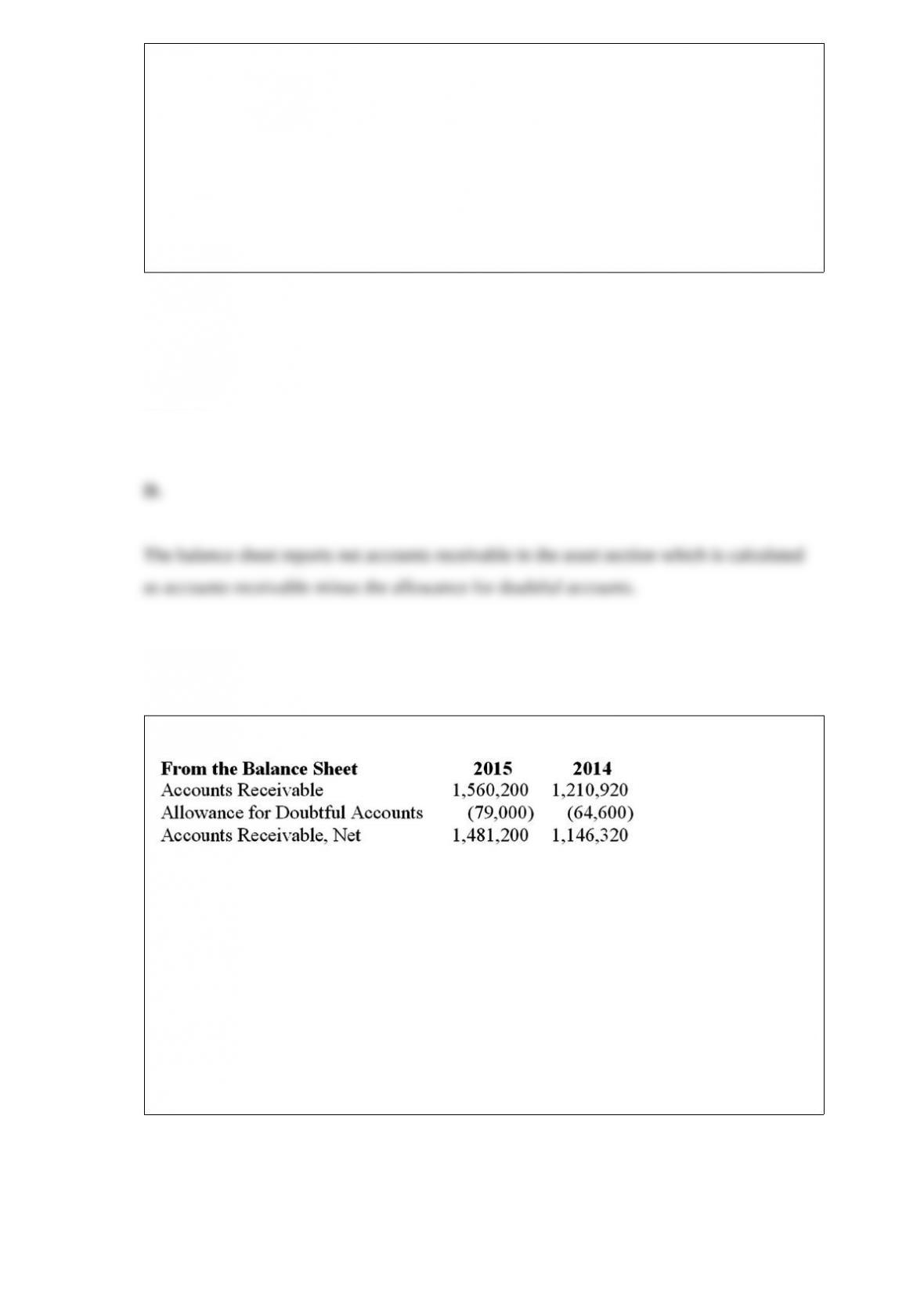
Assume the Mirtha Company had the following balances at year-end.
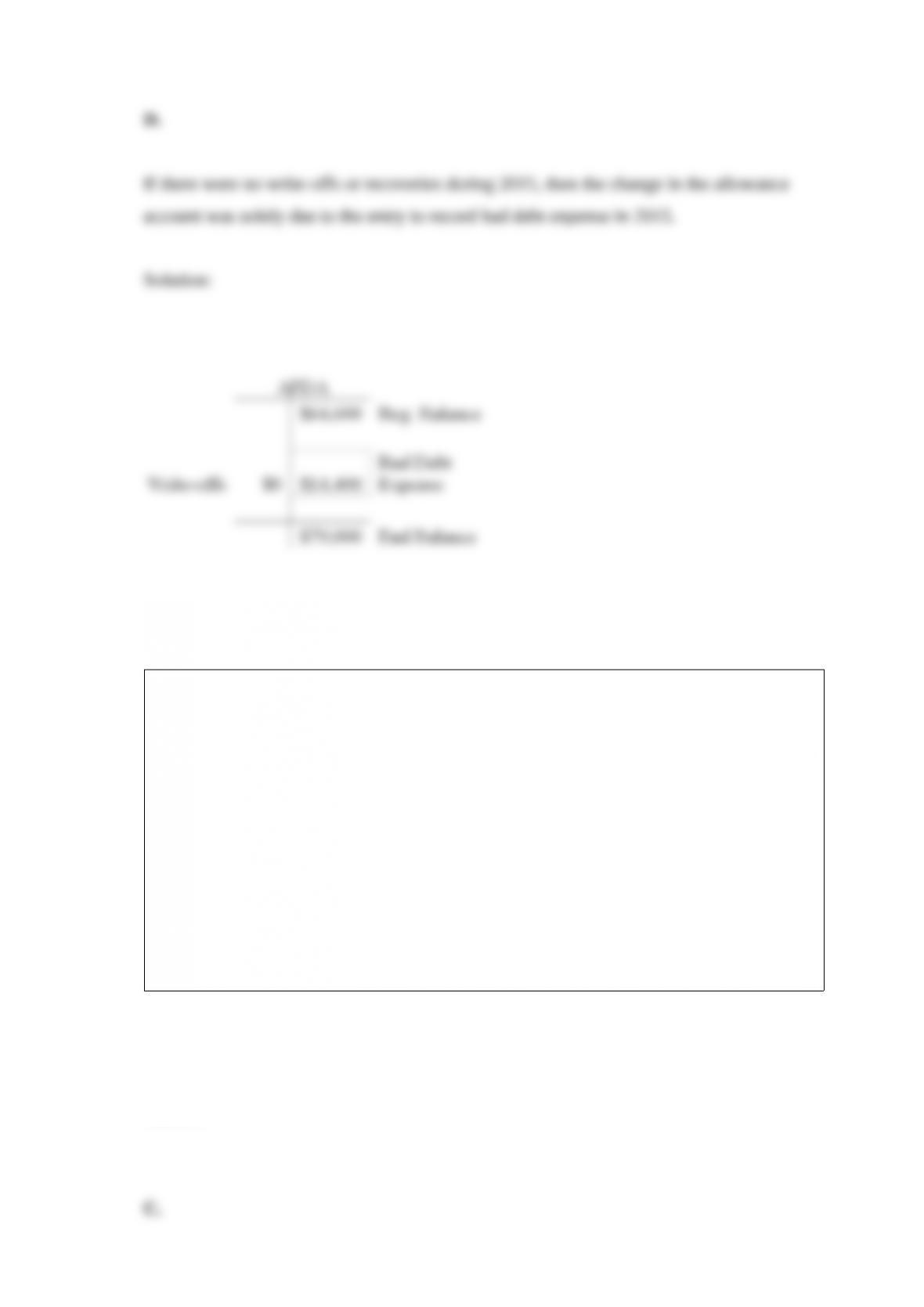
Assume the company recorded no write-offs or recoveries during 2015. What was the
amount of bad debt expense reported in 2015?
A. $79,000.
B. $64,600.
C. $28,800.
D. $14,400.
Answer:
On average, 5% of total accounts receivable has been uncollectible in the past. At the
end of the year, the current balance of accounts receivable is $100,000. The allowance
for doubtful accounts has an unadjusted debit balance of $500 using the aging of
accounts receivable method. Credit sales during the year were $150,000. The estimated
bad debt expense is:
A. $4,500.
B. $5,000.
C. $5,500.
D. $7,000.
Answer: