Paul Company had 100,000 shares of common stock outstanding on January 1, 2016.
On September 30, 2016, Paul sold 48,000 shares of common stock for cash. Paul also
had 10,000 shares of convertible preferred stock outstanding throughout 2016. The
preferred stock is $100 par, 6%, and is convertible into 3 shares of common for each
share of preferred. Paul also had 500, 8%, convertible bonds outstanding throughout
2016. Each $1,000 bond is convertible into 30 shares of common stock. The bonds sold
originally at face value. Reported net income for 2016 was $300,000 with a 40% tax
rate. Common shareholders received $2 per share dividends after preferred dividends
were paid in 2016.
Required:
Compute basic and diluted earnings per share (rounded to 2 decimal places) for 2016.
The note about debt included in the financial statements of Healdsburg Company for
the year ended December 31, 2015 disclosed the following: Debt. The following table
summarizes the long-term debt of the Company at December 31, 2015. All of the notes
were issued at their face (maturity) value.
Required: Assuming that the notes pay interest annually and mature on December 31
of the respective years, compute the following: Suppose that Healdsburg renegotiates
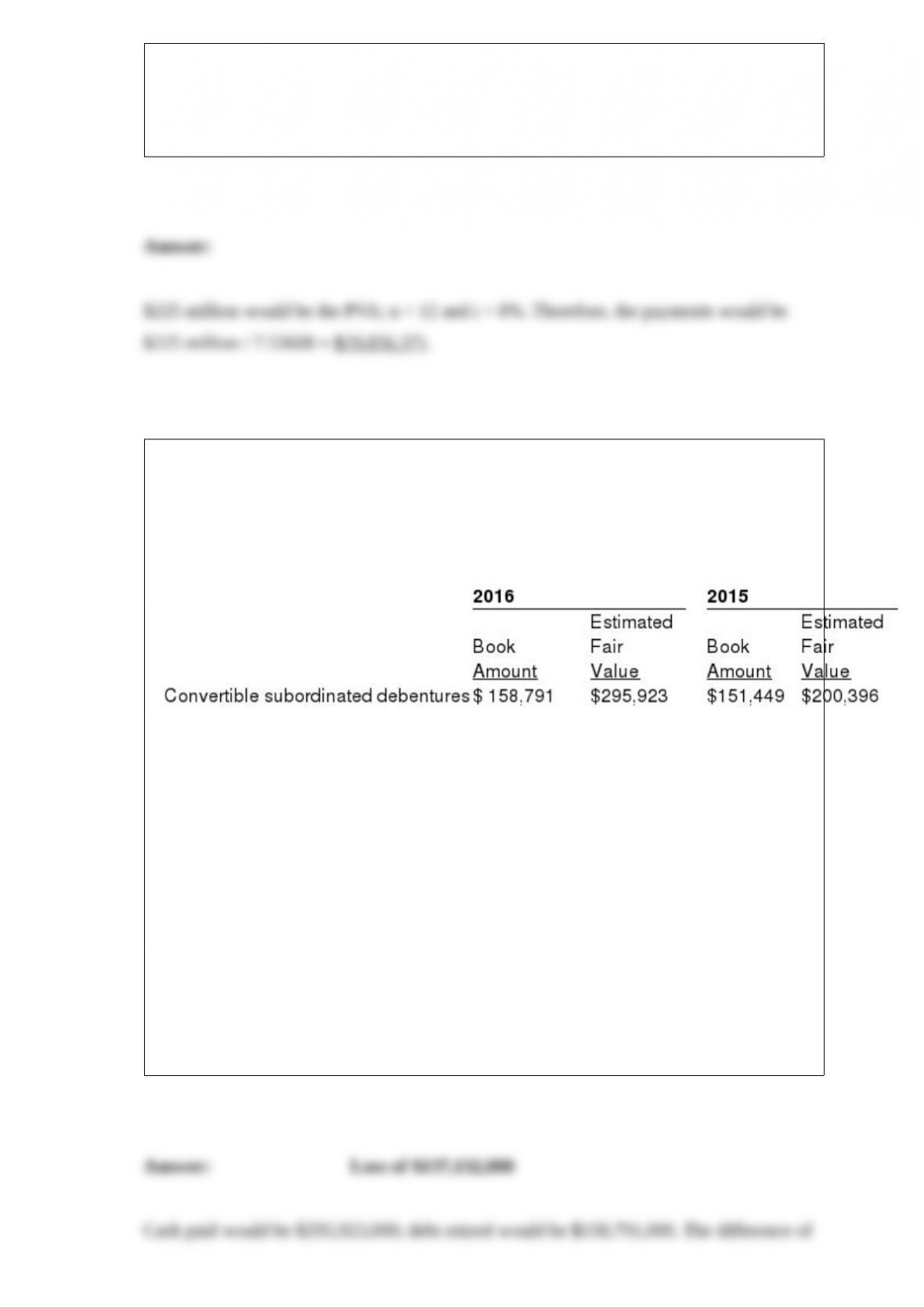
the 8% notes on December 31, 2021, when the going interest rate is 8%. Healdsburg
agrees to make 12 equal annual installments, commencing on December 31, 2022,
rather than pay the annual interest payments and the $225 million in a lump sum at
maturity. What would the annual payments be?
In its 2016 annual report to shareholders, Health Foods, Inc., disclosed the following
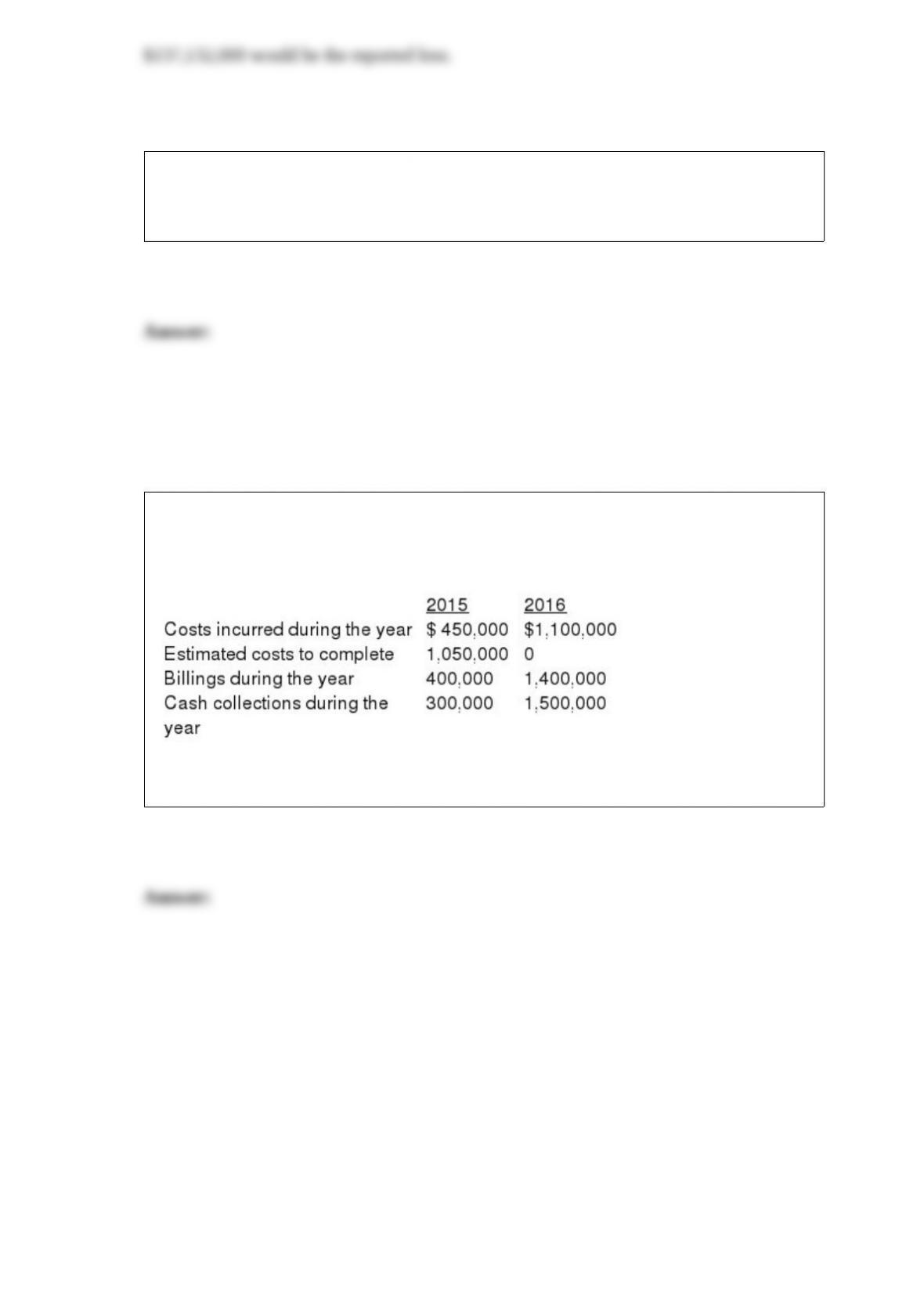
information about some of its indebtedness: The fair value of convertible subordinated
debentures is estimated using quoted market prices. Book amounts and estimated fair
values of our financial instruments other than those for which book amounts
approximate fair values as noted above are as follows (in thousands)
In addition, the company disclosed the following: We have outstanding zero coupon
convertible subordinated debentures which had a book amount of approximately $158.8
million and $151.4 million at September 26, 2016, and September 28, 2015,
respectively. The debentures have an effective yield to maturity of 5 percent and a
principal amount at maturity on March 2, 2030, of approximately $308.8 million. The
debentures are convertible at the option of the holder, at any time on or prior to
maturity, unless previously redeemed or otherwise purchased. The debentures have a
conversion rate of 10.64 shares per $1,000 principal amount at maturity, representing
3,285,632 shares. The debentures may be redeemed at the option of the holder on
March 2, 2020, or March 2, 2025, at the issue price plus accrued original discount
totaling approximately $188 million and $241 million, respectively.
Required: Determine the gain or loss that Health Foods would have reported in its
2016 income statement if it had redeemed (and retired) the debentures at fair value at
the end of the fiscal year.
Chapter 15 Leases
Beavis Construction Company was the low bidder on a construction project to build an
earthen dam for $1,800,000. The project was begun in 2015 and completed in 2016.
Cost and other data are presented below:
Assume that Beavis recognizes revenue upon completion of the project. Required:
Prepare all journal entries to record costs, billings, collections, and profit recognition.