1) On December 31, 2010, Parminter Corporation owns an 80% interest in the common
stock of Sanchez Corporation and an 80% interest in Sanchez’s preferred stock. On
December 31, 2010, Sanchez’s stockholders’ equity was as follows:
10% preferred stock, cumulative, $10 par value $50,000
Common stock350,000
Retained earnings100,000
Total stockholders’ equity$500,000
On December 31, 2010, preferred dividends are not in arrears. Sanchez had 2011 net
income of $30,000 and only preferred dividends are declared and paid in 2011 . There
are no book value/fair value differentials associated with Parminter’s investments.
What should be the noncontrolling interest share, preferred in the consolidated financial
statements of Parminter for the year ending December 31, 2011?
A) $1,000
B) $2,000
C) $4,000
D) $5,000
2) Pasfield Corporation acquired a 90% interest in Santini Corporation for $90,000 cash
on January 1, 2011 . The following information is available for Santini at that time.
Book ValueFair ValueDifference
Current assets$40,000$50,000$10,000
Plant assets60,00075,00015,000
Liabilities(50,000)(50,000)0
Net assets$50,000$75,000
Under the entity theory, a consolidated balance sheet prepared immediately after the
business combination will show noncontrolling interest of
A) $5,000
B) $7,500
C) $9,000
D) $10,000
3) Bower Corporation purchased a 70% interest in Stage Corporation on June 1, 2010 at
a purchase price of $350,000. On June 1, 2010, the book values of Stage’s assets and
liabilities were equal to fair values. On June 1, 2010, Stage’s stockholders’ equity
consisted of $290,000 of Common Stock and $210,000 of Retained Earnings. All
cost-book differentials were attributed to goodwill.
During 2010, Stage earned $120,000 of net income, earned uniformly throughout the
year and paid $6,000 of dividends on March 1 and another $6,000 on September 1 .
Noncontrolling interest share for 2010 is
A) $21,000
B) $32,400
C) $36,000
D) $50,000
4) What statements are required for Government-wide financial statements?
A) Statement of Cash Flows and Balance Sheet
B) Statement of Cash Flows and Statement of Net Assets
C) Statement of Net Assets and Statement of Activities
D) Operating Statement and Balance Sheet
5) Everything else held constant, if the federal government were to guarantee today that
it will pay creditors if a corporation goes bankrupt in the future, the interest rate on
corporate bonds will ________ and the interest rate on Treasury securities will
________
A) increase; increase
B) increase; decrease
C) decrease; increase
D) decrease; decrease
6) Sandpiper Corporation paid $120,000 for annual property taxes on January 15, 2011,
and $20,000 for building repair costs on March 10, 2011 . Total repair expenses for the
year were estimated to be $200,000, and are normally accrued during the year until
incurred. What total amount of expense for these items was reported in Sandpiper’s first
quarter 2011 interim income statement?
A) $ 50,000
B) $ 80,000
C) $100,000
D) $140,000

7) Bart Company purchased a 30% interest in Simpson Corporation on January 1, 2008,
and Bart accounted for its investment in Simpson under the equity method for the next
3 years. On January 1, 2011, Bart sold one-half of its interest in Simpson after which it
could no longer exercise significant influence over Simpson. Bart should
A) continue to account for its remaining investment in Simpson under the equity
method for the sake of consistency
B) adjust the investment in Simpson account to one-half of its original amount and
account for the remaining 15% interest using the equity method
C) account for the remaining investment under the cost method, using the investment in
Simpson account balance immediately after the sale as the new cost basis
D) adjust the investment account to one-half of its original amount (one-half of the
purchase price in 2008), and account for the remaining 15% investment under the cost
method
8) The four cash flow categories required in an Enterprise Fund’s Statement of Cash
Flows are listed below and assigned a letter code.
A)Cash flows from operating activities
B)Cash flows from noncapital financing activities
C)Cash flows from capital and related financing activities
D)Cash flows from investing activities
Required:
Use the correct letter code to indicate where each of the following ten items associated
with an Enterprise Fund should be reported in the Statement of Cash Flows.
1>An enterprise fund’s fixed asset was sold for cash.
2>Cash paid to suppliers for goods.
3>Paid principal, $100,000, and interest, $5,000, on a mortgage.
4>Cash proceeds from sale of investments, $65,000.
5>Cash paid for new equipment, $18,000.
6>Cash received from the general fund; restricted to cover part of the cost of plant
expansion, $900,000.
7>Cash received from another fund as a 6-month loan for the sole purpose of financing
purchase of equipment, $47,000.
8>Cash proceeds from issuing bonds for an enterprise fund’s construction project.
9>Cash paid to employees for salaries.
10>Cash received from interest earned on investments.
9) Using the revenue types shown below, match each of the revenue sources to a
revenue type. Each revenue type may be used more than once.
A.Derived Tax Revenues
B.Imposed Nonexchange Revenues
C.Government-Mandated Nonexchange Transactions
D.Voluntary Nonexchange Transactions
_____1> Corporate income tax
_____2> Sales taxes
_____3> Liquor taxes
_____4> Fines and penalties paid to a government entity
_____5> Cigarette taxes
_____6> Personal income tax
_____7> Donation made to a government entity
_____8> Motor fuel tax
_____9> Property tax
10) The accounting equation for a governmental fund is
A) Assets = Liabilities + Equity
B) Current assets + Noncurrent assets – Current liabilities – Noncurrent liabilities = Net
assets
C) Current assets – Current liabilities = Fund Balance
D) Assets = Liabilities + Fund Balance
11) On January 1, 2011, Jeff Company acquired a 90% interest in Margaret Company
for $198,000 cash. On January 1, 2011, Margaret Company had the following assets
and liabilities:
Book ValueFair Value
Cash$5,000$5,000
Accounts Receivable30,00035,000
Inventory40,00050,000
Plant Assets60,00080,000
Total Assets$135,000$170,000
Liabilities$25,000$25,000
Capital Stock100,000
Retained Earnings10,000
Total Liabilities &
Stockholders’ Equity$135,000
Push-down accounting is used for the acquisition.
Required:
1> Assume both companies use the entity theory.
a. Record the journal entry on Margaret’s separate books on January 1, 2011 .
b. Record the journal entry on Jeff’s separate books on January 1, 2011 .
2> Assume both companies use the parent company theory.
a. Record the journal entry on Margaret’s separate books on January 1, 2011 .
b. Record the journal entry on Jeff’s separate books on January 1, 2011 .
12) The Justin, Kyle, and Lulu partnership was dissolved by the partners on May 1,
2011 . Their balance sheet on that date is shown below:
Cash$26,000Liabilities$41,000
Other assets96,000Loan from Kyle3,000
Loan to Justin10,000Justin,capital (20%)19,000
Kyle, capital (20%)26,000
Lulu, capital (60%)43,000
Total assets$132,000Total liab./equity$132,000
In May, other assets with a book value of $46,000 were sold for $50,000 in cash.
Required:
Determine how the available cash on May 31, 2011 will be distributed.
13) Paleo Corporation holds 80% of the capital stock of Sockrite Company. On January
1, 2011, Sockrite purchased $50,000 par value, 10% bonds on the open market that had
been issued by Paleo on January 1, 2009 . Sockrite paid $58,000 for these bonds which
had originally been issued by Paleo for $53,000, with a 10-year maturity from the date
of issue. Interest is paid annually on December 31 . Straight-line amortization is used
by both companies.
Required:
1> Calculate the interest income reported by Sockrite related to these bonds in 2011 .
2> Calculate the interest expense reported by Paleo related to these bonds in 2011 .
3> Calculate the gain or loss on retirement of bonds payable to be reported on
consolidated financial statements in 2011 .
14) Ivan has 14,000 barrels of oil that were purchased a month ago at $50.00 per barrel.
On November 1, 2011 Ivan hedges the value of the inventory by entering into a forward
contract to sell 14,000 barrels of oil on January 31, 2012 for $60.00 per barrel. The
forward contract is to be settled net.
Assume this is a fair value hedge.
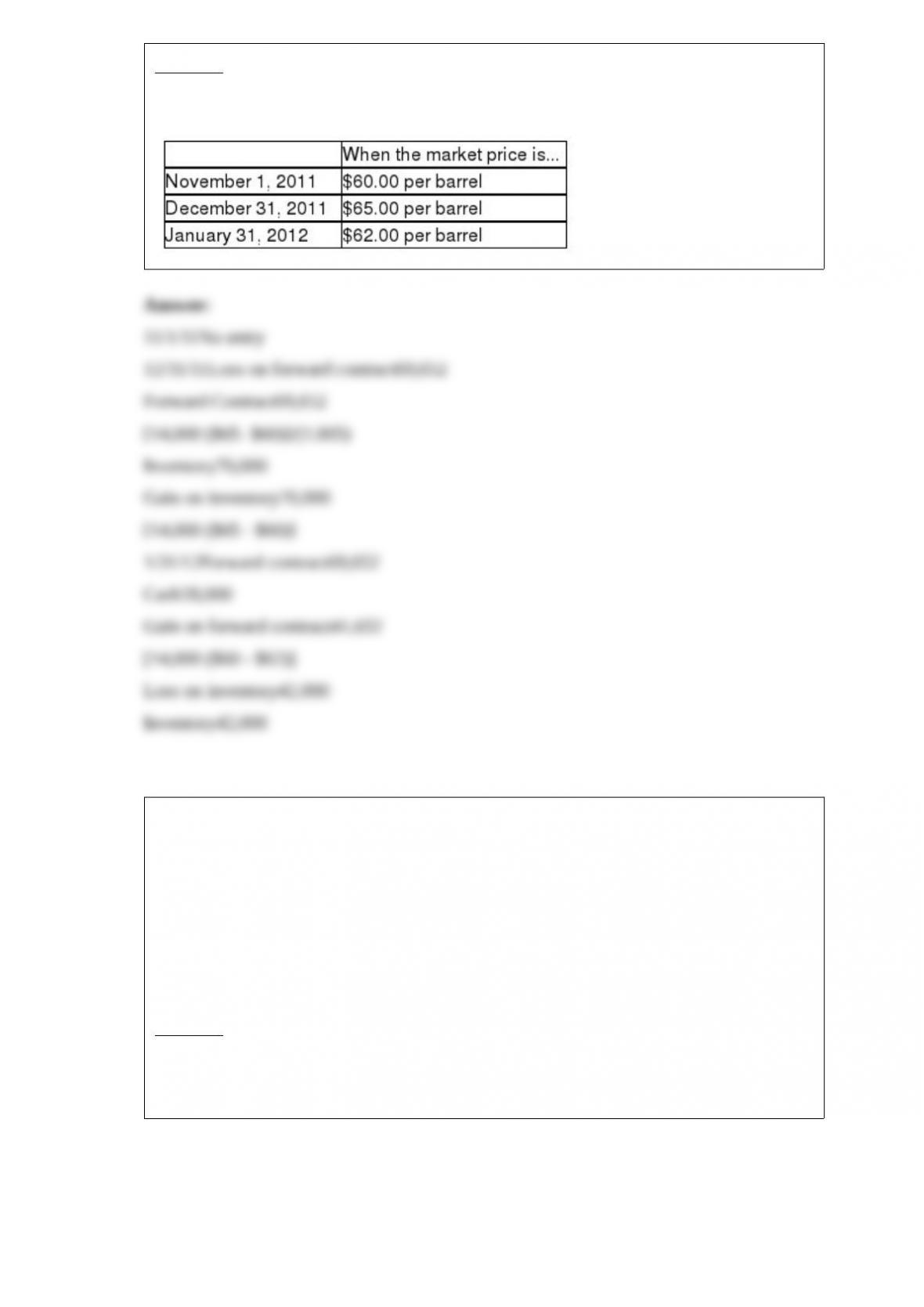
Required:
Assume a 6% discount rate is reasonable, and using a mixed-attribute model, prepare
the journal entries to account for this hedge at the following dates:
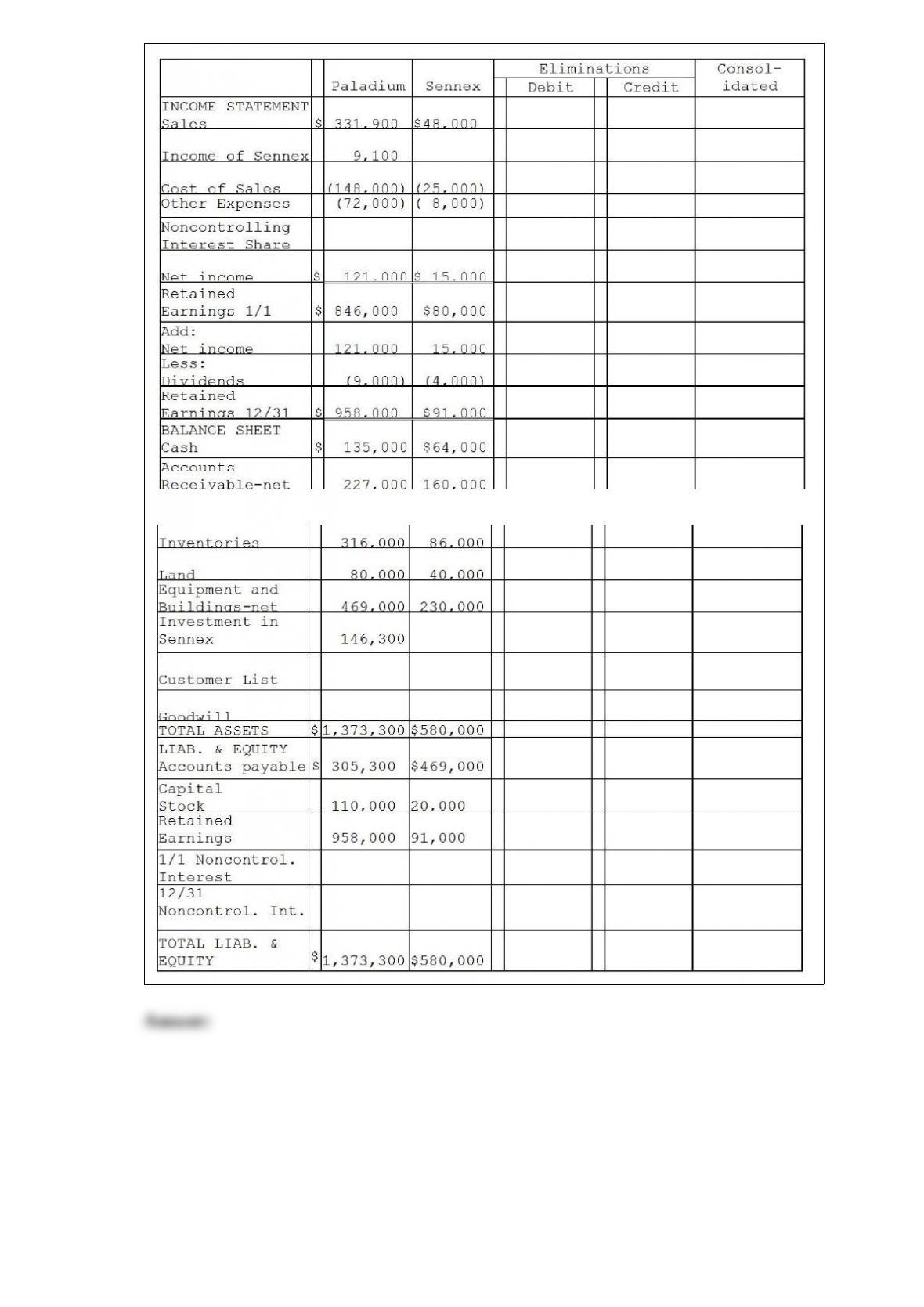
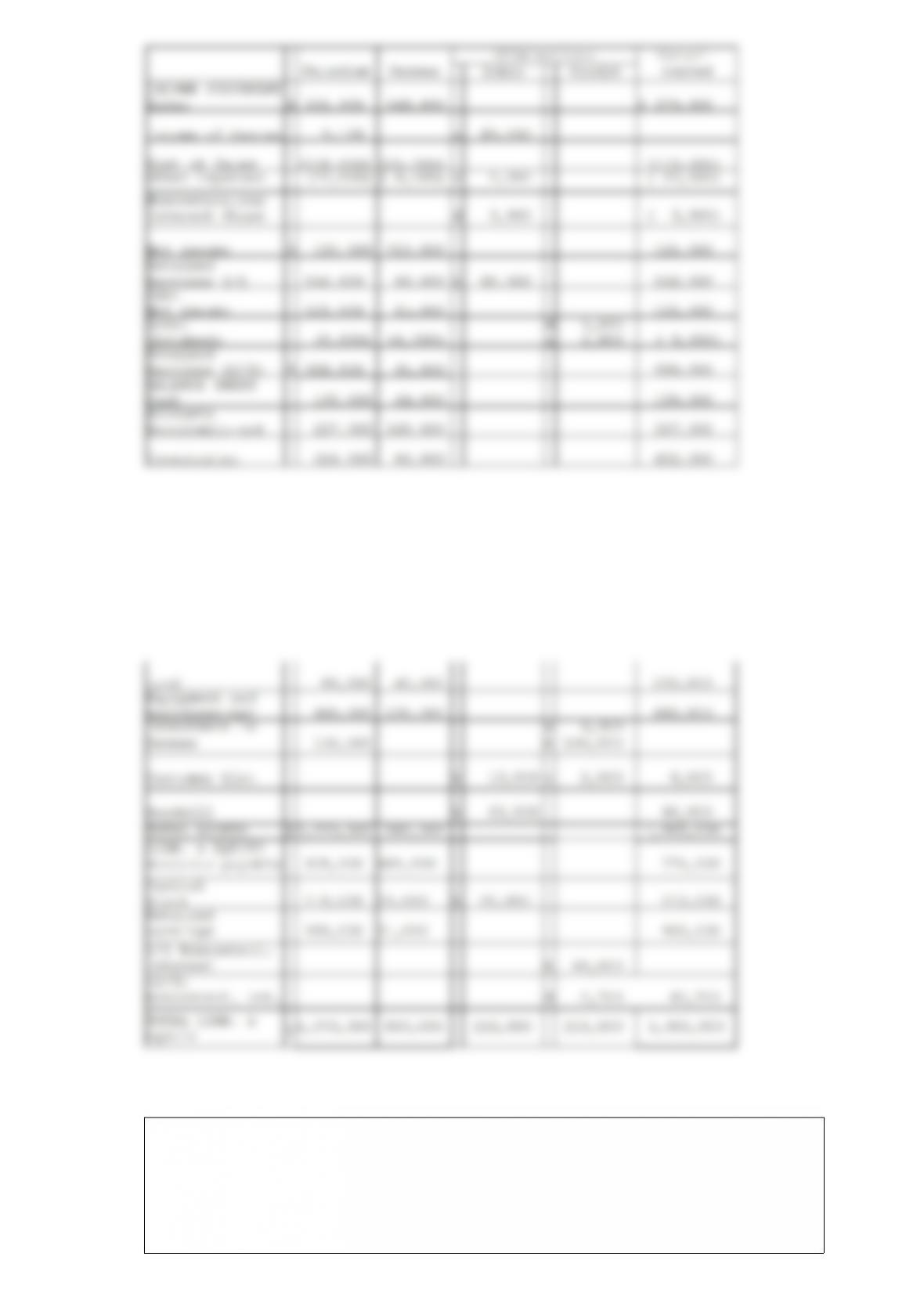
15) On December 31, 2011, Paladium International purchased 70% of the outstanding
common stock of Sennex Chemical. Paladium paid $140,000 for the shares and
determined that the fair value of all recorded Sennex assets and liabilities approximated
their book values, with the exception of a customer list that was not recorded and had a
fair value of $10,000, and an expected remaining useful life of 5 years. At the time of
purchase, Sennex had stockholders’ equity consisting of capital stock amounting to
$20,000 and retained earnings amounting to $80,000. Any remaining excess fair value
was attributed to goodwill. The separate financial statements at December 31, 2012
appear in the first two columns of the consolidation workpapers shown below.
Required:
Complete the consolidation working papers for Paladium and Sennex for the year
2012 .
Paladium
16) Plymouth Corporation (a U.S. company) began operations on September 1, 2011,
when the owner borrowed $250,000 to establish the business. Plymouth then had the
following import and export transactions with unaffiliated Chinese companies:
September 6, 2011Bought material inventory for 100,000 yuan on account. Invoice
denominated in yuan.
September 18, 2011Sold 80% of inventory acquired on 9/6/11 for 110,000 yuan on
account. Invoice denominated in yuan.
October 5, 2011Acquired and paid the 100,000 yuan owed to the Chinese supplier
October 18, 2011Collected the 110,000 yuan from the Chinese customer and
immediately converted them into U.S. dollars
The following exchange rates apply:
DateRate
September 6$0.1544 = 1 yuan
September 18$0.1607 = 1 yuan
September 30$0.1591 = 1 yuan
October 5$0.1578 = 1 yuan
October 18$0.1593 = 1 yuan
Required:
1> What were Sales in the September month-end income statement?
2> What was the COGS associated with these sales?
3> What is the Accounts Receivable balance in the balance sheet at September 30,
2011?
4> What is the Inventory balance in the balance sheet at September 30, 2011?
5> What is the Exchange gain or loss that will be reported for the month of September?
17) If the federal government where to raise the income tax rates, would this have any
impact on a state’s cost of borrowing funds? Explain
18) Pongo Company has $2,000,000 of 6% bonds outstanding on December 31, 2010
with unamortized premium of $60,000. These bonds pay interest semiannually on
January 1 and July 1 and mature on January 1, 2016 . Straight-line amortization is used.
Syring Inc., 90%-owned subsidiary of Pongo, buys $1,000,000 par value of Pongo’s
outstanding bonds in the market for $980,000 on January 2, 2011 . There is only one
issue of outstanding bonds of the affiliated companies and they have consolidated
financial statements.
For the year 2011, Pongo has income from its separate operations (excluding
investment income) of $3,000,000 and Syring reports net income of $200,000. Pongo
uses the equity method to account for the investment.
Required: Determine the following:
1>Noncontrolling interest share for 2011 .
2>Controlling share of consolidated net income for Pongo Company and subsidiary for
2011 .
19) On November 1, 2011, Portsmith Corporation, a calendar-year U.S. corporation,
invested in a purely speculative contract to purchase 1 million yen on January 30, 2012,
from the Karoke Trading Company, a Japanese brokerage firm. Portsmith agreed to
purchase 1,000,000 yen from Karoke at a fixed price of $0.0100 per yen. Karoke agreed
to transmit 1,000,000 yen to Portsmith on January 30 . Net settlement is not permitted.
The spot rates for yen are:
Nov 01, 2011 1 yen = $0.0097
Dec 31, 2011 1 yen = $0.0104
Jan 30, 2012 1 yen = $0.0106
The 30-day forward rate for yen on December 31, 2011 was $0.0104.
Required:
Prepare the General Journal entries that Portsmith would record on November 1,
December 31, and January 30 .
20) Shebing Corporation had $80,000 of $10 par value common stock outstanding on
January 1, 2010, and retained earnings of $120,000 on the same date. During 2010 and
2011, Shebing earned net incomes of $30,000 and $45,000, respectively, and paid
dividends of $8,000 and $10,000, respectively.
On January 1, 2010, Pentz Company purchased 25% of Shebing’s outstanding common
stock for $60,000. On January 1, 2011, Pentz purchased an additional 10% of Shebing’s
outstanding stock for $30,200. The payments made by Pentz in excess of the book value
of net assets acquired were attributed to equipment, with each excess value amount
depreciable over 8 years under the straight-line method.
Required:
1>What is the adjustment to Investment Income for depreciation expense relating to
Pentz’s Investment in Shebing in 2010 and 2011?
2>What will be the December 31, 2011 balance in the Investment in Shebing account
after all adjustments have been made?

21) An adjusted trial balance is provided below for the Dade County copy services
department at June 30, 2011 .
Cash$ 21,000
Due from Enterprise Fund6,000
Due from Debt Service Fund2,000
Supplies inventory5,000
Supplies used3,000
Equipment32,000
Salary expense25,000
Utility expense9,000
Depreciation expense6,000
Operating transfer to General Fund4,000
$113,000
Accumulated depreciation $ 24,000
Accounts payable2,000
Advance from General Fund (not for capital assets)10,000
Capital Contribution from General Fund1,000
Net assets (beginning)28,000
Revenue – services billed48,000
$113,000
Required:
1>Prepare a statement of revenues, expenses and changes in net assets for the copy
services department for the year ended June 30, 2011 .
2>Prepare a statement of net assets for the copy services department at June 30, 2011 .
Assume all assets are not externally or internally restricted.