1) Preen Corporation acquired a 60% interest in Shino Corporation at a cost equal to
60% of the book value of Shino’s net assets in 2010 . At the time of acquisition, the
book value and fair value of Shino’s assets and liabilities were equal. During 2011,
Preen sold $120,000 of merchandise to Shino. All intercompany sales are made at 150%
of Preen’s cost. Shino’s beginning and ending inventories resulting from intercompany
sales for 2011 were $60,000 and $36,000, respectively. Income statement information
for both companies for 2011 is as follows:
PreenShino
Sales Revenue$730,000 $262,000
Investment income from Shino38,000
Cost of Goods Sold(319,000)(172,000)
Expenses(165,000)(40,000)
Net Income$284,000 $50,000
Required:
Prepare a consolidated income statement for Preen Corporation and Subsidiary for 2011
.
2) Static City started a department to provide copy, printing and mailing services for all
departments and agencies of the city.
During the fiscal year from July 1, 2010 through June 30, 2011, the copy services
department had the following transactions:
1>Paper and toner inventory was purchased for $58,000, on account.
2>The paper and toner inventory physical count showed only $8,000 on hand at June
30, 2011 .
3>The department billed other departments for services rendered to them amounting to:
General Fund, $43,000; Enterprise Fund, $24,000; Debt Service Fund, $21,000; and
Trust Fund, $16,000. All receivables were collected with the exception of $6,000 from
the Trust Fund which is expected to be collected in July, 2011 .
4>The department incurred and paid the following expenses: salaries and wages,
$23,000; Electric, $8,000; Other operating expenses, $6,000. Also, $63,000 of the
Accounts Payable were paid during the year.
5>Depreciation Expense on Equipment amounted to $6,000 for the year ending June
30, 2011 .
6>The department prepared the closing entry on June 30, 2011 .
Required:
For the fiscal year ended June 30, 2011, prepare the journal entries to record the
transactions for the Internal Service Fund.
3) The following information was taken from the accounts and records of the
Community Chest Foundation, a private, not-for-profit VHWO organization. All
balances are as of December 31, 2011, unless otherwise noted.
Unrestricted Support – Contributions$6,500,000
Unrestricted Support – Membership Dues700,000
Unrestricted Revenues – Investment Income63,000
Temporarily restricted gain on sale of investments20,000
Expenses – Program Services2,950,000
Expenses – Supporting Services670,000
Expenses – Supporting Services350,000
Temporarily Restricted Support – Contributions560,000
Temporarily Restricted Revenues – Investment Income70,000
Permanently Restricted Support – Contributions80,000
Unrestricted Net Assets, January 1, 2011500,000
Temporarily Restricted Net Assets, January 1, 20114,000,000
Permanently Restricted Net Assets, January 1, 201150,000
The unrestricted support from contributions was received in cash during the year. The
expenses included $980,000 paid from temporarily-restricted cash donations.
Required:
Prepare Community Chest’s Statement of Activities for the year ended December 31,
2011 .
4) A summary balance sheet for the Ash, Brown, and Curly partnership on December
31, 2011 is shown below. Partners Ash, Brown, and Curly allocate profit and loss in
their respective ratios of 2:1:1. The partnership agreed to pay partner Brown $135,000
for his partnership interest upon his retirement from the partnership on January 1,
2012 . The partnership financials on January 1, 2012 are:
Assets
Cash$ 75,000
Marketable securities60,000
Inventory85,000
Land90,000
Building-net110,000
Total assets$420,000
Equities
Ash, capital$210,000
Brown, capital105,000
Curly, capital105,000
Total equities$420,000
Required:
Prepare the journal entry to reflect Brown’s retirement from the partnership:
1>Assuming a bonus to Brown.
2>Assuming a revaluation of total partnership capital based on excess payment.
3>Assuming goodwill equal to the excess payment is recorded.
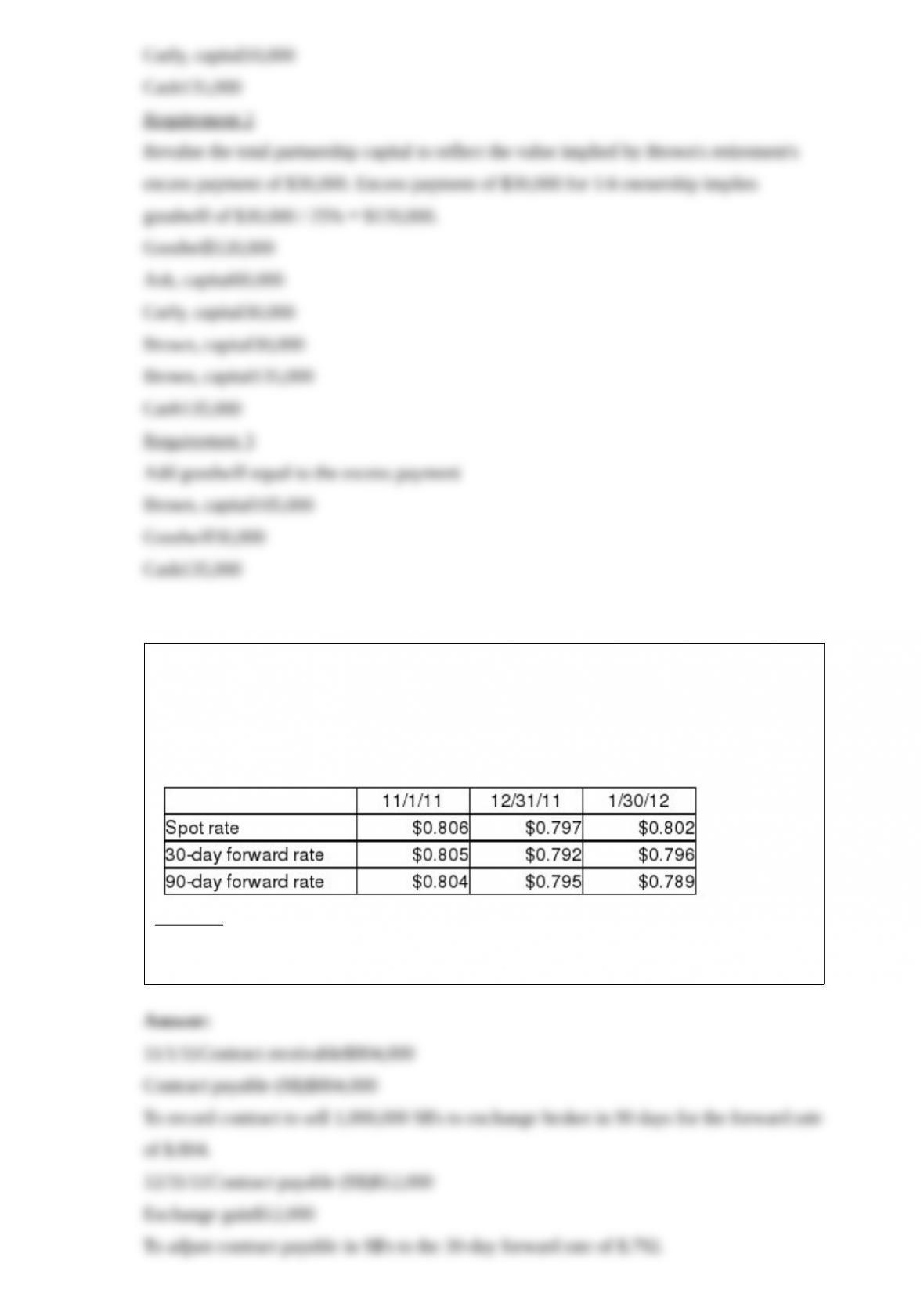
5) Slickton Corporation, a U.S. holding company, enters into a forward contract on
November 1, 2011 to speculate in Singapore dollars (S$). The forward contract requires
Slickton to sell 1,000,000 Singapore dollars to the exchange broker on January 30, 2012
. Net settlement is not permitted. Relevant exchange rates for the Singapore dollar are
listed below:
Required:
Prepare the journal entries required by Slickton on November 1, 2011, December 31,
2011 (year end), and January 30, 2012 .
6) Flagship Company has the following information collected in order to prepare a cash
flow statement and uses the indirect method for Cash Flow from Operations. The
annual report year end is December 31, 2011 .
Noncontrolling Interest Dividends Paid$17,000
Undistributed Income of Equity Investees7,000
Depreciation Expense80,000
Controlling Interest Share of Consolidated Net Income325,000
Increase in Accounts Payable26,000
Amortization of Patent10,000
Decrease in Accounts Receivable57,000
Increase in Inventories72,000
Gain on sale of equipment45,000
Noncontrolling Interest Share27,000
Required:
Prepare the Cash Flow for Operations part of the cash flow statement for Flagship for
the year ended December 31, 2011 .
7) Savy Corporation’s stockholders’ equity on December 31, 2010 was as follows:
8% cumulative preferred stock, $100 par value,
callable at $109, with two years of dividends
in arrears$100,000
Common stock, $25 par value700,000
Additional paid-in capital250,000
Retained earnings400,000
Total stockholders’ equity$1,450,000
On January 1, 2011, Paul Corporation purchased a 70% interest in Savy’s common
stock for $2,100,000. On this date the book values of Savy’s assets and liabilities are
equal to their fair values.
Required:
1> Determine the book value of the common stockholders’ equity for Savy Corporation
on January 1, 2011 .
2> What is the amount of goodwill reported on the consolidated balance sheet for Paul
Corporation and Subsidiary at January 2, 2011?
3> On January 2, 2011, Paul purchased 70% of Savy’s preferred stock for $50,000.
Prepare the journal entry(ies) for Paul for this purchase on January 2, 2011 .
4> Prepare the elimination entry on the consolidating work papers for the Investment in
Savy, Preferred Stock and Savy’s Preferred Stock on January 2, 2011 .
8) DeFunk Corporation is being liquidated under Chapter 7 of the Bankruptcy Act. The
trustee has determined that the unsecured claims will receive $.18 on the dollar. Magma
Corporation holds a $200,000 mortgage receivable from DeFunk that is secured by the
land and buildings with a book value of $180,000 and a fair value of $190,000. Magma
also holds an $80,000 unsecured note receivable from Defunk. Mortgage interest owed,
which is secured with the mortgage note, is $4,000. Note interest owed, which is
unsecured, is $2,000.
Required:
How much of the amounts owed will Magma recover?
9) On December 31, 2010, Peris Company acquired Shanta Company’s outstanding
stock by paying $400,000 cash and issuing 10,000 shares of its own $30 par value
common stock, when the market price was $32 per share. Peris paid legal and
accounting fees amounting to $35,000 in addition to stock issuance costs of $8,000.
Shanta is dissolved on the date of the acquisition. Balance sheet information for Peris
and Shanta immediately preceding the acquisition is shown below, including fair values
for Shanta’s assets and liabilities.
PerisShantaShanta
Book ValueBook ValueFair Value
Cash490,000$140,000$140,000
Accounts Receivable560,000280,000280,000
Inventory520,000200,000260,000
Land460,000150,000140,000
Plant Assets Net980,000325,000355,000
Construction Permits380,000170,000190,000
Accounts Payable(460,000)(140,000)(140,000)
Other accrued expenses(160,000)(45,000)(45,000)
Notes Payable(800,000)(460,000)(460,000)
Common Stock ($30 par)(960,000)
Common Stock ($20 par)(200,000)
Additional P.I.C(192,000)(80,000)
Retained Earnings(818,000)(340,000)
Required: Determine the consolidated balances which Peris would present on their
consolidated balance sheet for the following accounts.
Cash
Inventory
Construction Permits
Goodwill
Notes Payable
Common Stock
Additional Paid in Capital
Retained Earnings