The Publish or Perish Printing Company paid a dividend to stockholders. This will be
reported on the:
A) audit report.
B) income statement.
C) balance sheet.
D) statement of retained earnings.
Welles Company uses the direct write-off method of accounting for uncollectible
accounts receivable. On December 6, 2015, Welles sold $6,300 of merchandise to the
Fleming Company. On August 8, 2016, after numerous attempts to collect the account,
Welles determined that the $6,300 account of the Fleming Company was uncollectible.
Required:
Part a. Prepare the general journal entries required to record the transactions on August
8, 2016.
Part b. Assuming that the $6,300 is material, explain how the direct write-off method
violates the matching principle in this case.
Pinkney’s Inc. had income before income tax of $164,000 last quarter and a 34% tax
rate. What is the company’s net income?
A) $55,760
B) $108,240
C) $219,760
D) $482,353
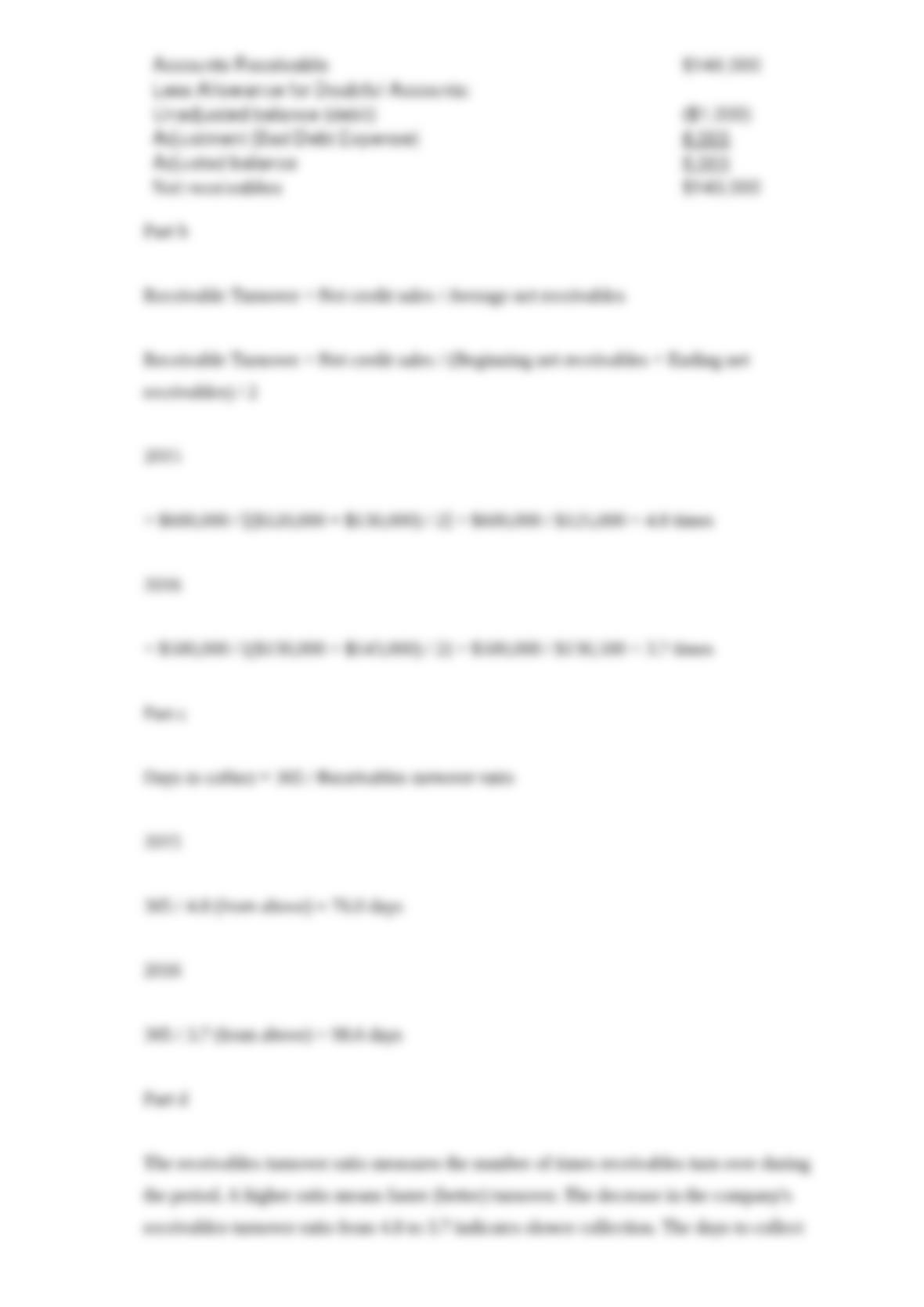
The records of Alberta Inc. included the following information:
Use the information above to answer the following question. What is the number of

days to sell?
A) 91.25 days
B) 94.30 days
C) 88.16 days
D) 182.50 days
Geisel, Inc. reported net sales revenue of $600,000 in 2015 and $500,000 in 2016. The
company’s average net receivables were $120,000 during 2014 and $130,000 during
2015. At December 31, 2016, the company had Accounts Receivable of $148,000 and
an unadjusted debit balance in its Allowance for Doubtful Accounts account of $1,000.
The company reported Bad Debt Expense of $6,000 during 2015.
Required:
Part a. Determine the net receivables at December 31, 2016.
Part b. Calculate the receivables turnover ratio for 2015 and 2016. (Round each
calculation to one decimal place).
Part c. Calculate the days to collect for 2015 and 2016. (Round each calculation to one
decimal place).
Part d. Interpret the results of this analysis.
Part e. Identify possible reasons for the changes in these two ratios from 2015 to 2016.
Under the periodic inventory system:
A) inventory records are updated immediately after each purchase.
B) inventory must be counted at the end of each accounting period.
C) inventory does not have to be counted. (It can be taken from the accounting records.)
D) inventory levels must be counted every day.
Which of the following would be included in cash flows from investing activities?
A) Cash collected from customers
B) Cash received from an issuance of bonds
C) Cash dividends paid
D) Cash used to purchase equipment
Which of the following journal entries would decrease stockholders’ equity?
A) Debit Prepaid Insurance and credit Cash
B) Debit Unearned Revenue and credit Service Revenue
C) Debit Supplies and credit Accounts Payable
D) Debit Insurance Expense and credit Cash
At the end of the accounting period:
A) all accounts are closed.
B) temporary accounts are closed; permanent accounts are not.
C) permanent accounts are closed; temporary accounts are not.
D) only accounts with a credit balance are closed.
Which of the following bank reconciliation items would notresult in a journal entry?
A) Service charge
B) Outstanding checks
C) A customer’s check returned NSF
D) Interest earned on deposits