During June, the Grass is Greener Company mows 100 lawns a week and is paid in July
by those customers. The company uses the accrual basis of accounting. How will these
events affect the company’s financial statements?
A. The income statement shows the effects of the transactions in June.
B. The income statement shows the effects of the transactions in July.
C. The balance sheet shows no effect from the transactions in June.
D. The transactions have no effect on the balance sheet.
Answer:
If a company is trying to maximize its perceived value to external decision makers, the
company is most likely to
A. understate the current assets.
B. understate the long-term liabilities.
C. understate the retained earnings.
D. understate the contributed capital.
Answer:
If a company’s Earnings per Share and Return on Equity rise:
A. it could mean that net income is rising or it could mean that the number of
outstanding shares is falling. The first is sustainable; the second cannot be continued
indefinitely.
B. it means that the company is becoming more profitable and stockholders will see
greater returns.
C. it means that the company’s tax liability will rise in the future and cause a decline in
profitability.
D. it could mean that net income is rising or it could mean that the number of
outstanding shares is falling. In either case, stockholders can expect greater future
returns indefinitely.
Answer:
Net income appears on which of the following financial statements?
A. Balance sheet and income statement.
B. Balance sheet and retained earnings statement.
C. Balance sheet and cash flow statement.
D. Income statement and retained earnings statement.
Answer:
Cash flow management may be more challenging for a merchandiser than a service
business for which of the following reasons?
A. A merchandiser has greater operating expenses.
B. Merchandisers sell on account, whereas service businesses make cash sales.
C. A merchandiser’s cost of goods sold is greater than a service company’s cost of
services provided.
D. Merchandisers must buy inventory before they can make a sale.
Answer:
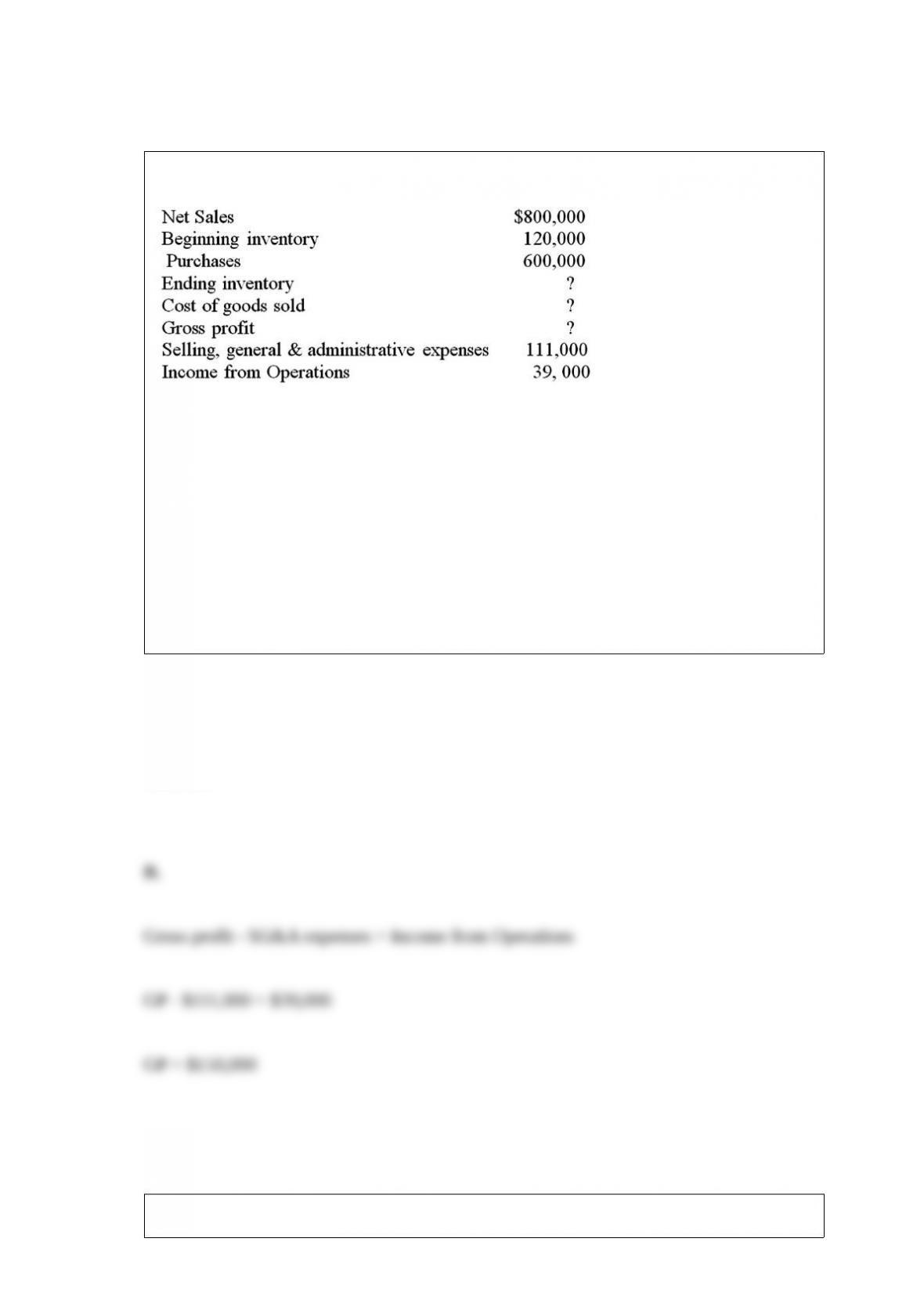
Use the information above to answer the following question. What is the amount of the
gross profit?
A. $720,000
B. $150,000
C. $200,000
D. $72,000
Answer:
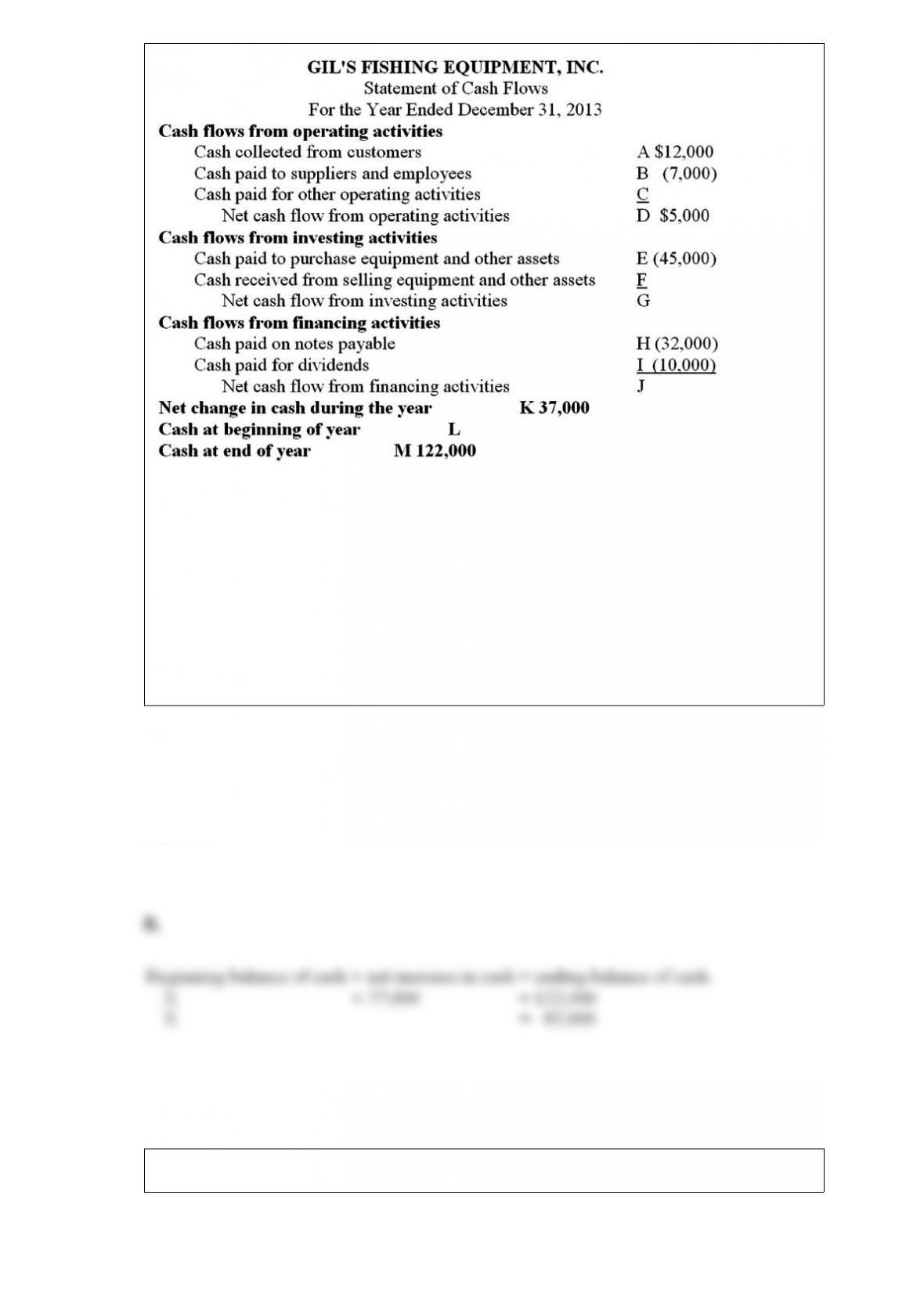
In the statement of cash flows, what amount is represented by letter L?
A. $159,000
B. $85,000
C. ($85,000)
D. ($159,000)
Answer:
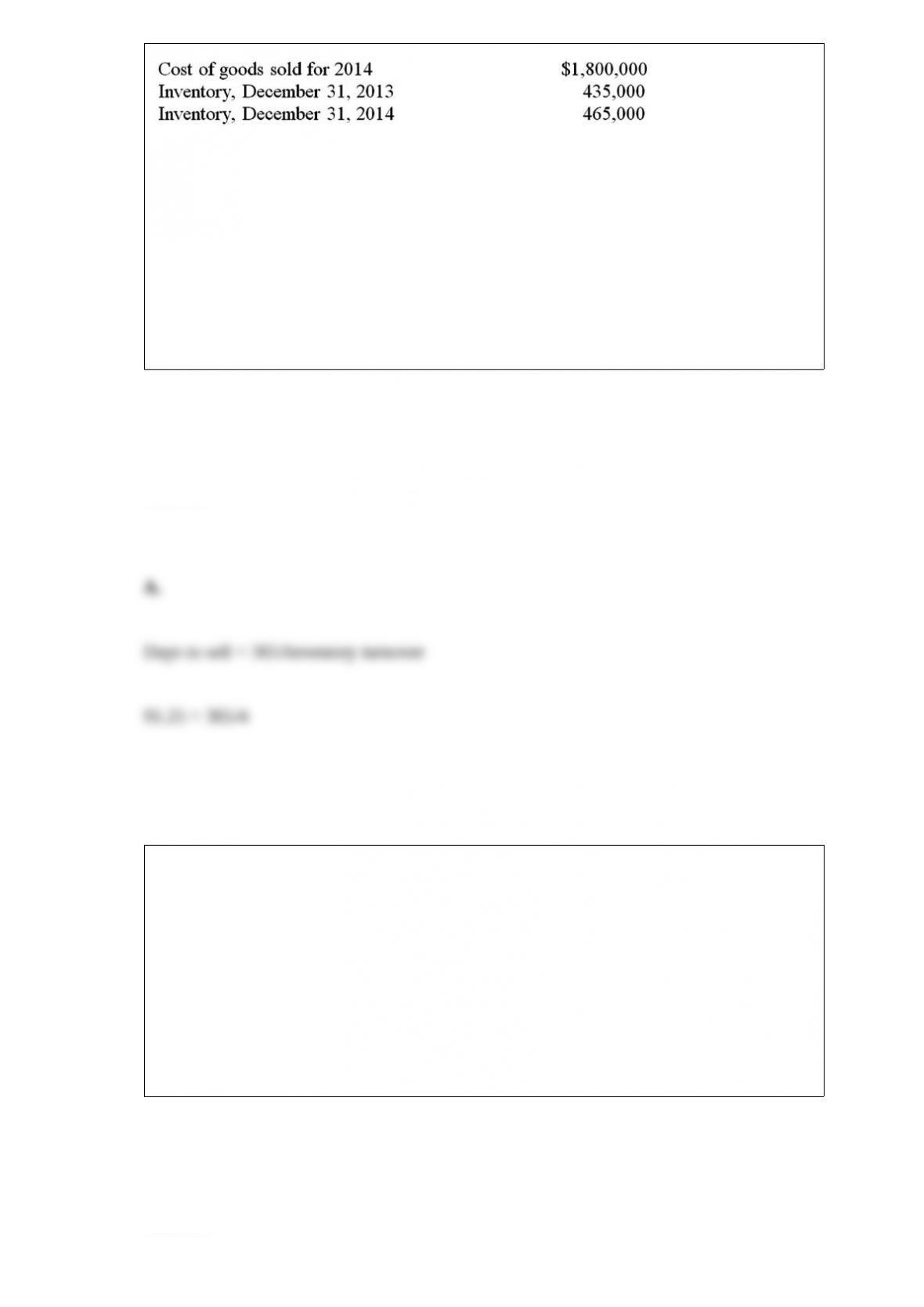
Use the information above to answer the following question. Days to sell for 2014 is:
A. 91.25.
B. 94.3.
C. 88.16.
D. 182.5.
Answer:
Failure to accrue wages would not affect which one of the following financial
statements?
A. Balance sheet.
B. Income statement.
C. Retained earnings statement.
D. Cash flow statement.
Answer:
Some bonds allow the issuing company to retire the bond with cash at any time. These
bonds are known as:
A. convertible bonds.
B. debenture bonds.
C. callable bonds.
D. coupon bonds.
Answer:
Which of the following types of items would you be most likely to see below the
income tax expense line on an income statement prepared in 2014?
A. Gain on Sale of Discontinued Operations, Net of Tax
B. Gross Profit
C. Cumulative Effect of Accounting Change
D. Salaries Expense
Answer:
During the month, a company uses up $4,000 of supplies. At the end of the month, the
related adjusting journal entry would result in:
A. a decrease in an asset and an equal decrease in expenses.
B. an increase in an asset and an equal increase in expenses.
C. a decrease in an asset and an equal increase in expenses.
D. an increase in an asset and a decrease in expenses.
Answer:
What is the annual rate of interest being charged on a 9-month note receivable of
$50,000 if the total interest is $3,000?
A. 6%
B. 8%
C. 12%
D. 10%
Answer:
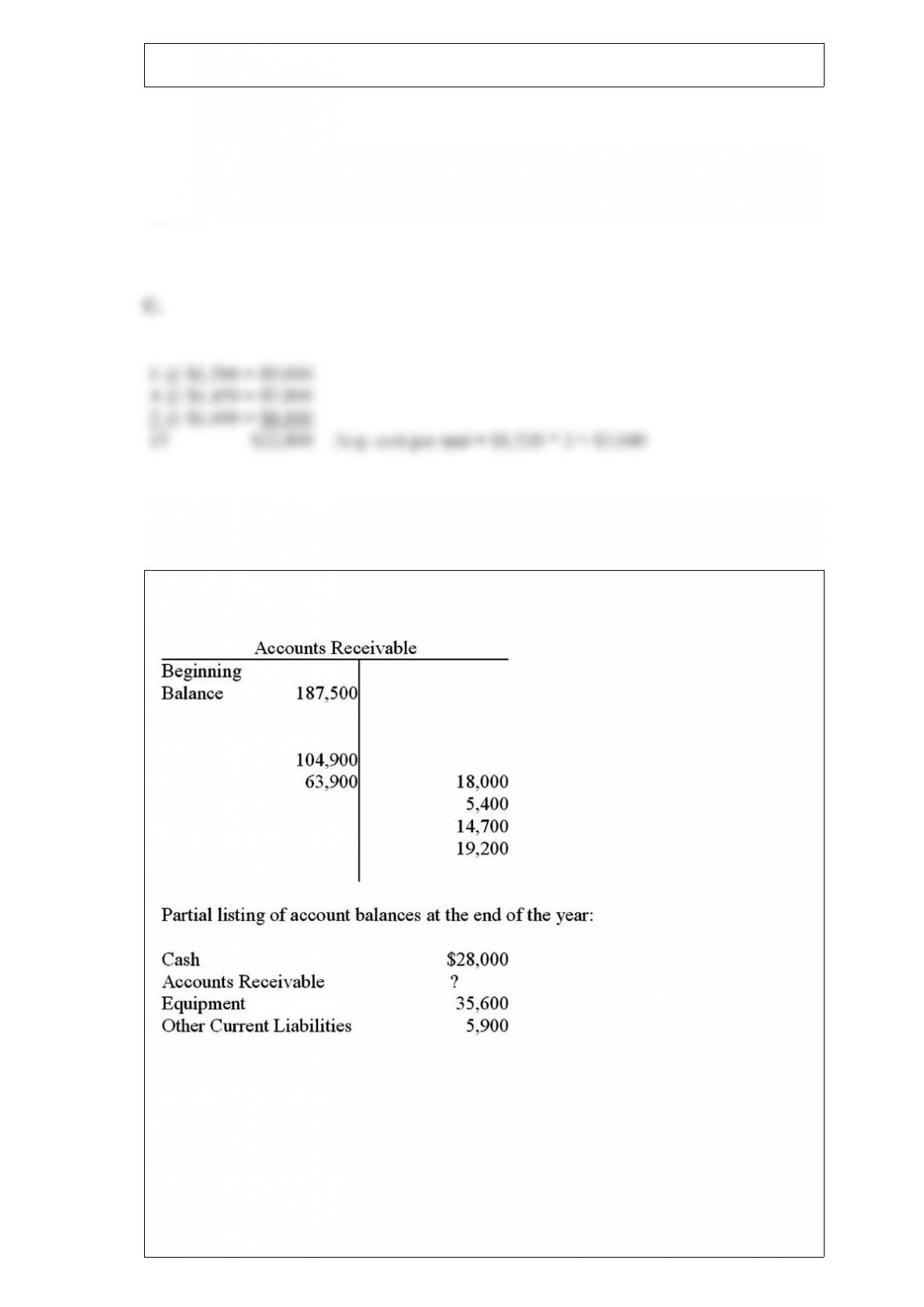
In March, BetterBuy purchases six plasma TVs from Toshiba for $1,500 each (serial
numbers 11534892 through 11534897). In April, the company purchases four more
identical TVs from Toshiba for $1,450 each (serial numbers 11542631 through
11542634). In May, the company purchases five more identical TVs for $1,600 each
(serial numbers 11550964 through 11550968). In June, BetterBuy sells two of these
TVs (serial numbers 11534894 and 11542631).
Use the information above to answer the following question. If BetterBuy uses the
weighted average method, its cost of goods sold will be:
A. $2,900.
B. $2,950.
C. $3,040.
D. $3,033.
Answer:
The amount of Total Current Assets that would be reported on the company’s balance
sheet at the end of the year would be:
A. $362,600.
B. $368,500.
C. $139,500.
D. $327,000.
Answer:
Freight costs incurred when a long-lived asset is purchased should generally be
A. expensed in the period incurred.
B. deducted from the accumulated depreciation account.
C. added to the cost of the asset.
D. not recorded in the accounts.
Answer:
Which of the following ratios is used to evaluate a company’s liquidity?
A. Debt to assets ratio.
B. Asset turnover ratio.
C. Return on equity ratio.
D. Current ratio.
Answer:
When evaluating its net profit margin for 2015, Coca Cola would most likely use all of
the following benchmarks except:
A. Anheuser Busch’s net profit margin for 2015.
B. Coca Cola’s net profit margin for 2014.
C. Pepsico’s net profit margin for 2015.
D. The average net profit margin for the soft drink manufacturing industry for 2015.
Answer:
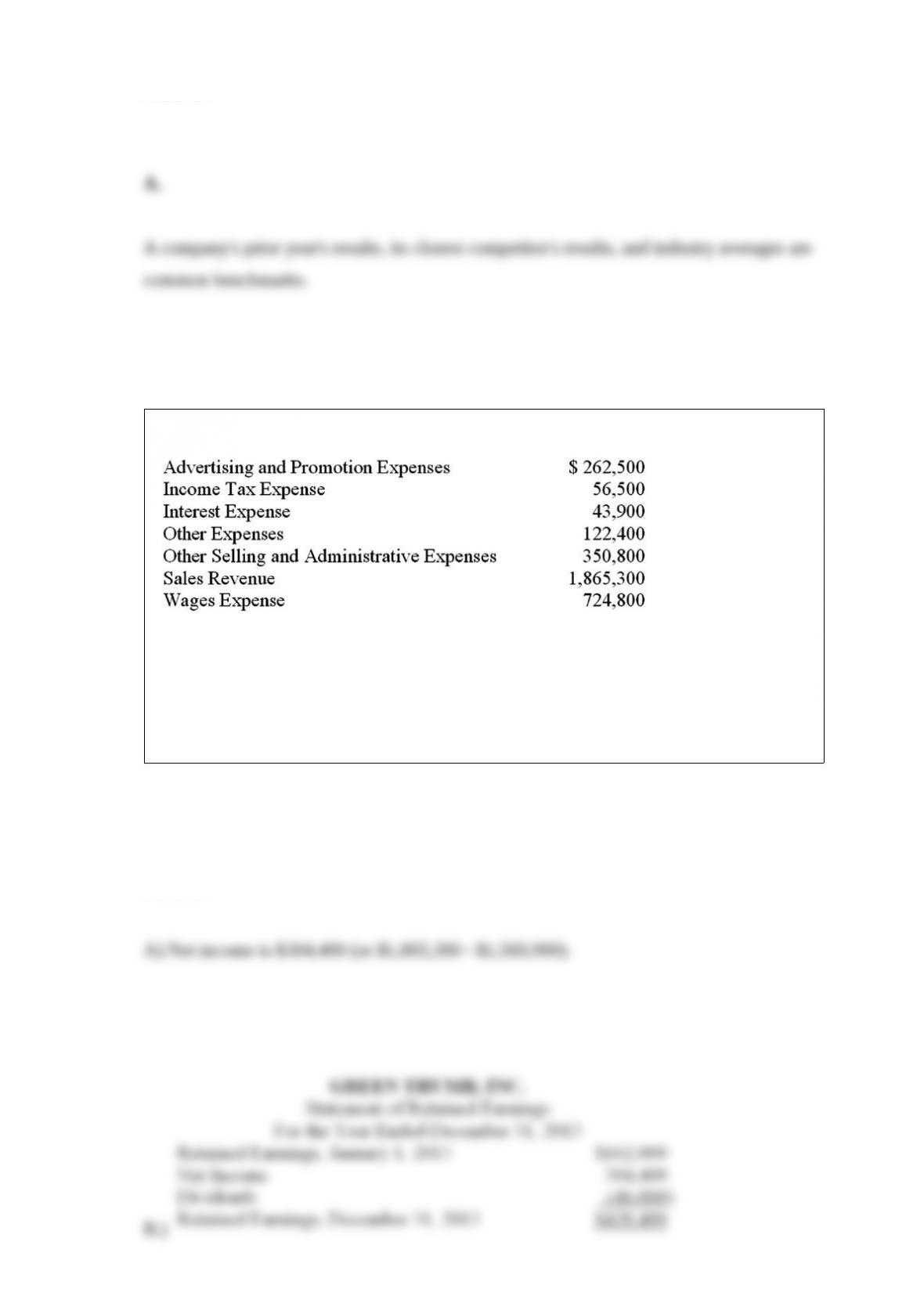
A list of 2013 revenues and expenses for Green Thumb, Inc. is provided below
A) Calculate the net income for the Green Thumb, Inc. for 2013.
B. Prepare a retained earnings statement for Green Thumb, Inc. for 2013. Assume the
company had retained earnings of $162,000 as of January 1, 2013, and paid out $46,000
in dividends during the year,
Answer:
Which of the following is a valid reason for a company to forgo a discount on a
purchase made under terms 2/10, n/30?
A. The company does not have the cash and would have to borrow funds to pay the
invoice within the discount period.
B. The interest rate the company can earn on investments exceeds the annualized
discount rate.
C. The company plans to return some of the merchandise before the end of the credit
period.
D. Other suppliers offer a 1% discount for prompt payment.
Answer:
A company acquired property that included land, building and equipment for a total
cost of $163,000. The land was appraised at $87,500, the building at $35,000, and the
equipment at $52,500. What should be the allocation of the total cost in the accounting
records?
A. Land $75,000; Building $30,000; Equipment $45,000.
B. Land $75,000; Building $30,800; Equipment $46,200.
C. Land $87,500; Building $35,000; Equipment $52,500.
D. Land $81,500; Building $32,600; Equipment $48,900.
Answer:
A company has current assets of $450,000 and a current ratio is 2.5. Assume that the
company prepays rent for 9 months in the amount of $20,000. The current ratio after
this transaction is closest to
A. 2.39
B. 2.61
C. 2.5
D. 2.81
Answer:
If certain assets are partially used up during the accounting period, then:
A. nothing is recorded on the financial statements until they are completely used up.
B. a liability account is decreased or eliminated and an expense is recorded.
C. an asset account is decreased or eliminated and an expense is recorded.
D. nothing is recorded on the financial statements until they are replaced or replenished.
Answer:
Your company buys a computer server which it expects to use for eight years and then
sell when it upgrades to a more powerful model. The server would probably be used by
the business that buys it at that time for another three years. The useful life of the server
for your company is:
A. eight years.
B. eleven years.
C. five years.
D. three years.
Answer:
Arid Company has a quick ratio of 0.90. Which of the following, if it occurred on the
last day of the accounting period, would increase Arid’s quick ratio?
A. Borrowing with a short-term promissory note.
B. Paying off some accounts payable.
C. Accruing interest payable on its promissory notes.
D. Purchasing inventory on account.
Answer:
On the balance sheet, the allowance for doubtful accounts:
A. is included in current liabilities.
B. increases the reported net value of accounts receivable.
C. appears under the heading “Other Assets.”
D. is deducted from accounts receivable.
Answer:
An error in the ending inventory one period causes an offsetting error in the next period,
and as a result:
A. it affects only income statement accounts.
B. it affects only balance sheet accounts.
C. management can ignore the error.
D. it is a self-correcting or counter-balancing error.
Answer:
Which of the following is correct?
A. Management is under constant pressure from directors to produce pleasing financial
results, whatever it takes.
B. Directors oversee the managers of the company and have the primary goal of
ensuring that financial decisions benefit management.
C. Managers oversee the members of the Board of Directors.
D. The stockholders elect the board of directors.
Answer:
The following accounts are taken from the December 31, 2013, financial statements of
A to Z Advertising Company:
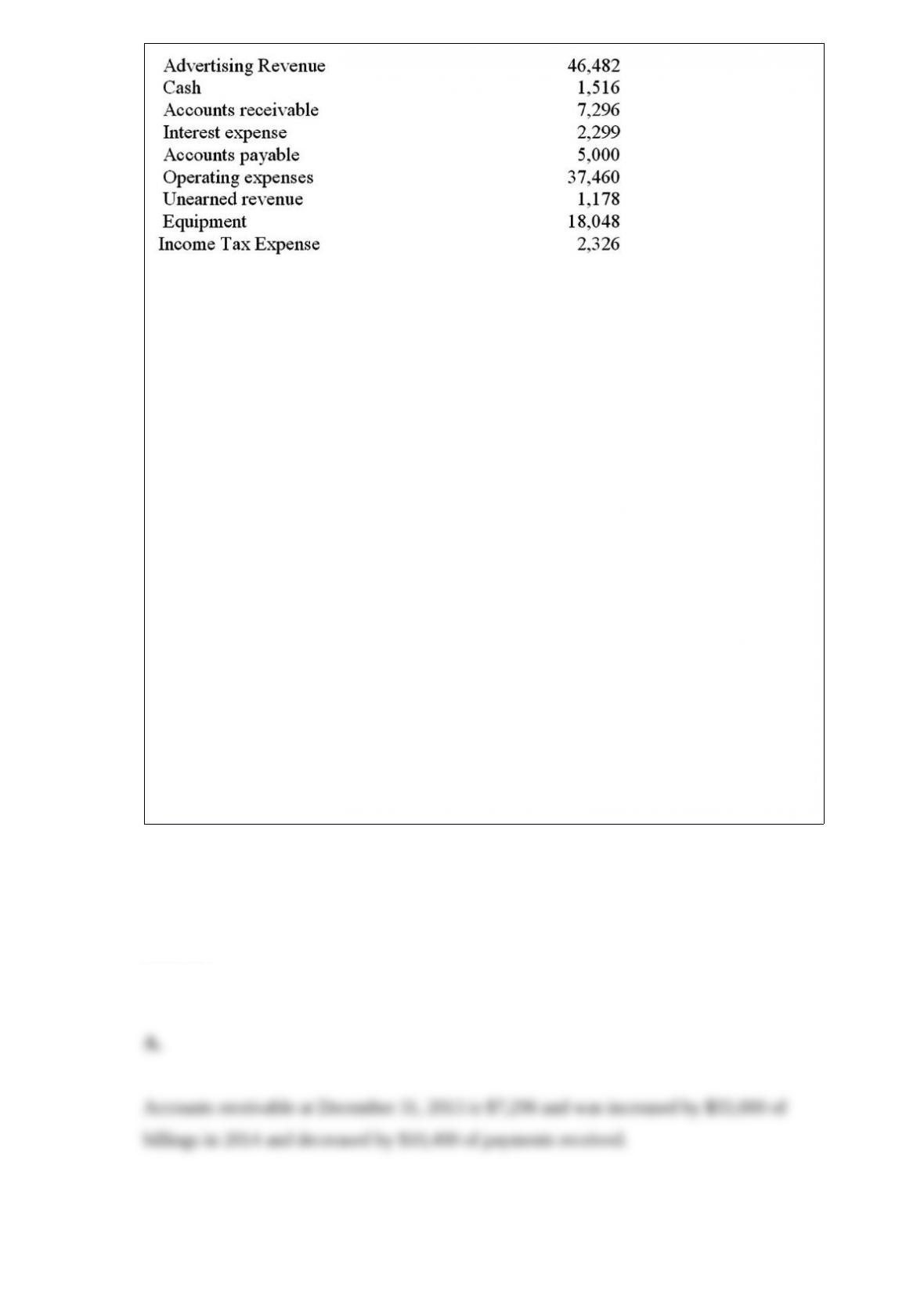
The following activities occurred in 2014:
1. Billed customers for advertising services rendered, $55,000.
2. Received cash from customers in payment of their accounts, $10,400.
3. Incurred $45,000 of operating expenses of which $39,000 was paid in cash and
$6,000 was on account and unpaid as of the end of the year.
4. Paid suppliers $5,000 on the accounts payable.
5. Received deposits from customers of $2,500 for advertising services to be performed
in 2015.
What is the amount of Accounts receivable at the end of 2014?
A. $51,896
B. $55,000
C. $44,600
D. $54,396
Answer:
All other things being equal, a company is better off when its receivable turnover ratio:
A. and its days-to-collect measure are both low.
B. is high and its days-to-collect measure is low.
C. and its days-to-collect measure are both high.
D. is low and its days-to-collect measure is high.
Answer:
The potential disadvantages of extending credit include all of the following except
which one?
A. Increased borrowing costs.
B. Customers buy too much.
C. The need for a collections department.
D. More staff hours spent in the accounting department.
Answer:
The ratio that measures the company’s ability to meet required interest payments is the:
A. Debt to equity ratio.
B. Current ratio.
C. Price/earnings ratio.
D. Times interest earned ratio.
Answer:
Stock dividends and stock splits are similar in all of the following ways except
A. they both involve a pro rata distribution of shares to existing stockholders.
B. they both reduce the stock price.
C. they both decrease retained earnings.
D. have no effect on cash.
Answer:
A ratio that may be used to evaluate solvency is the:
A. Asset turnover ratio.
B. Quick ratio.
C. Current ratio.
D. Times interest earned ratio.
Answer:
Using straight-line amortization, when a bond is sold at a discount:
A. bonds payable declines by a constant amount each year.
B. interest expense declines by a constant amount each year.
C. bonds payable, net of discount, declines by a constant amount each year.
D. interest expense is a constant amount each year.
Answer: