Discounting a future amount of a cash receipt will determine the present value of that
receipt.
Having a liability that is fixed in terms of a foreign currency results in a loss for the
debtor if the exchange rate falls between the transaction date and the payment date.
The most common method to allocate joint costs is in proportion to the relative sales
value of the products.
Common fixed costs jointly benefit several parts of the business and would not change
significantly even if one of the parts of the business were discontinued.
Preferred stockholders generally do not have the same voting rights as do common
stockholders in a corporation.
A statement of stockholders’ equity is not a required financial statement and need not be
prepared along with a statement of retained earnings.
While the price-earnings ratio is computed using historical earnings, it reflects
investors’ expectations of future earnings.
The acquiring of a subsidiary company by a publicly traded company would be an
example of a capital expenditure.
Product costs are charged directly to expense accounts.
Short-term investments in marketable securities may not be reported in the balance
sheet at values higher than original cost.
In capital budgeting, the investment proposal with the shortest payback period always
has the highest rate of return.
Most disclosures appear within the body of the financial statements; however, a few
disclosures may also appear in the notes that accompany the financial statements.
The payment of cash dividends to common stockholders is classified as a financing
activity on the statement of cash flows whereas payment of a cash dividend to preferred
stockholders is classified as an investing activity.
To increase return on sales, a manager could decrease cost of goods sold while
increasing revenues.
Financial assets may be current or long-term assets.
A major purpose of using an Allowance for Doubtful Accounts is to recognize
uncollectible accounts expense in the same accounting period as the related sales which
caused the expense.
A budget provides a comprehensive plan enabling multiple departments to work
together in a coordinated manner.
A cost that is directly traceable to a particular center must be a variable cost.
The LIFO conformity requirement permits a company to use LIFO for tax purposes
only if the company also uses LIFO for internal reporting purposes.
A partnership has a limited life and each partner has unlimited personal liability.
Every transaction which affects an income statement account also affects a balance
sheet account.
The residual value of an asset should be subtracted from the cost of the asset when
determining the average amount invested.
If the maker of a note defaults, an entry is made which debits Accounts Receivable and
credits Notes Receivable.
Charges for depositing NSF checks are an example of a transaction that has been
recorded by the depositor but may not have been recorded by the bank.
A trial balance that balances provides proof that all transactions were correctly
journalized and posted to the ledger.
A dollar that is stronger than the British pound would make travel to the United States
more attractive to British citizens.
The statement of financial position and the income statement are one and the same.
An accounting practice can become a “generally accepted accounting principle” through
widespread use, even if the practice is not mentioned in the official pronouncements of
the accounting standard-setting organizations.
Stockholders of a corporation are personally liable for the debts of the corporation if all
shares of stock are owned by the officers of the corporation.
An annuity due assumes the cash flow will occur at the beginning of the period.
Stock splits:
A. Allow management to conserve cash.
B. Give stockholders more shares.
C. Cause no change in total assets, liabilities, or stockholders’ equity.
D. Allow management to conserve cash, give stockholders more shares, and cause no
change in total assets, liabilities, or stockholders’ equity.
On November 1, 2014, Salem Corporation sold land priced at $900,000 in exchange for
a 6%, six-month note receivable.
Refer to the information above. Salem’s balance sheet at December 31, 2014 includes
which of the following as a result of the sale of land on November 1?
A. Notes Receivable of $900,000 and Interest Receivable of $9,000.
B. Notes Receivable of $927,000 and Interest Receivable of $9,000.
C. Notes Receivable of $900,000 and Interest Receivable of $27,000.
D. Notes Receivable of $900,000 only.
A cost that has already been incurred and cannot be changed is called a(n):
A. Opportunity cost.
B. Out-of-pocket cost.
C. Joint cost.
D. Sunk cost.
At the beginning of the year, Robert Company’s Allowance for Doubtful Accounts had a
$3,200 credit balance. During January, a provision of 2% of sales was made for
uncollectible accounts expense. During January, sales totaled $350,000, and $2,900 of
accounts receivable were written off as worthless. No recoveries of accounts previously
written off were made during the month. Robert’s financial statements for January
show:
A. Allowance for Doubtful Accounts with a credit balance of $10,200.
B. Allowance for Doubtful Accounts with a credit balance of $7,300.
C. Uncollectible Accounts Expense of $9,900.
D. Uncollectible Accounts Expense of $4,100.
To compute a future amount from a present value, we need to know:
A. The future value and length of time.
B. The interest rate and length of time.
C. The future annuity amount.
D. The present annuity amount.
The time value of money is based on the idea that:
A. The value of money in the future equals the interest received in the present.
B. The value of money in the future will be greater than an amount available today.
C. The value of money at present over some length of time will be reduced by inflation.
D. The future value of money will become the current value as time passes.
Grand Gimmicks Company produces a single product with a current selling price of
$170. Variable costs are $130 per unit, and fixed costs per month average $6,240.
Management is considering increasing the selling price to $190 per unit. Assume that
the variable cost per unit of the product and monthly fixed expenses will not change as
a result of the proposed increase in selling price.
Refer to the information above. At the current selling price of $170 per unit, closest to
what dollar volume of sales per month is required for Grand Gimmicks to break-even?
(Round your intermediate percentage to one decimal place.)
A. $6,178.
B. $8,299.
C. $26,553.
D. $20,800.
Net income in a partnership may not be distributed to the partners:
A. As a salary allowance.
B. As interest on beginning capital.
C. In a fixed ratio.
D. In the form of dividends.
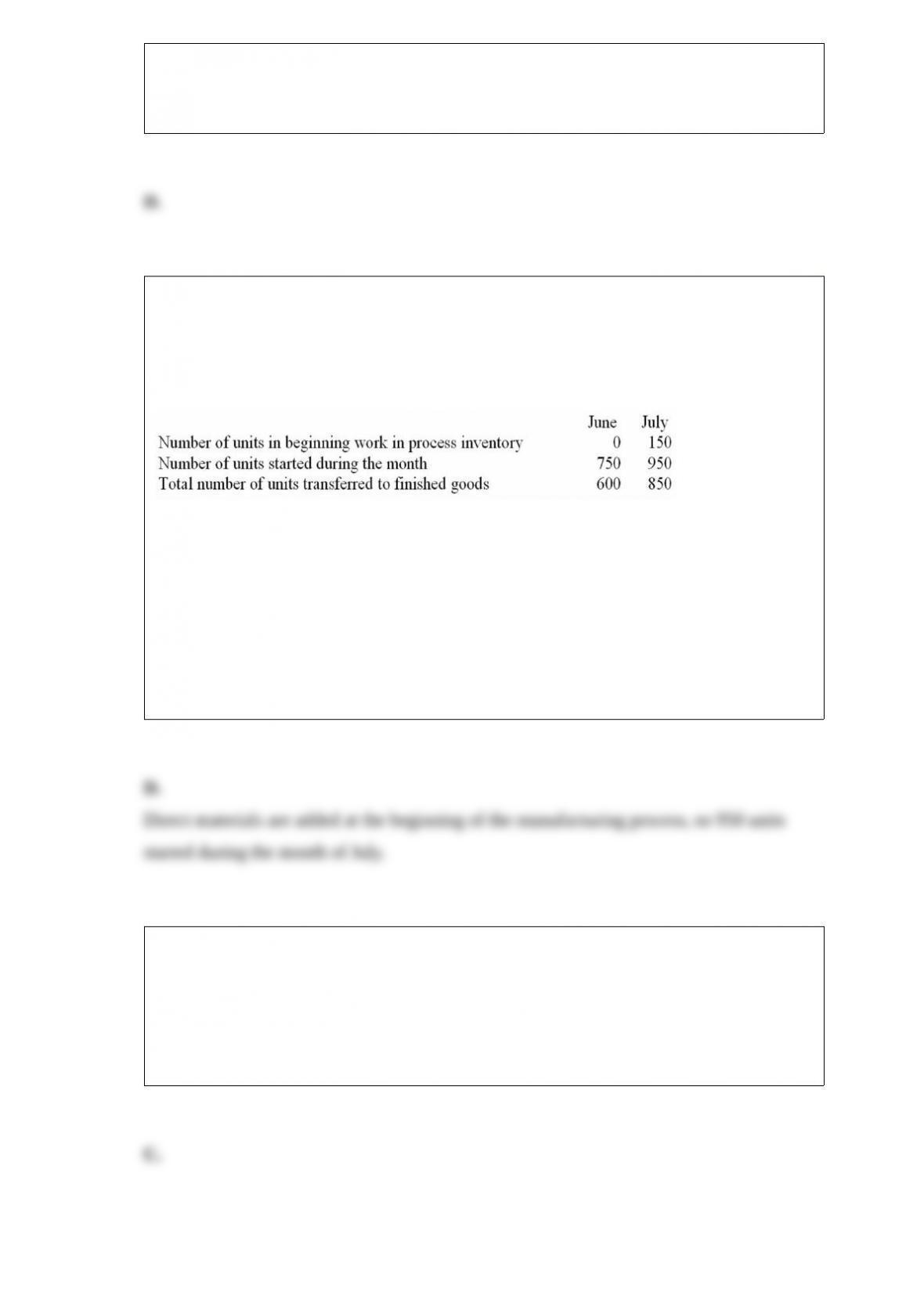
Aves Treats, Inc. produces bird seeds. All direct materials used in the production
process are added at the beginning of the manufacturing process. Labor and overhead
are added evenly thereafter, as each unit is mixed and packaged. Aves Treats uses
process costing and had the following unit production information available for the
months of June and July:
The units remaining in work in process at the end of June were 30% complete. During
the month of July, all of the beginning work in process units was completed and the
units remaining in work in process at the end of the month were 60% complete.
Refer to the information above. For the month of July, the number of equivalent units of
direct materials produced was:
A. 700.
B. 800.
C. 900.
D. 950.
Ben Dryden, president of Jet Glass, Inc, noticed a $8,000 debit to Accounts Payable in
the company’s general ledger. This debit could correspond to:
A. A $8,000 sale to a customer.
B. A purchase of equipment costing $8,000 on credit.
C. A payment of $8,000 to a supplier to settle a balance due.
D. The failure to pay this month’s $8,000 utility bill on time.
The book value of equipment:
A. Increases with the passage of time.
B. Decreases with the passage of time.
C. Remains the same with the passage of time.
D. May increase or decrease depending upon the economy.
Grand Gimmicks Company produces a single product with a current selling price of
$170. Variable costs are $130 per unit, and fixed costs per month average $6,240.
Management is considering increasing the selling price to $190 per unit. Assume that
the variable cost per unit of the product and monthly fixed expenses will not change as
a result of the proposed increase in selling price.
Refer to the information above. At the current selling price of $170 per unit, the
contribution margin ratio is closest to:
A. 23.5%.
B. 76%.
C. 34%.
D. 21%.
Adjusting entries are needed:
A. Whenever revenue is not received in cash.
B. Whenever expenses are not paid in cash.
C. Only to correct errors in the initial recording of business transactions.
D. Whenever transactions affect the revenue or expenses of more than one accounting
period.
Capital expenditures are recorded as:
A. An expense.
B. An asset.
C. A liability.
D. Income.
The measures used by an organization to provide reasonable assurance that the
organization produces reliable financial reports, complies with applicable laws and
regulations, and conducts its operations in an efficient and effective manner are
collectively referred to as:
A. Generally accepted accounting principles.
B. Financial accounting standards.
C. Securities and exchange regulations.
D. The internal control structure.
Sultan Company produces a single product. The selling price is $50 per unit, and
variable costs amount to $20 per unit. Sultan’s fixed costs per month total $80,000.
Refer to the information above. What will be Sultan’s monthly operating income if
3,700 units are sold each month?
A. $15,000.
B. $31,000.
C. $75,000.
D. $105,000.
The ratio which measures total liabilities as a percentage of total assets is called:
A. Current ratio.
B. Working capital.
C. Debt ratio.
D. Quick ratio.
Flow of manufacturing costs
The “flow” of manufacturing costs through the ledger of Wolpe Mfg. Co. during the
month of October is summarized in the following T accounts. Certain amounts have
been omitted and are represented by question marks.
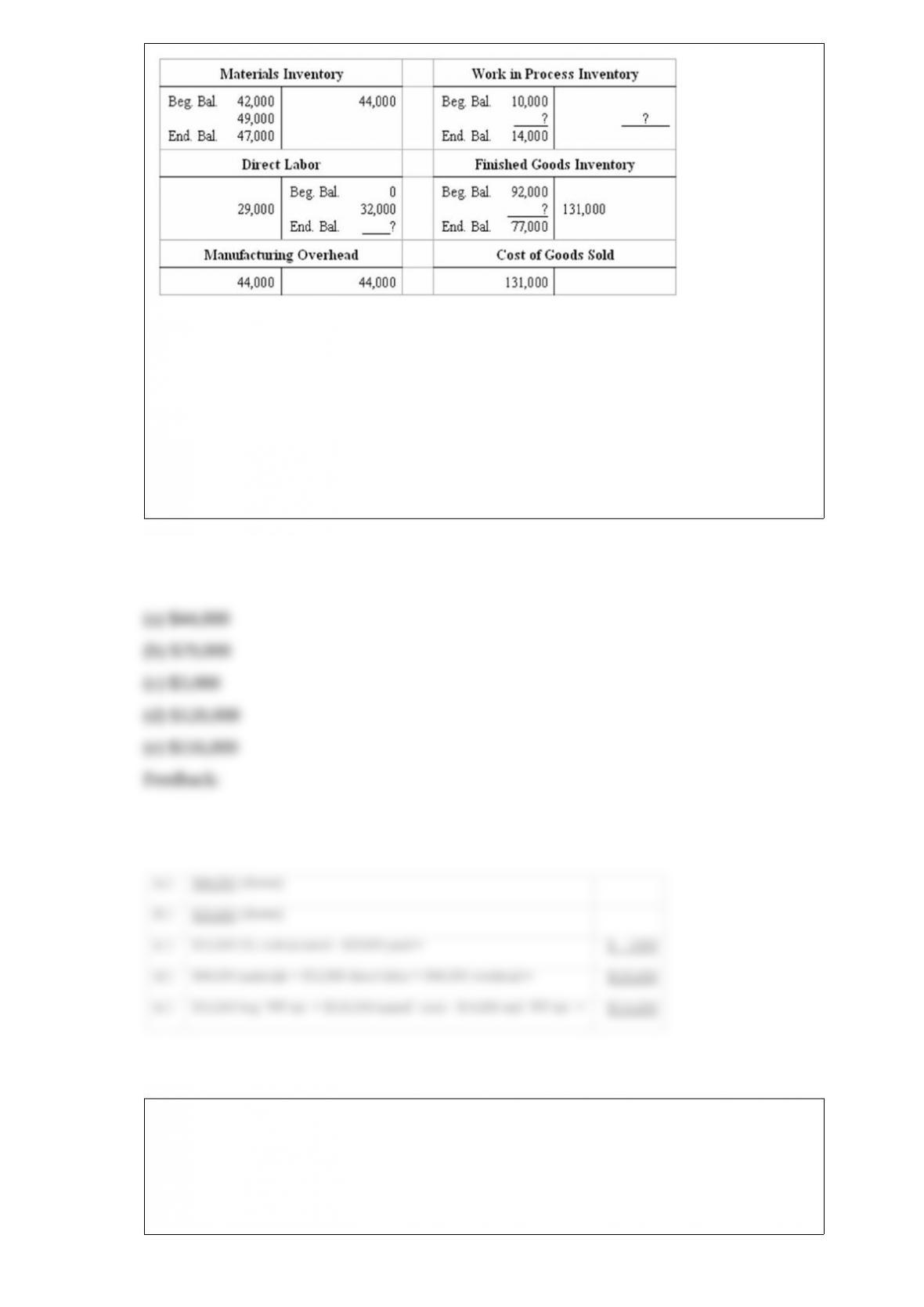
From the data supplied above, determine each of the following amounts. Some of the
required amounts already appear in the T accounts; others require a short computation.
(a) The amount of direct materials used during the month: $___________
(b) The amount paid to direct labor workers during the month: $___________
(c) The amount of accrued wages payable to direct labor workers at October 31:
$___________
(d) Total manufacturing costs charged (debited) to the Work in Process Inventory
account during the month: $___________
(e) The cost of finished goods manufactured during the month: $___________
Which of the following is not an advantage of using a standard cost system?
A. It eliminates the need for analysis of variances.
B. It facilitates establishing an effective system of responsibility accounting.
C. It requires an analysis of all aspects of operations.
D. It helps management control costs.
For financial reporting purposes, the gain or loss on the sale of a plant asset is
determined by comparing the asset’s:
A. Cost with its book value.
B. Sales price with its book value.
C. Tax basis with its book value.
D. Sales price with its tax basis.
Shown below is the adjusted Trial Balance for Simon Inc., on December 31, after the
first year of operations, after adjusting entries:
Refer to the information above. Income Summary will have what balance before it is
closed?
A. $28,640.
B. $15,600.
C. $21,920.
D. $16,640.
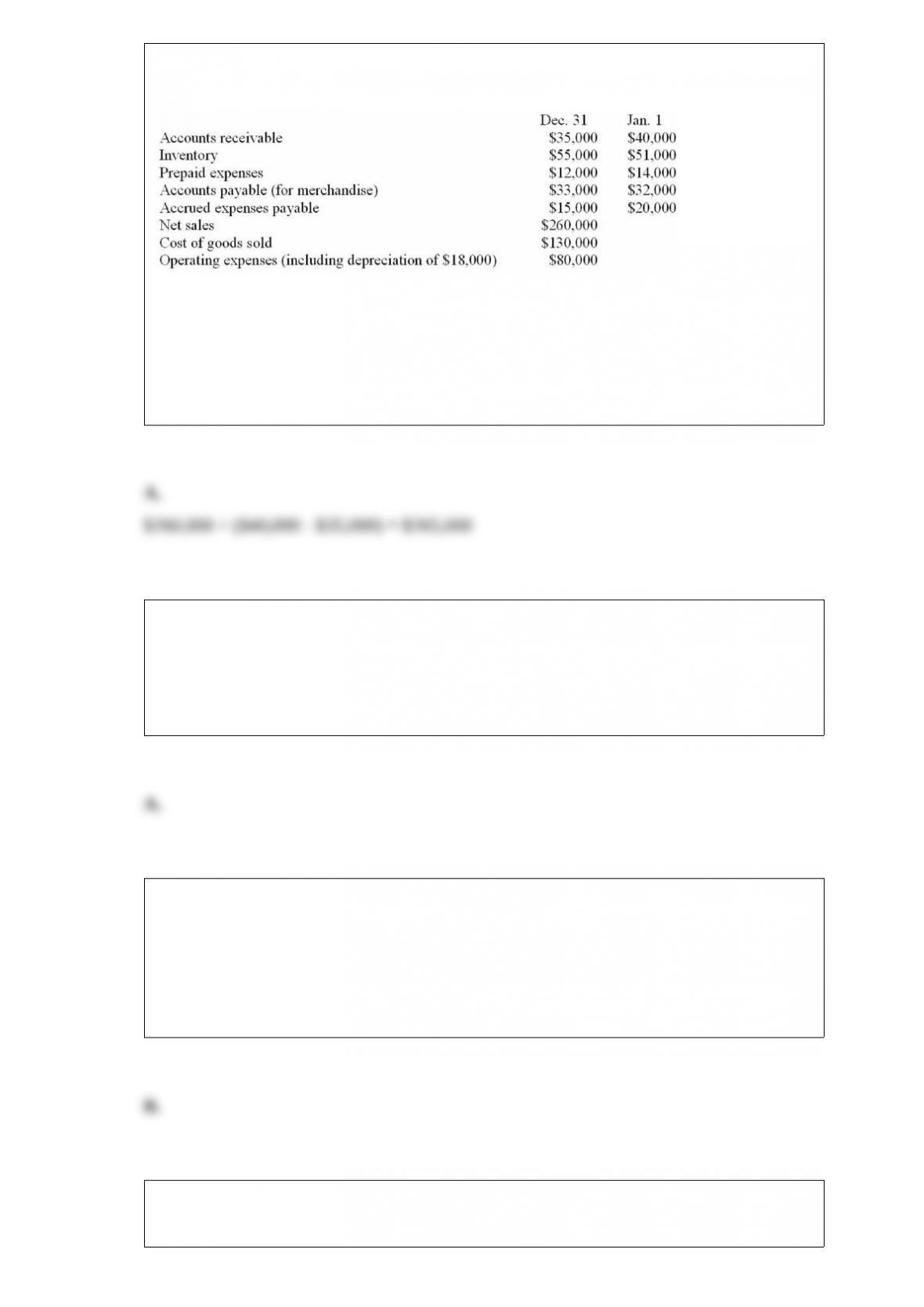
The financial statements of Seldin, Inc., provide the following information for the
current year:
Refer to the information above. Compute the amount of cash received from customers
during the current year.
A. $265,000.
B. $255,000.
C. $260,000.
D. $40,000.
Which of the following is a characteristic of financial accounting information?
A. Its preparation requires judgment.
B. It is more about the future than it is about the past.
C. None of it is based on estimates, assumptions, and judgments.
D. Notes and explanations from management are not included.
In an activity-based costing system, manufacturing overhead costs are divided into
separate:
A. Cost drivers.
B. Activity cost pools.
C. Activity bases.
D. Indirect cost centers.
Refer to the information above. The expected rate of return on average investment of
the machine is:
A. 10%.
B. 17%.
C. 18.6%.
D. 48%.
A rising gross profit rate most strongly suggests:
A. An increase in physical sales volume.
B. Strong consumer demand for the company’s products.
C. Intense competition.
D. Increased short-term solvency.
Shrek Cyclery sells a bicycle to W. O’Connor, a customer who uses Empress Charge (a
national credit card, but not issued by a bank). In recording this sale, Shrek Cyclery
should record:
A. An account receivable from W. O’Connor.
B. A cash receipt.
C. An account receivable from Empress Charge.
D. A small increase in the allowance for doubtful accounts.
If a business ceases operations and liquidates, which of the following will be paid last?
A. Owners.
B. General creditors.
C. Employees.
D. Creditors who have collateral for their loans.
Cranston Instrumentation sold a depreciable asset for cash of $150,000. The original
cost of the asset was $600,000. Cranston recognized a gain of $22,500 on the sale.
What was the amount of accumulated depreciation on the asset at the time of its sale?
A. $472,500.
B. $127,500.
C. $577,500.
D. $495,000.
Interest that has accrued during the accounting period on a note payable requires an
adjusting entry consisting of:
A. A debit to Interest Expense and a credit to Cash.
B. A debit to Notes Payable and a credit to Interest Payable.
C. A debit to an asset and a credit to a liability.
D. A debit to Interest Expense and a credit to Interest Payable.
A call provision on a bond:
A. Permits the corporation to redeem the bonds at a specified price.
B. Allows the corporation to revise the stated interest rate.
C. Allows the corporation to revise the maturity date.
D. Always creates the lowest price at which the bond will sell for.
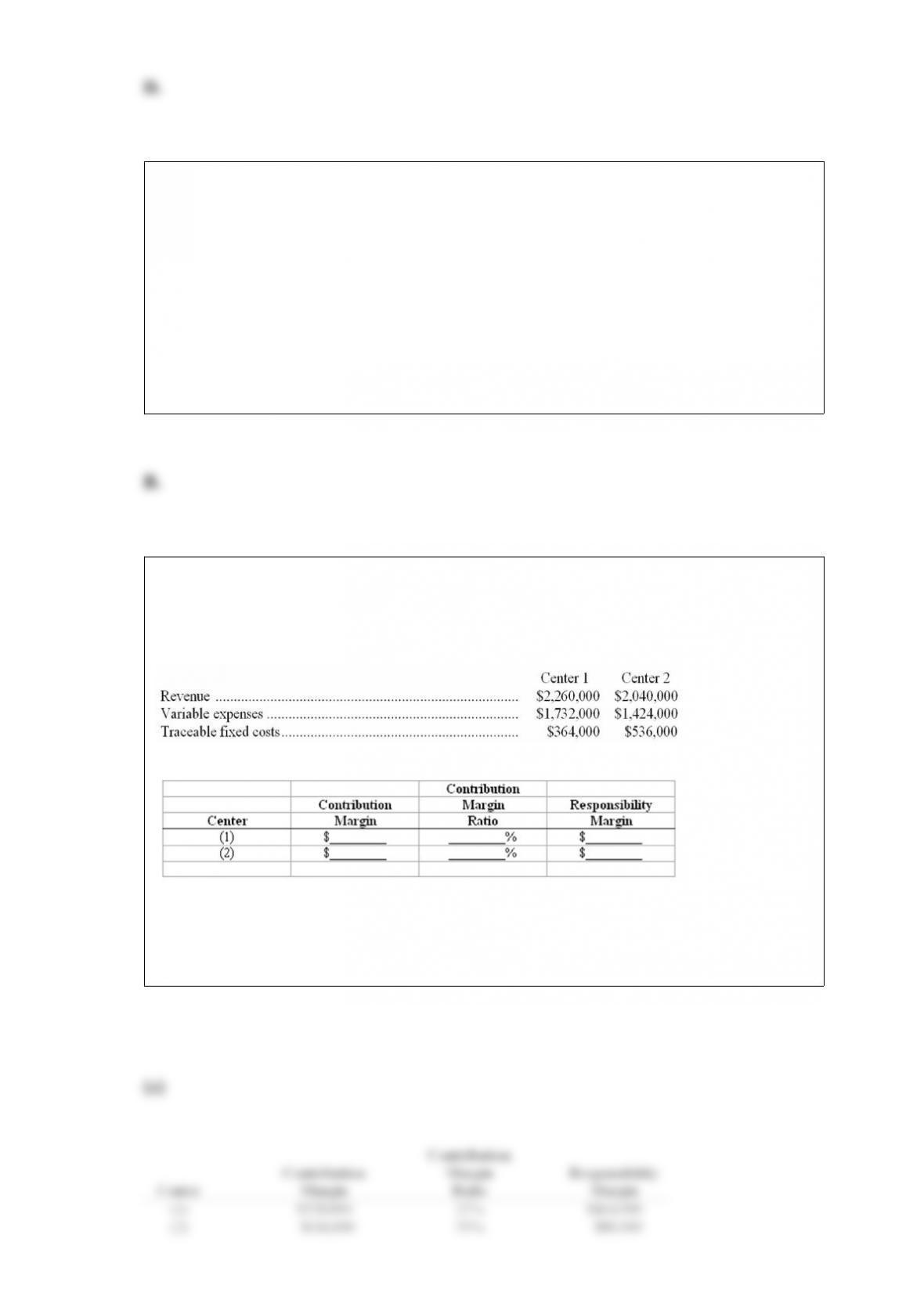
The purchase of treasury stock for cash will have which effect upon the following
items?
A. Option A
B. Option B
C. Option C
D. Option D
An adjusting entry involving recognition of accrued revenue is necessary at the end of
March in which of the following situations?
A. Midwood Consultants received payment in February for consulting services
rendered in March.
B. Midwood Consultants began working for a client on March 15; bills will be sent
monthly beginning April 15.
C. Midwood Consultants made payment in January for office rent for the first three
months of the year.
D. On March 31, a major customer paid his bill for a consulting job completed in
February.
Evaluation of responsibility centers
Shown below are the current-year data for two investment centers of Chelsea Trading,
Inc. The total assets utilized by each of these investment centers during the year amount
to $1,500,000:
(a) Compute the following measures for each investment center:
(b) Assume that a $3,000 monthly expenditure for advertising could increase the
monthly sales of either investment center by $20,000. Which center should the
company advertise to receive the maximum benefit from its advertising expenditure?
Center _________. Explain your reasoning: