
If the upper limit rate of deviation exceeds the tolerable rate of deviation, the auditor
would most likely
A. accept the account balance as fairly stated.
B. reject the account balance as fairly stated.
C. increase the planned effectiveness of substantive procedures.
D. not increase the planned effectiveness of substantive procedures.
What type of evidence would provide the highest level of assurance in an attestation
engagement?
A. Evidence secured solely from within the entity.
B. Evidence obtained from independent sources.
C. Evidence obtained indirectly.
D. Evidence obtained from multiple internal inquiries.
When auditing the revenue and collection cycle, auditors normally select balances to
confirm from the
A. sales journal.
B. accounts receivable listing.
C. general ledger.
D. cash receipts listing.
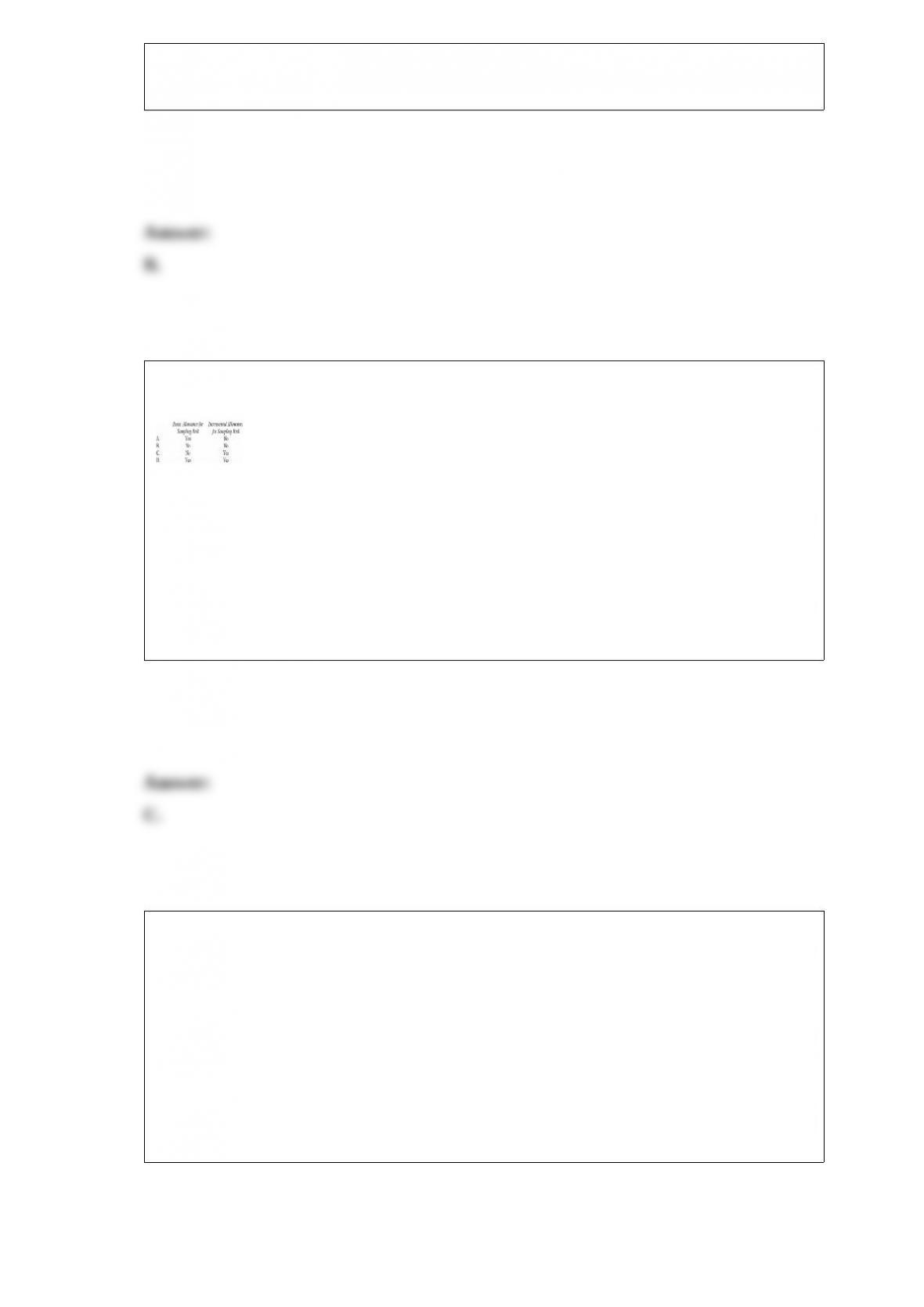
Which of the following components of the upper limit on misstatements is affected by
misstatements detected during the audit examination?
A. Option A
B. Option B
C. Option C
D. Option D
A report that acknowledges reliance on the reports of component auditors is a type of
report modification known as a(n)
A. qualification.
B. division of responsibility.
C. expansion of scope.
D. scope limitation.

Which of the following controls is designed to meet the completeness assertion?
A. Prenumbering invoices, shipping documents, and sales orders.
B. Sales orders are approved by the credit department prior to shipping goods.
C. The sale is to a customer on the approved customer list.
D. Sales are dated by the computer to ensure it is included in the proper period.
A related party is a person or entity that
A. has a family tie to a management member.
B. does business with the company.
C. can exert significant influence over or be influenced by the company.
D. is a member of the company’s management.
Lauren hires Humphrey, a CPA, to audit her financial statements. The engagement letter
includes a statement acknowledging that audited financial statements will be provided

to Key Largo Bank for a loan. Humphrey completes the audit and issues an unqualified
opinion. Based on the audited financial statements, Key Largo Bank approves the loan
to Lauren. Four months later, Lauren files for bankruptcy. Key Largo Bank would most
likely sue Humphrey claiming
A. it was in privity of the contract.
B. it was a primary beneficiary.
C. it was a foreseen party.
D. it was a foreseeable party.
Alpha Brewery Corporation recorded sales through January 4, 2005, dating them
December 31, 2004. This situation is an example of a violation of which of the
following assertions?
A. Existence or occurrence.
B. Completeness.
C. Classification.
D. Accuracy.
When the _____ exceeds the _____, the audit team is exposed to the risk of incorrect
acceptance.
A. upper limit on misstatements; tolerable misstatement

B. tolerable misstatement; expected misstatement
C. tolerable misstatement; upper limit on misstatements
D. upper limit on misstatements; expected misstatement
Which of the following is least related to the concept of independence in appearance?
A. The auditors’ objectivity and ability to act impartially toward the client
B. The perceptions of individuals who rely on the financial statements and auditors’
opinion on the financial statements
C. The ownership of a financial interest in a client by the auditor
D. The employment of the auditor’s family member in an important position with the
client
The probability that an auditor’s conclusion based on a sample might be different from
the conclusion based on the entire population identifies the concept of
A. confidence levels.
B. nonsampling risk.
C. nonstatistical sampling.
D. sampling risk.

Auditors are evaluating an account with a recorded balance of $700,000 using classical
variables sampling. Based on an allowable risk of incorrect acceptance of 10%, the
auditors have determined the following:
– Estimated account balance = $640,000
– Precision = $20,000
– Tolerable misstatement = $50,000
Which of the following best describes the auditors’ decision and rationale for that
decision?
A. The auditors would accept the account balance as fairly stated, since the sample
estimate falls outside of the precision interval.
B. The auditors would conclude that the account balance is not fairly stated, since the
sample estimate falls outside of the precision interval.
C. The auditors would accept the account balance as fairly stated, since the difference
between the upper bound of the precision interval and recorded balance is less than the
tolerable misstatement.
D. The auditors would conclude that the account balance is not fairly stated, since the
difference between the lower bound of the precision interval and recorded balance
exceeds the tolerable misstatement.
The particular and specialized actions that auditors undertake to obtain evidence in a
specific audit engagement are known as
A. Interim Auditing Standards.
B. audit procedures.

C. Interpretive Publications.
D. Statements on Auditing Standards.
Cutoff tests designed to detect purchases made before the end of the year that have been
recorded in the subsequent year most likely would provide assurance about
management’s assertion of
A. valuation or allocation.
B. existence or occurrence.
C. completeness.
D. rights and obligations.
An audit team would be most likely to use attributes sampling in which of the following
situations?
A. Performing analytical procedures during the planning stages of the audit
B. Evaluating management’s integrity during the client acceptance process
C. Determining the effectiveness of the audit committee in evaluating the entity’s
control environment
D. Examining purchase requisitions for proper authorization

The typical assertion relating to investments and related accounts in a manufacturing
company would not include the assertion that
A. all investments are valued at cost.
B. investment securities are on hand or held in safekeeping by a trustee.
C. investment income has been received and recorded.
D. investments are adequately classified and described in the balance sheet, including
disclosures.
The issuance of a disclaimer of opinion generally indicates
A. the auditors cannot form an opinion on the fairness of presentation of the financial
statements as a whole.
B. the auditors have some uncertainties, but these uncertainties are not so material that
they cannot form an opinion on the fairness of presentation of the financial statements
as a whole.
C. the auditors have observed a departure from generally accepted accounting
principles but the departure is not of sufficient materiality to justify a qualified opinion.
D. the auditors have observed a departure from generally accepted accounting
principles that is so material and pervasive that a qualified opinion is not justified.

An auditor reviews job cost sheets to test which transaction assertion?
A. Occurrence.
B. Completeness.
C. Accuracy.
D. Classification.
Narbona, CPA is reviewing controls over cash received through a bank night depository.
Which controls would she find most important?
A. Responsibilities are rotated for processing night depository receipts among
employees of the various departments.
B. Dual control (joint custody) is established over the contents of the night depository
box from the time of removal until initial recording is completed.
C. Vacations are required for all employees engaged in night depository activities.
D. All deposit tickets related to night deposits are numbered.
ABC Company has 100 shares of IBM stock that is held as an investment. The stock
was purchased three years ago and has been in the client’s safe deposit box along with
other investment securities. During an inspection of securities held by the client, the
auditor noted the 100 shares of IBM stock had a different CUSIP number than the

number listed when purchased and the number verified during the previous audit.
Which of the following would be the auditor’s main concern about this discovery?
A. The certificates in the safe deposit box were forgeries.
B. There was unauthorized buying and selling of investment securities.
C. The securities may be misclassified on the balance sheet.
D. The securities were no longer owned by ABC Company.
Which of the following is not considered an accounting estimate?
A. Allowance for loan losses
B. Credit sales
C. Net realizable value of inventory
D. Percentage-of-completion revenue to be recorded
An auditor using variables sampling to perform substantive procedures concludes that
the account balance is misstated. This conclusion is the result of which of the
following?
A. The actual rate of deviation is greater than the tolerable rate of deviation.
B. The upper limit on misstatement is less than the tolerable misstatement.
C. The upper limit rate of deviation is less than the tolerable rate of deviation.

D. The upper limit on misstatement is greater than the tolerable misstatement.
Auditors would use the Enterprise Risk Model.
A. To reduce the client’s business risk
B. To determine detection risk
C. To evaluate management’s risk assessment
D. To monitor client risk
Which of the following is the audit team’s primary objective in selecting an attributes
sampling selection method?
A. To provide a high probability of selecting at least one item containing a deviation
B. To select a sample that is representative of the population from which it is drawn
C. To select controls applied to larger dollar transactions for examination
D. To select controls applied to transactions that are more likely to contain deviations

Matthew Corp. has changed from a system of recording time worked on clock cards to
a computerized payroll system in which employees record time in and out with
magnetic cards. The computerized system automatically updates all payroll records.
Because of this change,
A. a generalized computer audit plan must be used.
B. part of the audit trail is altered.
C. the potential for payroll-related fraud is diminished.
D. transactions must be processed in batches.
Which of the following accounts is not normally part of the revenue and collection
cycle?
A. Sales.
B. Accounts Receivable.
C. Cash.
D. Purchases Returns and Allowances.
Mays bought McCovey Corp. common stock in an offering registered under the
Securities Act of 1933. Hart & Co., CPAs, gave an unqualified opinion on McCovey’s
financial statements that were included in the registration statement filed with the

Securities and Exchange Commission. Mays sued Hart under the provisions of the 1933
Act that deal with omission of facts required to be in the registration statement. Mays
must prove that
A. there was fraudulent activity by Hart.
B. the financial statements contained a material misstatement.
C. Mays relied on Hart’s opinion.
D. Mays was in privity with Hart.
Which of the following is an internal control weakness for a company whose inventory
of supplies consists of a large number of individual items?
A. Supplies of relatively little value are expensed when purchased.
B. The cycle basis is used for physical counts.
C. The warehouse manager is responsible for maintenance of perpetual inventory
records.
D. Perpetual inventory records are maintained only for items of significant value.
Williams, CPA, determined that the appropriate samples size for a test of controls
related to the completeness of purchase transactions was 148 items. Using the AICPA
Sample Size tables, which of the following represent assessments that could have been
made by Williams to determine this sample size?
A. 5% risk of overreliance, 4% tolerable rate of deviation, and 1% expected population

deviation rate
B. 5% risk of overreliance, 7% tolerable rate of deviation, and 3.25% expected
population deviation rate
C. 10% risk of overreliance, 8% tolerable rate of deviation, and 2% expected population
deviation rate
D. 10% risk of overreliance, 15% tolerable rate of deviation, and 1.75% expected
population deviation rate
When dealing with standards, measurements, and comparisons, input measurements are
most important for audits of
A. economy.
B. efficiency.
C. program results.
D. financial statements.
Rome, CPA is conducting a classical variables sampling application on a client’s
accounts receivable recorded at $3,000,000. These receivables are comprised of 5,000
customer accounts. Assume that Rome identified an acceptable level of the risk of
incorrect acceptance of 5%, determined a sample size of 100, and confirmed the
accounts with the client’s customers. Rome’s substantive procedures indicated that the
average audited value was $590 per account.
a. Determine the sample estimate of the client’s accounts receivable.

b. If the standard deviation of sample estimates is $30, calculate the precision.
c. Calculate the precision interval.
N = number of accounts in population, n = sample size, R(IA) = confidence factor for
risk of incorrect acceptance, SD = standard deviation
When other information is presented in a document with audited financial statements,
the auditors’ report should
A. state that the auditor read the other information for inconsistencies and
misstatements with the financial statements and identified no discrepancies.
B. provide limited assurance as to whether the other information is presented in
accordance with generally accepted accounting principles.
C. reference the other information only if inconsistencies or material misstatements are
identified between this information and the financial statements.

D. be expanded to express an opinion that the other information is consistent with the
financial statements and not materially misstated.
In testing the completeness assertion for a liability account, an auditor ordinarily works
from the
A. financial statements to the potentially unrecorded items.
B. potentially unrecorded items to the financial statements.
C. accounting records to the supporting evidence.
D. trial balance to the subsidiary ledger.
Sound internal control can be described as separating all of the following duties and
responsibilities except for
A. transaction authorization.
B. recordkeeping.
C. custody of, or direct access to, assets.
D. hiring of employees.