Gross profit is not a ledger account name.
Creditors are mainly interested in the profitability of a company.
The carrying value of an asset is an approximation of the asset’s market value.
The debt-to-assets ratio indicates financing risk by computing the proportion of total
assets financed by debt.
Corporations are governed by federal law.
If a merchandiser offers a sales discount of 2/10, net/30 on a sale of $1,000, the amount
due in 30 days is the net amount of $980.
The direct write-off method for uncollectible accounts is not allowed by GAAP because
it overstates the net realizable value of accounts receivable and violates the expense
recognition principle.
The fraud triangle identifies incentive, opportunity, and benchmarks as the requirements
for a fraud to occur.
Temporary accounts are closed at what stage of the accounting process?
A) At the time that adjustments are made.
B) After adjustments are made and before the income statement is prepared.
C) After the income statement and the statement of retained earnings are prepared, but
before the balance sheet is prepared.
D) As the last journal entries at the end of each accounting year.
Company A lends $100,000 to Company B. The interest on the loan is reported as:
A) an expense to Company A and a revenue to Company B.
B) an asset to Company A and a revenue to Company B.
C) a liability to Company A and an asset to Company B.
D) a revenue to Company A and an expense to Company B.
Lock Security Company updates its inventory perpetually. The company reported a
beginning inventory of $1,500. During the year, the company recorded inventory
purchases of $4,500 and cost of goods sold of $5,000. What was the amount of its
ending inventory?
A) $1,000
B) $2,500
C) $2,600
D) $2,700
A company using a perpetual inventory system made the following entry: Debit
Accounts Payable for $3,000, credit Inventory for $60, and credit Cash for $2,940.
What does this entry reflect?
A) A purchase of inventory at a discount.
B) A return of inventory for credit.
C) A sale of inventory on account.
D) A payment within the discount period for inventory previously purchased on credit.
The direct exchange of debt for equipment would be shown:
A) on the statement of cash flows as an operating activity.
B) on the statement of cash flows as an investing activity.
C) on the statement of cash flows as a financing activity.
D) as a supplementary disclosure to the statement of cash flows.
Assets are listed on a classified balance sheet:
A) in alphabetical order.
B) from the largest dollar amount to the lowest dollar amount.
C) beginning with noncurrent assets and ending with current assets.
D) beginning with current assets and starting with Cash.
During January 2015, the first month of operations, a consulting firm had following
transactions:
1> Issued common stock to owners in exchange for $20,000 cash.
2> Purchased $5,000 of equipment, paying $1,000 cash and signing a promissory note
for $4,000.
3> Received $9,000 in cash for consulting services performed in January.
4> Purchased $1,500 of supplies on account; all of the supplies were used in January.
5> Provided consulting services on account in the amount of $16,000.
6> Paid $750 on account.
7> Paid $3,000 to employees for work performed during January.
8> Received a bill for utilities for January of $3,400; the bill remains unpaid.
Use the information above to answer the following question. What is the amount of
total revenue to be reported on the income statement for the month of January?
A) $45,000.
B) $9,000.
C) $29,000.
D) $25,000.
Lexington Company updates its inventory periodically. The company ‘s beginning
inventory was $1,000 and purchases were $5,000 during the year. The company ‘s
ending inventory count was $2,000. What was the amount of its cost of goods sold?
A) $6,000
B) $4,000
C) $8,000
D) $2,000
Which of the following is not an asset?
A) Cash
B) Notes Receivable
C) Common Stock
D) Land
The primary difference between ordinary repairs and extraordinary repairs is:
A) ordinary repairs cost less.
B) ordinary repairs are expenditures for routine maintenance and upkeep, whereas
extraordinary repairs increase an assets economic usefulness in the future through
increased efficiency, capacity, or longer life.
C) extraordinary repairs only maintain the asset for a short time, whereas ordinary
repairs increase the usefulness of assets beyond their original condition.
D) extraordinary repairs are expenditures, not expenses.
Which of the following journal entries has an effect on cash provided by (used in)
operating activities?
A) Bad debts expense
B) Depreciation expense
C) Sale of an investment
D) Payment of interest on long-term notes payable
Countryside Corporation is owed $11,890 from a customer for landscaping. The
account is overdue and the customer is having difficulty paying. Countryside might ask
the customer to sign a note for the unpaid amount to:
A) decrease its net income for tax reporting purposes.
B) strengthen Countryside Corporation’s legal right to be repaid with interest.
C) reduce its tax liability.
D) eliminate any doubts of collection of the amount due.
A creditor might look at a company’s financial statements to determine if the:
A) company is likely to have the resources to repay its debts.
B) company’s stock price is likely to fall, signaling a good time to sell.
C) company’s stock price is likely to rise, signaling a good time to buy.
D) company pays a dividend.
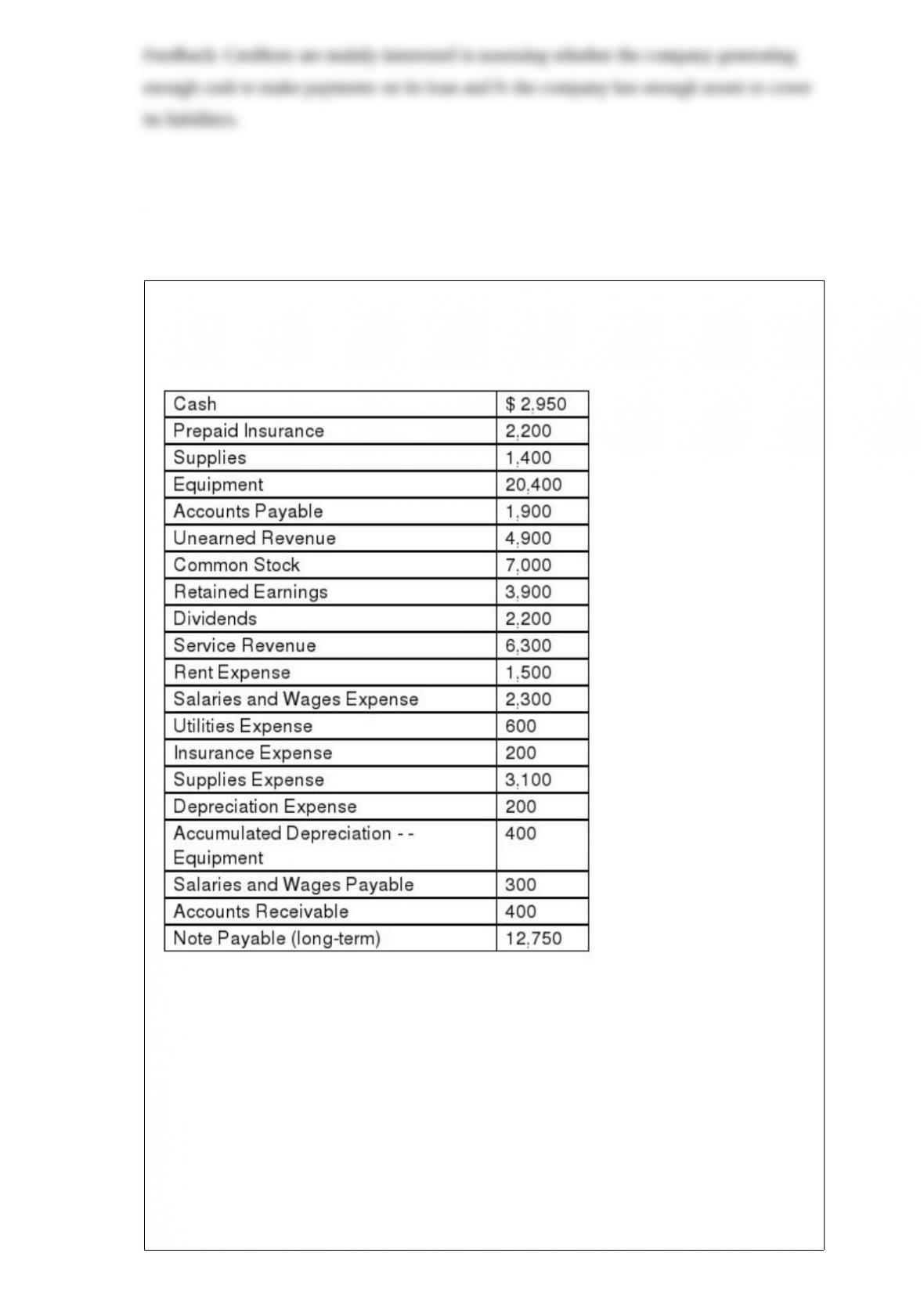
The following items are taken from an adjusted trial balance prepared as of December
31, 2015. All accounts have normal balances.
Required:
Part a. Determine the Credits column total on the adjusted trial balance.
Part b. Determine that amount of net income (net loss) for the year.
Part c. Determine the Total Assets amount that will be reported on the Balance Sheet at
December 31, 2015.
Part d. Determine the Total Liabilities amount that will be reported on the Balance
Sheet at December 31, 2015.
Part e. Determine the amount of Retained Earnings that will be reported on the Balance
Sheet at December 31, 2015.
Company X has net sales revenue of $780,000, cost of goods sold of $343,200, and all
other expenses of $327,600. The gross profit percentage is closest to:
A) 32%.
B) 56%.
C) 86%.
D) 14%.
For a merchandiser, inventory turnover refers to how many times:
A) during the period the company replaces its raw materials inventory.
B) the company purchases and sells its inventory of goods.
C) the company produces and delivers its inventory of goods to customers.
D) the company orders merchandise.
Which of the following statements about asset impairment is correct?
A) Asset impairment losses appear on a company’s income statement every year.
B) When a company records an asset impairment loss, it will increase net income for
that period.
C) Impairment occurs when an asset’s book value is less than its current value.
D) Asset impairment losses are reported on the income statement as an operating
expense.
Which of the following accounts does not have a normal debit balance?
A) Salaries and Wages Expense
B) Service Revenue
C) Accounts Receivable
D) Cash
During June, the Grass is Greener Company mows 100 lawns a week and is paid in July
by those customers. The company uses the accrual basis of accounting. Which financial
statement is impacted by these transactions?
A) The income statement shows the effects of the transactions in June.
B) The income statement shows the effects of the transactions in July.
C) The balance sheet shows no effect from the transactions in June.
D) The transactions have no effect on the balance sheet.
Identify the purpose of a voucher system and describe a voucher.
Neutron uses a periodic inventory system. On June 10, the company purchased
inventory on credit from Proton for $9,000, terms 2/10, n/30.
Required:
Prepare the journal entry to record the June 10 transactions on the books of Neutron
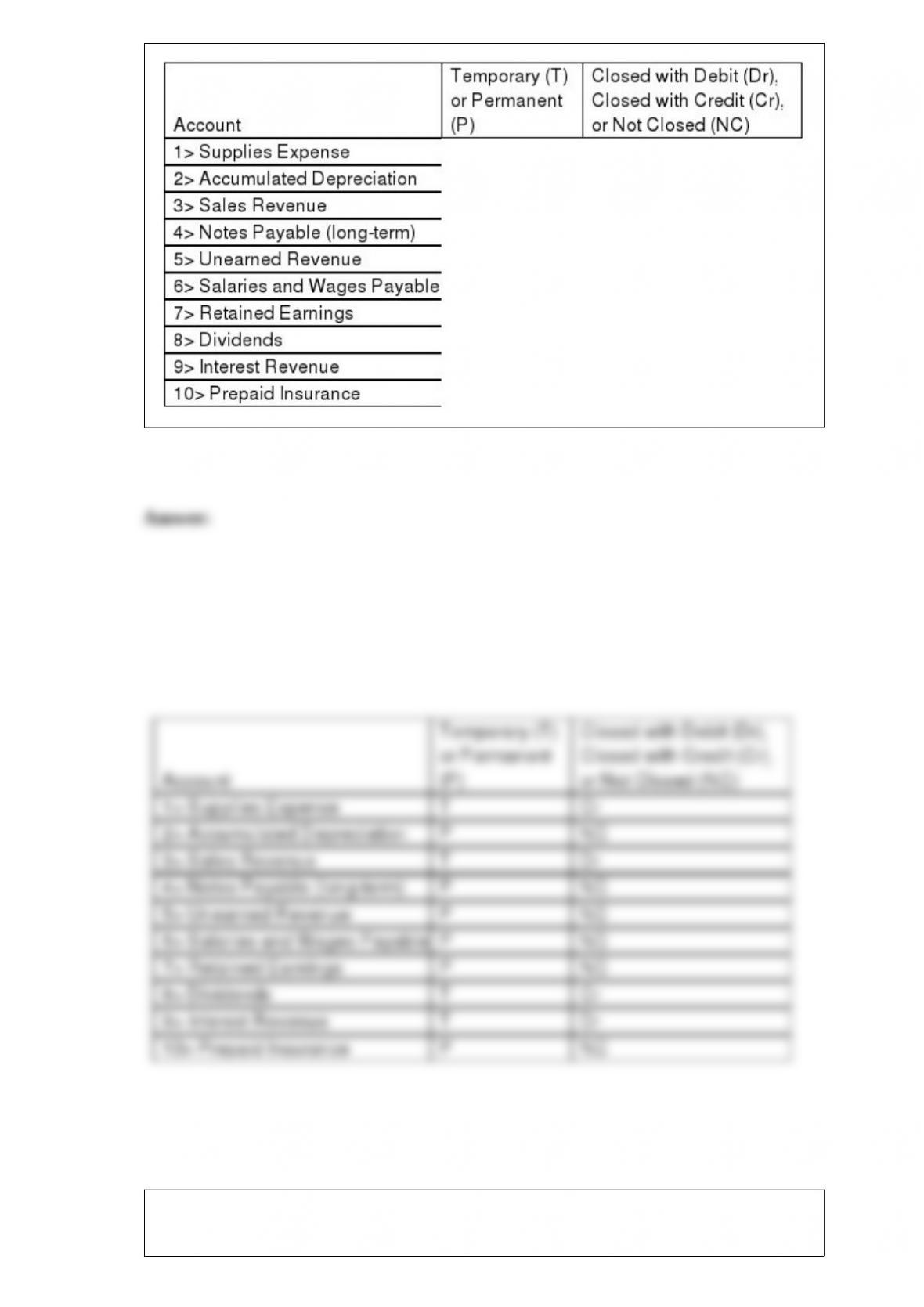
The table below includes some of the accounts that are included on a company’s chart
of accounts.
Required:
For each of the accounts listed, identify whether the account is a temporary (T) or a
permanent (P) account. Then, indicate whether the account will be closed with a debit
(Dr) or credit (Cr) or whether it will not be closed (NC).
Following is a list of financial statement items and amounts for Tim Burr’s Tree Service
as of 12/31/X3, the end of its first year in operation.
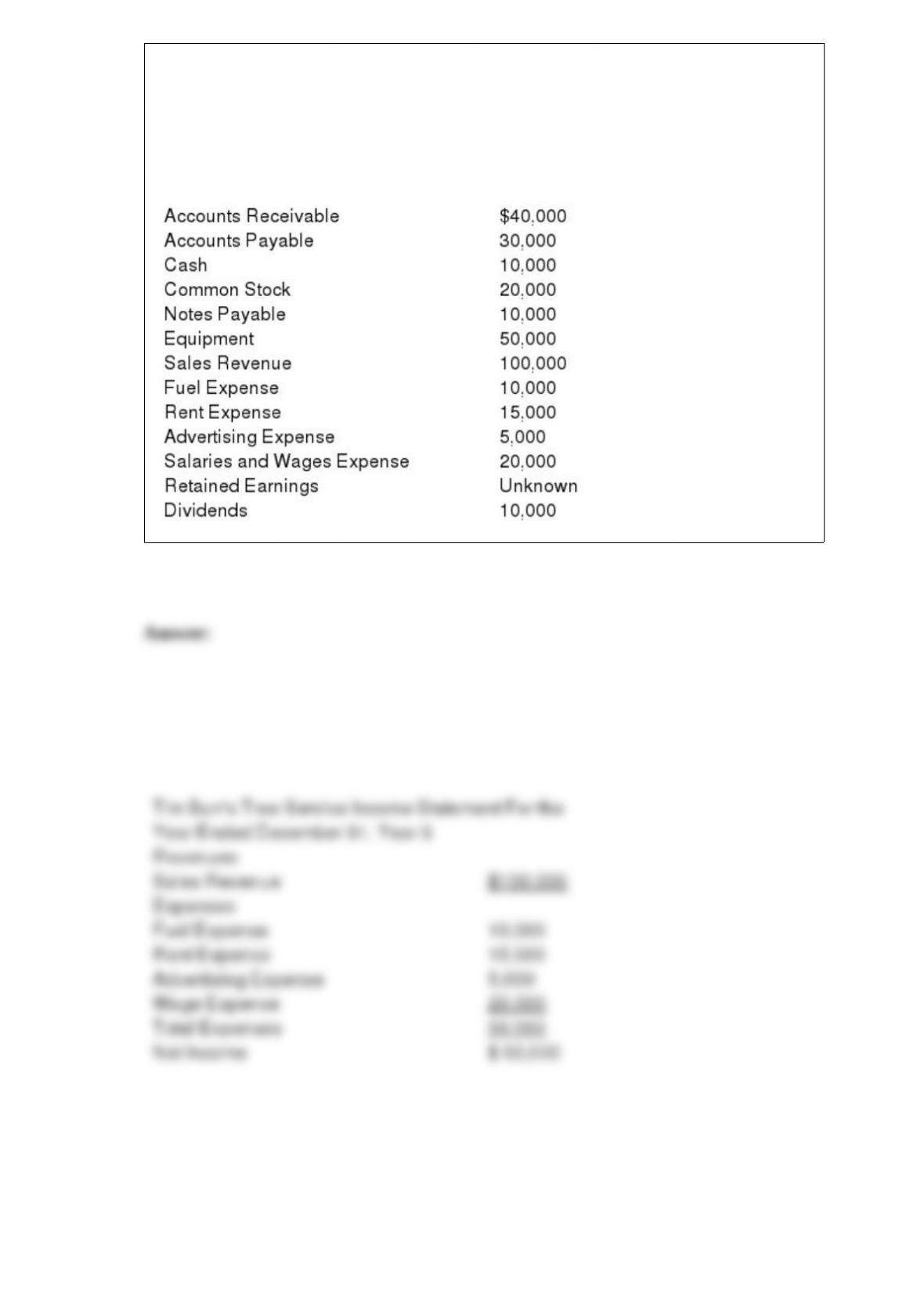
Required:
Use this information to prepare the Income Statement, Statement of Retained Earnings,
and Balance Sheet.
CheapBooks Incorporated (CBI) had the following business activities:
1> Stockholders invest $25,000 cash in the corporation.
2> CBI purchased $400 of office supplies on credit.
3> CBI purchased office equipment for $7,000, paying $2,500 in cash and signing a
30-day note payable for the remainder.
4> CBI paid $200 cash on account for office supplies purchased in transaction 2.
5> CBI purchased two acres of land for $10,000, signing a 2-year note payable.
6> CBI sold one acre of land at one-half of the total cost of the two acres, receiving the
full amount or $5,000 in cash.
7> CBI made a payment of $5,000 on its 2-year note.
Required:
Prepare the journal entries that would be used to record the transactions. (Reference
each journal entry to the transaction number, shown above).
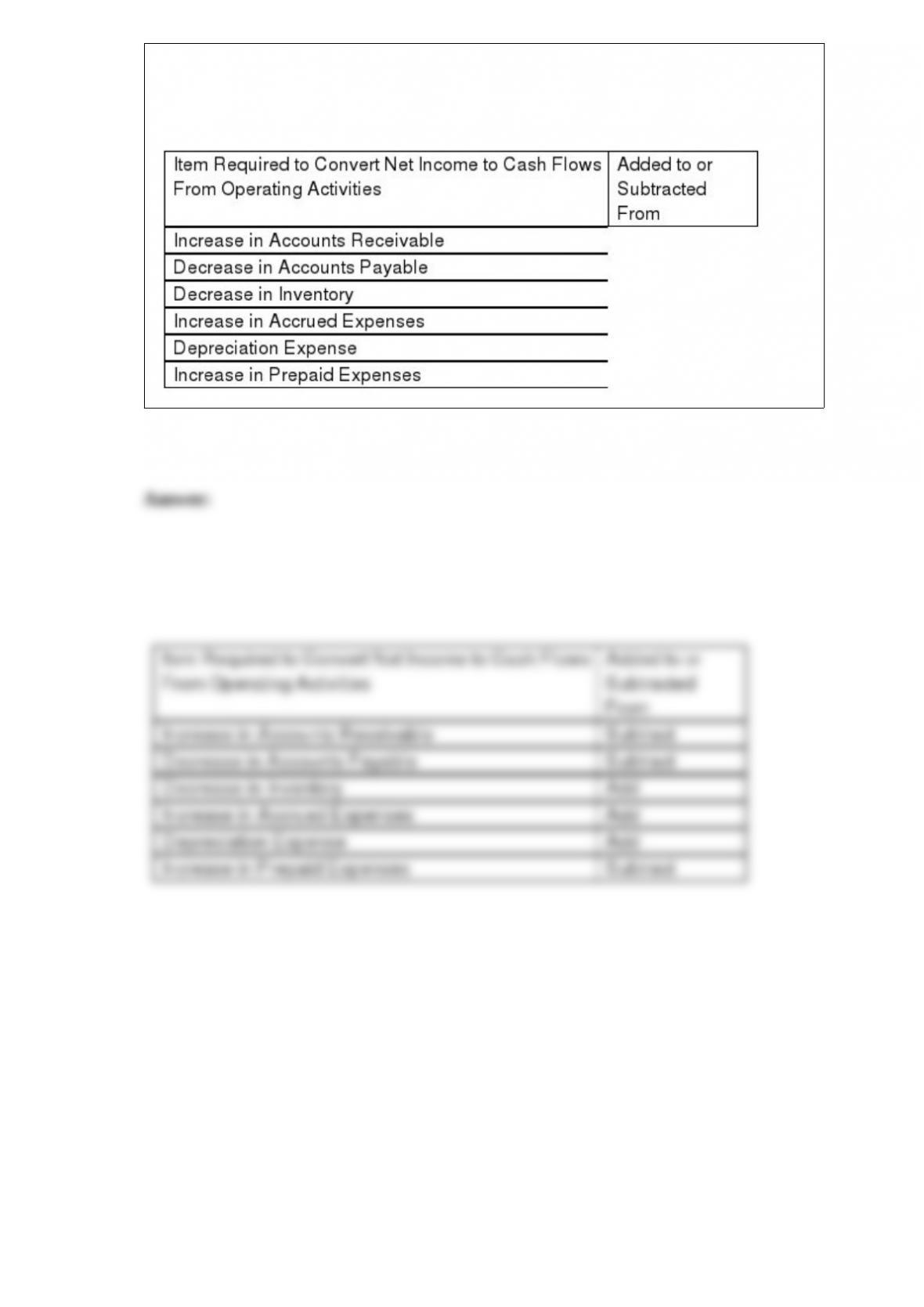
Indicate whether each of the following would be added to or subtracted from net
income when using the indirect method to reconcile net income to cash flows from
operating activities.