Qualitative information is only relevant for decision making if it can be quantified.
Direct labor is an example of a product-level cost.
If more overhead was applied than had been incurred, the balance in the manufacturing
overhead account represents the amount of overapplied overhead.
Unlike direct material and direct labor costs, overhead costs must be allocated to
products.
Under continuous budgeting a new month is added to the end of the budget period each
time the present month expires so that a twelve-month budget is available at all times.
Descriptions of cost behavior as fixed or variable pertain to a particular range of
activity.
The absorption costing approach uses the contribution margin income statement format.
Farber Company produces its product in three departments, Prepping, Machining, and
Finishing. A customer recently returned a defective product that had not been machined
properly. The company’s accountant would classify the repair cost as an internal failure
cost.
Matt needs to compute the present value of $5,000 to be received four years from now.
He should multiple $5,000 by the appropriate present value interest factor obtained
from the present value of $1 table.
The terms “cost tracing” and “cost allocation” may be used interchangeably because
they mean the same thing.
If the master budget prepared at a volume level of 20,000 units includes factory rent of
$40,000, a flexible budget based on a volume of 21,000 units would include factory rent
of $40,000.
The objective of target pricing is to establish a price that will maximize profits given
existing costs.
Downstream costs are not relevant to a product elimination decision.

Use of absorption costing allows a company to increase its profits by increasing the
level of production of its products.
Differential revenues are expected future revenues that vary between the alternatives
under consideration.
A materials requisition is sent to the purchasing agent by the materials storeroom clerk
to request that additional materials be purchased.
The Sarbanes-Oxley Act allows, but does not require, a corporation to establish a
whistleblower policy.
A budget prepared at a single volume of activity is referred to as a:
A. Strategic budget.
B. Standard budget.
C. Static budget.
D. Flexible budget.
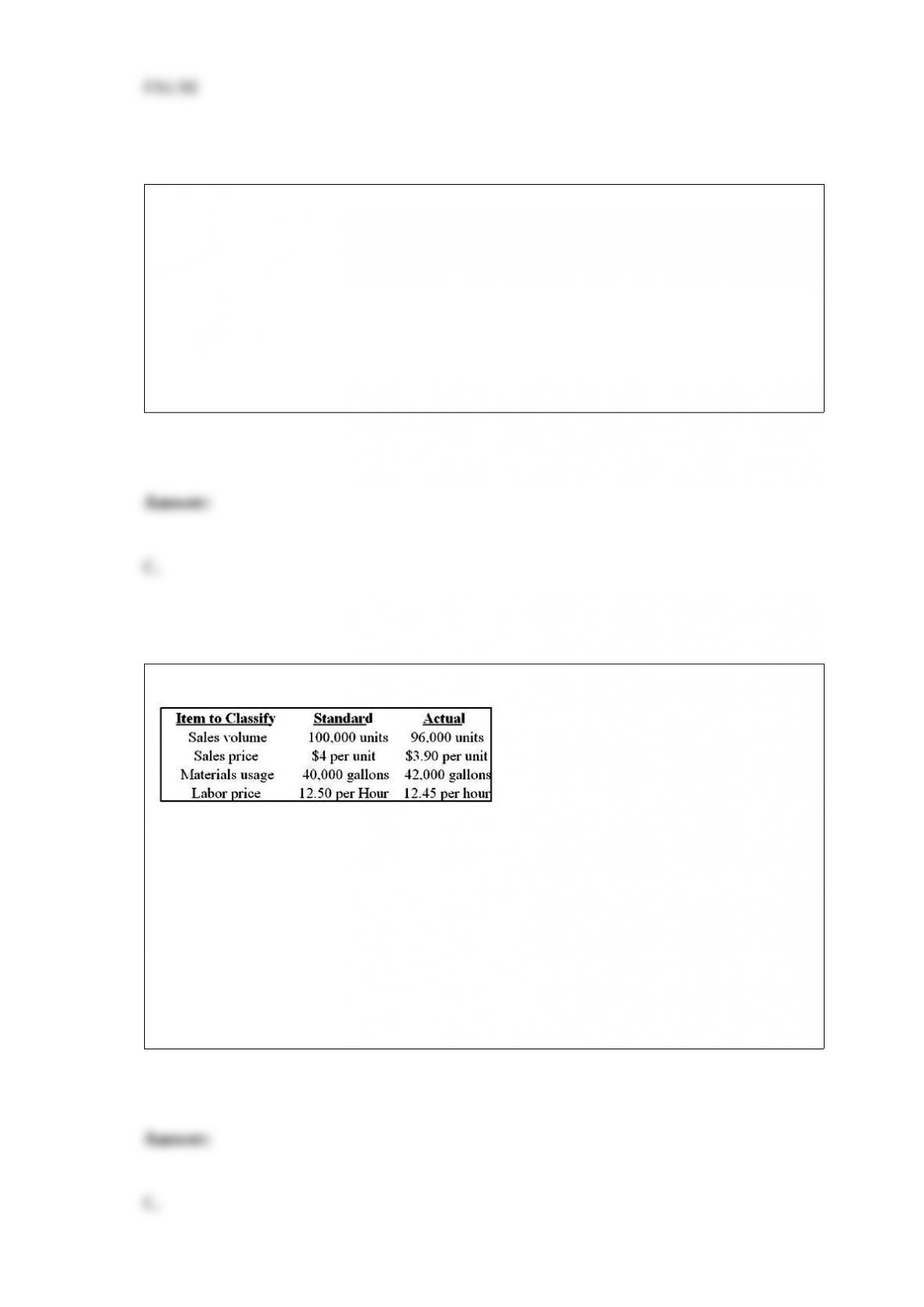
Which of the following statements is incorrect?
A. The sales volume variance unfavorable.
B. The materials usage variance is unfavorable.
C. The sales price variance is favorable.
D. The labor price variance is favorable.
The cost of indirect labor will initially be charged to:
A. cost of goods sold.
B. work in process.
C. manufacturing overhead.
D. wages expense.
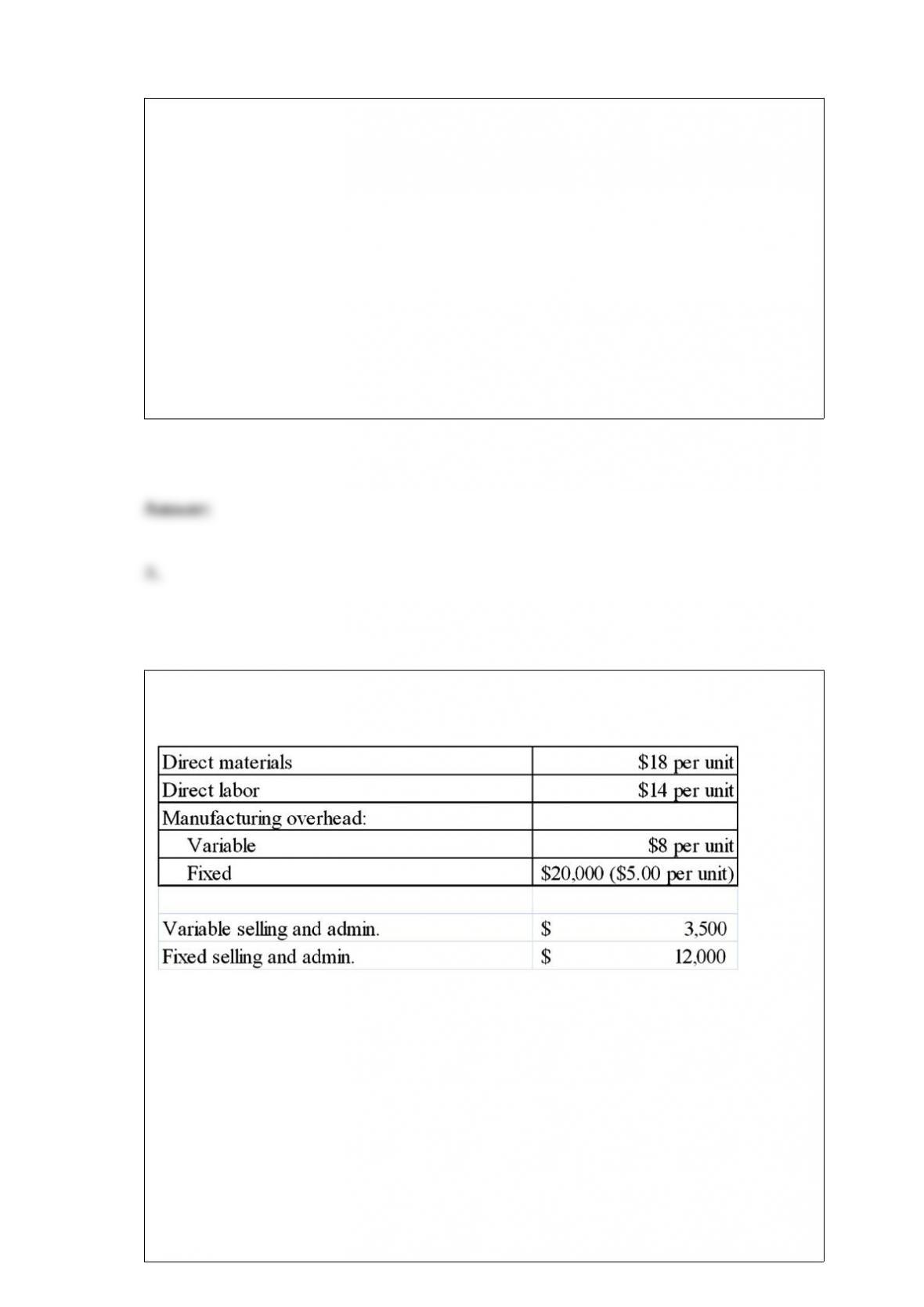
Alleghany Community College operates four departments. The square footage used by
each department is shown below.
Alleghany’s annual building rental cost is $320,000
What amount of rent expense that should be allocated to the Sciences Department?
A. $60,000
B. $80,000
C. $120,000
D. $106,667
Select the incorrect statement about budgeting committees.
A. Membership on the budgeting committee is restricted most often to accountants
because the budget involves numbers.
B. Budgeting committees usually have responsibility for the coordination of budgeting
activities.
C. The budgeting committee is responsible for settling disputes between various
departments over budget matters.
D. One of the responsibilities of the budget committee is to monitor the organization’s
progress toward achieving its budget standards.
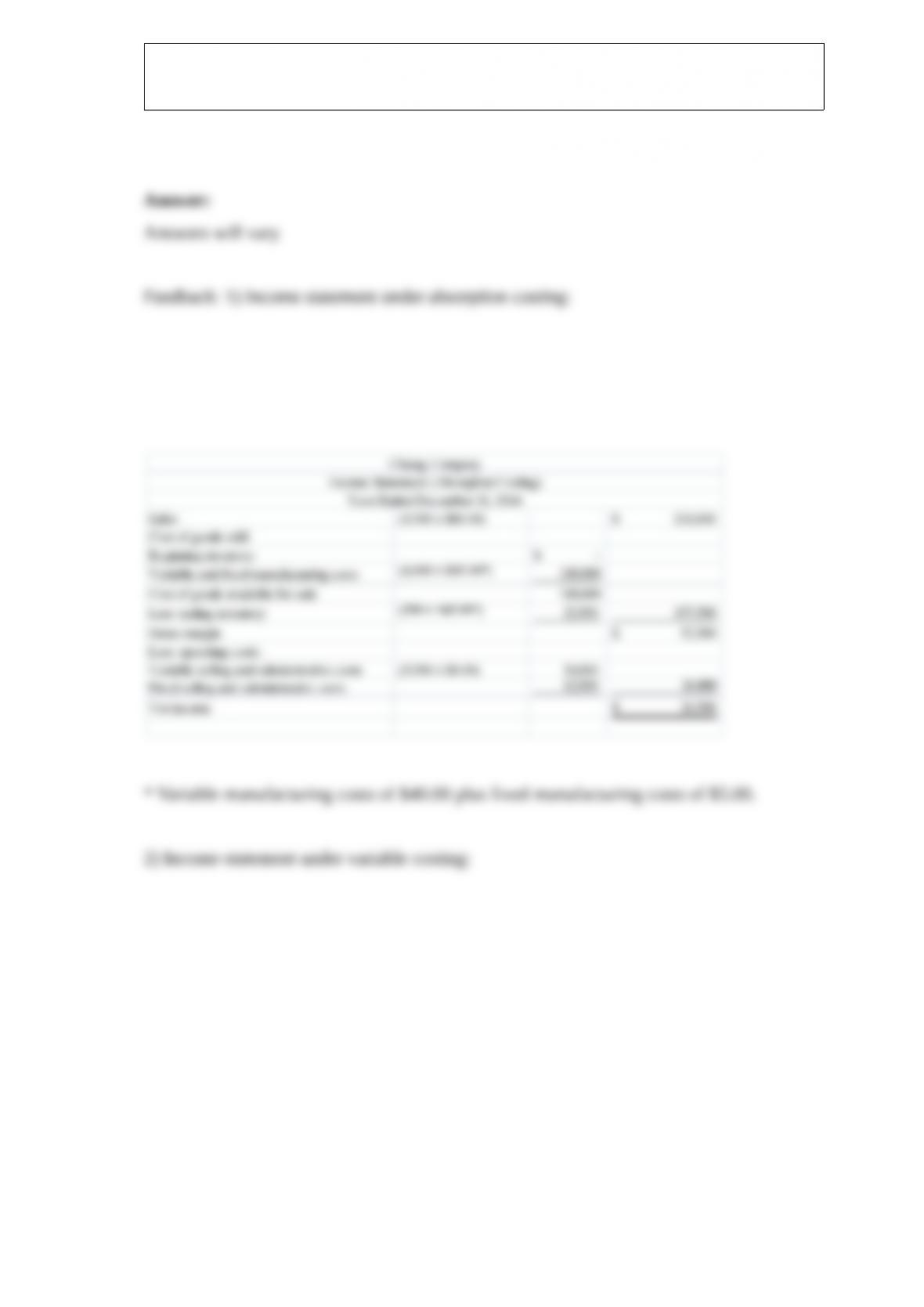
The cost structure for Chiang Company, which began operations on January 1, 2014, is
provided below:
Variable selling and administrative costs are $4 per unit sold.
During 2014, the company produced 4,000 units and sold 3,500 units at the $60 selling
price.
Required:
1) Prepare an income statement under absorption costing.
2) Prepare an income statement under variable costing.
3) Explain the difference between the two income amounts.
4) What absorption costing disadvantage does this exercise emphasize?
Benson Company declared and paid a cash dividend totaling $500,000 on its common
stock. As a result of this transaction, the company’s debt to assets ratio will:
A. Decrease.
B. Increase.
C. Remain the same.
D. Cannot be determined.
Which of the following is the approximate internal rate of return for an investment that
costs $33,550 and provides a $5,000 annuity for 10 years?
A. 5%
B. 6%
C. 8%
D. 10%
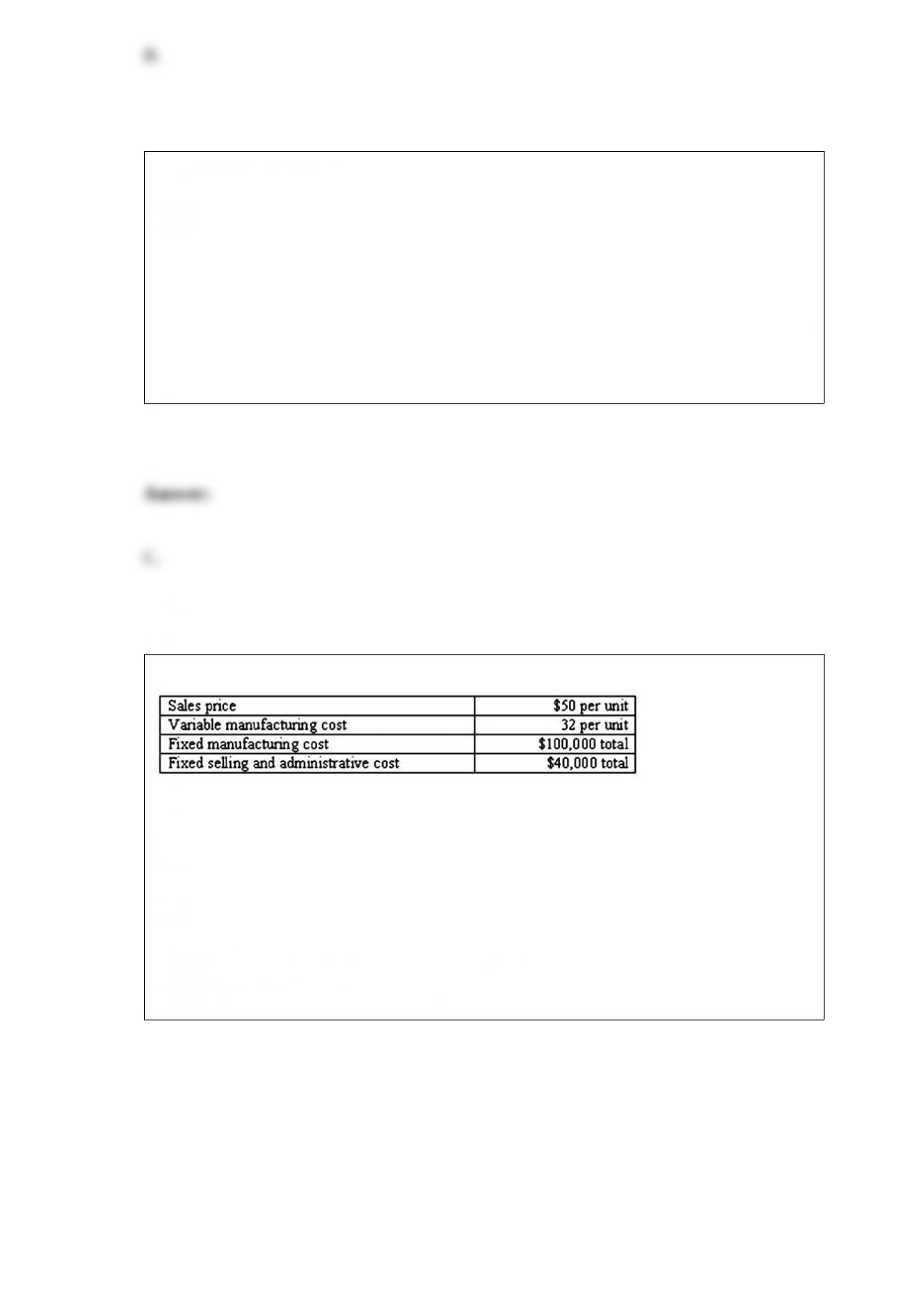
Douglas Company provided the following budgeted information for 2014.
Douglas predicted that sales would be 20,000 units, but the sales actually were 22,000
units. The actual sales price was $48.50 per unit, and the actual variable manufacturing
cost was $33 per unit. Actual fixed manufacturing cost and fixed selling and
administrative cost were $104,000 and $39,000, respectively.
Required:
(a) Using the form below, prepare a flexible budget; show actual results; calculate the
flexible budget variances; and indicate whether the variances are favorable (F) or
unfavorable (U).
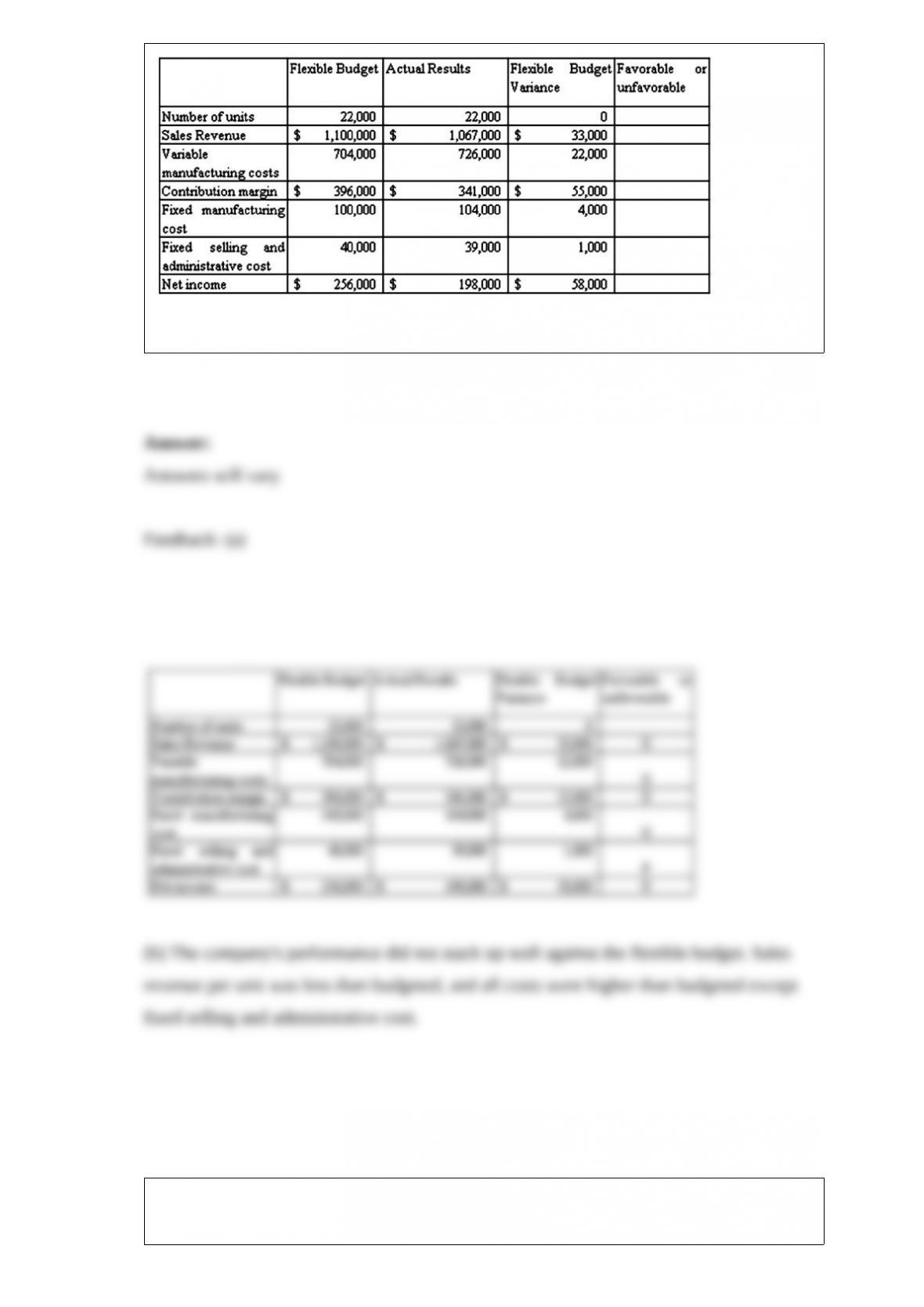
(b) Assess the company’s performance compared to the flexible budget.
To get a feel for the impact on profits of various changes in costs and volume levels
management should perform:

A. cost benefit analysis
B. sensitivity analysis
C. cost analysis
D. profitability analysis
Which formula best represents the first step used to allocate an indirect cost to a cost
object?
A. Total cost to be allocated/cost driver
B. Cost driver/allocation rate
C. Cost driver/total cost to be allocated
D. Allocation rate/total cost to be allocated
For the year ended December 31, 2014, Burton Company had cash collections from
customers of $100,000, cash paid to employees of $16,000, cash paid to suppliers of
$50,000, cash used to retire long-term bonds of $16,000, and cash payments for
dividends of $10,000. Cash provided by operating activities for 2014 is:
A. $8,000.
B. $34,000.
C. $18,000.

D. $50,000.
All of the following are downstream costs except:
A. advertising costs.
B. distribution costs.
C. patent filing legal costs.
D. warehousing costs.
Which of the following items is not needed to prepare a sales budget by product line?
A. Expected purchase price of each product.
B. Expected unit sales of each product.
C. Expected selling price of each product.
D. All of these answers are correct.
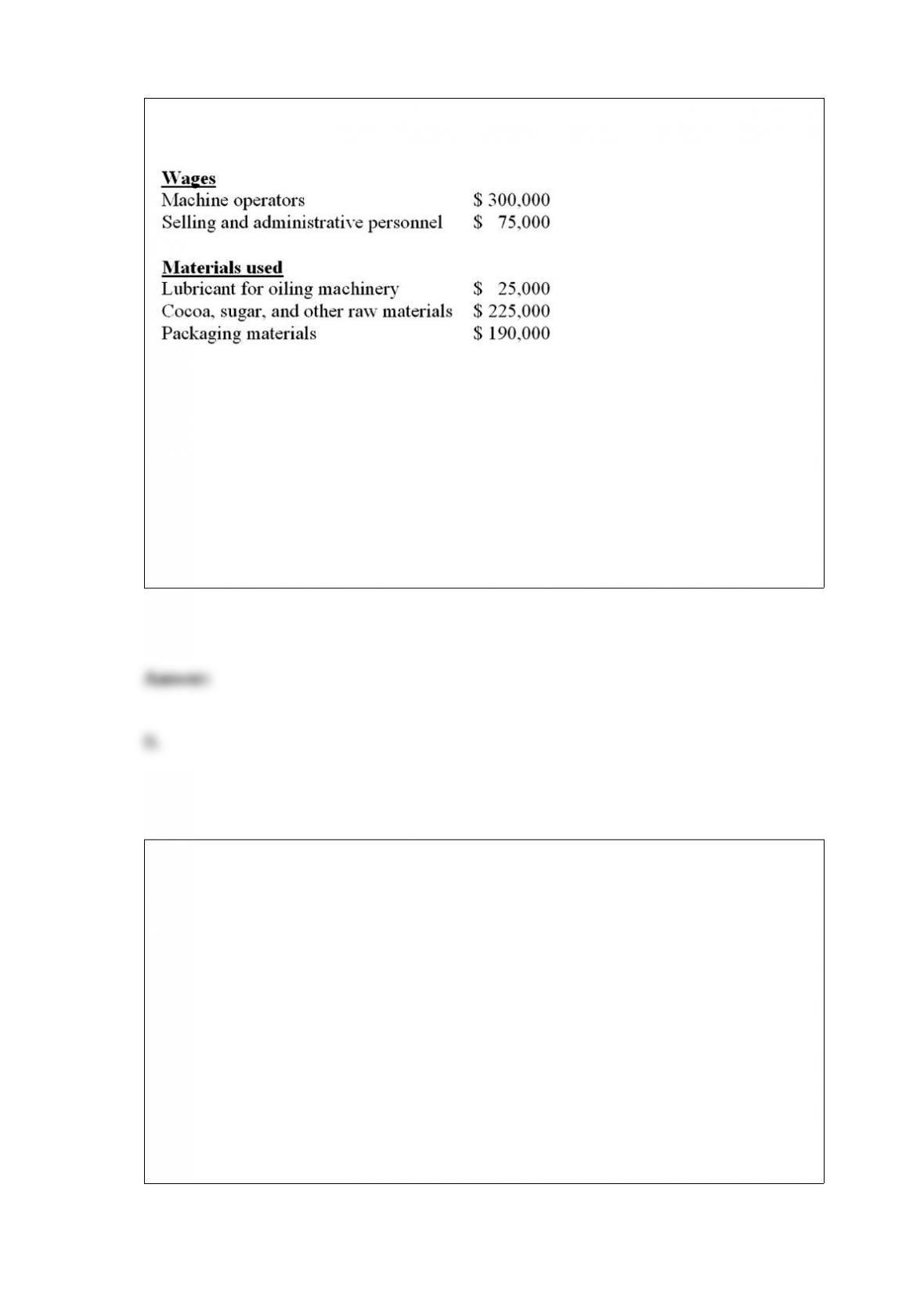
Randall Company manufactures chocolate bars. The following were among Randall’s
2013 manufacturing costs:
Randall’s 2013 direct materials amounted to:
A. $25,000
B. $225,000
C. $250,000
D. $475,000
Indicate whether each of the following statements is true or false.
Internal rate of return measures the difference between an investment’s rate of return
and the company’s required rate of return.
A spreadsheet program is useful in doing internal rate of return analyses.
Capital investment analyses should take tax consequences into account.
Depreciation on equipment or a building has the effect of sheltering some of a
corporation’s income from income taxes.
The amount of a depreciation tax shield is calculated by multiplying the amount of
depreciation by (1 – the tax rate).
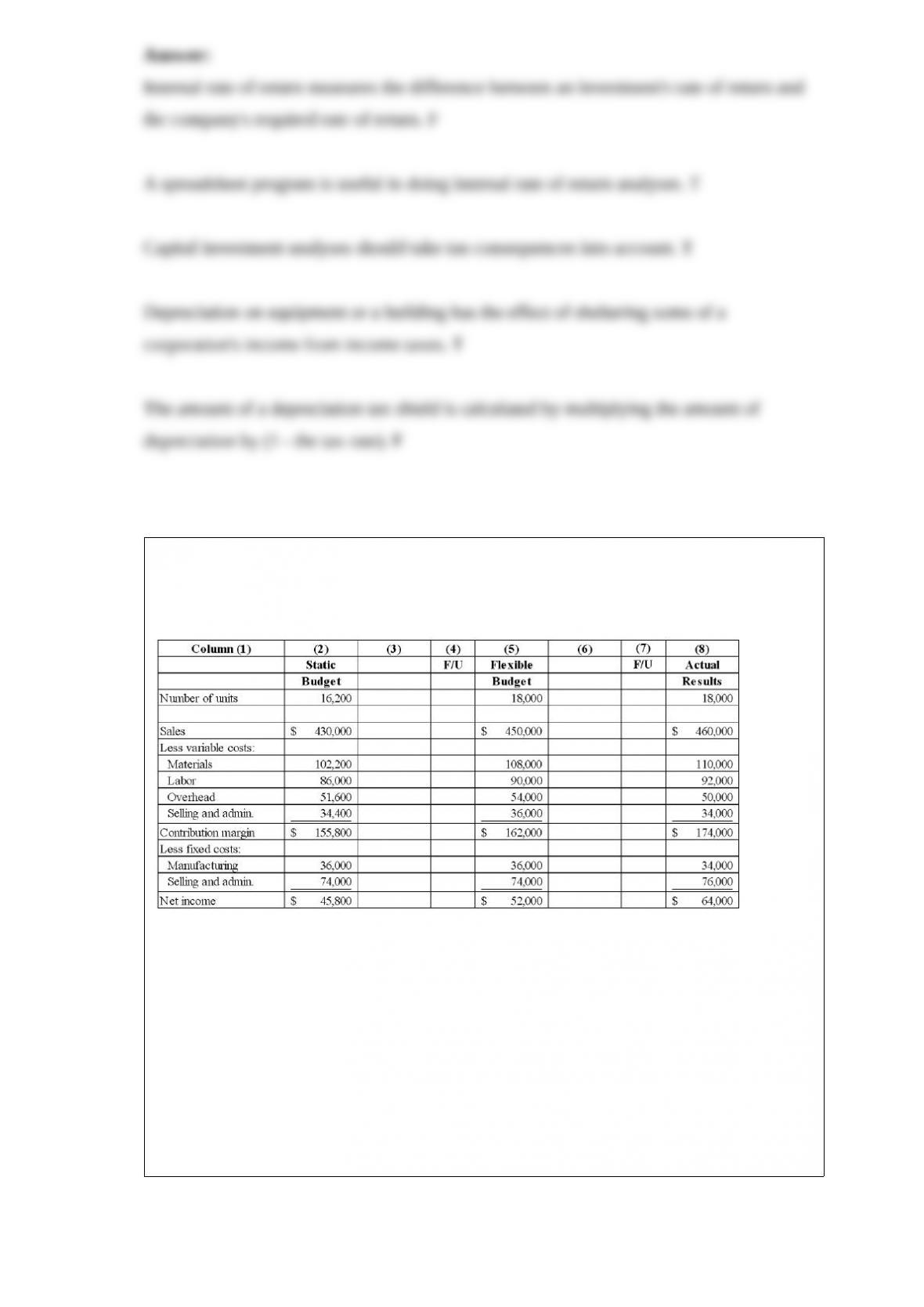
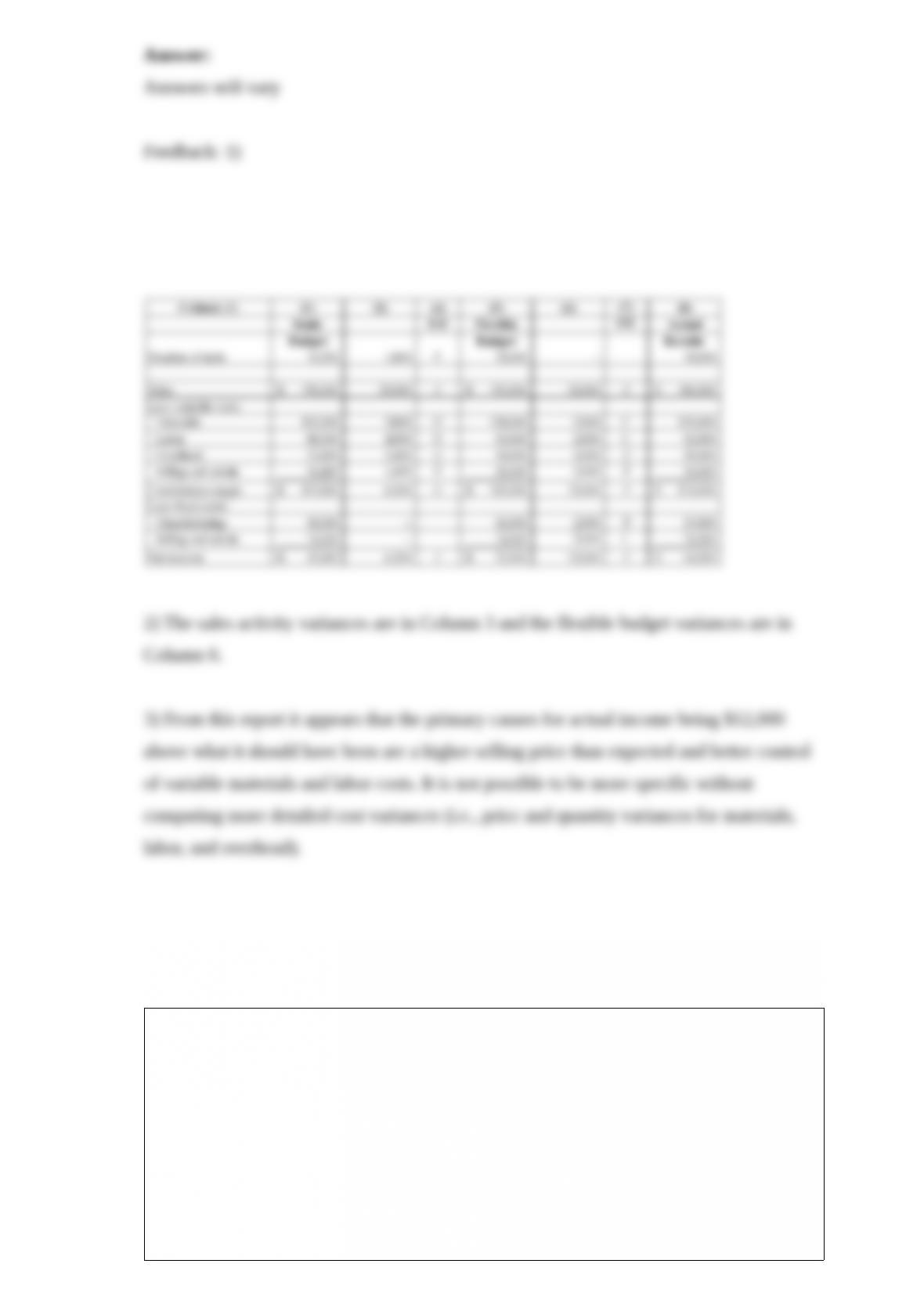
The Vermont Company has requested a performance report that reports both sales
activity variances and flexible budget variances. The following table of information is
provided:
Required:
1) Compute and enter variances in columns 3 and 6. In column 3, enter the variance
(difference) between column 2 and column 5; in column 4, label the variance as
favorable (F) or unfavorable (U). In column 6, enter the variance between columns 5
and 8, and in column 7 indicate whether this variance is favorable or unfavorable.
2) Which column contains sales volume variances and which column contains flexible
budget variances?
3) Comment on this company’s performance.
Indicate whether each of the following statements is true or false.
A master budget is a group of detailed, related budgets and schedules.
The master budget includes only operating budgets.
Capital budgets include projections for purchases of property, plant, and equipment.
A sales budget includes a schedule of cash payments for inventory.
The first step in preparing the master budget is to prepare an estimate of cash that will
be needed during the period.
What is the reasoning behind the use of cost pools in an activity-based costing system?
What is a segment elimination decision? Under what conditions should a company
decide to eliminate a segment?