
1) Winner Corporation acquired 80 percent of the common shares and 70 percent of the
preferred shares of First Corporation at underlying book value on January 1, 20X9. At
that date, the fair value of the noncontrolling interest in First’s common stock was equal
to 20 percent of the book value of its common stock. First’s balance sheet at the time of
acquisition contained the following balances:
The preferred shares are cumulative and have a 10 percent annual dividend rate and are
four years in arrears on January 1, 20X9. All of the $5 par value preferred shares are
callable at $6 per share. During 20X9, First reported net income of $100,000 and paid
no dividends.
Based on the preceding information, what is the portion of First’s retained earnings
assignable to its preferred shareholders on January 1, 20X9?
A.$40,000
B.$50,000
C.$60,000
D.$70,000
2) Culver owns 80 percent of the common stock of Fowler Company. Culver also
purchases some of Fowler’s bonds directly from Fowler and holds the bonds as a
long-term investment. How is the acquisition of the bonds treated for consolidated
reporting purposes?
A.As a retirement of bonds
B.As an increase in the Bonds Payable account on Fowler’s books
C.Everything related to the intercompany bonds is eliminated in the consolidation
worksheet, and nothing related to the bonds appears in the consolidated financial
statements
D.As an increase in noncurrent assets
3) A private, not-for-profit hospital expended $35,000 of temporarily restricted assets to
acquire equipment. What account should be debited in the hospital’s plant replacement
and expansion fund as a result of the acquisition of the equipment?
A.Net Assets ReleasedPlant Acquisition
B.Fund balance ReleasedPlant Acquisition
C.Equipment
D.Contribution Revenue ReleasedPlant Acquisition
4) Note: This is a Kaplan CPA Review Question
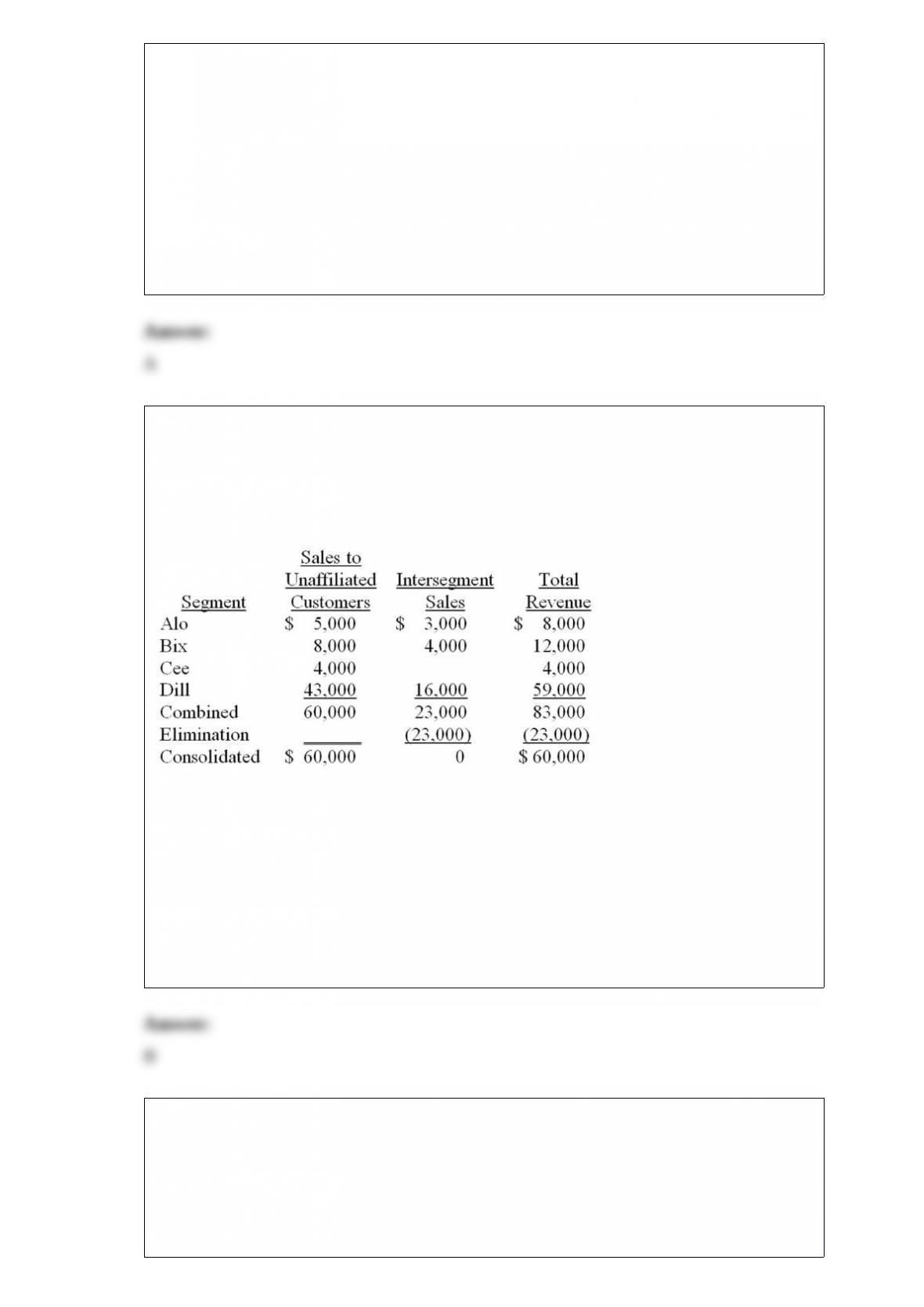
The following information pertains to revenue earned by Timm Co.’s industry segments
for the year ended December 31st:
In conformity with the revenue test, Timm’s reportable segments were
A.Only Dil
B.Only Bix and Dil
C.Only Alo, Bix, and Dil
D.Alo, Bix, Cee, and Dil
5) Note: This is a Kaplan CPA Review Question
Fox, Greg, and Howe are partners with average capital balances during 20X1 of
$120,000, $60,000, and $40,000, respectively. Partners receive 10% interest on their
average capital balances. After deducting salaries of $30,000 to Fox and $20,000 to
Howe, the residual profit or loss is divided equally. In 20X1 the partnership sustained a
$33,000 loss before interest and salaries to partners. By what amount should Fox’s
capital account change?
A.$7,000 increase
B.$11,000 decrease
C.$35,000 decrease
D.$42,000 increase
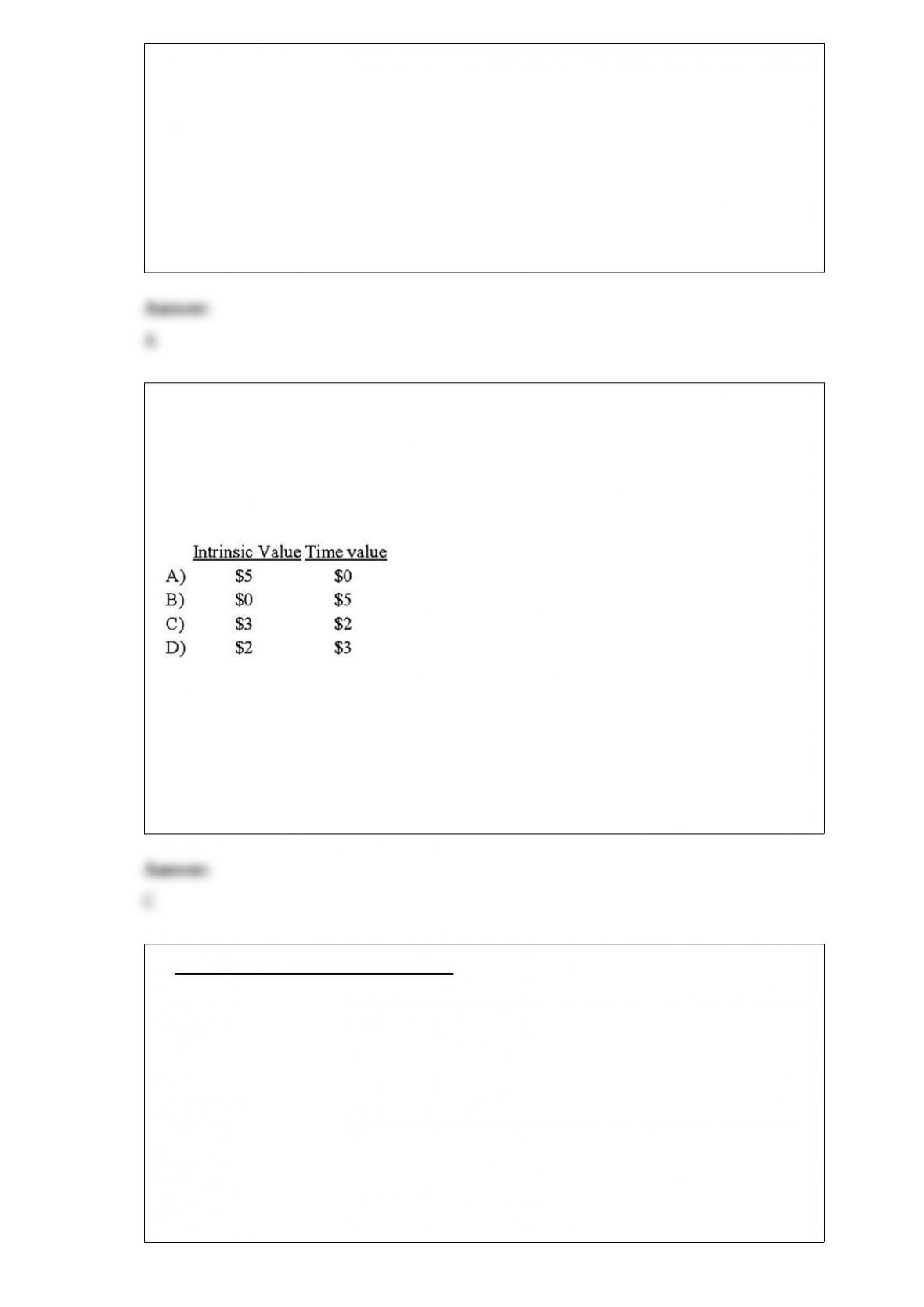
6) The fair market value of a near-month call option with a strike price of $45 is $5,
when the stock is trading at $48.
Based on the preceding information, which of the following is true of the intrinsic and
time values associated with this option.
A.Option A
B.Option B
C.Option C
D.Option D
7) Private Not-For-Profit (NFP) Entities.
Select from this list of terms to answer the following questions.
A. Fair value
B. Unrestricted net assets
C. GASB
D. FASB
E. Statement of Revenues, Expenditures, and Changes in Fund Balance
F. Lower of cost or market
G. Accrual method
H. Statement of Activities
I. General fund, restricted fund, endowment fund
J. Modified accrual method
K. Permanently restricted net assets
L. Temporarily restricted net assets
M. Endowment fund
N. Unrestricted, temporarily restricted, permanently restricted
O. Depreciation
P. Works of art and other historical treasures
Q. General fund
R. Cost
Indicate your choice by entering the letter corresponding to the correct term. A term
may be used more than once or not at all.
“Classification of contributions restricted by purpose” describes which term listed
above?
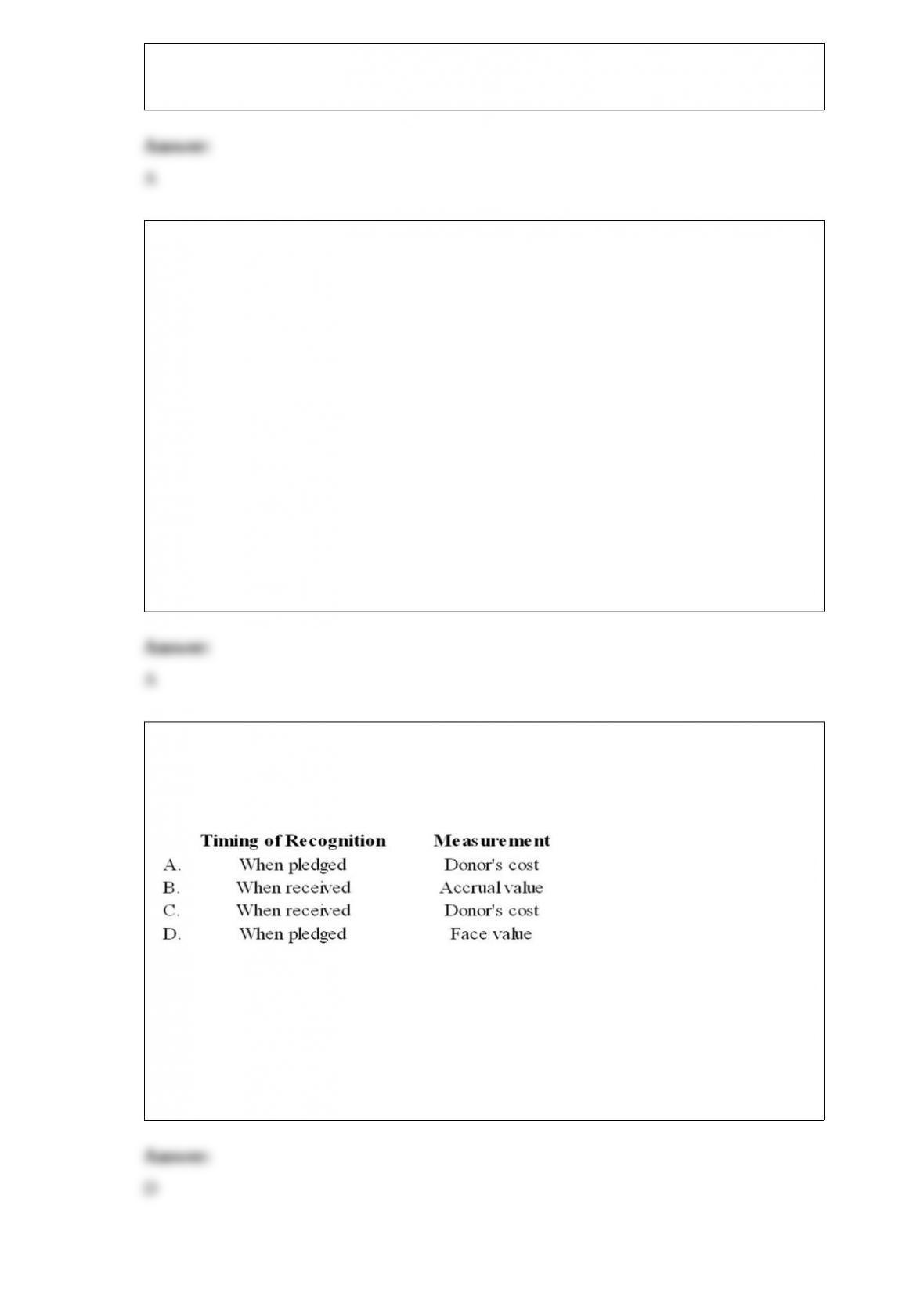
8) Jones and Smith formed a partnership with each partner contributing the following
items:
Assume that for tax purposes Jones and Smith agree to share equally in the liabilities
assumed by the Jones and Smith partnership.
Refer to the above information. What is each partner’s tax basis in the Jones and Smith
partnership?
A.Option A
B.Option B
C.Option C
D.Option D
9) On January 1, 20X6, Nichols Corporation issued 10-year bonds at par to unrelated
parties. The bonds pay interest of $15,000 every June 30 and December 31. On
December 31, 20X9, Harn Corporation purchased all of Nichols’ bonds in the open
market at a $6,000 discount. Harn is Nichols’ 80 percent owned subsidiary. Harn uses
the straight line method of amortization. The consolidated income statement for the
year 20X9 should report with respect to the bonds:
I. interest expense of $30,000.
II. an extraordinary gain of $6,000.
A.I
B.II
C.Either I or II
D.Neither I nor II
10) Which of the following recognition and measurement bases best summarizes the
usual treatment of current contributions to private not-for-profit entities in accordance
with ASC 958?
A.Option A
B.Option B
C.Option C
D.Option D
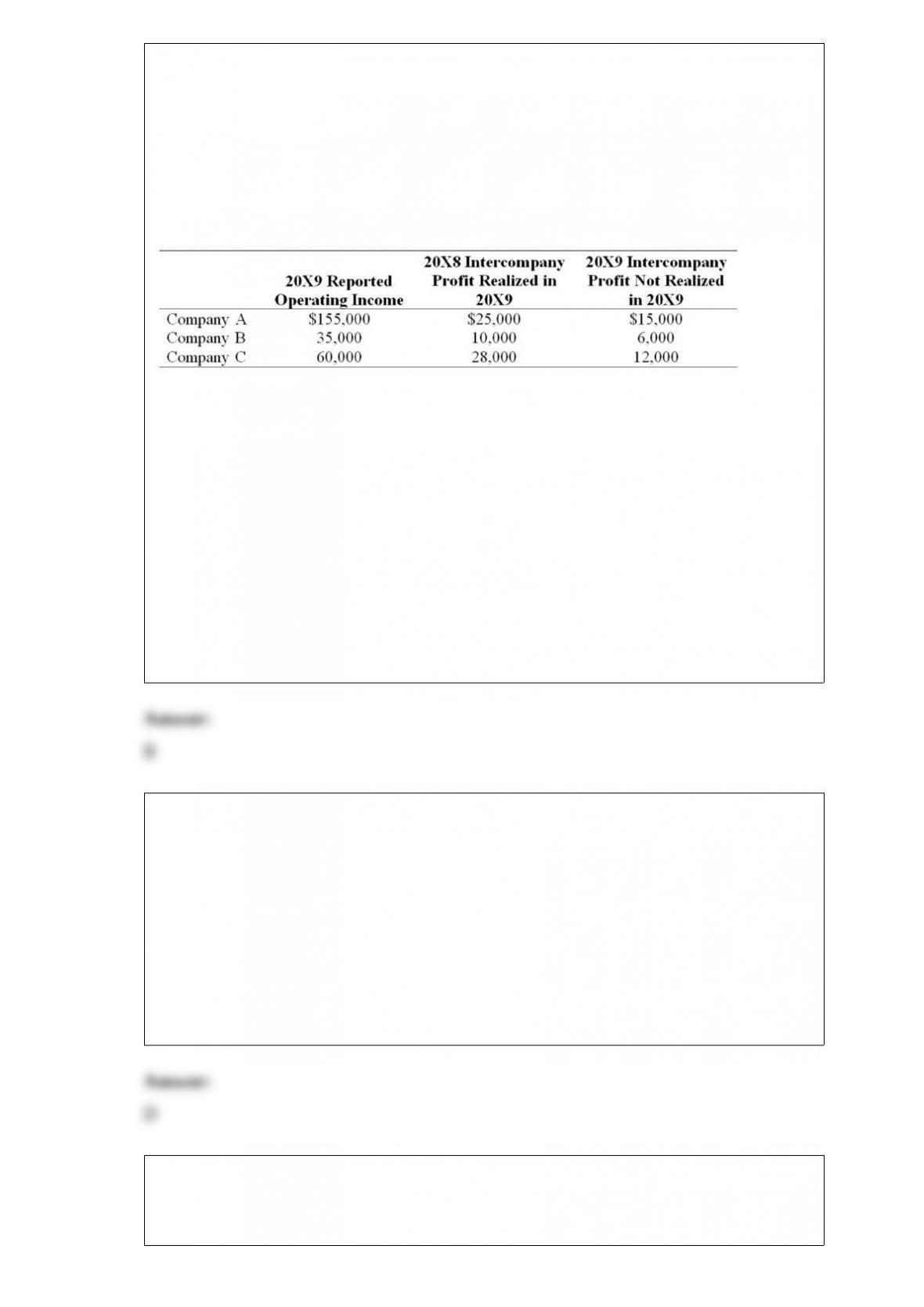
11) Company A owns 85 percent of Company B’s stock and 80 percent of Company C’s
stock. All acquisitions were made at book value. The fair values of noncontrolling
interests at the time of acquisition were equal to the proportionate share of the book
values of the companies. The companies file a consolidated tax return each year and in
20X9 paid a total tax of $112,000. Each company is involved in a number of
intercompany inventory transfers each period. Information on the companies’ activities
for 20X9 is as follows:
Company A does not record income tax expense on income from subsidiaries because a
consolidated tax return is filed.
Based on the information provided, what amount of income tax expense should be
assigned to Company A?
A.$72,000
B.$66,000
C.$112,000
D.$62,000
12) If a company changes the method it uses to compute the allowance for uncollectible
accounts receivable because more recent information has become available, how is this
change in method is accounted for?
A.The change is only reported in the current period in which the change is made
B.The change is reported in all future periods affected by the change
C.Previously issued financial statements are not adjusted by the change
D.All of these are correct ways to account for the change
13) On January 1, 20X8, Ramon Corporation acquired 75 percent of Tester Company’s
voting common stock for $300,000. At the time of the combination, Tester reported
common stock outstanding of $200,000 and retained earnings of $150,000, and the fair
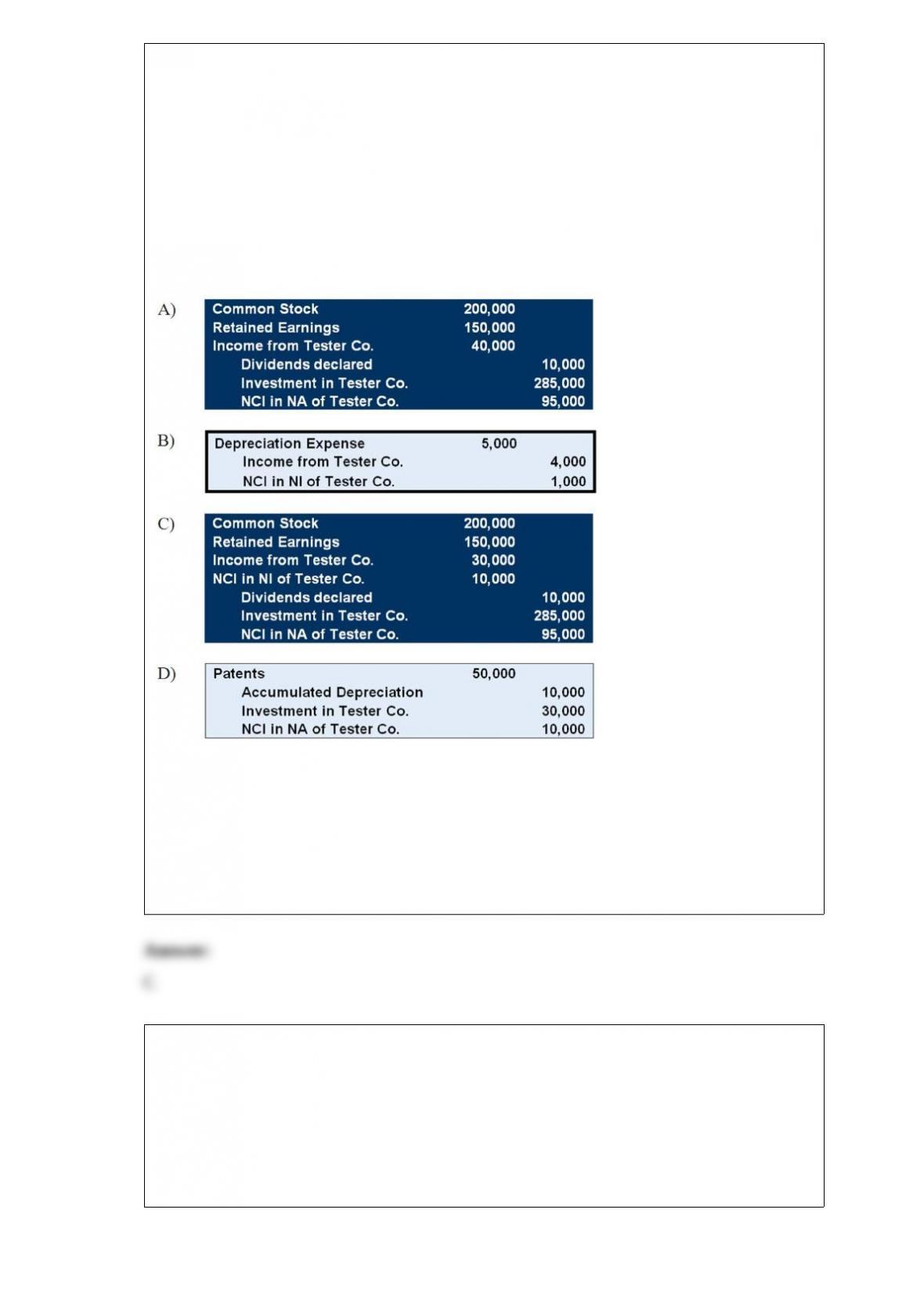
value of the noncontrolling interest was $100,000. The book value of Tester’s net assets
approximated market value except for patents that had a market value of $50,000 more
than their book value. The patents had a remaining economic life of ten years at the date
of the business combination. Tester reported net income of $40,000 and paid dividends
of $10,000 during 20X8.
Based on the preceding information, which of the following is an eliminating entry
needed to prepare a full set of consolidated financial statements at December 31, 20X8:
A.Choice A
B.Choice B
C.Choice C
D.Choice D
14) On December 1, 20X8, Hedge Company entered into a 60-day speculative forward
contract to sell 200,000 British pounds (£) at a forward rate of £1 = $1.78. On the same
day it purchased a 60-day speculative forward contract to buy 100,000 euros () at a
forward rate of 1 = $1.42.
The rates are as follows:
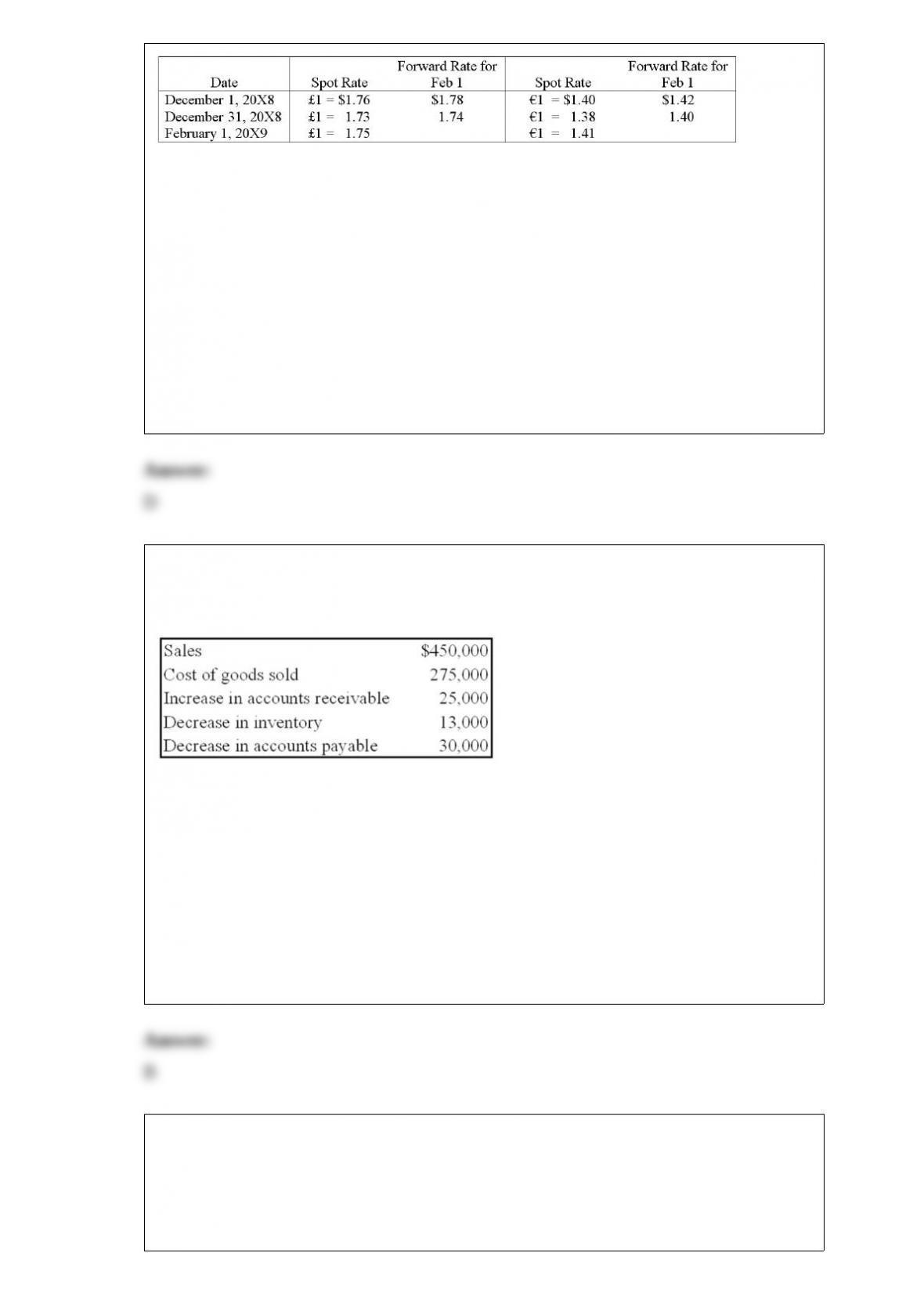
Hedge had no other speculation transactions in 20X8 and 20X9. Ignore taxes.
Based on the preceding information, what is the net gain or loss on the euro speculative
contract?
A.$8,000 gain
B.$6,000 gain
C.$3,000 loss
D.$1,000 loss
15) Sigma Company develops and markets organic food products to natural foods
retailers. The following information is available for the company for the year 20X8:
Based on the preceding information, what amount will be reported by the company as
cash flows from operating activities for 20X8?
A.$175,000
B.$133,000
C.$167,000
D.$207,000
16) Which of the following statements is(are) correct about the funds used by
governmental entities?
I. Funds are fiscal entities.
II. Funds are accounting entities.

A.I only
B.II only
C.I and II
D.Neither I nor II
17) Master Corporation owns 85 percent of Servant Corporation’s voting shares. On
January 1, 20X8, Master Corporation sold $200,000 par value 8 percent bonds to
Servant when the market interest rate was 5 percent. The bonds mature in 10 years and
pay interest semiannually on June 30 and Dec 31.
Based on the information given above, in the preparation of the 20X8 consolidated
financial statements, interest income will be:
A.debited for $12,293 in the eliminating entries
B.credited for $12,293 in the eliminating entries
C.debited for $16,000 in the eliminating entries
D.credited for $16,000 in the eliminating entries
18) Which of the following observations regarding the use of fresh start accounting is
true?
A.It is always required under Chapter 11 bankruptcy proceedings
B.Prior shareholders will have control of the emerging company
C.It results in a new reporting entity
D.It is used under Chapter 7 bankruptcy proceedings
19) A private, not-for-profit hospital received the following restricted contributions and
other receipts during the year ended December 31, 20X8:

None of the contributions or other receipts were expended during the ended December
31, 20X8. For the year ended December 31, 20X8, what amount would be reported on
the hospital’s statement of changes in net assets as an increase in temporarily restricted
net assets?
A.$1,500,000
B.$1,200,000
C.$500,000
D.$300,000
20) Note: This is a Kaplan CPA Review Question
Grant, Inc. acquired 30 percent of South Co.’s voting stock for $200,000 on January 2,
20X4. Grant’s 30 percent interest in South gave Grant the ability to exercise significant
influence over South’s operating and financial policies. During 20X4, South earned
$80,000 and paid dividends of $50,000. South reported earnings of $100,000 for the six
months ended June 30, 20X5, and $200,000 for the year ended December 31, 20X5. On
July 1, 20X5, Grant sold half of its stock in South for $150,000 cash. South paid
dividends of $60,000 on October 1, 20X5.
In Grant’s December 31, 20X4, balance sheet, what should be the carrying amount of
this investment?
A.$224,000
B.$200,000
C.$234,000
D.$209,000
21) Under a composition agreement,
A.creditors agree to accept less than the face amount of their claims
B.debtors in financial difficulty transfer assets “without recourse.”
C.a creditors’ committee is initiated with a plan of settlement proposed by the debtor
D.the debtor petitions for relief in a bankruptcy court
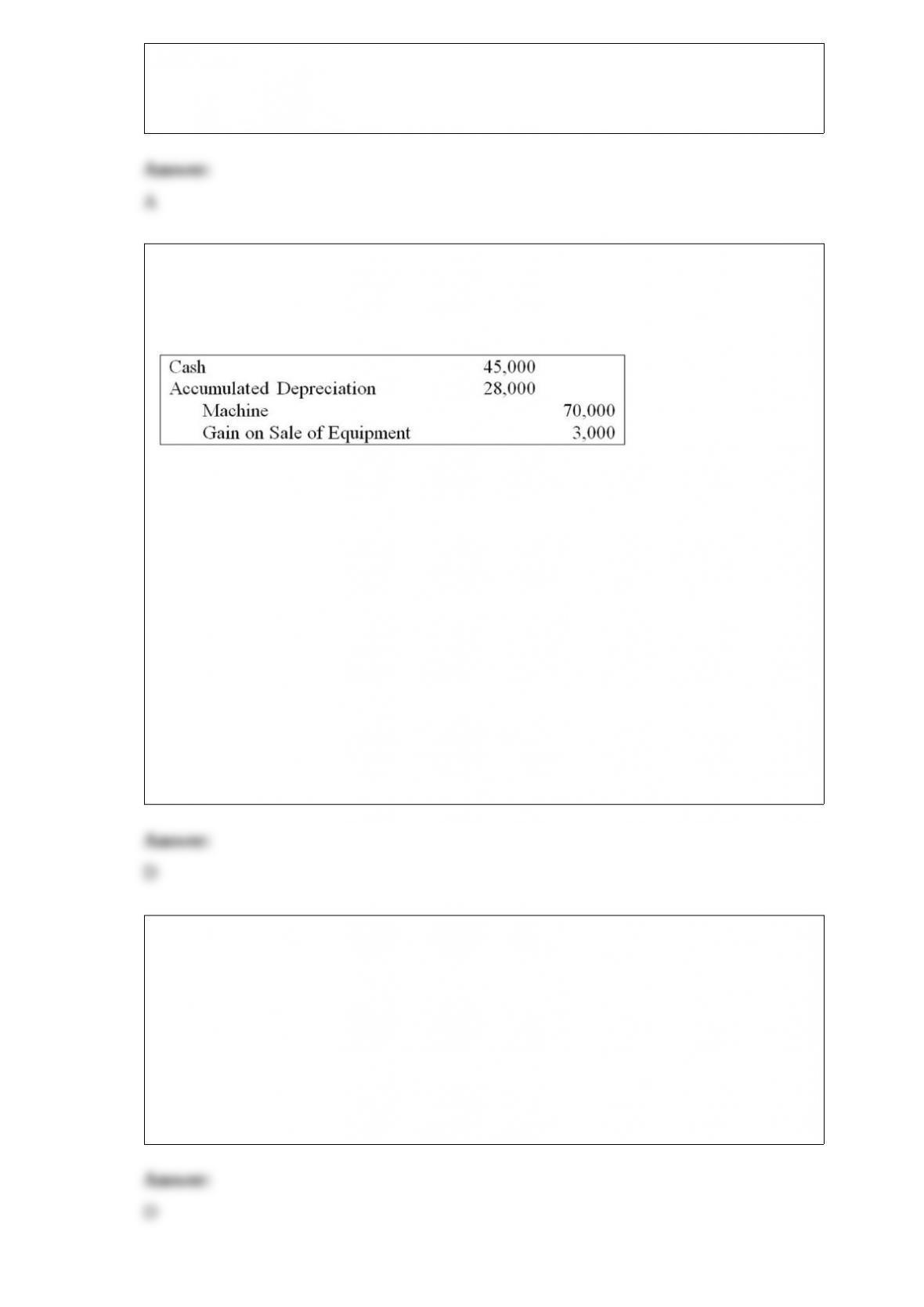
22) On January 1, 20X7, Servant Company purchased a machine with an expected
economic life of five years. On January 1, 20X9, Servant sold the machine to Master
Corporation and recorded the following entry:
Master Corporation holds 75 percent of Servant’s voting shares. Servant reported net
income of $50,000, and Master reported income from its own operations of $100,000
for 20X9. There is no change in the estimated economic life of the equipment as a result
of the intercorporate transfer.
Based on the preceding information, in the preparation of the 20X9 consolidated
balance sheet, machine will be:
A.debited for $1,000
B.debited for $15,000
C.credited for $45,000
D.debited for $25,000
23) Typically, the plan of reorganization must be approved by at least _____ of all
creditors, who must hold at least _____ of the dollar amount of the outstanding debt.
A.one-third; half
B.two-thirds; half
C.half; one-third
D.half; two-thirds

24) All of the following stockholders’ equity accounts of a foreign subsidiary are
translated at historical exchange rates except:
A.retained earnings
B.common stock
C.additional paid-in capital
D.preferred stock
25) A parent sold land to its partially owned subsidiary during the year at a loss. The
subsidiary continues to hold the land at the end of the year. The amount to be reported
as consolidated net income for the year should equal:
A.the parent’s separate operating income, plus the intercompany loss
B.the parent’s separate operating income, plus the intercompany loss, plus the
subsidiary’s net income
C.the parent’s separate operating income, minus the intercompany loss
D.the parent’s separate operating income, minus the intercompany loss, plus the
subsidiary’s net income
26) In which of the following situations do accounting standards not require that the
financial statements of the parent and subsidiary be consolidated:
A.A corporation creates a new 100 percent owned subsidiary
B.A corporation purchases 90 percent of the voting stock of another company
C.A corporation has both control and majority ownership of an unincorporated
company
D.A corporation owns less-than a controlling interest in an unincorporated company