Generally accepted accounting principles (GAAP) require that the inventory be
reported at:
A) market value.
B) historical cost.
C) lower of cost or market.
D) retail value.
A typical classified balance sheet provides no information about which of the following
items?
A) To whom the company owes money
B) For what the company owes money
C) How much the company owes
D) The proportion of the company’s debts that will be paid in the short-term
Which of the following statements about payroll liabilities is correct?
A) Accrued payroll includes liabilities required by law or voluntarily requested by
employees that have not yet been paid (or remitted).
B) Only employees are required to pay FICA taxes.
C) Both employers and employees are required to pay unemployment taxes.
D) Accrued payroll liabilities do not include any voluntary deductions by employees for
charitable contributions or union dues.
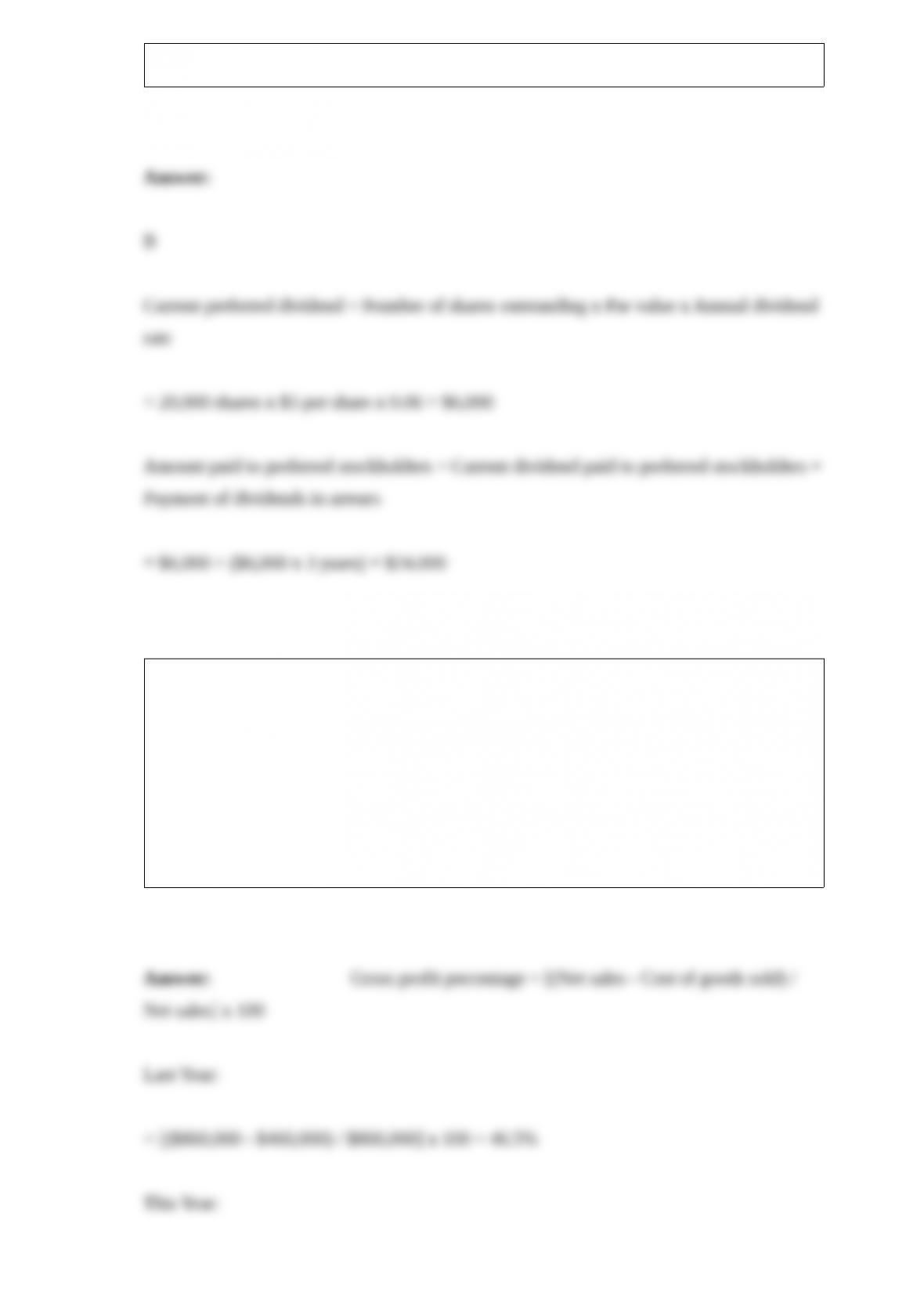
A company has the following paid-in capital:
Use the information above to answer the following question. If the company pays a
$100,000 dividend, and the preferred stock is cumulative and three years’ dividends are
in arrears, what is the amount the preferred stockholders will receive?
A) $18,000
B) $24,000
C) $6,000
D) $54,000
A company reported a decrease in sales revenue from $860,000 last year to $760,000
this year and a decrease in gross profit from $400,000 last year to $360,000 this year.
Required:
Part a. Calculate the gross profit percentages for both years.
Part b. Was the change in gross profit caused by the change in sales volume, the change
in the gross profit per sale, or a combination of the two? Explain.
A company reported a gross profit percentage of 25% with net sales of $347,800. What
is the amount of cost of goods sold?
A) $86,950
B) $260,850
C) $326,063
D) $108,688
Cash flows from financing activities:
A) includes all cash inflows and outflows associated with a company’s lending
activities.
B) includes all cash inflows and outflows between a company and its stockholders.
C) are always negative because of the payments of cash dividends as well as interest
and principal on debt.
D) are always positive unless the company is experiencing serious financial trouble.
Judging only from the ratios below, which of the following clothing wholesalers is least
likely to be having cash flow problems?
A) Company A: Receivable turnover of 5; inventory turnover of 2
B) Company B: Receivable turnover of 2; inventory turnover of 5
C) Company C: Receivable turnover of 10; inventory turnover of 10
D) Company D: Receivable turnover of 1; inventory turnover of 1
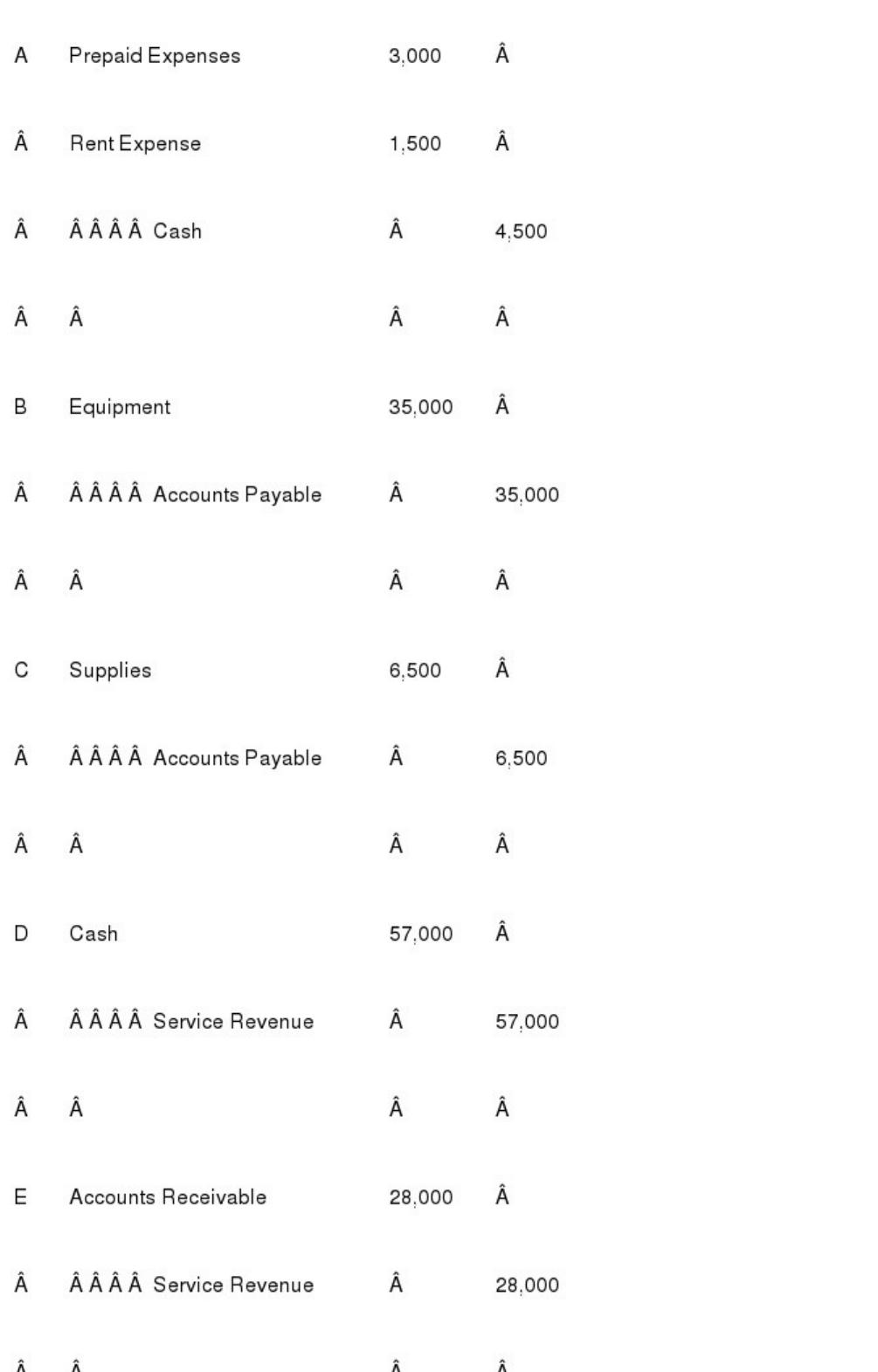
A company entered into the following transactions during April.
A. Signed a lease and made a payment of $4,500 to the landlord comprised of the
current month’s rent of $1,500 and the required $3,000 security deposit.
B. Purchased equipment on account for $35,000.
C. Purchased supplies for $6,500 on account.
D. Performed services and received cash of $57,000.
E. Performed services on account for $28,000.
F. Received a payment of $24,000 for services to be performed in the future.
G. Collected $14,000 from customers on account.
H. Paid employees $11,000 for work done during the month.
I. Made a $35,000 payment on account for equipment that was purchased above.
J. Made a payment of $6,500 on account for the supplies purchased above.
K. Received bills for the current month from telephone and electricity companies
totaling $3,800; payments will be made next month.
Required:
Prepare journal entries for the transactions set forth above.
A company purchased office equipment for $24,500 and paid $1,470 in sales tax, $550
for installation, $3,200 for a needed adjustment to the equipment, and $2,600 for
supplies that will be used for periodic routine maintenance. How should the company
record this transaction?
A) Debit Equipment $24,500, debit Repairs and Maintenance Expense for $5,220, debit
Supplies for $2,600, and credit Cash for $32,320
B) Debit Equipment for $29,720, debit Supplies for $2,600, and credit Cash for $32,320
C) Debit Equipment for $25,970, debit Repairs and Maintenance Expense $3,750, debit
Supplies for $2,600, and credit Cash for $32,320
D) Debit Equipment and credit Cash for $32,320
On January 1, Kirk Corporation had total assets of $850,000. During the month, the
following activities occurred:
Kirk Corporation acquired equipment costing $6,000, promising to pay cash for it in 60
days.
Kirk Corporation purchased $3,500 of supplies for cash.
Kirk Corporation sold land which it had acquired 2 years ago. The land had cost
$15,000 and it was sold for $15,000 cash.
Kirk Corporation signed an agreement to rent additional storage space next month at a
charge of $1,000 per month.
What is the amount of total assets of Kirk Corporation at the end of the month?
A) $859,500.
B) $856,000.
C) $837,500.
D) $840,000.
To ensure that the Allowance for Doubtful Accounts account does not become
materially misstated over time, companies revise overestimates of prior periods by:
A) recording a retroactive correcting entry.
B) lowering estimates in the current period.
C) increasing estimates in the current period.
D) notifying the users of its financial statements of the error.
A company reported net income of $5.6 million. At the beginning of the year, 3.4
million shares of common stock were outstanding and at the end of the year, 3.6 million
shares were outstanding. No dividends were declared. The EPS is approximately:
A) $1.60.
B) $1.56.
C) $1.65.
D) $1.40.
Consider the following information from a company’s unadjusted trial balance at
December 31, 2015. All accounts have normal balances.
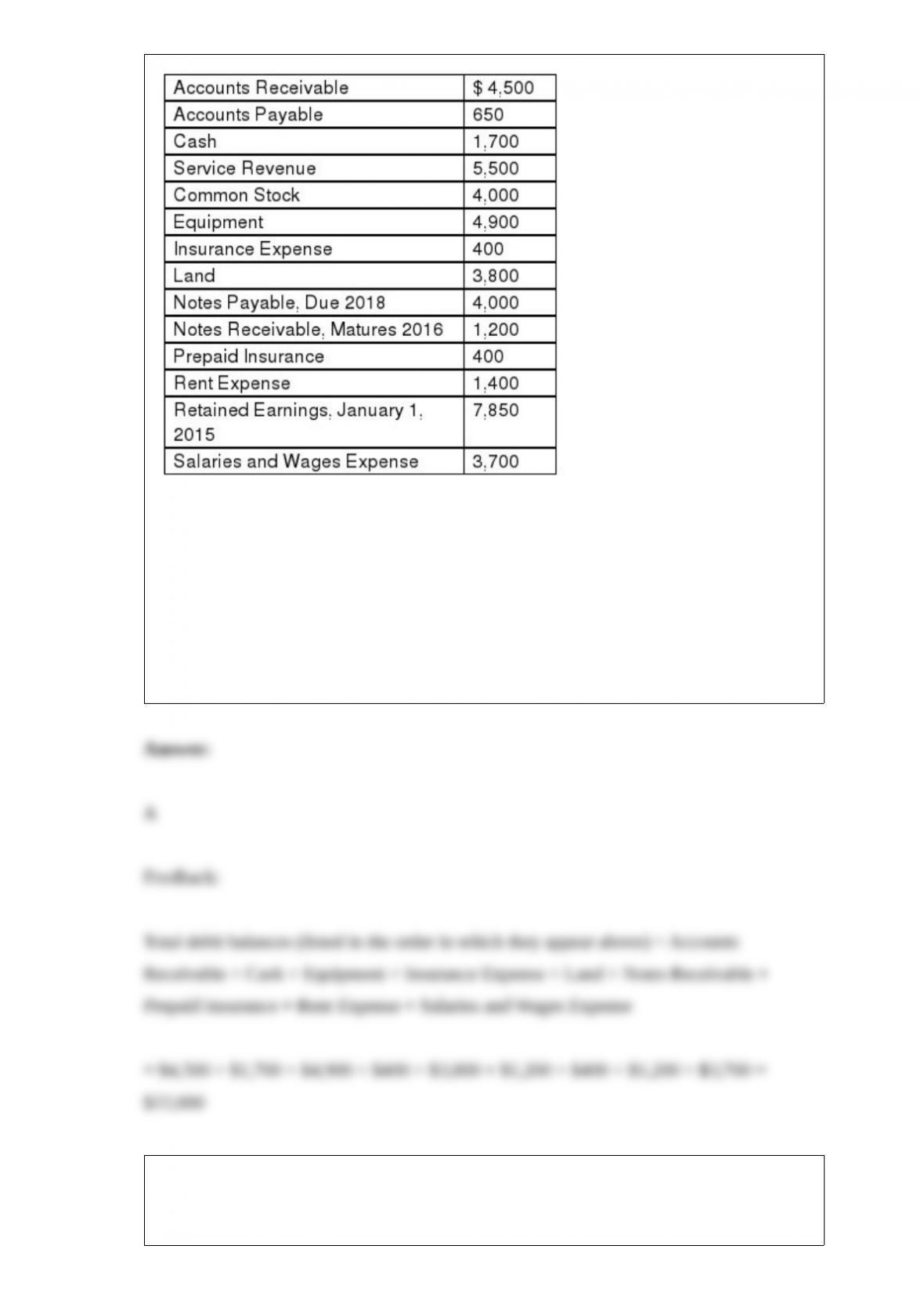
What is the total of the debit side of the unadjusted trial balance?
A) $22,000.
B) $17,350.
C) $16,500.
D) $13,500.
Which of the following is an activity in the operations of a manufacturer, but not in the
operations of a merchandising or service company?
A) Selling the good to consumers
B) Receiving cash
C) Selling the good to other firms
D) Buying raw materials
Use the information above to answer the following question. What is the missing
amount for Total Liabilities?
A) $3,347,700.
B) $1,439,200.
C) $1,470,700.
D) $1,877,000.
Which of the following is not a profitability ratio?
A) Return on equity (ROE)
B) Earnings per share
C) Fixed asset turnover
D) Days to sell