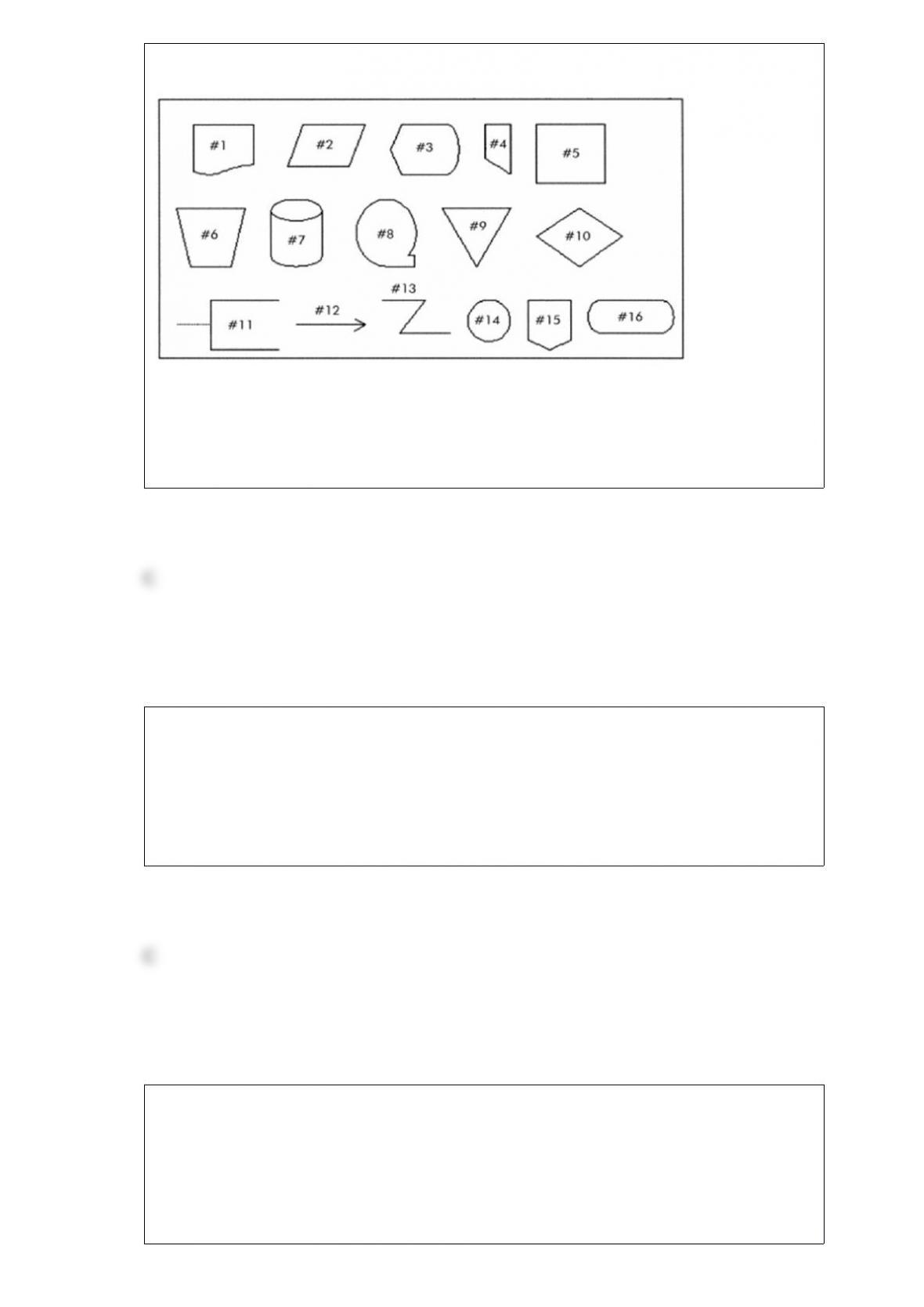
Use the chart below to answer the following questions regarding flow chart symbols.
Which symbol would be used in a flowchart to represent a computer process?
A) #1
B) #2
C) #5
D) #3
Perimeter defense is an example of which of the following preventive controls that are
necessary to provide adequate security?
A) Training.
B) Controlling physical access.
C) Controlling remote access.
D) Host and application hardening.
Which of the following organization controls should be implemented and maintained to
counteract the general threat that the loss of production data will greatly slow or halt
production activity?
A) Store key master inventory and production order files on-site only to prevent their
theft.
B) Back up data files only after a production run has been physically completed.
C) Access controls should apply to all terminals within the organization.
D) Allow access to inventory records from any terminal within the organization to
provide efficient data entry.
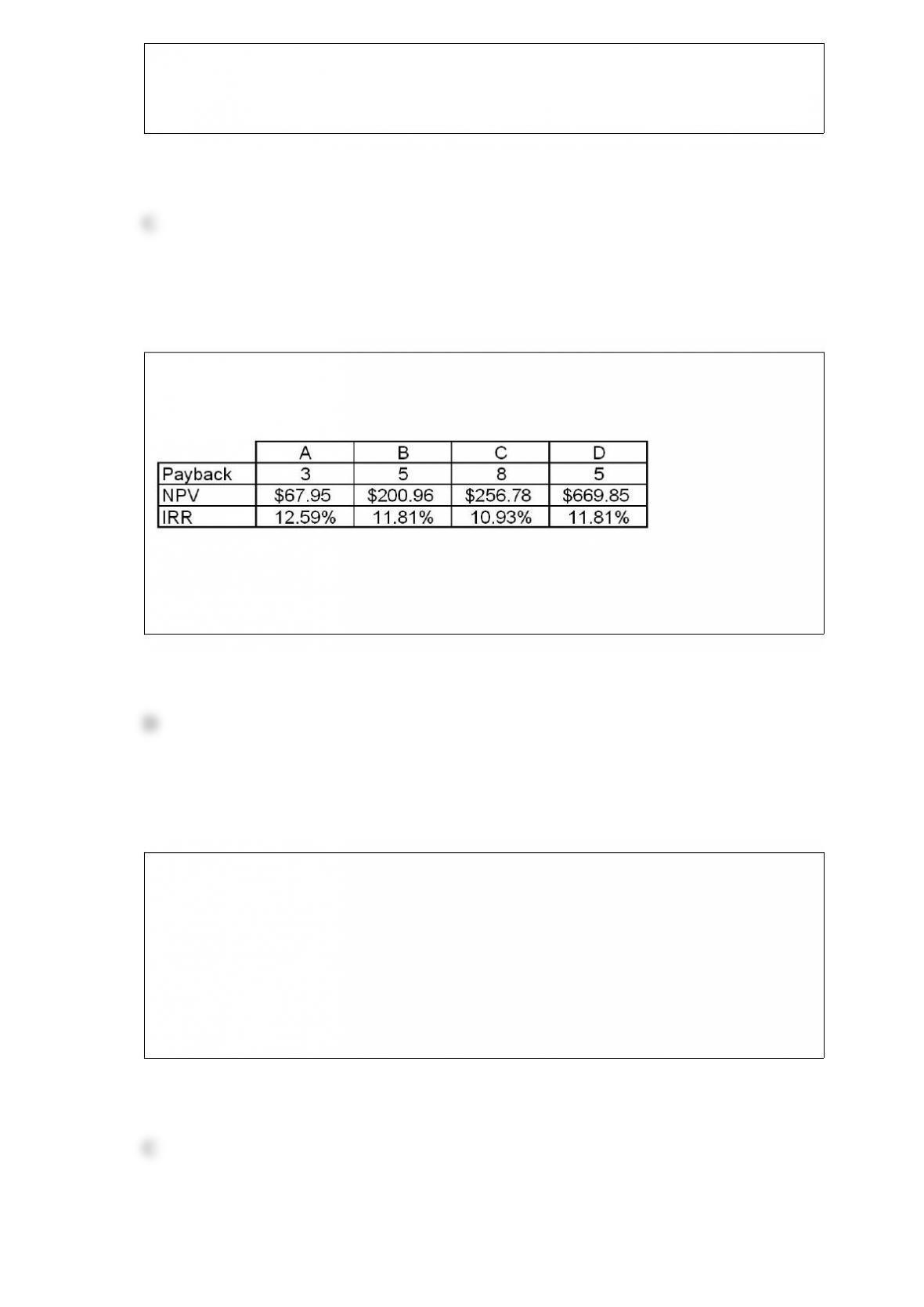
Refer to the table below, which shows the results of payback, net present value, and
internal rate of return analysis of four projects. Which is preferred by the net present
value criterion?
A) Project A
B) Project B
C) Project C
D) Project D
The task of improving the efficiency of Crawford Insurance’s accounting information
system was given to a project development team. During the ________ step in the
systems development life cycle, the team determined that the project’s objectives can be
best accomplished by upgrading the existing system.
A) systems analysis
B) implementation and conversion
C) physical design
D) conceptual design

In which stage(s) of the database design process does data modeling occur?
A) During the systems analysis stage.
B) During the design stage.
C) During both the systems analysis and design stages.
D) After the design stage.
Which of the following were CASE tools not designed to do?
A) replace skilled designers
B) plan, analyze, design, program, and maintain an information system
C) automate important aspects of the software development process
D) enhance the efforts of managers in understanding information needs
Which of the following is not an example of something monitored by a responsibility
accounting system?
A) Budgets.
B) Quotas.
C) Vendor analysis.
D) Quality standards
Marina Filimena is an accountant at Jasmina Hair Products. Marina received the
following error message while making an adjusting entry to the general ledger: “The
amounts debited and credited are not equal. Please correct and try again.” This is an
example of a

A) validity check.
B) field check.
C) zero-balance check.
D) completeness test.
Falk Noam is the internal auditor for Matan Incorporated. Before investigating the
HRM / payroll cycle at Matan, Falk decided to read up on the proper segregation of
duties regarding payroll disbursement processes. For strongest segregation of duties, the
________ should distribute paychecks.
A) accounts payable department
B) cashier
C) internal audit department
D) external auditor
Which is a true statement regarding the use of the manual processing symbol in a
flowchart?
A) If a document is moved from one column to another, show the document only in the
last column.
B) Each manual processing symbol should have an input and an output.
C) Do not connect two documents when moving from one column to another.
D) Use a manual processing symbol to indicate a document being filed.
What is the best way to prevent the acceptance of goods that were never ordered?

A) Order only from approved vendors.
B) Enforce an appropriate conflict of interest policy in place.
C) Match the packing slip to a purchase order before accepting delivery.
D) Require specific authorization from the purchasing manager before accepting any
goods.
The day after Christmas, Jane Olson, Chief Information Officer at American Trading
Corporation (ATC), received some bad news. The hard drive use to store the company’s
system data backups was lost while it was being transported to an offsite storage
location. Jane called a meeting of her technical staff to discuss the implications of the
loss. Which of the following is most likely to relieve her concerns over the potential
cost of the loss?
A) ATC has a comprehensive disaster recovery plan.
B) The hard drive was encrypted and password protected.
C) The shipper has insurance that will reimburse ATC for the cost of the hard drive.
D) ATC has a copy of the hard drive onsite, so a new copy for storage offsite can easily
be prepared.
The ________ is responsible for identifying such risk factors in an implementation
plan.
A) implementation team
B) steering committee
C) systems analysis team
D) systems development team

Which department should have the sole ability to provide information to the AIS about
hiring, terminations, and pay rate changes?
A) Accounting.
B) Benefit.
C) Production.
D) HRM.
The ________ is responsible for evaluating the design alternatives and selecting the one
that best meets the organization’s needs.
A) design team
B) implementation committee
C) steering committee
D) systems analysts
Which is a true statement about the REA data model?
A) The REA data model classifies entities into three distinct categories.
B) The term REA is an acronym that stands for resources, entities, and agents.
C) Using an REA data model is not helpful when creating an R-E diagram.
D) The term REA is an acronym that stands for resources, entities, and activities.
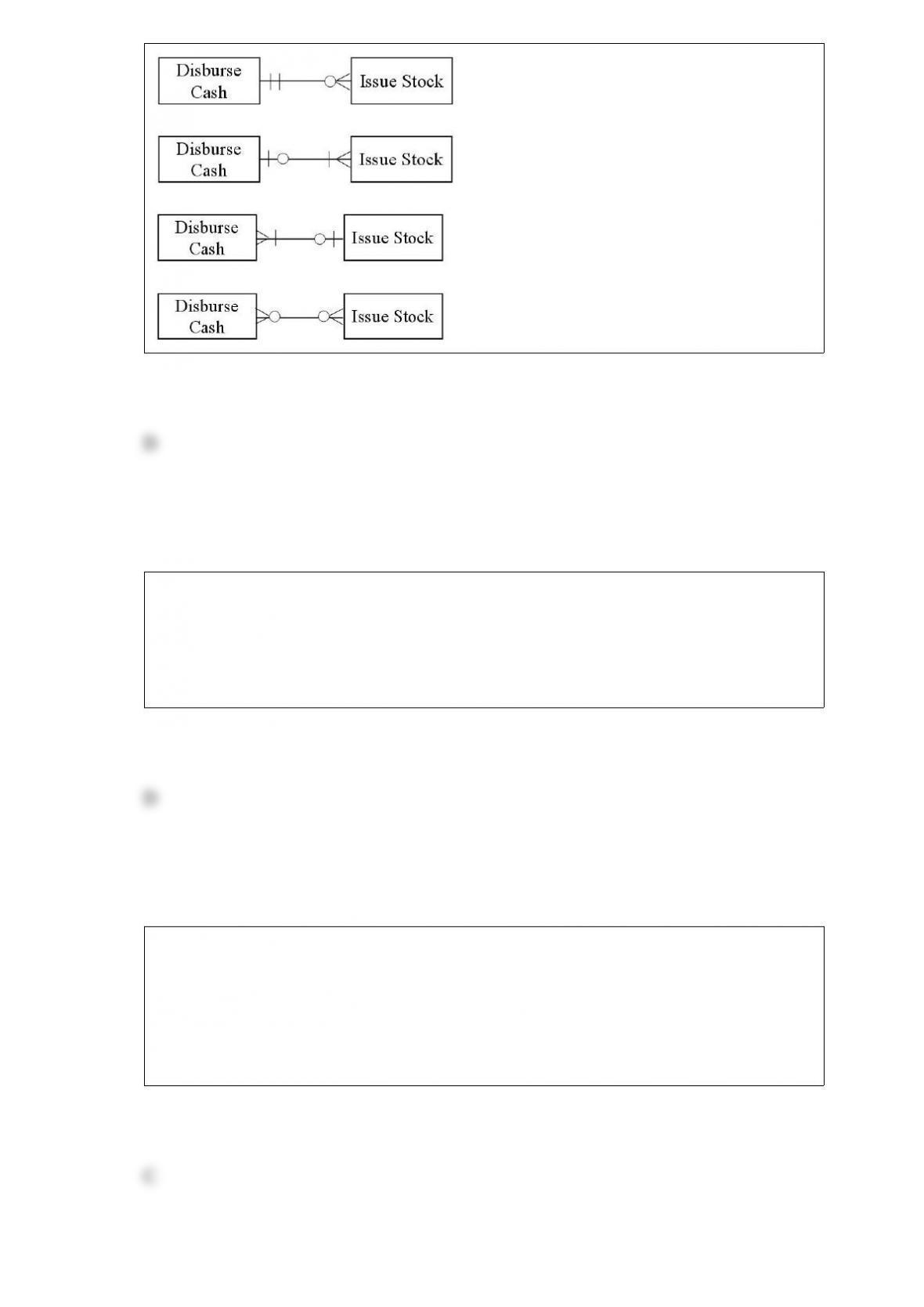
Which of the following accurately represents typical cardinalities for two entities in the
finance cycle?
A)
B)
C)
D)
Which method of fraud is physical in its nature rather than electronic?
A) cracking
B) hacking
C) eavesdropping
D) scavenging
The system objective concerned that crucial information be produced first, and then less
important items as time permits, is known as
A) flexibility.
B) reliability.
C) timeliness.
D) usefulness.

A number that enables customers to remit payments via an ACH credit without
requiring the seller to divulge detailed information about its bank account is called
A) EFT.
B) EFDI.
C) UPC
D) UPIC.
Data flow diagrams depict
A) processes, but not who is performing the processes.
B) processes, but not the data that flows between processes.
C) who is performing processes, but not how they perform the process.
D) who is performing processes, but not the data that flows between processes.
Chopra, Limited, is an Indian company operating in New York state. It offers stylized,
boutique public relations services to upscale retailers in quaint New England towns. A
major source of revenue is a weekly newsletter that reports on current and projected
tourist travel and spending patterns. Preparation of the newsletter requires study and
analysis of weather conditions, economic activity, and travel costs. It is available at an
annual subscription rate of $299.99. There are currently 190 subscribers. Preparation
and distribution of the newsletter costs $12,000 annually. The value of information to
subscribers is
A) $236.83.
B) $44,998.10.
C) less than $63.16.
D) at least $300.00.

A query that extracts, for a given time period, all sales events for which there is no
corresponding receive cash event on the date of the sales event will yield
A) a cash account ledger.
B) a credit sales journal.
C) an accounts receivable ledger.
D) an accounts payable journal.
The ________ is a legal contract that defines responsibility for goods that are in transit.
A) bill of lading
B) packing slip
C) back order
D) picking list
An information system used by an furniture maker took 48 hours to process an order
received over the internet. After upgrading the system, processing time was reduced to
sixty seconds. This is an example of
A) productivity gains.
B) a technological change.
C) an improved business process.
D) better systems integration.

The information systems audit objective that pertains to having management’s
authorization and approval is known as
A) overall security.
B) program development.
C) program modifications.
D) processing.
Which type of software blocks outgoing messages containing key words or phrases
associated with an organization’s sensitive data?
A) Anti-virus software.
B) Data loss prevention software.
C) A digital watermark.
D) Information rights software.
How many tables are needed to implement an REA data model that has three distinct
entities, two M:N relationships and two 1:N relationships in a relational database?
A) 5
B) 7
C) 8
D) 10
During a routine audit, a review of cash receipts and related accounting entries revealed
discrepancies. Upon further analysis, it was found that figures had been entered

correctly and then subsequently changed, with the difference diverted to a fictitious
customer account. This is an example of
A) kiting.
B) data diddling.
C) data leakage.
D) phreaking.
At the beginning of this chapter, you were presented with a situation regarding Jason
Scott. Jason is an internal auditor for Northwest Industries, a forest products company.
On March 31, he reviewed his completed tax return and noticed that the federal income
tax withholding on his final paycheck was $5 more than the amount indicated on his
W-2 form.He used the W-2 amount to complete his tax return and made a note to ask
the payroll department what happened to the other $5. The next day, Jason was
swamped, and he dismissed the $5 difference as immaterial. On April 16, a coworker
grumbled that the company had taken $5 more from his check than he was given credit
for on his W-2. When Jason realized he was not the only one with the $5 discrepancy,
he investigated and found that all 1,500 employees had the same $5 discrepancy. He
also discovered that the W-2 of Don Hawkins, the payroll programmer, had
thousands of dollars more in withholdings reported to the Internal Revenue Service
(IRS) than had been withheld from his paycheck.
Identify the type of fraud scheme may have happened as described. Describe controls
you would implement to address the fraud risk, and label each control as preventive or
detective.
Describe the data processing cycle used to process transactions, including how data is
input, stored, and processed and how information is output.
Discuss the conceptual systems design process and the activities in this phase.
Explain the process and key decisions involved in making cash disbursements to
suppliers, identify the threats to those activities, and describe the controls that can
mitigate those threats.
Discuss the role the accountant can play in the production cycle.
Describe the relationships between Recruiting event and Skills, and between Recruiting
event and Job Applicants.
Describe four ways companies can reduce losses from fraud.
Why is cost information stored in several relational tables?
Explain why users should participate in data modeling?
Explain basic control concepts and explain why computer control and security are
important.
Discuss the reasons small and midsized businesses are attracted to payroll service
bureaus and PEOs.
Identify possible problems associated with receiving goods and appropriate actions in
response to the problems.
Explain the importance and advantages of databases, as well as the difference between
database systems and file-based legacy systems.
Describe the two methods to manage accounts receivable.
Explain what CIM means and its benefits.
Discuss the weaknesses in COSO’s internal control framework that led to the
development of the COSO Enterprise Risk Management framework.
In the expenditure cycle, the majority of payments made are by check. What are some
control issues related to payment of vendors by check?
Describe the nature and scope of an operational audit.
Identify the ways an organization can gain full advantage of using a Request For
Proposal (RFP).