A preemptive right means shareholders can purchase their proportional share of
common stock issued later by the corporation.
An activity-based costing system usually involves a fewer number of allocations
compared with a traditional cost allocation system.
A company had net sales and cost of goods of $545,000 and $345,000, respectively. Its
gross margin equals $890,000.
If obsolete or damaged goods can be sold, they will be included in inventory at their net
realizable value.
An invoice is a document that is used within a company to notify the appropriate
persons that ordered goods have been received and to describe the quantities and
condition of the goods.
The first section of the income statement reports cash from operations.
Authorized stock is the total number of shares outstanding.

Experience shows that when times interest earned falls below 1.5 to 2.0 and remains at
that level or lower for several time periods, the default rate on liabilities increases
sharply.
An investor purchased $50,000 of bonds and held them to maturity. This investor’s
journal entry at maturity of the bonds should include a debit to Cash for $50,000 and a
credit to Long-Term Investments for $50,000.
Intracompany analysis is based on comparisons with competitors.
An understatement of the ending inventory balance will understate cost of goods sold
and overstate net income.

To be classified as a cash equivalent an investment must be readily convertible to an
unknown amount of cash, because the market value may be affected by interest rate
changes.
Foreign exchange rates fluctuate due to many factors including changing political and
economic conditions.
Payments on installment notes normally include accrued interest plus a portion of the
principal amount borrowed.
Scatter diagrams plot volume on the vertical axis and cost on the horizontal axis.
The heading on each financial statement lists the three W’s ” Who (the name of the
organization), What (the name of the statement), and Where (the organization’s address)
Dividend yield is computed by dividing annual cash dividends per share by earnings per
share.
FOB shipping point (or FOB factory) implies that ownership of goods transfers to the
buyer at the buyer’s place of business.
Multinational corporations can be U.S. companies with operations in other countries.
If a bond’s interest period does not coincide with the issuing company’s accounting
period, an adjusting entry is necessary to recognize bond interest expense accruing
since the most recent interest payment.
The concept of total quality management focuses on continuous improvement.
Callable bonds can be exchanged for a fixed number of shares of the issuing
corporation’s common stock.
The Petty Cash account is a separate checking account used for small amounts.
Market prospects are the ability to provide financial rewards sufficient to attract and
retain financing.
If a machine is damaged during unpacking, the repairs are added to its cost.
A company performed warranty repair work for a customer that cost $1,000. The
journal entry to record the work should be a debit of $1,000 to Warranty Expense and a
credit of $1,000 to Estimated Warranty Liability.
The main principle of the lean business model is the elimination of waste of every kind
while satisfying the customer and providing a positive return to the company.
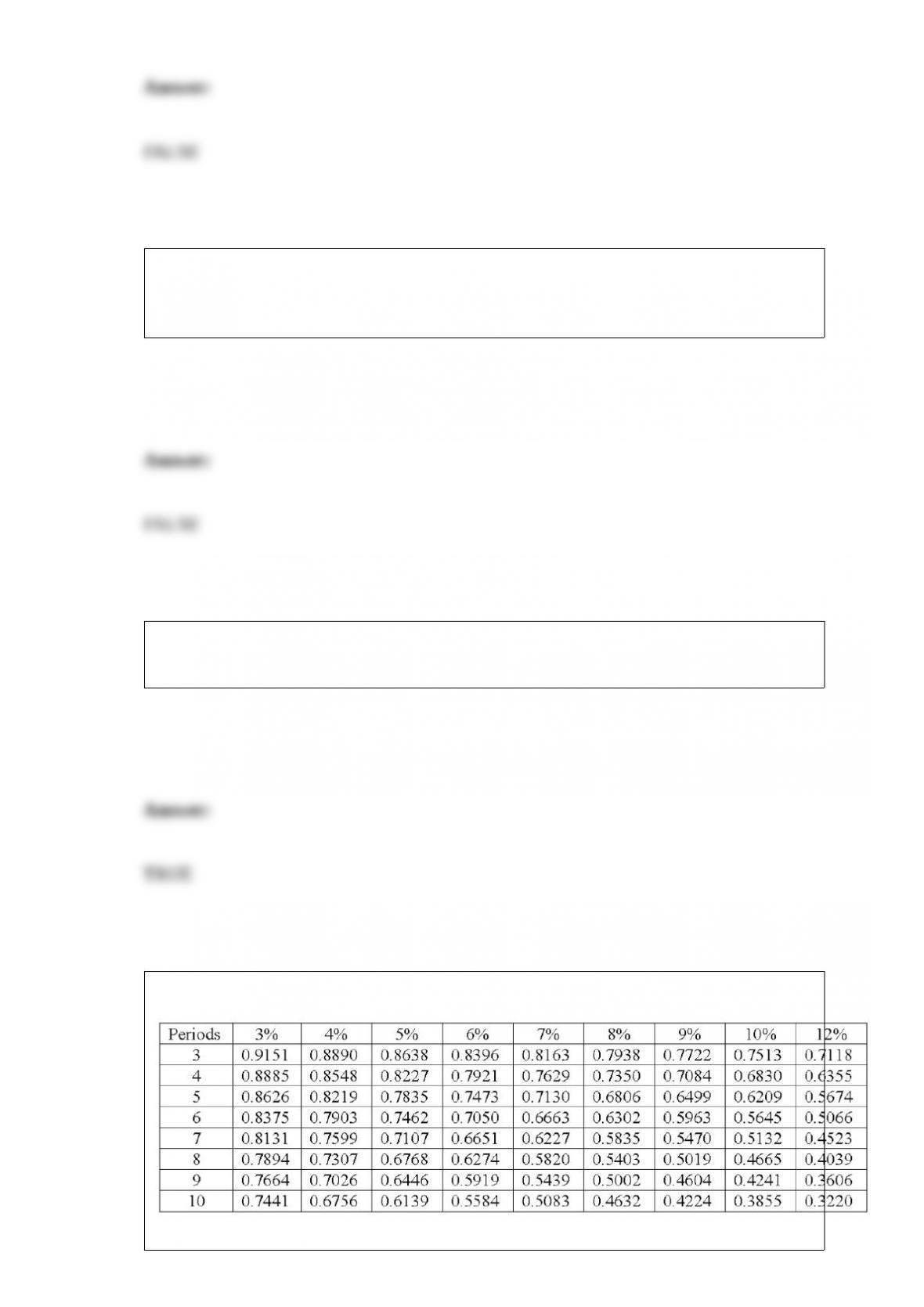
Present Value of 1
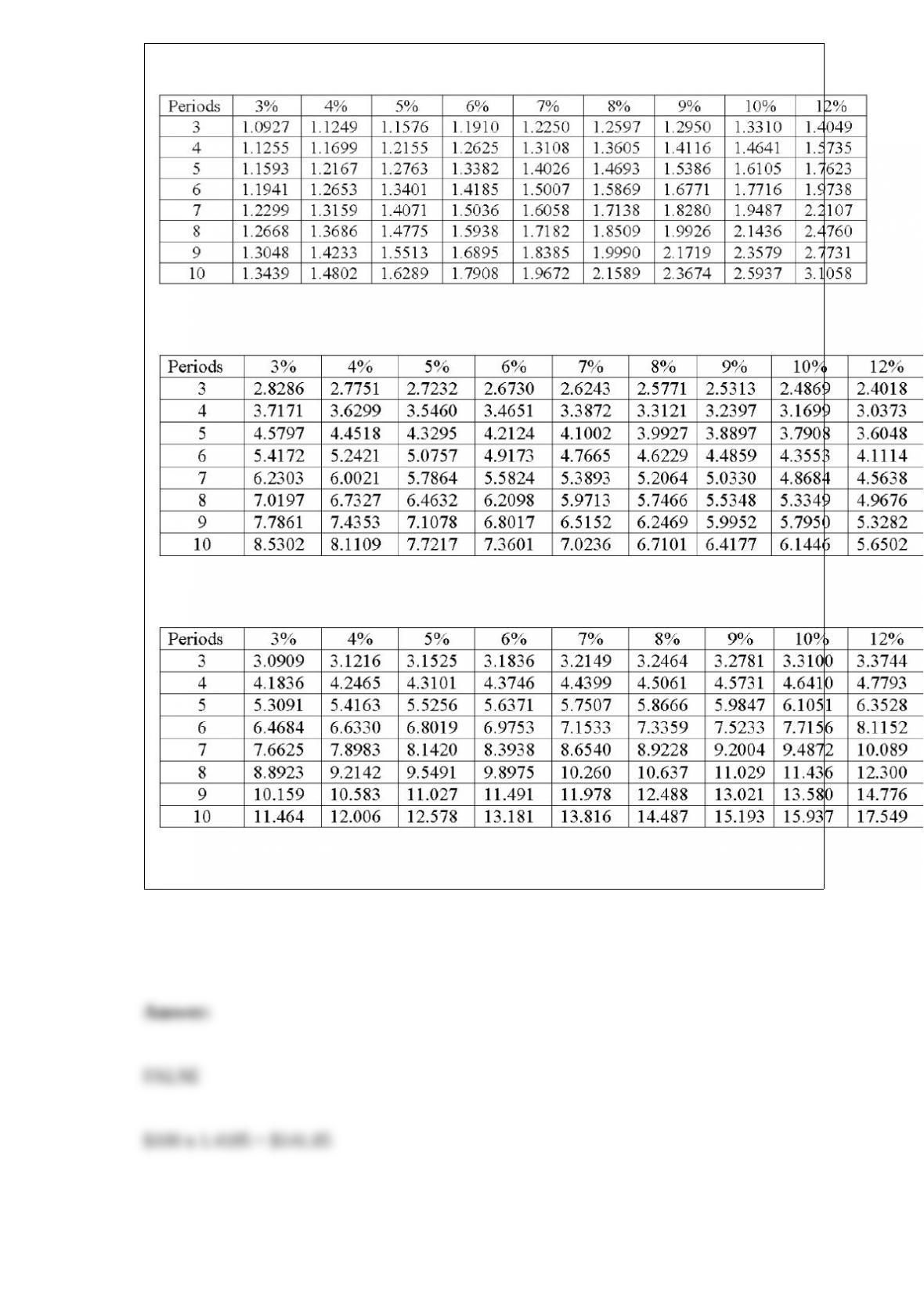
Future Value of 1
Present Value of an Annuity of 1
Future Value of an Annuity of 1
The future value of $100 compounded semiannually for 3 years at 12% equals $140.49.

Depreciation measures the decline in market value of an asset.
A production department is an organizational unit of a factory that has the responsibility
for at least partially manufacturing or producing a product or service.
The committee that attempts to create more harmony among the accounting practices of
different countries by identifying preferred practices and encouraging their worldwide
acceptance is the:
A.AICPA.
B.FASB.
C.CAP.
D.SEC.
E.IASB.

The total amount of stock that a corporation’s charter allows it to issue is referred to as:
A.Issued stock.
B.Outstanding stock.
C.Common stock.
D.Preferred stock.
E.Authorized Stock.
The basic financial statements include the:
A.Balance Sheet.
B.Income Statement.
C.Statement of Owner’s Equity.
D.Statement of Cash Flows.
E.All of these.
A company’s had fixed interest expense of $6,000, its income before interest expense
and any income taxes is $18,000, and its net income is $8,400. The company’s times
interest earned ratio equals:
A.0.33.

B.0.71.
C.1.40.
D.3.00.
E.12,000.
A company has 1,000 shares of $50 par value, 4.5% cumulative and nonparticipating
preferred stock and 10,000 shares of $10 par value common stock outstanding. The
company paid total cash dividends of $1,000 in its first year of operation. The cash
dividend that must be paid to preferred stockholders in the second year before any
dividend is paid to common stockholders is:
A.$1,000.
B.$1,250.
C.$2,250.
D.$3,500.
E.$4,500.
The usual budget period is:
A.An annual period of 250 working days.
B.A monthly period separated into daily budgets.
C.A quarterly period separated into weekly budgets.
D.An annual period separated into weekly budgets.
E.An annual period separated into quarterly and monthly budgets.
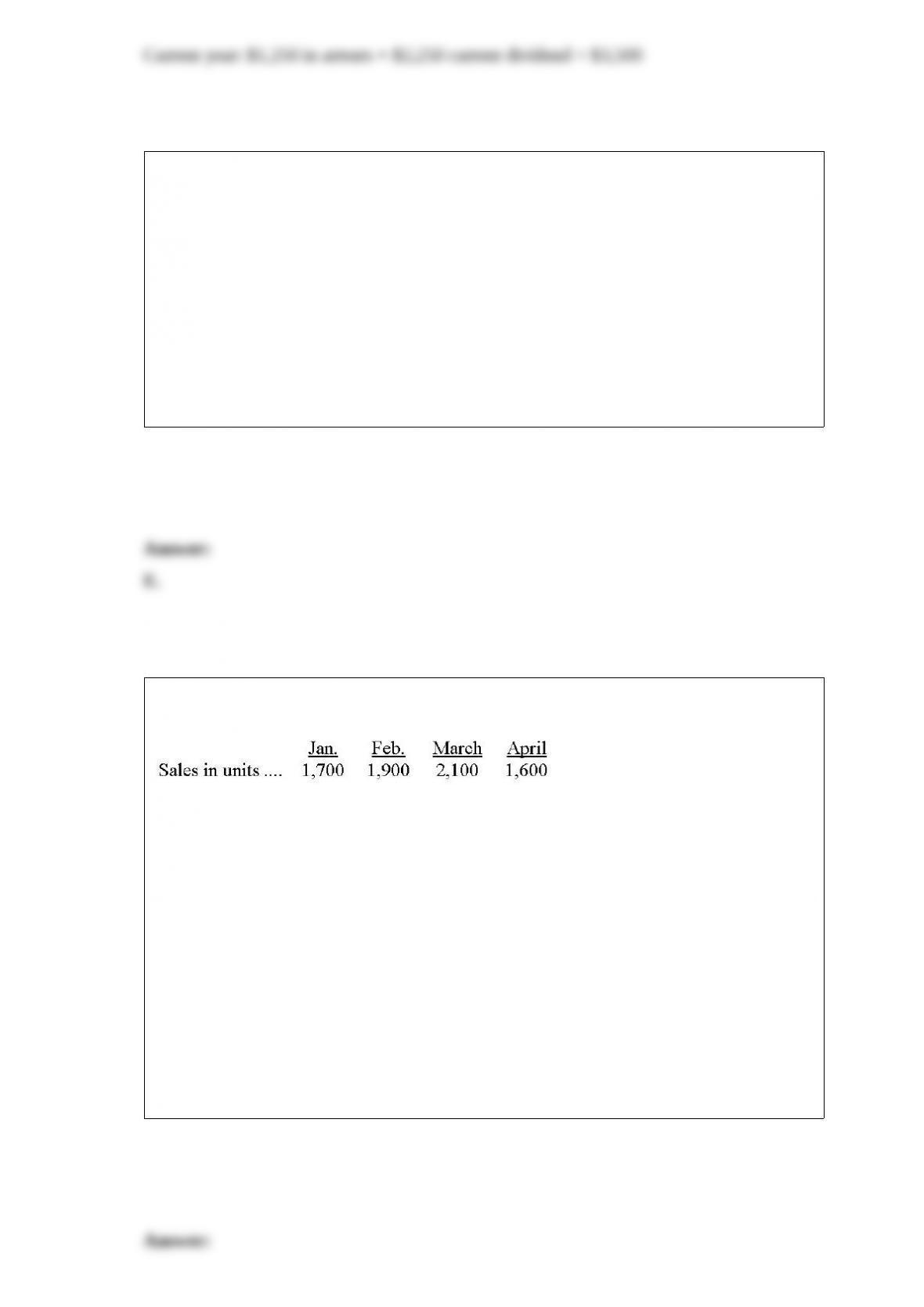
Ecology Co. sells a biodegradable product called Dissol and has predicted the following
sales for the first four months of the current year:
Ending inventory for each month should be 20% of the next month’s sales, and the
December 31 inventory is consistent with that policy. How many units should be
purchased in February?
A.1,860.
B.1,900.
C.1,940.
D.1,980
E.2,320.

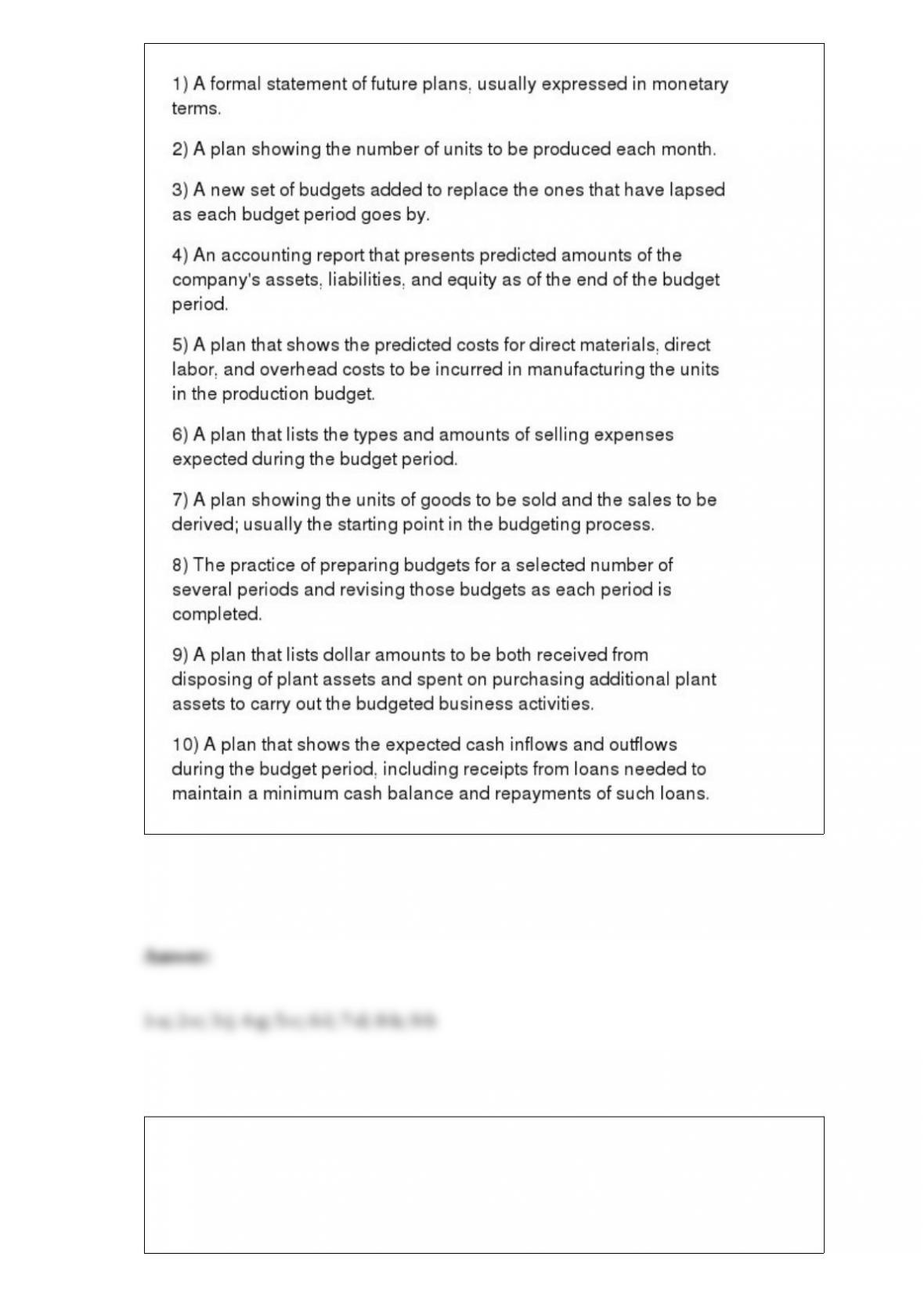
Presented below are terms or phrases preceded by letters a through j and followed by a
list of definitions 1 through 10. Match the correct definitions with the terms or phrases
by placing the letter of the term or phrase in the answer space provided at the beginning
of the definition.
(a) Budget
(b) Capital expenditure budget
(c) Manufacturing budget
(d) Sales budget
(e) Production budget
(f) Cash budget
(g) Budgeted balance sheet
(h) Continuous budgeting
(i) Selling expense budget
(j) Rolling budgets
Which interest rate column would you use from a present value table or a future value
table for 8% compounded quarterly?
A.12%.

B.6%.
C.3%.
D.2%.
E.1%.
Which of the following assets is not depreciated?
A.Store fixtures.
B.Computers.
C.Land.
D.Buildings.
E.All of these are depreciated.
Sales analysis is useful for:
A.Planning purposes only.
B.Budgeting purposes only.
C.Control purposes only.
D.Planning and control purposes.
E.Planning and budgeting purposes.
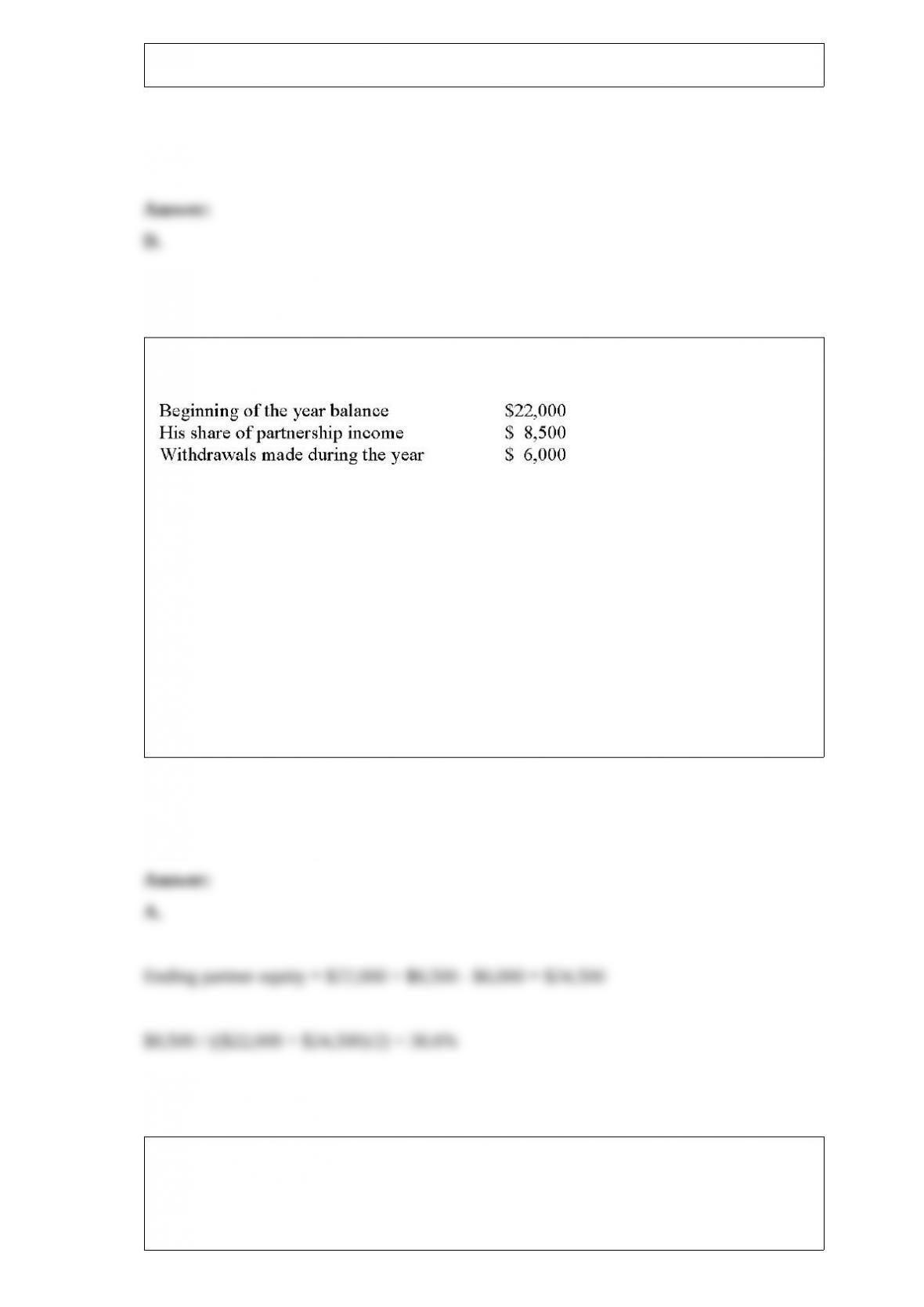
The following information is available regarding John Smith’s capital account in
Technology Consulting Group, a general partnership, for a recent year:
What is Smith’s partner return on equity during the year in question?
A.36.6%
B.34.7%
C.10.8%
D.11.4%
E.55.7%
The statement of cash flows helps analysts evaluate the:
A.Source of cash for debt repayments.

B.Source of cash for plant expansion.
C.Differences between net income and net operating cash flow.
D.Means used to finance investing activities.
E.All of these.
Nelson Company purchased equipment on July 1 for $27,500 and decided to depreciate
the equipment on the straight-line method over its useful life of five years. Assuming
the equipment’s salvage value is $3,500, the amount of monthly depreciation expense
Nelson should recognize is:
A.$2,400
B.$ 200
C.$4,800
D.$ 400
E.$ 450
After-tax net income divided by the annual average investment in an investment, is the:
A.Net present value rate.

B.Payback rate.
C.Accounting rate of return.
D.Earnings from investment.
E.Profit rate.
A company has bonds outstanding with a par value of $100,000. The unamortized
premium on these bonds is $2,700. If the company retired these bonds at a call price of
99, the gain or loss on this retirement is:
A.$ 1,000 gain.
B.$ 1,000 loss.
C.$ 2,700 loss.
D.$ 2,700 gain.
E.$ 3,700 gain.

A stock dividend transfers:
A.Paid-in capital to retained earnings.
B.Retained earnings to paid-in capital.
C.Retained earnings to assets.
D.Paid-in capital to assets.
E.Assets to paid-in capital.
Target cost is calculated as
A.direct costs + desired profit
B.direct costs – desired profit
C.expected selling price – direct costs
D.expected selling price – desired profit
E.expected selling price + desired profit
Which of the following events would cause a bank to debit a depositor’s account?
A.The depositor authorizes the bank to charge the depositor’s account $50 for new
checks.
B.The bank collects a note receivable and related interest on the depositor’s behalf.

C.The depositor determines there are outstanding checks drawn on the account at
month-end.
D.The depositor determines there are deposits in transit on the account at month-end.
E.The bank determines it incorrectly charged the depositor’s account twice for the
monthly service charge in a previous month.
Parris Corporation purchased 40% of Samitz Corporation for $100,000 on January 1.
On November 17 of the same year, Samitz Corporation declared total cash dividends of
$12,000. At year-end, Samitz Corporation reported net income of $60,000. The balance
in the Parris Corporation’s Long”Term Investment in Samitz Corporation at December
31 should be:
A.$ 80,800.
B.$100,000.
C.$ 95,200.
D.$119,200.
E.$124,000.
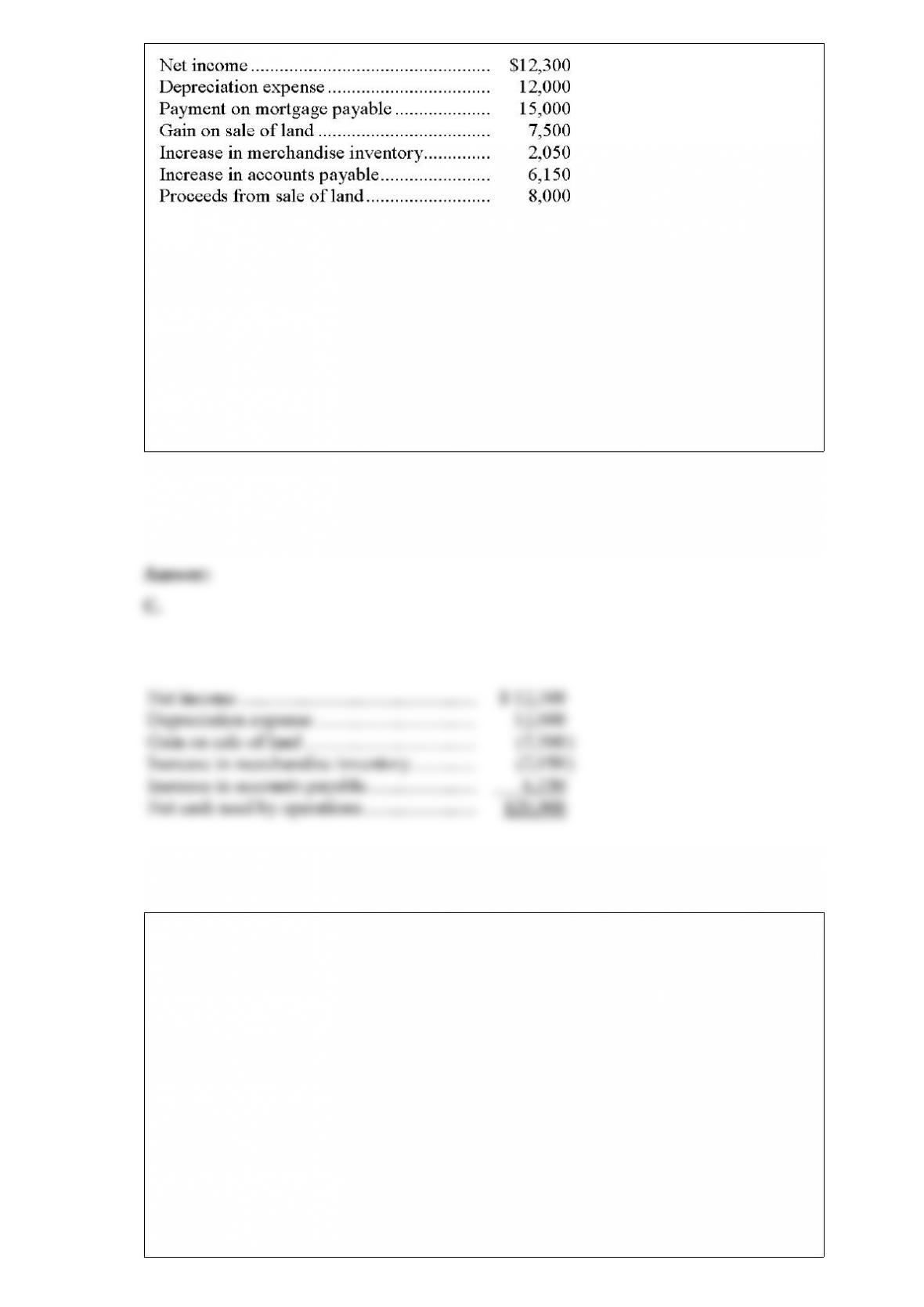
Use the following information and the indirect method to calculate the net cash
provided or used by operating activities:
A.$12,700.
B.$13,900.
C.$20,900.
D.$28,400.
E.$35,900.
The Unadjusted Trial Balance columns of a company’s work sheet show the balance in
the Office Supplies account as $750. The Adjustments columns show that $425 of these
supplies were used during the period. The amount shown as Office Supplies in the
Balance Sheet columns of the work sheet is:
A.$325 debit.
B.$325 credit.
C.$425 debit.
D.$750 debit.
E.$750 credit.

Which of the following is not one of the four steps in accounting for production activity
in a period?
A.Determine over or underapplied overhead.
B.Analyze the physical flow of units.
C.Analyze equivalent units.
D.Determine cost per equivalent unit.
E.Prepare a cost reconciliation.
A method that allocates an equal portion of the total depreciable cost for a plant asset to
each unit produced is called:
A.Accelerated depreciation.
B.Declining-balance depreciation.
C.Straight-line depreciation.
D.Units-of-production depreciation.
E.Modified accelerated cost recovery system (MACRS) depreciation.

A company that has operated with a 30% average gross profit ratio for a number of
years had $100,000 in sales during the first quarter of this year. If it began the quarter
with $18,000 of inventory at cost and purchased $72,000 of inventory during the
quarter, its estimated ending inventory by the gross profit method is:
A.$30,000.
B.$21,000.
C.$20,000.
D.$18,000.
E.$27,000.
The cash flow on total assets ratio is calculated by:
A.Dividing cash flows from operations by average total assets.
B.Dividing total cash flows by average total assets.
C.Dividing average total assets by cash flows from investing activities.
D.Dividing average total assets by total cash flows.
E.Total cash flows divided by average total assets times 365.

A job cost sheet shows information about each of the following items except:
A.The direct labor costs assigned to the job.
B.The name of the customer.
C.The costs incurred by the marketing department in selling the job.
D.The overhead costs assigned to the job.
E.The direct materials costs assigned to the job.
Based on the ratios and analysis of the account balances for Breanna Boutique, the
company is:
A.likely to face near-term liquidity problems.
B.unlikely to face near-term liquidity problems.
C.likely raising liquidity concerns unless cash can be generated from inventory sales.
D.unlikely raising liquidity concerns.
E.Both A and C.

A company had net sales of $600,000, total sales of $750,000, and an average accounts
receivable of $75,000. Its accounts receivable turnover equals:
A..13
B..80
C.7.75
D.8.00
E.10.00
Bonds that have an option exercisable by the issuer to retire them at a stated dollar
amount prior to maturity are known as:
A.Convertible bonds.
B.Sinking fund bonds.
C.Callable bonds.
D.Serial bonds.
E.Junk bonds.
Gross increases in equity from a company’s earnings activities are:
A.Assets.
B.Revenues.
C.Liabilities.
D.Owner’s Equity.
E.Expenses.
Discuss the options for the allocation of income and loss among partners, including
with and without a partnership agreement.
Inventory shrinkage can be computed by comparing the ___________ of inventory with
recorded quantities and amounts.
On a bank statement, deposits are shown as __________________, because the
depositor’s account is a liability on the bank’s records.
If the _______________ is responsible for paying the freight, ownership of
merchandise inventory passes when the goods arrive at their destination.
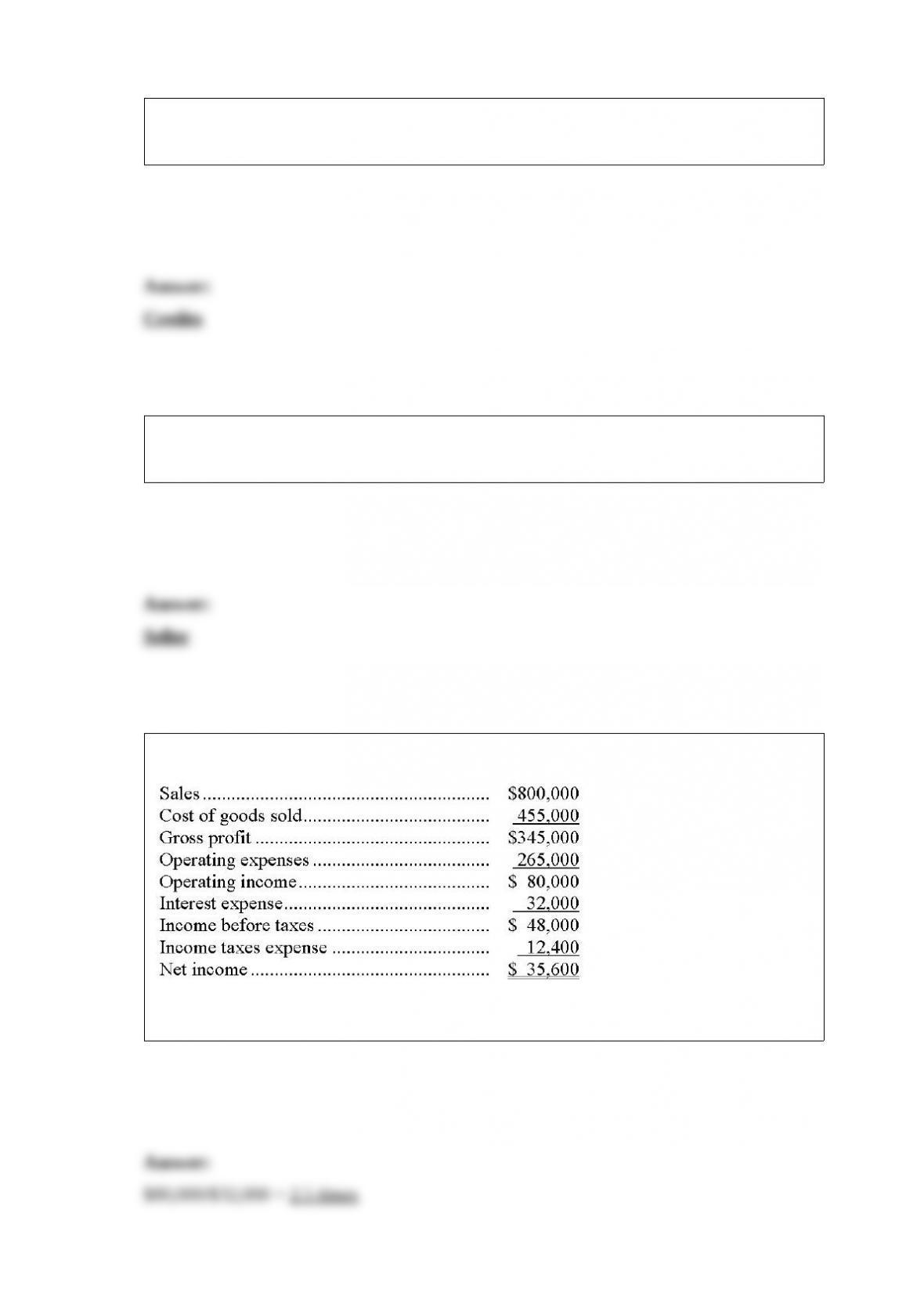
Information from a manufacturing company’s current year income statement follows:
Calculate the company’s times interest earned.
A ___________________ cost has already been incurred and cannot be avoided or
changed, so it irrelevant to decision making.
A ______________________ incurs costs without directly generating revenues.
Nike’s net income was $780,000; its net assets were $5,200,000; and its net sales were
$9,000,000. Calculate its profit margin ratio.
How do the consistency concept and the full disclosure principle affect inventory
valuation?
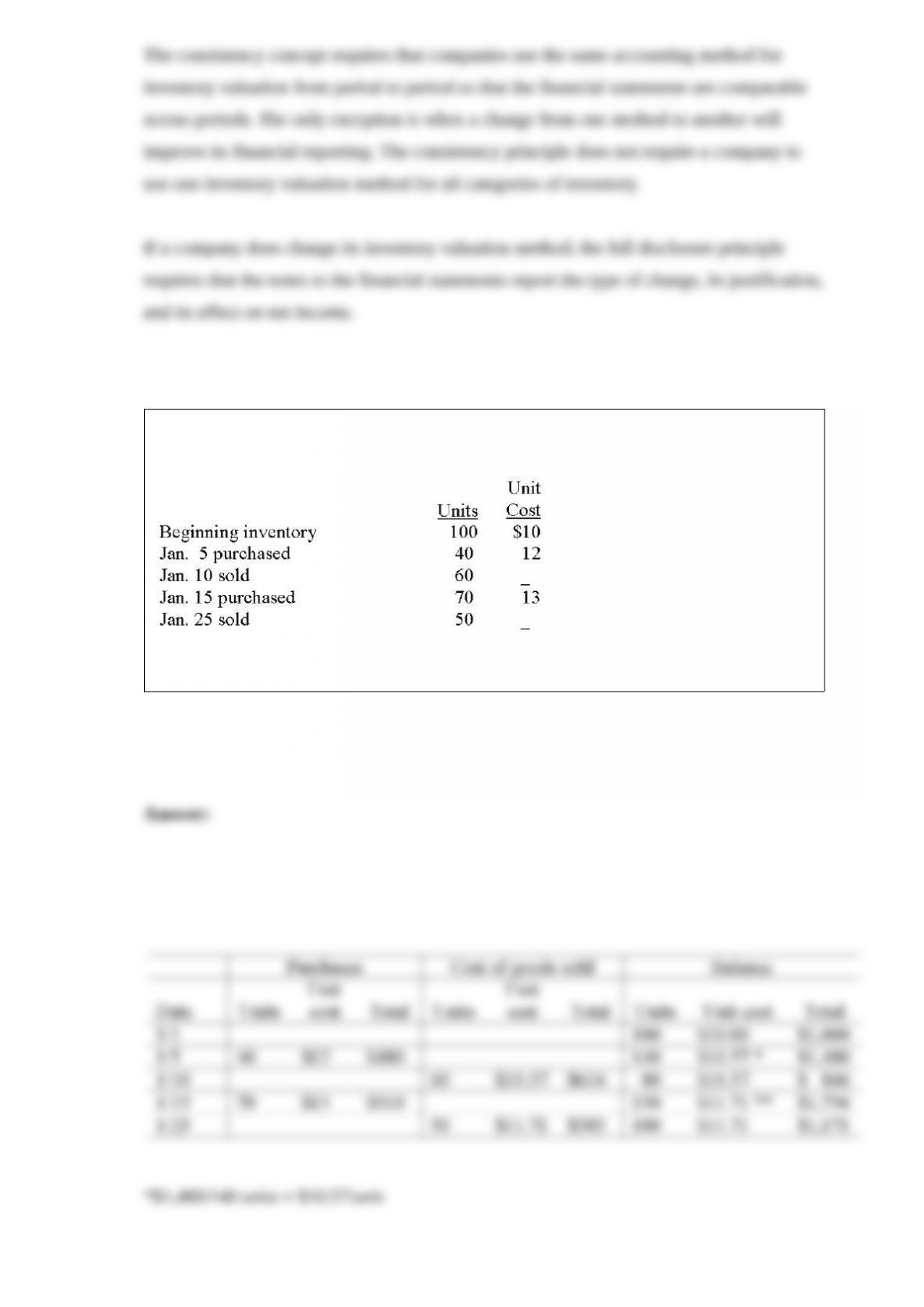
During January, a company that uses a perpetual inventory system had beginning
inventory, purchases, and sales as follows:
What was the weighted average cost of the company’s January 31 inventory?