
Depreciation expense is not a cash flow item but it will affect the calculation of which
cash flow item?
A. initial investment.
B. income taxes.
C. salvage value.
D. working capital.
One of the most important reasons for having a system of internal control is to:
A. improve the effectiveness and efficiency of the operations of the organization.
B. ensure no employees have ever been convicted of stealing.
C. eliminate any temptations that may be presented to employees that could lead to theft
from the company.
D. prevent a salesperson from using a company car for personal transportation.
Selling price per unit $100 Variable expenses per unit $40 Fixed expenses per month
$60,000
The contribution margin ratio is:
A. 40%.
B. 60%.
C. 62.5%.
D. 70%.
Performance analysis in the planning and control cycle relates to the act of:
A. planning.
B. managing.
C. controlling.
D. revising plans.

The purchasing agent of an organization acquired some raw materials at a bargain price,
even though she knew that their quality was lower than that of the materials customarily
used. This action resulted in a favorable raw materials purchase price variance that
might very well have been more than offset by:
A. an unfavorable raw materials usage variance.
B. a favorable direct labor efficiency variance.
C. an unfavorable variable overhead spending variance.
D. an unfavorable direct labor rate variance.
Which of the following is not a strong reason for budgeting?
A. budgets provide a benchmark for judging performance.
B. budgeting requires little effort by non-accounting managers.
C. budgeting requires management to plan.
D. budgeting requires coordination among the functional areas of the firm.
Expenditures capitalized as long-lived assets generally include those expenditures that:
A. are made for normal repairs to maintain the usefulness of the asset over a number of
years.
B. are for items that have a physical life of more than a year, regardless of their cost.
C. are material in amount and that have an economic benefit to the entity only in the
current year.
D. are material in amount and that have an economic benefit to the entity that extends
beyond the current year.
The statement of changes in retained earnings for the year shows:
A. the retained earnings balance at the beginning of the year.
B. amounts received from the sale of additional common stock during the year.
C. gains or losses from discontinued operations during the year.
D. the effect of a stock split during the year.

A 10% change in a firm’s revenues is likely to result in a change of more than 10% in
the firm’s operating income because:
A. not all of the firm’s costs will change in proportion to the revenue change.
B. the firm has financial leverage.
C. the contribution margin ratio will change in proportion to the revenue change.
D. only fixed expenses will change in proportion to the revenue change.
Fixed costs classified according to the time frame perspective are known as:
A. direct cost and indirect cost.
B. constant and inconsistent cost.
C. committed cost and discretionary cost.
D. product cost and period cost.
Noncurrent, intangible assets such as leasehold improvements, patents, and copyrights
are all subject to:
A. depreciation.
B. amortization.
C. depletion.
D. consolidation.
The primary difference between absorption costing and direct costing is the treatment
of:
A. direct material costs.
B. variable manufacturing overhead.
C. fixed manufacturing overhead.
D. direct labor costs.
Wisdom Co. has a note payable to its bank. An adjustment is likely to be required on
Wisdom’s books at the end of every month that the loan is outstanding to record the:
A. amount of interest paid during the month.
B. amount of total interest to be paid when the note is paid off.
C. amount of principal payable at the maturity date of the note.
D. accrued interest expense for the month.
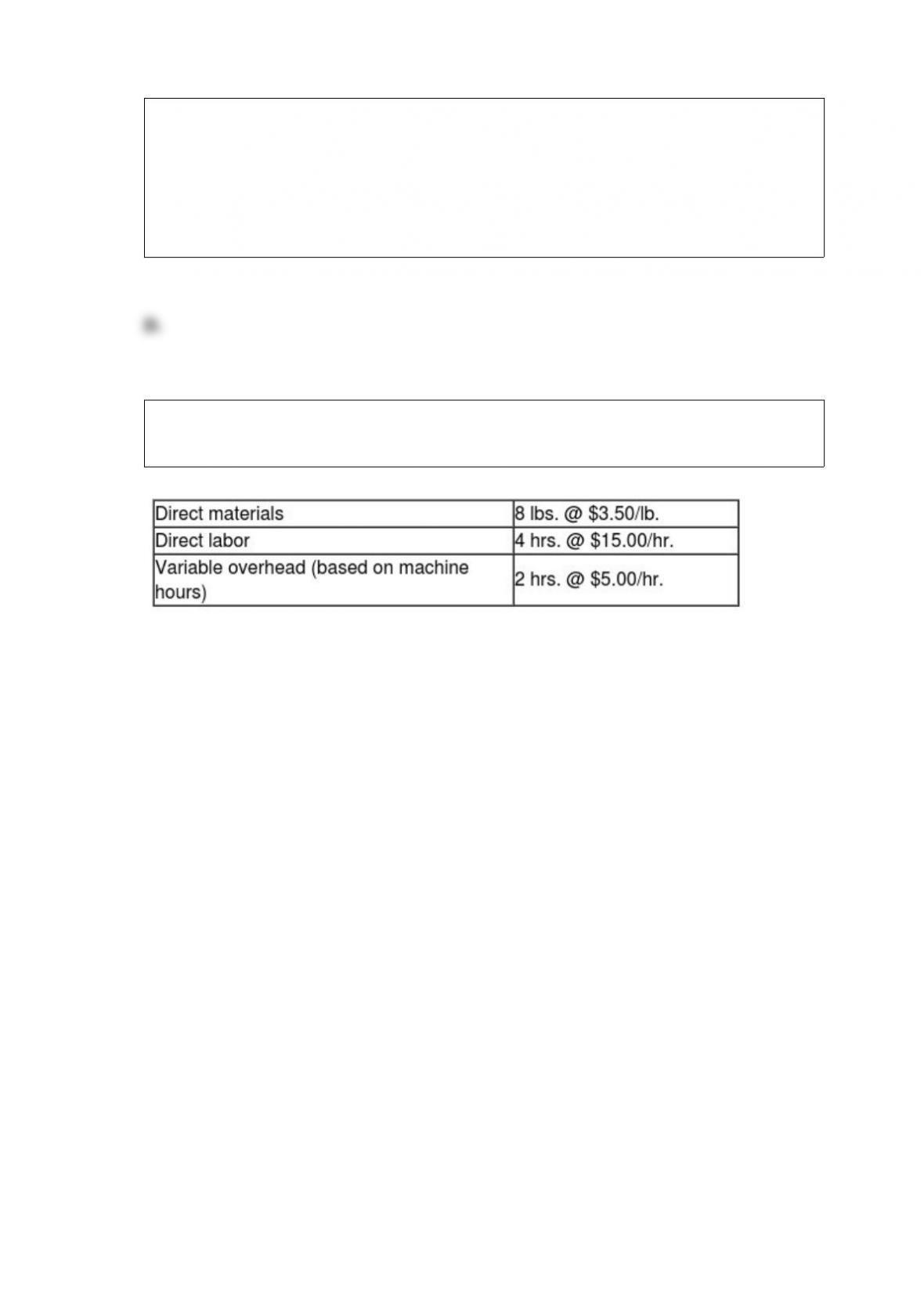
The standards for one case of Peardrax are:
During the week ended June 7, the following activity took place:
• 5,740 machine hours were worked;
• 22,600 lbs. of raw material were purchased for inventory at a total cost of $83,620;
• 2,700 cases of finished product were produced;
• 21,330 lbs. of raw material were used;
• 10,650 labor hours were worked at an average rate of $15.20 per hour;
• $27,552 actual variable overhead costs were incurred.
Calculate each of the following variances:
(a.) Price variance for raw materials purchased.
(b.) Raw materials usage variance.
(c.) Direct labor rate variance.
(d.) Direct labor efficiency variance.
(e.) Variable overhead spending variance.
(f.) Variable overhead efficiency variance.
A variance is the difference between actual costs and:
A. selling price.
B. expected costs.
C. activity-based costs.
D. historical costs.

Additional paid-in capital is most likely to appear on the balance sheet of a corporation
that:
A. has par value stock.
B. has no-par value stock.
C. has issued stock at different dates.
D. has issued stock dividends.
A budgeting approach that implies little or no input from lower levels of management is
known as the:
A. top-down approach.
B. zero based approach.
C. proportionate increase approach.
D. participative approach.
Which of the following statements about the Financial Accounting Standards Board is
correct?
A. The FASB is an agency of the Federal government.
B. The FASB has the authority to fine a noncompliant firm.
C. The FASB follows a due process procedure that permits input from interested parties
before a standard is issued.
D. The FASB is controlled by the American Institute of CPA’s.
E. None of the above statements is correct.
Total manufacturing costs for the month on the statement of costs of goods
manufactured equals:
A. variable costs + fixed costs + mixed costs.
B. work in process inventory – finished goods inventory.
C. cost of goods sold – cost of goods manufactured.
D. cost of raw material used + direct labor cost incurred + manufacturing overhead
applied.
The balance sheet caption for common stock is:
Common stock, $10 par value, 14,000,000 shares authorized, 11,400,000 shares issued,
11,000,000 shares outstanding.
(a.) Calculate the dollar amount that will be presented opposite of this caption.
(b.) Calculate the total amount of a cash dividend of $1.00 per share.
(c.) What accounts for the difference between issued shares and outstanding shares?
The provisions of the Sarbanes-Oxley Act of 2002 had the following components:
A. Enforce auditing.
B. Attestation.
C. Quality control.
D. None of the above are provisions.
E. A, B and C are correct.
A performance report for direct labor shows a variance between the budget and actual
amounts. This difference is a:
A. budget variance.
B. direct labor efficiency variance.
C. direct labor spending variance.
D. direct labor rate variance.
Southern Company’s accountant failed to accrue as of 12/31/16 some employee fringe
benefit program expenses that were incurred in 2016 and that will be paid in 2017. The
result of this omission is to:
A. overstate 2016 net income and understate noncurrent liabilities at 12/31/16.
B. understate 2016 expenses and understate current liabilities at 12/31/16.
C. understate 2016 expenses and overstate current liabilities at 12/31/16.
D. understate 2016 net income and overstate assets at 12/31/16.
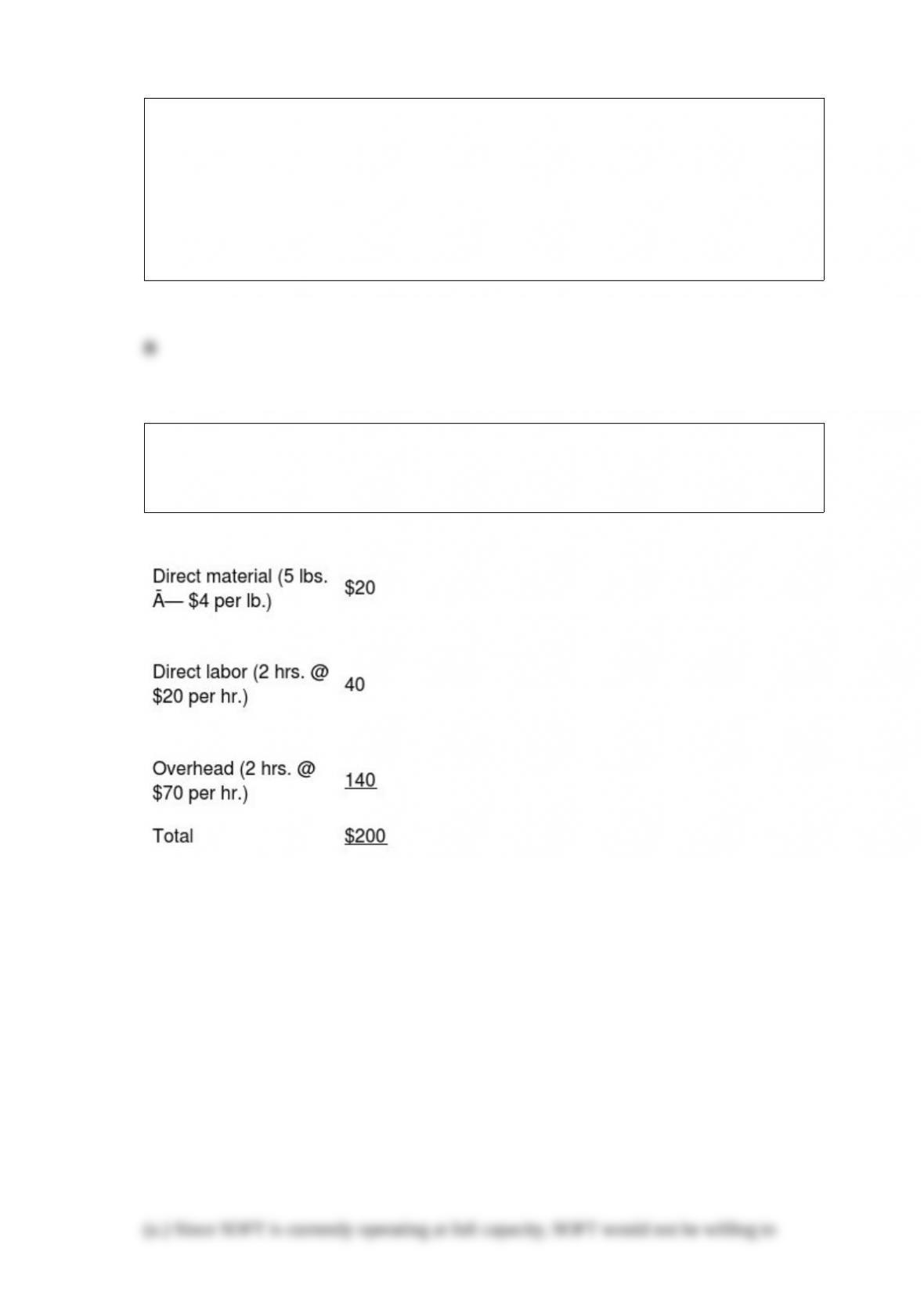
SOFT Micro Co., sells part #1973 for $240 per unit and the standard cost of producing
each unit of part #1973 is determined as follows:
SOFT received a special order for 1,000 units of part #1973. The only additional cost to
SOFT is a special packaging requirement that would cost $10 per unit.
(a.) If SOFT were currently able to sell all of its production of part #1973, what would be
the minimum sales price that SOFT should consider for this special order?
(b.) Assume that SOFT has enough idle capacity to produce 1,000 units of part #1973 and
that overhead is 20% variable. If SOFT wants to increase its operating profit by $110,000,
what price per unit would SOFT charge for the special order?
Factors that usually affect retained earnings directly include:
A. net income or loss, and dividends.
B. restructuring charges and losses from discontinued operations.
C. stock dividends and gains or losses from the sale of treasury stock.
D. net income or loss, and the issuance of stock at an amount in excess of par value.
Another term for the price/earnings ratio is:
A. cost ratio.
B. sales multiple.
C. earnings multiple.
D. profit ratio.

The declaration of a cash dividend by the directors results in:
A. a decrease in cash and a decrease in retained earnings.
B. a decrease in retained earnings and an increase in current liabilities.
C. a decrease in net income and a decrease in cash.
D. a decrease in net income and an increase in current liabilities.
When a manufacturer invests in short-term marketable securities:
A. the return on investment is more important than the risk involved.
B. the securities are likely to have a maturity date more than a year in the future.
C. the market value of the securities is likely to fluctuate significantly.
D. risk avoidance is of great importance.
Product costs are inventoried and treated as assets until:
A. the next accounting period.
B. related liabilities no longer exist.
C. the period in which the products they relate to are sold.
D. none of the above.
An income statement organized by cost behavior does not include:
A. operating income.
B. gross profit.
C. contribution margin.
D. revenues.

The budgeting process that most likely creates an attitude supportive of achieving
organization goals is:
A. top-down approach.
B. zero based approach.
C. proportionate increase approach.
D. participative approach.
Which of the following cost classifications would not be considered relevant in
comparing decision alternatives?
A. opportunity cost.
B. differential cost.
C. sunk cost.
D. none of the above.
Sage, Inc. has 20 employees who work Monday through Friday each week; each
employee earns $200 per day and is paid every Friday. The end of the accounting period
is on a Wednesday. How much wages expense should the firm accrue at the end of the
period?
A. $4,000
B. $2,000
C. $0
D. $12,000
The effect of an adjustment is:
A. to correct an entry that was not in balance.
B. to increase the accuracy of the financial statements.
C. to record transactions not previously recorded.
D. to close the books.

“Accumulated other comprehensive income (loss)”:
A. is a component of net income and reported on the income statement.
B. is a component of stockholders’ equity and reported on the balance sheet.
C. includes a component that adjusts for the effects of treasury stock transactions.
D. is another name for the cumulative foreign currency translation adjustment.