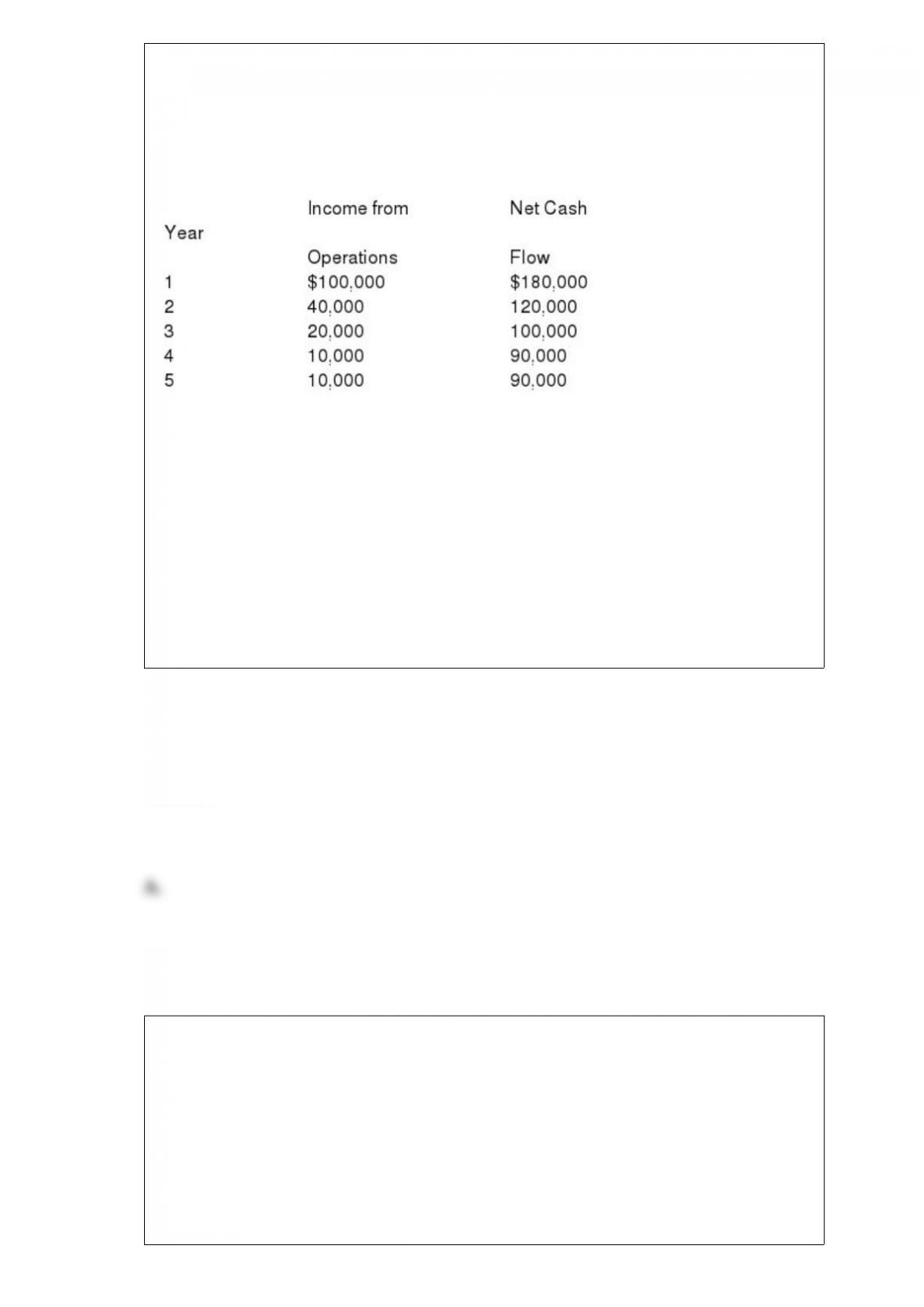
The management of Dakota Corporation is considering the purchase of a new machine
costing $420,000. The company’s desired rate of return is 10%. The present value
factors for $1 at compound interest of 10% for 1 through 5 years are 0.909, 0.826,
0.751, 0.683, and 0.621, respectively. In addition to the foregoing information, use the
following data in determining the acceptability in this situation:
The present value index for this investment is:
A.1.08
B.1.45
C.1.14
D..70
Answer:
Fast-Flow Paints produces mixer base paint through a two stage process, Mixing and
Packaging. The following events depict the movement of value into and out of
production. Journalize each event if appropriate, if not, provide a short narrative reason
as to why you choose not to journalize that action. Bob, the Production Manager,
accepts an order to continue processing the current run of mixer base paint.
(a) $27,000.00 worth of materials are withdrawn from Raw Materials inventory. Of this
amount, $25,500.00 will be issued to the Mixing Department and the balance will be
issued to the Maintenance Department to be used on production line machines.
(b) Bob calculates that labor for the period is $12,500.00. Of this value $1,750.00 is for
maintenance and indirect labor. The remainder is directly associated with mixing.
(c) Bob, who is paid a salary but earns about $35.00 / hour, spends 1 hour inspecting the
production line.
(d) The manufacturing overhead drivers for Mixing are (1) hours of mixer time at
$575.00 per hour, and material movements from Raw Materials at $125.00 per
movement. An inspection of the machine timers reveals that a total of 8 hours has been
consumed in making this product. An inspection of “Stocking Orders” indicates that
only one material movement was utilized to “load” the raw materials. (Note: All values
have been journalized to Factory Overhead, you need only apply it to the production
run.)
(e) Within Fast-Flow items are transferred between departments at a standard cost or
value. This production run has created 4,015 gallons of mixer base paint. This paint is
transferred to Packaging at a standard cost of $10.05 per gallon.
(f) Packaging draws $755.00 in raw materials for packaging of this production run.
(g) Packaging documents that 12 hours of direct labor at $10.25 per hour were
consumed in the packaging of this production run.
(h) Packaging uses a driver of direct labor hours to allocate manufacturing overhead at
the rate of $25.00 per hour.
(i) Packaging transfers these 4,015 gallons of packaged goods to Finished Goods
Inventory at a standard cost of $10.34 per gallon.
Round total cost to nearest dollar value.
Answer:
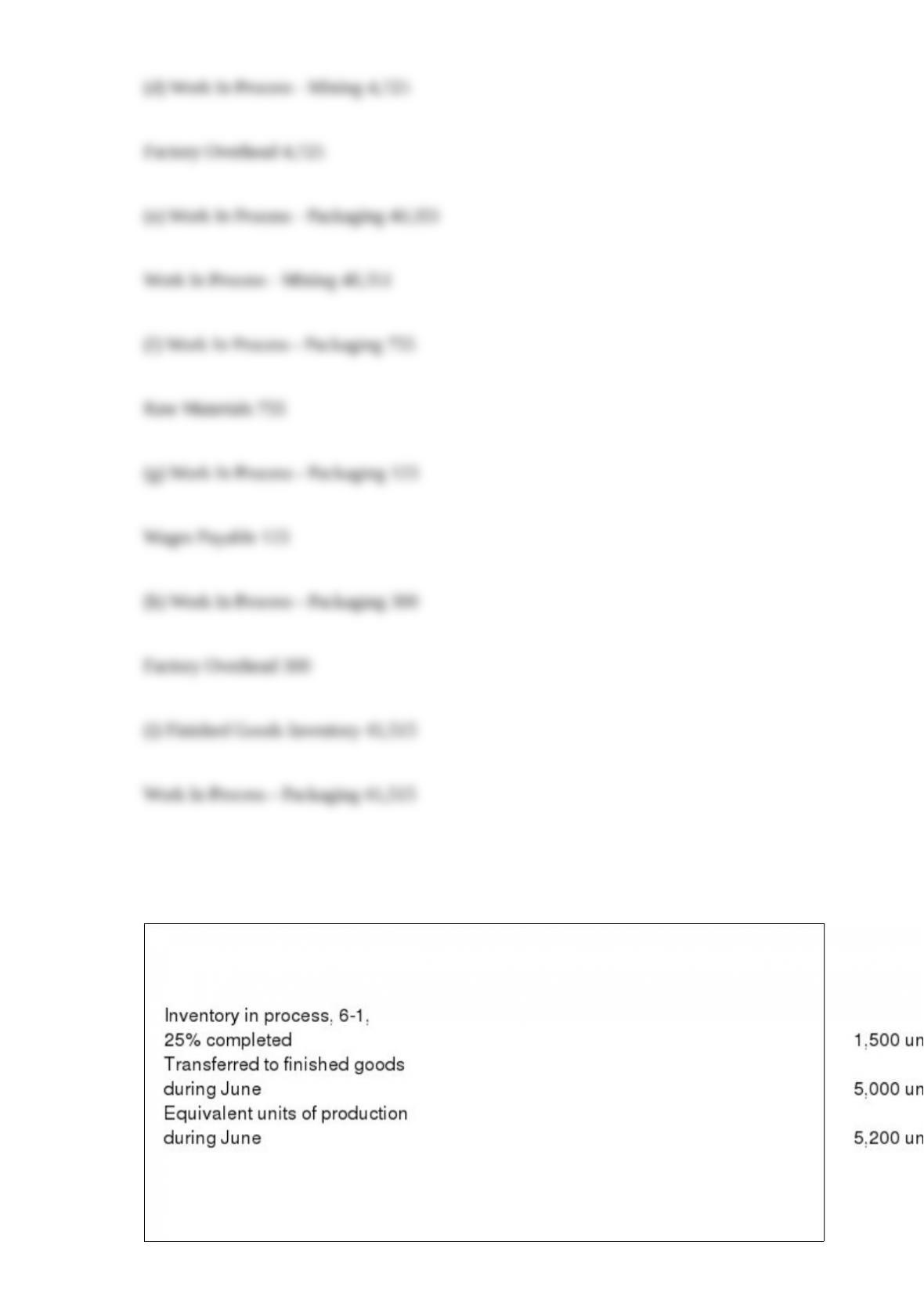
The following production data were taken from the records of the Finishing Department
for June:
Determine the number of equivalent units of production in the June 30 Finishing

Department inventory, assuming that the first-in, first-out method is used to cost
inventories. Assume the completion percentage of 25% applies to both direct materials
and conversion costs.
A.575 units
B.200 units
C.1,000 units
D.300 units
Answer:
The excess of divisional income from operations over a minimum amount of divisional
income from operations is termed:
A.profit margin
B.residual income
C.rate of return on investment
D.gross profit
Answer:

The percent of fixed assets to total assets is an example of
A.vertical analysis
B.solvency analysis
C.profitability analysis
D.horizontal analysis
Answer:
A fixed asset with a cost of $52,000 and accumulated depreciation of $47,500 is traded
for a similar asset priced at $60,000 in a transaction with commercial substance.
Assuming a trade-in allowance of $5,000, the cost basis of the new asset is
A.$54,000
B.$59,500
C.$60,000
D.$60,500
Answer:

At the end of the year, overhead applied was $35,000,000. Actual overhead was
$34,300,000. Closing over/under applied overhead into cost of goods sold would cause
net income to:
A.Increase by $700,000
B.Decrease by $700,000
C.Remain constant
D.Decrease by $300,000
Answer:
Benson and Orton are partners who share income in the ratio of 1:3 and have capital
balances of $70,000 and $30,000 respectively. Ramsey is admitted to the partnership
and is given a 40% interest by investing $20,000. What is Orton’s capital balance after
admitting Ramsey?
A.$20,000
B.$9,000
C.$70,000
D.$63,000
Answer:

Gross profit is equal to:
A.sales plus (sales discounts and sales returns and allowances) plus cost of merchandise
sold)
B.sales plus sales returns and allowances less sales discounts less cost of merchandise
sold)
C.sales plus sales discounts less sales returns and allowances less cost of merchandise
sold)
D.sales less (sales discounts and sales returns and allowances) less cost of merchandise
sold)
Answer:
Which of the following entries records the receipt of cash for two months’ rent? The
cash was received in advance of providing the service.
A.Prepaid Rent, debit; Rent Revenue, credit.
B.Cash, debit; Unearned Rent, credit.
C.Cash, debit; Prepaid Rent, credit.
D.Cash, debit; Rent Expense credit.
Answer:
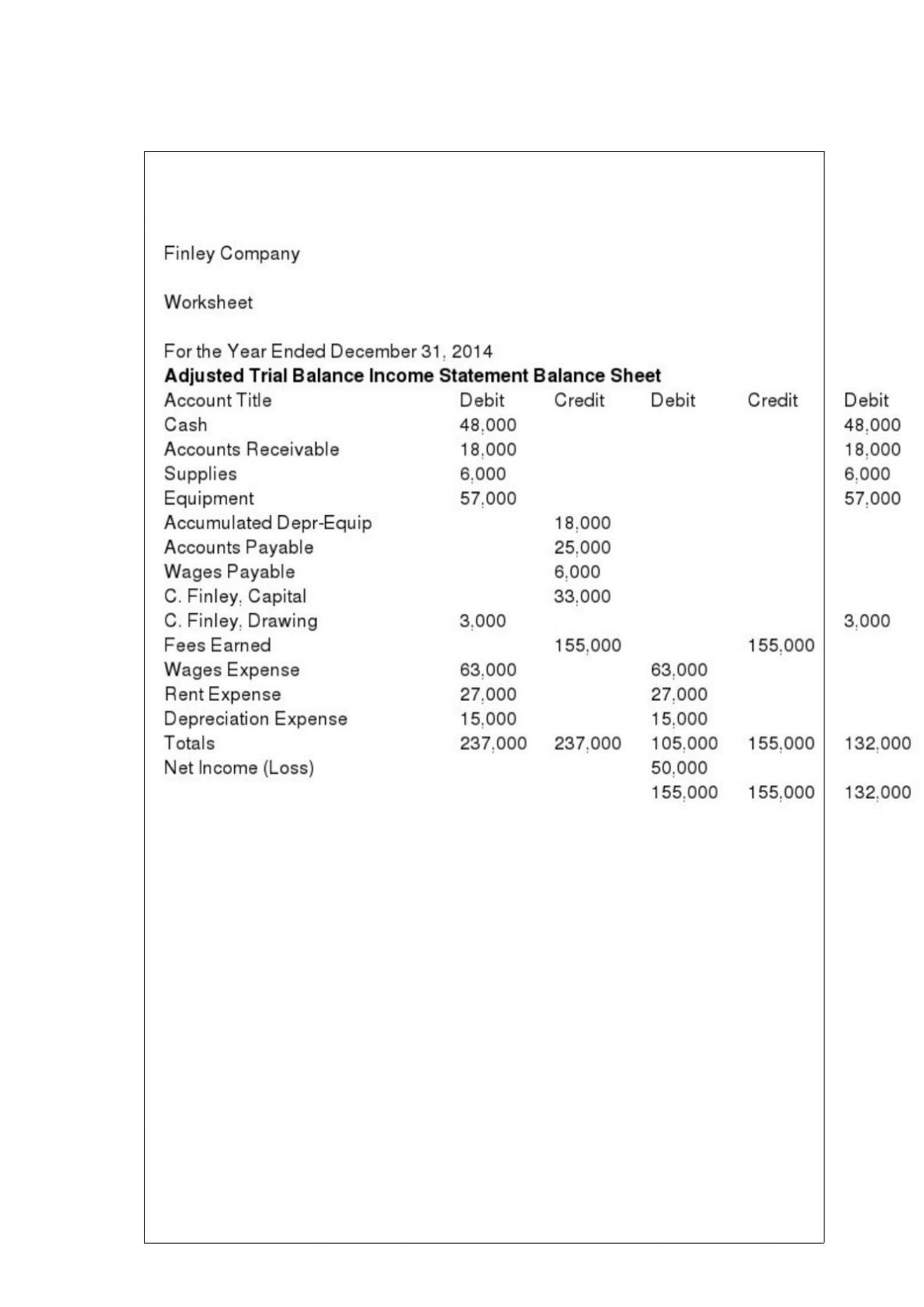
Use the following worksheet to answer the following questions.
Based on the preceding trial balance, the entry to close expenses would be:
A.Wages Expense 63,000
Rent Expense 27,000
Depreciation Expense 15,000
Income Summary 105,000
B.Expenses 105,000
Income Summary 105,000
C.Wages Expense 63,000
Rent Expense 27,000
Depreciation Expense 15,000
C. Finley, Drawing 105,000
D.Income Summary 105,000
Wages Expense 63,000
Rent Expense 27,000
Depreciation Expense 15,000
Answer:
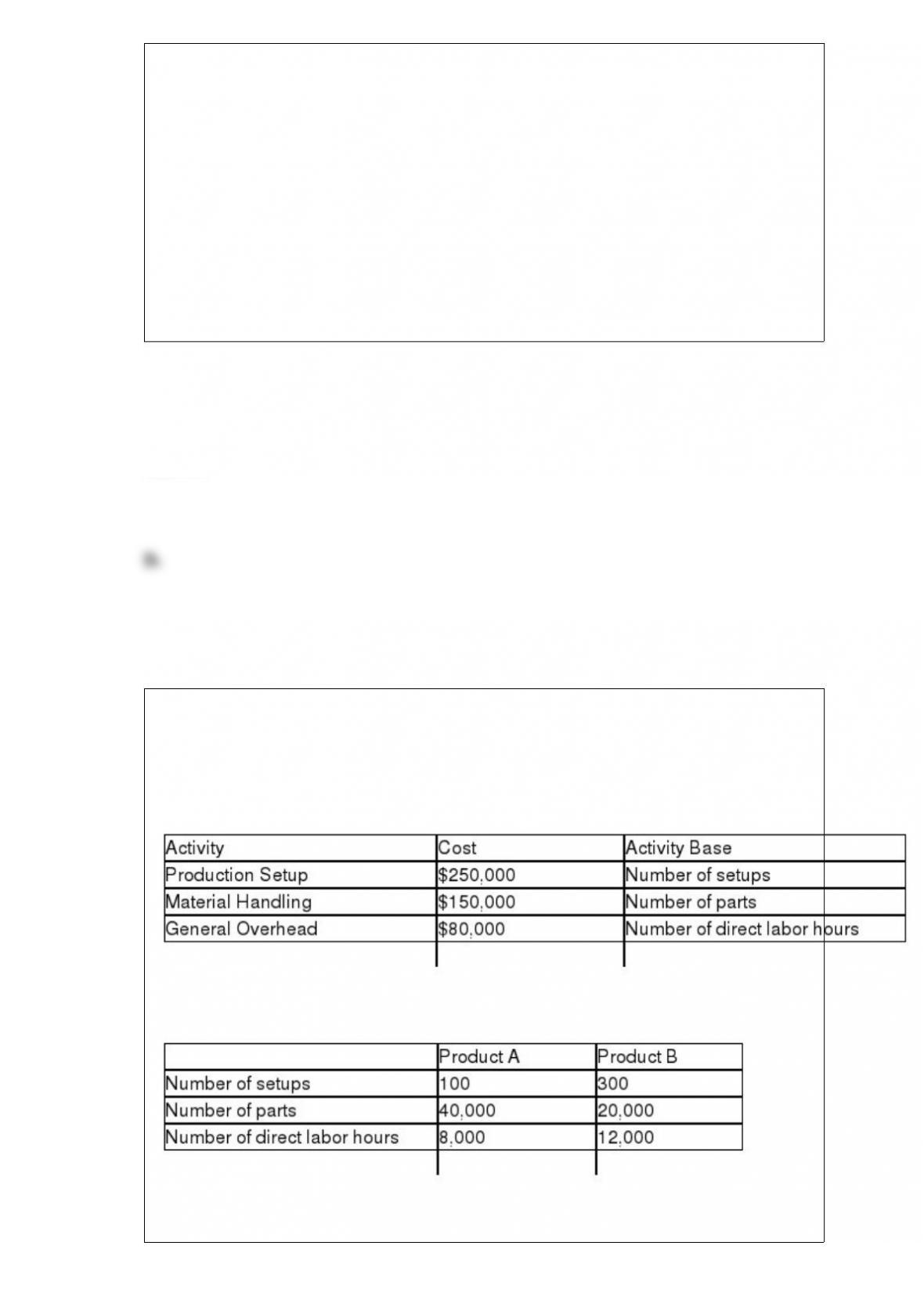
Miramar Industries manufactures two products, A and B. The manufacturing operation
involves three overhead activities – production setup, material handling, and general
factory activities. Miramar uses activity-based costing to allocate overhead to products.
An activity analysis of the overhead revealed the following estimated costs and activity
bases for these activities:
Each product’s total activity in each of the three areas are as follows:
What is the activity rate for Material Handling?

A.$1.50 per part
B.$3.75 per part
C.$7.50 per part
D.$2.50 per part
Answer:
Which of the following accounts would be included in the chart of accounts of a
merchandising company using the: (a) periodic inventory system, (b) perpetual
inventory system, or (c) both systems?
(1) Sales Discounts
(2) Merchandise Inventory
(3) Sales
(4) Purchases Discounts
(5) Cost of Merchandise Sold
(6) Freight In
(7) Delivery Expense
(8) Sales Returns and Allowances
Answer:

The Lucy Corporation purchased and used 129,000 board feet of lumber in production,
at a total cost of $1,548,000. Original production had been budgeted for 22,000 units
with a standard material quantity of 5.7 board feet per unit and a standard price of $12
per board foot. Actual production was 23,500 units.
Compute the material quantity variance.
A.63,000F
B.63,000U
C.59,400F
D.59,400U
Answer:
Financial Statement data for the years ended December 31 for Parker Corporation is as
follows:
2012 2011
Net Sales $2,595,600 $2,409,498
Fixed Assets:
Beginning of the year $ 901,070 $820,000
End of the year 829,330 901,070
a) Determine the Fixed Asset Turnover for 2012 and 2011.
b) Does the change in Fixed Asset Turnover from 2011 to 2012 indicate a favorable or
unfavorable trend.?
Answer:
Manley Co. manufactures office furniture. During the most productive month of the
year, 4,500 desks were manufactured at a total cost of $86,625. In its slowest month, the
company made 1,800 desks at a cost of $49,500. Using the high-low method of cost
estimation, total fixed costs are:
A.$61,875
B.$33,875
C.$24,750
D.cannot be determined from the data given
Answer:
Which of the following receivables would not be classified as an “other receivable”?
A.Advance to an employee
B.Interest receivable
C.Refundable income tax
D.Notes receivable
Answer:
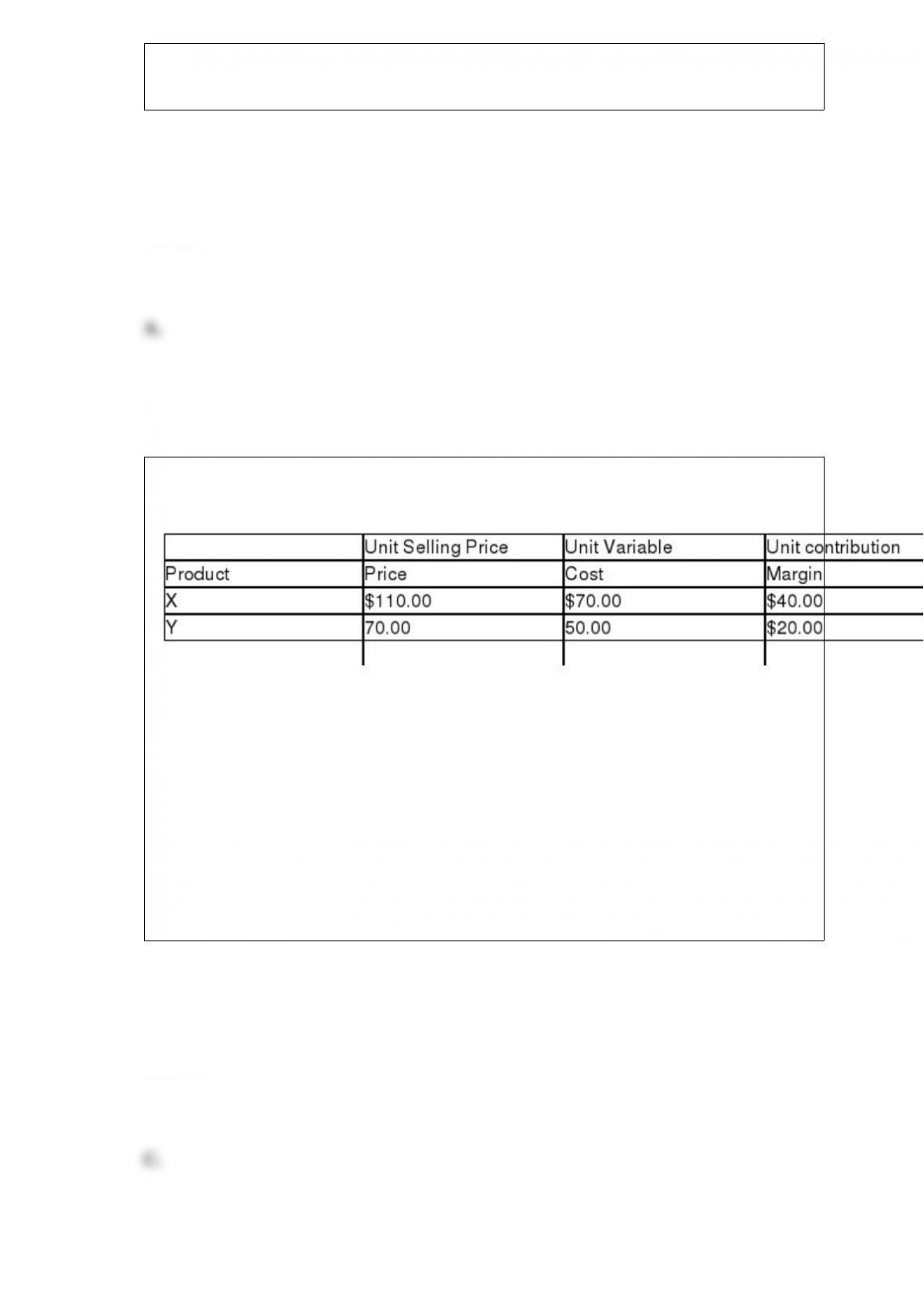
Based on the following data for the current year, what is the inventory turnover?
A.2.7
B.9.7
C.2.5
D.3.0
Answer:
Rusty Co. sells two products, X and Y. Last year Rusty sold 5,000 units of X’s and
35,000 units of Y’s. Related data are:
Assuming that last year’s fixed costs totaled $675,000. What was Rusty Co.’s
break-even point in units?
A.16,875 units
B.30,100 units
C.30,000 units
D.11,250 units
Answer:

The year-end balance of the owner’s capital account appears in
A.both the statement of owner’s equity and the income statement
B.only the statement of owner’s equity
C.both the statement of owner’s equity and the balance sheet
D.both the statement of owner’s equity and the statement of cash flows
Answer:
If sales are $400,000, variable costs are 80% of sales, and operating income is $40,000,
what is the operating leverage?
A.0
B.7.500
C.2.0
D.1.333
Answer:
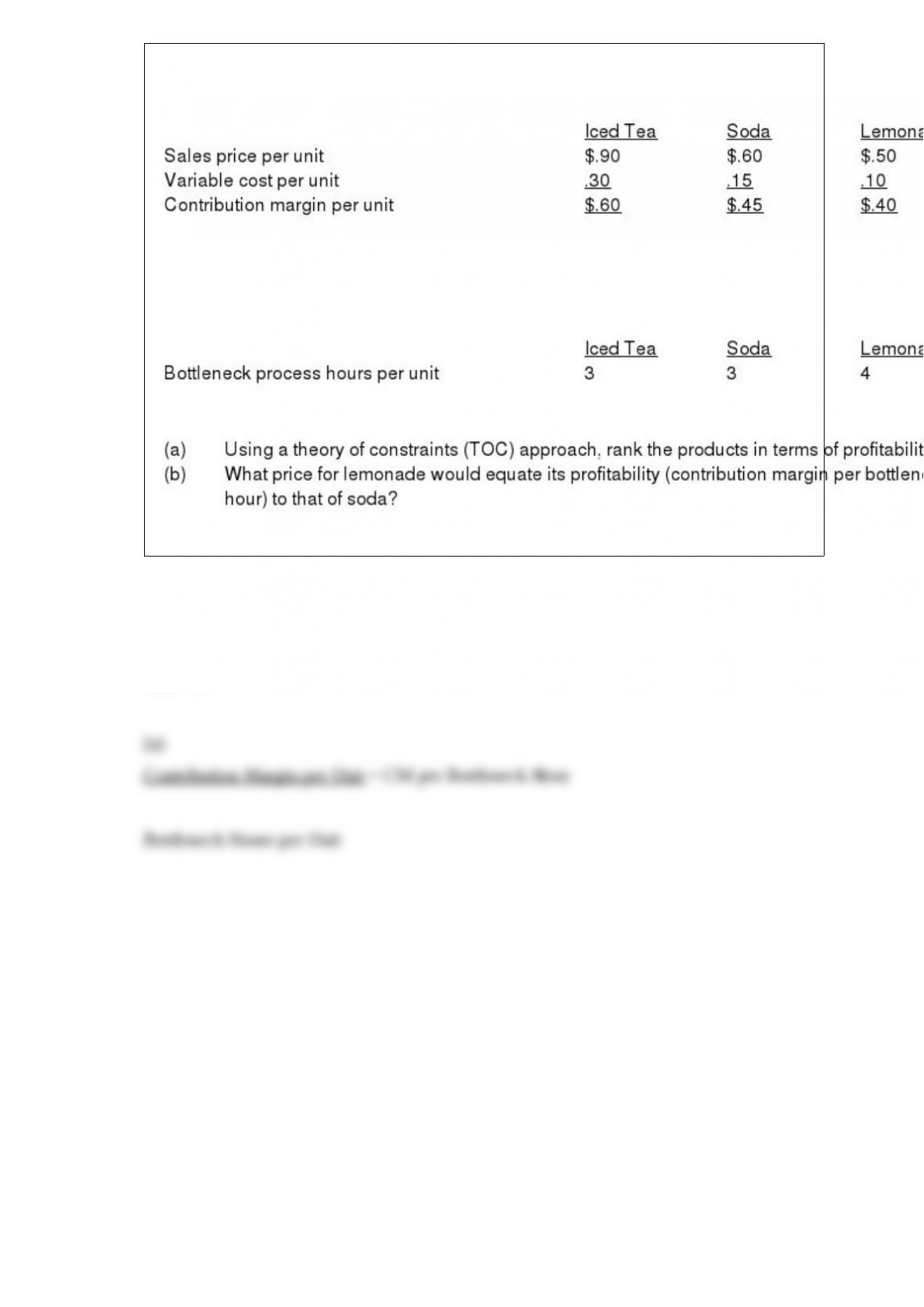
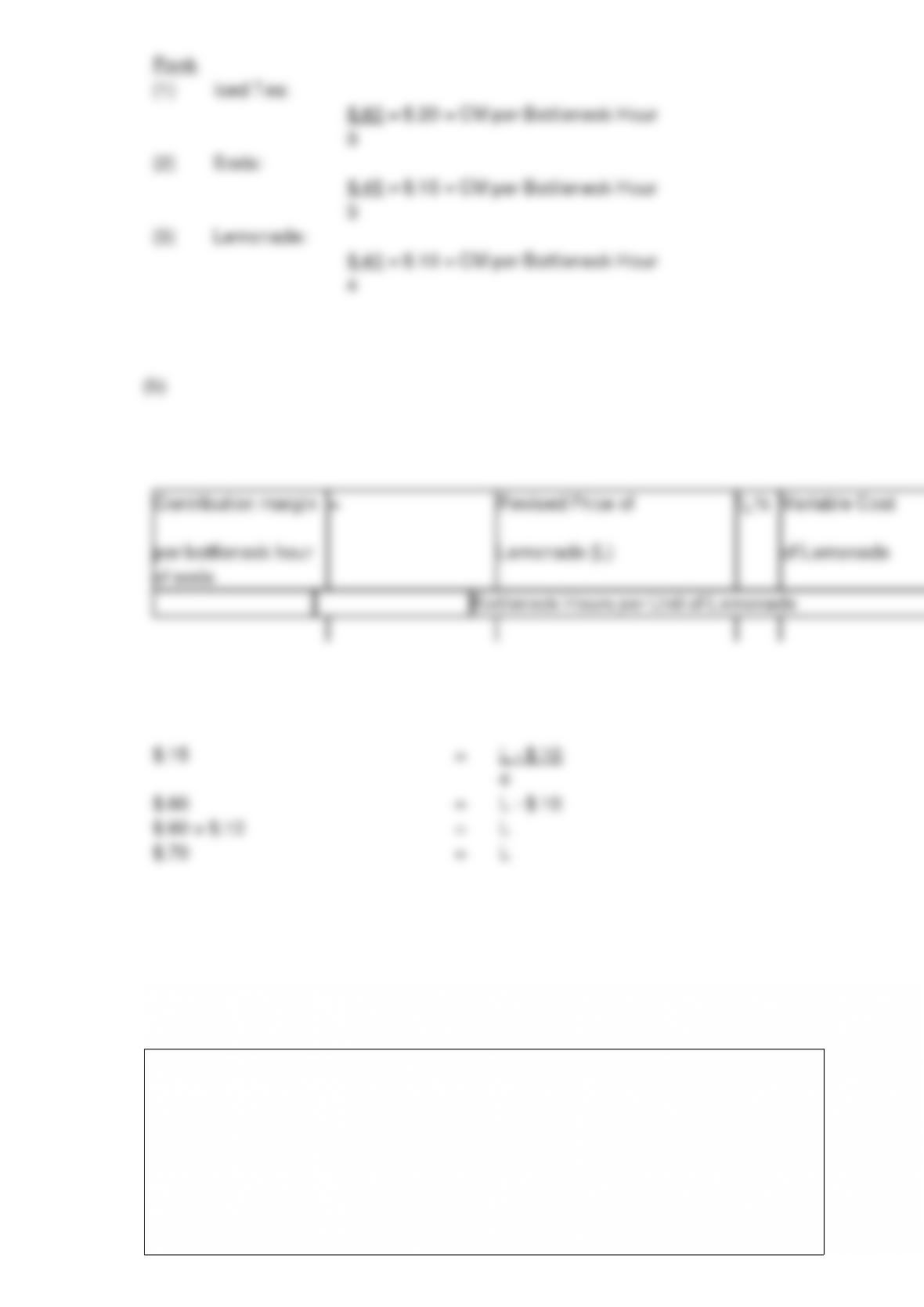
Sensational Soft Drinks makes three products: iced tea, soda, and lemonade. The
following data are available:
Sensational is experiencing a bottleneck in one of its processes that affects each product
as follows:
Answer:
Which of the following is not a characteristic of a process cost system?
A.Manufacturing costs are grouped by departments.
B.The system may use several Work-in-Process accounts.
C.The system measures costs for each completed job.
D.The system allocates costs between completed and partially completed units within a
department.
Answer:
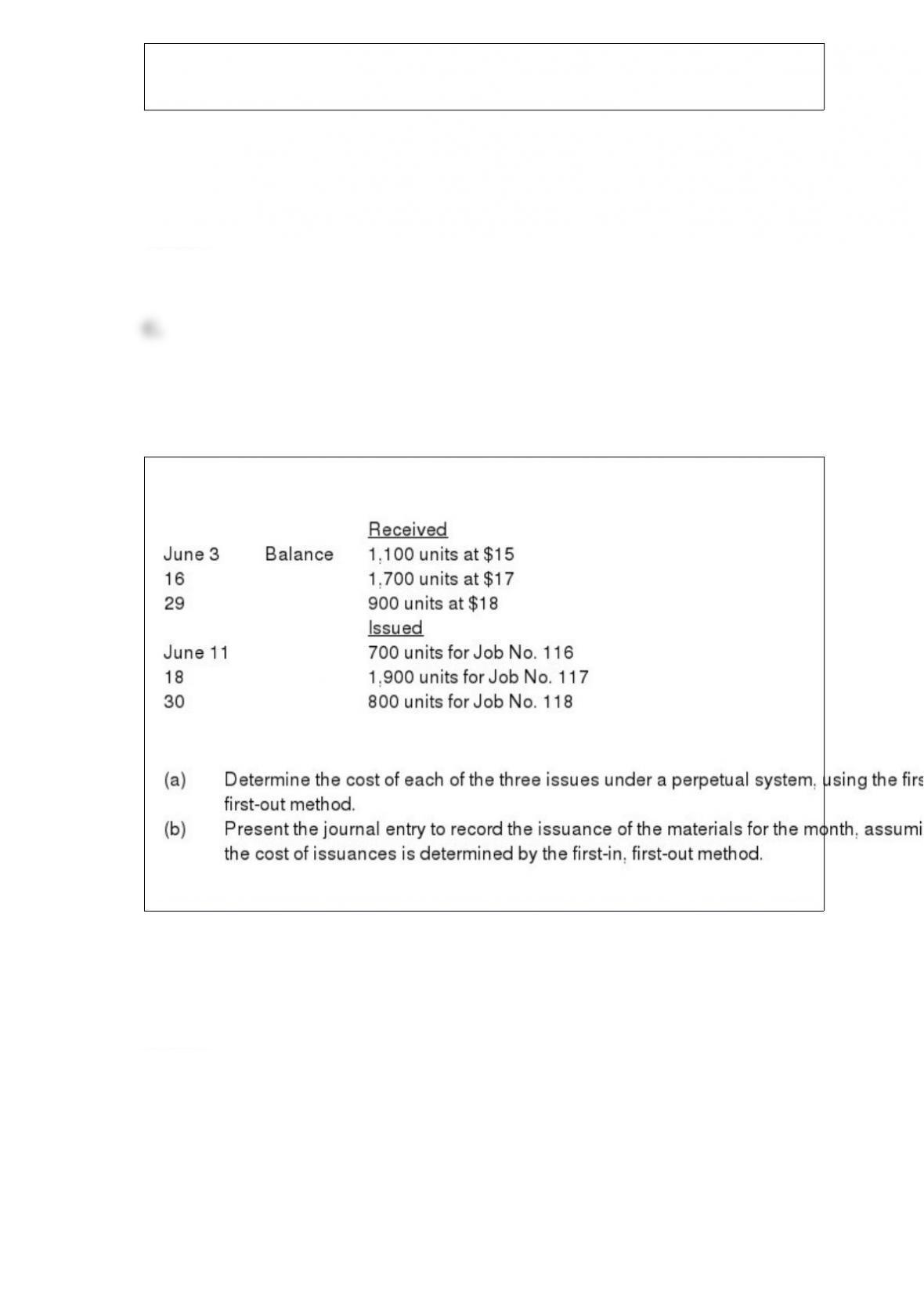
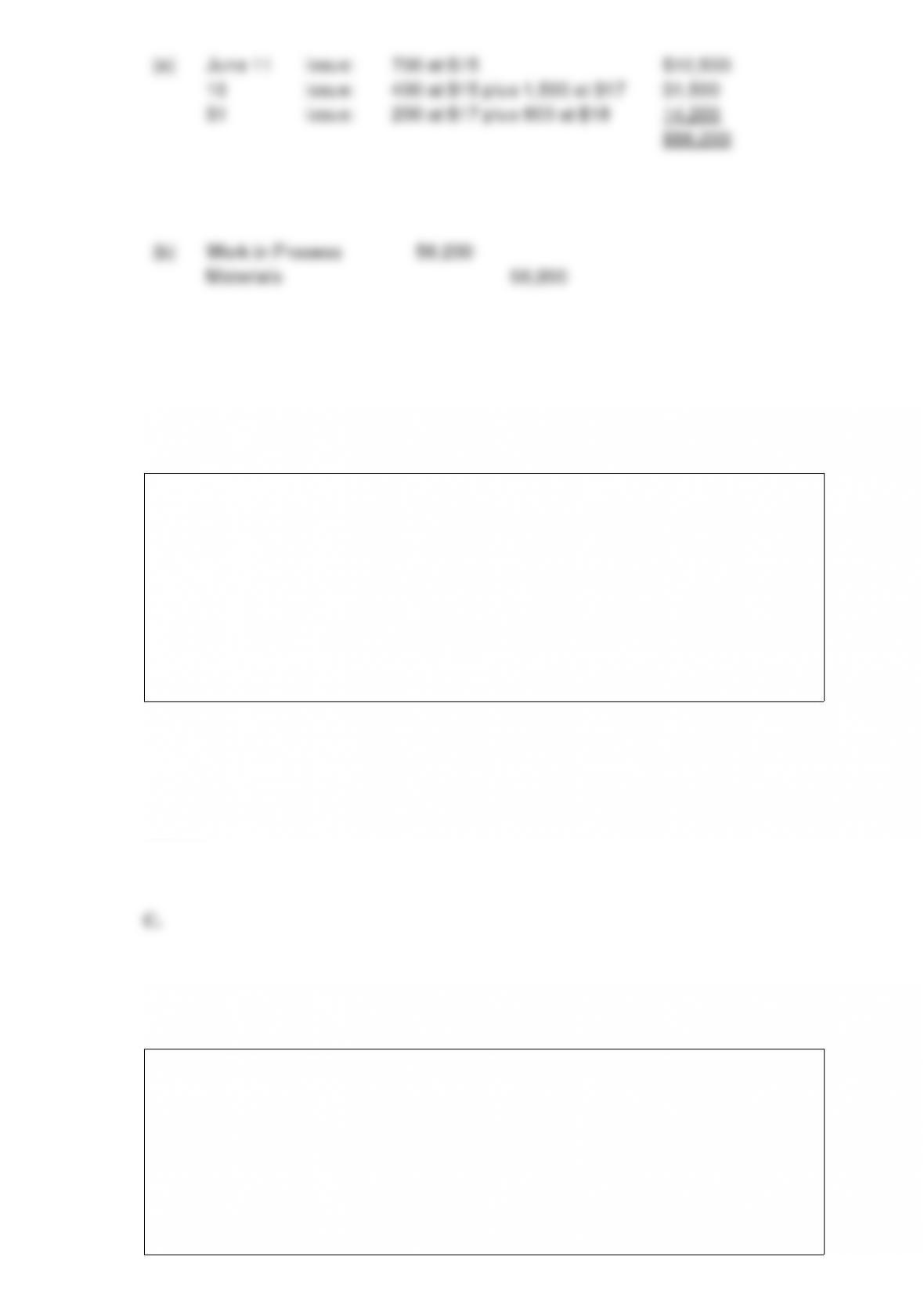
During June, the receipts and issuances of Material No. A2FO are as follows:
Answer:
Generally, period costs are classified as either
A.selling expenses or production expenses.
B.administrative expense or production expenses.
C.selling expenses or administrative expenses.
D.general expenses or selling expenses.
Answer:
Office supplies purchased by Ari’s Alarm Service on account were returned. Which of
the following entries for Ari’s Alarm Service records this transaction?
A.Cash, debit; Office Supplies, credit
B.Office Supplies, debit; Accounts Receivable, credit
C.Accounts Payable, debit; Office Supplies, credit
D.Office Supplies, debit; Accounts Payable, credit
Answer:
Which of the following is always recorded in the general journal?
A.services rendered for cash
B.correction of error in billing client
C.purchases of equipment on account
D.purchases of equipment for cash
Answer:
Given the following cost data, what type of cost is shown?
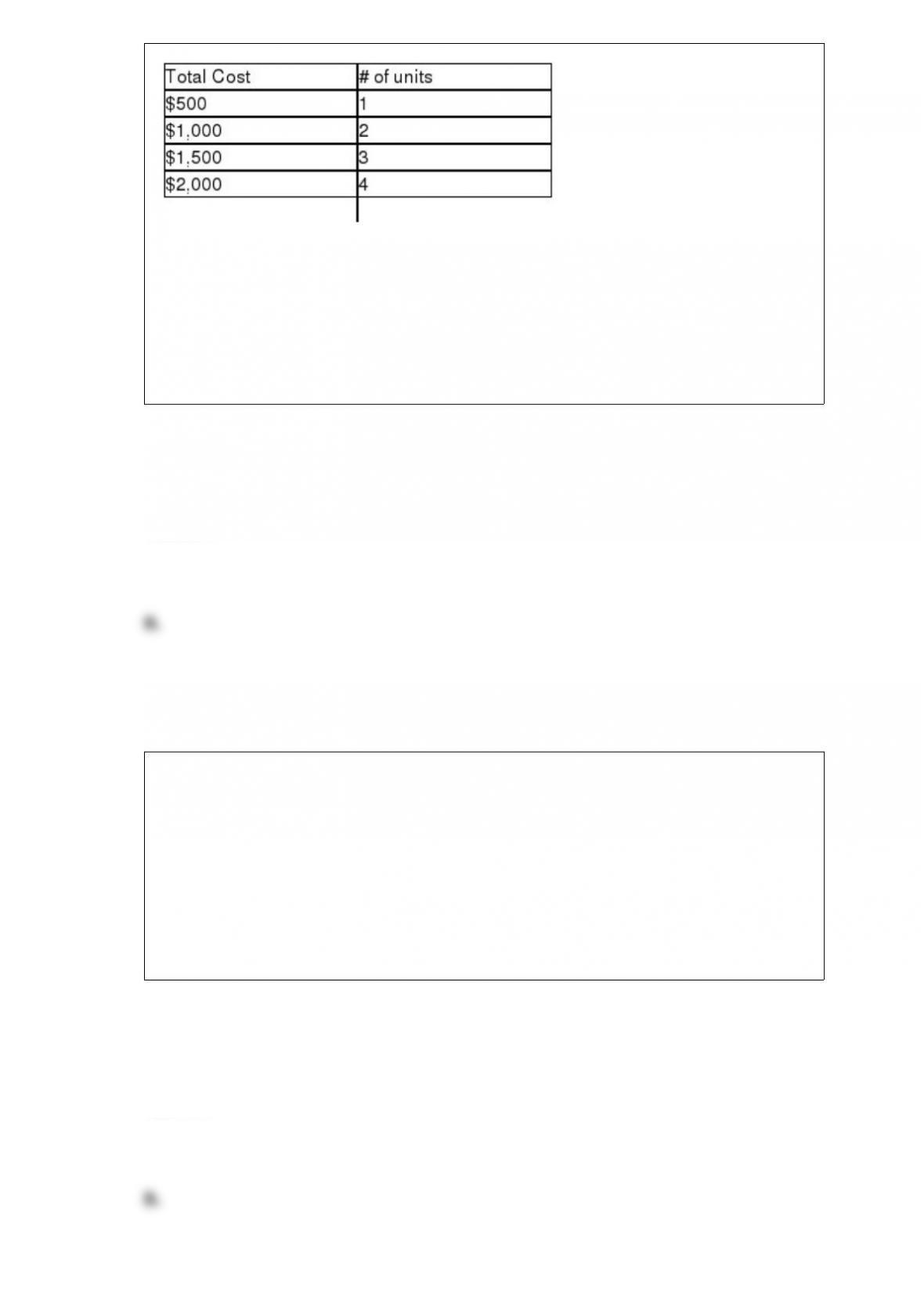
A.mixed cost
B.variable cost
C.fixed cost
D.none of the above
Answer:
A ratio of 3:2:1 is the same as
A.30%:20%:10%
B.3/6:2/6:1/6
C.3/10:2/10:1/20
D.None of these
Answer:

If sales are $500,000, variable costs are 75% of sales, and operating income is $40,000,
what is the operating leverage?
A.0
B.1.25
C.1.3
D.3.1
Answer:
A patient has a physical examination and asks the bookkeeper to mail the bill. The
bookkeeper should
A.make no entry until the cash is received
B.Cash, debit; Accounts Receivable, credit
C.Cash, debit; Fees Earned, credit
D.Accounts Receivable, debit; Fees Earned, credit
Answer:

Most employers are required to withhold from employees which of the following
employment taxes?
A.FICA tax
B.FICA tax, state and federal unemployment compensation tax
C.only state unemployment compensation tax
D.only federal unemployment compensation tax
Answer:
The Cardinal Company had a finished goods inventory of 55,000 units on January 1. Its
projected sales for the next four months were: January – 200,000 units; February –
180,000 units; March – 210,000 units; and April – 230,000 units. The Cardinal Company
wishes to maintain a desired ending finished goods inventory of 20% of the following
months sales.
What would be the budgeted inventory for March 31st?
A.46,000
B.36,000
C.Cannot be determined from the data given
D.42,000
Answer: