1) A parent corporation owns 55% of the outstanding voting common stock of one
domestic subsidiary. The parent has control over the subsidiary. Which of the following
statements is correct?
A) The parent corporation must prepare consolidated financial statements for the
economic entity
B) The parent corporation must use the fair value method
C) The parent company may use the equity method but the subsidiary cannot be
consolidated
D) The parent company can use the equity method or the fair value/cost method
2) Pallet Corporation owns 80% of Adelt Corporation and Adelt owns 60% of Bajo Inc.
Which of the following is correct?
A) Bajo should not be consolidated because noncontrolling interests hold 52%
B) Bajo should be consolidated because the 60% of Bajo stock is held in the affiliate
structure
C) Pallet has 8% indirect ownership of Bajo
D) Pallet has 80% indirect ownership of Bajo
3) According to the liquidity premium theory of the term structure
A) bonds of different maturities are not substitutes
B) if yield curves are downward sloping, then short-term interest rates are expected to
fall by so much that, even when the positive term premium is added, long-term rates fall
below short-term rates
C) yield curves should never slope downward
D) interest rates on bonds of different maturities do not move together over time
4) When a corporation’s total liabilities are greater than the fair value of total assets, the
firm is
A) a distressed corporation
B) a bankrupt corporation
C) insolvent in the equity sense
D) insolvent in the bankruptcy sense

5) Which one of the following will increase consolidated retained earnings?
A) An increase in the value of goodwill associated with a subsidiary subsequent to the
parent’s date of acquisition
B) The amortization of a $10,000 excess in the fair value of a note payable over its
recorded book value
C) The depreciation of a $10,000 excess in the fair value of equipment over its recorded
book value
D) The sale of inventory by a subsidiary that had a $10,000 excess in fair value over
recorded book value on the parent’s date of acquisition
6) Assume a company’s preferred stock is cumulative with a call provision and has
dividends in arrears. The amount of stockholders’ equity allocated to preferred
stockholders is equal to the number of shares outstanding times the
A) sum of the par value per share plus any liquidation premium per share, plus the sum
of any preferred dividends in arrears, plus the current year’s dividend requirement, but
only if dividends have been declared
B) sum of the par value per share, plus any liquidation premium per share, plus the sum
of any preferred dividends in arrears, plus the current year’s dividend requirement,
regardless of whether dividends have been declared
C) call price plus the sum of any preferred dividends in arrears, plus the current year’s
dividend requirement, but only if dividends have been declared
D) call price plus the sum of any preferred dividends in arrears, plus the current year’s
dividend requirement, regardless of whether dividends have been declared
7) An alumnus of a nonprofit, nongovernmental university establishes an endowment of
$50,000. When the university receives the endowment from the donor, what account
will the university credit?
A) Temporarily restricted revenues
B) Temporarily restricted support
C) Permanently restricted revenues
D) Permanently restricted support
8) On January 1, 2011, Punch Corporation purchased 80% of the common stock of
Soopy Co. Separate balance sheet data for the companies at the acquisition date(after
the acquisition) are given below:
PunchSoopy
Cash$34,000 $206,000

Accounts Receivable144,00026,000
Inventory132,00038,000
Land68,00032,000
Plant assets700,000300,000
Accum. Depreciation(240,000)(60,000)
Investment in Soopy392,000
Total assets$ 1,230,000$ 542,000
Accounts payable$206,000$142,000
Capital stock800,000300,000
Retained earnings224,000100,000
Total liabilities & equities$ 1,230,000$ 542,000
At the date of the acquisition, the book values of Soopy’s net assets were equal to the
fair value except for Soopy’s inventory, which had a fair value of $60,000.
Determine below what the consolidated balance would be for each of the requested
accounts.
What is the amount of consolidated Retained Earnings?
A) $224,000
B) $259,200
C) $304,000
D) $324,000
9) Pomograte Corporation bought 75% of Sycamore Company’s common stock, with a
book value of $900,000, on January 2, 2011 for $750,000. The law firm of Dewey,
Cheatam and Howe was paid $55,000 to facilitate the purchase. At what amount should
Pomograte’s Investment in Sycamore account be reported on January 2, 2011?
A) $675,000
B) $695,000
C) $750,000
D) $845,000
10) Oscar Lloyd is the trustee for the Petra/Hobbes Trust. The following transactions
occurred during 2011. Petra and Hobbes, two cats are going to reside with Oscar Lloyd,
the trustee and devoted cat lover.
February 18The Petra/Hobbes Trust was established at First State Bank by depositing
$200,000 cash.
February 19$195,000 was deposited into a three-year certificate of deposit earning 6% a
year. Interest is paid semi-annually. $5,000 was deposited into a money market account
paying 4% annual interest. Interest is paid on the average daily balance for the past
year.

February 20Paid $368 for cat food, cat toys, and kitty litter at Cats R Us.
February 24Bought assorted cat DVDs for Hobbes and Petra. The DVDs were a
combination of fish, bird, and squirrel movies. Paid $182 for the DVDs.
June 25Paid $405 for cat food, toys, and kitty litter.
August 19Deposited one-half year’s interest income of $5,850 into the money market
account.
December 22Paid $722 for cat food, cat toys, kitty litter, Christmas presents for Petra
and Hobbes.
Required:
Prepare the necessary journal entries for the above transactions. You may ignore any tax
effects.
11) Plenty Corporation issued six thousand, $1,000 par, 6% bonds on January 1, 2010,
at par. Interest is paid on January 1 and July 1 of each year; the bonds mature on
January 1, 2015 . On January 2, 2012, Scrawn Corporation, a 75%-owned subsidiary of
Plenty, purchased 3,000 of the bonds on the open market at 102.50 . Plenty’s separate
net income for 2012 included the annual interest expense for all 3,000 bonds. Scrawn’s
separate net income for 2012 was $400,000, which included the bond interest received
on July 1 as well as the accrual of bond interest revenue earned on December 31 . Both
companies use straight-line amortization of bond discounts/premiums.
Using the original information, the elimination entries on the consolidation working
papers prepared on December 31, 2012 included at least
A) debit to Bond Interest Expense for $360,000

B) credit to Bond Interest Expense for $180,000 and a debit to Bond Interest Payable
for $90,000
C) credit to Bond Interest Receivable for $180,000
D) debit to Bond Interest Revenue for $360,000
12) A U.S. importer that purchased merchandise from a South Korean firm would be
exposed to a net exchange gain on the unpaid balance if the
A) dollar weakened relative to the Korean won and the won was the denominated
currency
B) dollar weakened relative to the Korean won and the dollar was the denominated
currency
C) dollar strengthened relative to the Korean won and the won was the denominated
currency
D) dollar strengthened relative to the Korean won and the dollar was the denominated
currency
13) Pascoe Corporation paid $450,000 for a 90% interest in Sarabet Corporation on
January 1, 2011, when Sarabet’s stockholders’ equity consisted of $250,000 Common
Stock and $50,000 Retained Earnings. The book values and fair values of Sarabet’s
assets and liabilities were equal when Pascoe acquired its interest.
The separate net incomes (excluding investment income) of Pascoe and Sarabet for
2011 were $600,000 and $100,000, respectively. Dividends declared and paid during
2011 were $250,000 for Pascoe and $50,000 for Sarabet. Pascoe uses the entity theory
in consolidating its financial statements with those of Sarabet.
Pascoe’s income from Sarabet under the equity method for 2011 was
A) $72,000
B) $87,500
C) $90,000
D) $100,000
14) Samford Corporation’s stockholders’ equity on December 31, 2010 was as follows:
8% cumulative preferred stock, $100 par value,
callable at $109, with two years of dividends
in arrears$100,000
Common stock, $25 par value700,000
Additional paid-in capital250,000
Retained earnings400,000
Total stockholders’ equity$1,450,000
On January 1, 2011, Panera Corporation purchased a 70% interest in Samford’s
common stock for $1,400,000. On this date the book values of Samford’s assets and
liabilities are equal to their fair values.
Required:
1> Determine the book value of the common stockholders’ equity for Samford
Corporation on January 1, 2011 .
2> What is the amount of goodwill reported on the consolidated balance sheet for
Panera Corporation and Subsidiary at January 2, 2011?
3> What is the noncontrolling interest that appeared on a consolidated balance sheet for
Panera Corporation and Subsidiary on January 2, 2011?
15) Plover Corporation acquired 80% of Sink Inc. equity on January 1, 2010, when the
book values of Sink’s assets and liabilities were equal to their fair values. The cost of
the investment was equal to 80% of the book value of Sink’s net assets.
Plover separate income (excluding Sink) was $1,800,000, $1,700,000 and $1,900,000 in
2010, 2011 and 2012 respectively. Plover sold inventory to Sink during 2010 at a gross
profit of $48,000 and one quarter remained at Sink at the end of the year. The remaining
25 percent was sold in 2011 . At the end of 2011, Plover has $25,000 of inventory
received from Sink from a sale of $100,000 which cost Sink $80,000. There are no
unrealized profits in the inventory of Plover or Sink at the end of 2012 . Plover uses the
equity method in its separate books. Select financial information for Sink follows:
201020112012
Sales$790,000$840,000$940,000
Cost of Sales(420,000)(440,000)(500,000)
Gross Profit370,000400,000440,000
Operating Expenses(300,000)(320,000)(350,000)
Net Income$ 70,000$ 80,000$ 90,000
Required:
Prepare a schedule to determine the controlling interest share of the consolidated net
income for 2010, 2011, and 2012 .
16) Plock Corporation, the 75% owner of Seraphim Company, reported net income of
$400,000 in 2011, prior to recording any income from Seraphim. Seraphim reported net
income for that same year of $80,000 on their stand-alone statements. During 2011, an
intercompany sale of a vehicle resulted in a gain of $4,000, and the vehicle was
assumed to have a four-year remaining useful life. The vehicle has no salvage value.
Straight-line depreciation is used.
Required:
1> Assuming that the vehicle transfer was downstream, calculate Plock’s consolidated
net income for 2011, and controlling share of consolidated net income for 2011 .
2> Assuming that the vehicle transfer was upstream, calculate Plock’s consolidated net
income for 2011, and controlling share of consolidated net income for 2011 .

17) On January 2, 2011 Piron Corporation issued 100,000 new shares of its $5 par value
common stock valued at $19 a share for all of Seana Corporation’s outstanding common
shares. Piron paid $15,000 to register and issue shares. Piron also paid $20,000 for the
direct combination costs of the accountants. The fair value and book value of Seana’s
identifiable assets and liabilities were the same. Summarized balance sheet information
for both companies just before the acquisition on January 2, 2011 is as follows:
Piron Seana
Cash$150,000$120,000
Inventories320,000400,000
Other current assets500,000500,000
Land350,000250,000
Plant assets-net 4,000,000 1,500,000
Total Assets$5,320,000$2,770,000
Accounts payable$1,000,000$300,000
Notes payable1,300,000660,000
Capital stock, $5 par2,000,000500,000
Additional paid-in capital1,000,000100,000
Retained Earnings 20,000 1,210,000
Total Liabilities & Equities$5,320,000$2,770,000
Required:
1> Prepare Piron’s general journal entry for the acquisition of Seana, assuming that
Seana survives as a separate legal entity.
2> Prepare Piron’s general journal entry for the acquisition of Seana, assuming that
Seana will dissolve as a separate legal entity.

18) Sally Corporation’s stockholders’ equity on December 31, 2010 was as follows:
10% cumulative preferred stock, $100 par value,
callable at $105, with one year dividends in arrears$10,000
Common stock, $1 par value50,000
Additional paid-in capital150,000
Retained earnings160,000
Total stockholders’ equity$370,000
On January 1, 2011, Panera Corporation paid $500,000 for a 70% interest in Sally’s
common stock. On January 1, 2011, the book values of Sally’s assets and liabilities
were equal to fair values.
Required:
1> Determine the book value of the common stockholders’ equity for Sally Corporation
on January 1, 2011 .
2> What is the amount of goodwill reported on the consolidated balance sheet for
Panera Corporation and Subsidiary at January 2, 2011?
3> On January 2, 2011, Panera purchased 70% of Sally’s preferred stock for $5,000.
Prepare the journal entry(ies) for Panera for this purchase on January 2, 2011 .
4> Prepare the elimination entry on the consolidating work papers for the Investment in
Sally, Preferred Stock and Sally’s Preferred Stock on January 2, 2011 .
19) On January 1, 2011, Parton Corporation acquired an 80% interest in Sandra
Corporation for $184,000. Sandra’s net assets on this date had a book value of $160,000
and a fair value of $210,000. The excess of fair value over book value at acquisition
was attributable to $20,000 of understated plant assets with a remaining useful life of
five years from January 1, 2011, and $30,000 to an understated patent with a remaining
economic life of six years from January 1, 2011 . Separate net incomes (excluding
investment income) of Parton and Sandra for 2011 were $300,000 and $50,000,
respectively.
Required:
1> Compute goodwill at January 1, 2011 under the parent company theory and the
entity theory.
2> Determine consolidated net income and noncontrolling interest share for 2011 under
the parent company theory and the entity theory.
20) On April 1, 2012, Button Industries enters into an agreement with Bows
Incorporated to lock in the price of cotton. Button agrees to purchase (and Bows agrees
to sell) 100,000 pounds of cotton at $1.19 per pound, six months from the date of
agreement. On October 1, 2012, the price of cotton is $1.17 per pound. The contract
allows for net settlement.
Required:
Determine the net settlement on the forward contract.
21) A small town in a rural area has an organization that serves the local community
when there is a financial need. Among the services they provide is free groceries,
clothes and furniture, along with transportation to doctors’ appointments when the

doctor is out of town. This voluntary health and welfare organization (VHWO) accepts
most donations of goods, all donations of cash, and has developed a relationship with
the local grocer who helps them obtain needed food items. The VHO has one paid
administrator who tracks and coordinates the donations, performs application reviews to
determine eligibility, and schedules transportation for those in need. Volunteers unload
and pack grocery items, sort clothes and furniture, and drive those who need
transportation. Gasoline costs are reimbursed to the driver based on mileage. The local
CPA provides bookkeeping and tax services for free, and designates 90% of expenses
incurred to community services and 10% to management and general.
The VHWO had the following transactions in 2011:
1>.The administrator is paid $11,000 salary.
2>The accountant services are valued at $6,000 based on their normal billable rate.
3>The landlord of the building they use for their operations has waived their rent and
provided the bill of $6,000 for their records. The VHWO paid utilities and property
taxes of $3,000.
4>Office furniture was donated with an estimated fair value of $9,400.
5>The VHWO received cash donations of $20,000, $5,000 of which was an unpaid
pledge from the prior year. The beginning pledges receivable balance was $6,000, and
no amount had previously been estimated to be uncollectible. The prior year balance
will now be written off. In addition, $12,000 was pledged to be donated in 2012 . Based
on recent history, the VHWO knows that 10% of the new pledges will not be collected.
Required:
Prepare the journal entries for the transactions noted above.
22) Paco Corporation owns 90% of Aber Corporation, Aber Corporation owns 85% of
Back Corporation, and Back Corporation owns 5% of Aber Corporation. The separate
net incomes (excluding investment income) of Paco, Aber, and Back are $100,000,
$40,000, and $55,000, respectively. Assume the investments were acquired at a cost
equal to the book value of each investment, which also equals the fair value.
Required:
1> Calculate revised net incomes for Paco, Aber, and Back by using the conventional
method.
2> Determine the controlling interest share of consolidated net income and the
noncontrolling interest shares.
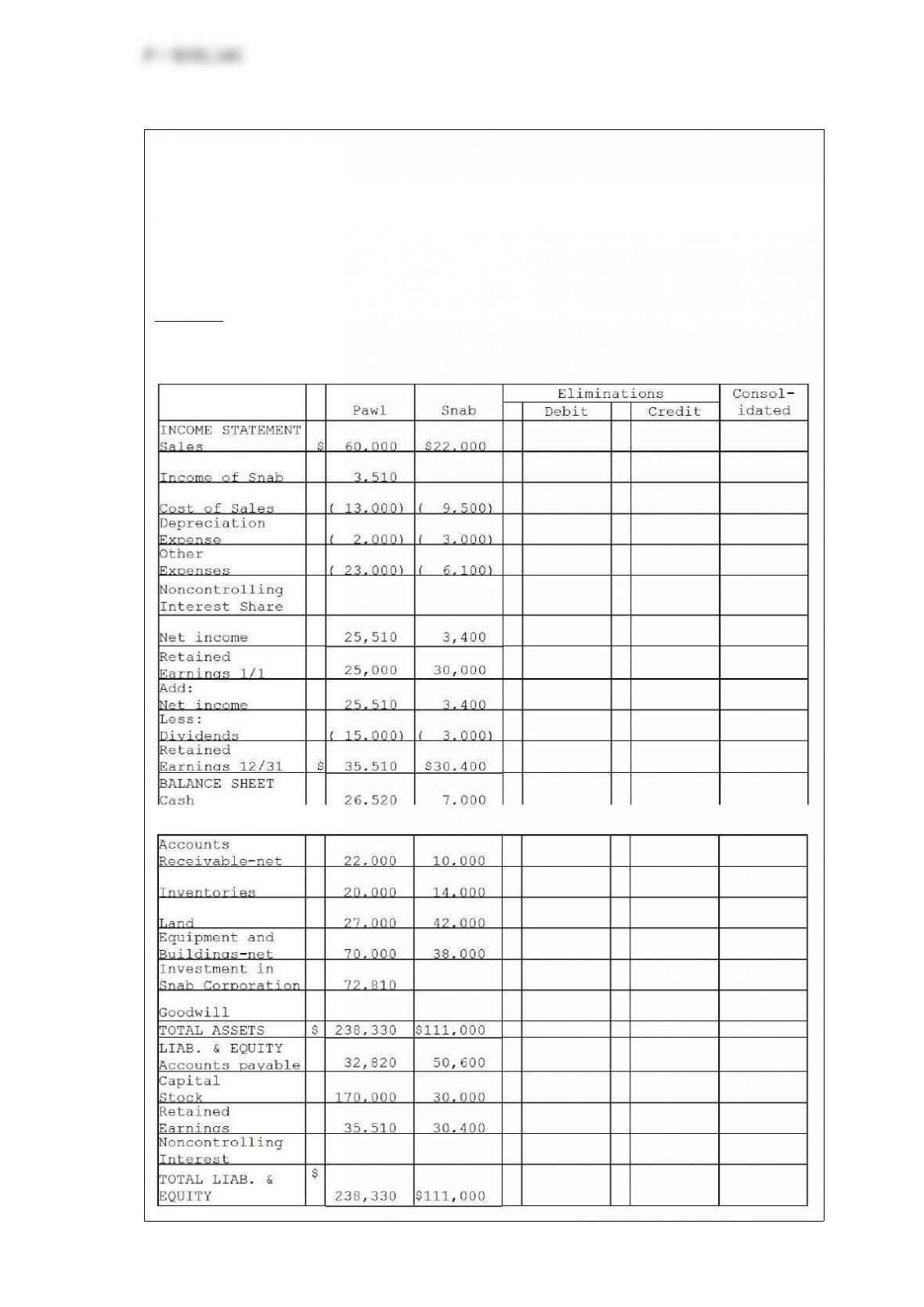
23) Pawl Corporation acquired 90% of Snab Corporation on January 1, 2011 for
$72,000 cash when Snab’s stockholders’ equity consisted of $30,000 of Capital Stock
and $30,000 of Retained Earnings. The difference between the fair value of Pawl’s
assets and liabilities and the book value was allocated to a plant asset with a remaining
10-year straight-line life that was overvalued on the books by $5,000. The remainder
was attributable to goodwill. The separate company statements for Pawl and Snab
appear in the first two columns of the partially completed consolidation working papers.
Required:
Complete the consolidation working papers for Pawl and Snab for the year 2011 .