A company’s fiscal year must correspond with the calendar year.
The professional designation “CGA” stands for “Chartered General Accountant”.
A merchandising company’s operating cycle begins with the sale of merchandise and
ends with the collection of cash from the sale.
The inventory cost flow assumption that assigns the highest cost to cost of goods sold in
a period of rising prices is FIFO.
In a perpetual inventory system, the net cost of purchases is accumulated in the
Inventory account.
If equipment were purchased from an outside party, the using up of the equipment’s
economic benefit would be considered an external transaction.
A special journal is any journal used for recording and posting transactions of a similar
type.
All businesses should take an inventory count once each year to identify inventory
errors or shortages.
A dishonoured note receivable is reclassified as an account receivable.
Cash withdrawn by the owner of an unincorporated business in the form of a monthly
salary should be treated as an expense of the business.
Accounting information systems collect and process data about transactions and events,
organize them in useful forms, and communicate results to decision makers.
Net income is equal to the change in equity due to operating activities over a period of
time.
The consistency principle means that one costing method, such as FIFO or moving
weighted average, has to be used exclusively.
Closing entries accomplish the goal of reflecting revenues and expenses in the owner’s
capital account.
At the request of the Board of Directors, internal auditors perform the audit function to
protect shareholder interests.
The primary purpose of Generally Accepted Accounting Principles is to ensure the
usefulness of financial information.
If on January 1 of this year, a company paid $12,000 rent for one year and adjusting
entries are made at the end of each month, the balance of Prepaid Rent at December 1
of this year should be $1,000.
Gallery Corp. paid $6,000 for a six-month insurance policy for the company van. The
policy coverage began on January 1. On January 31, $1,000 of insurance expense must
be reported.
Career opportunities in accounting include auditing, forensic accounting, and tax
planning.
All businesses should take an inventory count once each year to avoid inventory errors
or shortages.
Withdrawals represent distributions from a corporation to its owners.
The aging of accounts receivable examines each account receivable to estimate the
amount that is uncollectible.
Companies try to lengthen their operating cycles to increase net income.
The current ratio is used to evaluate the ability of a business to meet its short-term
obligations.
Trekking Company’s total cost of inventory was $305,000. The net realizable value is
$297,000. Under LCNRV, the amount reported should be $305,000.
In general, subsidiary ledgers are not needed in perpetual systems because the
accounting system captures sufficient details to support analyses that decision makers
need.
TechCom has $40,000 in outstanding accounts receivable. Past experience suggests that
5% of outstanding receivables are uncollectible. The current balance in the allowance
for doubtful accounts is $2,500 debit. The required adjusting journal entry includes a
debit to bad debt expense for $4,500.
A work sheet is a substitute for the financial statements.
A sole proprietorship is a business owned by one or more persons.
Bank service charges are treated as a reconciling item on the book side of a bank
reconciliation.
A sales journal is used for recording cash sales.
After posting the entries to close all revenue and expense accounts, Hatfield Company’s
Income Summary account has a credit balance of $6,000, and the Hatfield, Withdrawals
account has a debit balance of $2,500. These balances indicate that net income for the
accounting period amounted to $3,500.

TechCom receives a 10%, 90-day note for $2,500. The interest on the note is:
A. $36.99.
B. $50.00.
C. $58.79.
D. $61.64.
E. $87.50.
A primary operating objective of a business is to increase the equity of its owner or
owners by:
A. Acquiring assets.
B. Incurring liabilities.
C. Earning a profit.
D. Incurring expenses.
E. Increasing retained earnings.

Indicate whether a debit or a credit entry would be made to record the following
changes in each account.
(a) To decrease Cash.
(b) To increase Owner, Capital.
(c) To decrease Accounts Payable.
(d) To increase Salaries Expense.
(e) To decrease Supplies.
(f) To increase Revenue.
(g) To decrease Accounts Receivable.
(h) To increase Owner, Withdrawals.
Which of the following statements is incorrect?
A. Working papers are invaluable tools of the accountant.
B. The work sheet shows the effects of adjustments on the account balances.
C. After the work sheet is completed, the work sheet information is used to prepare the
financial statements.
D. On the work sheet, the accountant sorts the adjusted amounts into columns according
to whether the accounts are used in preparing the unadjusted trial balance or the
adjusted trial balance.
E. The work sheet is an optional step in the accounting cycle.

Before recording adjusting entries, the Office Supplies account had a $359 debit
balance while a physical count of the supplies showed $105 of unused supplies on hand.
Thus, the required adjusting entry is:
A. Debit Office Supplies $105 and credit Office Supplies Expense $105.
B. Debit Office Supplies Expense $254 and credit Office Supplies $254.
C. Debit Office Supplies Expense $105 and credit Office Supplies $105.
D. Debit Office Supplies $254 and credit Office Supplies Expense $254.
E. Some other entry.
Liquidity problems exist for a company when its acid-test ratio:
A. Is less than the industry average.
B. Is 1 to 1.
C. Is higher than 1 to 1.
D. Is lower than 1 to 1.
E. Is less than the industry average and is lower than 1 to 1.

A simple account form widely used in accounting education to illustrate how debits and
credits work is called a:
A. Withdrawals account.
B. Capital account.
C. Ledger.
D. T-account.
E. Balance column account.
Z-Mart had net sales of $31,500 and accounts receivable of $2,700. To one decimal,
Z-Mart’s days’ sales uncollected was:
A. 11.7.
B. 23.3.
C. 28.6
D. 31.3.
E. 46.6.
Cash investments by owners are listed on which of the following statement(s)?

A. Balance sheet.
B. Income statement.
C. Statement of changes in equity.
D. Statement of cash flows.
E. Both a statement of changes in equity and statement of cash flows.
Failure by the maker of a promissory note to pay the amount due at maturity is known
as:
A. Protesting a note.
B. Closing a note.
C. Dishonouring a note.
D. Discounting a note.
E. Depreciating a note.
If assets are $175,000 and equity is $47,000, then liabilities equal:
A. $47,000.
B. $128,000.

C. $175,000.
D. $204,000.
E. $222,000.
Physical counts of inventory:
A. Are not necessary under the perpetual system.
B. Are necessary to adjust for shrinkage.
C. Should be taken at least once a month.
D. Are necessary to adjust for shrinkage and should be taken at least once a month.
E. Are not necessary under the perpetual system and should be taken at least once a
month.
The Unadjusted Trial Balance columns of a work sheet total $84,000. The Adjustments
columns contain entries for the following:
(1) Office supplies used during the period, $1,200.
(2) Expiration of prepaid rent, $700.
(3) Accrued salaries expense, $500.
(4) Depreciation expense, $800.

(5) Accrued repair service fees receivable, $400.
The Adjusted Trial Balance columns total:
A. $80,400.
B. $84,000.
C. $85,700.
D. $85,900.
E. $87,600.
While in the process of posting from the journal to the ledger, the accountant for X
Company failed to post a $50 debit to the Office Supplies account. The effect of this
error will be as follows:
A. The Office Supplies account balance will be overstated.
B. The trial balance will not balance.
C. The error will overstate the debits listed in the journal.
D. The total debits in the trial balance will be larger than the total credits.
E. This error will not make any difference.
A classified balance sheet:

A. Measures a company’s ability to pay its bills on time.
B. Organizes assets and liabilities into important subgroups.
C. Presents revenues, expenses and net income.
D. Shows operating, investing, and financing activities.
E. Shows the effect of net income and withdrawals on owner’s capital.
A corporation:
A. Is a legal entity separate and distinct from its owners.
B. Is regulated by Canada Revenue Agency.
C. Has shareholders who have unlimited liability for the acts of the corporation.
D. Can only have two owners.
E. Is not a legal entity.
Which accounting principle requires reporting expenses in the same period as the sales
they helped to produce?
A. Materiality.
B. Going concern.
C. Matching.

D. Cost.
E. Business entity.
Z-Mart’s current assets were $17,980. Its quick assets were $11,420. Its current
liabilities were $12,190. Its quick ratio is:
A. 1.48.
B. 1.57.
C. .94.
D. 2.40.
E. 1.07.
The question of when revenue should be recognized on the income statement
(according to GAAP) is answered by the:
A. Revenue recognition principle.
B. Going concern principle.
C. Monetary unit principle.
D. Business entity principle.
E. Cost principle.

Accounts receivable turnover is calculated by:
A. Dividing net sales by average accounts receivable.
B. Dividing net sales by average accounts receivable and multiplying by 365.
C. Dividing average accounts receivable by net sales.
D. Dividing average accounts receivable by net sales and multiplying by 365.
E. Dividing net income by average accounts receivable.
Costs included in the value of inventory are:
A. Purchase price less discounts.
B. Transportation-in.
C. Storage.
D. Insurance.
E. All of these answers are correct.

Outstanding cheques are cheques that:
A. Have been written, recorded, sent to the payees, received, and paid by the bank.
B. Have been written and not yet recorded in the company books.
C. Are blank cheques.
D. Have been written, recorded on the company books, and sent to the payees, but have
not yet been paid by the bank.
E. Have been issued by the bank.
An account used to record the owner’s investments in the business plus any more or less
permanent changes in the equity is called a(n):
A. Withdrawals account.
B. Capital account.
C. Asset account.
D. Expense account.
E. Revenue account.
Under the alternative method for accounting for unearned revenues, which of the
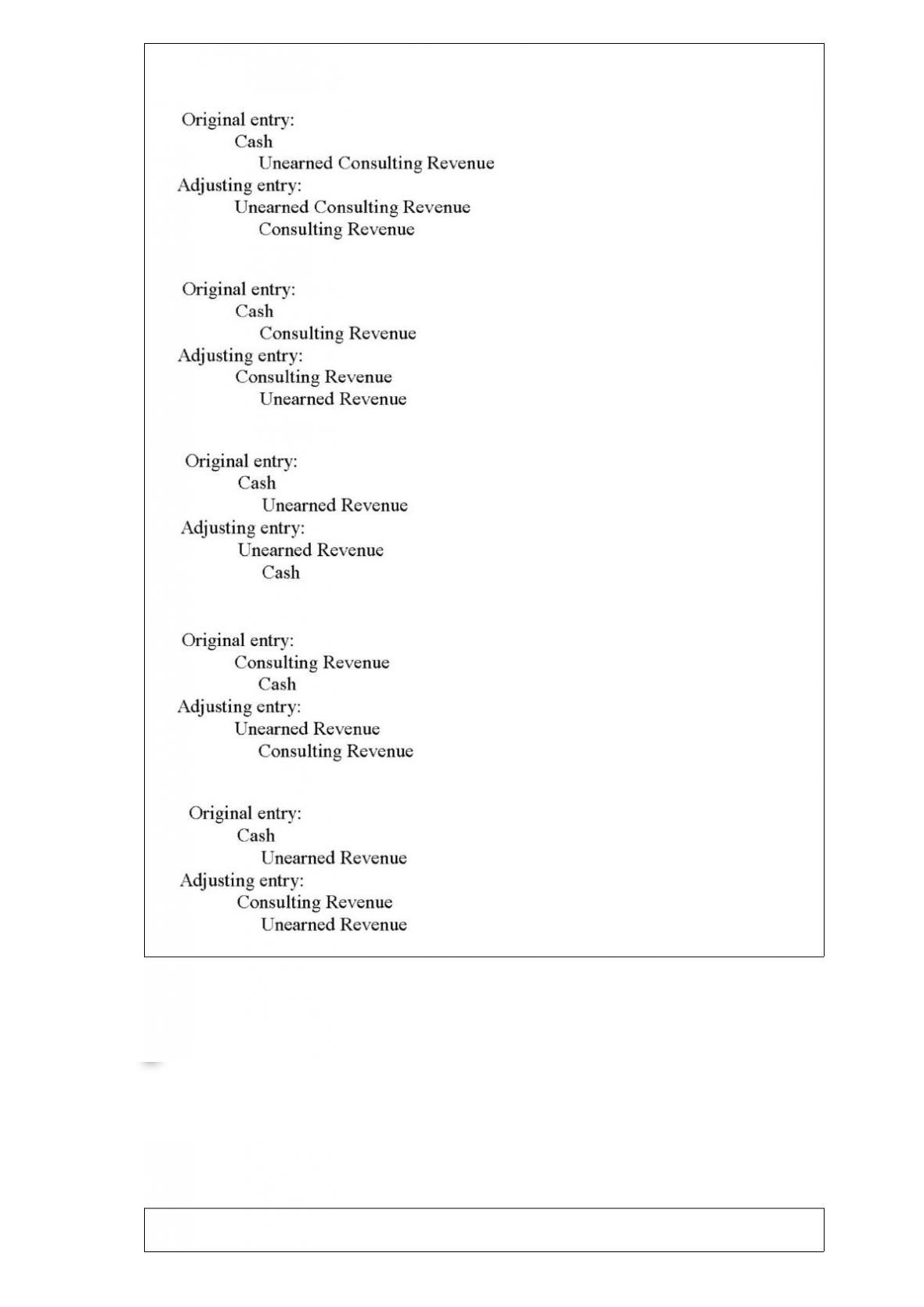
following pairs of journal entry formats is correct?
A.
B.
C.
D.
E.
Which of the following is NOT a principle of internal control?

A. Responsibilities should be clearly established.
B. Adequate records should be maintained.
C. Responsibility for related transactions should be divided.
D. Assets should be insured and employees bonded.
E. Audits should always be conducted by employees internal to the organization.
The days’ sales uncollected ratio:
A. Measures how much time is likely to pass before a company receives cash receipts
from credit sales equal to the current amount of accounts receivable.
B. Is used to compare a company to other companies in the same industry.
C. Is used to compare between current and prior periods.
D. Is used to compare a company to other companies in the same industry and is used to
compare between current and prior periods.
E. All of these answers are correct.
After all appropriate closing entries to the following accounts have been made, what
will be the balance in the Jeff Corvette, Capital account?
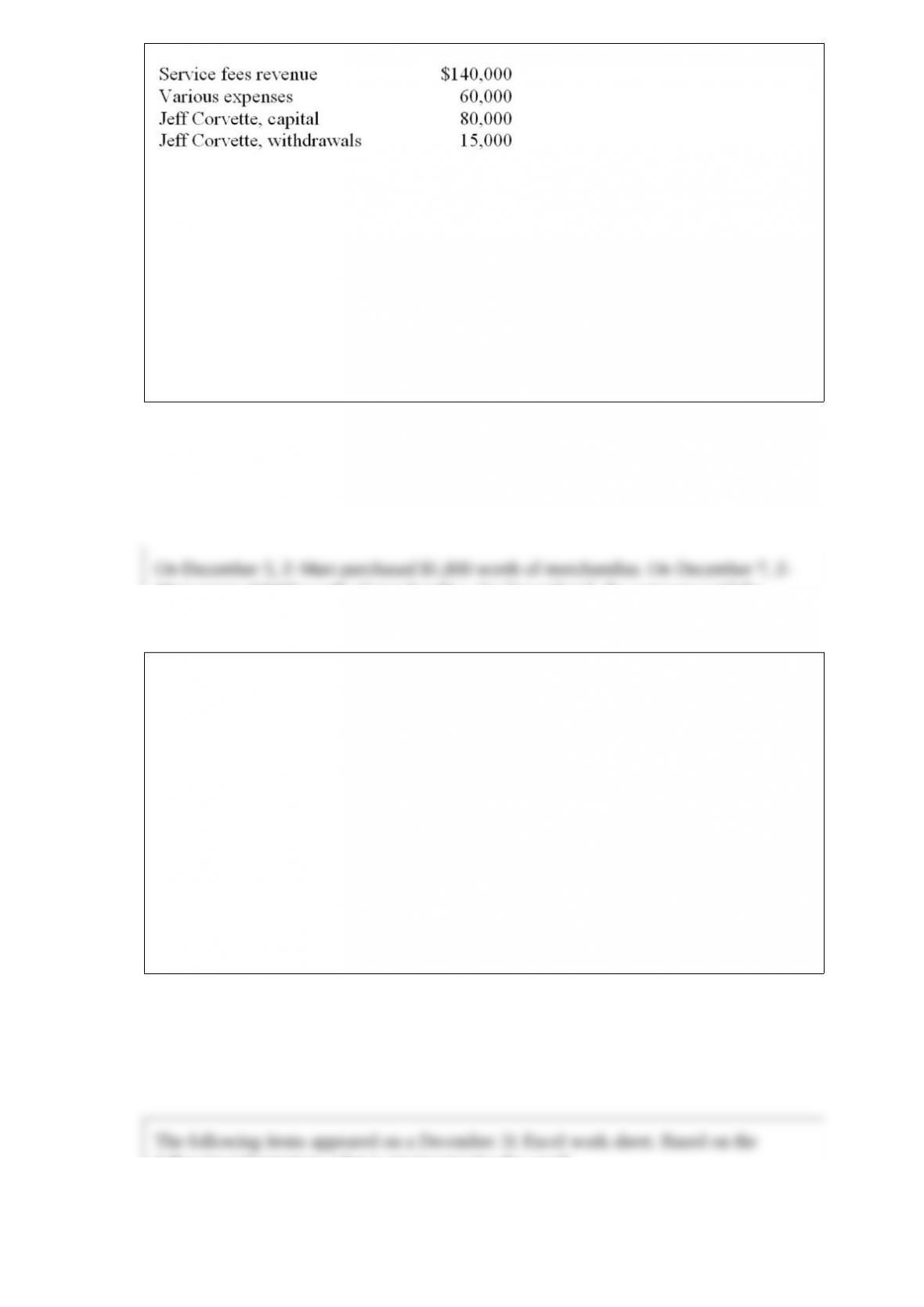
A. $65,000.
B. $80,000.
C. $130,000.
D. $145,000.
E. $280,000.
On December 5, Z-Mart purchased $1,800 worth of merchandise. On December 7,
Z-Mart returned $400 worth of merchandise. On December 8, the company paid the
balance in full, taking a 2% discount. The amount of the payment was:
A. $200.
B. $1,372.
C. $1,568.
D. $1,600.
E. $1,800.
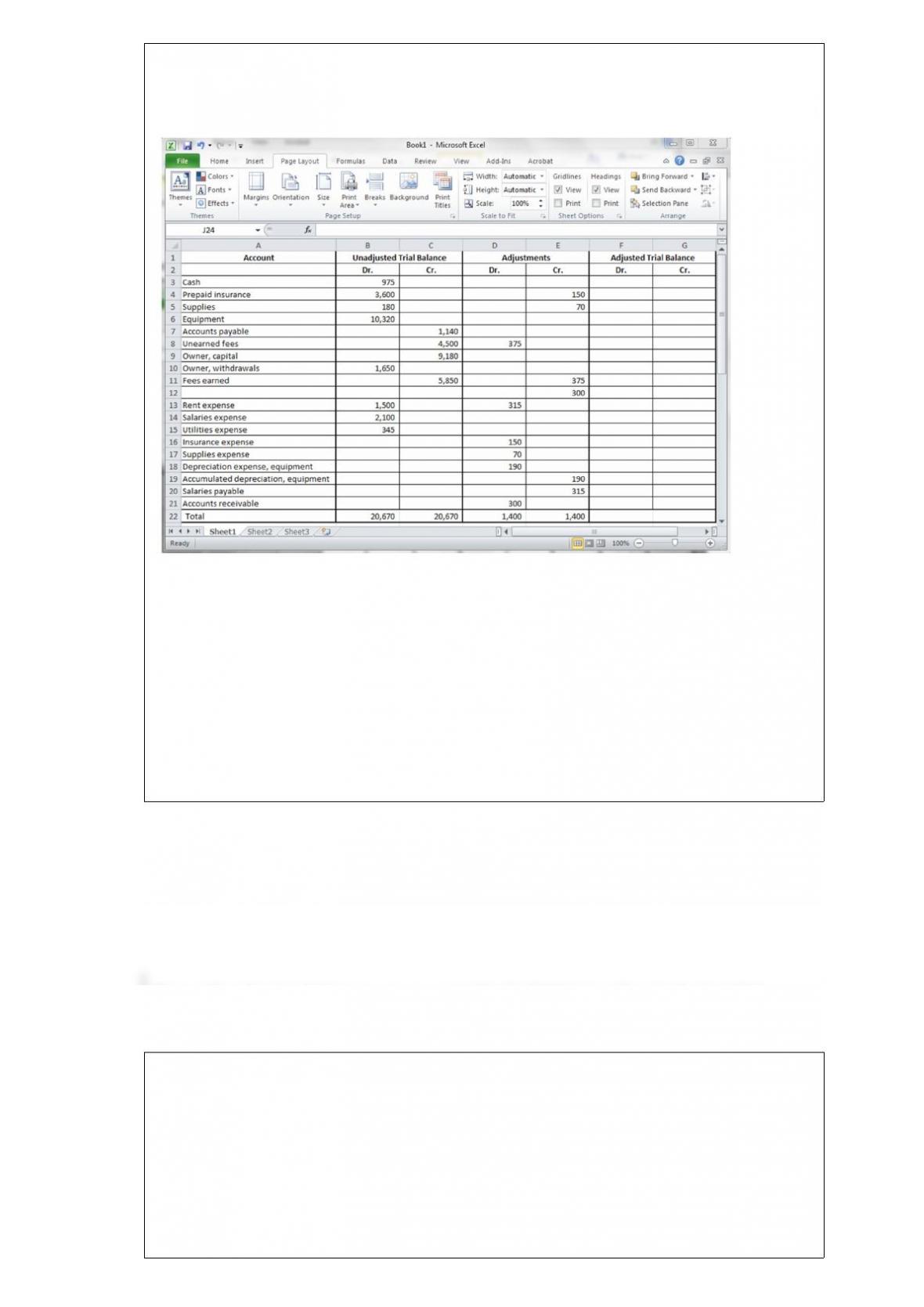
The following items appeared on a December 31 Excel work sheet. Based on the
following information, what is net income for the year?
A. $1,725.
B. $1,855.
C. $2,060.
D. $4,125
E. $4,670.
Prenumbered printed cheques are an example of which internal control principle?
A. Technological controls.
B. Maintain adequate records.
C. Perform regular and independent reviews.
D. Technological controls and maintain adequate records.
E. All of these answers are correct.
The excess of expenses over revenues for a period is:
A. Net assets.
B. Equity.
C. Net loss.
D. Net income.
E. A liability.
Ethics:
A. Are beliefs that separate right from wrong.
B. And law often coincide.
C. Help to prevent conflicts of interest.
D. Are very important considerations for accountants.
E. All of these answers are correct.
The most flexible type of journal that can be used to record any kind of transaction is
called a:
A. Ledger.
B. Trial balance.
C. Chart of accounts.
D. General Journal.
E. Balance column account.
A liability created by the receipt of cash from customers in payment for products or
services that have not yet been delivered to the customers is:
A. Recorded as a debit to an unearned revenue account.
B. Recorded as a debit to a prepaid expense account.
C. Recorded as a credit to an unearned revenue account.
D. Recorded as a credit to a prepaid expense account.
E. Not recorded in the accounting records.
Match each of the following terms with the appropriate definition.
List the steps in the accounting cycle.
Blu Lightning Co. performed testing services for the Cheetah Co. Blu Lightning Co.
billed Cheetah Co. $5,000. Enter the appropriate amounts into the accounting equation
format.
Explain the use of controlling accounts and subsidiary ledgers.
Explain the difference between the functions of an internal auditor and an external
auditor.
Describe the main user groups, their members, and their uses of accounting
information.
Define an accounting information system (AIS).
Match the following definitions and terms by placing the letter that identifies the best
definition in the blank space next to the term.
On December 31, 2015, the accountant for a proprietorship forgot to record $7,000 of
depreciation on office equipment. In the 2015 financial statements, what is the effect of
this error on assets, net income, and equity?