One disadvantage of the high-low method is the highest and lowest points may not be
representative of normal operating activities.
Answer:
One advantage of the step method is that all reciprocal services are recognized between
service departments.
Answer:
Managers in a cost center are held responsible for both the costs and volumes of inputs
used to produce a product or provide a service.
Answer:
When actual costs are used as the basis for a transfer, inefficiencies of the selling
division are transferred to the buying division.
Answer:
The basic difference between the department cost allocation method and activity-based
costing (ABC) is the number of stages involved in allocating costs to products.
Answer:
“Beginning Balance (BB) plus Transfers Out (TO) equals Ending Balance (EB) plus
Transfers In (TI)”.
Answer:
Properly developed and implemented management control systems influence
subordinates to act in the organization’s best interest.
Answer:
Differential analysis cannot be used for long-run decisions because it cannot
incorporate the timing of revenues and costs (i.e., the time-value of money).
Answer:
It is important that the manager assigned to lead a responsibility center be held
accountable for its operations.
Answer:
The production budget allows management to plan for the resources needed to meet the
current sales demand and ensure that inventory levels are sufficient for future sales.
Answer:
The Transfers In (TI) costs in the basic cost flow model of a manufacturing firm are
Direct materials, Direct labor and Manufacturing overhead.
Answer:
Differential analysis involves the comparison of one or more alternative courses of
action with the status quo.
Answer:
The GAAP financial reporting rules for segments require that all companies use
transfer prices based on market prices.
Answer:
If the cost of goods manufactured during the period exceeds the cost of goods sold, the
balance of the Finished Goods Inventory account increased.
Answer:
Employees empowered with real decision-making authority are more likely to be more
responsive to customer concerns.
Answer:
Some variances are the result of standards that are inaccurate or do not reflect the
current production process.
Answer:
Employee involvement in setting performance objectives is likely to increase the
employee’s commitment to the organization.
Answer:
Cost-volume-profit (CVP) analysis assumes that the production volume equals sales
volume so that any changes in unit prices can be ignored.
Answer:
The number of defective units is an example of a subjective performance measure.
Answer:
The production budget must be prepared before the direct materials, direct labor and
overhead budgets can be prepared.
Answer:
The relevant range represents those activity levels for which valid cost relationships
have been observed.
Answer:
The plant wide cost allocation method should be used by companies that manufacture
products that are similar and use the same resources.
Answer:
Partial factor productivity is the ratio of the value of output to the value of all key
inputs.
Answer:
The production cost yield variance is conceptually the same as the sales quantity
variance.
Answer:
Normal costing uses the actual allocation base activity to apply manufacturing
overhead costs to jobs during the period.
Answer:
If materials are only added at the end of the production process, then the degree of
completion for materials of units in the ending Work-in-Process Inventory is always
0%.
Answer:
The cost of an item is the sacrifice made to acquire it.
Answer:
Managerial myopia is the distortion in incentives that result from using accounting
measures to evaluate performance.
Answer:
Cost management systems should be designed to report the same costs to each
decision-maker.
Answer:
A balanced scorecard uses only nonfinancial measures to determine how well the
organization is doing in view of competing stakeholder concerns.
Answer:
Total cost of goods purchased minus beginning merchandise inventory plus ending
merchandise inventory equals cost of goods sold.
Answer:
The break-even point for an organization with a low operating leverage will be
relatively higher than the break-even point for an organization with a high operating
leverage.
Answer:
The linear cost estimate tends to understate the slope of the cost line in ranges close to
capacity.
Answer:
Hospitals are more likely to use a process costing system than a job order costing
system.
Answer:
A selling division at capacity is indifferent between selling to outsiders and transferring
inside at the market price.
Answer:
The average selling price is $.60 per unit, the average variable cost is $.36 per unit, and
the total fixed costs are $1,500. If operating profits of $900 are desired, a sales volume
of 2,500 units is necessary.
Answer:
Current costs should not be used to compute either return on investment (ROI) or
residual income because current costs are not generally accepted accounting principles
(GAAP).
Answer:
When managers are held responsible for costs but the input-output relationship is not
well specified, a(n) ________________________ is established.
A. standard cost center
B. revenue center
C. discretionary cost center
D. asset center
Answer:
In the standard regression equation of y = a + bx, the letter a is best described as the
A. independent variable.
B. dependent variable.
C. slope of the equation.
D. intercept of the equation.
Answer:
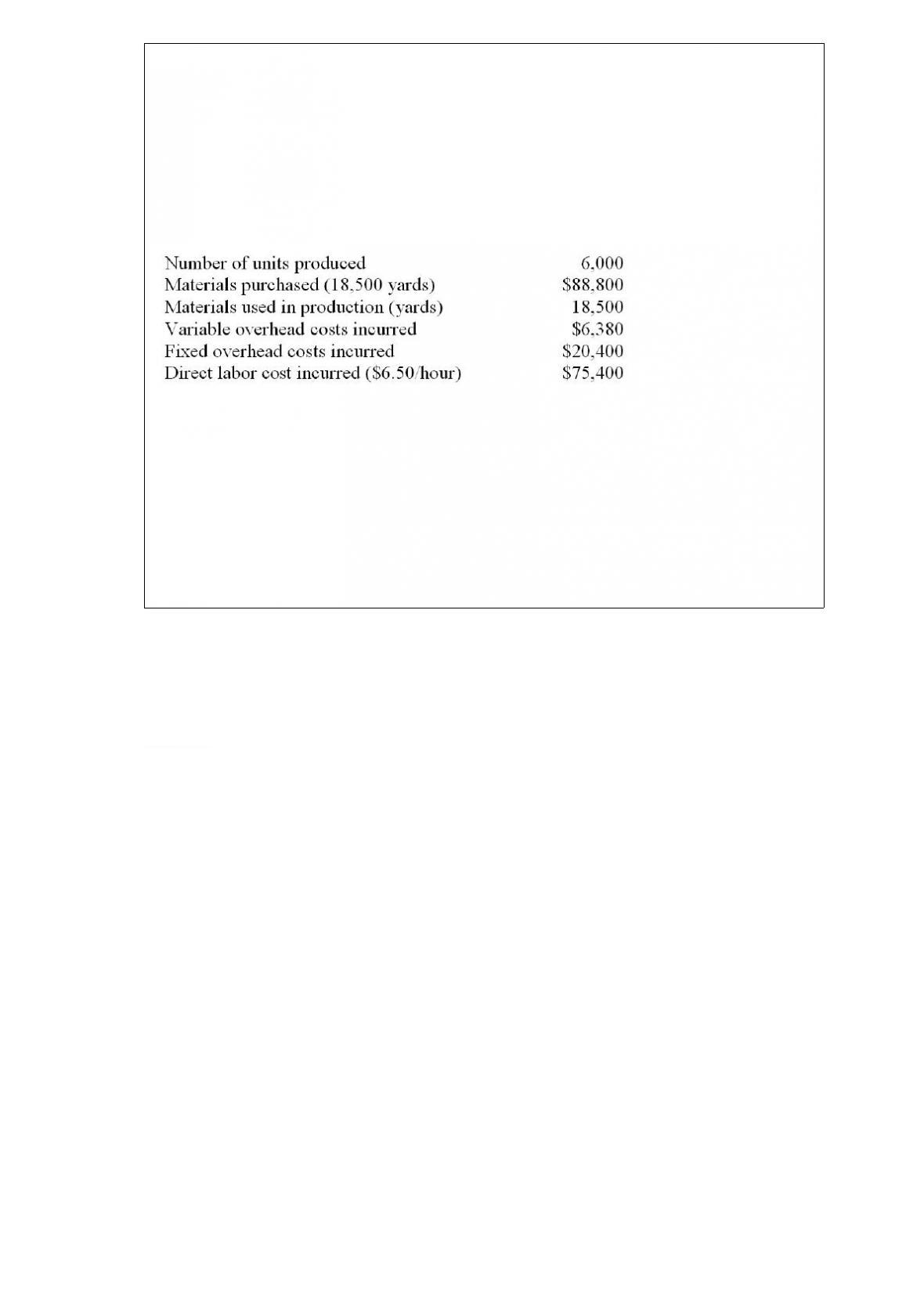
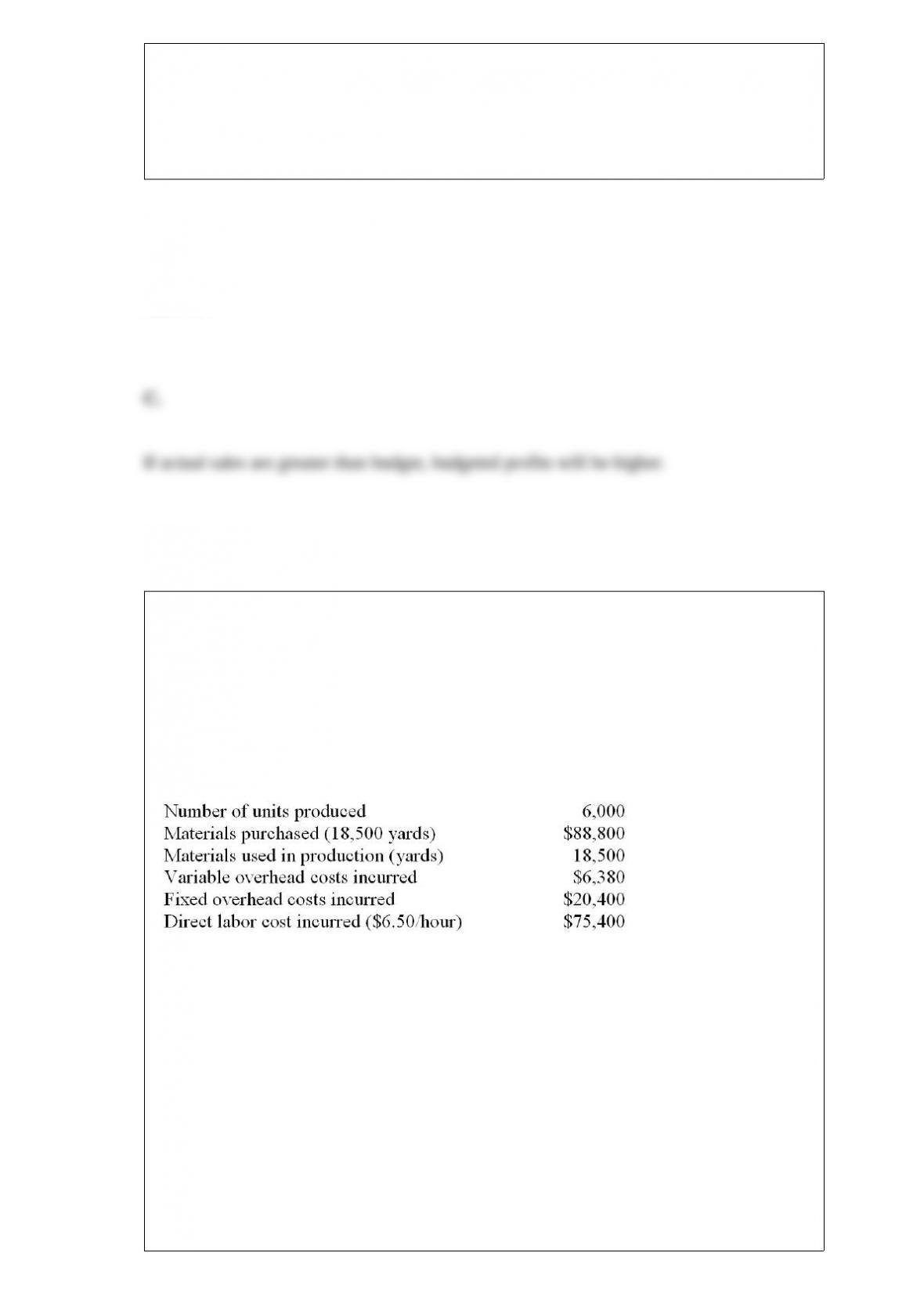
The XYZ Company uses a standard cost accounting system and estimates production
for the year to be 60,000 units. At this volume, the company’s variable overhead costs
are $.50 per direct labor hour.
The company’s single product has a standard cost of $30.00 per unit. Included in the
$30.00 is $13.20 for direct materials (3 yards) and $12.00 of direct labor (2 hours).
Production information for the month of March follows:
Required: Prepare the journal entries to record the following:
a) Incurring actual overhead
b) Application of overhead to production.
c) Closing of overhead accounts and recognizing variances.
d) Transferring production to finished goods.
Answer:
RST Company incurred $126,000 in material costs during July. Additionally, the
12,000 units in the Work-in-Process Inventory on July 1 had materials assigned to them
of $32,000, even though they were only 5% complete as to materials. No additional
units were started during July, and there were no unfinished units on hand on July 31.
What is the material cost per unit for July, assuming RST uses weighted-average
process costing?
A. $10.50
B. $11.59
C. $13.17
D. $15.49
Answer:
Controllable revenue is included in a performance report of a
A. a
B. b
C. c
D. d
Answer:
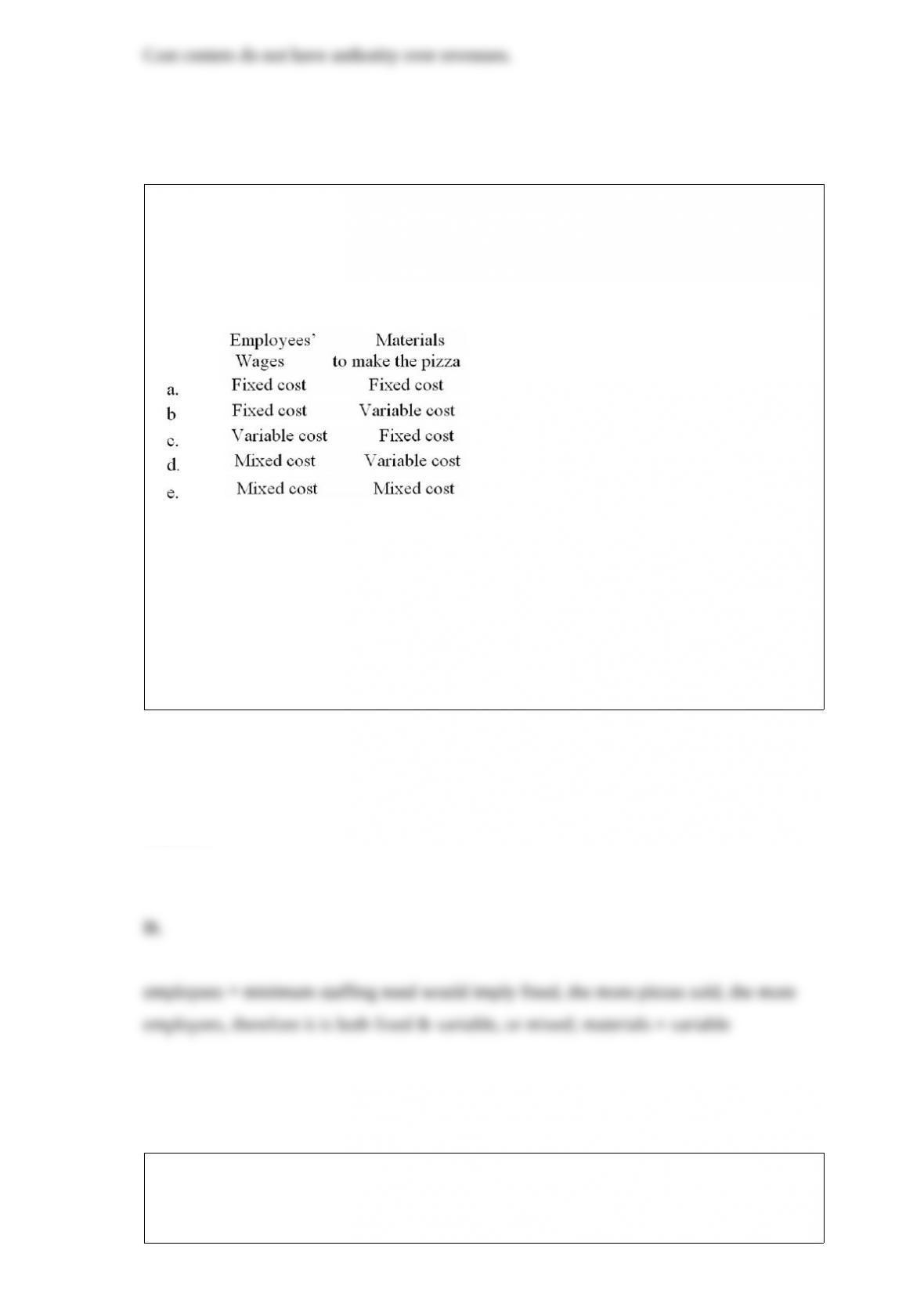
Pete’s Pizza Place has four pizza makers and ten other employees who take orders from
customers and perform other tasks. The four pizza makers and the other employees are
paid an hourly wage. How would one classify (1) the wages paid to the pizza makers
and other employees and (2) materials (e.g., cheeses, sauce, etc.) used to make the
pizza? Assume the activity is the number of pizzas made.
A. Option A
B. Option B
C. Option C
D. Option D
Answer:
Lo-crete produces quick setting concrete mix. Production of 200,000 tons was started
in April, 190,000 tons were completed. Material costs were $3,152,000 for the month
while conversion costs were $591,000. There was no beginning work-in-process; the
ending work-in-process was 70% complete. What is the material cost of the product that
remains in work-in-process?
A. $315,200
B. $157,600
C. $112,000
D. $160,000
Answer:
If both the variable cost per unit and the selling price per unit increase, the new
contribution margin ratio in relation to the old contribution margin ratio will be:
A. Lower.
B. Higher.
C. Unchanged.
D. Not enough information to tell.
Answer:
The measure (ratio) that reflects the performance of a manager regarding sales and cost
of goods sold, but not other operating costs and income taxes, is called the
A. gross margin ratio.
B. profit margin ratio.
C. operating margin ratio.
D. contribution margin ratio.
Answer:
Using ending balances for the investment base in computing return on investment
(ROI) might encourage managers to acquire assets
A. early in the year and dispose of assets late in the year.
B. early in the year and dispose of assets early in the year.
C. late in the year and dispose of assets late in the year.
D. late in the year and dispose of assets early in the year.
Answer:
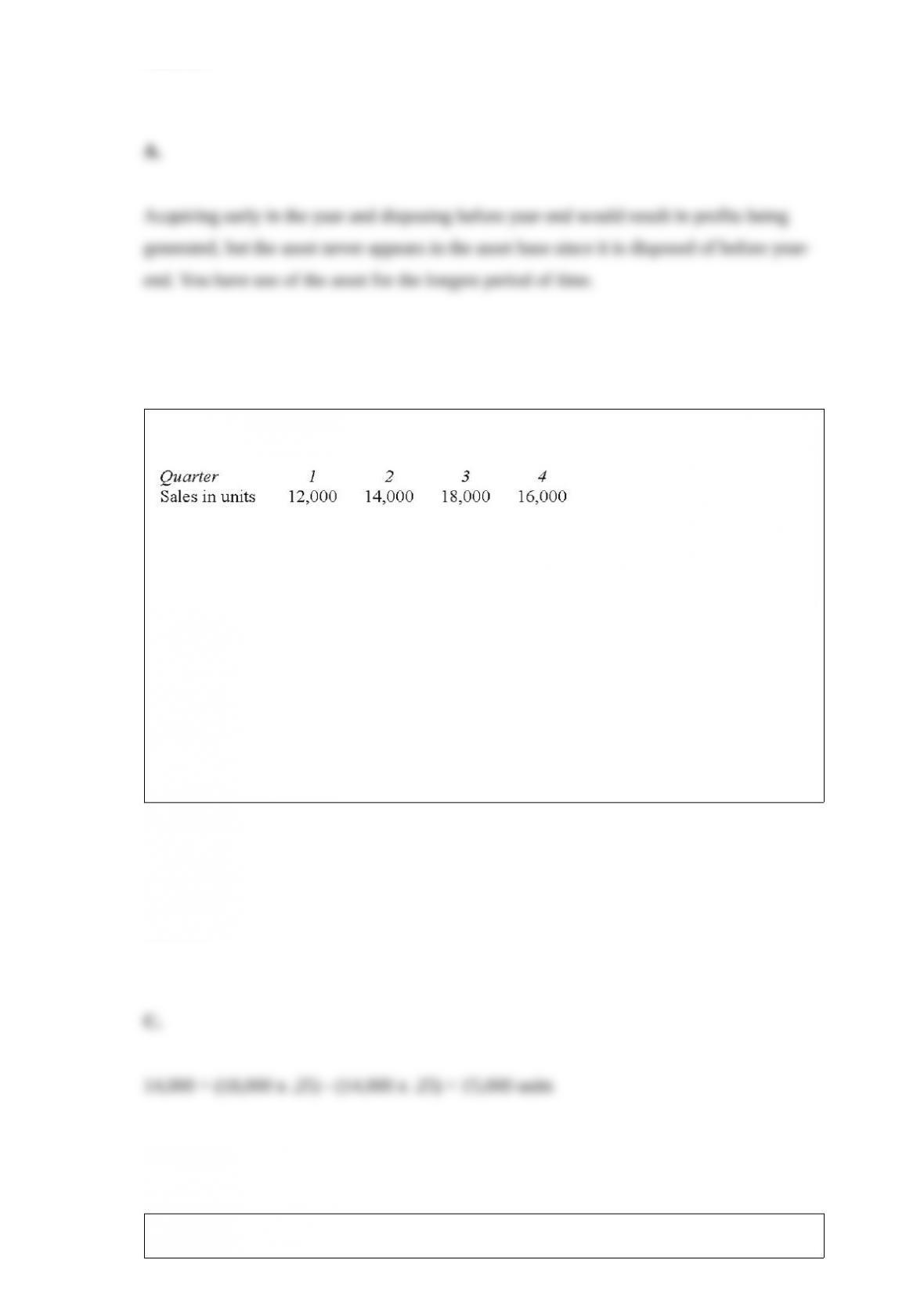
The Waverly Company has budgeted sales for the year as follows:
The ending inventory of finished goods for each quarter should equal 25% of the next
quarter’s budgeted sales in units. The finished goods inventory at the start of the year is
3,000 units. Scheduled production for the second quarter is (in units)
A. 17,500 units.
B. 16,500 units.
C. 15,000 units.
D. 13,000 units.
Answer:
The ABC Company has three divisions: A Division, B Division, and C Division.
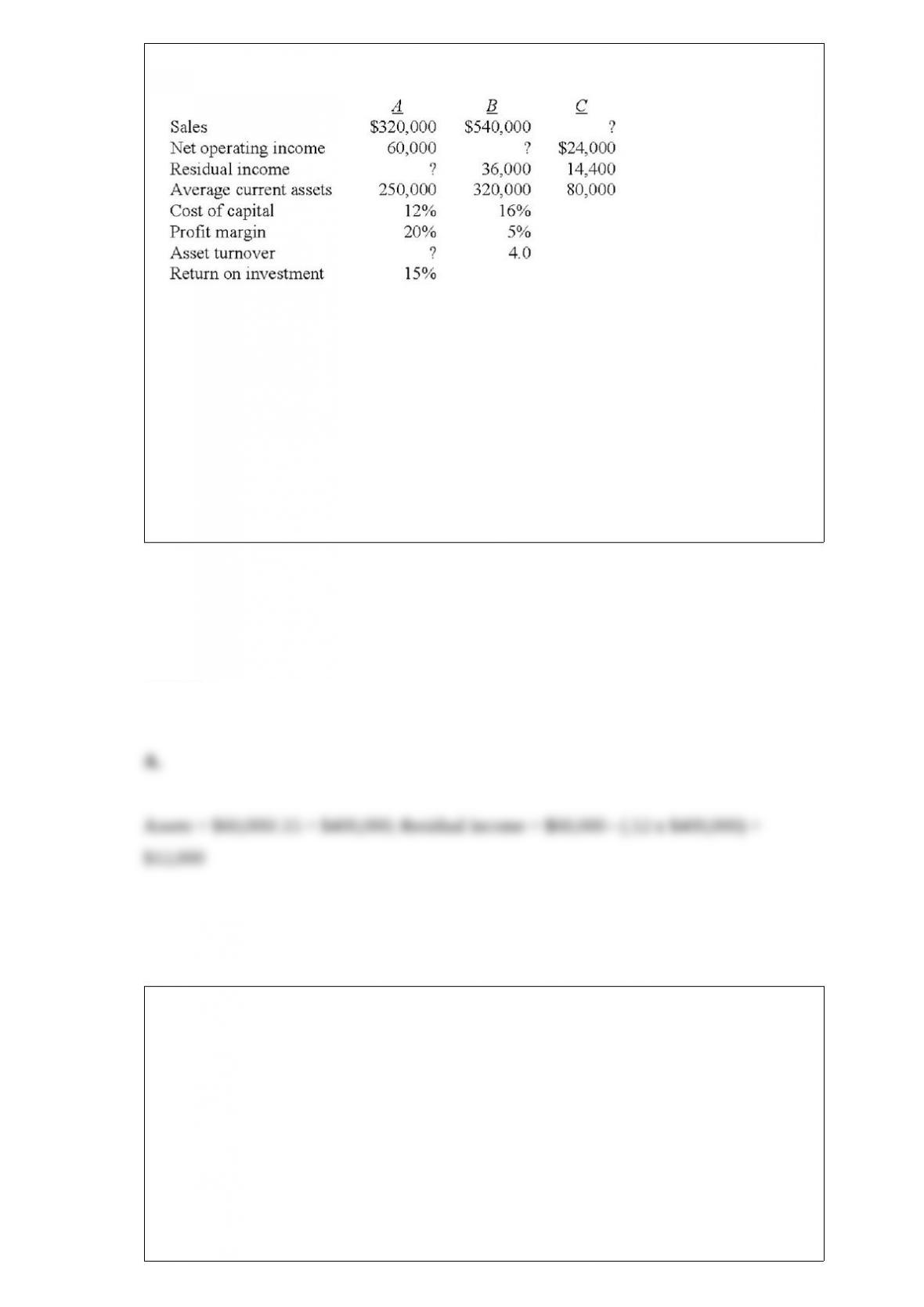
What was A Division’s residual income last year?
A. $12,000.
B. $22,500.
C. $30,000.
D. $48,000.
Answer:
A large manufacturing company has several autonomous divisions that sell their
products in perfectly competitive external markets as well as internally to the other
divisions of the company. Top management expects each of its divisional managers to
take actions that will maximize the organization’s goal as well as their own goals. Top
management also promotes a sustained level of management effort of all of its
divisional managers. Under these circumstances, for products exchanged between
divisions, the transfer price that will generally lead to optimal decisions for the
manufacturing company would be a transfer price equal to the (CIA adapted)
A. full cost of the product.
B. full cost of the product plus a markup.
C. variable cost of the product plus a markup.
D. market price of the product.
Answer:
Which of the following events or transactions will not result in manufacturing
overhead being applied to production?
A. Completion of a job in the current period that was started in a prior period
B. Completion of a job in the current period that was started in the current period
C. Preparing financial statements when work is in process at the end of the period
D. Preparing financial statements when there is no work in process at the end of the
period
Answer:
Of the following process costing steps, which must be done last?
A. Compute the equivalent units of production.
B. Compute the costs per equivalent unit of production.
C. Measure the physical flow of resources.
D. Identify the product costs to account for.
Answer:
For the past five years, the Selin Company has produced and sold frequency meters to
genetics labs throughout the United States. Recently, a strong competitor has entered
the market and Selin is considering whether it should continue to produce and sell the
frequency meters. The following information has been gathered to assist management in
their decision:
A) Sales volume (units) is estimated to drop by 25% once the competitor becomes fully
operational.
B) The equipment used to produce the meters was purchased five-years ago for
$1,500,000.
C) The space now used to produce the meters would be reallocated to eliminate the
need to rent warehouse space.
D) Three of the employees who produce meters would be reassigned to the oscillator
division.
Which of the items listed above is (are) relevant to the decision to continue the
production and sale of the frequency meters?
A. A and C.
B. B and C.
C. C and D.
D. A, B, and D.
E. B, C, and D.
Answer:
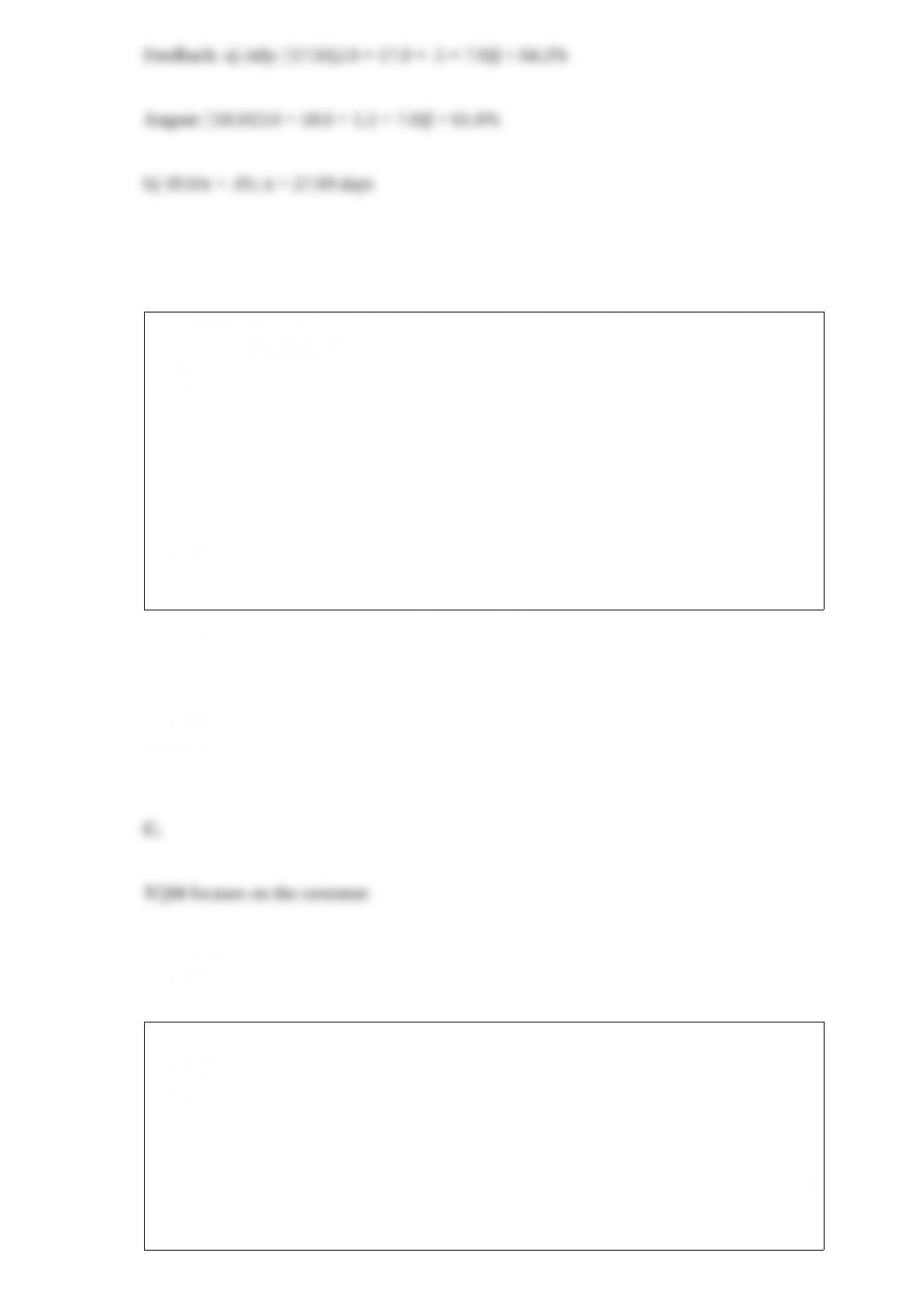
The XYZ Manufacturing Company collected the following information (in days) for
July and August.
Required:
a) Calculate the manufacturing cycle efficiency for July and August.
b) Assume September’s processing time will be the same as August’s. If XYZ’s target
for manufacturing cycle efficiency is 65%, what will September’s target for
manufacturing cycle time be?
Answer:
The primary reason for adopting total quality management (TQM) is to achieve (CIA
adapted)
A. reduced delivery time.
B. reduced delivery charges.
C. greater customer satisfaction.
D. greater employee participation.
E. better managerial decisions.
Answer:
Which of the following statement(s) is/are true?
(A) If a division’s return on investment (ROI) exceeds its cost of capital, then its
residual income is positive.
(B) If a division’s cost of capital equals its return on investment (ROI), then its residual
income is zero.
A. only (A) is true
B. only (B) is true
C. both (A) and (B) are true
D. neither (A) and (B) is true
Answer:
If a company multiplies its actual overhead rate by the actual activity level of its
allocation base, it is using
A. standard costing.
B. normal costing.
C. actual costing.
D. budget costing.
E. ideal costing.
Answer:
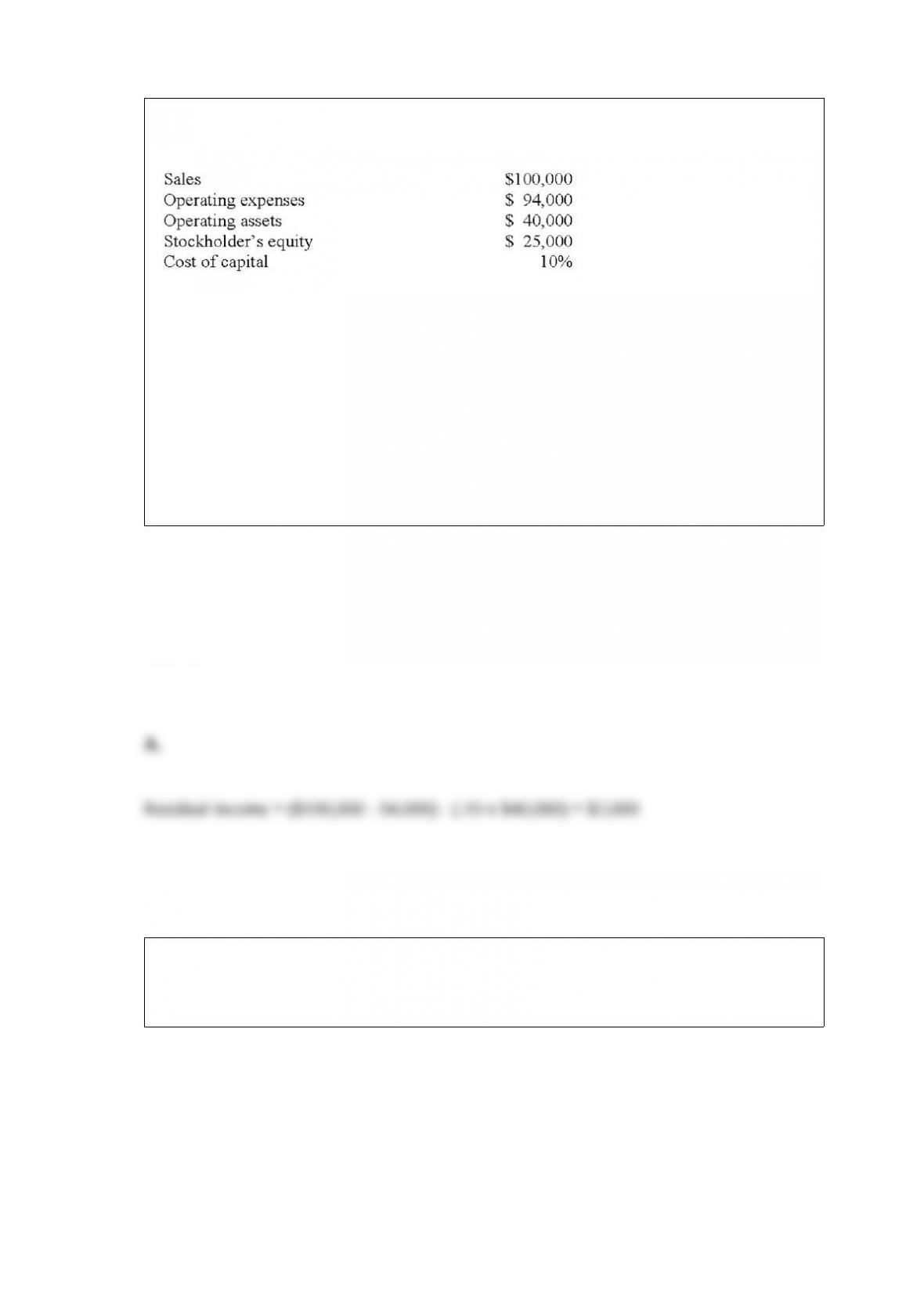
The following information is available for Company X:
What is Company X’s residual income?
A. $2,000
B. $2,500
C. $3,500
D. $4,000
Answer:
Lein Office Products produces three models of commercial shelving, the Basic, the
Advanced and the Superior. Data on operations and costs for the month are:
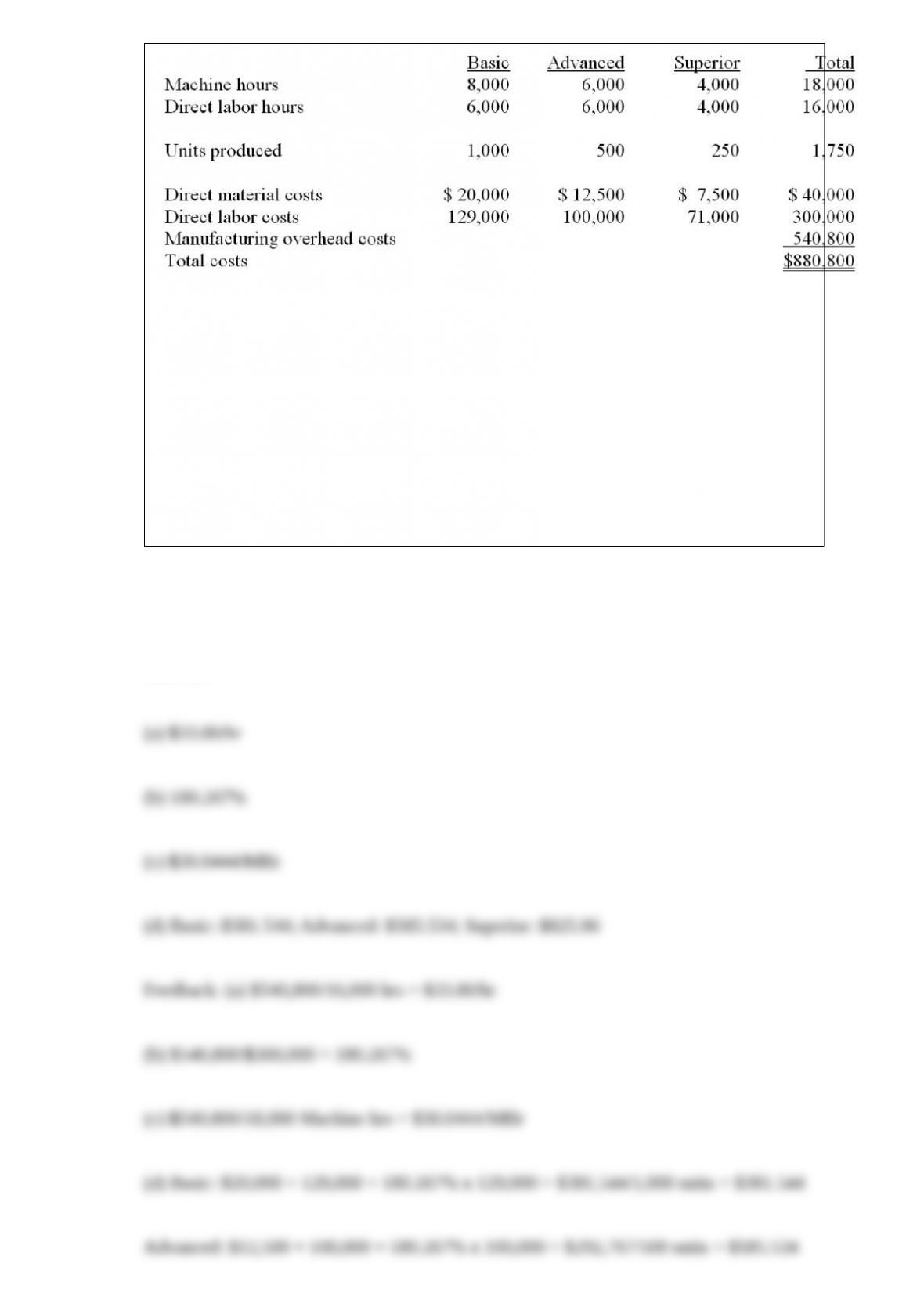
Required: Compute the predetermined overhead rate, assuming Lein Office Products
uses:
(a) Direct labor hours to allocate overhead costs.
(b) Direct labor costs to allocate overhead costs.
(c) Machine hours to allocate overhead costs.
(d) Compute the unit cost for each model using direct labor costs to allocate overhead.
Answer:
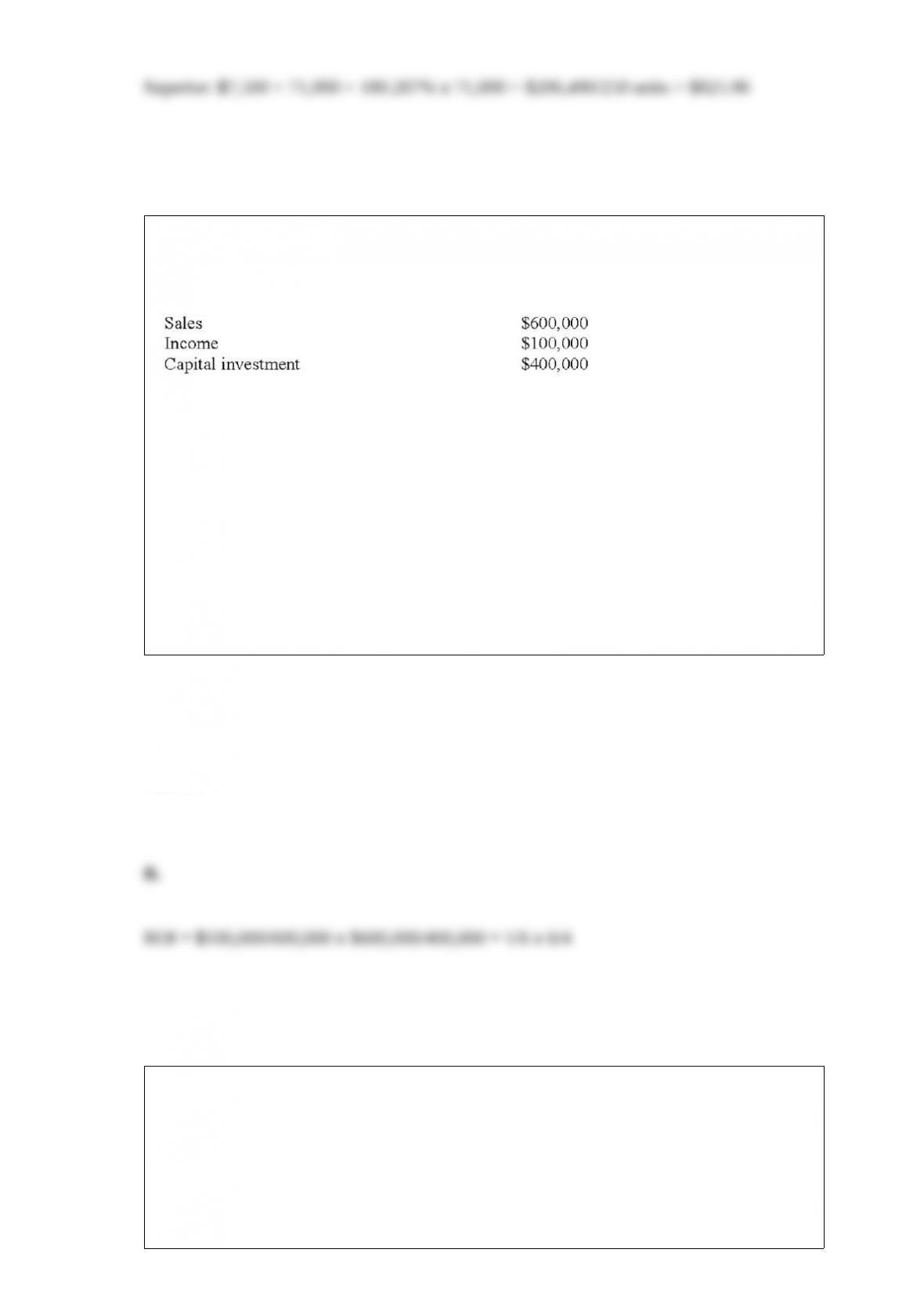
The following information pertains to Bala Co. for the year ended December 31: (CPA
adapted)
Which of the following equations should be used to compute Bala’s return on
investment (ROI)?
A. (4/6) x (6/1) = ROI
B. (6/4) x (1/6) = ROI
C. (4/6) x (1/6) = ROI
D. (6/4) x (6/1) = ROI
Answer:
Which of the following variances will always be favorable when actual sales exceeds
budgeted sales?
A. variable cost
B. fixed cost
C. sales activity
D. operating profit
E. contribution margin
Answer:
The XYZ Company uses a standard cost accounting system and estimates production
for the year to be 60,000 units. At this volume, the company’s variable overhead costs
are $.50 per direct labor hour.
The company’s single product has a standard cost of $30.00 per unit. Included in the
$30.00 is $13.20 for direct materials (3 yards) and $12.00 of direct labor (2 hours).
Production information for the month of March follows:
Required: (Be sure to indicate whether the variances are favorable or unfavorable.)
a) Compute the predetermined overhead rate/hr used for the year.
b) Compute the budgeted fixed costs for the month.
c) Compute the variable overhead spending variance.
d) Compute the variable overhead efficiency variance.
e) Compute the fixed overhead spending (budget) variance.
f) Compute the production volume variance.
Answer:
According to the Institute of Management Accountants (IMA), the final step in
resolving an ethical dilemma is to
A. resign from the organization.
B. call the IMA’s ethics hotline.
C. report the circumstances to a local newspaper.
D. consult with an objective, independent advisor.
E. discuss the situation with an immediate supervisor.
Answer:
Which of the following statements about activity-based costing (ABC) is not true?
(CIA adapted)
A. In ABC, cost drivers are what cause costs to be linked to products.
B. ABC is useful for assigning marketing and distribution costs.
C. ABC differs from traditional costing systems in that products are not
cross-subsidized.
D. ABC is more likely to result in major differences from traditional costing systems if
the firm manufactures only one product rather than multiple products.
Answer:
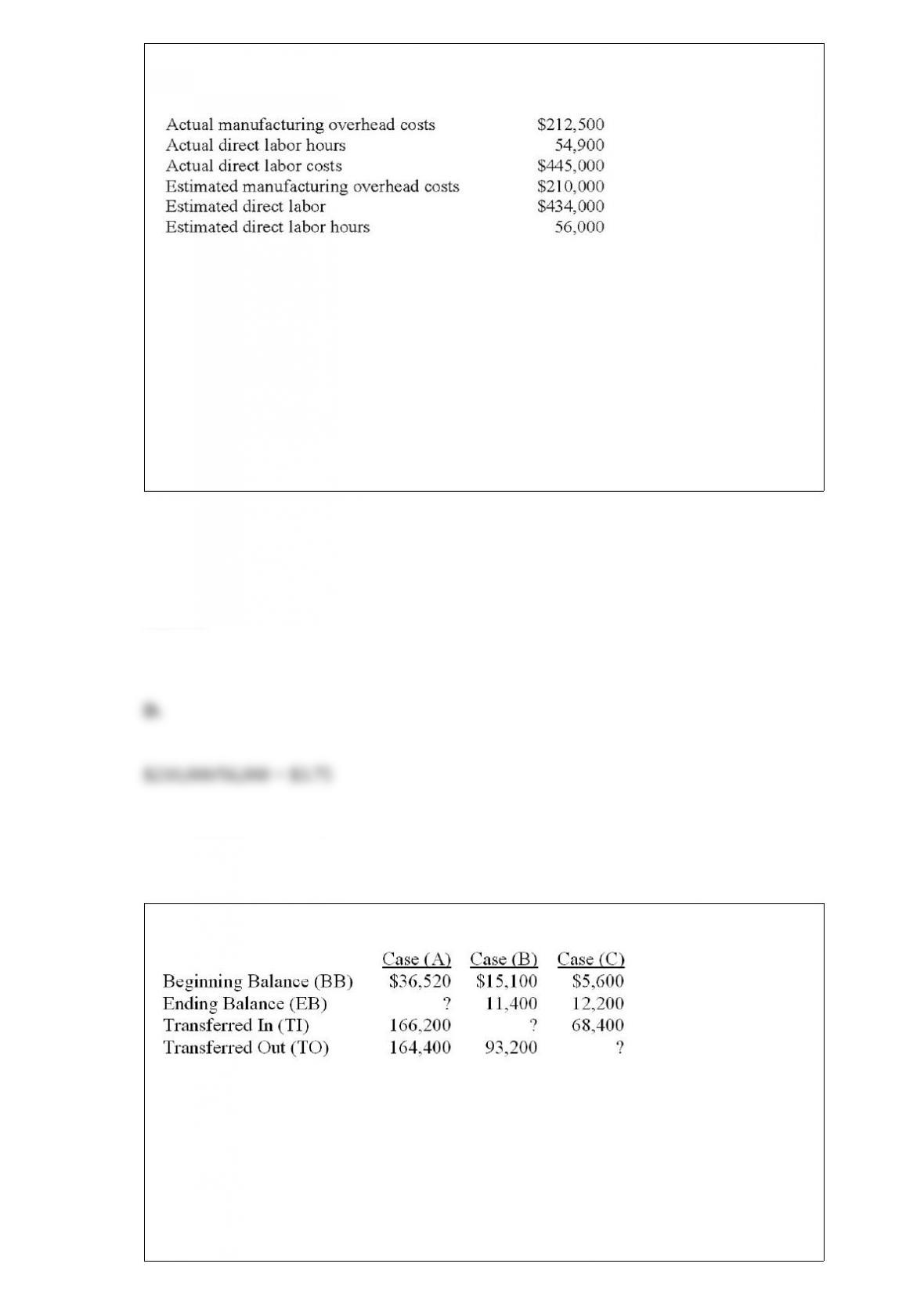
The following information has been gathered for the GHI Manufacturing Company for
its fiscal year ending December 31:
What is the predetermined manufacturing overhead rate per direct labor hour?
A. $3.87
B. $3.79
C. $3.83
D. $3.75
Answer:
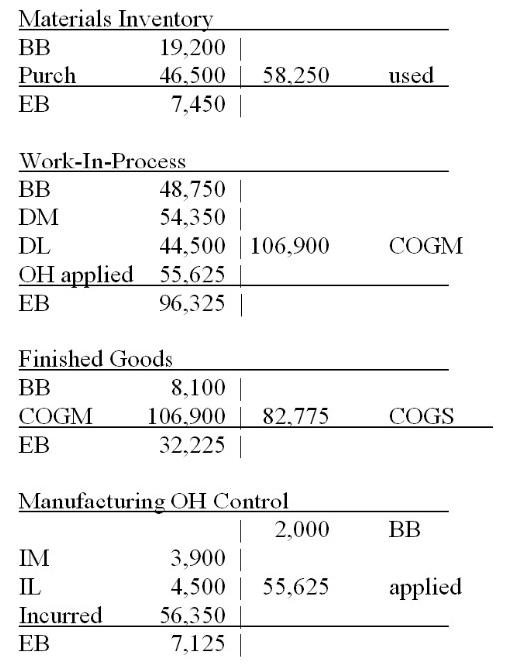
For Case (A) above, what is the Ending Balance (EB)?
A. $36,920
B. $36,520
C. $34,720
D. $38,320
Answer:
Division S sells its product to unrelated parties at a price of $20 per unit. It incurs
variable costs of $7 per unit and has fixed costs of $50,000 per month. Monthly
production is generally 10,000 units.
Division B uses Division S’s product in its operations. It can purchase the units from
Division S at $20 per unit, but must pay a $1.50 per unit in shipping costs.
Alternatively, Division B can buy from Division S’s competition at a delivered price of
$21 per unit.
Required:
a) From the company’s perspective, should Division B purchase the units internally or
externally? Assume Division S has ample capacity to handle all of Division B’s needs.
b) Would your answer change if Division S can sell everything it produces to outside
customers?
Answer:
Why is operations costing often called a “hybrid” system?
Answer:
Explain the difference between the break-even point, the margin of safety, and
operating leverage.
Answer:
A machine distributor sells two models, basic and deluxe. The following information
relates to its master budget.
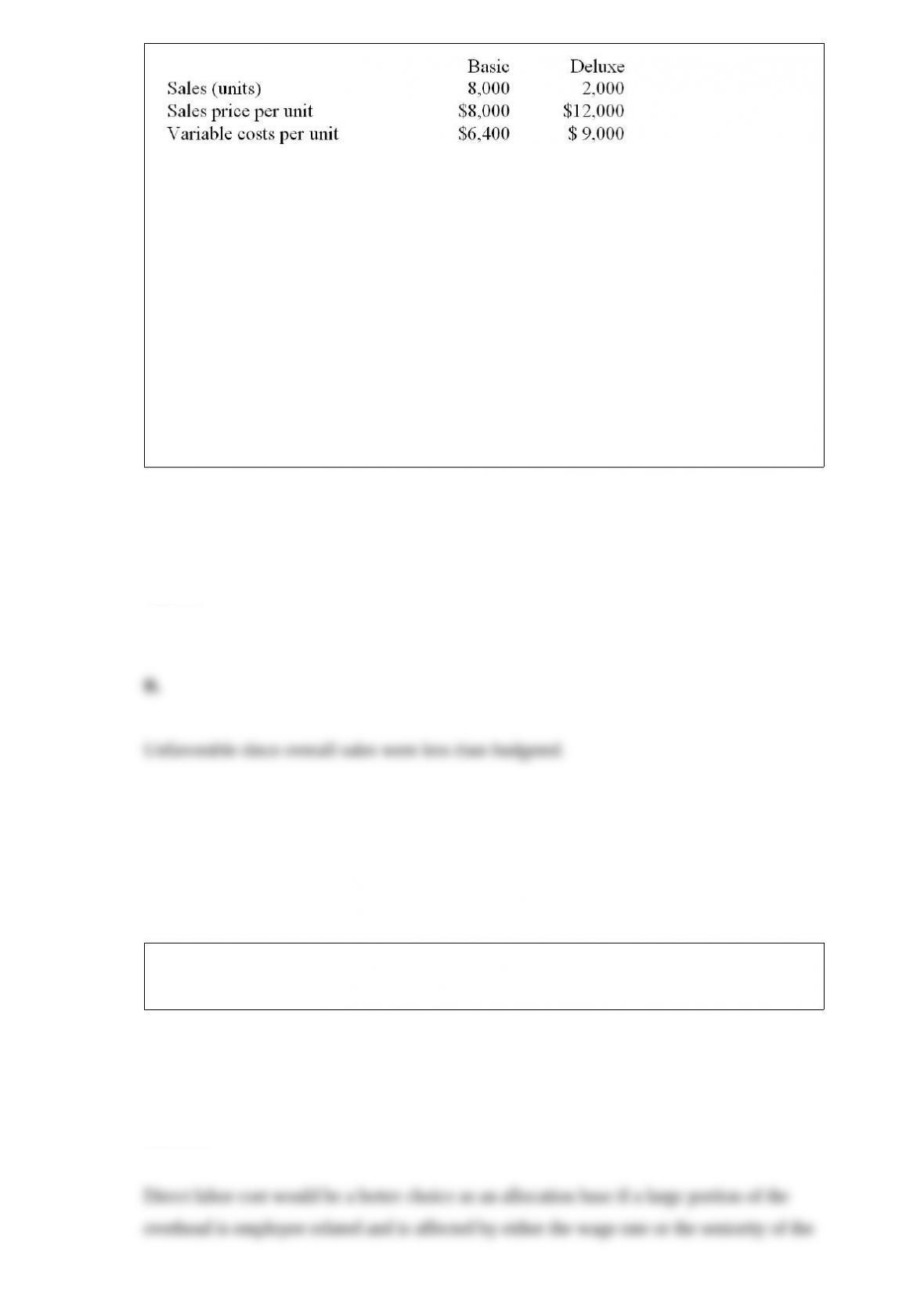
Actual sales were 7,000 basic models and 2,800 deluxe models. The actual sales prices
were the same as the budgeted sales prices for both models.
Is the sales quantity variance for the basic model favorable or unfavorable?
A. favorable.
B. unfavorable.
Answer:
Why might a company use direct labor cost as an overhead allocation base rather than
using direct labor hours?
Answer:
How does job costing for a service organization differ from job costing for a
manufacturer?
Answer:
How does job costing differ from process costing?
Answer:
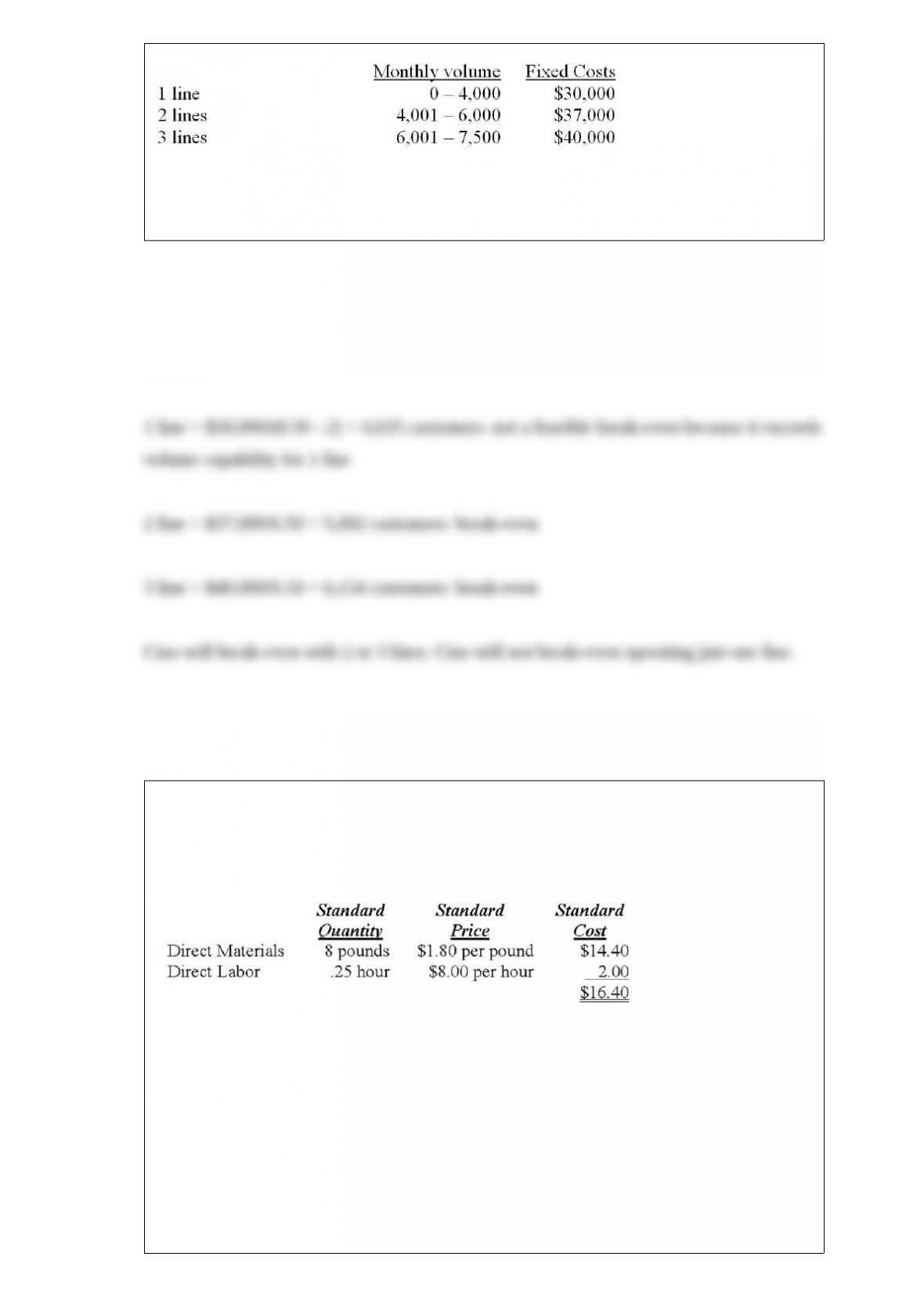
The Ciao Line Buffet is a new buffet-style restaurant offering pizza and Italian dishes.
The buffet has a fixed price of $8.50 per person. The estimated food costs are $2.00 per
person, regardless of volume. Fixed costs are related to the number of buffet lines that
are maintained, with the estimated costs as follows:
Required:
Determine the break-even point(s).
Answer:
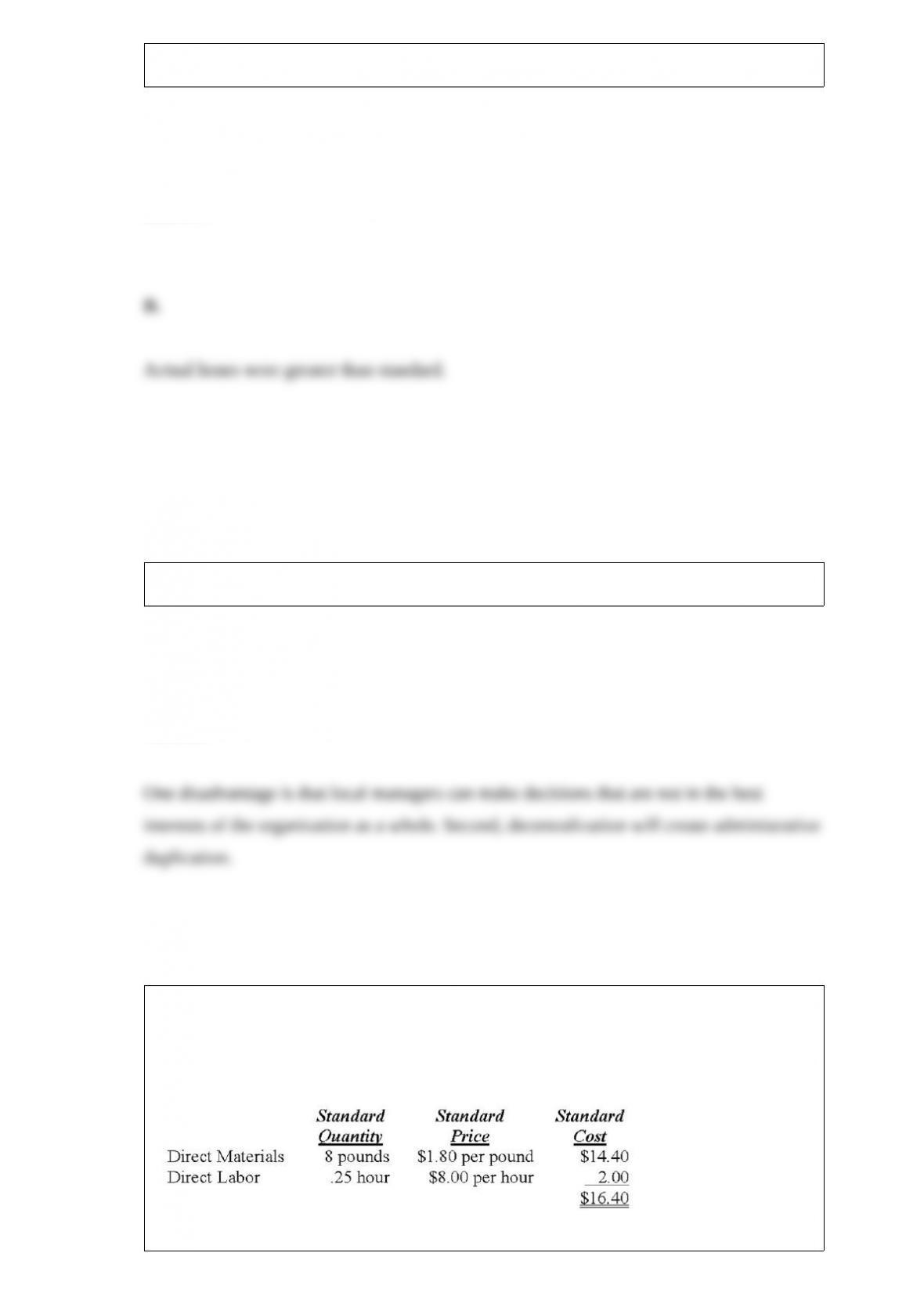
Arrow Industries employs a standard cost system in which direct materials inventory is
carried at standard cost. Arrow has established the following standards for the prime
costs of one unit of product.
During November, Arrow purchased 160,000 pounds of direct materials at a total cost
of $304,000. The total factory wages for November were $42,000, 90% of which were
for direct labor. Arrow manufactured 19,000 units of product during November using
142,500 pounds of direct materials and 5,000 direct labor hours.
Is the direct labor efficiency variance favorable or unfavorable?
A. favorable
B. unfavorable
Answer:
Describe two disadvantages of decentralization.
Answer:
Arrow Industries employs a standard cost system in which direct materials inventory is
carried at standard cost. Arrow has established the following standards for the prime
costs of one unit of product.
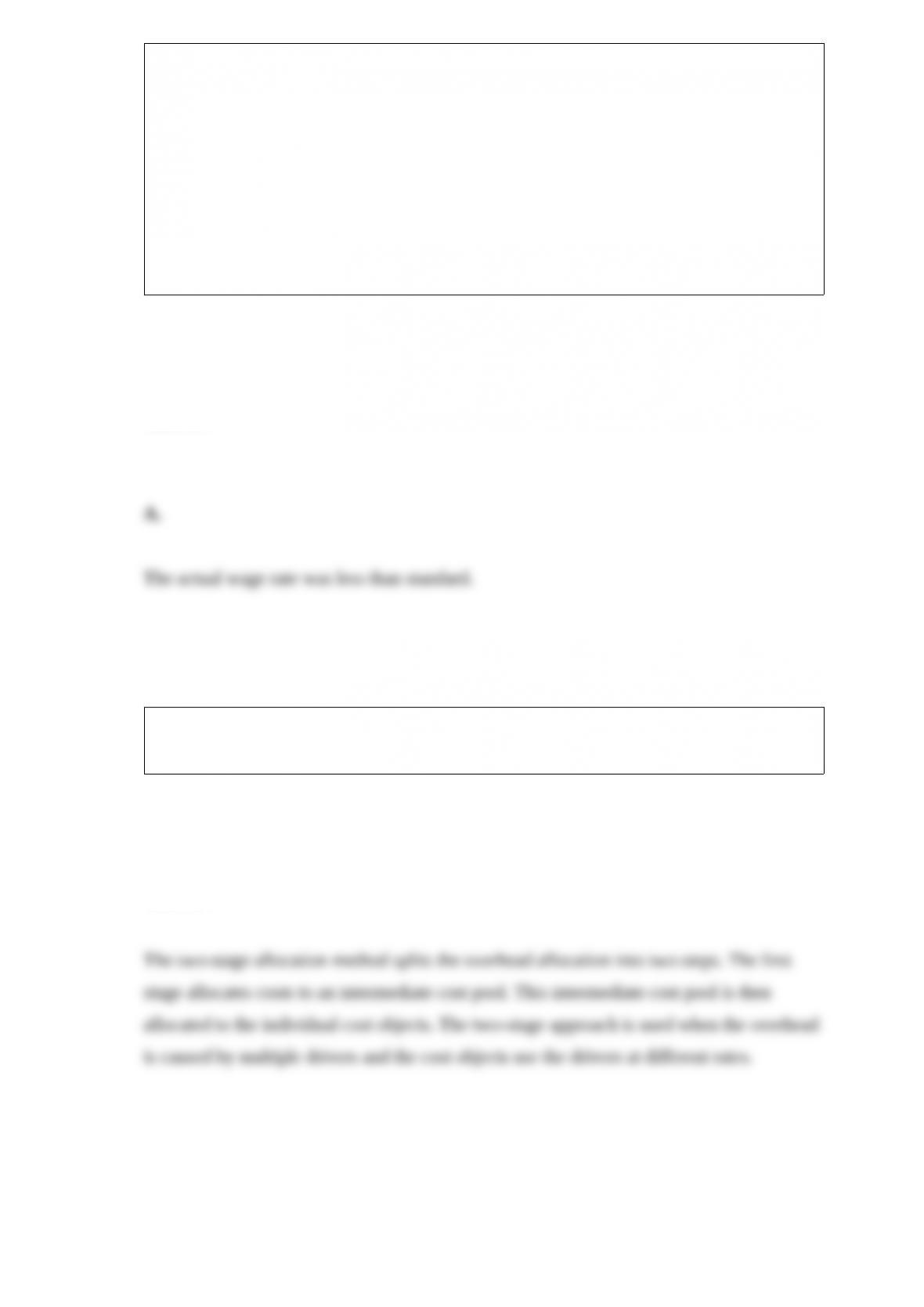
During November, Arrow purchased 160,000 pounds of direct materials at a total cost
of $304,000. The total factory wages for November were $42,000, 90% of which were
for direct labor. Arrow manufactured 19,000 units of product during November using
142,500 pounds of direct materials and 5,000 direct labor hours.
Is the direct labor price (rate) variance favorable or unfavorable?
A. favorable
B. unfavorable
Answer:
Describe the two-stage allocation method. When is it important to use a two-stage
approach rather than a single-stage approach?
Answer:
Answer:
Quality costs can be divided into two categories: conformance and nonconformance.
Explain the difference between the two and give two examples of each.
Answer:
Answer:
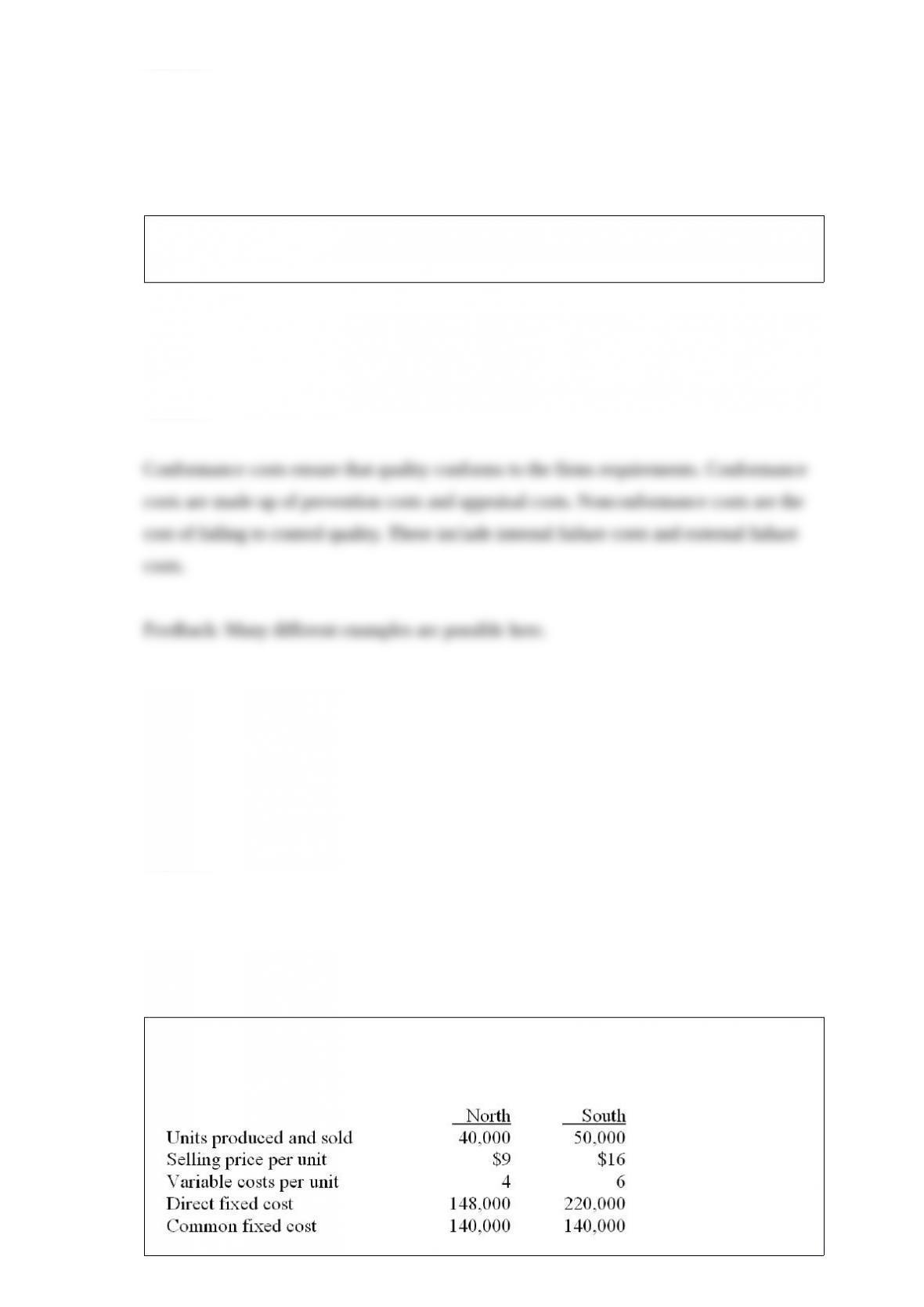
Bisson Industries has two divisions: the North Division and the South Division.
Information relating to the divisions for the year just ended is as follows:
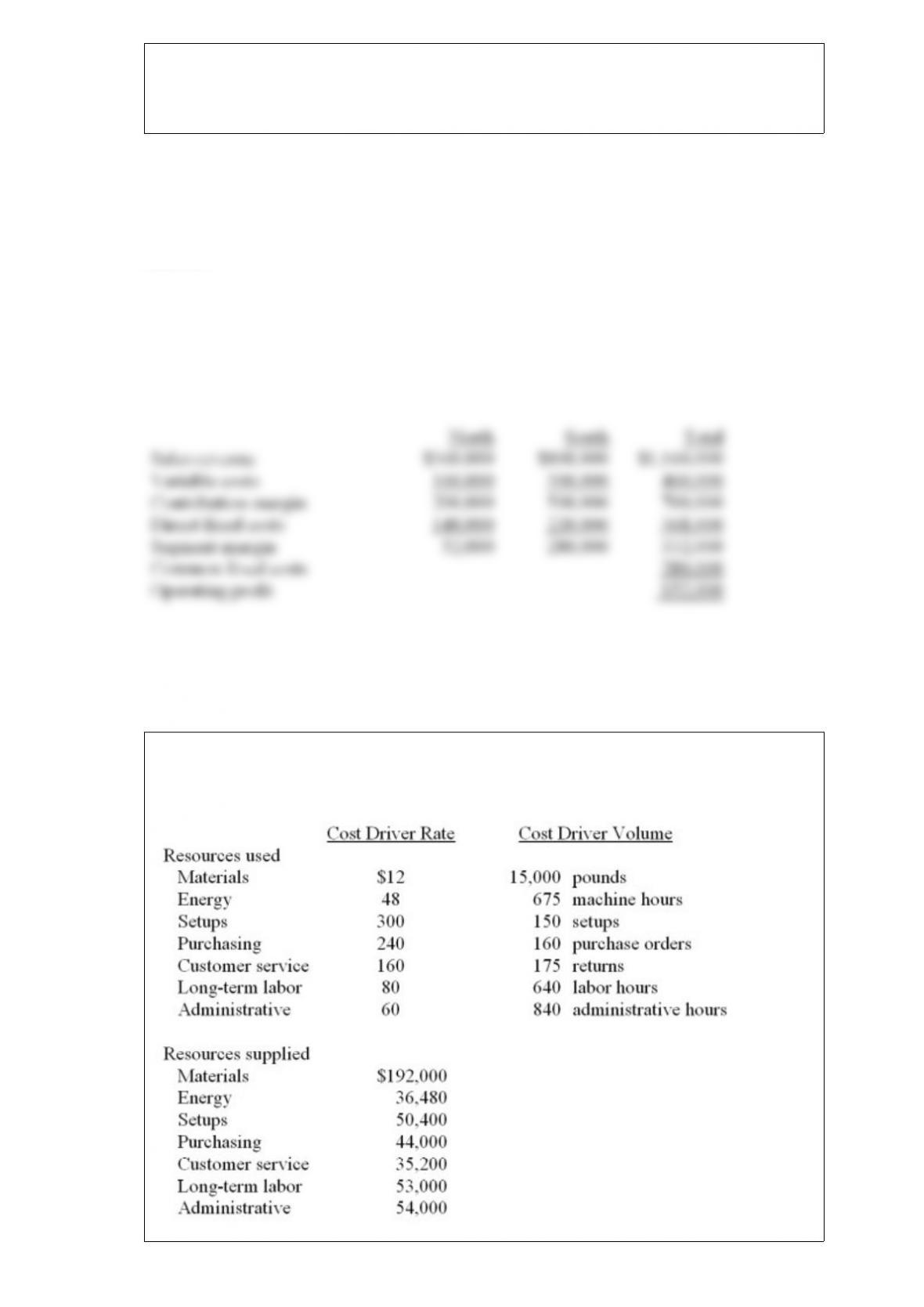
Common fixed expenses have been allocated equally to each of the two divisions.
Prepare a segmented contribution approach income statement for Bisson
Answer:
Gunnison Supply provides the following information about resources:
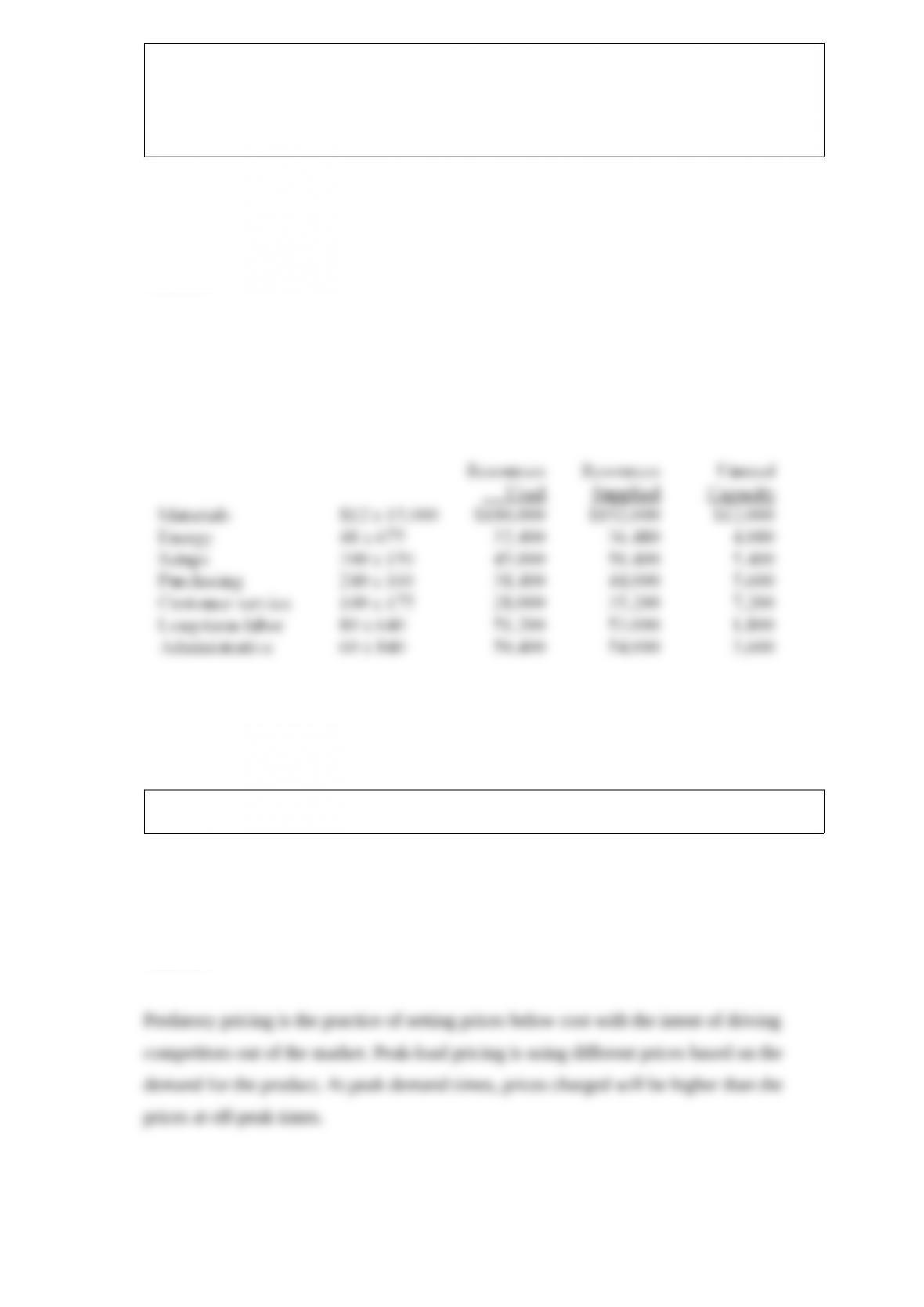
In addition, sales for the period totaled $600,000.
Required: Compute the unused resource capacity for each preceding item.
Answer:
Explain the distinction between predatory pricing and peak-load pricing.
Answer:
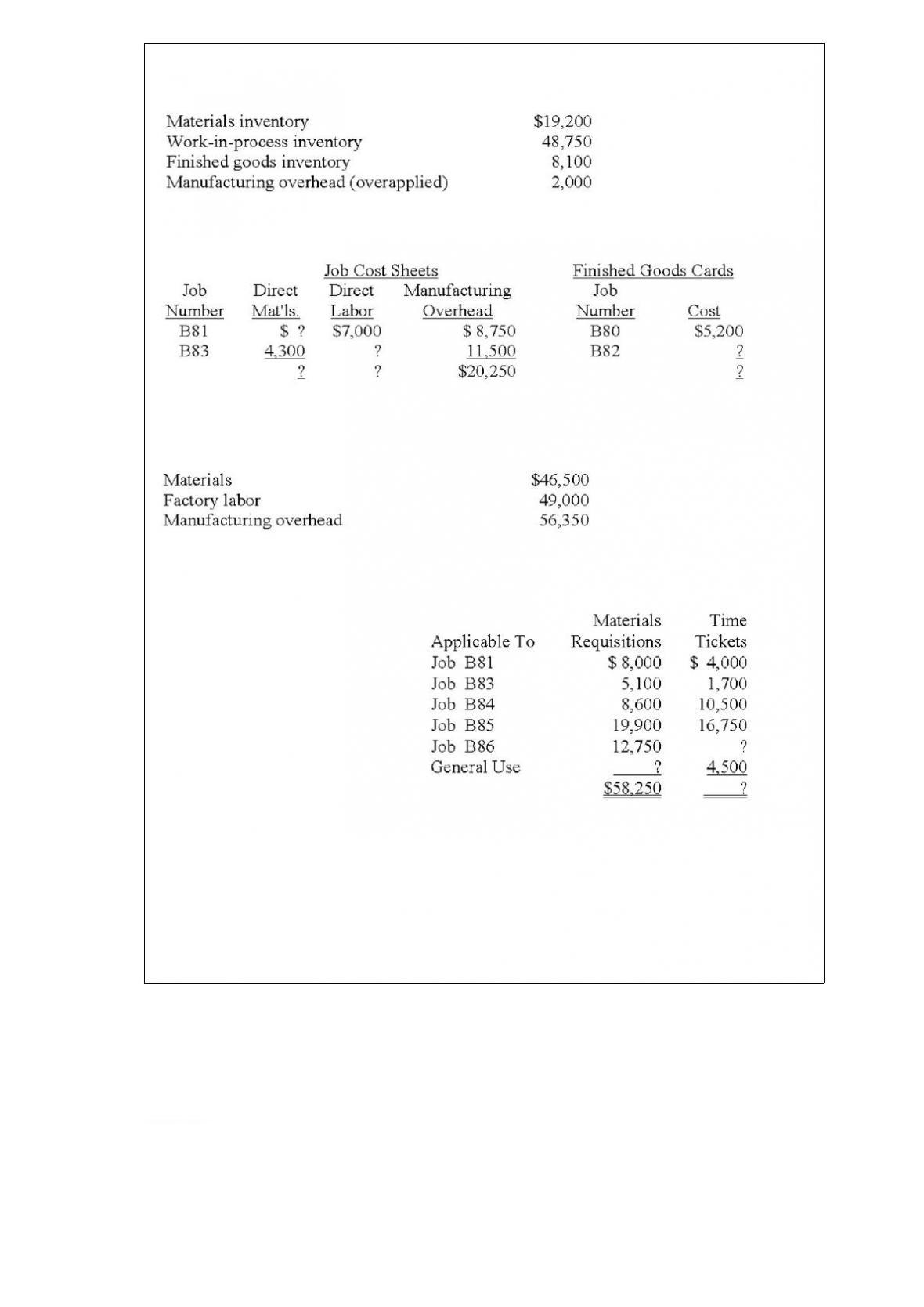
On October 1, the general ledger of Slipshod Company had the following accounts and
balances:
The subsidiary ledgers had the following information on October 1:
During October, the following costs were incurred on account:
A summary of the materials requisition slips and the labor time tickets for the month
revealed the following distribution:
Overhead is applied based upon direct labor cost. Jobs B81, B83, and B84 were for
8,000, 6,000 and 4,800 units of product respectively, and were completed during
October. Jobs B80, B81, B82, and B83 were sold on account for $150,000.
Required: Prepare T-accounts for a job order cost system, posting the beginning
balances and all transactions for the month. Clearly indicate the ending balances for the
accounts and label the ‘cost of goods manufactured’ and ‘cost of goods sold’ amounts.
Answer: