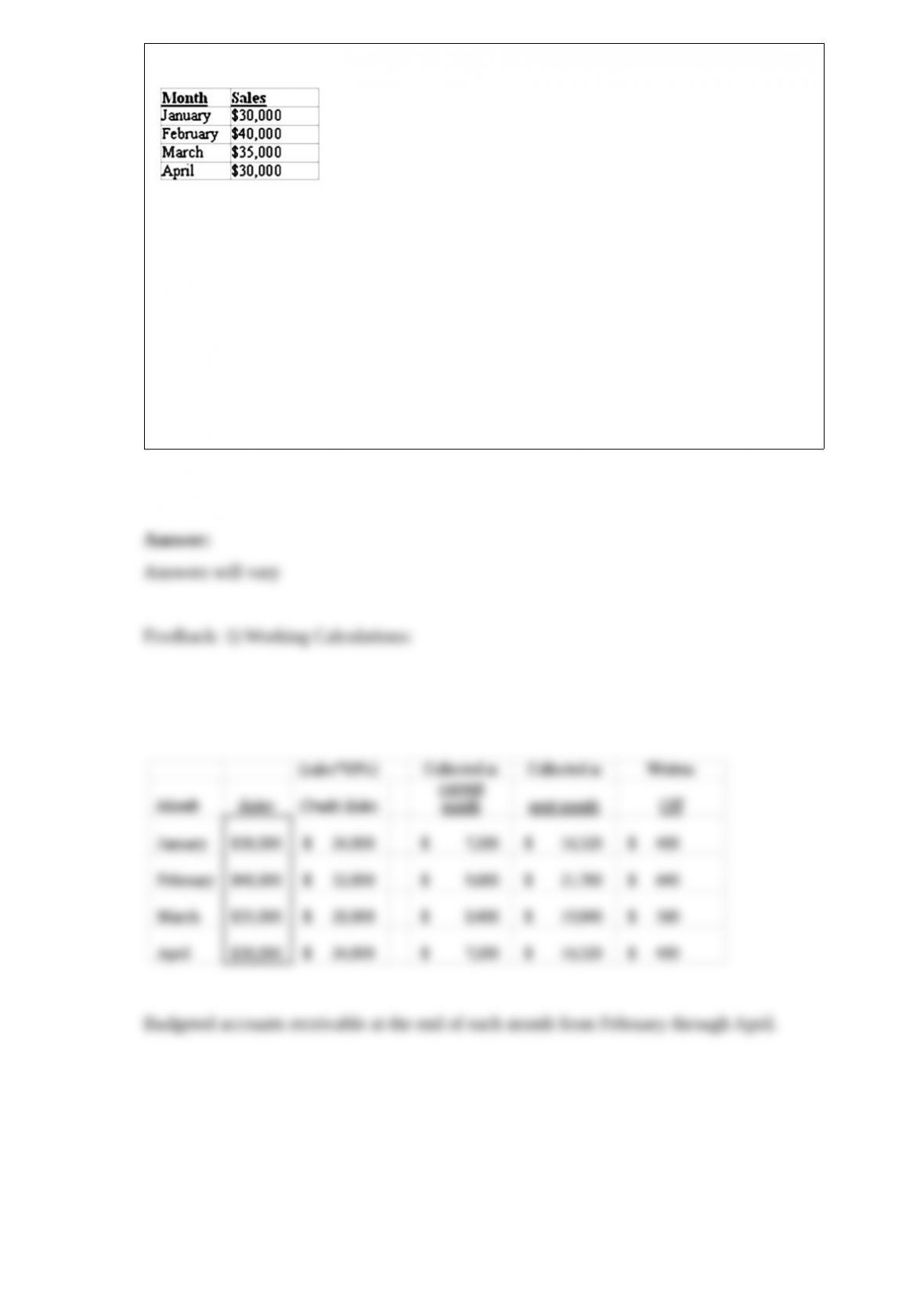
Spacely Sprockets’ sales budget shows the following expected total sales:
The company expects 80% of its sales to be on account (credit sales). Credit sales are
collected as follows: 30% in the month of sale, 68% in the month following the sale
with the remainder being uncollectible and written off in the month following the
sale.Required:
a) Calculate budgeted accounts receivable at the end of each month from February
through April.
b) Calculate budgeted cash inflows from collection of receivables for each month from
February through April.
Ashley Bradshaw is the manager of one department in a large store. In this capacity,
which of the following kinds of information would she be interested in?
A. Economic data.
B. Financial data
C. Nonfinancial data.
D. Both Financial data and Nonfinancial data.

Which ratio compares the earnings per share of a company to the market price for a
share of the company’s stock?
A. Price-earnings ratio
B. Dividend yield
C. Book value per share
D. Return on equity
The difference between the direct and the indirect method applies only to cash from
what type of activity?
A. Operating
B. Investing
C. Financing
D. All of these answers are correct.
Which of the following would not be included in a selling and administrative expenses
budget?
A. Budgeted salary expenses

B. Budgeted rent expense
C. Cash payments for selling and administrative expenses
D. Budgeted interest expense
Wu Company incurred $40,000 of fixed cost and $50,000 of variable cost when 4,000
units of product were made and sold.
If the company’s volume increases to 5,000 units, the total cost per unit will be:
A. $18.00.
B. $20.00.
C. $20.50.
D. $22.50.
Select the correct statement regarding vertical analysis.
A. Vertical analysis of the income statement involves showing each item as a
percentage of sales.
B. Vertical analysis of the balance sheet involves showing each asset as a percentage of
total assets.
C. Vertical analysis examines two or more items from the financial statements of one
accounting period.

D. All of these answers are correct.
Company X has variable costs per unit of $20, fixed costs of $300,000, and a
break-even sales volume of 60,000 units. What would happen to break-even volume in
units if the sales price per unit decreases by $2 and the variable cost per unit decreases
by $2?
A. Break-even volume increases.
B. Break-even in dollars decreases.
C. Break-even volume stays the same.
D. Both Break-even in dollars decreases and Break-even volume stays the same are
correct.
Bates Company makes two products. Product X requires 6,000 hours of labor, and
Product Y requires 4,000 hours of labor. Bates undertook an automation program that
reduced the consumption of labor required by Product X to only 2,000 hours of labor.
Product Y was not affected by the automation process. Overhead cost prior to the
automation totaled $10,000. After automation, overhead cost amounted to $24,000.
Assuming Bates uses direct labor hours as a company-wide allocation base before and
after the automation, the amount of overhead cost allocated to:
A. product X would be $4,000 prior to automation and $16,000 after automation.
B. product X would be $6,000 prior to automation and $16,000 after automation.
C. product Y would be $8,000 prior to automation and $8,000 after automation.
D. product Y would be $4,000 prior to automation and $16,000 after automation.
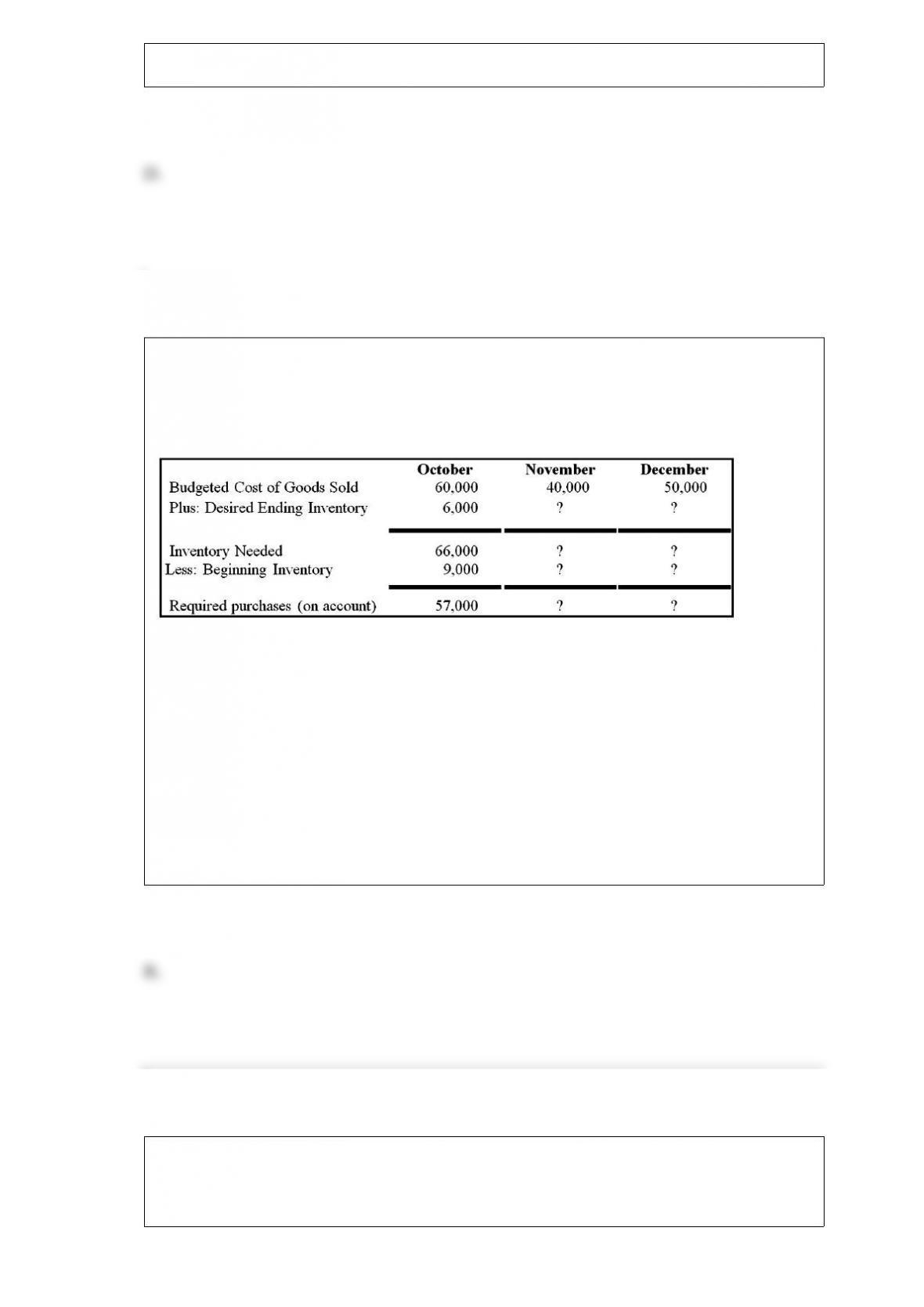
Sentra Sporting Company sells tennis rackets and other sporting equipment. The
purchasing department manager prepared the inventory purchases budget. Sentra’s
policy is to maintain an ending inventory balance equal to 15% of the following
month’s cost of goods sold. January’s budgeted cost of goods sold is $70,000.
What is the amount of ending inventory that the company will report on its pro-forma
balance sheet?
A. $7,500
B. $10,500
C. $35,300
D. $60,500
The Game Zone sells computer and other electronic games. The store has budgeted
sales for January 2014 as indicated in the following table. The company expects a 4
percent increase in sales for the month of February and a 3 percent increase for March.
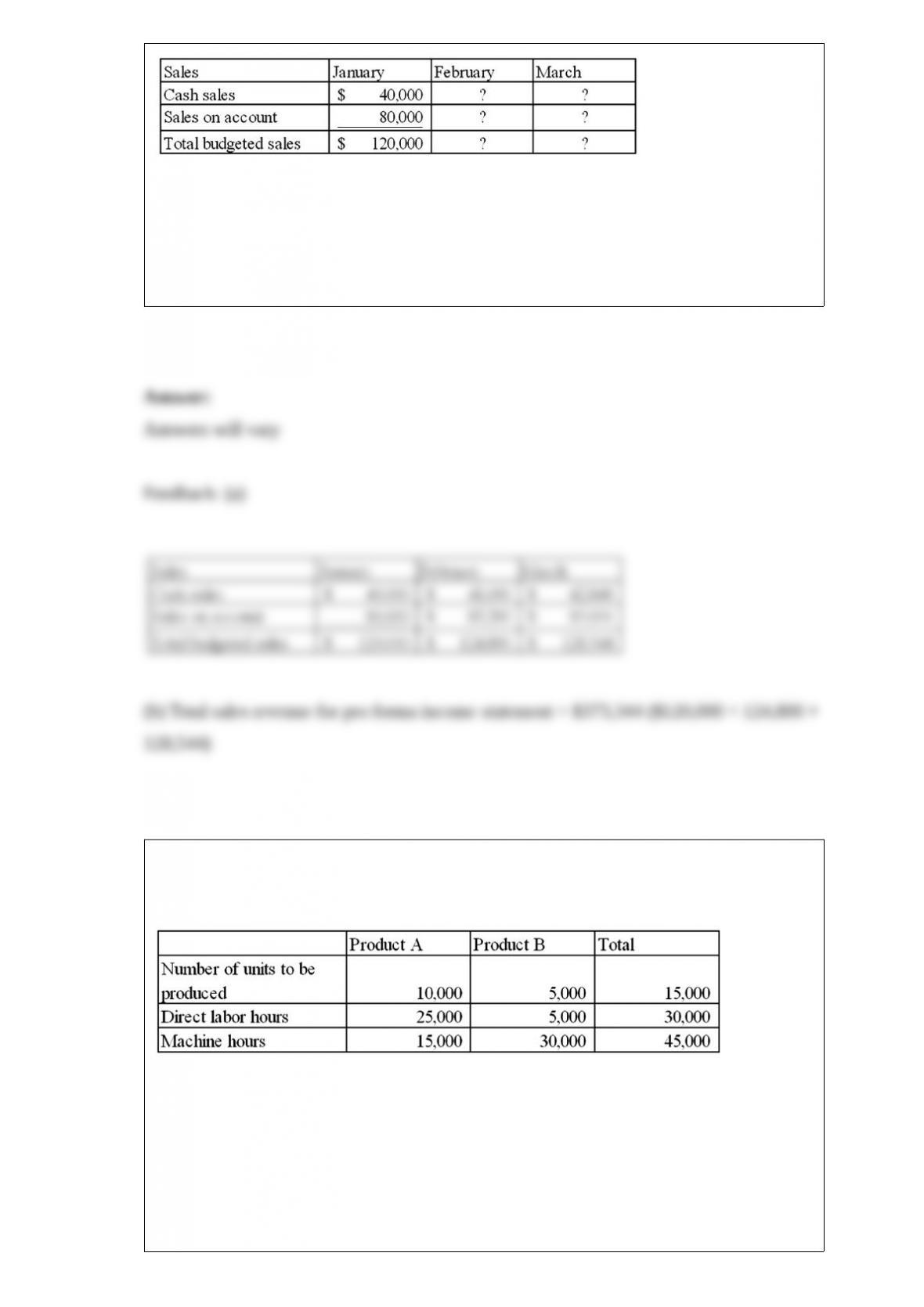
Required:
(a) Complete the sales budget by filling in the missing amounts.
(b) What is the amount of sales revenue the company will report on its pro forma
income statement for the first quarter?
Harrison Company expects to incur $600,000 in manufacturing overhead for the
coming year. The company makes two products, A and B, and it has accumulated the
following budget information for the products:
Required:
1) Use direct labor hours as the cost driver to compute the allocation rate. Determine
the amount of budgeted overhead to be allocated to each unit of product A.
2) Use machine hours as the cost driver to compute the allocation rate. Determine the
amount of budgeted overhead to be allocated to each unit of product A.
3) How should Harrison decide between machine hours and direct labor hours as the
cost driver for its manufacturing overhead?
All of the following are hierarchical categories in which a firm’s overhead support costs
can be classified except:
A. product-level activities.
B. industry-level activities.
C. batch-level activities.
D. facility-level activities.
Joan Osborne is evaluating a potential capital investment. She has calculated the net

present value using a minimum rate of return of 10%. Using this rate, the net present
value is negative. What does this tell her about the rate of return expected for the
project?
A. If the net present value is negative; the expected rate of return for the project is
greater than the 10% minimum or required rate of return.
B. If the net present value is negative; the expected rate of return for the project is less
than the 10% minimum or required rate of return.
C. If the net present value is negative; the expected rate of return for the project is equal
to the 10% minimum or required rate of return.
D. None of the other answers are correct.
The cash budget is based on which budget?
A. Sales budget
B. Inventory purchases budget
C. Selling and administrative expense budget
D. All of these answers are correct.
The records of Gemini Company show a contribution margin ratio of 40%. The
company desires to earn a profit of $35,000 and has fixed costs of $70,000. What sales
revenue would have to be generated in order to earn the desired profit?
A. $87,500
B. $262,500
C. $175,000
D. $42,000
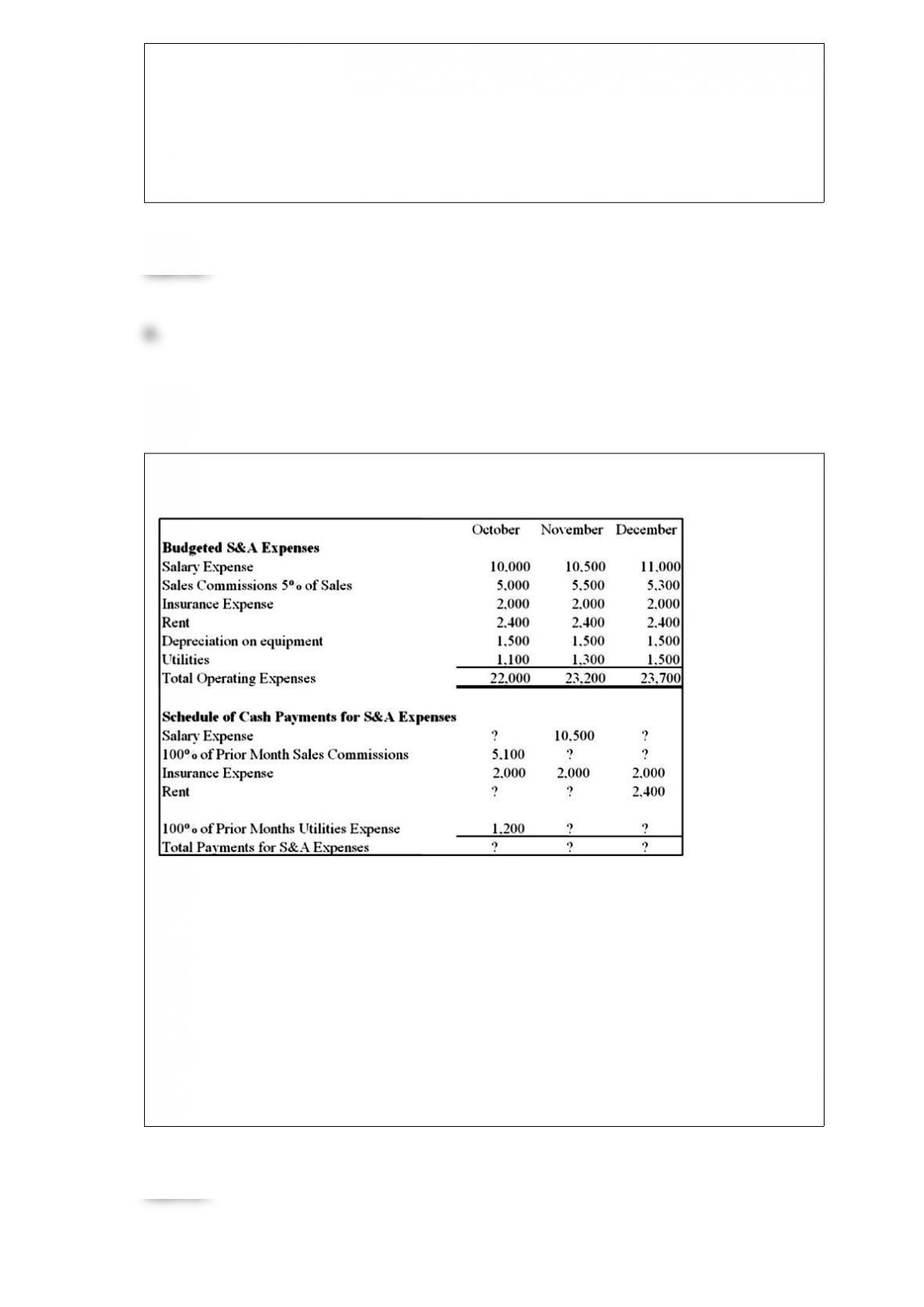
What is the total amount of S&A expenses for the fourth quarter that the company will
report on its pro forma income statement?
A. $64,400
B. $68,900
C. $23,700
D. $63,900
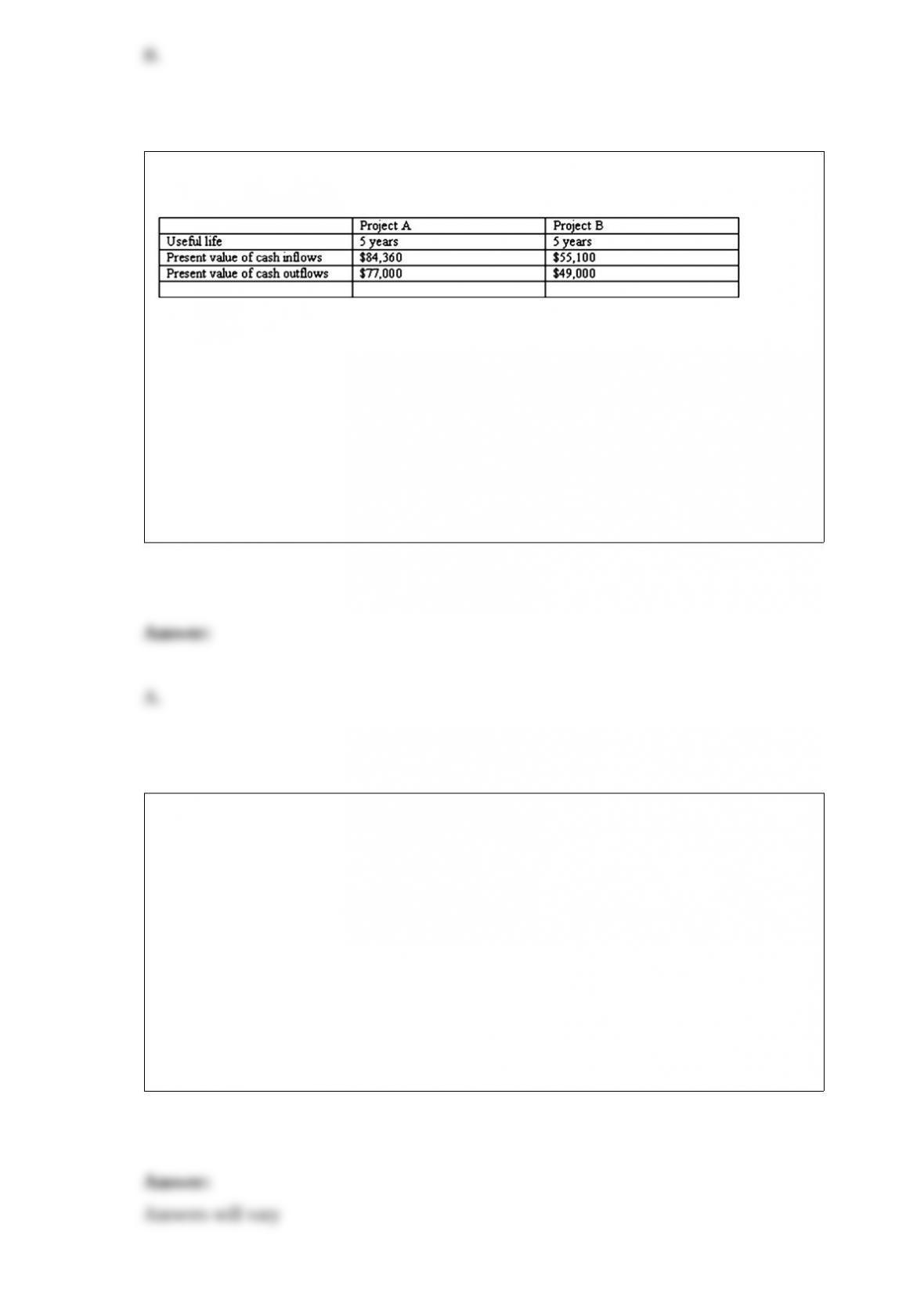
Findell Corporation is considering two projects, A and B, and it has gathered the
following estimates for the project
What is the present value index for project A?
A. 1.096
B. 1.124
C. 0.889
D. 0.913
Alcorn Company is considering purchasing equipment that costs $400,000. The
equipment has an estimated useful life of 8 years and no salvage value. Alcorn believes
that the annual cash inflows from using the equipment will be $80,000.
Required:
1) Calculate the net present value of the equipment assuming that Alcorn’s cost of
capital is 12%. Is the equipment an acceptable investment?
2) Calculate the net present value of the equipment assuming that Alcorn’s cost of
capital is 10%. Is the equipment an acceptable investment?
3) What general conclusion can you reach from your results to parts 1) and 2)?
Indicate whether each of the following statements about cost systems is true or false.
Job-order cost systems accumulate product costs by department.
Job-order cost systems are used by many companies to determine the cost of services
provided to customers.
Companies use job-order cost systems when they need to determine the cost of
individual batches of products.
Job-order cost systems allocate costs to homogeneous products.
With a process cost system, the cost per unit of product is calculated by dividing total
product cost by number of units produced in a batch.
What are job cost sheets, and how are they used in a job-order cost system?
Indicate whether each of the following statements is true or false.
The accuracy of sales forecasts is critical to the effectiveness of a business’ overall
budgeting process.
Sales estimates to be used in the budgeting process are usually prepared by the
accounting department.
Sales forecasts often are prepared using sophisticated computer programs and statistical
techniques.
A company’s senior vice president for sales would be held responsible for the sales
budget.
Accompanying the sales budget is a schedule of cash payments for inventory, which is
used in preparing the cash budget.
What are mixed or semivariable costs? Give an example of a mixed cost.
How would a company determine the optimal number of activity centers in an
activity-based costing system?