
Which of the following is not a responsibility of an audit committee?
(a) Hiring, compensating, and overseeing the company’s independent auditor
relationship.
(b) Receiving and addressing complaints about accounting, internal control, and
auditing matters.
(c) Resolving disagreements between management and the auditor regarding financial
reporting.
(d) Preparing the disclosures that accompany the financial statements in the company’s
annual report.
Which of the following is not an important consideration for the auditor’s assessment of
audit committee effectiveness?
(a) Independence of audit committee members from management.
(b) The audit committee’s oversight of external financial reporting and ICFR.
(c) The audit committee’s approval of the external auditors’ approach to the audit.
(d) The audit committee’s responsiveness to issues raised by the external auditors.
Materiality decisions are based on:

(a) qualitative factors.
(b) quantitative factors.
(c) the audit fees.
(d) Both a and b.
If a client company performs its physical inventory counts on a date other than
year-end, auditors must verify that:
a. no shrinkage results.
b. there are no discrepancies between accounting records and goods on hand as of the
date of the physical count.
c. the count data is rolled forward or rolled back to the financial statements based on
transaction data between the dates of the physical count and year-end.
d. authorization controls applied during the period were sufficient to prevent losses
between the dates of the physical count and year-end.
Letters for underwriters are commonly called:
a. general use letters.
b. target letters.

c. comfort letters.
d. due diligence letters.
e. financial letters.
An auditor encounters an error and decides not to suggest an adjustment. This is an
example of:
(a) professional skepticism.
(b) professional judgment.
(c) materiality decision.
(d) Both b and c.
What are the initial steps for a test of details of balances when using a sample?
a. Determine the sampling method.
b. Determine which assertion is being tested.
c. Determine which account is being tested.
d. Both b and c.
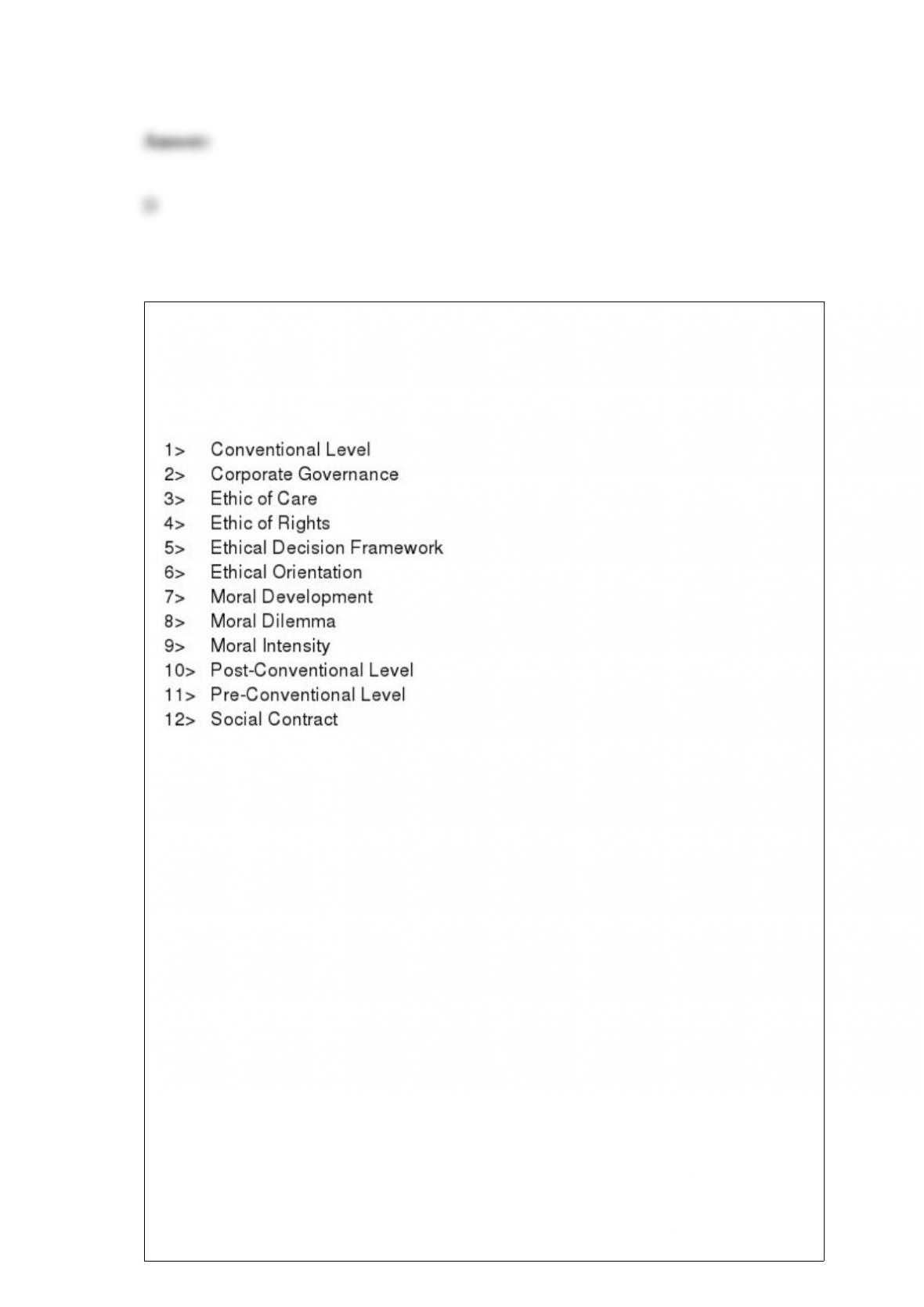
The discussion of morals and ethics is important to all professions, including
accounting. Many of the terms listed below were presented in the chapter related to
morals and ethics. Match each of the listed terms with the appropriate description. Use
each term only once.
TASK
(a) The process of setting and enforcing the policies and procedures of a corporation;
includes many actions of the Board of Directors and management.
(b) A special case of ethical decision in which, even after applying an ethical decision
framework and one’s own values, there is no clear cut answer.
(c) An ethical orientation that focuses on relationships and the interdependence of
individuals.
(d) Level of moral development at which individuals make decisions in a self-centered
way.
(e) The focus of the decision maker when making ethical decisions.
(f) A profession’s agreement with society through which professionals commit to
serving the public good through their work, maintaining standards of excellence and
policing their own ranks, in return for economic reward and some degree of prestige
and self-governance.
(g) Describes specific variables and the level at which they cause an individual to

recognize that a situation or decision has moral and ethical components.
(h) Level of moral development at which individuals consider impacts beyond those
that affect them personally when making decisions.
(i) Level of moral development at which individuals make decisions based on abstract
analysis of what is right and wrong, taking philosophical issues into consideration.
(j) The sequence of steps used by a decision maker when making a decision recognized
to have ethical components.
An engagement that requires independence as defined by the AICPA Professional
Standards is termed:
A. Professional Engagement.

B. Lending Engagement.
C. Attest Engagement.
D. Tax Engagement.
Which of the following would not be considered audit evidence?
a. Invoices received by the company and retained on the company’s IT system in
electronic form.
b. The electronic work paper program package used by the auditor to produce the
electronic work papers.
c. Hard copy minutes of the Board of Directors and Audit Committee meetings.
d. Electronic images of the front and back of checks that the company has written.
Which of the following accounts presents the greatest inherent risk?
a. Cash.
b. Marketable securities.
c. Accounts receivable.
d. Sales.

The Hochfelder case involved:
a. Management collusion.
b. Management fraud.
c. Scienter.
d. All of the above.
Foreseeable third parties are those who:
a. Are potential users of the financial statements.
b. Are potential plaintiffs in legal actions against auditors.
c. Increase the potential liability for auditors.
d. All of the above.
One of management’s objectives in paying employees includes:

a. paying employees at least once a month.
b. withholding the proper amounts from employee paychecks.
c. providing legal evidence to the government of the employee’s right to work.
d. All of the above.
Which of the following procedures would you perform for an audit of accounts
receivable at year-end?
a. Determine if any accounts have been factored or used as collateral for a loan.
b. Determine the adequacy of the allowance account.
c. Determine if there are any related party transactions.
d. All of the above.
The advantage of an electronic document is that it:
a. can be updated automatically.
b. can be used for multiple purposes.
c. Both a and b.
d. None of the above.

Assertions are:
a. audited by the auditors.
b. declarations made by management.
c. declarations made by the auditor.
d. Both a and b.
In addition to withdrawal, scope limitations on ICFR audits result in:
a. an adverse opinion.
b. a qualified opinion.
c. a disclaimer of opinion.
d. depending on the circumstances, the auditor may choose any of the above.

Judgment errors indicate:
(a) the auditor behaved in a negligent manner.
(b) the auditor failed to exhibit professional care.
(c) the auditor failed to exhibit professional skepticism.
(d) None of the above.
A review of a public company consists primarily of inquiry and:
a. dual purpose tests.
b. scanning.
c. tracing.
d. calculation reperformance.
e. analytical procedures.
The auditor is reviewing the current tax liability for a client in an industry where tax
rates are anticipated to decrease because of near-certain Congressional action. In this
case the auditor should:
(a) recalculate the tax liability under the proposed rate.

(b) recalculate the tax liability under both the current and proposed rate.
(c) review the appropriateness of the tax liability assuming the current rate.
(d) disclose the benefit of probable tax legislation on tax liability in the footnotes.
Comprehensive income:
(a) is the change in equity resulting from nonowner sources except net income.
(b) is the changes in equity resulting from nonowner sources.
(c) excludes gains and losses on marketable securities.
(d) None of the above.
The receiving report in an electronic environment:
a. may be a continuation of the purchase order.
b. may be a continuation of the supplier purchase confirmation.
c. may be a continuation of the supplier invoice.
d. All of the above.

How would you detect that accounts payable transactions had been omitted from the
general ledger?
a. Reconcile the receiving reports to the subsidiary ledger.
b. Reconcile the subsidiary ledger to the general ledger.
c. Reconcile the cash disbursements journal to the subsidiary ledger.
d. Any of the above would detect the error.
The negative request form of accounts receivable confirmation is useful particularly
when the:
Assessed level of risk of material misstatement relating Number of small Proper
consideration
to receivables is is balances by the recipient is
A. Low Many Likely
B. Low Few Unlikely
C. High Few Likely
D. High Many Likely
a. Option A
b. Option B
c. Option C
d. Option D

e. No Option
Sometimes an aspect of ICFR, such as management’s philosophy and operating style,
has limited or no documentary:
a. background.
b. controls.
c. information.
d. evidence.
e. conclusions.
A management representation letter is prepared for the purpose of:
(a) confirming management’s acceptance of the audit fees.
(b) setting forth the terms of the audit engagement.
(c) confirming the honesty and validity of audit information provided by management.
(d) establishing management’s responsibility for making the company’s financial
records available to the auditor.

The advantages of using parallel processing verses the test data approach is:
(a) parallel processing tests the entire input, processing, and output functions.
(b) parallel processing uses actual client data.
(c) parallel processing prevents the risk of client data being infected with test data.
(d) All of the above.
Match the task corresponding to the correct answer by placing the number next to the
correct description.
1> Auditor
2> Client/firm
3> PCAOB
4> AICPA
5> Audit Committee of the Board of Directors
TASK
(a) Prepare the financial statements.
(b) Design and implement the ICFR.

(c) Make assertions.
(d) Produce audit standards for non-public companies.
(e) Produce audit standards for public companies.
(f) Evaluate evidence.
(g) Gather evidence.
(h) Propose adjustments to the financial statements intended to correct errors identified
during the audit.
(i) Inspect the work of audit firms engaged in the audit of public companies.
(j) Appoint the auditors.

A client company has a small number of finance and IT personnel that supports a
packaged financial reporting software system. The appropriate tests of controls could
include auditor verification that:
(a) the code in the packaged software cannot be changed by the user.
(b) management override is not possible in this small environment.
(c) outside professionals supplement the financial reporting function and provide an
assessment of ICFR effectiveness.
(d) entity-level controls are not relevant in this small environment.
One of the premier organizations for forensic accountants is the:
a. Association of Investigative Forensic Services.
b. Association of Certified Fraud Examiners.
c. Association of Ligation Support.
d. Association of Legal Investigators.
e. Association of Fraud Investigators.
An activity that complicates sales transactions involves the shipment of goods to the
customer rather than the customer taking the goods at the time of sale.
The AICPA Rules of Conduct, 201, refers to Due Professional Care. Discuss what is
meant by this rule.
Analytical procedures pinpoint the exact location of fraud.
Problems that come from social engineering are the result of a lack of internal controls.
Imagine that you are a new auditor scheduled on a year-end audit engagement. Your
senior has instructed you to test the Accounts Receivable account. The account is large
and contains many customer balances, so you have been instructed to use sampling
techniques for your testing.
(a) Describe the audit risk model explaining the relationships of tests of details
of balances detection risk and analytical procedures detection risk.
(b)What is the detection risk related to your task of auditing Accounts Receivable?
(c) Does the risk of incorrectly rejecting the Accounts Receivable balance affect
your audit risk when using the audit risk model? What negative impact does
incorrect rejection have on the audit?

The initial cash records are the cash alternative record and daily transmittal list.
If the plaintiff did not rely on the financial statements, the auditor can use this as a valid
defense.
The seller will not hear from a customer when a cash payment the customer made is not
posted to the customer’s account balance.
Cash coming into the business from all sources is deposited weekly using a deposit
ticket.
Since much of a health-care provider’s collections are paid by third-party payers, it is
important for the health-care provider to verify the patient’s insurance coverage before
providing services.
Assume the auditor has a contract with society.What are the components of that
contract? In other words, what does the auditor commit to give, and what does the
auditor receive?
The complaint in a civil suit filed by a plaintiff has to prove standing.

Holding out has a specific definition and means that the CPA is informing others of his
or her professional status.
Testing accounts receivable requires inquiry of existing creditors as to amount payable
accuracy.
The SEC is responsible for setting standards for not-for-profit organizations.