
An operating unit of an organization is called an investment center if it is responsible
A. only for costs.
B. only for revenues.
C. for costs and revenues.
D. for investments in assets.
Answer:
Chipper Division of Acme Corp. sells 80,000 units of part Z-25 to the outside market.
Part Z-25 sells for $40, has a variable cost of $22, and a fixed cost per unit of $10.
Chipper has a capacity to produce 100,000 units per period. Jones Division currently
purchases 10,000 units of part Z-25 from Chipper for $40. Jones has been approached
by an outside supplier willing to supply the parts for $36. What is the effect on Acme’s
overall profit if Chipper ACCEPTS the outside price and Jones continues to buy
inside?
A. no change
B. $140,000 decrease in Acme profits
C. $80,000 decrease in Acme profits
D. $40,000 increase in Acme profits
Answer:
The forecasting method in which individual forecasts of group members are submitted
anonymously and evaluated by the group as a whole is called
A. trend analysis.
B. econometric models.
C. Delphi technique.
D. regression analysis.
Answer:
Which of the following costs are not considered in a differential analysis for a
make-or-buy decision?
A. Indirect materials and indirect labor if the item is purchased
B. Direct materials and direct labor if the item is manufactured internally
C. Variable overhead if the item is purchased
D. Fixed overhead that will continue if the item is purchased
E. Fixed overhead that can be avoided if the item is purchased
Answer:
Economic value added (EVA) assumes that which of the following GAAP expenses
would not result in an adjustment to either the income or the capital employed?
A. Research & development costs
B. Use of process costing rather than job costing
C. Advertising expenses
D. Writeoff of goodwill
Answer:
The variable overhead price variance is due to
A. price items only.
B. efficiency items only.
C. both price and efficiency items.
D. neither price or efficiency items.
Answer:
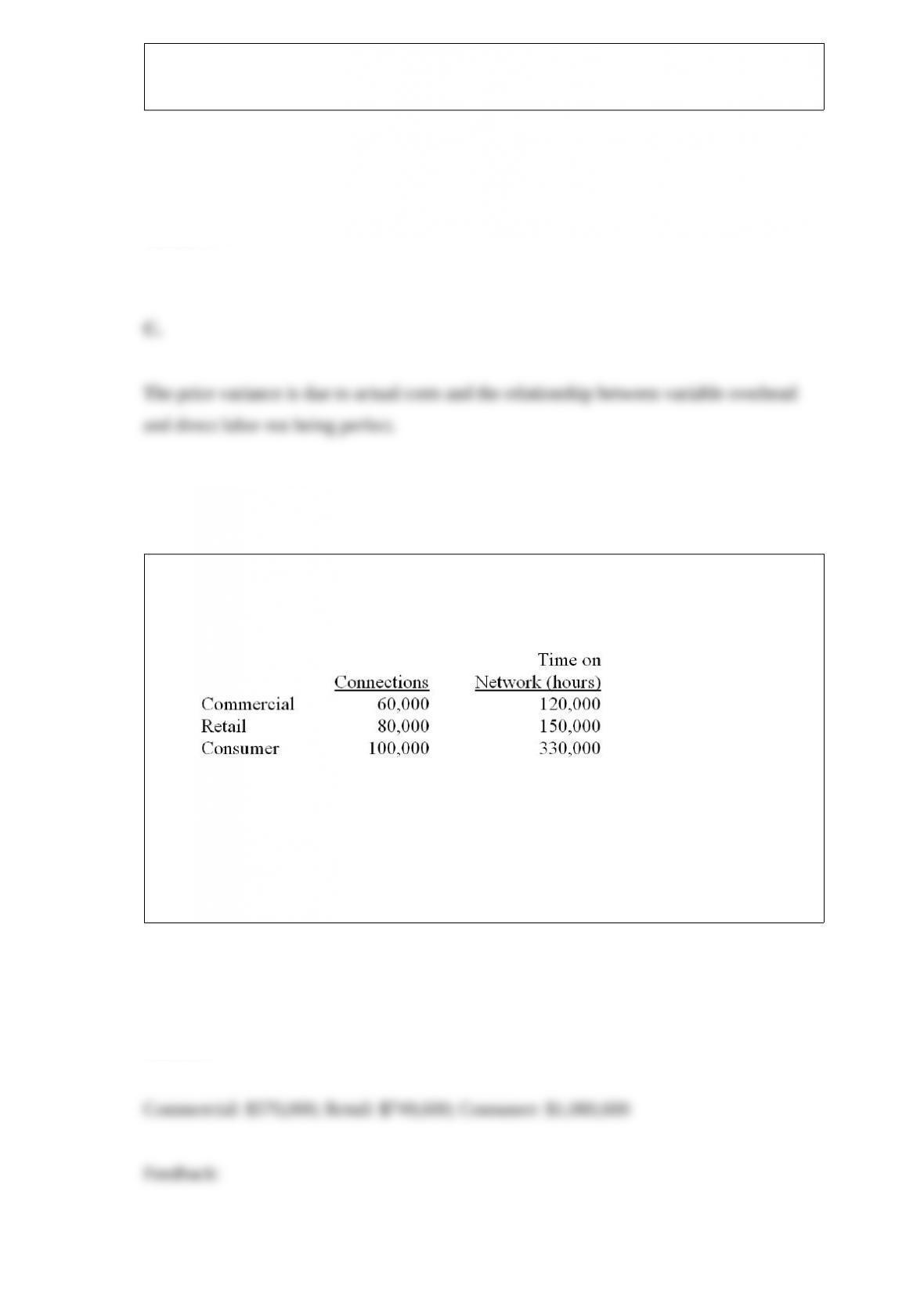
Marlin has three divisions, commercial, retail and consumer, that share the common
costs of the company’s computer server network. The annual common costs are
$2,400,000. You have been provided with the following information for the upcoming
year:
Required (use three decimal places in your calculations):
a) The cost accountant determined $1,800,000 of the server network’s costs were fixed
and should be allocated based on the number of connections. The remaining costs
should be allocated based on the time on the network. What is the total server network
costs allocated to each division?
Answer:
Eastern Company manufactures special electrical equipment and parts. Eastern
employs a standard cost accounting system with separate standards established for each
product.
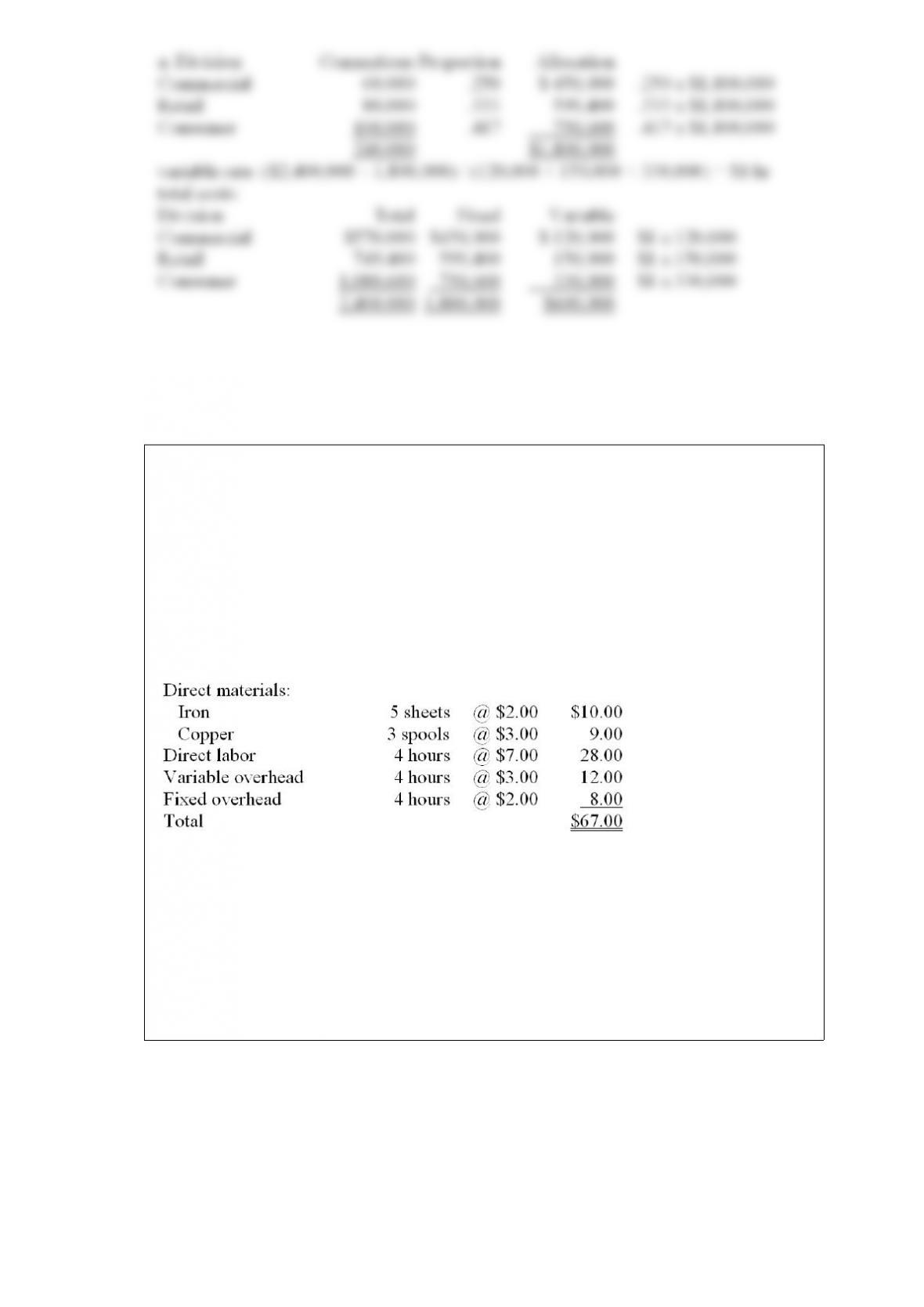
A special transformer is manufactured in the Transformer Department. Production
volume is measured by direct labor hours in this department and a flexible budget
system is used to plan and control department overhead. Standard costs for the special
transformer are determined annually in September for the coming year. The standard
cost of a transformer was computed at $67.00 as shown below.
Overhead rates were based upon normal and expected monthly capacity, both of which
were 4,000 direct labor hours. Practical capacity for this department is 5,000 direct
labor hours per month. Variable overhead costs are expected to vary with the number of
direct labor hours actually used. During October, 800 transformers were produced. This
was below expectations because a work stoppage occurred at the copper supplier and
shipments were delayed.
Required: Compute each of the following variances, showing all your work. Be sure to
indicate whether the variances are favorable or unfavorable.
a) Variable overhead spending variance
b) Variable overhead efficiency variance
c) Fixed overhead spending (budget) variance
d) Production volume variance
Answer:

Which of the following is typically not considered an objective of quality control?
A. reduce costs associated with customer complaints
B. reduce costs of honoring product or service warranty
C. increase customer satisfaction with product or service
D. increase the number of deliveries made when promised
Answer:
Which one of the following firms is likely to experience dysfunctional motivation on
the part of its managers due to its allocation methods? (CMA adapted)
A. To allocate depreciation of forklifts used by workers at its central warehouse,
Shahlimar Electronics uses predetermined amounts calculated on the basis of the long
term average use of the services provided by the warehouse to the various segments.
B. Manhattan Electronics uses the sales revenue of its various divisions to allocate costs
connected with the upkeep of its headquarters building. It also uses ROI to evaluate the
divisional performance.
C. Rainier Industrial does not allow its service departments to pass on their cost
overruns to production departments.
D. Tashkent Auto’s management information system (MIS) is operated out of
headquarters and serves its various divisions. Tashkent’s allocation of MIS-related costs
to its divisions is limited to costs the divisions will incur if they were to outsource their
MIS needs.
E. Golkonda Refineries separately allocates fixed and variable costs incurred by its
service departments to its production departments.
Answer:
Which of the following statements is (are) false?
(1) In general, the term expense is used for managerial purposes, while the term cost
refers to external financial reports.
(2) An opportunity cost is the benefit forgone by selecting one alternative over another.
A. Only (1) is false.
B. Only (2) is false.
C. Both (1) and (2) are false.
D. Neither (1) nor (2) are false.
Answer:
Which of the following items would not be classified as a contingent compensation
item?

A. Administrative salaries
B. Sales commissions
C. Stock options
D. Piece rates
Answer:
Which of the following is not one of the overarching ethical principles of the Institute
of Management Accountants (IMA) Code of Ethics?
A. Competence
B. Responsibility
C. Honesty
D. Objectivity
E. Fairness
Answer:
Woodville Industries evaluates its divisions based on residual income. The Hilton
Division has the capacity to produce 20,000 units of a component. The Hilton
Division’s variable costs are $150 per unit; fixed costs are $110 per unit.
The Sutton Division can use the product as a component in one of its products. The
Sutton Division would incur $75 of variable costs to convert the component into its
own product which sells for $300.
Required (consider each question independent of each other):
a) Assume the Hilton Division can sell all that it produces for $285 each. The Sutton
Division needs 1,000 units. What is the appropriate transfer price?
b) Assume the Hilton Division can sell 18,000 units at $285. Any excess capacity will
be unused unless the units are purchased by the Sutton Division (which can use up to
1,000 units). What are the minimum and maximum transfer prices?
Answer:
The following information relates to the month of April for The Marilyn
Manufacturing Company, which uses a standard cost accounting system.
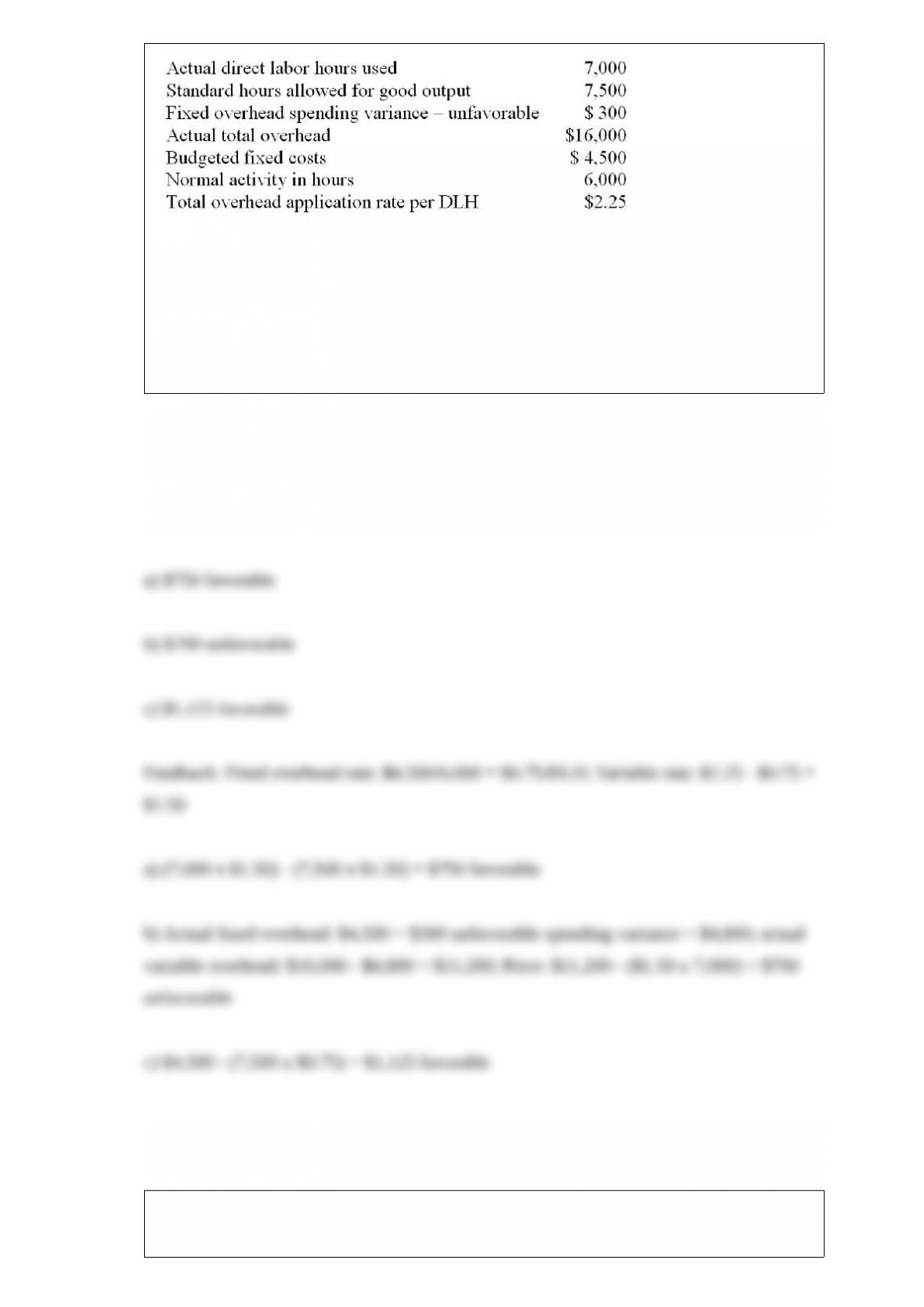
Required: (Be sure to indicate whether the variances are favorable or unfavorable.)
a) What is the variable overhead efficiency variance?
b) What is the variable overhead price variance?
c) What is the fixed production volume variance?
Answer:
The Tally Company produces 15,000 units of item QT34 annually at a total cost of
$600,000.
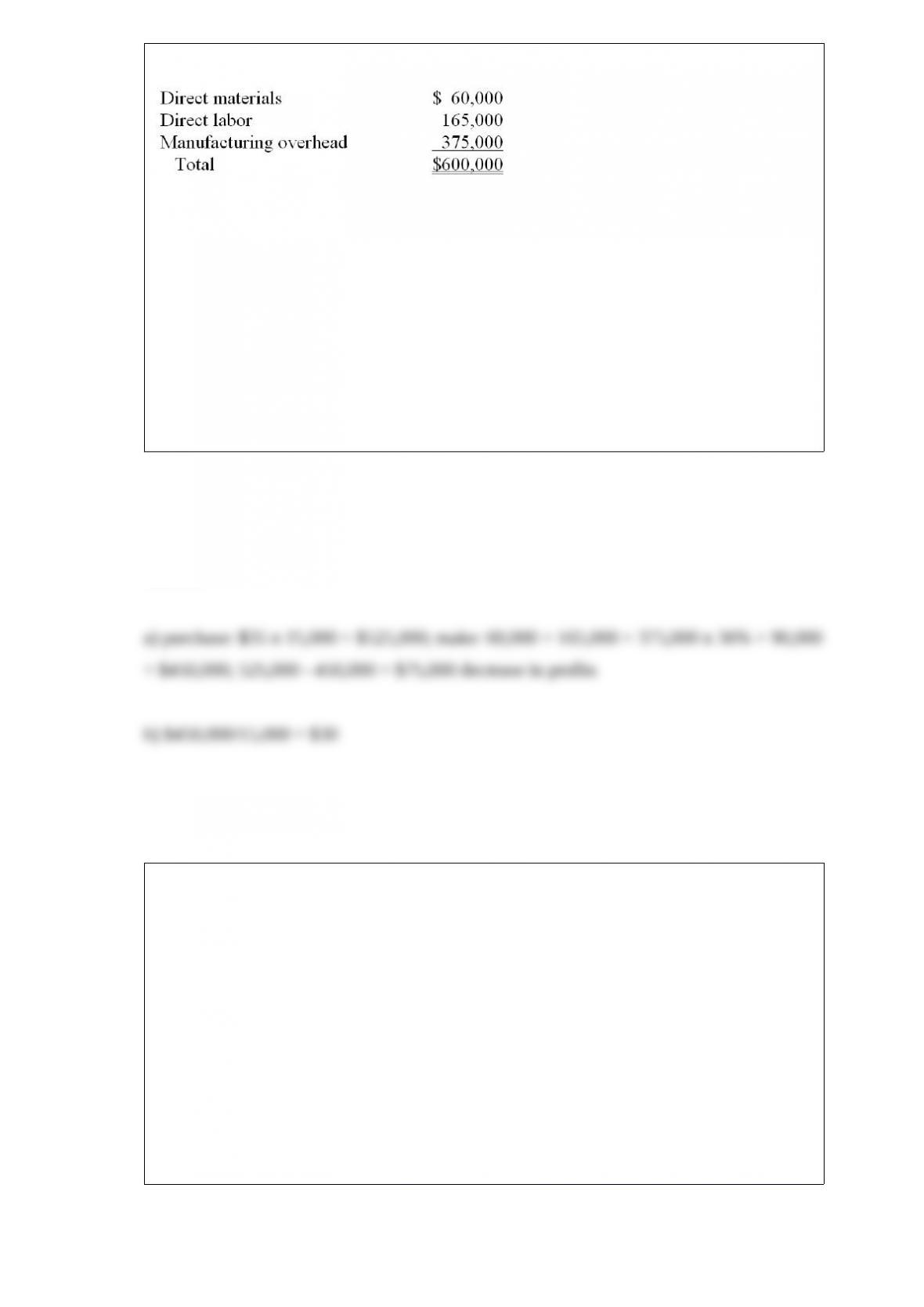
Manufacturing overhead is 36% variable. The Daisy Company has offered to supply all
15,000 units of QT34 per year for $35 per unit. If Tally accepts the offer, $8 per unit of
the fixed overhead would be avoided. In addition, some of Tally’s leased facilities could
be vacated, reducing lease payments by $90,000 per year.
Required:
a) By how much would Tally’s profits change if 15,000 of part QT34 are purchased
from Daisy?
b) At what price would Tally be indifferent to Daisy’s offer?
Answer:
A credit balance in the labor yield variance implies
A. the total units produced was greater than the expected number of units given the total
labor hours actually used.
B. the total units produced was less than the expected number of units given the total
labor hours actually used.
C. the total units produced was greater than the expected number of units given the total
standard hours allowed.
D. the total units produced was less than the expected number of units given the total
standard hours allowed.
Answer:
The relevance of a particular cost to a decision is determined by the: (CMA adapted)
A. riskiness of the decision.
B. number of decision variables.
C. amount of the cost.
D. potential effect on the decision.
E. accuracy of the cost.
Answer:
Which of the following should not be used as the allocation base in a company that
appropriately uses a single plant wide rate?
A. Sales volume
B. Machine hours
C. Material costs
D. Direct labor cost
E. Direct labor hours
Answer:
Ryman Company has two divisions organized as profit centers: Redmon and Tomlin.
Ryman expects the following results:
Included in Redmon’s costs are 100,000 units of a subcomponent purchased from an
outside supplier for $4.50. The managers have recently initiated negotiations for Tomlin
to supply the components to Redmon. Tomlin has a total capacity of 400,000 units.
Required:
a) Would Ryman Company prefer the subcomponent used by Redmon to be purchased
internally from Tomlin or from the outside vendor? What would be the profit impact?
b) What would be the maximum and minimum transfer prices?
Answer:
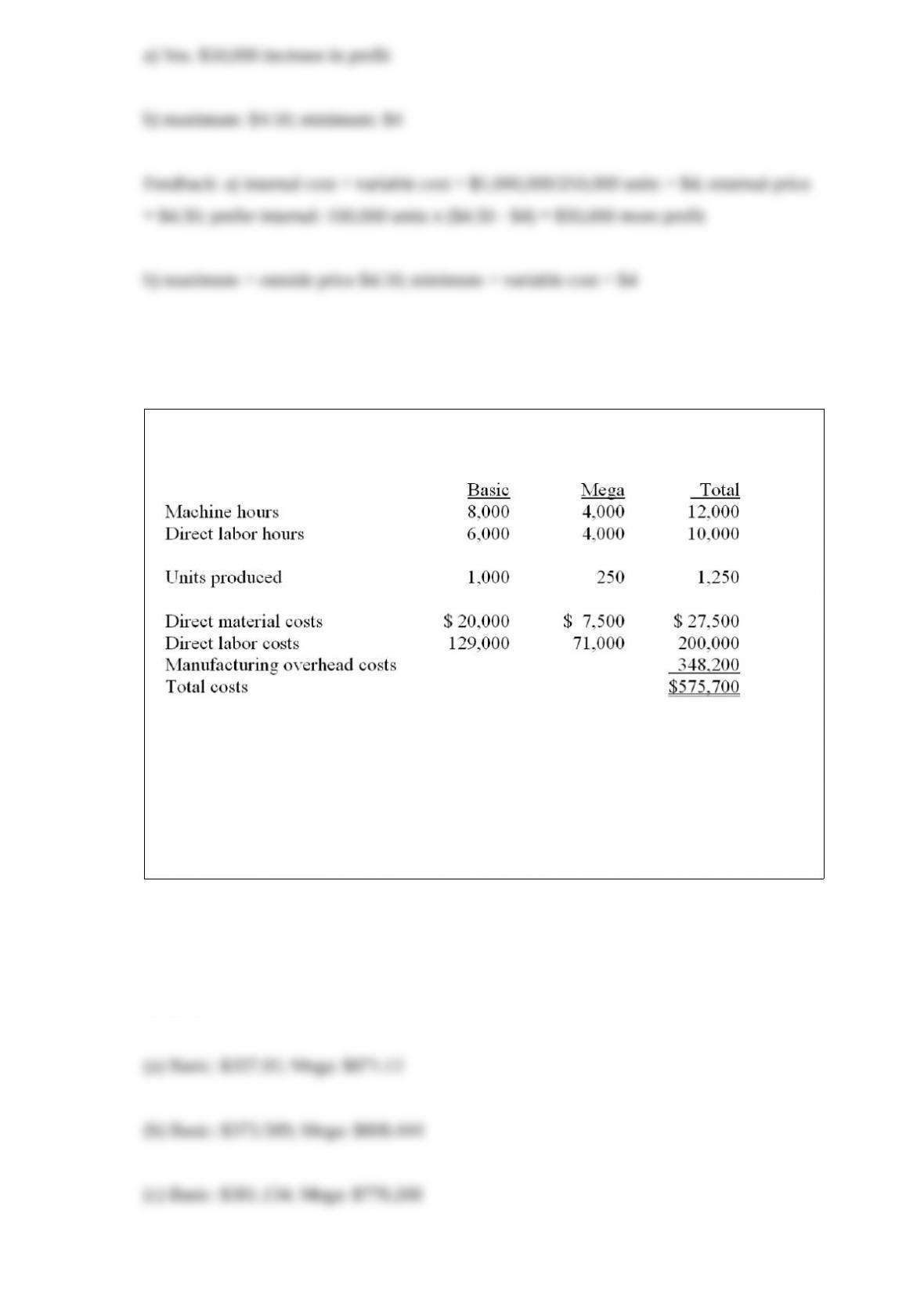
Loin Cabinetry produces two models of home shelving, the Basic and the Mega. Data
on operations and costs for November are:
Required: Compute the unit cost for each model, assuming Loin Cabinetry uses:
(a) Direct labor hours to allocate overhead costs.
(b) Direct labor costs to allocate overhead costs.
(c) Machine hours to allocate overhead costs.
Answer:
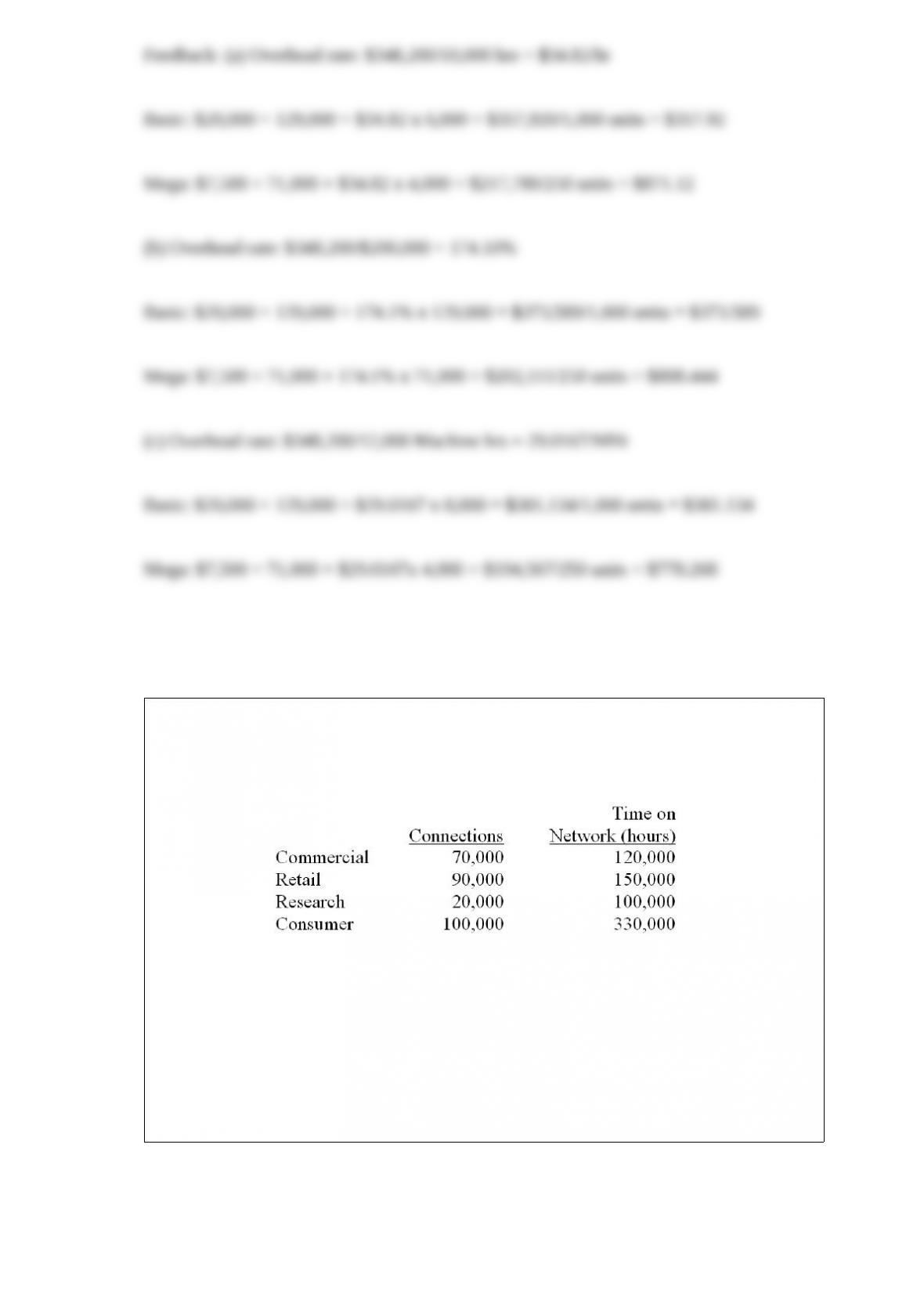
Sanper Corp. has four divisions, commercial, retail, research, and consumer, that share
the common costs of the company’s computer server network. The annual common
costs are $3,500,000. You have been provided with the following information for the
upcoming year:
Required (use three decimal places in your calculations):
a) What is the allocation rate for the upcoming year assuming Sanper uses the
single-rate method and allocates common costs based on the number of connections?
b) What is the allocation rate for the upcoming year assuming Sanper uses the
single-rate method and allocates common costs based on the time on network?
Calculate the allocated amount for each division.
Answer:
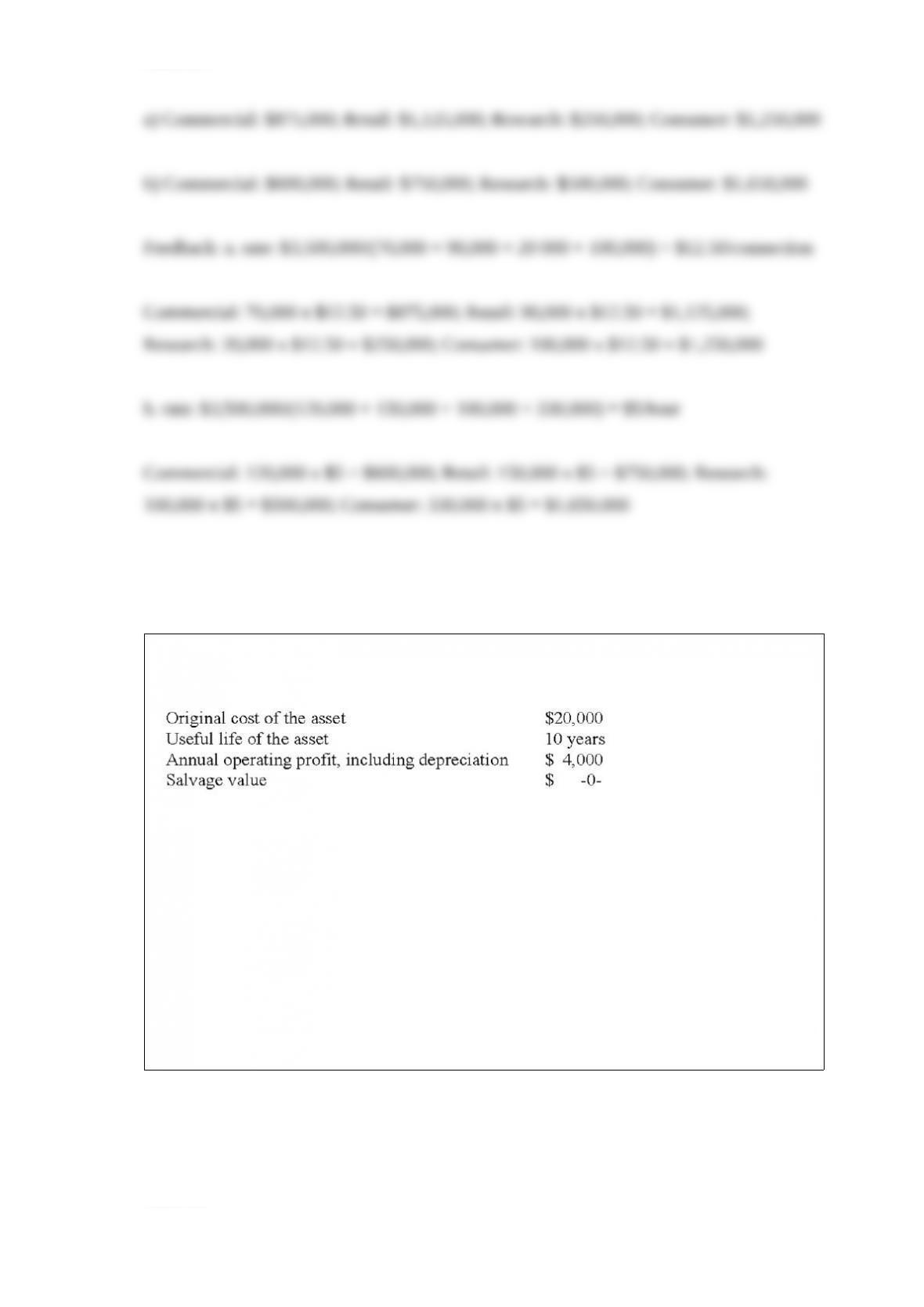
The following information was presented by Delta Manufacturing Company for an
asset purchased at the end of the previous year.
What is the return on investment (ROI) assuming Delta (a) uses the straight-line method
for depreciation and (b) beginning-of-year net book values to compute ROI?
A. 11.1%
B. 20.0%
C. 22.2%
D. 25.0%
Answer:
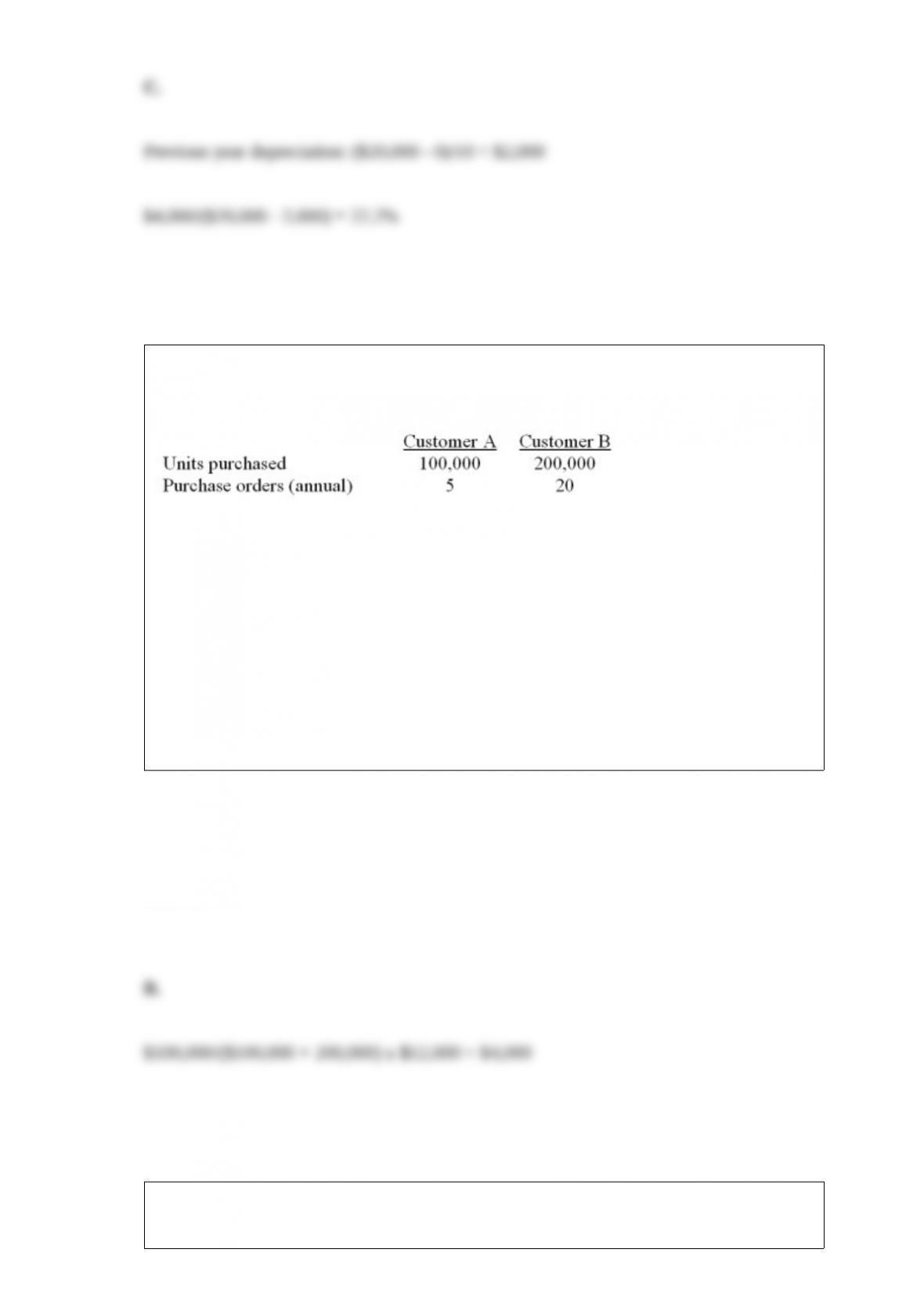
Beta Company is preparing its annual profit plan. As part of its analysis of the
profitability of its customers, management estimates that the $12,000 for sales support
should be assigned to the individual customers from the information given as follows:
What is the amount of the sales support costs that should be allocated to Customer A
assuming Beta uses units purchased to compute activity-based costs?
A. $2,400
B. $4,000
C. $8,000
D. $9,600
Answer:
Smith and Blarney Refiners began business on July 1. The following operations data
are available for July and the one product the company produces:
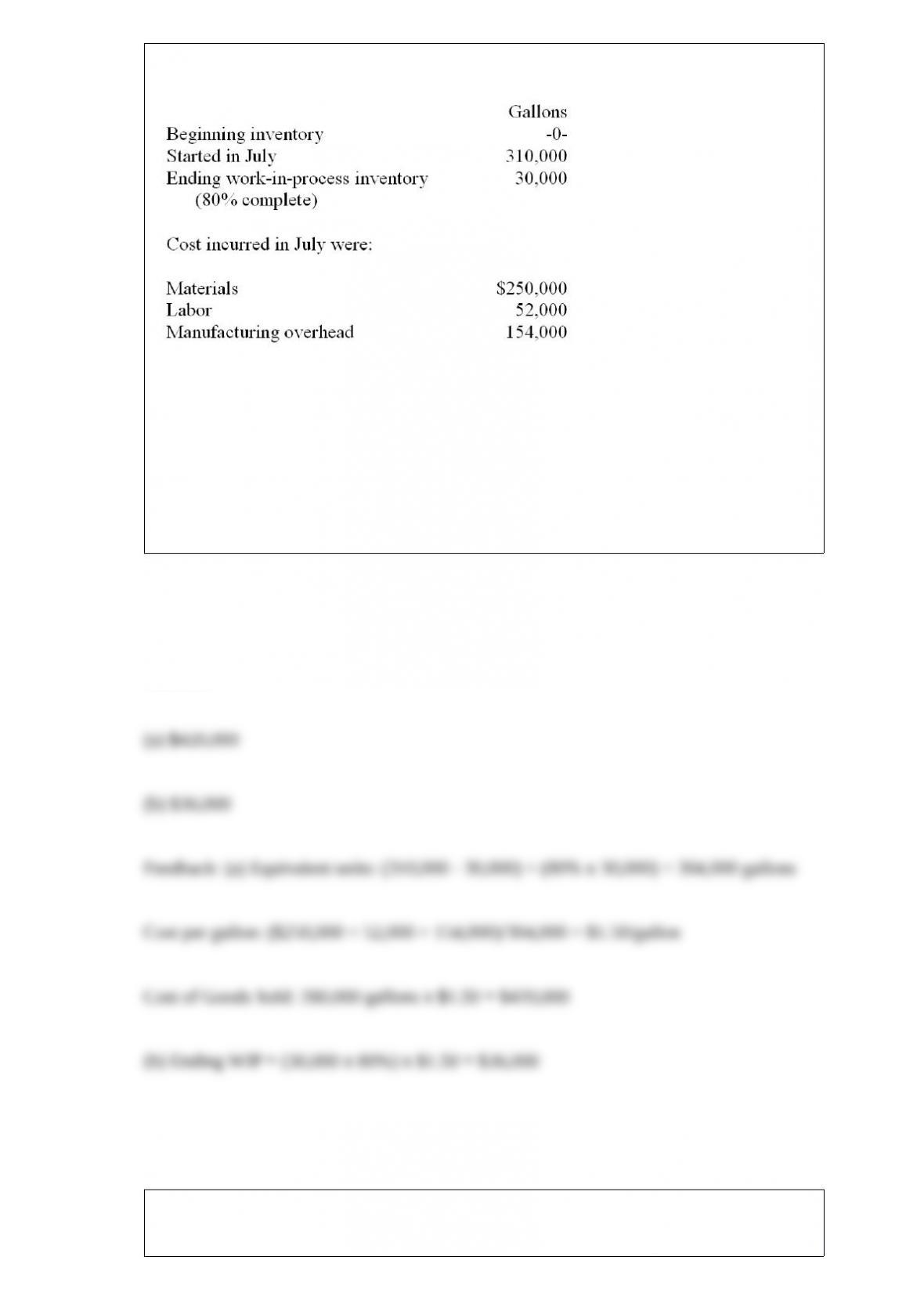
All production at Smith and Blarney is sold as it is produced (i.e., there are no finished
goods inventories).
Required:
(a) Compute cost of goods sold for July.
(b) What is the value of the work-in-process inventory on July 31?
Answer:
Fenway Telcom has three divisions, commercial, retail and consumer, that share the
common costs of the company’s computer server network. The annual common costs
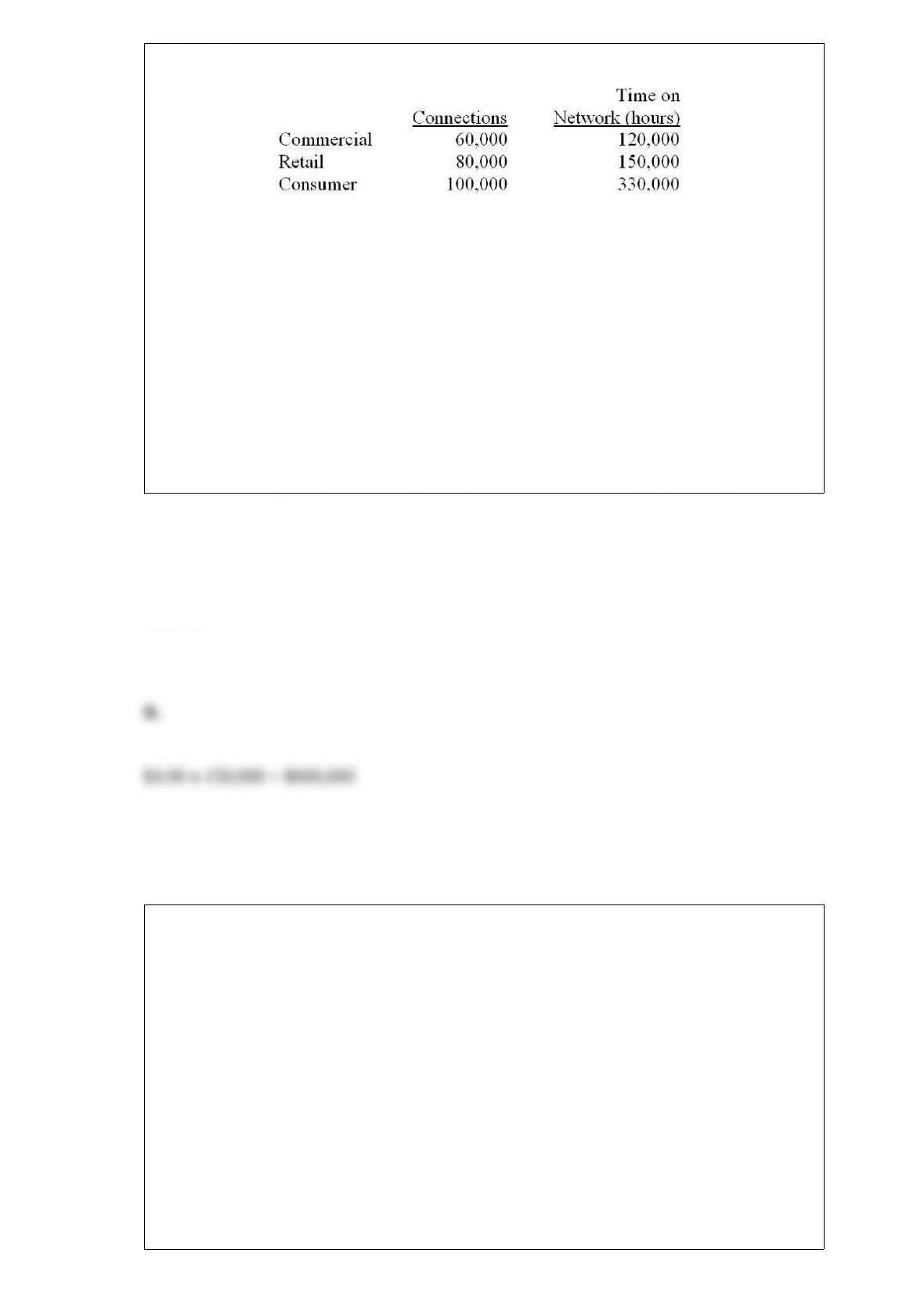
are $2,400,000. You have been provided with the following information for the
upcoming year:
Fenway Telcom uses the single rate method and allocates common costs based on the
time on the network. What is the total computer server network cost allocated to the
Retail Division?
A. $429,000
B. $600,000
C. $657,800
D. $3,000,000
Answer:
When comparing performance report information for top management with that of
lower-level management, (CMA adapted)
A. top management reports are more detailed.
B. lower-level management reports are typically for longer time periods.
C. top management reports show control over fewer costs.
D. lower-level management reports are likely to contain more quantitative data and less
financial data.
E. top management reports are usually not of the exception type but present a complete
analysis of all variances.
Answer:
Kaufman Industries has just completed its sales forecasts and its marketing department
estimates that the company will sell 36,000 units during the upcoming year. In the past,
management has maintained inventories of finished goods at approximately three
months’ sales. However, the estimated inventory at the start of the year of the budget
period is only 6,000 units. Sales occur evenly throughout the year. What is the
estimated production level (units) for the first month of the upcoming budget year?
A. 12,000
B. 9,000
C. 6,000
D. 3,000
Answer:

Information technology that links the various processes of the company into a single
comprehensive information system is called
A. customer relationship management
B. distribution chain
C. total quality management
D. cost of quality
E. enterprise resource planning
Answer:
Activity-based costing (ABC) is a costing technique that uses a two stage allocation
process. Which of the following statements best describes these two stages?
A. The costs are assigned to activities, and then to the products based upon their use of
the activities.
B. The costs are assigned to departments, and then to the products based upon their use
of activity resources.
C. Service department costs are allocated to the production departments, and then to the
products based upon their use of the activities.
D. Indirect costs are assigned to activities, and then to the products based upon the
direct cost resources used by the activities.
Answer:
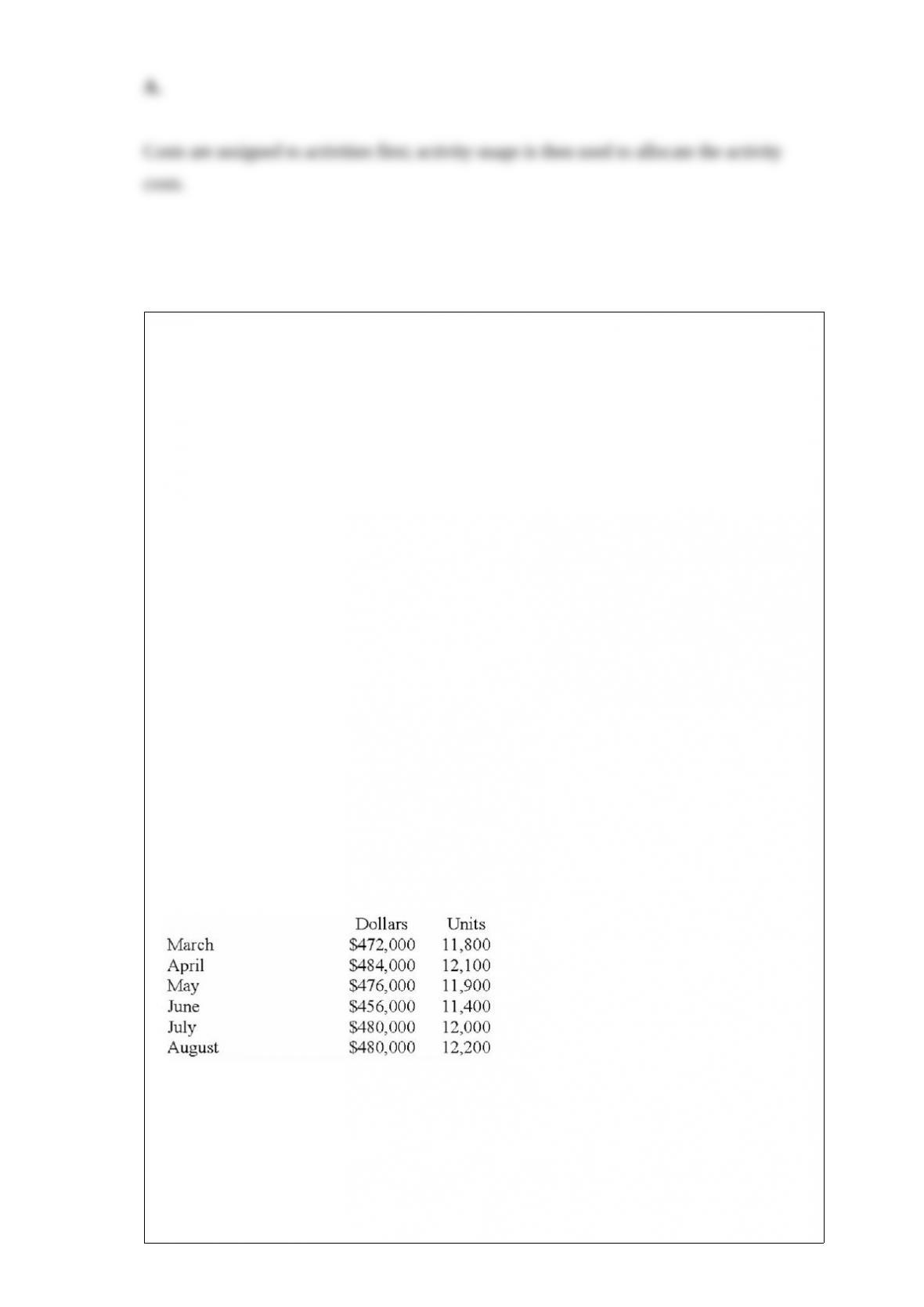
T. Jackson Retail seeks your assistance to develop cash and other budget information
for May, June, and July. At April 30, the company had cash of $5,500, accounts
receivable of $437,000, inventories of $309,400, and accounts payable of $133,055.
The budget is to be based on the following assumptions:
SALES:
Each month’s sales are billed on the last day of the month. Customers are allowed a 3%
discount if payment is made within 10 days after the billing date. Receivables are
recorded in the accounts at their gross amounts (not net of discounts). 55% of the
billings are collected within the discount period; 30% are collected by the end of the
month; 9% are collected by the end of the second month; and 6% turn out to be
uncollectible.
PURCHASES:
60% of all purchases of merchandise and the selling, general, and administrative
expenses are paid in the month purchased and the remainder in the following month.
The number of units in each month’s ending inventory is equal to 125% of the next
month’s units of sales. The cost of each unit of inventory is $30. Selling, general, and
administrative expenses, of which $3,000 is depreciation, are equal to 15% of the
current month’s sales.
Actual and projected sales are as shown below:
What are the budgeted merchandise purchases (in dollars) for June?
A. $319,500
B. $342,000
C. $364,500
D. $375,000
Answer: