
The PBO is increased by: A. An increase in the average life expectancy of employees.
B. Amortization of prior service cost.
C. An increase in the actuary’s assumed discount rate.
D. A return on plan assets that is lower than expected.
Answer:
On July 10, 2013, Johnson Corporation signed a purchase commitment to purchase
inventory for $200,000 on or before February 15, 2014. The company’s fiscal year-end
is December 31. The contract was exercised on February 1, 2014, and the inventory was
purchased for cash at the contract price. On the purchase date of February 1, the market
price of the inventory was $210,000. The market price of the inventory on December
31, 2013, was $180,000. The company uses a perpetual inventory system.
At what amount will Johnson record the inventory purchased on February 1, 2014? A.
$210,000.
B. $200,000.
C. $180,000.
D. $190,000.
Answer:

GG Inc. uses LIFO. GG disclosed that if FIFO had been used, inventory at the end of
2013 would have been $15 million higher than the difference between LIFO and FIFO
at the end of 2012. Assuming GG has a 40% income tax rate: A. Its reported cost of
goods sold for 2013 would have been $9 million higher if it had used FIFO rather than
LIFO for its financial statements.
B. Its reported cost of goods sold for 2013 would have been $15 million higher if it had
used FIFO rather than LIFO for its financial statements.
C. Its reported net income for 2013 would have been $9 million higher if it had used
FIFO rather than LIFO for its financial statements.
D. Its reported net income for 2013 would have been $15 million higher if it had used
FIFO rather than LIFO for its financial statements.
Answer:
If Dinsburry Company concluded that an investment originally classified as a trading
security would now more appropriately be classified as held to maturity, Dinsburry
would: A. Not reclassify the investment, as original classifications are irrevocable.
B. Reclassify the investment as held to maturity and immediately recognize in net
income all unrealized gains and losses that have not already been recognized as of the
reclassification date.
C. Reclassify the investment as held to maturity and treat the fair value as of the date of
reclassification as the investment’s amortized cost basis for future amortization.
D. Reclassify the investment as held to maturity, but there would be no income effect.
Answer:
Which of the following is not an inflow of cash? A. Depletion.
B. Cash borrowed on a short-term note.
C. Sale of a computer.
D. Cash borrowed on a long-term note.
Answer:
Nu Company reported the following pretax data for its first year of operations.

What is Nu’s net income if it elects LIFO? A. $288.
B. $144.
C. $240.
D. $480.
Answer:
The LIFO Conformity Rule states that if LIFO is used for: A. One class of inventory, it
must be used for all classes of inventory.
B. Tax purposes, it must be used for financial reporting.
C. One company in an affiliated group, it must be used by all companies in an affiliated
group.
D. Domestic companies, it must be used by foreign partners.
Answer:
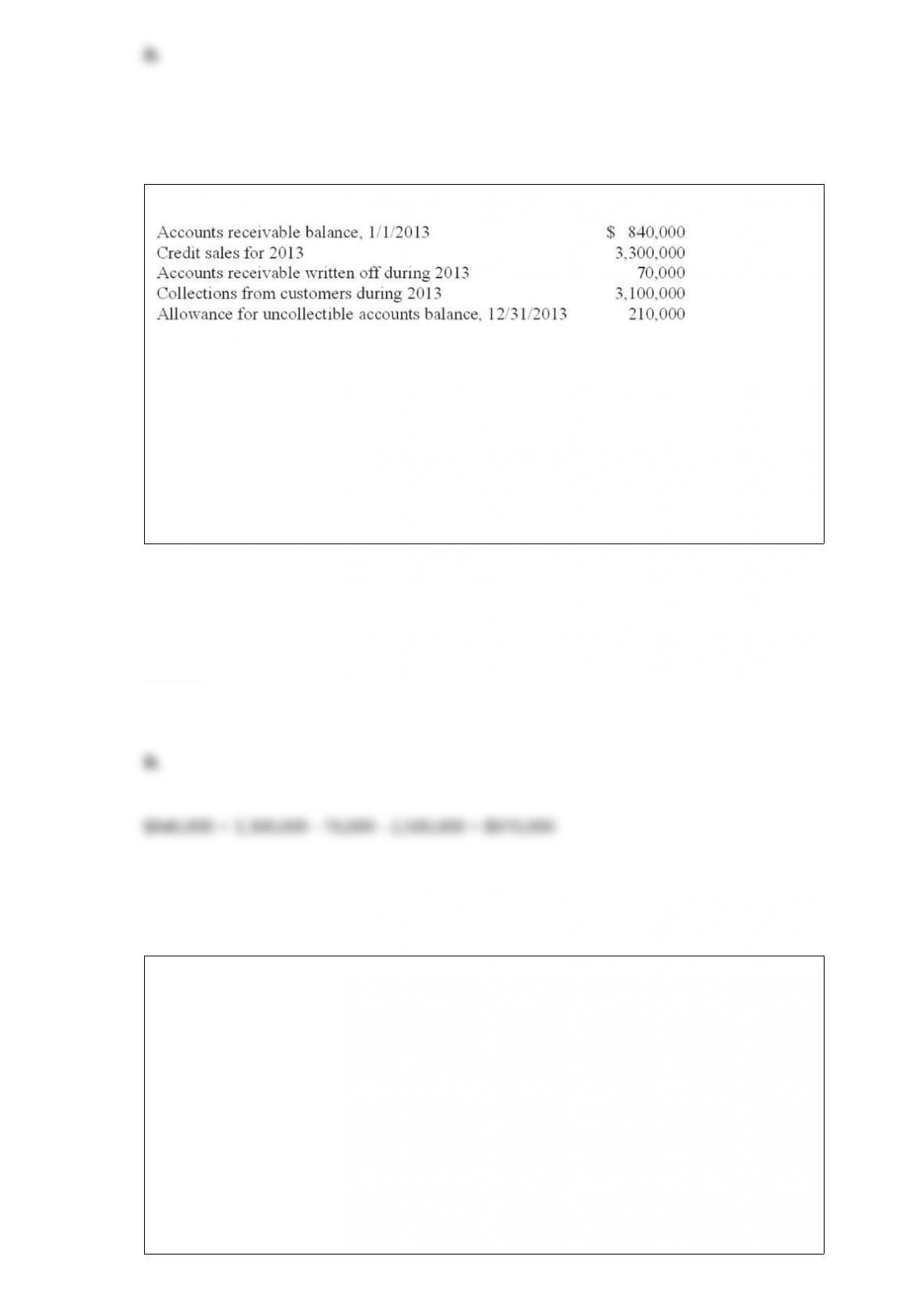
The following information relates to Halloran Co.’s accounts receivable for 2013:
What amount should Halloran report for accounts receivable, before allowances, at
December 31, 2013? A. $1,040,000.
B. $970,000.
C. $760,000.
D. None of the above.
Answer:
Northwest Fur Co. started 2013 with $94,000 of merchandise inventory on hand.
During 2013, $400,000 in merchandise was purchased on account with credit terms of
1/15, n/45. All discounts were taken. Purchases were all made f.o.b. shipping point.
Northwest paid freight charges of $7,500. Merchandise with an invoice amount of
$5,000 was returned for credit. Cost of goods sold for the year was $380,000.
Northwest uses a perpetual inventory system.
What is ending inventory assuming Northwest uses the gross method to record
purchases? A. $112,490.
B. $112,550.

C. $116,500.
D. $120,300.
Answer:
Listed below are 5 terms followed by a list of phrases that describe or characterize each
of the terms. Match each phrase with the most correct term. 1)Balance sheet
classification
2)Temporary difference
3)Income tax expense
4)Permanent difference
5)Valuation allowance
A. No tax consequences
B. “More likely than” not test
C. Same as related asset or liability
D. A “plug” for the net effect of the current tax liability and changes in deferred tax
assets and liabilities
E. Produces future taxable amounts or future deductible amounts.

Answer:
Slick’s Used Cars sells pre-owned cars on the installment basis and carries its own notes
because its customers typically cannot qualify for a bank loan. Default rates tend to be
high or unpredictable. However, in the event of nonpayment, Slick’s can usually
repossess the cars without loss. The revenue method Slick would use is the:A.
Installment sales method.
B. Point of sales method.
C. Cost recovery method.
D. Installment sales method or cost recovery method.
Answer:
The attribution period for postretirement health care plans does not include:A. The first
five years of service.
B. The year of hire.
C. The employee probation period.
D. The years of service beyond the full eligibility date.

Answer:
Adjusting entries are primarily needed for: A. Cash basis accounting.
B. Accrual accounting.
C. Current value accounting.
D. Manual accounting systems.
Answer:
Which of the following is not a required segment reporting disclosure according to
International Financial Reporting Standards? A. Segment profit or loss.
B. Segment assets.
C. Segment liabilities.
D. All are required disclosures.
Answer:

Operating cash outflows would include: A. Purchase of investments.
B. Purchase of equipment.
C. Payment of cash dividends.
D. Purchases of inventory.
Answer:
On September 30, 2013, Bricker Enterprises purchased a machine for $200,000. The
estimated service life is 10 years with a $20,000 residual value. Bricker records
partial-year depreciation based on the number of months in service. Depreciation for
2014, using double-declining balance, would be: A. $32,000.
B. $34,000.
C. $38,000.
D. $40,000.
Answer:
On January 1, 2013, D Corp. granted an employee an option to purchase 6,000 shares of
D’s $5 par common stock at $20 per share. The options became exercisable on
December 31, 2014, after the employee completed two years of service. The option was
exercised on January 10, 2015. The market prices of D’s stock were as follows: January
1, 2013, $30; December 31, 2014, $50; and January 10, 2015, $45. An option pricing
model estimated the value of the options at $8 each on the grant date. For 2013, D
should recognize compensation expense of: A. $0.
B. $24,000.
C. $30,000.
D. $60,000.
Answer:
If bond interest expense is $800,000, bond interest payable increased by $8,000 and
bond discount decreased by $2,000, cash paid for bond interest is: A. $790,000.
B. $784,000.
C. $806,000.
D. $910,000.
Answer:

A long-term liability should be reported as a current liability in a classified balance
sheet if the long-term debt: A. Is callable by the creditor.
B. Is secured by adequate collateral.
C. Will be refinanced with stock.
D. Will be refinanced with debt.
Answer:
When using the cost recovery method of accounting for long-term contracts under
IFRS: A. Estimated losses on the overall contract are recognized before the contract is
completed.
B. Expenses are recorded each period, but revenue is only recognized when the contract
is completed.
C. Companies can use the percentage-of-completion method if that is their preference.
D. Neither gains nor losses are recognized until the contract is completed.

Answer:
Research and development expense for a given period includes: A. The full cost of
newly acquired equipment that has an alternative future use.
B. Depreciation on a research and development facility.
C. Research and development conducted on a contract basis for another entity.
D. Patent filing and legal costs.
Answer:
The following transactions occurred during the year for XYZ Corporation:
(a.) During the year, trading securities were purchased for $250,000.
(b.) During the year, securities available for sale were purchased for $80,000.
(c.) During the year, trading securities that are carried on the balance sheet at their fair
value of $125,000 were sold for $125,000 cash.
(d.) At the end of the year, the trading securities portfolio has an aggregate market value
of $142,000 and an aggregate cost of $150,000.
(e.) At the end of the year the securities available for sale portfolio has an aggregate
market value of $95,000.
Required:
Indicate how each of these transactions would affect the statement of cash flows for a
corporation. Assume the statement of cash flows is prepared using the indirect method.
Each transaction is assumed to be independent of the other transactions.
Answer:
On November 10 of the current year, Cherokee Industries sold materials to a customer
for $8,000 with credit terms 2/10, n/30. Cherokee uses the net method of accounting for
cash discounts
What entry would Cherokee make on November 10? A.
B.
C.

D.
Answer:
Molly’s Auto Detailers maintains its records on the cash basis. During 2013, Molly’s
collected $72,000 from customers and paid $21,000 in expenses. Depreciation expense
of $5,000 would have been recorded on the accrual basis. Over the course of the year,
accounts receivable increased $4,000, prepaid expenses decreased $2,000, and accrued
liabilities decreased $1,000. Molly’s accrual basis net income was: A. $38,000.
B. $54,000.
C. $49,000.
D. $42,000.
Answer:

Chez Fred Bakery estimates the allowance for uncollectible accounts at 3% of the
ending balance of accounts receivable. During 2013, Chez Fred’s credit sales and
collections were $125,000 and $131,000, respectively. What was the balance of
accounts receivable on January 1, 2013, if $180 in accounts receivable were written off
during 2013 and if the allowance account had a balance of $750 on December 31,
2013? A. $5,820.
B. $31,000.
C. $31,180.
D. None of the above is correct.
Answer:
Gain contingencies usually are recognized in a company’s income statement when:A.
Realized.
B. The amount can be reasonably estimated.
C. The gain is reasonably possible and the amount can be reasonable estimated.
D. The gain is probable and the amount can be reasonably estimated.

Answer:
In 2013, Magic Table Inc. decides to add a 36-month warranty on its new product sales.
Warranty costs are tax deductible when claims are settled. In its financial statements for
2013, Magic Table Inc incurs: A. An increase in a deferred tax asset.
B. A decrease in a deferred tax asset.
C. An increase in a deferred tax liability.
D. A decrease in a deferred tax liability.
Answer:
Which of the following was the first private-sector entity that set accounting standards
in the United States?A.Accounting Principles Board.
B.Committee on Accounting Procedure.
C.Financial Accounting Standards Board.
D.AICPA.
Answer:
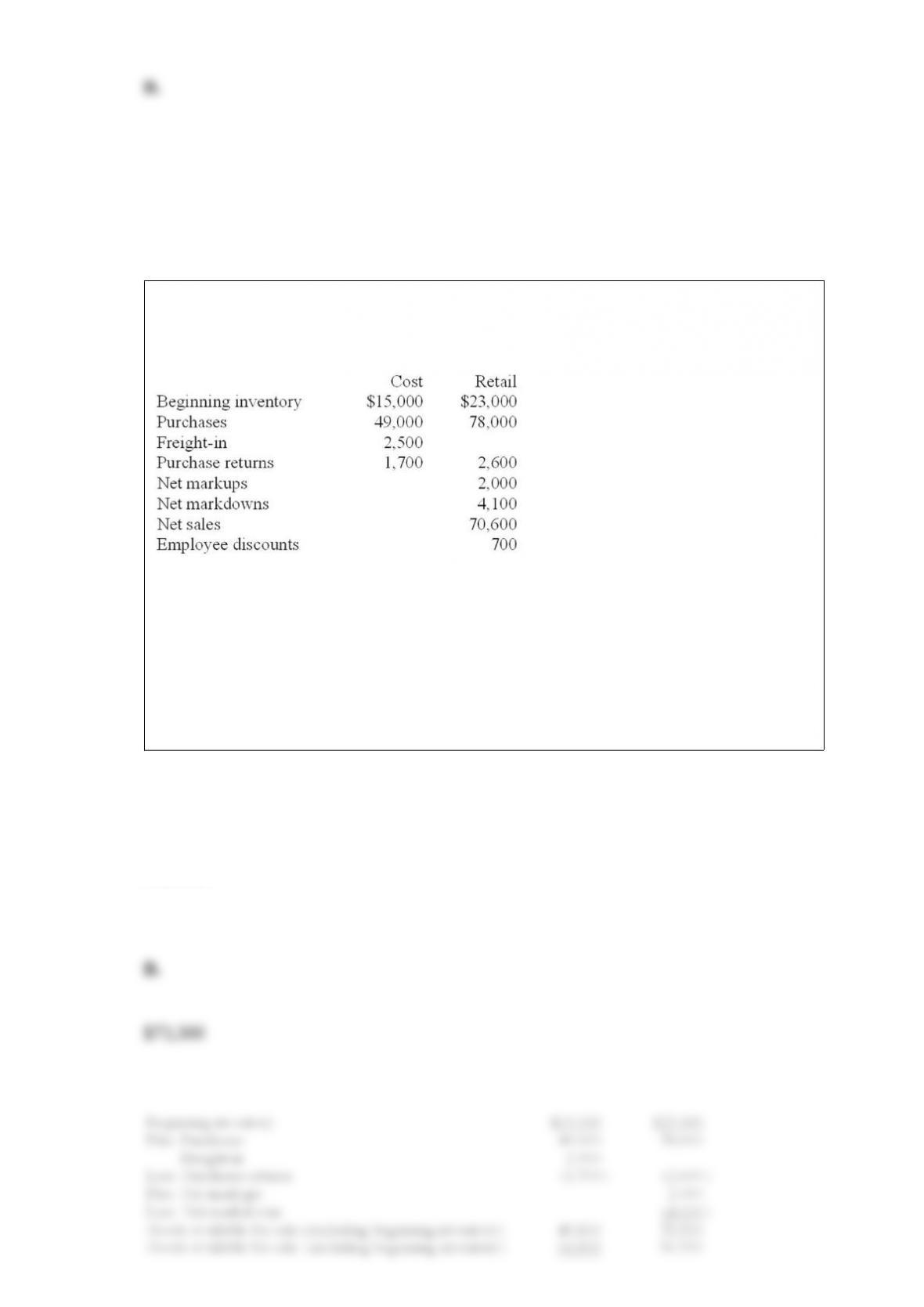
Harvey’s Junk Jewelry started business January 1, 2013, and uses the LIFO retail
method to estimate ending inventory. Listed below is data accumulated for the year
ended December 31, 2013:
The denominator for the current period’s cost-to-retail percentage is: A. $96,300.
B. $73,300.
C. $101,000.
D. $81,500.
Answer:

Listed below are five terms followed by a list of phrases that describe or characterize
each of the terms. Match each phrase with the correct term by placing the number
designating the best term in the space provided by the phrase. 1) Stock volatility
2) Grant date
3) Market condition plans
4) Option exercise price
5) Option exercise date
A. An important factor in option pricing models
B. The amount paid to convert the option into stock
C. Date on or after which employees can buy stock with options
D. Require(s) compensation expense regardless of condition satisfaction
E. Date on which options are awarded
Answer:
When the interest payment dates are March 1 and September 1, and the bonds are
issued on July 1, the amount of interest expense reported in the December 31 income
statement for the year of issue would be for: A. Six months.
B. Four months.
C. 10 months.
D. 12 months.

Answer:
Which of the following is not an example of a change in accounting principle? A. A
change in the useful life of a depreciable asset.
B. A change from LIFO to FIFO for inventory costing.
C. A change to the full costing method in the extractive industries.
D. A change from the cost method to the equity method of accounting for investments.
Answer:
Cash equivalents generally would not include short-term investments in: A.
Commercial paper.
B. Certificates of deposit.
C. Held-to-maturity securities.
D. Money market funds.
Answer:

Roberto Corporation was organized on January 1, 2013. The firm was authorized to
issue 100,000 shares of $5 par common stock. During 2013, Roberto had the following
transactions relating to shareholders’ equity:
Issued 10,000 shares of common stock at $7 per share.
Issued 20,000 shares of common stock at $8 per share.
Reported a net income of $100,000.
Paid dividends of $50,000.
Purchased 3,000 shares of treasury stock at $10 (part of the 20,000 shares issued at $8).
What is total shareholders’ equity at the end of 2013? A. $270,000.
B. $300,000.
C. $250,000.
D. $200,000.
Answer: