1) DeGiaimo Co. has an operating leverage of 5. If next year’s sales are expected to
increase by 10%, then the company’s operating income will increase by 50%.
2) When a corporation issues bonds, it executes a contract with the bondholders known
as a bond debenture.
3) If a proposed expenditure of $400,000 for a fixed asset with a 4-year life has an
annual expected net cash flow and net income of $160,000 and $60,000, respectively,
the cash payback period is 2.5 years.
4) Statements in which all items are expressed as percentages with no dollar amounts
are called common-sized statements.
5) Under the straight-line method, the amount of depreciation expense for the first full
year of use of a fixed asset costing $95,000, with an estimated residual value of $5,000,
and a useful life of 5 years, will be $18,000.
6) An adjusting entry would adjust revenue so that it is reported when earned and not
when cash is received.
7) When the market rate of interest is less than the contract rate of a bond, the bond will
sell for a discount.
8) The comparison of the financial data of a single company for two or more years is
called horizontal analysis.
9) Current assets are assets that are expected to be converted to cash, sold or used up
within 6 months.
10) In response to materials requisition, materials are transferred from the storeroom to
the factory.
11) The total depreciation across the years of an assets life is the same under the
double-declining-balance method or the straight-line method.
12) To determine cash payments for operating expenses for the cash flow statement
using the direct method, a decrease in prepaid expenses is added to operating expenses
other than depreciation.
13) On the income statement in the single-step form, the total of all expenses is
deducted from the total of all revenues.
14) Internal rate of return is often called the payback rate of return.
15) The manager of the furniture department of a leading retailer does not have control
on salaries of the department personnel.
16) If the cost of materials is not a significant portion of the total product cost, the
materials may be classified as a part of factory overhead cost.
17) When eliminating a product or segment of a business, the fixed costs pertaining to
the product or segment will always be eliminated.
18) Merchandising businesses produce products rather than provide services to
customers.
19) In using the total cost concept of applying the cost-plus approach to product pricing,
what is included in the markup?
A.Total selling and administrative expenses plus desired profit
B.Total fixed manufacturing costs, total fixed selling and administrative expenses, and
desired profit
C.Total costs plus desired profit
D.Desired profit
20) Expenses can be defined as:
A.assets consumed
B.services used in the process of generating revenues
C.costs that have been incurred during the normal course of business
D.all of these
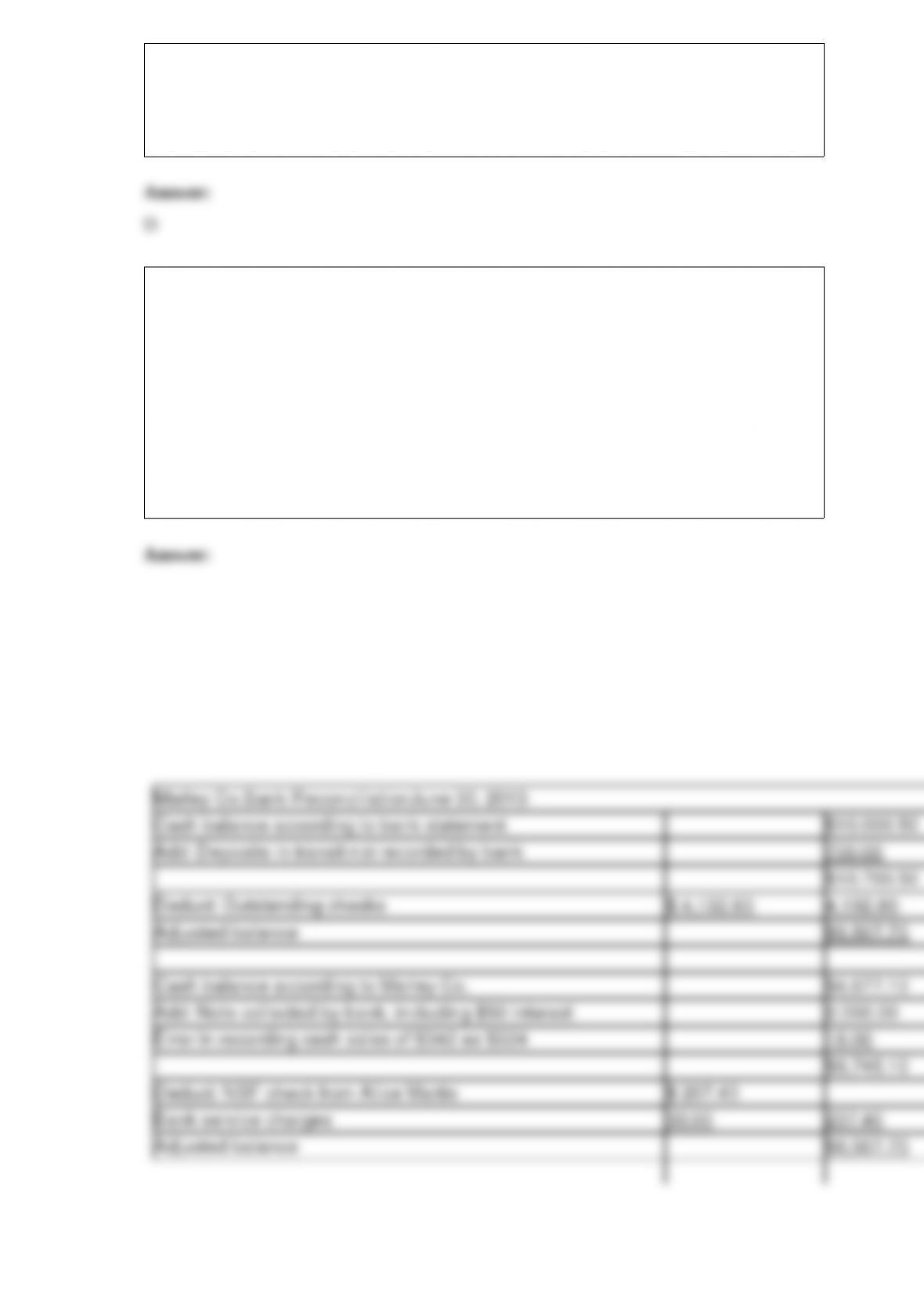
21) The bank statement for Marley Co. indicates a balance of $10,000.50 on June 30,
2013 . The cash account for the company had a balance of $4,677.10. Prepare a bank
reconciliation on the basis of the following reconciling items:
(a) Cash sales of $342 had been erroneously recorded as $324.
(b) Deposits in transit not recorded by bank, $700.
(c) Bank debit memorandum for service charges, $30.
(d) Bank credit memorandum for note collected by bank, $2,050, including $50 interest.
(e) Bank debit memorandum for $207.40 NSF (not sufficient funds) check from Alice
Martin, a customer.
(f) Checks outstanding, $4,192.80.
22) Fees receivable would appear on the balance sheet as a(n):
A.asset
B.liability
C.fixed asset
D.unearned revenue
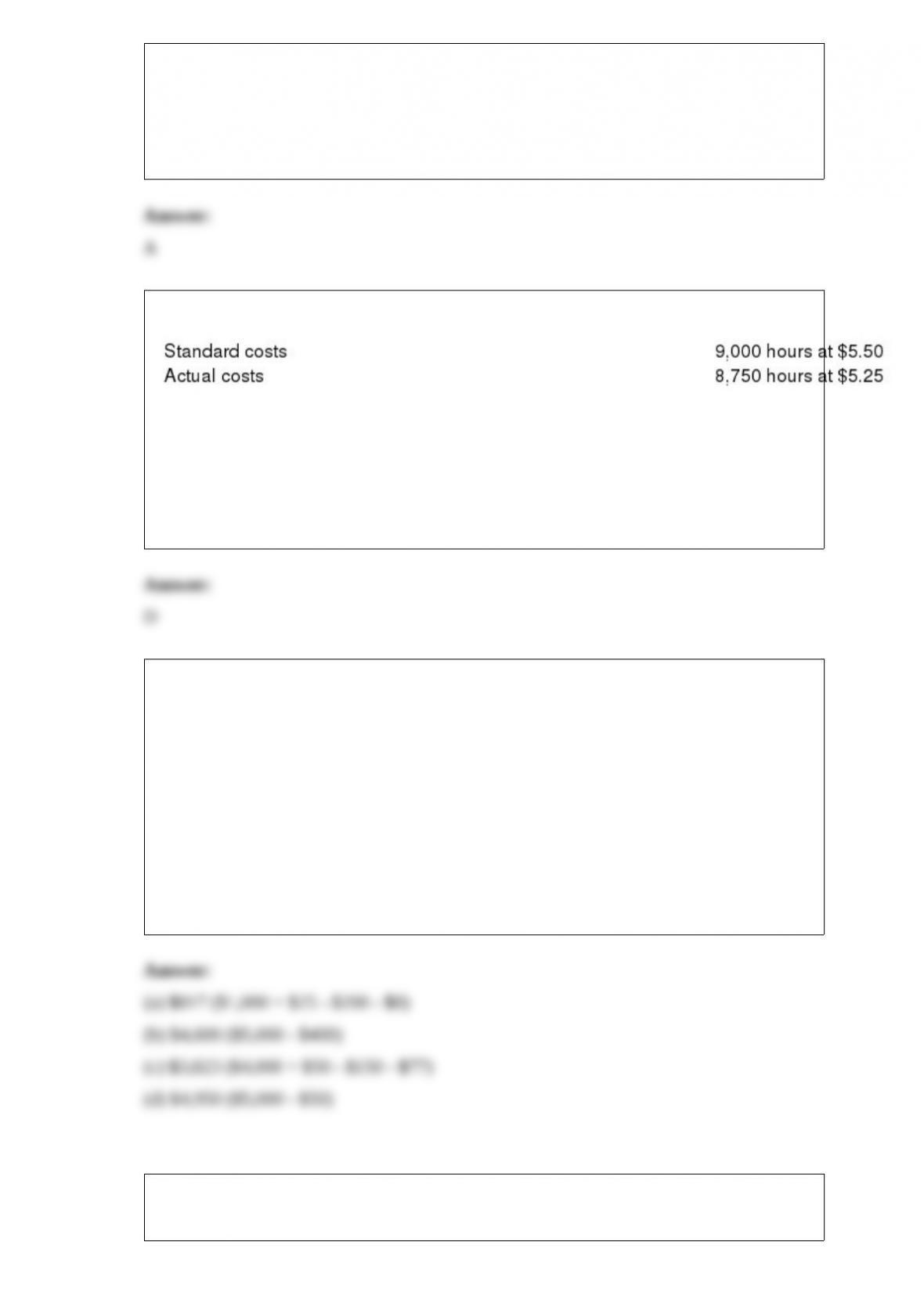
23) The following data relate to direct labor costs for the current period:
What is the direct labor rate variance?
A.$2,250.00 unfavorable
B.$2,187.50 unfavorable
C.$2,250.00 favorable
D.$2,187.50 favorable
24) Details of invoices for purchases of merchandise are as follows:
Merchandise Transportation Terms Returns and Allowances
a. $1,000 $25 FOB shipping point, 1/10, n/30 $200
b. 5,000 — FOB destination, n/30 400
c. 4,000 50 FOB shipping point, 2/10, n/30 150
d. 5,000 — FOB destination, 1/10, n/30 —
Determine the amount to be paid in full settlement of each of the invoices, assuming
that credit for returns and allowances was received prior to payment and that all
invoices were paid within the discount period. Also assume that the seller has prepaid
the transportation expenses.
25) Which of the following cannot be used to assess solvency of a company?
A.Liabilities to stockholders equity
B.Current position analysis
C.Ratio of net sales to assets
D.Inventory analysis
26) The amount of the average investment for a proposed investment of $70,000 in a
fixed asset, with a useful life of four years, recognition is given to the effect of
straight-line depreciation on the investment, no residual value, and an expected total net
income of $21,600 for the 4 years, is:
A.$10,800
B.$21,600
C.$35,000
D.$30,000
27) Which of the following are business stakeholders?
A.Stockholders
B.Suppliers
C.Customers
D.All of these
28) In reference to a promissory note, the person who is to receive payment is called
the:
A.maker
B.payee
C.seller
D.payer
29) Division A of Purvis Company has a rate of return on investment of 15% and an
investment turnover of 1.6 . What is the profit margin?
A.10%
B.12.5%
C.9.4%
D.24%
30) In a job order cost accounting system, the effect of the flow of direct materials into
production will be:
A.increase in Work-in-Process and decrease in Materials Inventory
B.increase in Materials Inventory and decrease in Work-in-Process
C.increase in Factory Overhead and decrease in Materials Inventory
D.increase in Work-in-Process and decrease in Supplies
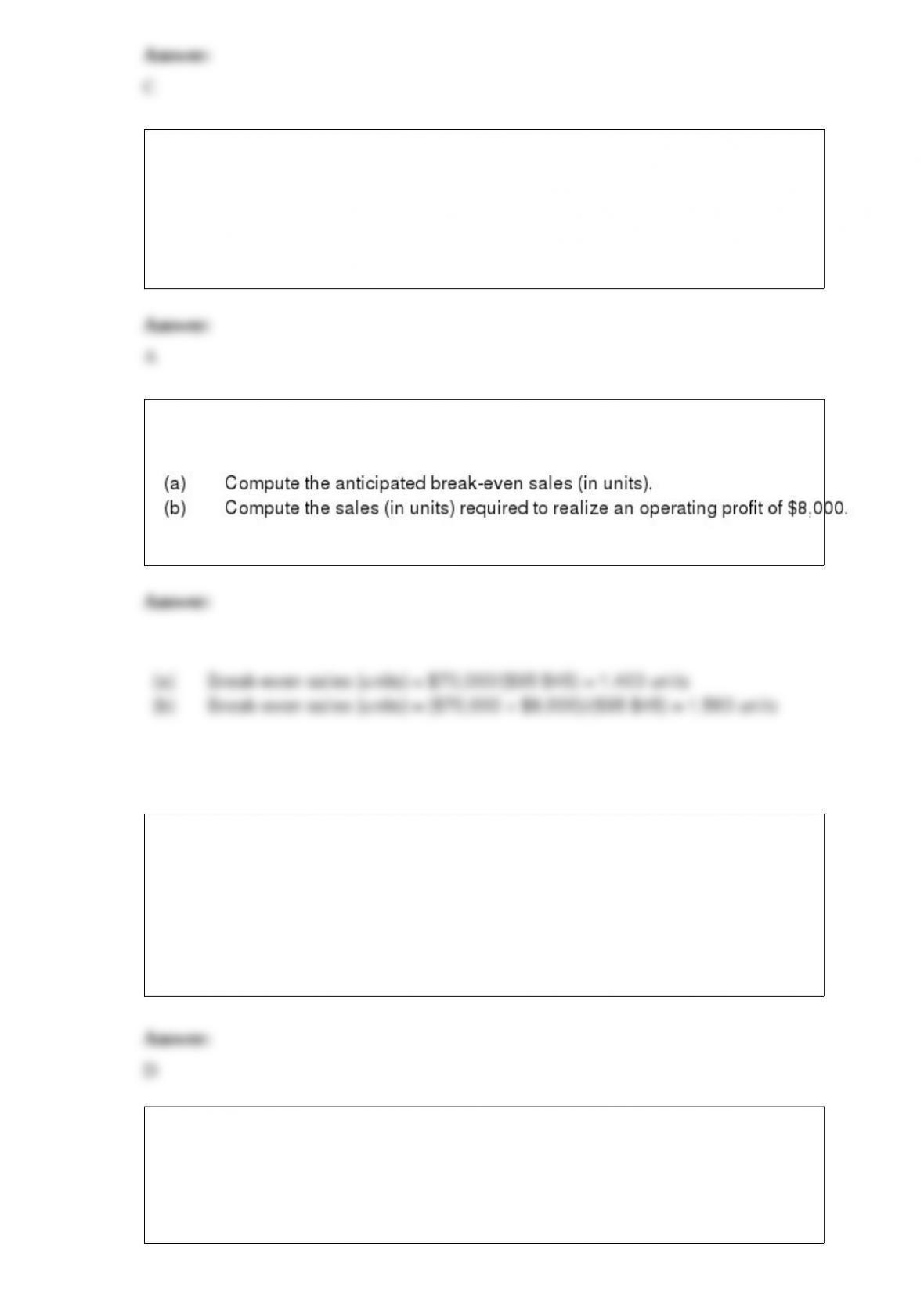
31) For the current year ending April 30, Philip Company expects fixed costs of
$70,000, a unit variable cost of $45, and a unit selling price of $95.
32) When a business sells more than one product at varying selling prices, the
business’s break-even point can be determined as long as the number of products does
not exceed:
A.two
B.three
C.fifteen
D.there is no limit
33) Cash paid to purchase long-term investments would be reported in the statement of
cash flows in:
A.the cash flows from operating activities section
B.the cash flows from financing activities section
C.the cash flows from investing activities section
D.a separate schedule
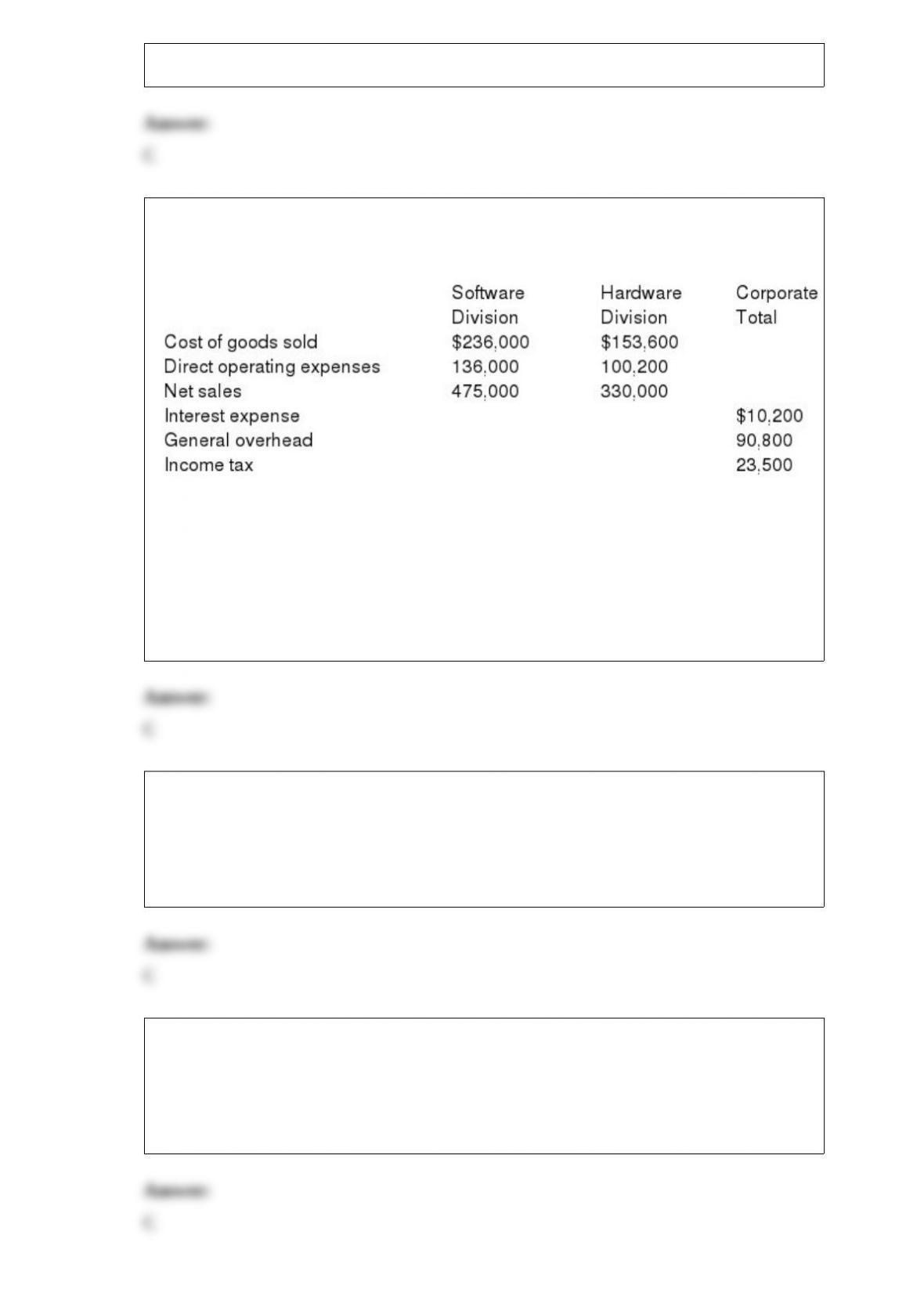
34) The following financial information was summarized from the accounting records
of Block Corporation for the current year ended December 31:
The gross profit for the Hardware Division is:
A.$103,000
B.$229,800
C.$176,400
D.$76,200
35) The amount of the outstanding checks is included on the bank reconciliation as a(n):
A.deduction from the cash balance per books
B.addition to the cash balance per bank
C.deduction from the cash balance per bank
D.addition to the cash balance per books
36) Which of the following will not affect direct materials quantity variance?
A.Malfunctioning equipment
B.Purchasing of inferior raw materials
C.Material requiring rework
D.Spoilage of materials
37) Assume the November transactions for Hoover Co. are as follows:
a. Received cash of $40,000 from investors in exchange for capital stock.
b. Provided services of $15,600 on account.
c. Purchased supplies on account $800.
d. Received cash of $10,900 from clients for services previously billed.
e. Received $5,100 for services provided from clients who paid cash.
f. Paid $400 on account for supplies that had been purchased.
g. Paid $2,400 for a one-year insurance policy.
h. Paid the following expenses: wages, $8,000; utilities, $900; rent, $2,000.
i. Paid dividends of $1,500 to stockholders.
Record the transactions, using the integrated financial statement framework that
follows:
Assets = Liabilities + Stockholders’ Equity
Cash Accounts Receivable Supplies Prepaid Insurance Accounts Payable Capital
Stock Retained Earnings
a.
b.
c.
d.
e.
f.
g.
h.
i.
Bal.
Calculate the November 30 cash balance and the amount of net income for November
for Hoover Co.
38) A note receivable due in five years is listed on the balance sheet under the caption:
A.investments
B.current assets
C.fixed assets
D.stockholders’ equity
39) Which of the following is not considered as cash?
A.Commercial paper
B.Checks
C.Money orders
D.Coins
40) Which statement below is not a reason for a corporation to buy back its own stock?
A.Resale to employees
B.Bonus to employees
C.For supporting the market price of the stock
D.To increase the shares outstanding
41) What are current liabilities?
A.Liabilities that are due and payable within two years
B.Liabilities that are due and to be paid out of current assets within one year
C.Liabilities that are due but not payable for more than one year
D.Liabilities that are payable if a possible subsequent event occurs
42) A business is operating at 90% of capacity and is currently purchasing a part used in
its manufacturing operations for $15 per unit. The unit cost for the business to make the
part is $20, including fixed costs, and $12, not including fixed costs. If 30,000 units of
the part are normally purchased during the year but could be manufactured using
unused capacity, what would be the amount of differential cost increase or decrease
from making the part rather than purchasing it?
A.$150,000 increase
B.$ 90,000 decrease
C.$150,000 decrease
D.$ 90,000 increase
43) For each of the following items indicate whether the transactions listed below
increased (+), decreased (–) or had no effect (o) by inserting the appropriate symbol.
NetIncome Assets Liab. Owners’Equity CashFlows
(a) Record depreciation expense
(b) Sold equipment for cash at a loss
(c) Recorded loss on impaired goodwill
(d) Recorded depletion expense
(e) Recorded a capital expenditure and issued a note payable
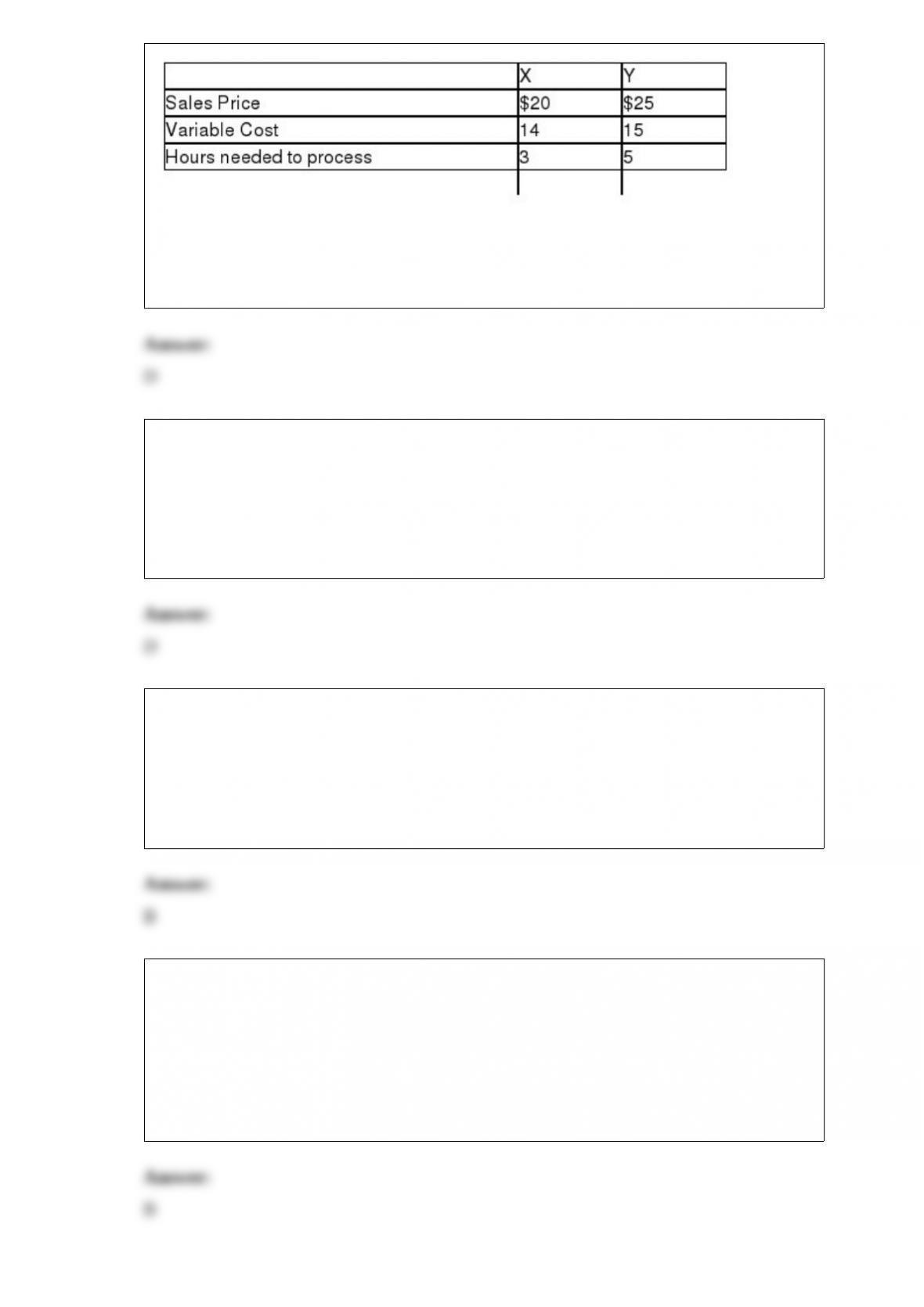
44) Soap Company manufactures Soap X and Soap Y and can sell all it can make of
either. Hours available to produce the products is the constrained resources.Based on
the following data, which statement is true?
A.X is more profitable than Y
B.Y is more profitable than X
C.Neither X nor Y have a positive contribution margin
D.X and Y are equally profitable
45) Which of the following expressions is termed the investment turnover factor as used
in determining the rate of return on investment?
A.Invested Assets/Sales
B.Income From Operations/Invested Assets
C.Income From Operations/Sales
D.Sales/Invested Assets
46) Which of the following should be shown on a statement of cash flows under the
financing activity section?
A.The purchase of a long-term investment in the common stock of another company
B.The payment of cash to retire a long-term note
C.The proceeds from the sale of a building
D.The issuance of a long-term note to acquire land
47) A company purchased an oil well for $25 million. It is estimated that 10 million
barrels can be extracted from the well. Determine depletion expense assuming 3 million
barrels are extracted and sold during the year.
A.$7,350,000
B.$7,500,000
C.$5,000,000
D.$7,650,000
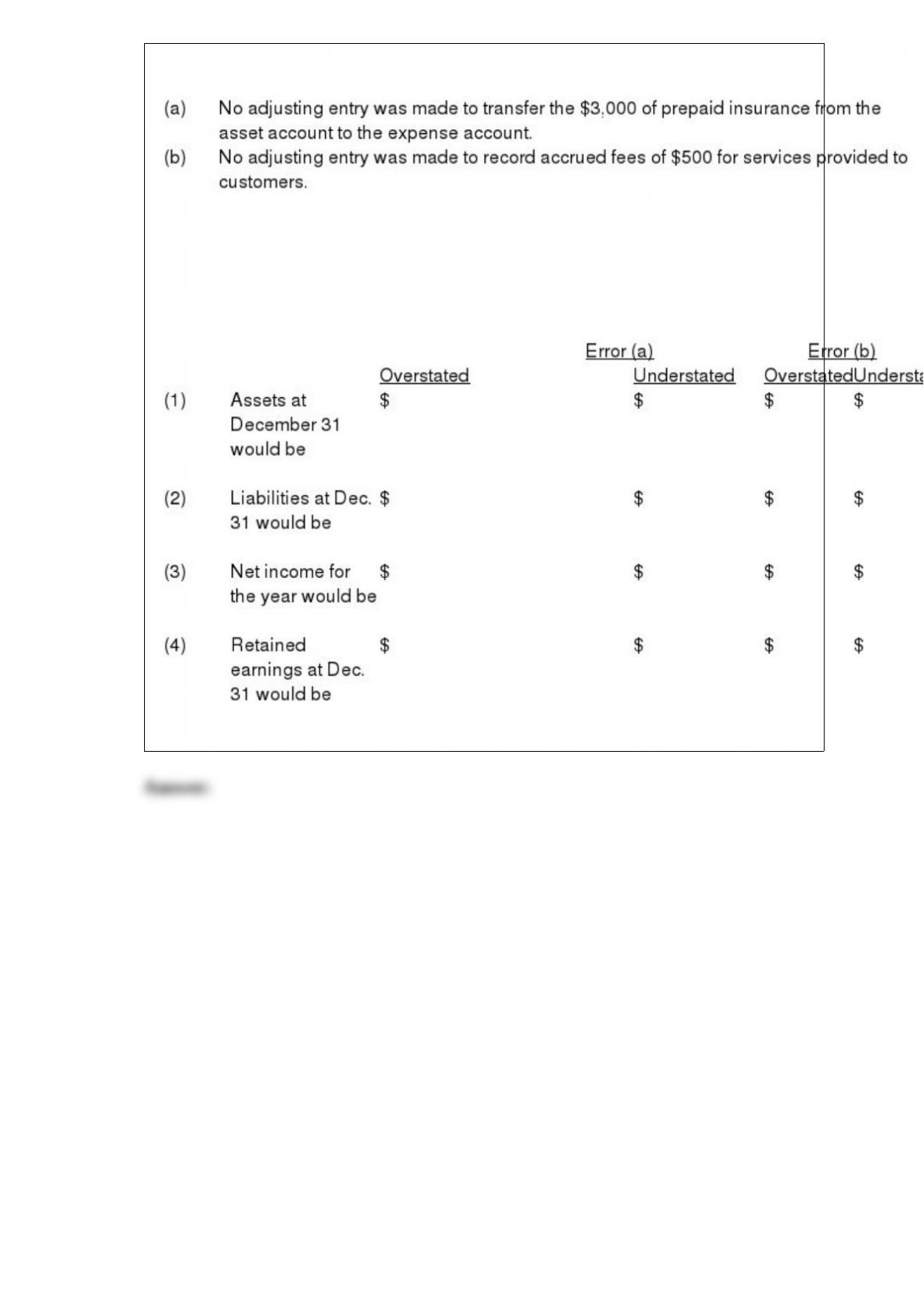
48) At the end of the fiscal year, the following adjusting entries were omitted:
Assuming that financial statements are prepared before the errors are discovered,
indicate the effect of each error, considered individually, by inserting the dollar amount
in the appropriate spaces. Insert “0” if the error does not affect the item.
49) Taxes receivable is classified as:
A.other receivable
B.notes receivable
C.accounts receivable
D.trade receivables
50) Expenses not related to the primary operations of the business are sometimes
reported as:
A.administrative expense
B.operating expense
C.other expense
D.all of these
51) Kennedy Co. sells two products, Arks and Bins. Last year, Kennedy sold 32,000
units of Arks and 18,000 units of Bins. Related data are:
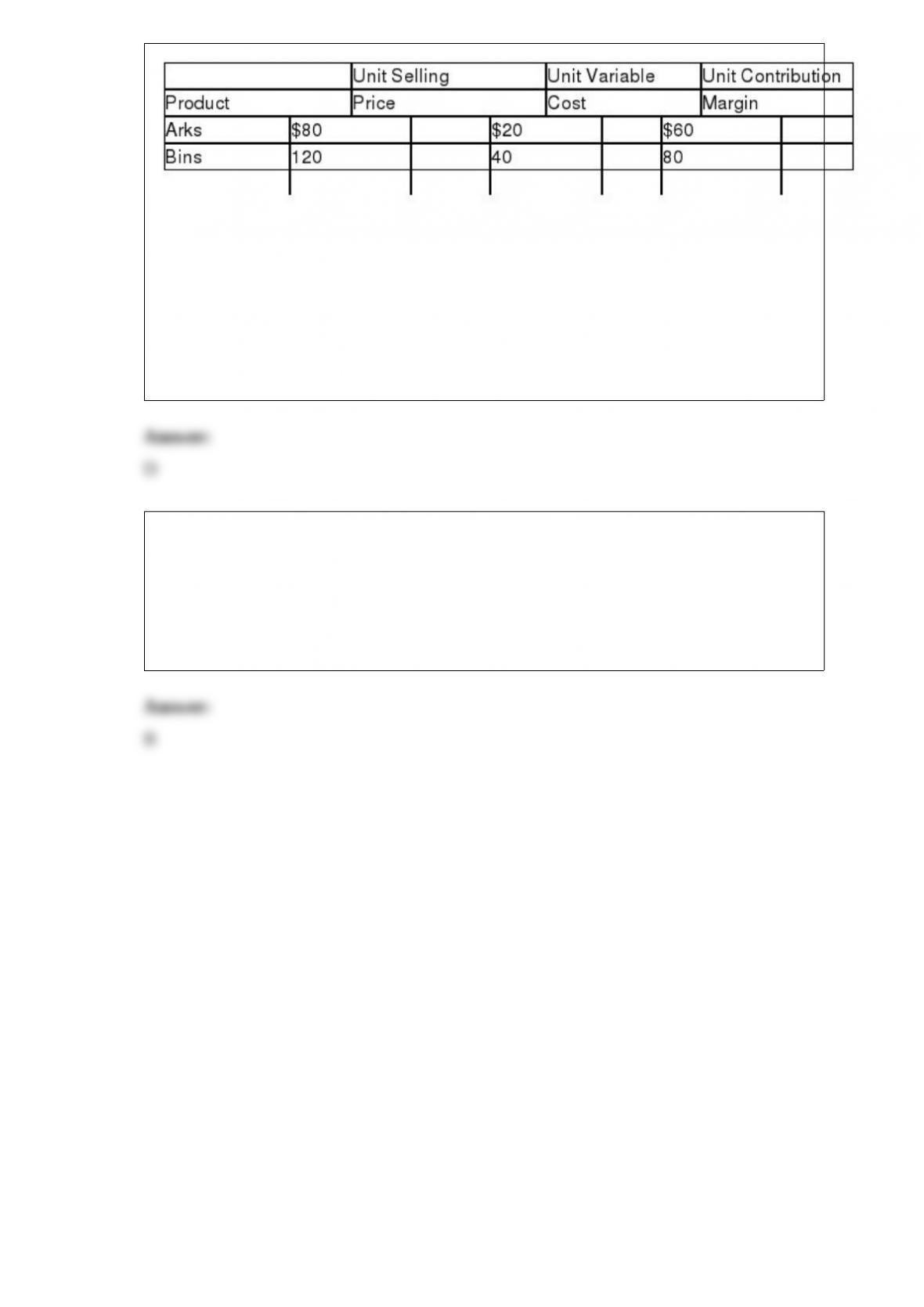
Use the above given data to solve the following questions:
Refer to the information provided for Kennedy Co. What was Kennedy’s overall
products unit selling price?
A.$97.60
B.$104.00
C.$102.40
D.$94.40
52) The reduction of par or stated value of stock by issuance of a proportionate number
of additional shares is termed a:
A.stock dividend
B.stock split
C.stock option
D.preferred dividend