
Cutter Enterprises purchased equipment for $72,000 on January 1, 2016. The equipment
is expected to have a five-year life and a residual value of $6,000. Using the
sum-of-the-years’-digits method, depreciation for 2016 and book value at December 31,
2016, would be:
a. $22,000 and $44,000.
b. $22,000 and $50,000.
c. $24,000 and $48,000.
d. $24,000 and $42,000.
Sullivan Software sells packages of a software program and one year’s worth of
technical support for $500. Its packaging lists the $500 sales price as comprised of a
software program at a price of $450 and technical support with a price of $100, with a
$50 discount for the package deal. All of Sullivan’s sales are for cash, and there are no
returns. Sullivan sells the software program separately for $475 and offers a year of
technical support separately for $75.
The amount of revenue that GAAP, regarding software revenue recognition, would
require Sullivan to attribute to the software program (as opposed to the technical
support) is (rounded):
a. $450.
b. $475.
c. $432.
d. $400.
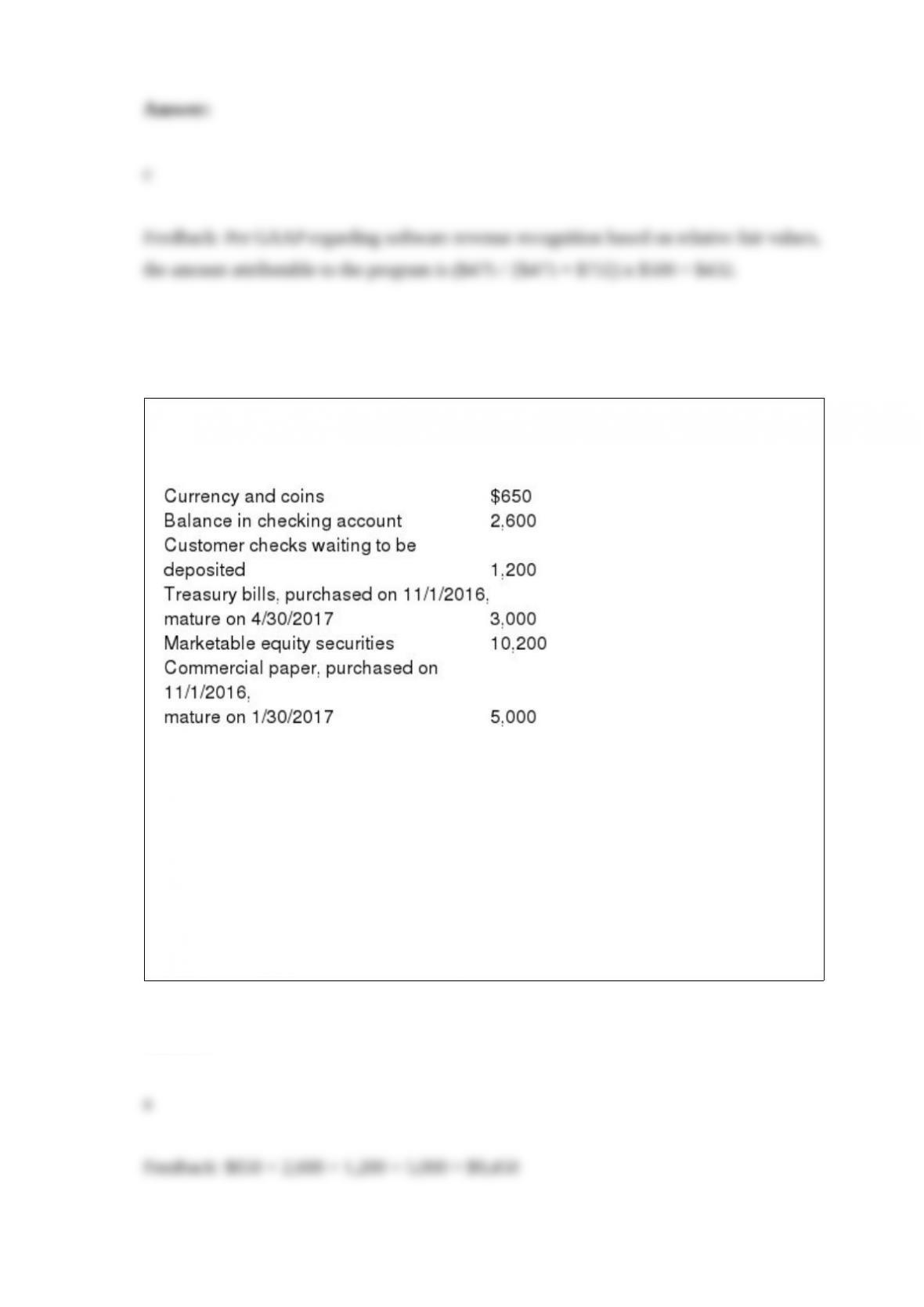
Cashmere Soap Corporation had the following items listed in its trial balance at
12/31/2016:
What amount will Cashmere Soap include in its year-end balance sheet as cash and cash
equivalents?
a. $ 9,450.
b. $12,450.
c. $ 7,450.
d. $19,650.
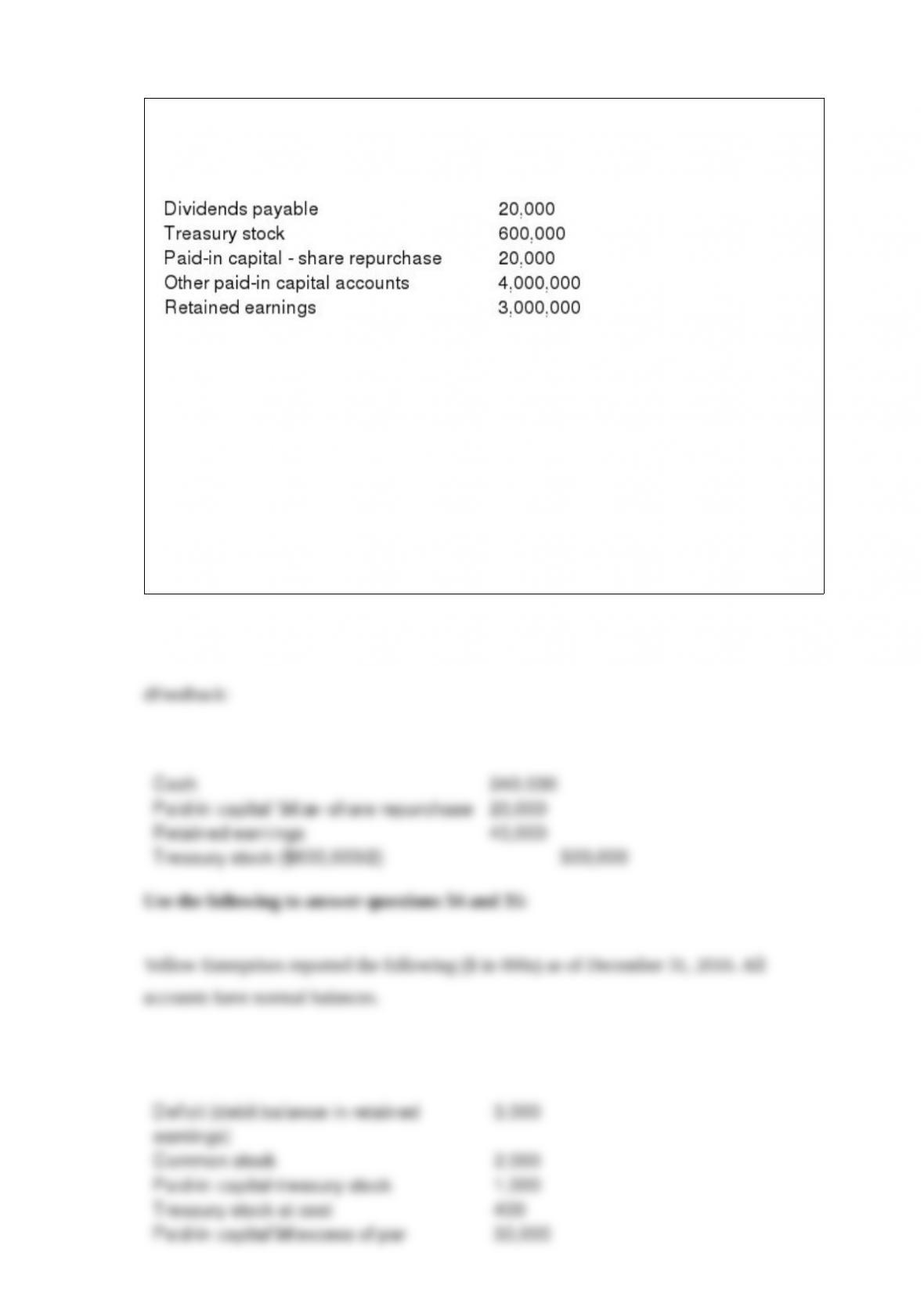
The 2017 sale of half of the treasury stock would:
As of December 31, 2016, Warner Corporation reported the following:
During 2017, half of the treasury stock was resold for $240,000; net income was
$600,000; cash dividends declared were $1,500,000; and stock dividends declared were
$500,000.
a. Reduce income before tax by $60,000.
b. Reduce retained earnings by $60,000.
c. Increase total shareholders’ equity by $300,000.
d. Reduce retained earnings by $40,000.

When we take into account the dilutive effect of stock options, rights, and warrants in
the calculation of EPS, the method used is called the:
a. Optional method.
b. If converted method.
c. Dilution method.
d. Treasury stock method.
In addition to the criteria that must be met by the lessee, the lessor must meet additional
conditions for classification as a capital lease to satisfy revenue recognition criteria.

In its first three years of operations Sharp Chairs reported the following operating
income (loss) amounts:
There were no deferred income taxes in any year. In 2015, Sharp elected to carry back
its operating loss. The enacted income tax rate was 35% in 2014 and 40% thereafter. In
its 2016 balance sheet, what amount should Sharp report as current income tax payable?
a. $ 900,000.
b. $1,260,000.
c. $1,440,000.
d. $2,160,000.
On March 1, 2016, Doll Co. issued 10-year convertible bonds at 106. During 2019, the
bonds were converted into common stock when the market price of Doll’s common
stock was 500 percent above its par value. On March 1, 2016, cash proceeds from the
issuance of the convertible bonds should be reported as:
a. A liability for the entire proceeds.
b. Paid-in capital for the entire proceeds.
c. Paid-in capital for the portion of the proceeds attributable to the conversion feature
and as a liability for the balance.
d. A liability for the face amount of the bonds and paid-in capital for the premium over
the par value.

A contingent loss should be reported in a disclosure note to the financial statements
rather than being accrued if:
a. The likelihood of a loss is remote.
b. The incurrence of a loss is reasonably possible.
c. The incurrence of a loss is more likely than not.
d. The likelihood of a loss is probable.
Which of the following changes is not usually accounted for retrospectively?
a. Change from expensing extraordinary repairs to capitalizing the expenditures.
b. Change from FIFO to LIFO.
c. Change in the composition of firms reporting on a consolidated basis.
d. Change from LIFO to FIFO.

When the interest payment dates are March 1 and September 1, and the bonds are
issued on July 1, the amount of interest expense reported in the December 31 income
statement for the year of issue would be for:
a. Six months.
b. Four months.
c. 10 months.
d. 12 months.
The three components of pension expense that are present most often are:
a. Service cost, prior service cost, and gain on plan assets.
b. Service cost, interest cost, and gain from revisions in pension liability.
c. Service cost, contribution cost, and prior service cost.
d. Service cost, interest cost, and expected return on plan assets.
Lopez Plastics Co. (LPC) issued callable bonds on January 1, 2016. LPC’s accountant
has projected the following amortization schedule from issuance until maturity:
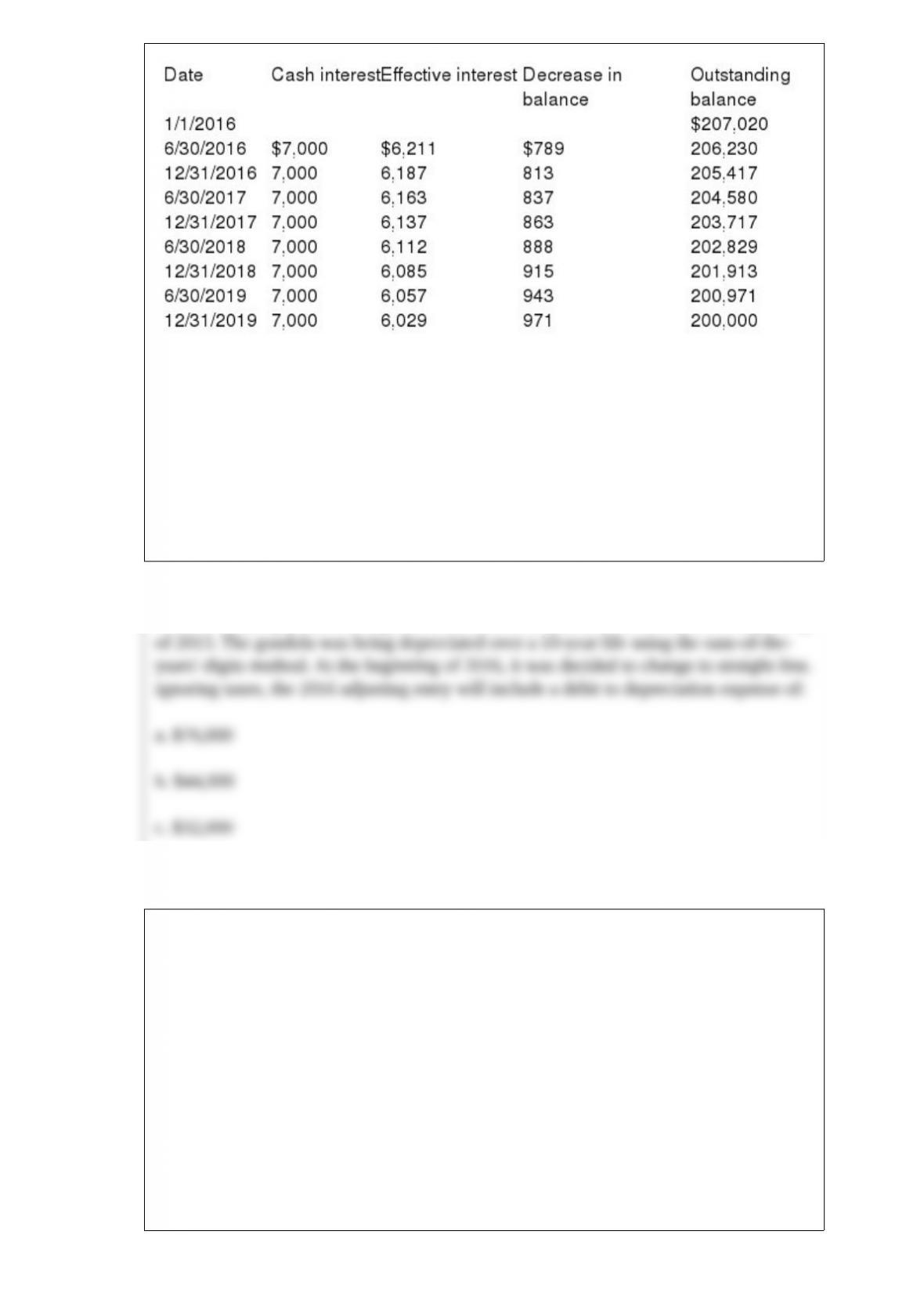
What is the annual stated interest rate on the bonds?
a. 3.5%
b. 6%
c. 7%
d. None of the answer choices is correct.
Venice Company purchased a gondola for $440,000 (no residual value) at the beginning
of 2013. The gondola was being depreciated over a 10-year life using the
sum-of-the-years’-digits method. At the beginning of 2016, it was decided to change to
straight-line. Ignoring taxes, the 2016 adjusting entry will include a debit to
depreciation expense of:
a. $76,000
b. $44,000
c. $32,000
d. $22,000

Most corporate bonds are:
a. Mortgage bonds.
b. Debenture bonds.
c. Secured bonds.
d. Collateral bonds.
What is the rebate promotion liability that Holyoakshould report in its December 31,
2016, balance sheet?
a. $20,000.
b. $28,000.
c. $18,000.
d. $19,000.

Using the gross method, purchase discounts lost are:
a. Included in purchases.
b. Added to accounts payable.
c. Included in interest expense.
d. Deducted from discount income.
A guaranteed residual value at the inception of a capital lease should be:
a. Excluded from minimum lease payments.
b. Included as part of minimum lease payments at present value.
c. Included as part of minimum lease payments at future value.
d. Included as part of minimum lease payments only to the extent that guaranteed
residual value is expected to exceed estimated residual value.
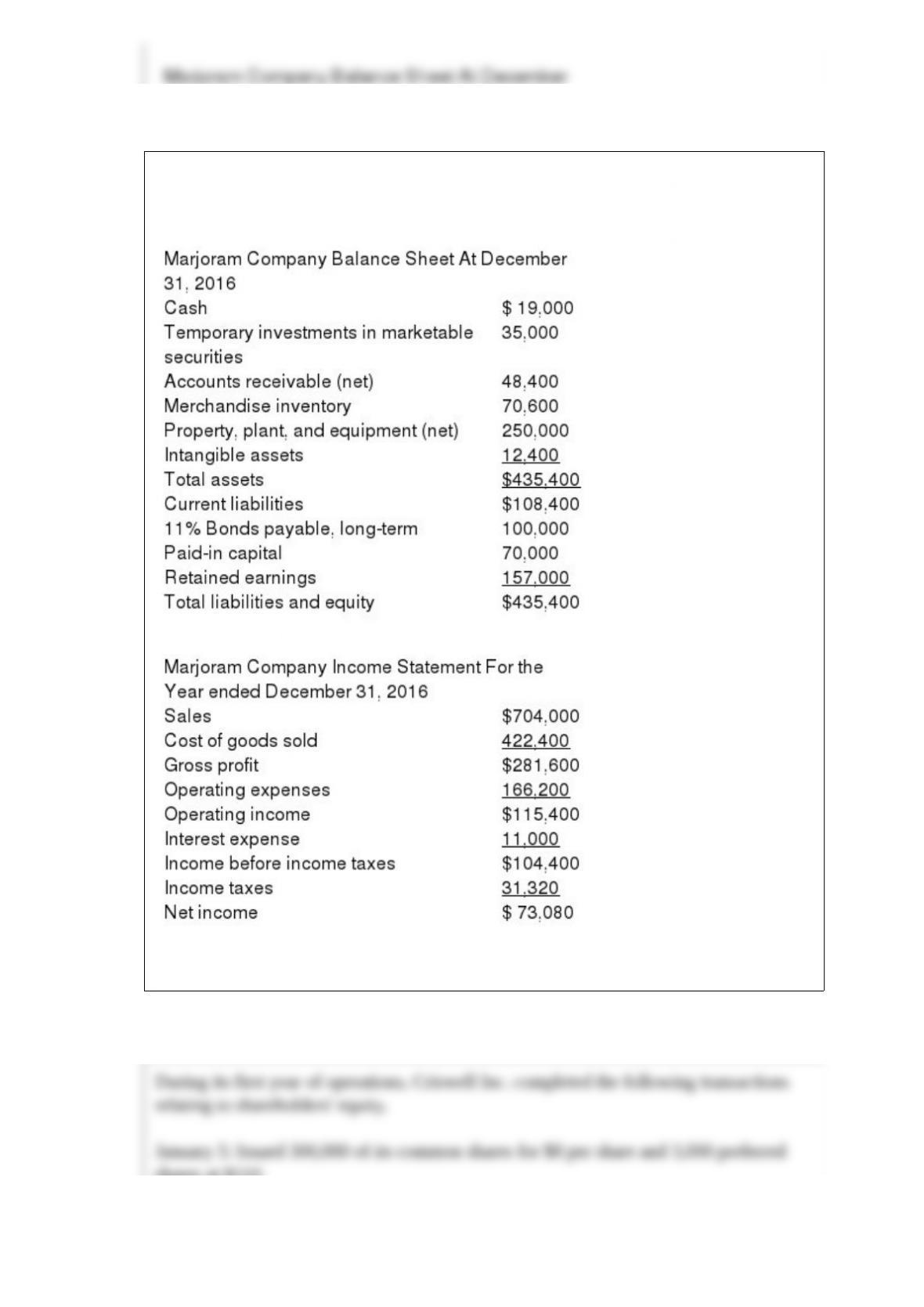
The condensed balance sheet and income statement for Marjoram Company are
presented below.
Compute the current ratio for Marjoram Company. Round your answer to two decimal
places.

During its first year of operations, Criswell Inc. completed the following transactions
relating to shareholders’ equity.
January 5: Issued 300,000 of its common shares for $8 per share and 3,000 preferred
shares at $110.
February 12: Issued 50,000 shares of common stock in exchange for equipment with a
known cash price of $310,000.
The articles of incorporation authorize 5,000,000 shares with a par value of $1 per share
of common and 1,000,000 preferred shares with a par value of $100 per share.
Required:
Record the above transactions in general journal form.
On December 31, 2015, Merlin Company had outstanding 400,000 shares of common
stock and 40,000 shares of 8% cumulative preferred stock (par $10). On February 28,
2016, Merlin issued an additional 36,000 shares of common stock. A 10% stock
dividend was declared and distributed on July 1, 2016. On September 1, 2016, 9,000
shares were retired. At year-end, there were fully vested incentive stock options
outstanding for 30,000 shares of common stock (adjusted for the stock dividend). The
exercise price was $18. The market price of the common stock averaged $20 during the
year. Also outstanding were $1,000,000 face amount of 10% convertible bonds issued
in 2013 and convertible into 50,000 common shares (adjusted for the stock dividend).
Net income was $900,000. The tax rate for the year was 40%.
Required:
Compute basic and diluted EPS (rounded to 2 decimal places) for the year ended
December 31, 2016.

Eastwood Enterprises owns 30,000 shares of the Van Cleef Company (5% of the
outstanding equity of Van Cleef). Eastwood is trying to determine Van Cleef’s fair
value. The relevant facts are as follows:
– Eastwood bought the Van Cleef shares earlier in the accounting period for $10/share at
a time when the shares were publicly traded on the New York Stock Exchange.
– Since Eastwood bought the shares, Van Cleef has been delisted and there is no longer
an active market in the Van Cleef shares.
-Eastwood’s internal valuation specialist estimates the Van Cleef shares to be worth
$8/share. -Eastwood plans to continue holding the shares, but may someday sell them if
their value increases sufficiently.
Required:
(1) What is the fair value of Eastwood’s investment in Van Cleef? Briefly explain your
choice of fair value, and relate that choice to the requirements of GAAP regarding fair
value measurement.
(2) Prepare a journal entry to record any necessary fair value adjustment.

Briefly describe at least two indicators that can be used to distinguish whether a seller is
a principal or an agent according to GAAP.