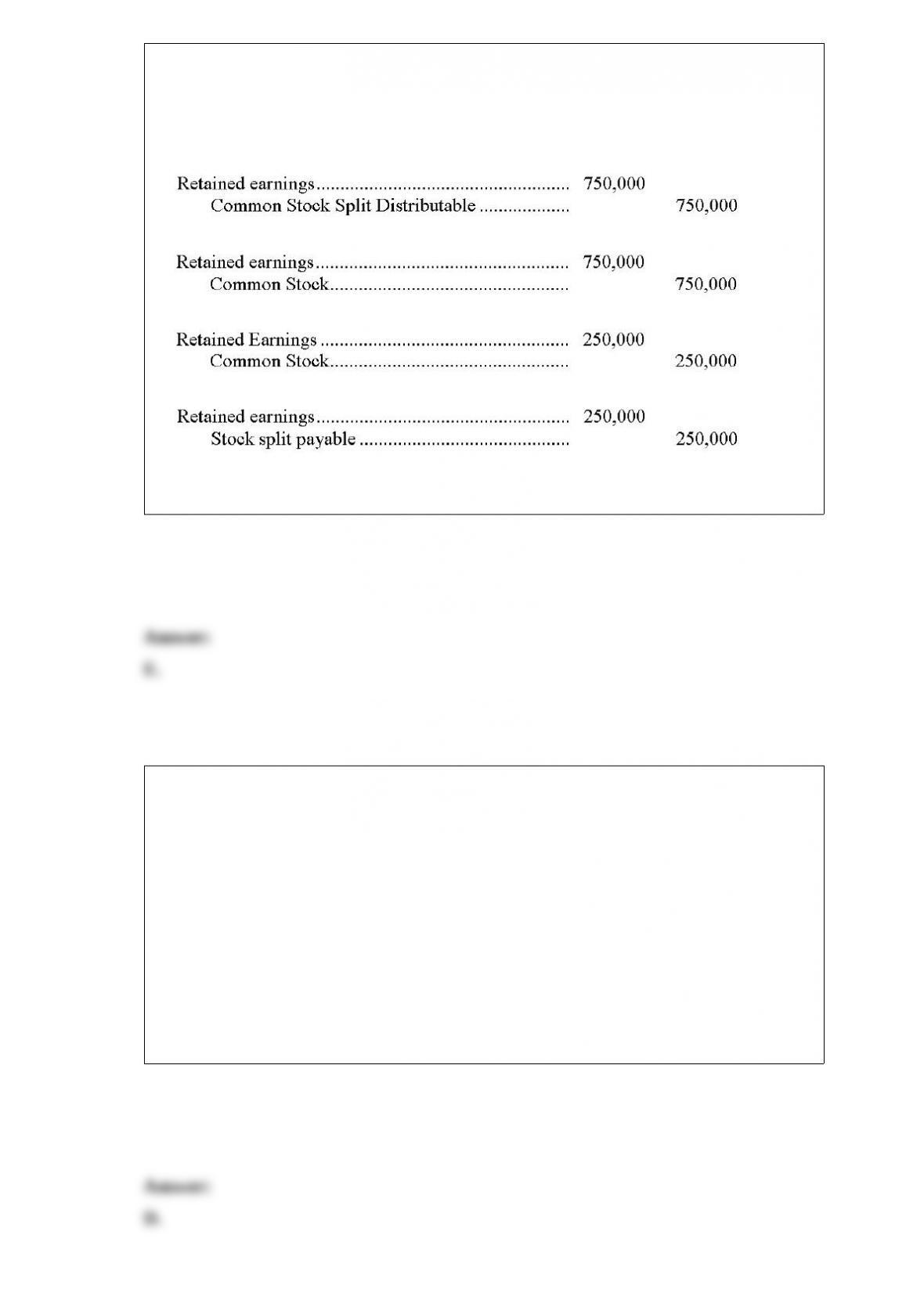
On September 1, a corporation had 50,000 shares of $5 par value common stock, and
$1,000,000 of retained earnings. On that date, when the market price of the stock is $15
per share, the corporation issues a 2-for-1 stock split. The general journal entry to
record this transaction is:
A.
B.
C.
D.
E.No entry is made for this transaction.
Chung owns 40% of Lu’s common stock. Lu pays $97,000 in total cash dividends to its
shareholders. Chung’s entry to record this transaction should include a:
A.Debit to Dividends for $97,000.
B.Debit to Dividends for $38,800.
C.Debit to Long”Term investments for $97,000.
D.Credit to Long”Term Investments for $38,800.
E.Credit to Cash for $97,000.

A managerial accounting report that presents predicted amounts of the company’s
assets, liabilities, and equity as of the end of the budget period is called a(n):
A.Rolling balance sheet.
B.Continuous balance sheet.
C.Budgeted balance sheet.
D.Cash balance sheet.
E.Operating balance sheet.
The purchase of long-term assets by issuing a note payable for the entire amount is
reported on the statement of cash flows in the:
A.Operating activities.
B.Financing activities.
C.Investing activities.
D.Schedule of noncash financing and investing activities.
E.None of these. This is not reported on the statement of cash flows.
Pledging receivables:

A.Allows firms to raise cash.
B.Allows a firm to retain ownership of its receivables.
C.Does not transfer risk of bad debts to the lender.
D.Should be disclosed in the financial statements.
E.All of these.
The understatement of the ending inventory balance causes:
A.Cost of goods sold to be overstated and net income to be understated.
B.Cost of goods sold to be overstated and net income to be overstated.
C.Cost of goods sold to be understated and net income to be understated.
D.Cost of goods sold to be understated and net income to be overstated.
E.Cost of goods sold to be overstated and net income to be correct.
Accounting certifications include the:
A.Certified Public Accountant.
B.Certified Management Accountant.
C.Certified Internal Auditor.

D.Personal Financial Specialist
E.All of these.
An advantage of bond financing is:
A.Bonds do not affect owners’ control.
B.Interest on bonds is tax deductible.
C.Bonds can increase return on equity.
D.It allows firms to trade on the equity.
E.All of these.
Match each of the following terms with the appropriate definitions.
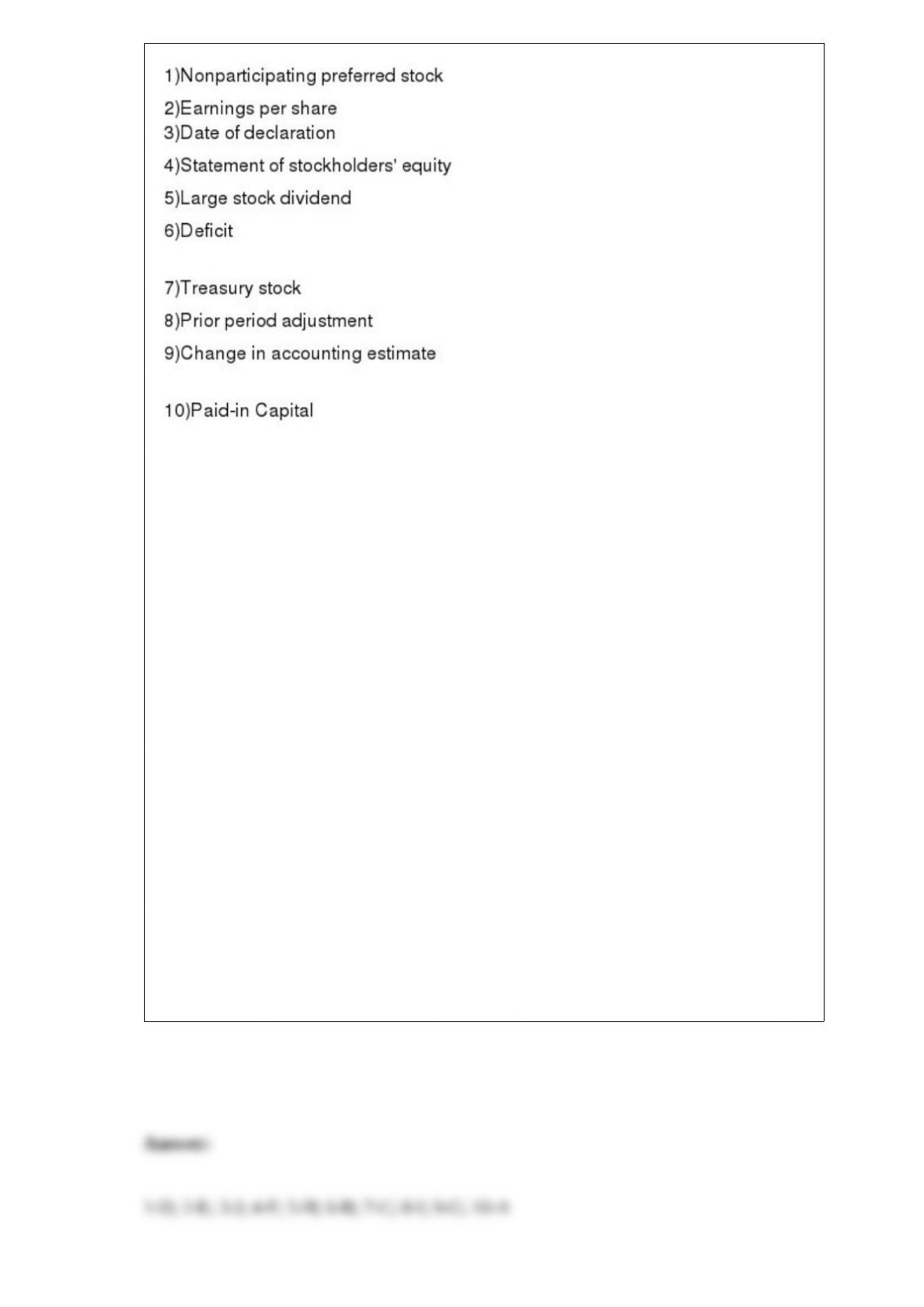
A) The total amount of cash and other assets a corporation receives from its
stockholders in exchange for its stock.
B) An abnormal debit balance in retained earnings.
C)A corporation’s own stock that was reacquired and is still held by the corporation.
D) A feature that limits dividends to a maximum amount each year regardless of excess
dividends declared.
E)Income earned by each share of a company’s outstanding common stock.
F) A financial statement that lists the beginning and ending balances of each equity
account and describes the changes in these accounts during the period.
G) Corrections to previous estimates of future events and outcomes accounted for in
current and future periods.
H)A stock dividend that is more than 25% of the previously outstanding shares.
I)A correction of an error in a prior year that is reported in the statement of retained
earnings or changes in stockholders’ equity net of any income tax effects.
J)The date a corporation’s directors vote to issue a dividend.

The most useful budget figures are developed:
A.From the “top-down”.
B.From the “bottom-up” following a participatory process.
C.Solely by the budget committee.
D.By the CEO.
E.After the accounting period has begun.
A credit is used to record:
A.A decrease in an expense account.
B.A decrease in an asset account.
C.An increase in an unearned revenue account.
D.An increase in a revenue account.
E.All of these.
An internal control system consists of the policies and procedures managers use to:
A.Protect assets.

B.Ensure reliable accounting.
C.Promote efficient operations.
D.Urge adherence to company policies.
E.All of these.
The excess of expected sales over the sales level at the break-even point is known as
the:
A.Sales turnover.
B.Profit margin.
C.Contribution margin.
D.Relevant range.
E.Margin of safety.
Of the following accounts, the one that normally has a credit balance is:
A.Cash.
B.Office Equipment.
C.Sales Salaries Payable.

D.Owner, Withdrawals.
E.Sales Salaries Expense.
The acid-test ratio differs from the current ratio in that:
A.Liabilities are divided by current assets.
B.Prepaid expenses and inventory are excluded from the calculation of the acid-test
ratio.
C.The acid-test ratio measures profitability and the current ratio does not.
D.The acid-test ratio excludes short-term investments from the calculation.
E.The acid-test ratio is a measure of liquidity but the current ratio is not.
In preparing a company’s statement of cash flows for the most recent year on the
indirect method, the following information is available:
Net cash provided by operating activities was:
A.$120,000.

B.$44,000.
C.$70,000.
D.$84,000.
E.$30,000.
An accounts payable ledger is:
A.A subsidiary ledger that contains an account for each supplier (creditor).
B.A list of the balances of all the accounts in the accounts receivable ledger that is
added to show the total amount of accounts receivable outstanding.
C.A book of original entry that is designed and used for recording only a specific type
of transaction.
D.The ledger that contains the financial statement accounts of a business.
E.A subsidiary ledger that contains a separate account for each party that grants both
short-term and long-term credit on account to the company.

The segment return on assets:
A.Can only be determined for international companies.
B.Reflects the profitability of a segment.
C.Is difficult to calculate because companies with traded stock are not required to report
segment information.
D.Is calculated as segment average assets divided by segment operating income.
E.Is calculated as segment sales divided by segment average assets.
A college uses advisors who work with all students in all divisions of the college. The
most useful allocation basis for the salaries of these employees would likely be
A.number of classes run in each division
B.student graduation rate
C.square footage of each division
D.number of students advised from each division
E.relative salaries of division heads
Phildell Phoenix is paid monthly. For the month of January of the current year, he
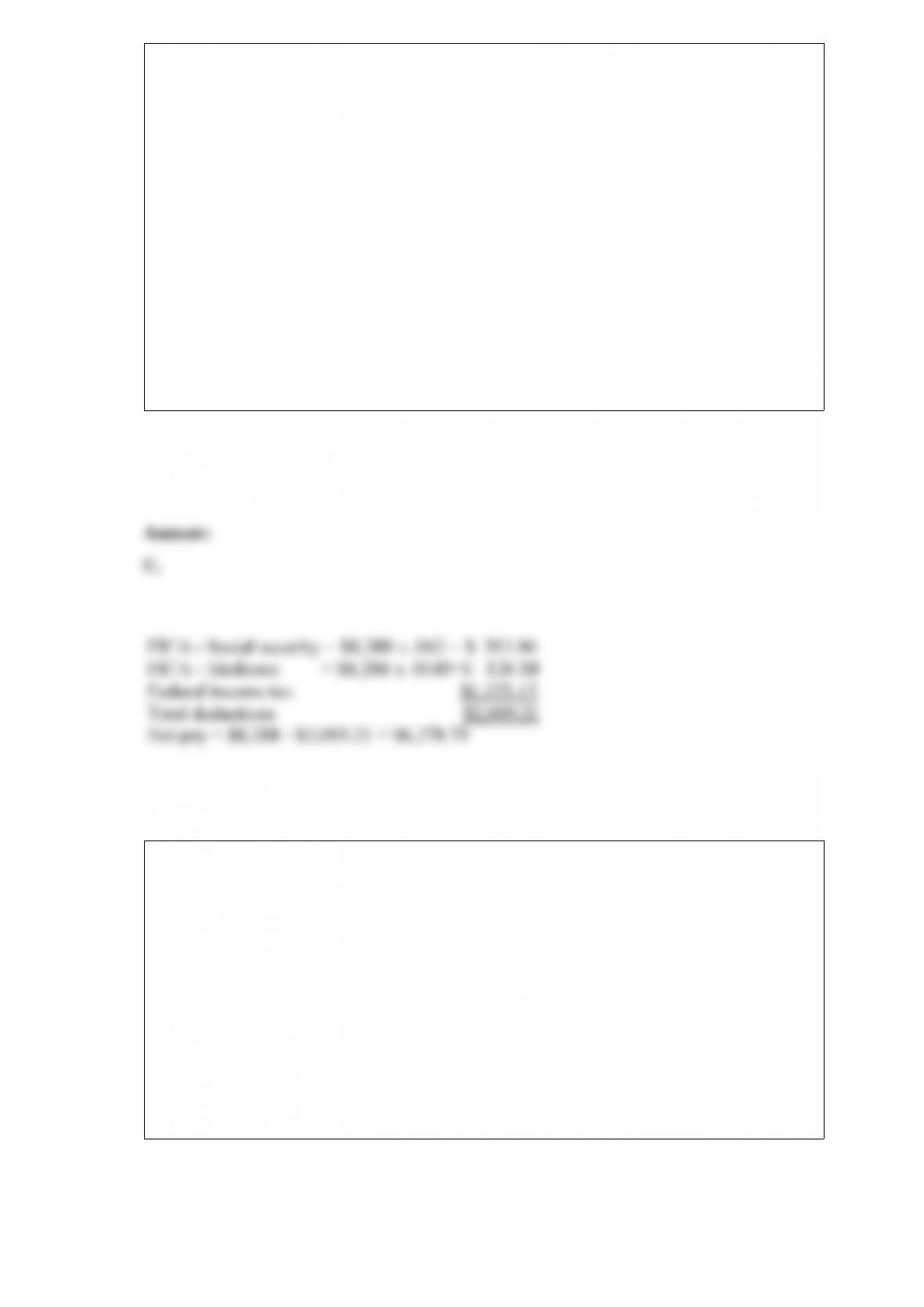
earned a total of $8,288. The FICA tax for social security is 6.2% and the FICA tax rate
for Medicare is 1.45%. The FUTA tax rate is 0.8%, and the SUTA tax rate is 5.4%. Both
unemployment taxes are applied to the first $7,000 of an employee’s pay. The amount of
federal income tax withheld from his earnings was $1,375.17. His net pay for the month
is:
A.$5,190.83
B.$5,844.79
C.$6,278.79
D.$6,566.00
E.$6,792.64
An important tool in predicting the volume of activity, the costs to be incurred, the sales
to be earned, and the profit to be received is:
A.Target income analysis.
B.Cost-volume-profit analysis.
C.Least-squares regression of costs.
D.Variance analysis.
E.Process costing.
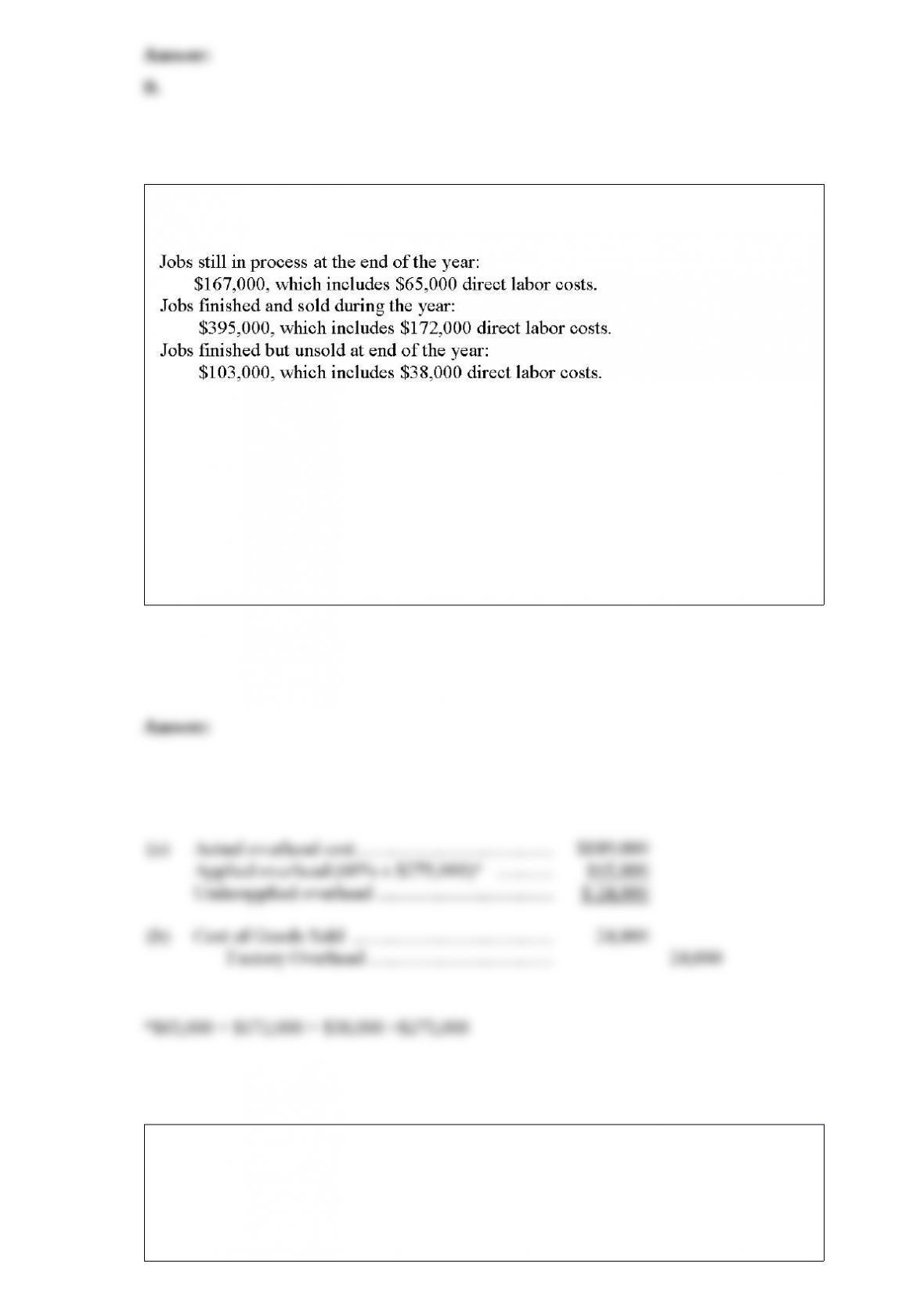
Samer Corp. uses a job order cost accounting system. The following is selected
information pertaining to costs applied to jobs during the year:
Samer Corp.’s predetermined overhead allocation rate is 60% of direct labor cost. At the
end of the year, the company’s records show that $189,000 of factory overhead has been
incurred.
(a) Determine the amount of overapplied or underapplied overhead.
(b) Prepare the necessary journal entry to close the Factory Overhead account assuming
that any remaining balance is not material.
Costs that flow directly to the current income statement are called:
A.Period costs.
B.Product costs.

C.General costs.
D.Balance sheet costs.
E.Capitalized costs.
Tart Company’s most recent balance sheet reports total assets of $42,000,000, total
liabilities of $16,000,000 and stockholders’ equity of $26,000,000. Management is
considering using $3,000,000 of excess cash to prepay $3,000,000 of outstanding
bonds. What effect, if any, would prepaying the bonds have on the company’s
debt-to-equity ratio?
A.Prepaying the debt would cause the firm’s debt-to-equity ratio to improve from .62
to .50.
B.Prepaying the debt would cause the firm’s debt-to-equity ratio to improve from .62
to .57.
C.Prepaying the debt would cause the firm’s debt-to-equity ratio to worsen from .62 to .
50.
D.Prepaying the debt would cause the firm’s debt-to-equity ratio to worsen from .62 to .
57.
E.Prepaying the debt would cause the firm’s debt-to-equity ratio to remain unchanged.

A table that shows the amount of federal income tax to be withheld from an employee’s
pay is the:
A.Form 941.
B.Tax table.
C.Wage bracket withholding table.
D.W-2.
E.W-4.
A collection of all accounts and their balances used by a business is called a:
A.Journal.
B.Book of original entry.
C.General Journal.
D.Balance column journal.
E.Ledger.

Which of the following procedures would weaken control over cash receipts that arrive
through the mail?
A.After the mail is opened, a list (in triplicate) of the money received is prepared with a
record of the sender’s name, the amount, and an explanation of why the money is sent.
B.The bank reconciliation is prepared by a person who does not handle cash or record
cash receipts.
C.For safety, only one person should open the mail, and that person should immediately
deposit the cash received in the bank.
D.The cashier should not also be the record keeper who records the amounts received in
the accounting records.
E.All of these are good internal control procedures over cash receipts that arrive
through the mail.
Match the following terms with the appropriate definition.
1)Current ratio
2)Owner’s capital
3)Classified balance sheet
4)Closing entries
5)Plant assets
6)Unclassified balance sheet
7)Current liabilities

8)Current assets
9)Intangible assets
10)Long-term investments
A) Tangible long-lived assets used to produce or sell products or services.
B) The owner’s claim on the assets of a company.
C) A balance sheet that organizes the assets and liabilities into important subgroups.
D) Long-term assets used to produce or sell products or services; these assets usually
lack physical form and their benefits are uncertain.
E) A ratio that is used to help evaluate a company’s ability to pay its short-term
obligations, calculated by dividing current assets by current liabilities.
F) Entries recorded at the end of each accounting period to transfer end-of-period
balances in revenue, expense, and withdrawals accounts to the permanent owner’s
capital account.
G) Debts that are due to be paid or settled within one year or the operating cycle of a
business whichever is longer.
H)Assets such as notes receivable or investments in stocks which are held for the longer
of one year or the operating cycle of the company.
I) Cash or other assets that are expected to be sold, collected, or used within one year or
the company’s operating cycle whichever is longer.
J)A balance sheet that broadly groups assets, liabilities and equity items.
The balances in the unadjusted columns of a work sheet will agree with:
A.the balances reflected in the company’s financial statements.
B.the balances reflected in the company’s unadjusted trial balance.
C.whatever balances management has decided to report.

D.the balances in the company’s post-closing trial balance.
E.the balances management budgeted for the accounting period.
The Discount on Bonds Payable account is:
A.A liability.
B.A contra liability.
C.An expense.
D.A contra expense.
E.A contra equity.
Hartman Co. has fixed costs of $36,000 and a contribution margin ratio of 24%. If
expected sales are $200,000, what is the margin of safety as a percent of sales?
A.6%.
B.25%.
C.33%.
D.50%.
E.75%.

Preferred stock with a feature allowing preferred stockholders to share with common
shareholders in any dividends in excess of the percent or dollar amount stated on the
preferred stock is called:
A.Cumulative preferred stock.
B.Callable preferred stock.
C.Participating preferred stock.
D.Convertible preferred stock.
E.Preferential preferred stock.
Output devices include:
A.Printers.
B.Monitors.
C.LCD projectors.
D.Web communications.
E.All of these.
A company’s income before interest expense and income taxes in 2008 and 2009 is
$395,000 and $427,000, respectively. Its fixed interest expense was $125,000 for both
years. Calculate the company’s times interest earned ratio, and comment on its level of
risk.
Josephine’s Bakery had the following assets and liabilities at the beginning and end of
the current year:
If Josephine invested an additional $12,000 in the business and withdrew $5,000 during
the year, what was the amount of net income earned by Josephine’s Bakery?
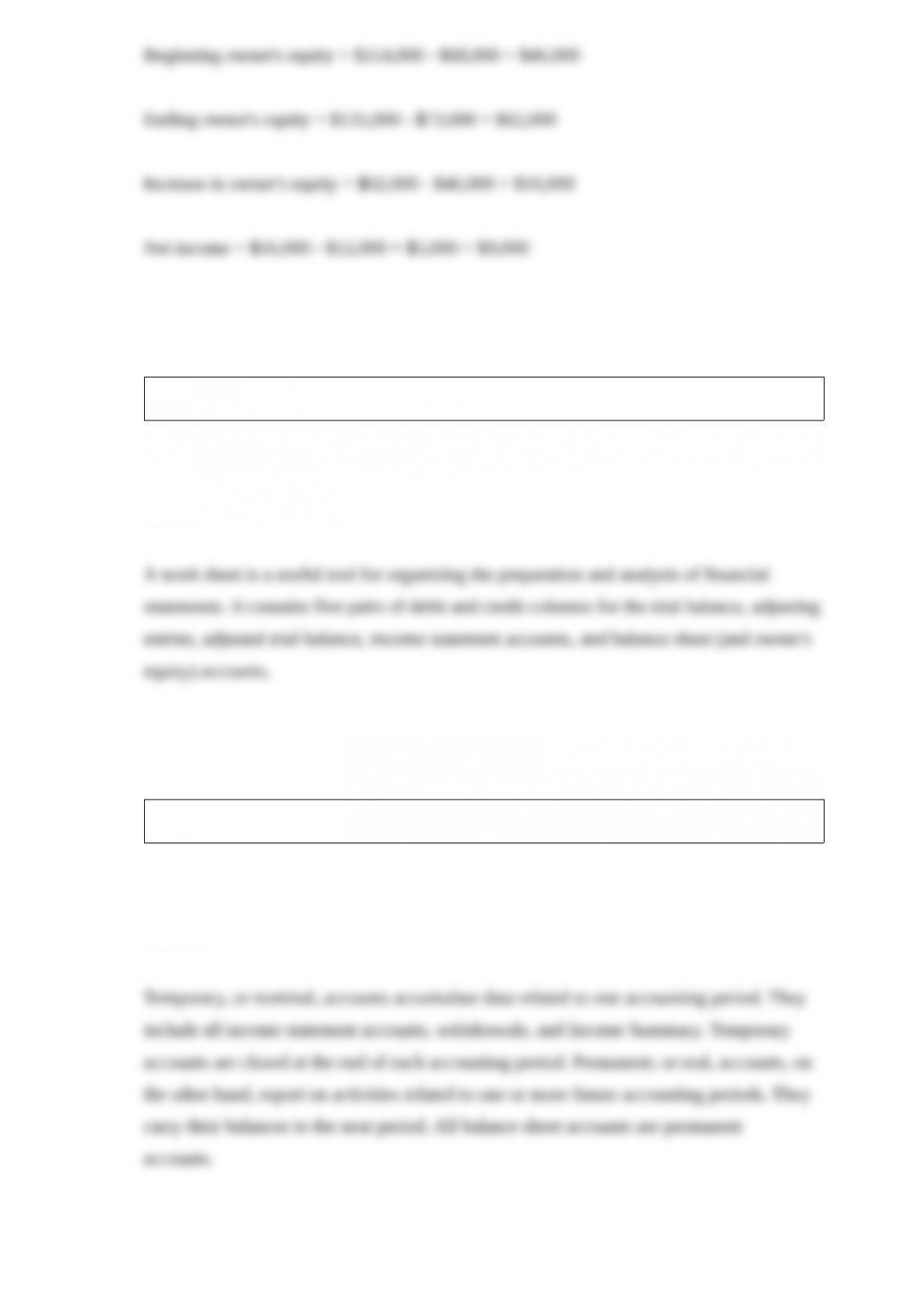
Describe a work sheet and explain why it is useful.
Explain the difference between temporary and permanent accounts.
A _________________ cost does not change in proportion to changes in the volume of
activity within the relevant range.
If partners agree on how to share income, but say nothing about losses, then losses are
shared ___________________.
A _____________________ income statement format shows detailed computations of
net sales and other costs and expenses, and reports subtotals for various classes of
items.
The ____________________ ratio reflects how much inventory is available in terms of
days’ sales.
An audit is _______________ of an organization’s accounting systems and records.
Unsecured bonds are also called ____________________, and are backed by the
issuer’s general credit standing.
The __________________ principle requires that an accounting information system
conform with a company’s activities, personnel, and structure, and must adapt to a
company’s unique characteristics.