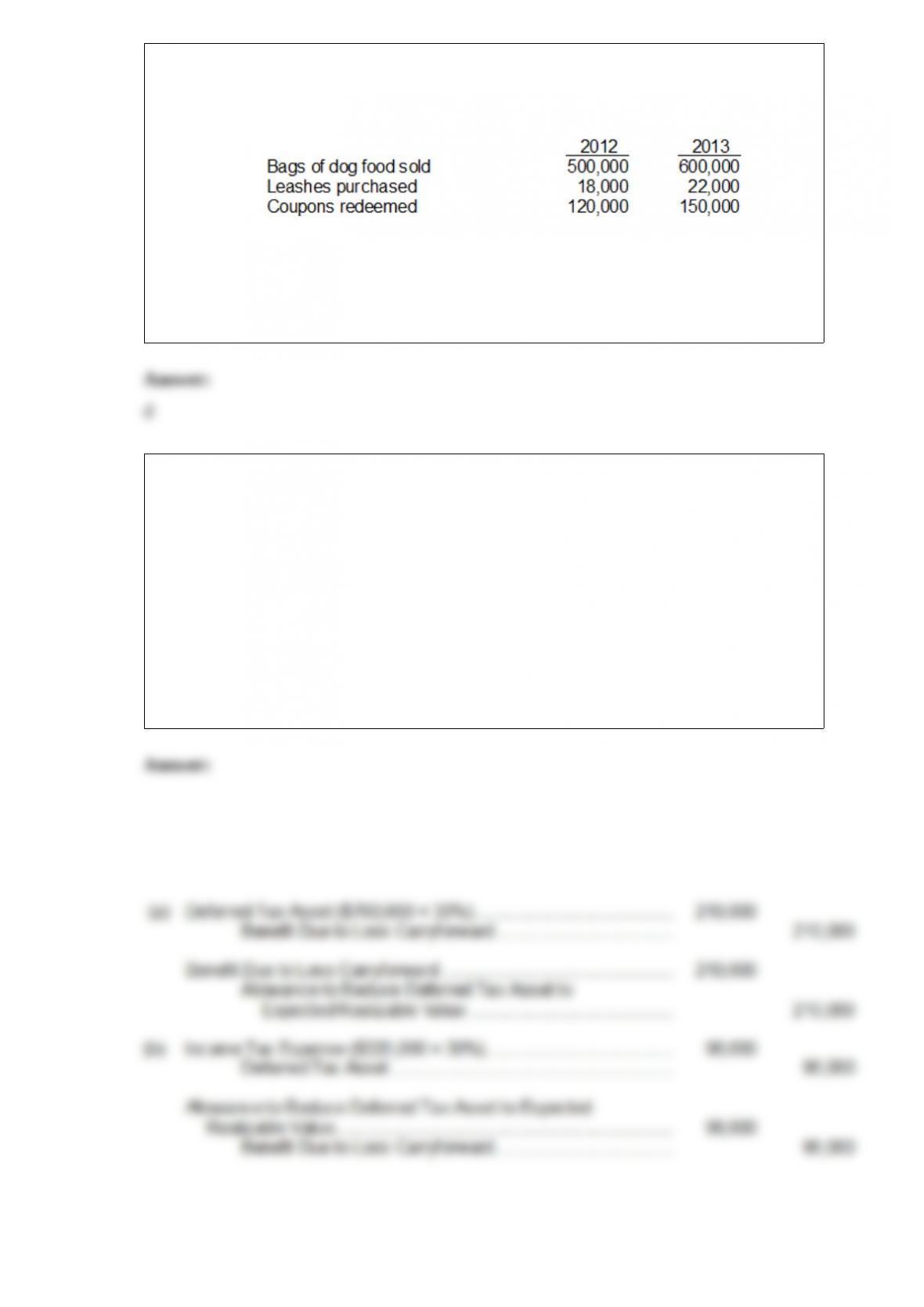
1) mott co. includes one coupon in each bag of dog food it sells. in return for eight
coupons, customers receive a leash. the leashes cost mott $3 each. mott estimates that
40 percent of the coupons will be redeemed. data for 2012 and 2013 are as follows:
the premium liability at december 31, 2012 is
a.$11,250
b.$15,000
c.$26,250
d.$30,000
2) in 2012, its first year of operations, kimble corp. has a $700,000 net operating loss
when the tax rate is 30%. in 2013, kimble has $320,000 taxable income and the tax rate
remains 30%.
instructions
assume the management of kimble corp. thinks that it is more likely than not that the
loss carryforward will not be realized in the near future because it is a new company
(this is before results of 2013 operations are known).
(a)what are the entries in 2012 to record the tax loss carryforward?
(b)what entries would be made in 2013 to record the current and deferred income taxes
and to recognize the loss carryforward? (assume that at the end of 2013 it is more likely
than not that the deferred tax asset will be realized.)

3) checkers uses the periodic inventory system. for the current month, the beginning
inventory consisted of 2,400 units that cost $12 each. during the month, the company
made two purchases: 1,000 units at $13 each and 4,000 units at $13.50 each. checkers
also sold 4,300 units during the month. using the fifo method, what is the ending
inventory?
a.$40,146
b.$37,200
c.$41,850
d.$37,900
4) proceeds from an issue of debt securities having stock warrants should not be
allocated between debt and equity features when
a.the market value of the warrants is not readily available
b.exercise of the warrants within the next few fiscal periods seems remote
c.the allocation would result in a discount on the debt security
d.the warrants issued with the debt securities are nondetachable
5) ziegler company self insures its property for fire and storm damage. if the company
were to obtain insurance on the property, it would cost them $1,500,000 per year. the
company estimates that on average it will incur losses of $1,200,000 per year. during
2012, $525,000 worth of losses were sustained. how much total expense and/or loss
should be recognized by ziegler company for 2012?
a.$525,000 in losses and no insurance expense
b.$525,000 in losses and $675,000 in insurance expense
c.$0 in losses and $1,200,000 in insurance expense
d.$0 in losses and $1,500,000 in insurance expense
6) during 2013, a construction company changed from the completed-contract method
to the percentage-of-completion method for accounting purposes but not for tax
purposes. gross profit figures under both methods for the past three years appear below:
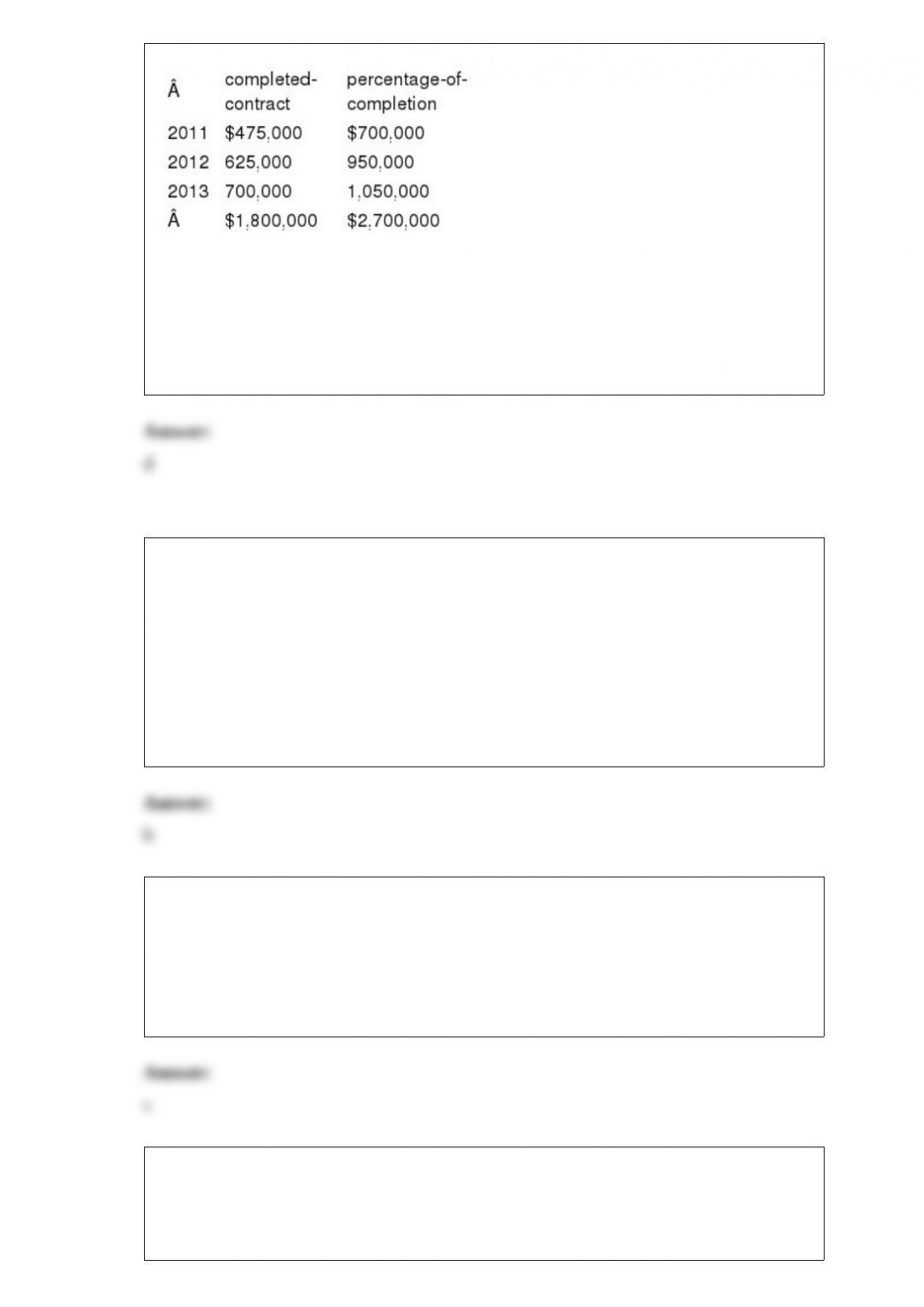
assuming an income tax rate of 40% for all years, the affect of this accounting change
on prior periods should be reported by a credit of
a.$540,000 on the 2013 income statement
b.$330,000 on the 2013 income statement
c.$540,000 on the 2013 retained earnings statement
d.$330,000 on the 2013 retained earnings statement
7) allen corp.’s liability account balances at june 30, 2013 included a 10% note payable
in the amount of $3,000,000. the note is dated october 1, 2011 and is payable in three
equal annual payments of $1,000,000 plus interest. the first interest and principal
payment was made on october 1, 2012. in allen’s june 30, 2013 balance sheet, what
amount should be reported as accrued interest payable for this note?
a.$225,000
b.$150,000
c.$75,000
d.$50,000
8) milner company will invest $400,000 today. the investment will earn 6% for 5 years,
with no funds withdrawn. in 5 years, the amount in the investment fund is
a.$400,000
b.$520,000
c.$535,292
d.$536,116
9) a principal objection to the straight-line method of depreciation is that it
a.provides for the declining productivity of an aging asset
b.ignores variations in the rate of asset use
c.tends to result in a constant rate of return on a diminishing investment base
d.gives smaller periodic write-offs than decreasing charge methods
10) which of the following is a characteristic of a perpetual inventory system?
a.inventory purchases are debited to a purchases account
b.inventory records are not kept for every item
c.cost of goods sold is recorded with each sale
d.cost of goods sold is determined as the amount of purchases less the change in
inventory
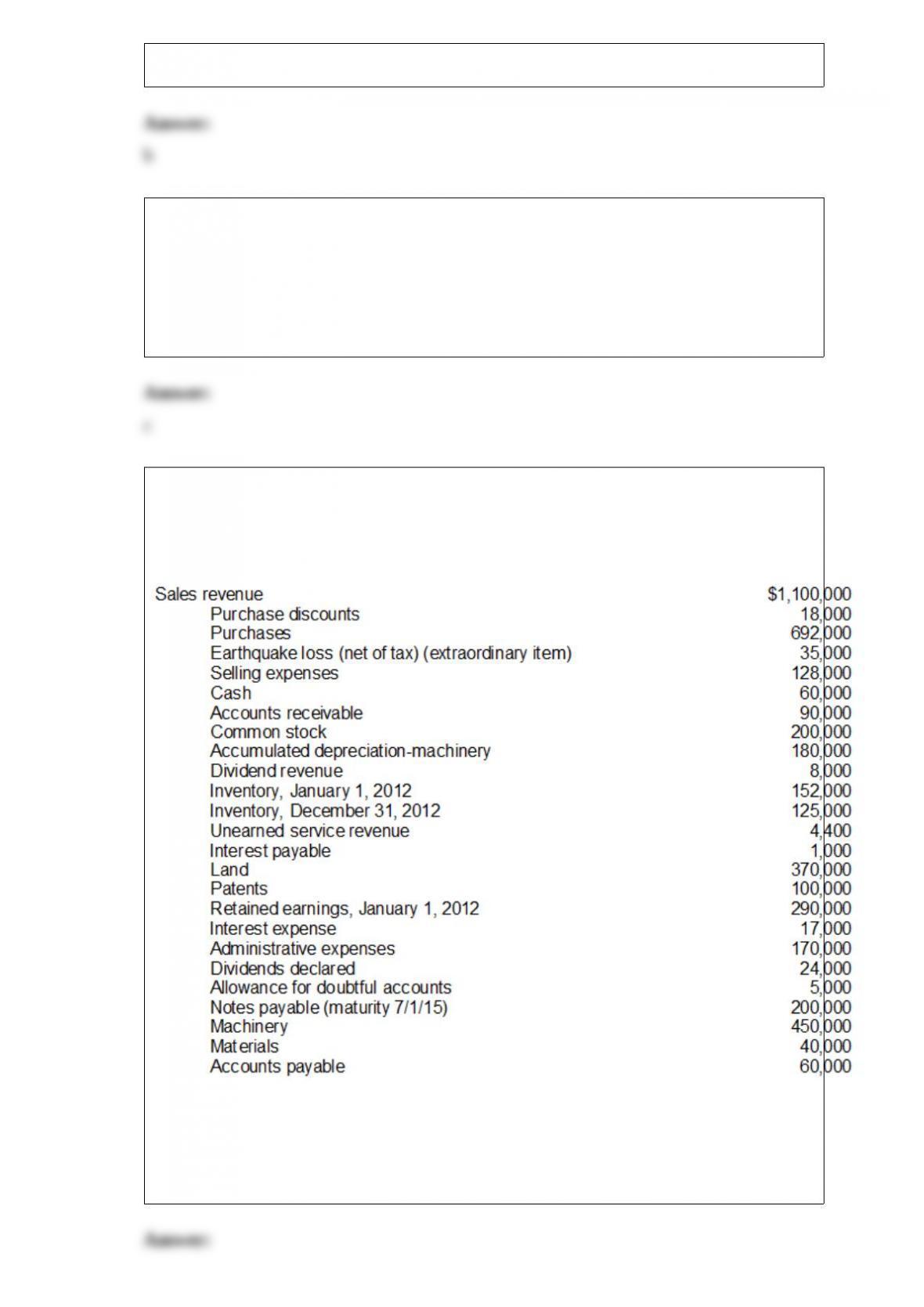
11) porter corporation’s capital structure consists of 50,000 shares of common stock. at
december 31, 2012 an analysis of the accounts and discussions with company officials
revealed the following information:
the amount of income taxes applicable to ordinary income was $27,600, excluding the
tax effect of the earthquake loss which amounted to $15,000.
instructions
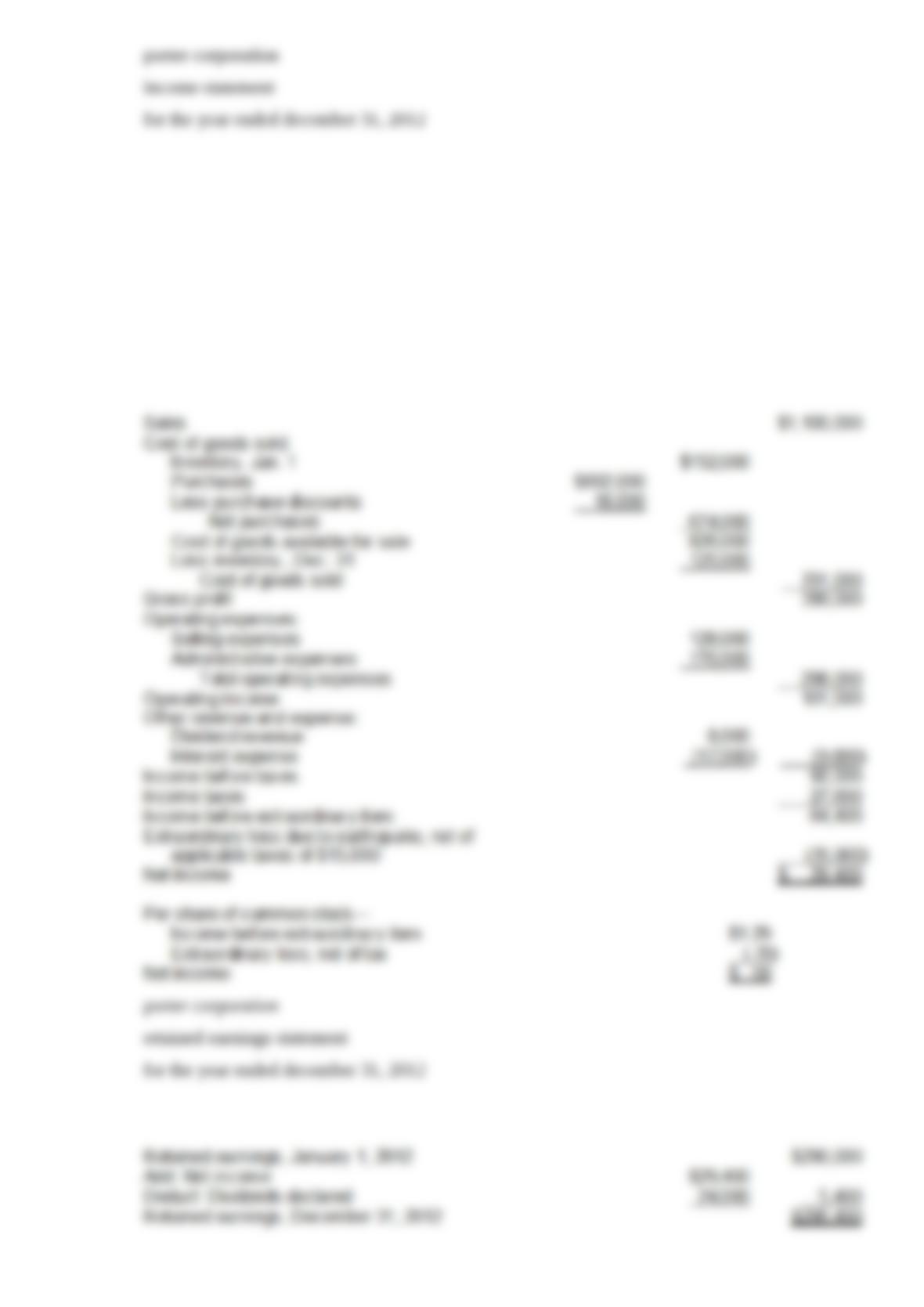
(a)prepare a multiple-step income statement.
(b)prepare a retained earnings statement.
12) which of the following is considered cash?
a.certificates of deposit (cds)
b.money market checking accounts
c.money market savings certificates
d.postdated checks
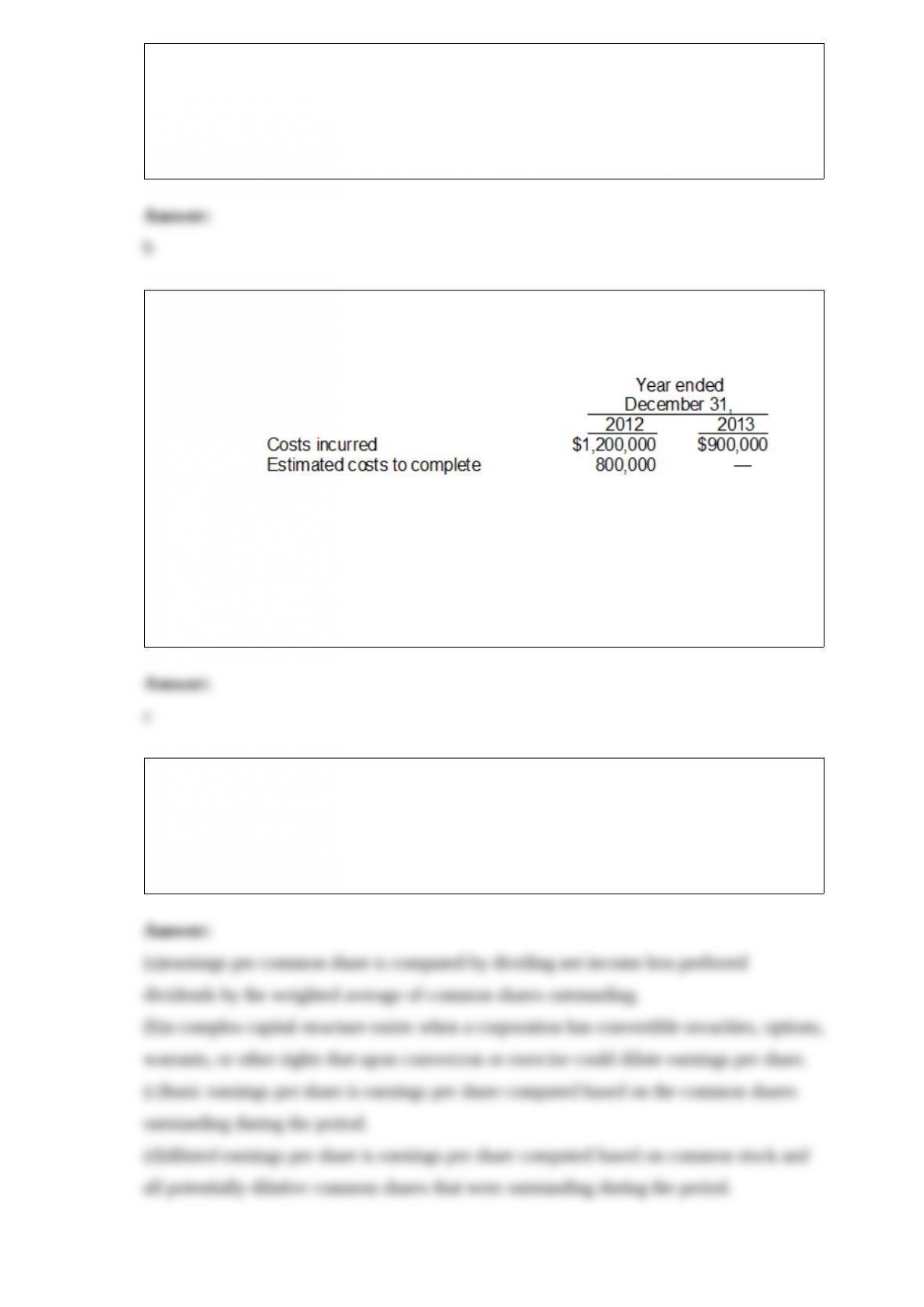
13) hayes construction corporation contracted to construct a building for $3,000,000.
construction began in 2012 and was completed in 2013. data relating to the contract are
summarized below:
hayes uses the percentage-of-completion method as the basis for income recognition.
for the years ended december 31, 2012, and 2013, respectively, hayes should report
gross profit of
a.$540,000 and $360,000.
b.$1,800,000 and $1,200,000.
c.$600,000 and $300,000.
d.$0 and $900,000.
14) define the following:
(a)the computation of earnings per common share
(b)complex capital structure
(c)basic earnings per share
(d)diluted earnings per share

15) what is not a source of pressure that may influence the accounting standard setting
process?
a.congress
b.lobbyist
c.cpa firms
d.none of the above
16) as in u.s. gaap, under ifrs the costs associated with research and development are
segregated into
a.two components, the research phase and the production phase
b.two components, the research phase and the development phase
c.three components, the planning phase, the research phase and the production phase
d.three components, the analysis phase, the development phase and the production
phase
17) if common stock was issued to acquire an $8,000 machine, how would the
transaction appear on the statement of cash flows?
a.it would depend on whether you are using the direct or the indirect method
b.it would be a positive $8,000 in the financing section and a negative $8,000 in the
investing section
c.it would be a negative $8,000 in the financing section and a positive $8,000 in the
investing section
d.it would not appear on the statement of cash flows but rather on a schedule of noncash
investing and financing activities
18) in certain cases, revenue is recognized at the completion of production even though
no sale has been made. which of the following statements is not true?
a.examples involve precious metals or farm equipment
b.the products possess immediate marketability at quoted prices
c.no significant costs are involved in selling the product
d.all of these statements are true