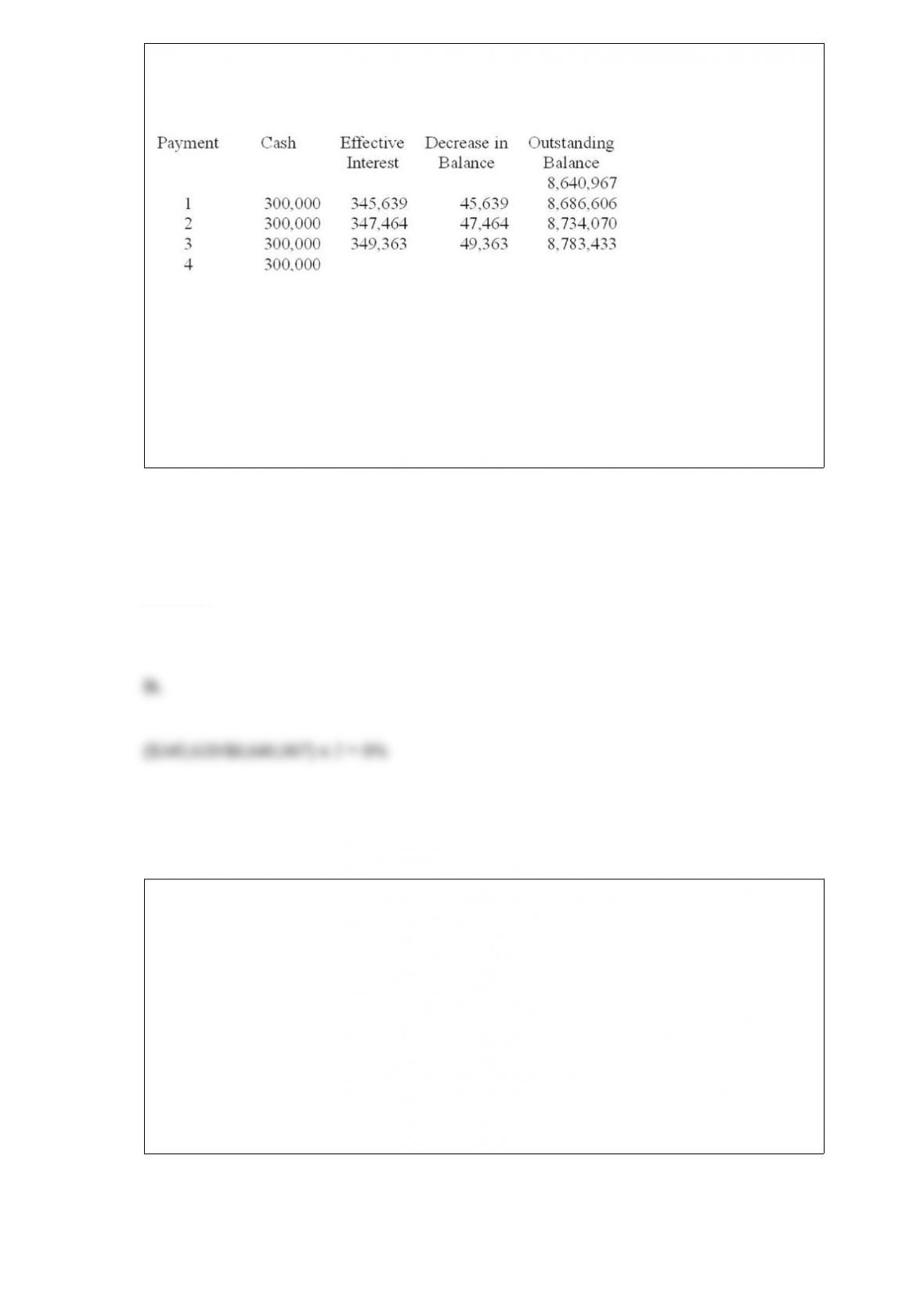
Discount-Mart issued ten thousand $1,000 bonds on January 1, 2013. The bonds have a
10-year term and pay interest semiannually. This is the partial bond amortization
schedule for the bonds.
What is the effective annual rate of interest on the bonds? A. 3%.
B. 4%.
C. 6%.
D. 8%.
Answer:
Cramer Company sold five-year, 8% bonds on October 1, 2013. The face amount of the
bonds was $100,000, while the issue price was $102,000. Interest is payable on April 1
of each year. The fiscal year of Cramer Company ends on December 31. How much
interest expense will Cramer Company report in its December 31, 2013, income
statement (assume straight-line amortization)? A. $2,000.
B. $1,900.
C. $1,778.
D. $2,040.

Answer:
Which of the following differences between financial accounting and tax accounting
ordinarily creates a deferred tax asset? A. Tax depreciation in excess of book
depreciation.
B. Revenue collected in advance.
C. The installment sales method for tax purposes.
D. None of the above.
Answer:
The exclusive right to benefit from a creative work, such as a film, is a: A. Patent.
B. Copyright.
C. Trademark.
D. Franchise.
Answer:

Intraperiod income tax presentation is primarily a matter of: A. Valuation.
B. Going concern.
C. Periodicity.
D. Allocation.
Answer:
Mobic Inc. acquired some manufacturing equipment in January 2010 for $400,000 and
depreciated it $40,000 each year for three years on a straight-line basis. During 2013,
the manufacturer announced a new technology for this type of equipment that will make
the old models obsolete by the end of 2016. As a result, Mobic will plan to replace the
equipment at that time, effectively reducing the asset’s life from ten to seven years. In
its financial statements for 2013, Mobic should: A. Charge $280,000 in depreciation
expense.
B. Report the book value of the equipment in its12/31/2013 balance sheet at $210,000.
C. Make an adjustment to retained earnings for the error in measuring depreciation
during 2010-2012.
D. None of the above is correct.
Answer:

When preferred stock is purchased by the issuing corporation at a price below the
original issue price and the stock is retired, the transaction: A. Increases net income for
the year.
B. Increases retained earnings.
C. Increases revenue for the year.
D. Increases paid-in capital share repurchase.
Answer:
Listed below are five terms followed by a list of phrases that describe or characterize
each of the terms. Match each phrase with the most correct term. 1)Short-term note
2)Advances from customers
3)Secured loan
4)Warranty liability

5)Probable
A. Most common temporary financing arrangement
B. A loss contingency accrued in the period of related sales
C. Liabilities when received
D. Confirming event is likely to occur
E. Requires collateral
Answer:
What is the effective interest rate (rounded) on a 3-month, noninterest-bearing note with
a stated rate of 12% and a maturity value of $200,000? A. 12.4%.
B. 12.0 %.
C. 11.5%.
D. 3.0%.
Answer:

During periods when costs are rising and inventory quantities are stable, cost of goods
sold will be: A. Higher under FIFO than LIFO.
B. Higher under FIFO than average cost.
C. Lower under average cost than LIFO.
D. Lower under LIFO than FIFO.
Answer:
An argument against the use of LCM is its lack of: A. Relevance.
B. Reliability.
C. Consistency.
D. Objectivity.
Answer:

Under IAS No. 39, which is not a category for accounting for investments? A. Fair value
through profit and loss.
B. Fair value through other comprehensive income.
C. Held-to-maturity.
D. Available-for-sale.
Answer:
Which of the following statements typifies defined contribution plans? A. Investment
risk is borne by the corporation sponsoring the plan.
B. The plans are more complex than defined benefit plans.
C. Present value factors are used to determine the annual contributions to the plan.
D. The employer’s obligation is satisfied by making the periodic contribution to the
plan.
Answer:
Liabilities payable within the coming year are classified as long-term liabilities if
refinancing is completed before date of issuance of the financial statements under: A.

US GAAP.
B. IFRS.
C. Either U.S. GAAP and IFRS.
D. Neither U.S. GAAP and IFRS.
Answer:
Bloomfield Bakers accounts for its investment in Clor Confectionary under the equity
method. Bloomfield carried the Clor investment at $150,000 and $165,000 at December
31, 2012 and 2013, respectively. During 2013 Clor recognized $80,000 of net income
and paid dividends of $30,000. Assuming that Bloomfield owned the same percentage
of Clor throughout 2013, their percentage ownership must have been: A. 15%.
B. 18.75%.
C. 30%.
D. 50%.
Answer:

Trading securities are most commonly found on the books of: A. Oil companies.
B. Manufacturing companies.
C. Banks.
D. Foreign subsidiaries.
Answer:
Under its executive stock option plan, Z Corporation granted options on January 1,
2013, that permit executives to purchase 15 million of the company’s $1 par common
shares within the next eight years, but not before December 31, 2015 (the vesting date).
The exercise price is the market price of the shares on the date of grant, $18 per share.
The fair value of the options, estimated by an appropriate option pricing model, is $4
per option. No forfeitures are anticipated. The options expired in 2019 without being
exercised. By what amount will Z’s shareholder’s equity be increased? A. $60 million.
B. $270 million.
C. $315 million.
D. $330 million.
Answer:
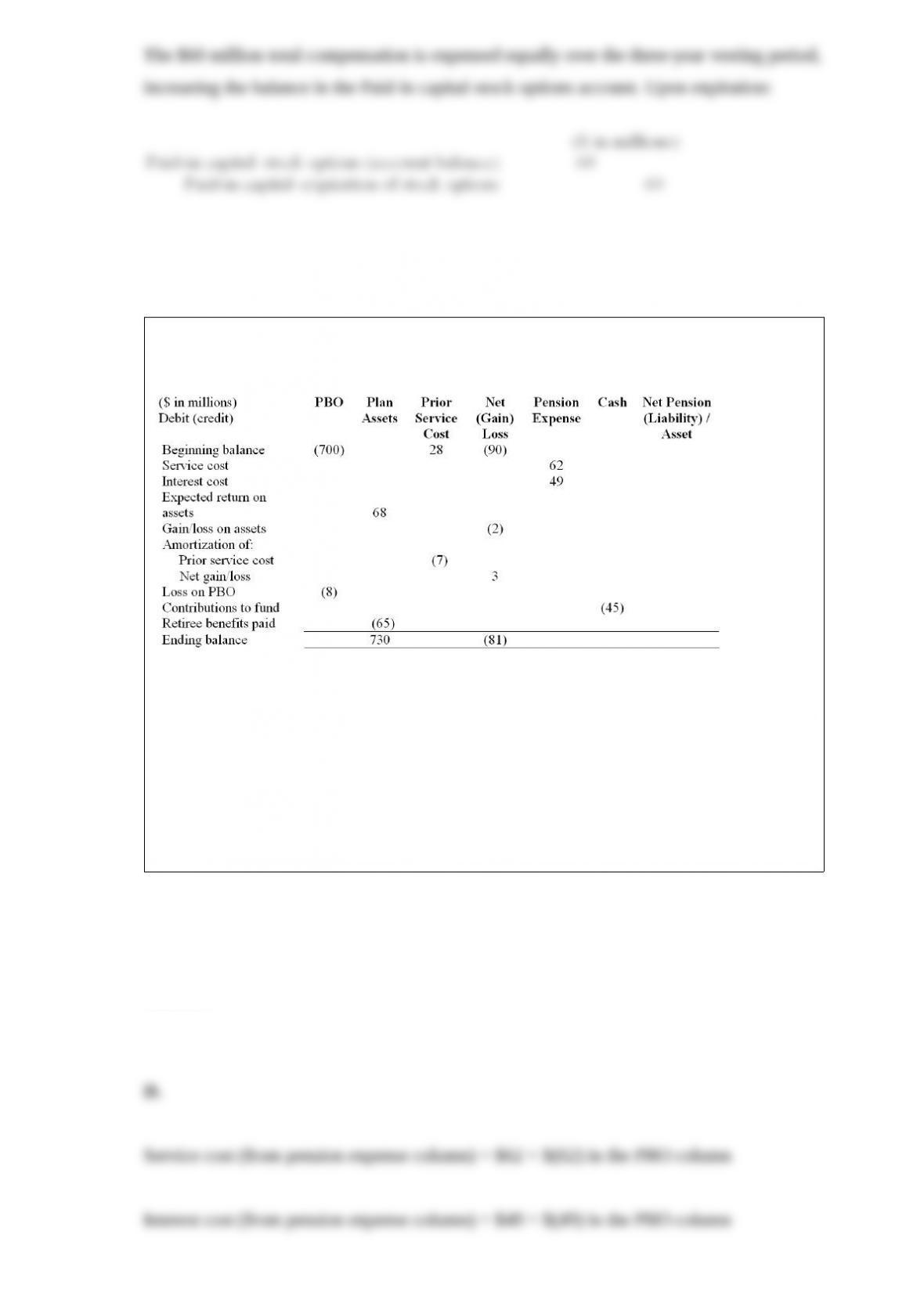
The following incomplete (columns have missing amounts) pension spreadsheet is for
the current year for First Republic Corporation (FRC).
What was the net pension asset/liability reported in the balance sheet at the end of the
year? A. Net pension asset of $50.
B. Net pension asset of $24.
C. Net pension liability of $50.
D. Net pension liability of $24.
Answer:

Listed below are the reporting classifications for a statement of cash flows using the
direct method for reporting operating cash flows. Indicate the reporting classification
that would apply to each of the five transactions described below by placing the number
of the reporting classification in the space provided by each transaction. 1) Operating
cash inflow
2) Investing cash inflow
3) Investing cash outflow
4) Financing cash inflow
5) Noncash financing and investing activity
A. Cash collected on accounts receivable
B. Payment of a property dividend
C. Cash collection of a nontrade note receivable
D. Cash purchase of securities issued by another corporation
E. Issuance of a long-term note payable for cash
Answer:
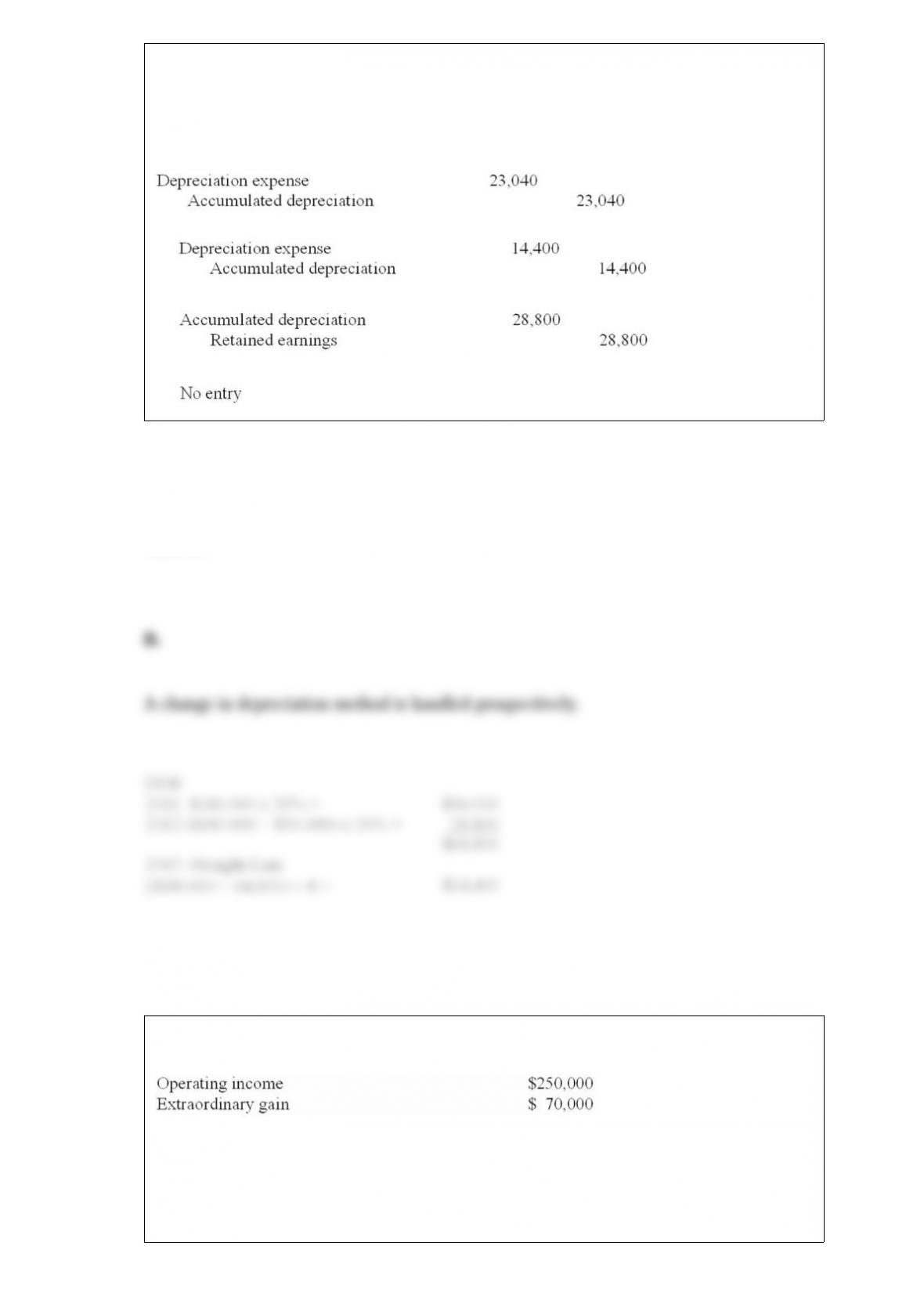
On January 1, 2011, Al’s Sporting Goods purchased store fixtures at a cost of $180,000.
The anticipated service life was 10 years with no residual value. Al’s has been using the
double-declining balance method, but in 2013 adopted the straight-line method because
the company believes it provides a better measure of income. Al’s has a December 31
year-end. The journal entry to record depreciation for 2013 is: A.
B.
C.
D.
Answer:
Freda’s Florist reported the following before-tax income statement items for the year
ended December 31, 2013:
All income statement items are subject to a 40% income tax rate. In its 2013 income
statement, Freda’s separately stated income tax expense and total income tax expense
would be: A. $128,000 and $128,000, respectively.

B. $128,000 and $100,000, respectively.
C. $100,000 and $128,000, respectively.
D. $100,000 and $100,000, respectively.
Answer:
Heidi Aurora Imports issued shares of the company’s Class B stock. Heidi Aurora
Imports should report the stock in the company’s statement of financial position: A.
Among liabilities if the shares are mandatorily redeemable or redeemable at the option
of the shareholder.
B. As equity unless the shares are mandatorily redeemable.
C. As equity unless the shares are redeemable at the option of the issuer.
D. Among liabilities unless the shares are mandatorily redeemable.
Answer:

On January 2, 2012, Howdy Doody Corporation purchased 12% of Ranger
Corporation’s common stock for $50,000 and classified the investment as available for
sale. Ranger’s net income for the years ended December 31, 2012 and 2013, were
$10,000 and $50,000, respectively. During 2013, Ranger declared and paid a dividend
of $60,000. There were no dividends in 2012. On December 31, 2012, the fair value of
the Ranger stock owned by Howdy Doody had increased to $70,000. How much should
Howdy Doody show in the 2013 income statement as income from this investment? A.
$26,000.
B. $7,200.
C. $20,000.
D. $27,200.
Answer:
On January 1, 2013, Tiny Tim Industries had outstanding $1,000,000 of 12% bonds
with a carrying amount of $966,130. The indenture specified a call price of $981,000.
The bonds were issued previously at a price to yield 14%. Tiny Tim called the bonds
(retired them) on July 1, 2013. What is the amount of the loss on early extinguishment?
A. $0.
B. $6,932.
C. $7,241.
D. $7,629
Answer:
Ramen Inc. adopted dollar-value LIFO (DVL) as of January 1, 2013, when it had a cost
inventory of $600,000. Its inventory as of December 31, 2013, was $667,800 at
year-end costs and the cost index was 1.06. What was DVL inventory on December 31,
2013? A. $630,000.
B. $631,800.
C. $636,000.
D. None of the above is correct.
Answer:

Information for Hobson Corp. for the current year ($ in millions):
How much tax expense on income from continuing operations would be reported in
Hobson’s income statement? A. $56 million.
B. $60 million.
C. $62 million.
D. $50 million.
Answer:
Consider the following:
I. Present value of vested benefits at present pay levels.
II. Present value of nonvested benefits at present pay levels.
III. Present value of additional benefits related to projected pay increases.
Which of the above constitutes the accumulated benefit obligation? A. I & II.

B. I, II, III.
C. II & III.
D. II only.
Answer:
On January 31, 2013, B Corp. issued $600,000 face value, 12% bonds for $600,000
cash. The bonds are dated December 31, 2012, and mature on December 31, 2022.
Interest will be paid semiannually on June 30 and December 31. What amount of
accrued interest payable should B report in its September 30, 2013, balance sheet? A.
$18,000.
B. $36,000.
C. $54,000.
D. $48,000.
Answer:
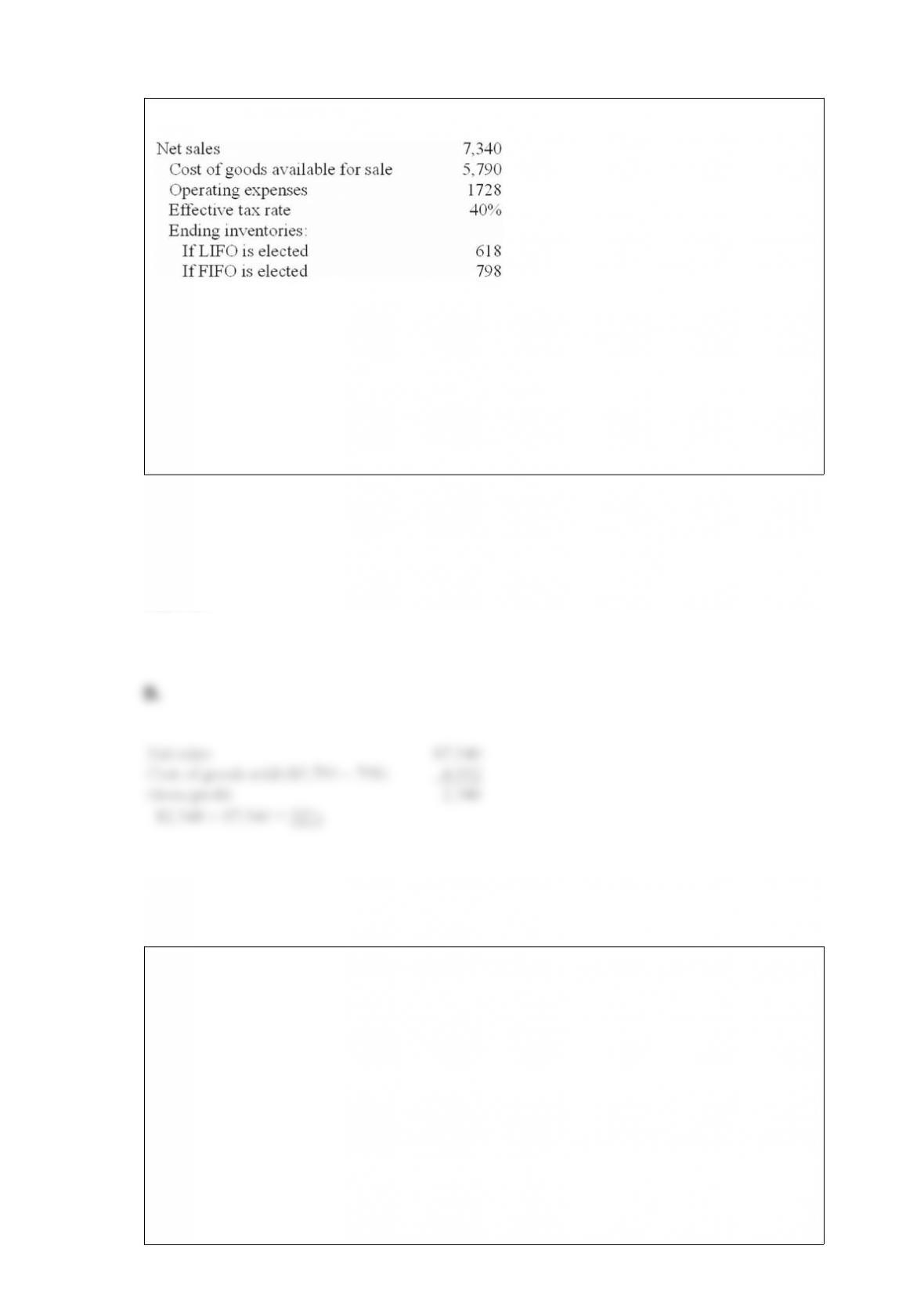
Nueva Company reported the following pretax data for its first year of operations.
What is Nueva’s gross profit ratio (rounded) if it elects FIFO? A. 30%.
B. 32%.
C. 10.7%.
D. 60%.
Answer:
Listed below are five terms followed by a list of phrases that describe or characterize
each of the terms. Match each phrase with the correct term. 1)Retrospective treatment
2)Change from LIFO to FIFO
3)LIFO retail
4)Gross profit method
5)Net markup
A. Required for a change from FIFO to average cost

B. Beginning inventory is not included in the calculation of the current period’s
cost-to-retail percentage
C. Estimates value of inventory based on historical relationships
D. Added in arriving at ending inventory at retail
E. Requires retrospective treatment
Answer:
What are the three types of expenses that a lessee experiences with a capital lease? A.
Lease expense, executory costs, interest expense.
B. Depreciation expense, lease expense, interest expense.
C. Executory costs, lease expense, depreciation expense.
D. Depreciation expense, interest expense, executory costs.
Answer:
Hughes Aircraft sold a four-passenger airplane for $380,000, receiving a $50,000 down
payment and a 12% note for the balance. The journal entry to record this sale would
include a: A. Credit to cash.

B. Debit to cash discount.
C. Debit to note receivable.
D. Credit to note receivable.
Answer:
DJ Co. is a calendar-year firm with 120 million common shares outstanding throughout
2013. As part of its executive compensation plan, at January 1, 2012, the company had
issued 12 million executive stock options permitting executives to buy 12 million
shares of stock for $10 each within the next eight years, but not prior to January 1, The
fair value of the options was estimated on the grant date to be $3 per option. The stock
options qualify for tax purposes as an incentive plan. The company’s net income was
$480 million in 2013. Its income tax rate is 40%. The average market price of the stock
during 2013 was $12 per share.
Required:
Determine basic and diluted earnings per share (rounded to two decimal places) for DJ
in 2013.
Answer:
What is comprehensive income and how does it differ from net income? Where is it
reported in the balance sheet?
Answer:
The statement of cash flows has been a required financial statement since 1988, but is
the reporting of cash flows a relatively new concept? Explain.
Answer:
Is depreciation a source of cash? Explain.
Answer:

Differentiate between the projected benefit obligation, the accumulated benefit
obligation, and the vested benefit obligation.
Answer:
In LMC’s 2013 annual report to shareholders, it disclosed the following information
about its income taxes:
INCOME TAXES
Deferred income taxes reflect the net tax effects of temporary differences between the
amounts of assets and liabilities for accounting purposes and the amounts used for
income tax purposes.
Significant components of the Company’s deferred tax liabilities and assets as of
December 31 were as follows:
Explain why LMC has a $209.4 million valuation allowance for its deferred tax assets.
Answer:
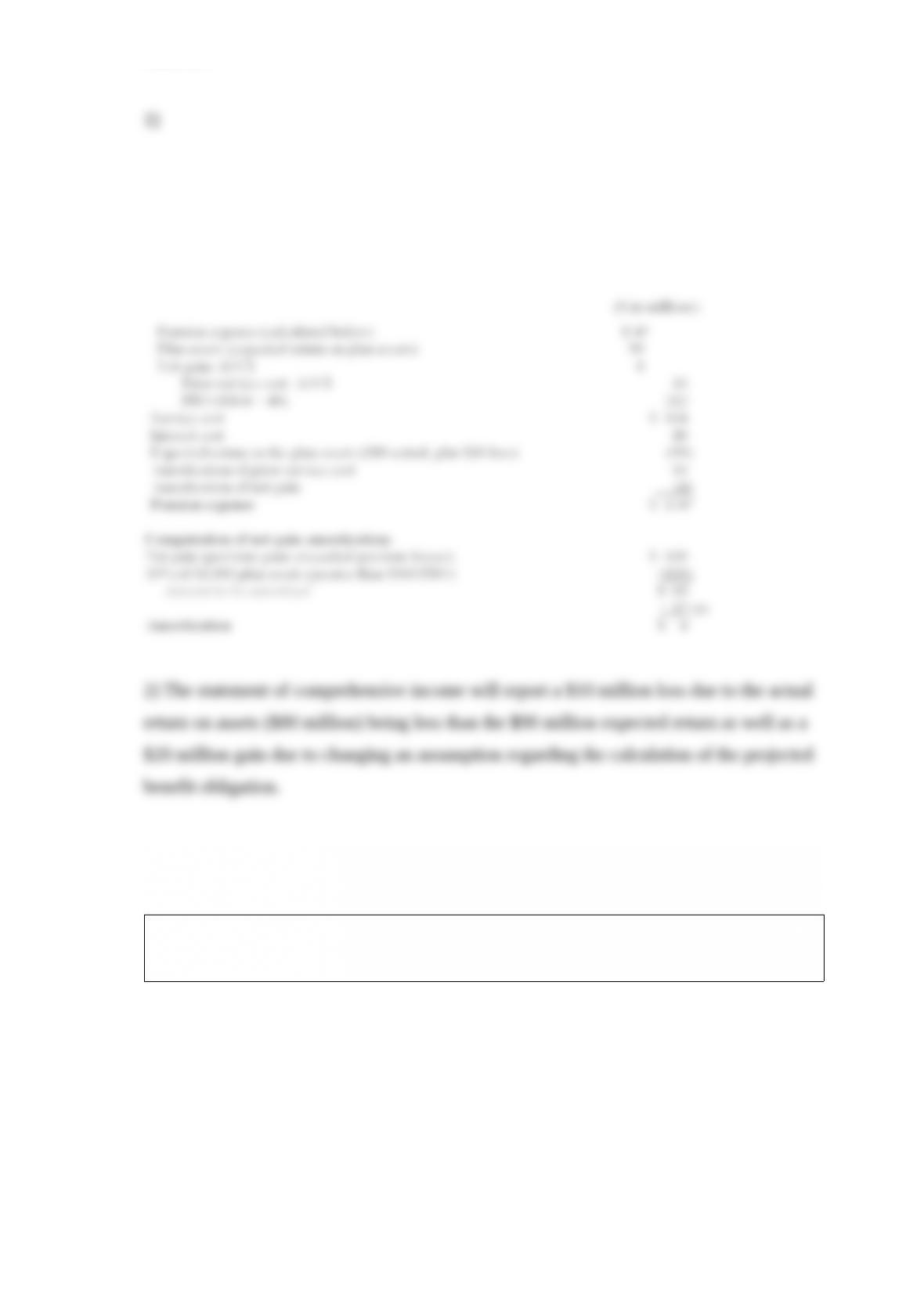
On December 31, 2013, the following pension-related data were available for CPS
Industries’ noncontributory, defined benefit pension plan:
Required:
1) Prepare the 2013 journal entry to record pension expense.
2) How will the statement of comprehensive income be affected by any 2013 gains and
losses?
Answer:
Jackson Company engaged in the following investment transactions during the current
year.
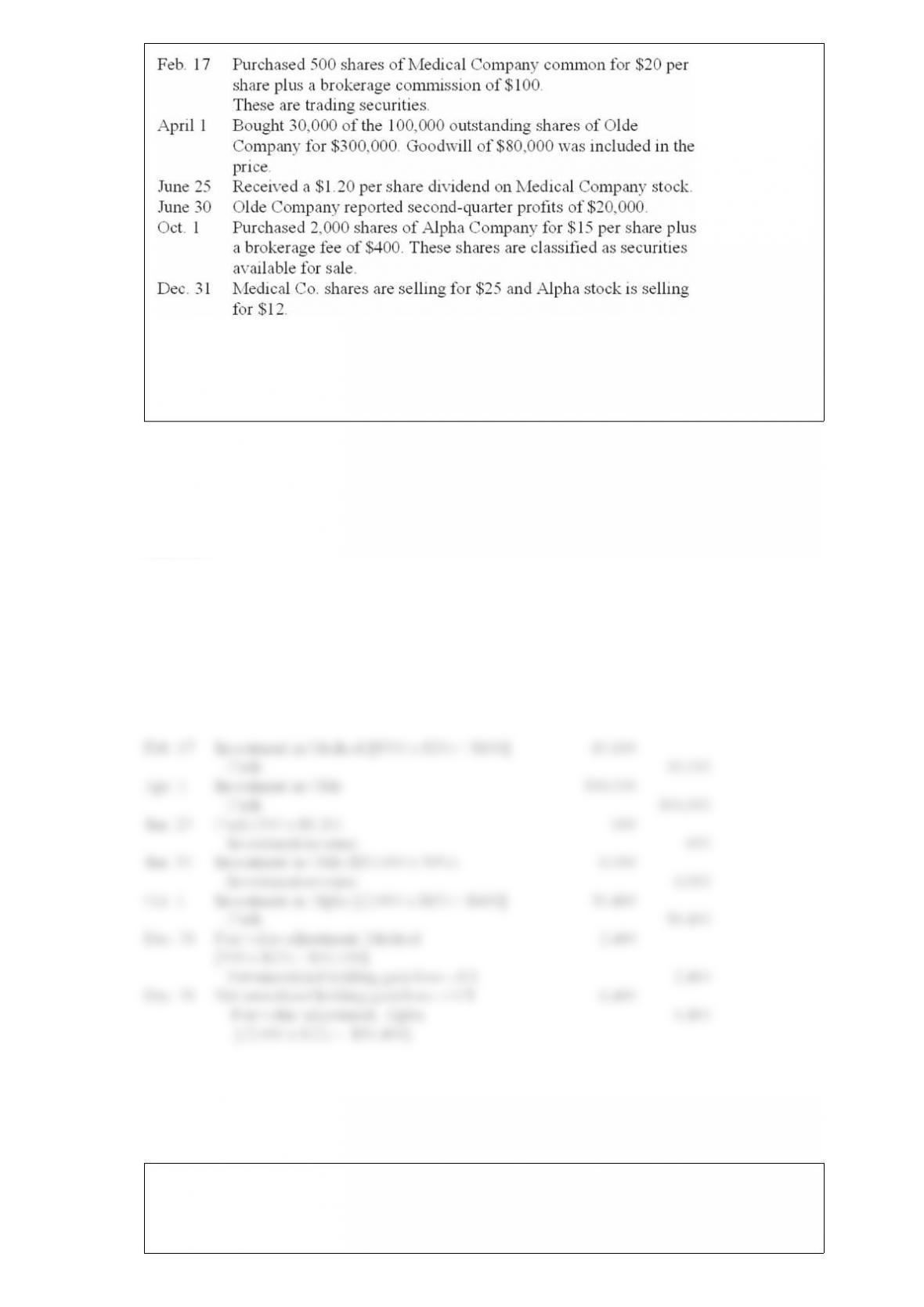
Required:
Prepare the appropriate journal entries to record the transactions for the year including
year-end adjustments. Show calculations.
Answer:
Zvinakis Mining Company paid $200,000 for the rights to mine lead in southeast
Missouri. The cost to drill and erect a mine shaft was $2,400,000, and equipment to
process the lead ore before shipment to the smelter was $1,800,000. The mine is
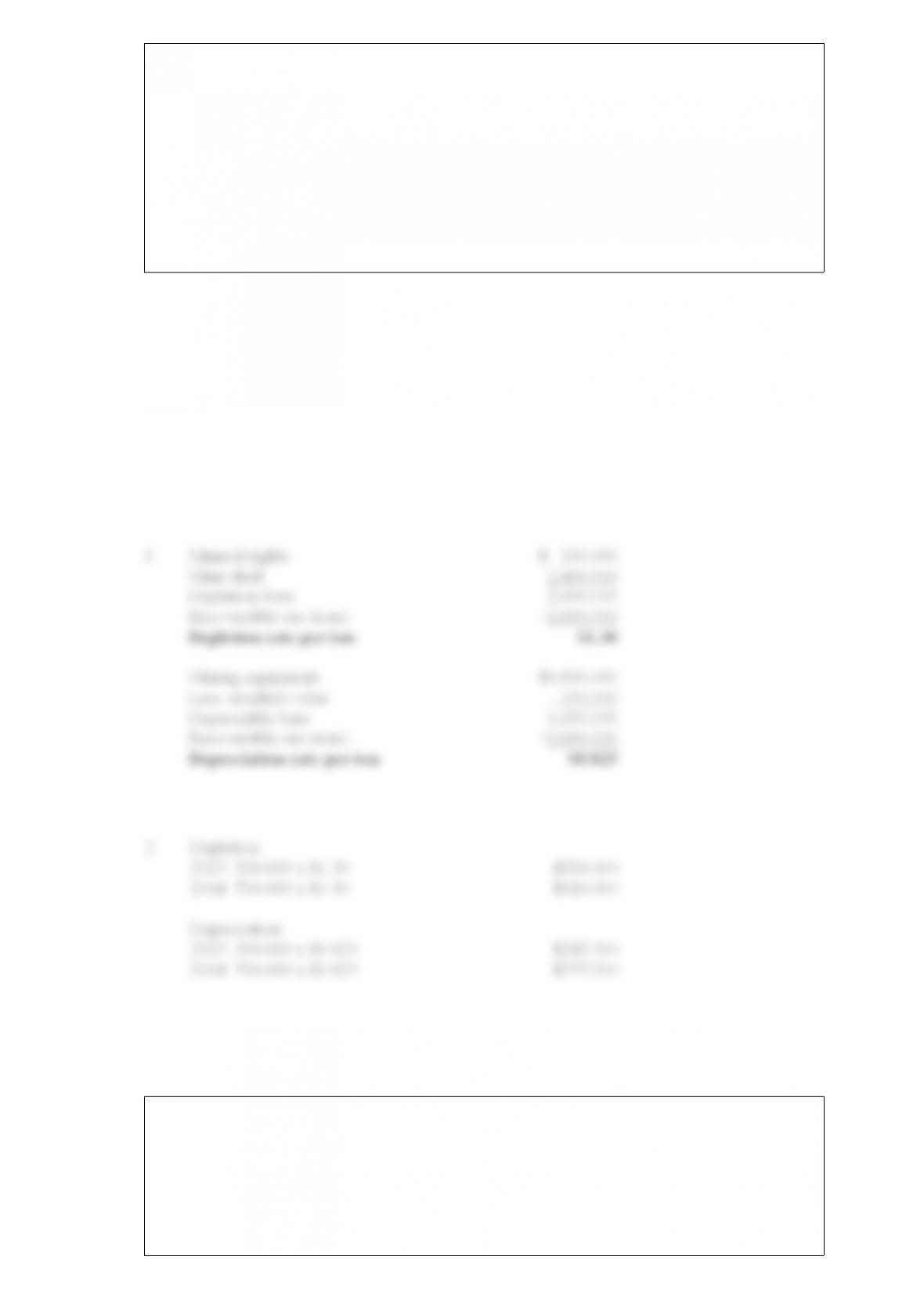
expected to yield 2,000,000 tons of ore during the five years it is expected to be
operating. The equipment has an estimated residual value of $150,000 when mining is
concluded. The mine started operations on April 30, 2013. In 2013, 300,000 tons of ore
were extracted, and in 2014, 700,000 tons were mined.
Required:
1. Compute the depletion rate and the units-of-production depreciation rate.
2. Compute depletion and depreciation for 2013 and 2014.
Answer:
Buckeye Company purchased a machine on January 1, 2011. The machine had a cost of
$260,000 with a $10,000 residual value. The estimated useful life of the machine was
eight years. On January 1, 2013, due to technological innovations, the estimated useful
life was reduced by two years from the original life and the residual value was reduced
by 50%. The company uses straight-line depreciation.
Required:
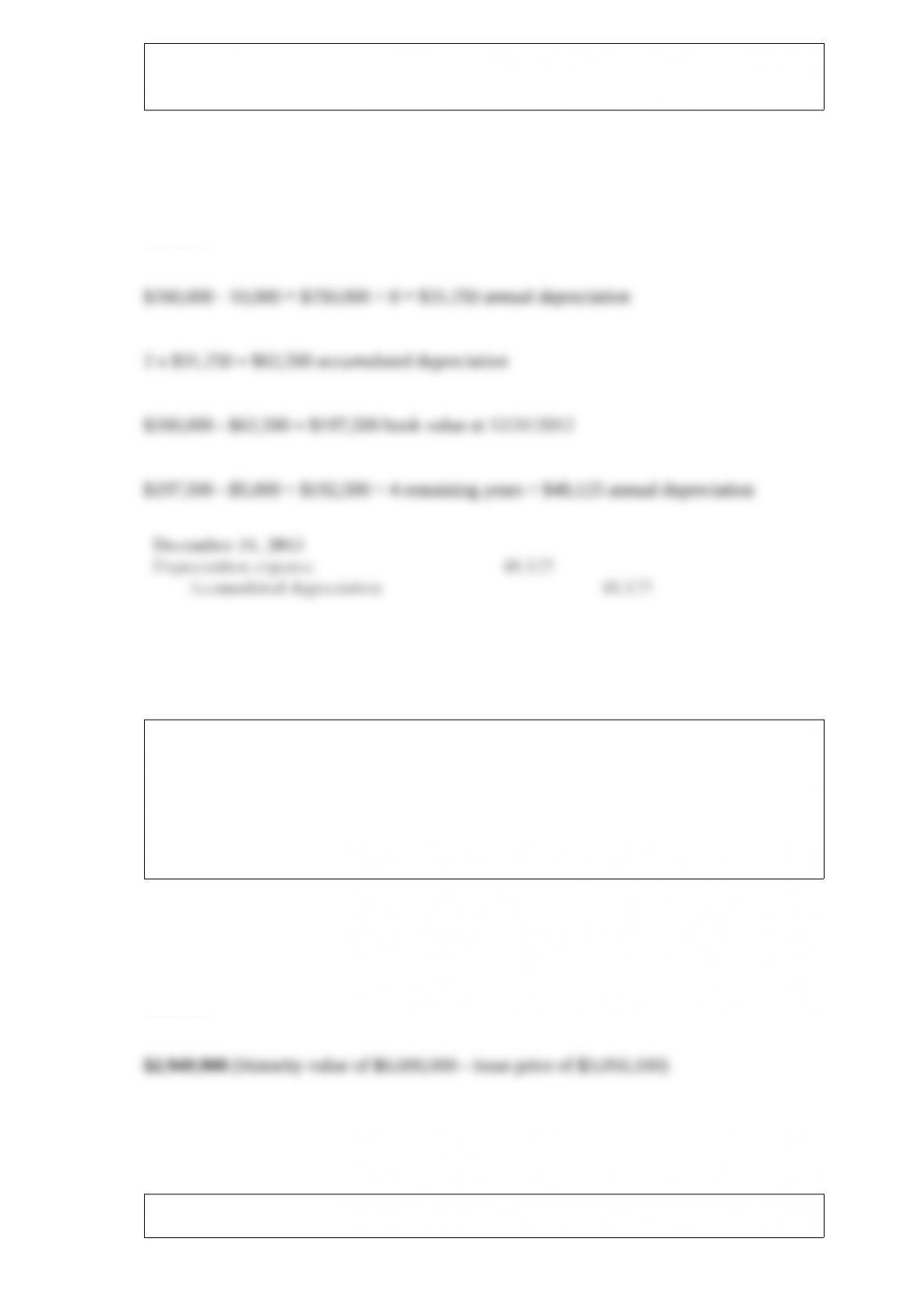
Prepare the journal entry to record the annual depreciation on December 31,
Answer:
On January 1, 2013, Morton Sales Co. issued zero-coupon bonds with a face value of
$6 million for cash. The bonds mature in 10 years and were issued at a price of
$3,050,100. Required:
What total interest expense will Morton Sales Co. report over the 10-year life of these
bonds?
Answer:
The accounting records of Harrison Company provided the data below.
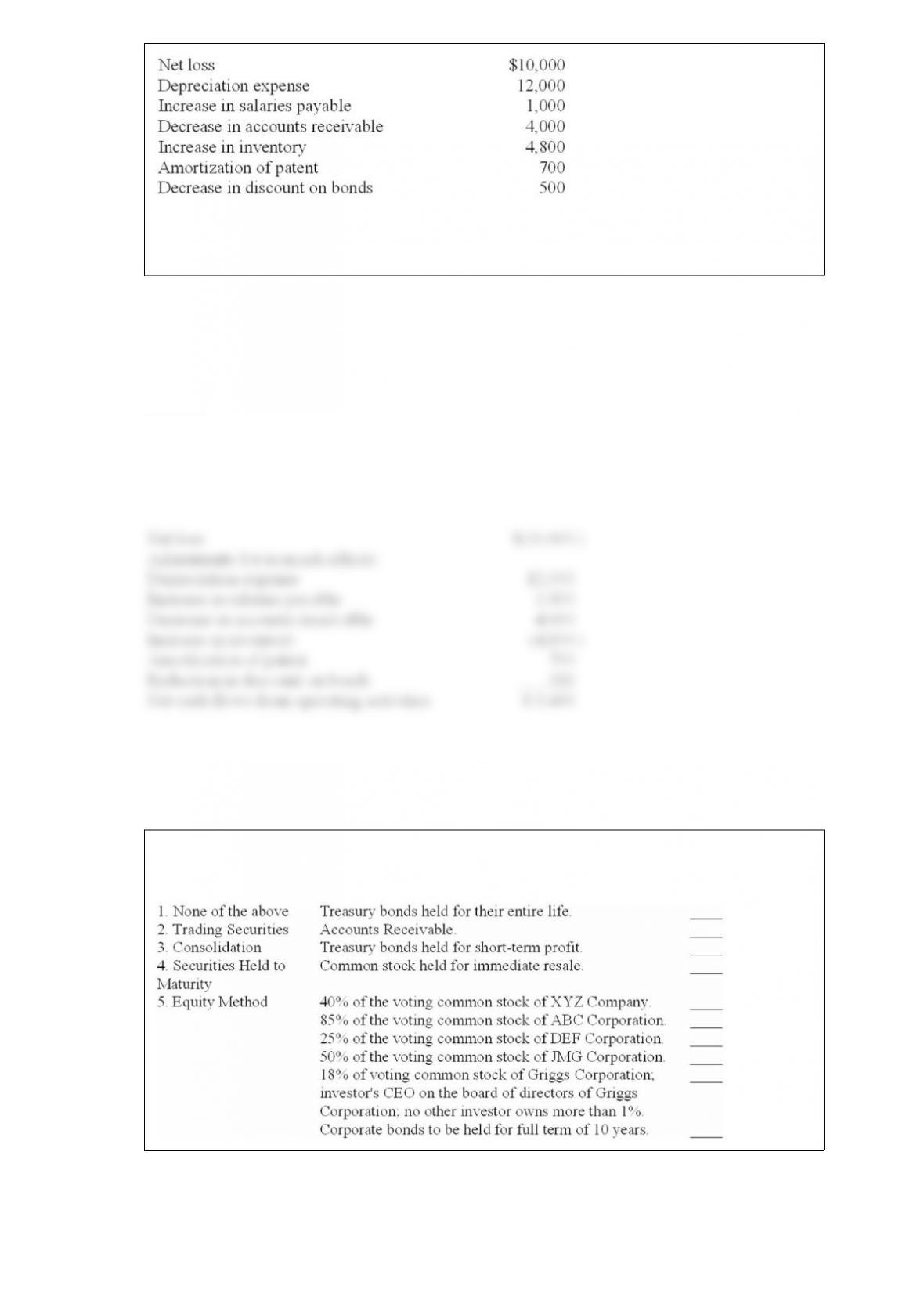
Required:
Prepare a reconciliation of net income to net cash flows from operating activities.
Answer:
Indicate (by number) the way each of the investments listed below usually should be
accounted for under U.S. GAAP based on the information provided.

Answer:
What argument serves as the basis for the GAAP requirement that deferred taxes should
be recognized for all temporary differences?
Answer:
Meteor Co. purchased merchandise on March 4, 2013, at a price of $30,000, subject to
credit terms of 2/10, n/30. Meteor uses the net method for recording purchases and uses
a periodic inventory system.
Required:
1. Prepare the journal entry to record the purchase.
2. Prepare the journal entry to record the appropriate payment if the entire invoice is
paid on March 11, 2013.
3. Prepare the journal entry to record the appropriate payment if the entire invoice is
paid on April 2, 2013.
Answer:
Big Bucks leased equipment to Shannon Company on July 1, 2013. The lease payments
were calculated to provide the lessor a 10% return. Ten annual lease payments of
$36,000 are due at the beginning of each fiscal year beginning July 1, 2013. The lease
payments were calculated to provide the lessor a 10% return. Big Bucks had
constructed the equipment recently for $198,000 and its retail fair value was $300,000.
Its estimated useful life was 15 years.
Required:
1) Following the guidance of the new ASU, prepare the journal entries to record the
lease by Shannon at its commencement and at December 31,
2) Following the guidance of the new ASU, prepare the journal entries to record the
lease by Big Bucks at its commencement and at December 31,
Answer:
The following partial income statement and balance sheet information (in $millions)

comes from the Annual Report of Saratoga Springs Co. for the year ending 12/31/2013:
Required: Compute the following amounts for Saratoga Springs Co.
Its average days in inventory for 2013. Round your final answer to one decimal place.
Answer:
Barone, Inc. is involved with several situations that possibly involve contingencies.
Each is described below. Barone’s fiscal year ends December 31, and the 2013 financial
statements are issued on March 1,
1) At March 1, 2014, the EPA is in the process of investigating possible chemical leaks
at two of Barone’s facilities, but has not proposed a deficiency assessment. Management
feels an assessment is reasonably possible, and if an assessment is made an unfavorable
settlement of up to $8 million is reasonably possible.
2) Barone is the plaintiff in a $33 million lawsuit filed against Faze Corp. for damages
due to lost profits from rejected contracts and for unpaid receivables. The case is in
final appeal and legal counsel advises that it is probable that Finley will prevail and be
awarded $25 million.
3) In July 2012, the State of Arkansas filed suit against Barone, seeking civil penalties
and injunctive relief for violations of environmental laws regulating hazardous waste.
On February 12, 2014, Barone reached a settlement with state authorities. Based upon
discussions with legal counsel, the Company feels it is probable that $13 million will be
required to cover the cost of violations. Barone believes that the ultimate settlement of
this claim will not have a material adverse effect on the company.
4) Barone is involved in a lawsuit resulting from a dispute with a customer. On January
5, 2014, judgment was rendered against Barone in the amount of $16 million plus
interest, a total of $18 million. Barone plans to appeal the judgment and is unable to
predict its outcome though it is not expected to have a material adverse effect on the
company.
Required:
1) Determine the appropriate means of reporting each situation. Explain your reasoning.
2) Prepare any necessary journal entries and disclosure notes.
Answer:

The following partial income statement and balance sheet information (in $millions)
comes from the Annual Report of Saratoga Springs Co. for the year ending 12/31/2013:
Required: Compute the following amounts for Saratoga Springs Co.
Its profit margin on sales for 2013. Round your answer to one decimal place, e.g., .1234
as 12.3%.
Answer: