1) Vouchers should be used only for purchases. Other expenditures do not need to go
through the voucher system.
2) Common shareholders always share equally with all other shareholders in all
dividends.
3) Since the process cost summary describes the activities of a production department
for a specified reporting period, it does not present information about any costs incurred
in prior periods.
4) External users include lenders, shareholders, customers, and regulators.
5) The process of preparing departmental income statements starts with allocating
service departments.
6) Premium on Bonds Payable is an adjunct or accretion liability account.
7) Before an adjusting entry is made to accrue employee salaries, Salaries Expense and
Salaries Payable are both understated.
8) If a corporation receives assets other than cash in exchange for stock, it records the
assets received at their market value as of the date of the transaction.
9) The current ratio is computed by dividing current liabilities by current assets.
10) A cash budget is a plan that includes the expected cash receipts and cash
expenditures during each of the periods that it covers.
11) Bond interest paid by a corporation is an expense, whereas dividends paid are not
an expense of the corporation.
12) The contribution margin per unit is the price at which a unit must be sold in order
for the company to break even.
13) Total asset turnover reflects a company’s ability to use its assets to generate sales
and is an important indication of operating efficiency.
14) The accounts receivable method to estimate bad debts obtains the estimated balance
in the Allowance for Doubtful Accounts in one of two ways: (1) computing the percent
uncollectible from the total accounts receivable or (2) aging accounts receivable.
15) Source documents provide evidence of business transactions and are the basis for
accounting entries.
16) The number of periods in a future value calculation can only be expressed in years.
17) A sales system with prenumbered, controlled sales slips is an example of the
internal control principle of ______________________.
18) The statement of cash flows is divided into three sections called the ___________,
___________, and _______________ sections.
19) Briefly describe the process by which budgets are developed and administered.
20) The following current year information is available from a manufacturing company:
Calculate the company’s accounts receivable turnover and its days’ sales uncollected.
21) In the analysis of variances, management commonly focuses on four categories of
production costs: __________________ cost, ___________________ cost;
_________________ cost; and _________________ cost.
22) Converting receivables to cash before they are due is usually done by either
_______________________ or ______________________________.
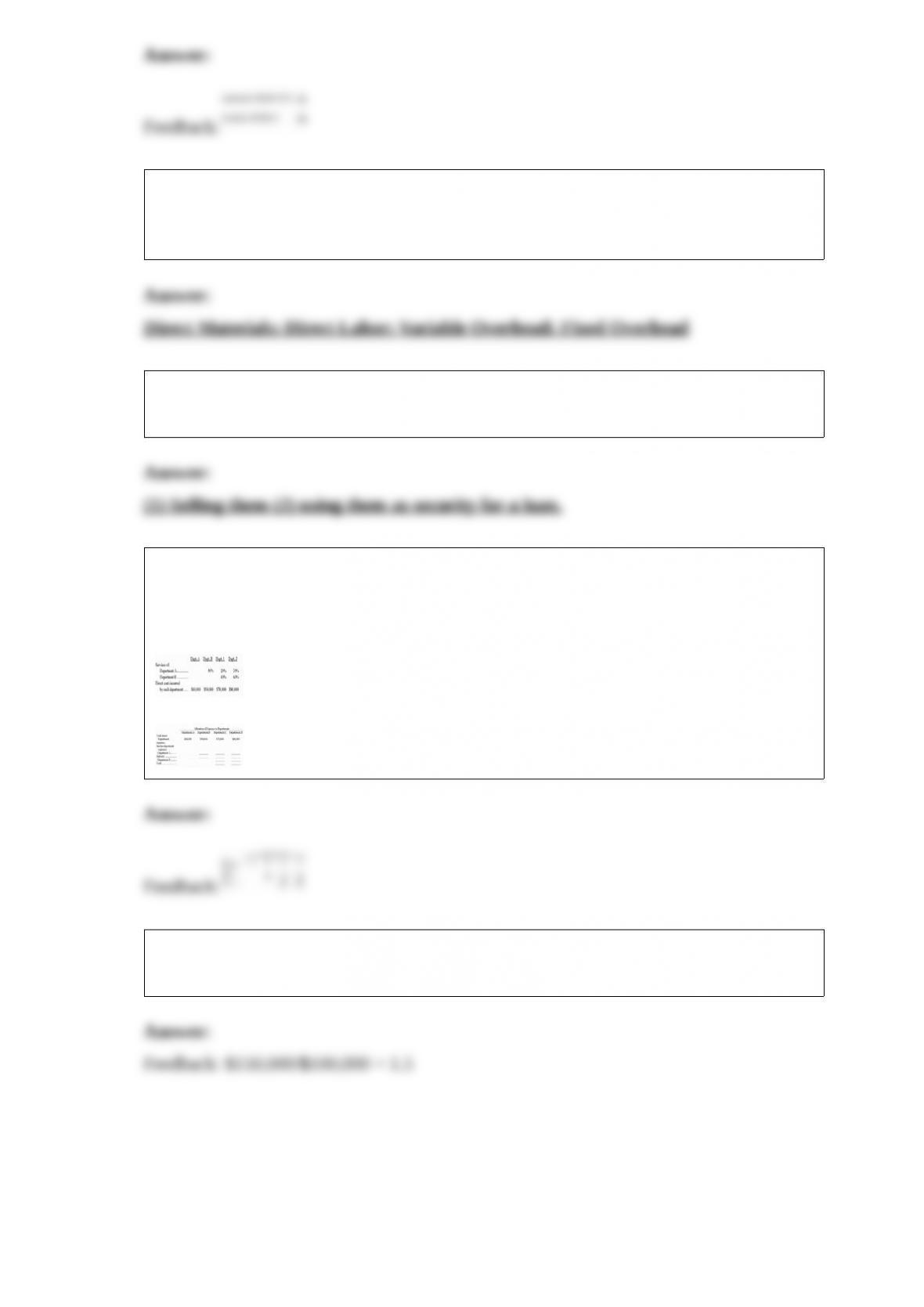
23) Blower Company is divided into four departments. Departments A and B are
service departments and Departments 1 and 2 are operating (production) departments.
The services of the two service departments are used by the other departments as
follows:
Complete the following table:
24) Harrison Company’s balance sheet reflects total assets of $250,000 and total
liabilities of $150,000. Calculate the company’s debt-to-equity ratio.