
If the market interest rate is greater than the contractual interest rate, bonds will sell
a. at a premium.
b. at face value.
c. at a discount.
d. only after the stated interest rate is increased.
Answer:
The consistent application of an inventory costing method is essential for
a. conservatism.
b. accuracy.
c. comparability.
d. efficiency.
Answer:
The cost of successfully defending a patent in an infringement suit should be
a. charged to Legal Expenses.
b. deducted from the book value of the patent.
c. added to the cost of the patent.
d. recognized as a loss in the current period.

Answer:
Retained earnings is increased by each of the following except
a. net income.
b. some prior period adjustments.
c. some disposals of treasury stock.
d. All of these increase retained earnings.
Answer:
A system of internal control
a. is infallible.
b. can be rendered ineffective by employee collusion.
c. invariably will have costs exceeding benefits.
d. is premised on the concept of absolute assurance.
Answer:
Which of the following is not true of a corporation?
a. It may buy, own, and sell property.

b. It may sue and be sued.
c. The acts of its owners bind the corporation.
d. It may enter into binding legal contracts in its own name.
Answer:
Legal capital per share cannot be equal to the
a. par value per share of par value stock.
b. total proceeds from the sale of par value stock above par value.
c. stated value per share of no-par value stock.
d. total proceeds from the sale of no-par value stock.
Answer:
Sam Wainwright is a new accountant with Ground Floor Company. Ground Floor
purchased merchandise on account for $18,000. The credit terms are 1/10, n/30. Sam
has talked with the company’s banker and knows that he could earn 4% on any money
invested in the company’s savings account.
Instructions
(a) Should Sam pay the invoice within the discount period or should he keep the
$18,000 in the money market account and pay at the end of the credit period? Support
your recommendation with a calculation showing which action would be best.
(b) If Sam forgoes the discount, it may be viewed as paying an interest rate of 1% for
the use of $18,000 for 20 days. Calculate the annual rate of interest that this is
equivalent to.
Answer:
Each of the following is added to net income in computing net cash provided by
operating activities except
a. amortization expense.
b. an increase in accrued expenses payable.
c. a gain on sale of equipment.
d. a decrease in inventory.
Answer:
Jackson Cement Corporation reported $35 million for sales when it only had $20
million of actual sales. Which of the following qualities of useful information has
Jackson most likely violated?
a. Comparability
b. Relevance
c. Faithful representation
d. Consistency
Answer:
The interest on a $9,000, 6%, 90-day note receivable is
a. $135.
b. $270.
c. $405.
d. $540.
Answer:
A weakness of the current ratio is
a. the difficulty of the calculation.
b. that it doesn’t take into account the composition of the current assets.
c. that it is rarely used by sophisticated analysts.
d. that it can be expressed as a percentage, as a rate, or as a proportion.
Answer:
The following transactions represent part of the activities of Bloc Party Company for
the first month of its existence. Indicate the effect of each transaction upon the total
assets of the business by one of the following phrases: increased total assets, decreased
total assets, or no change in total assets.
(a) Issued stock in exchange for cash.

(b) Purchased a computer for cash.
(c) Purchased office equipment with money borrowed from the bank.
(d) Paid the first month’s utility bill.
(e) Collected an accounts receivable.
(f) Paid dividends.
Answer:
The purchase of office equipment for $15,000 cash
a. is a cash outflow from financing activities.
b. is a cash outflow from operating activities.
c. is a cash outflow from investing activities.
d. does not affect cash flows.
Answer:
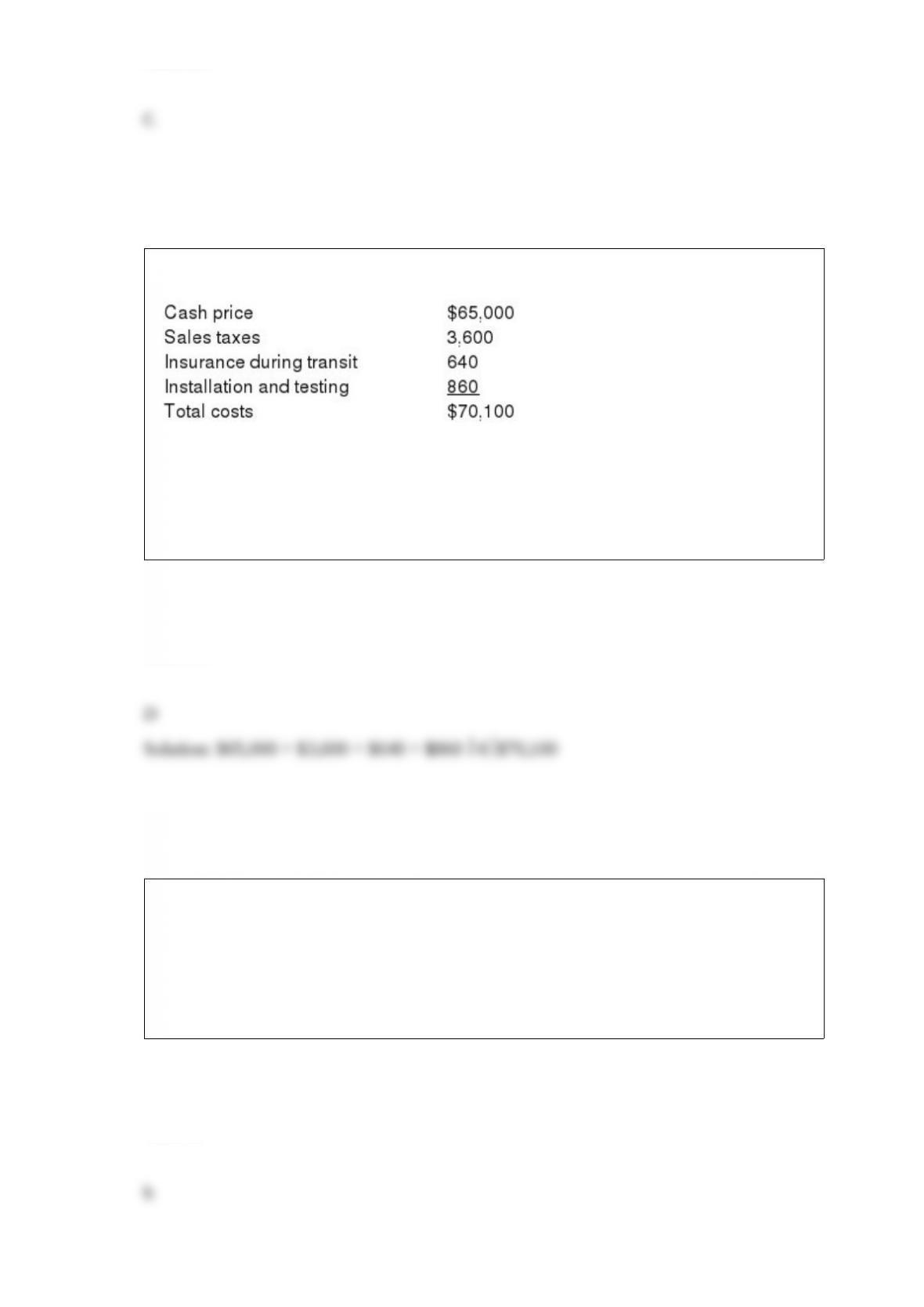
Presto Company purchased equipment and these costs were incurred:
Presto will record the acquisition cost of the equipment as
a. $65,000.
b. $68,600.
c. $69,240.
d. $70,100.
Answer:
If the cost method is used to account for a long-term investment in common stock,
dividends received should be
a. credited to the Stock Investments account.
b. credited to the Dividend Revenue account.
c. debited to the Stock Investments account.
d. recorded only when 20% or more of the stock is owned.
Answer:
The expense recognition principle states that expenses should be matched with
revenues. Another way of stating the principle is to say that
a. assets should be matched with liabilities.
b. efforts should be matched with accomplishments.
c. owner withdrawals should be matched with owner contributions.
d. cash payments should be matched with cash receipts.
Answer:
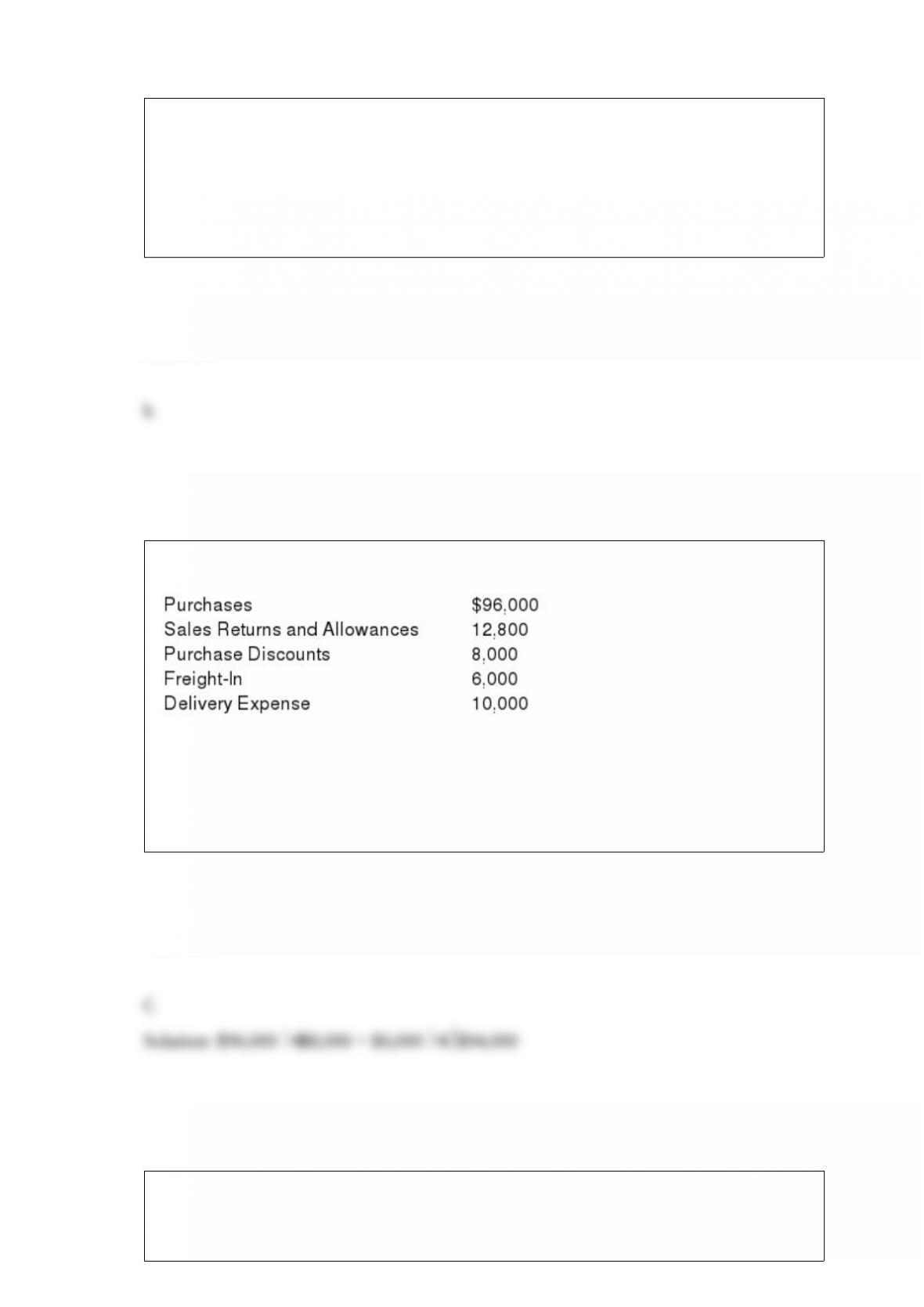
Goldblum Company has the following account balances:
The cost of goods purchased for the period is
a. $80,800.
b. $88,000.
c. $94,000.
d. $104,000.
Answer:
A sales discount does not
a. provide the purchaser with a cash saving.
b. reduce the amount of cash received from a credit sale.
c. increase a contra-revenue account.
d. increase an operating expense account.
Answer:
Ellen Corhy and Bryn Davis, two salespersons in adjoining territories, regularly
compete for bonuses. During the last month, their dollar volume of sales, on which the
bonuses are based, was nearly equal. On the last day of the month, both made a large
sale. Both orders were shipped on the last day of the month and both were received by
the customer on the fifth of the following month. Ellen’s sale was FOB shipping point,
and Bryn’s was FOB destination. The company “counts” sales for purposes of
calculating bonuses on the date that ownership passes to the purchaser. Ellen’s sale was
therefore counted in her monthly total of sales, Bryn’s was not. Bryn is quite upset. She
has asked you to just include it, or to take Ellen’s off as well. She also has told you that
you are being unethical for allowing Ellen to get a bonus just for choosing a particular
shipping method.
Write a memo to Bryn. Explain your position.
Answer:
The future value of a single amount is the value at a future date of a given amount
invested now, assuming compound interest.
Answer:
Under a perpetual inventory system, inventory shrinkage and lost or stolen goods are
more readily determined.
Answer:
Transactions that cannot be entered in a special journal are recorded in the
_______________, and if control and subsidiary accounts are involved, there must be a
_______________ posting.
Answer:

In order to encourage prompt payment of a trade receivable, companies often offer
______________ to customers.
Answer:
The employer incurs a payroll tax expense equal to the amount withheld from the
employees’ wages for federal income taxes.
Answer:
Extraordinary items are reported net of applicable taxes in a separate section of the
income statement.
Answer: