Page 1
1. Which of the following can help you be successful in a job search?
A) Taking a different approach to every job you apply for
B) Waiting for a company to seek you out to offer you a job
C) Applying for positions without researching the company
D) Treating the job search as part of a process
2. Which question should you ask yourself before applying for a job if you want to examine
yourself from an interviewer’s perspective?
A) Why do I want this specific job?
B) Why should this employer want me?
C) Does where I work matter?
D) What matters most to me in a job?
3. Being able to __________ will assist you greatly in the job interview.
A) articulate your strengths
B) speak ill of a previous employer
C) limit your responses to a simple yes or no
D) deny that you have weaknesses
4. Generally, it’s best to save your résumé as one of which of the following file types?
A) DOC
B) PDF
C) MP3
D) MOV
5. What information should you always include in a résumé?
A) Your educational background
B) Your salary requirement
C) A thorough list of your references
D) A description of your hobbies
6. When submitting a cover letter to a potential employer, you should address it
to__________.
A) “To whom it may concern”
B) the human resources department
C) a specific individual
D) the name of the company
Page 2
7. Which social media site is designed specifically for making professional connections?
A) Facebook
B) Pinterest
C) Twitter
D) LinkedIn
8. Which question should you try to answer when researching a company you might want to
work for?
A) What is the company’s reputation?
B) How long will it be before I’m called for an interview?
C) What are some questions the interviewer is likely to ask?
D) In which state was the company incorporated?
9. When answering an interviewer’s questions, you should try to__________.
A) showcase your skills and achievements
B) project a sense of overconfidence
C) answer every question with a question
D) give simple yes or no answers whenever possible
10. Men should generally wear __________ to an interview.
A) jeans and a T-shirt
B) a suit and tie
C) slacks and a polo shirt
D) a tuxedo
11. Who is usually the first person to interview job candidates at a company?
A) President or owner of the company
B) Supervisor the new employee would work under
C) Other members of the team the new employee would work with
D) Human resources manager
12. Where would be a good place to conduct a phone interview?
A) Alone in a quiet room in your home
B) At a popular local café
C) Alongside a friend on a park bench
D) In a student lounge on campus
Page 3
13. If you have an interview via a videoconferencing service, you should make sure that you
appear in the __________ of the screen.
A) upper left corner
B) upper right corner
C) center
D) lower left corner
14. Which question do interviewers commonly ask?
A) What interests you about this job?
B) What is your ethnic background?
C) Do you think you’re likely to be hired here?
D) Which political party do you belong to?
15. One way to act confident during an interview is to __________.
A) shake hands loosely when you meet the interviewer
B) avoid making direct eye contact with the interviewer
C) sit up straight throughout the interview
D) appear disinterested in the job
16. You should engage in __________ listening during an interview.
A) superficial
B) argumentative
C) interruptive
D) interactive
17. When asked to explain your qualifications, you should __________.
A) incorporate your résumé
B) exaggerate your accomplishments
C) take a self-deprecating approach
D) deflect the question
18. Asking the interviewer questions during the interview __________.
A) is considered inappropriate behavior
B) may cause a boomerang effect that can cost you the job
C) indicates to the interviewer that you are overconfident
D) shows that you are engaged in the conversation
Page 4
19. Asking which question during an interview can significantly improve your chances of
making it to the next round of interviews?
A) How much can I expect to earn if you hire me for the job?
B) Do you have any questions about my qualifications?
C) Would you prefer a handwritten thank-you note or an e-mail?
D) If you were in my shoes and were offered this job, would you accept?
20. Which of the following questions is it OK not to answer?
A) How long were you at your previous job?
B) What skills do you have that would make you an asset here?
C) Do you have any questions for me?
D) Are you single?
21. What should you do if an interviewer asks a question that he or she cannot legally ask
you? A) Answer the question anyway, because doing so will likely help you get the job
B) Assume that the interviewer is prejudiced, and get up and leave the interview
immediately
C) State that the question is inappropriate and that you assume that this is not what he
or she meant
D) Answer the question, and then explain that it was inappropriate for the interviewer
to ask it
22. You should refrain from bringing up __________ during the first interview.
A) your skills
B) the salary for the position
C) your professional experience
D) the company’s mission
23. Dina interviewed with a company yesterday, and she thinks it went well, although the
interviewer has not gotten back to her yet. She has an interview scheduled tomorrow with
another organization, although she’d prefer to work for the company she interviewed with
yesterday. What should Dina do?
A) Cancel tomorrow’s interview
B) Go on the interview as planned
C) Call the first interviewer to see if she got the job
D) Postpone tomorrow’s interview until she hears back from the first company
Page 5
24. After an interview, it is recommended that you ___________.
A) e-mail a thank-you note to the interviewer
B) send a handwritten thank-you note to the interviewer
C) send a thank-you e-mail and also mail a handwritten thank-you note
D) do not send a thank-you note, because doing so would be inappropriate
25. If you interviewed weeks ago and have not gotten a response, what should you do?
A) Send a polite e-mail checking in
B) Assume you did not get the job
C) Drive to the company and ask for the manager
D) Resubmit your résumé and cover letter
26. Job interviews are often not very long—the average one lasts just forty minutes.
A) True
B) False
27. Preparing for the interview during your job search is critical.
A) True
B) False
28. You should ask yourself some general questions to encourage some reflection and
introspection on your part before applying for a specific job.
A) True
B) False
29. Before interviewing, it’s important to consider what you will be able to bring to the
employer or organization.
A) True
B) False
30. If asked about a weakness during an interview, never admit that you have any.
A) True
B) False
31. Your résumé should be full of information that is verifiable and truthful.
A) True
B) False
Page 6
32. If you already submitted your résumé to a company when applying for a job, you do not
have to bring it with you to the interview.
A) True
B) False
33. You’ll likely send both your résumé and a cover letter together when applying for a job.
A) True
B) False
34. Your LinkedIn profile should not include your résumé.
A) True
B) False
35. Your Facebook and Instagram photos are likely to be searched by someone looking to
hire you, so be sure to make all your posts available for public viewing.
A) True
B) False
36. It is generally difficult to find information about large companies online.
A) True
B) False
37. Interviewers often ask the same types of questions.
A) True
B) False
38. You should practice answering interview questions until you can do so confidently.
A) True
B) False
39. First impressions are lasting impressions.
A) True
B) False
40. It is advised that you dress casually for an interview.
A) True
B) False
Page 7
41. Job interviews are always conducted face-to-face.
A) True
B) False
42. Your job interview may occur over a meal.
A) True
B) False
43. Potential employers generally don’t mind if you’re a few minutes late to the interview.
A) True
B) False
44. If you are applying for a creative job, you should bring a professional portfolio of your
work. A) True
B) False
45. Even if you’ve done your homework and think that you’d be a good fit for the role,
letting that passion and interest shine through in an interview is likely to cost you the job.
A) True
B) False
46. You shouldn’t take notes during an interview because it is considered rude.
A) True
B) False
47. During the interview, make sure that you are learning as much about the company as the
interviewer is learning about you.
A) True
B) False
48. Before an interview, you should think of some questions to ask the interviewer, because
he or she will likely ask if you have any questions.
A) True
B) False
Page 8
49. It is OK to bad-mouth former employers in an interview as long as you are being honest.
A) True
B) False
50. You should not contact the interviewer after an interview unless he or she contacts you
first. A) True
B) False
51. Many communications majors often migrate into ________________ jobs because of the
communication component required for the work.
52. You should be prepared to discuss not just your strengths but also your greatest
_________________ in a job interview.
53. In most cases, you will need to submit a(n) _______________ for job postings.
54. If you are close to being hired, you will likely be asked for __________________, which
can be given on a separate page.
55. A(n) __________________ is a letter to a specific person at a hiring company that
describes your qualifications for the job.
56. __________________ is reaching out to people in the field that you know.
57. Interviewers will likely check out your presence on ___________________ platforms
such as Facebook, Instagram, and Twitter.
58. If you can’t practice interviewing with a person, you can practice in front of a(n)
__________________ or record yourself with your phone.
59. Being _________________, or arriving on time, leaves a positive first impression
60. When answering questions, always tell the ________________.
Page 9
61. If a hand is offered again when the interview is over, shake it firmly with good
________________ contact.
62. Instead of trying to oversell yourself and risk being seen as conceited or desperate, you
should aim for _______________, showing confidence and enthusiasm but not arrogance.
63. Even if you feel comfortable with an interviewer, or if he or she is your age, you should
maintain a(n) _________________ demeanor.
64. A(n) ___________________ note of thanks will set you apart from the crowd, as it
demonstrates a personal touch.
65. You should always ask each interviewer for a(n) ____________, which will contain his
or her contact information, before you leave the interview.
66. List the parts that should be included in your résumé. Create a mock résumé for yourself,
applying for a job in the position of your choice.
67. Discuss the wardrobe that men and women should have when both interviewing for a job
and looking to build a business casual wardrobe. What might happen if you dress too casually
for a job interview?
68. Discuss three guidelines you should follow if you are being interviewed over a meal.
69. Identify five questions you can ask an interviewer, and explain how the answer to each
can benefit you as the person applying for a job.

Page 10
Answer Key
22. B
23. B
24. C
25. A
26. A
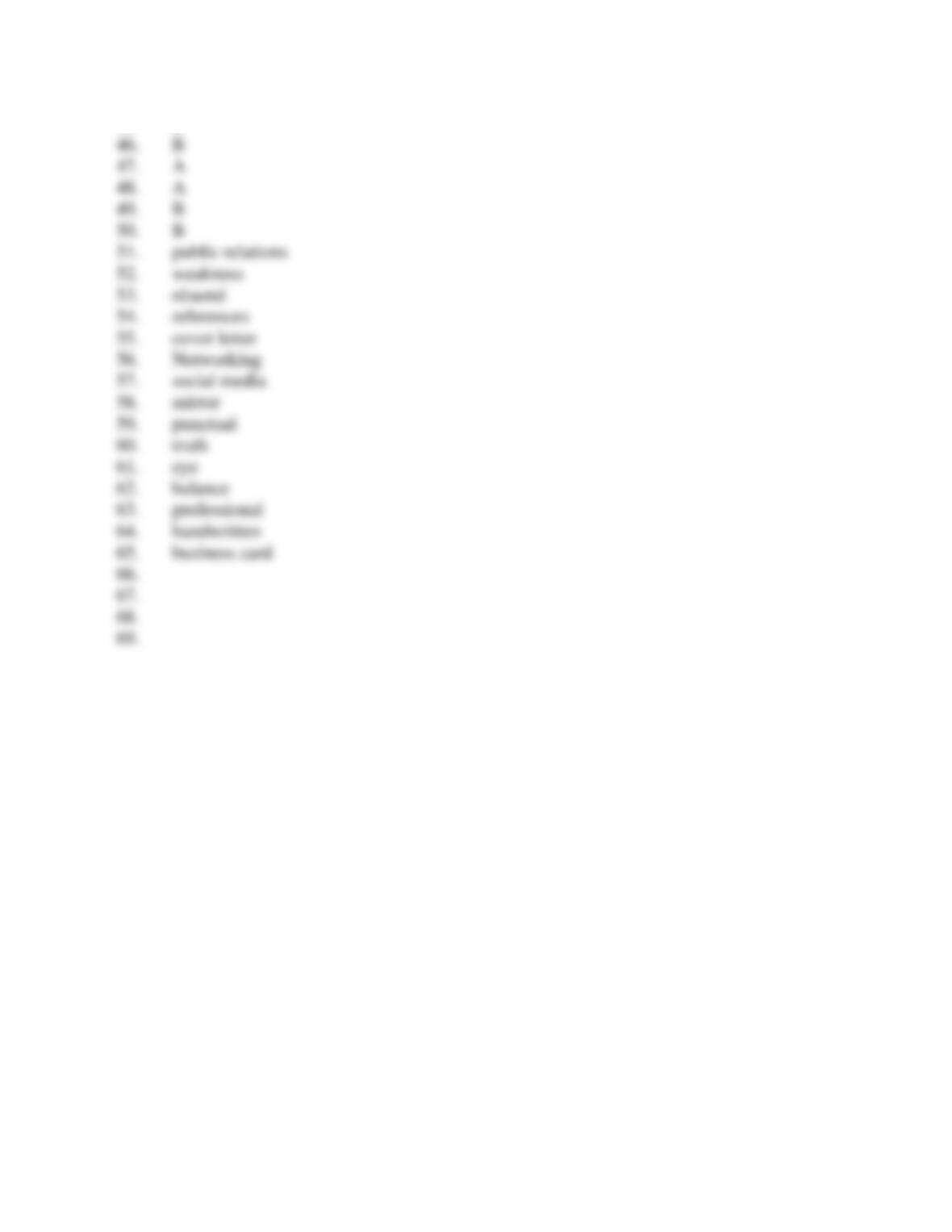
Page 11
45. B